
It is Friday, and your candidate interview feedback tool holds 1 scorecard from the 4 people who met your finalist. That scorecard says "good culture fit", and nothing else.
You don't need another form to fill in. You need evidence: what the candidate said, scored against what the job needs.
The trouble is rarely that your interviewers are lazy. Most interviewer feedback tools ask them for an opinion at the end of a busy day, and then the debrief, the meeting where the panel decides, rewards whoever speaks first.
Vague notes cost more than time, because they can make the decision worse. In a foundational study of grade predictions, those made after a free-form interview matched actual grades only half as closely as those made without one.
Late scorecards also keep your finalist waiting. In a survey that Greenhouse, which makes hiring software, published in December 2024, 61% of job seekers said an employer had ghosted them after an interview.
The fix is a routine every interviewer follows. Each one scores every criterion straight after the interview, backs each score with 1 quote and submits within 24 hours.
Every score goes in before the debrief, so nobody's judgement leans on anyone else's. Then a fixed rule combines the scores, and the panel discusses only the criteria where interviewers split.
Key takeaways
- Which candidate interview feedback tool should I start with? The one for your failure: scorecards for vague feedback, note-takers for forgotten details, AI interview reports for late feedback at round 1. A loud debrief needs a process.
- What makes interview feedback usable? A score on each of 4 to 6 agreed criteria, 1 quote per score, and the recommendation last.
- Does structured interview scoring predict job performance? Yes. A large re-analysis ranked them 1st, ahead of ability tests.
- Should the panel decide together in the debrief? Not first. A fixed rule predicted performance more than 50% better than an overall judgement.
- Can AI write or score interview feedback? AI can tidy wording, not add evidence. Trust an AI interview report only if it passes the 5 checks in section 7.
1. Which candidate interview feedback tool fixes late, vague feedback from my interviewers?
Match the tool to the failure: a prompt right after the interview fixes late feedback, and per-criterion ratings with a quote fix vague feedback. Collect every score before the debrief, so the loudest voice cannot win.
Late feedback is a memory problem, because the longer the wait, the less anyone recalls of what the candidate actually said. A recruiter posted on Reddit that feedback for a senior engineering role took 3 days on average to arrive, with replies of 1 line at most.
Then an automation began asking for structured feedback right after each interview. The first time it ran, all 4 interviewers submitted within 2 minutes.
It is 1 team's report, not a study, but it shows why a feedback tool should prompt at once.
The candidate feels the delay too. That 61% comes from Greenhouse's 2024 State of Job Hunting report, a survey of 2,500 workers in the US, UK and Germany.
Delay is 1 of 4 common failures in feedback about a candidate, and each calls for a different fix:
- Late: the scorecard arrives days later (this section and section 10).
- Vague: "good culture fit" with nothing behind it (section 2).
- Forgotten: nobody recalls what the candidate said (section 5).
- Loud: the debrief follows the most senior voice (section 9).
Late feedback, the first of these, looks different when software writes the report, as after an AI interview. These figures, by Flowmingo's own count, measure that kind of report, not a human write-up.
Flowmingo data · 49,459 completed AI interviews with a report timestamp · 925 companies · 1 Jul to 15 Oct 2026
- 16 seconds was the median time from the end of an AI interview to its scored report.
- 27 seconds or less was the wait for 90% of AI interview reports in this period.
- 98.5% of these AI interview reports were ready within 5 minutes of the candidate finishing.
This is when Flowmingo's evaluation service stamped its AI report, not when a recruiter read it. It is not a human interviewer's write-up.
The chart below shows the spread: 25% of reports were ready within 14 seconds, half of reports (the median) within 16 and 75% within 21.
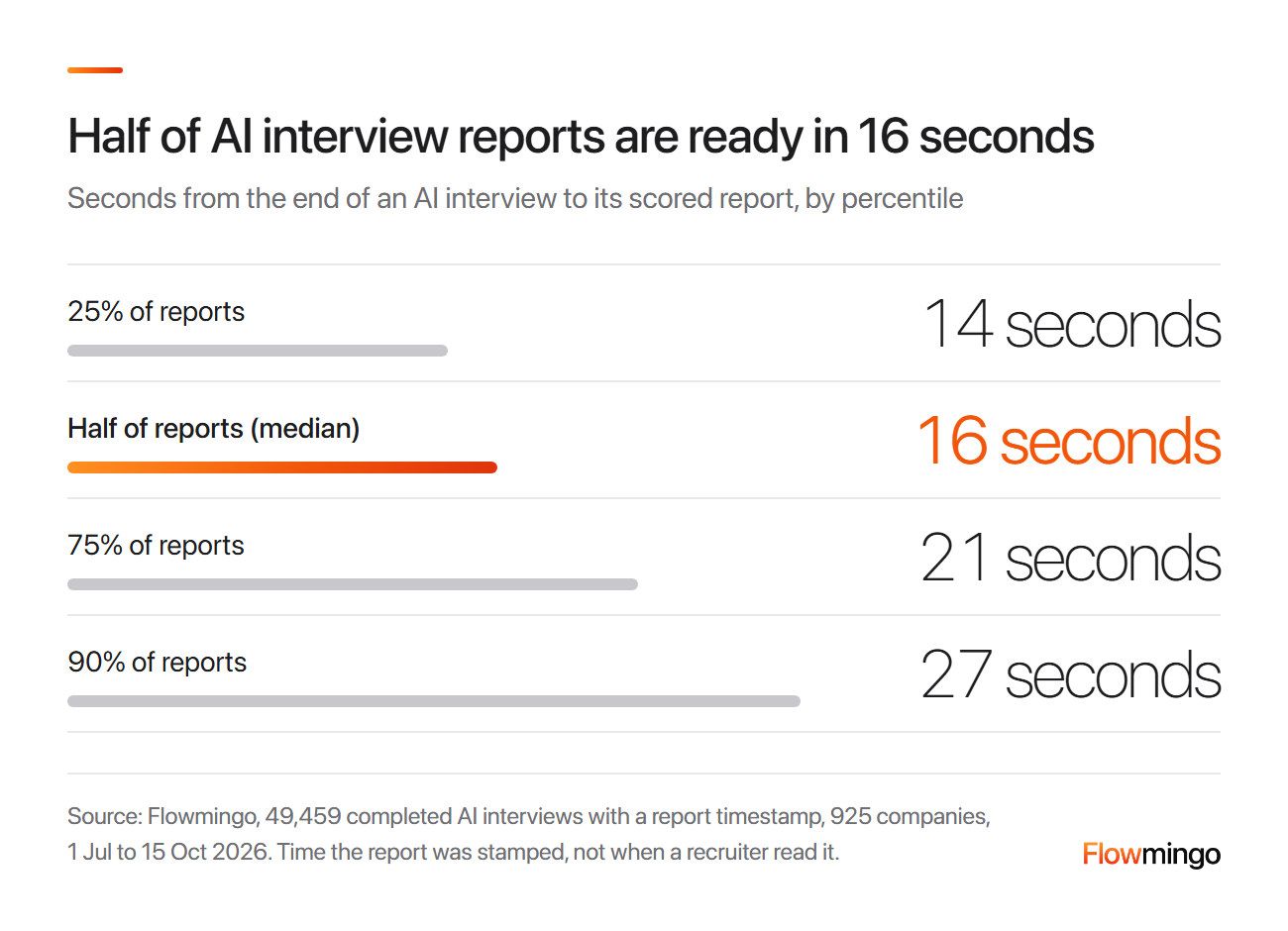
Report speed chart: the median AI interview report was ready 16 seconds after the candidate finished (49,459 timestamped interviews, 1 Jul to 15 Oct 2026).
2. My interviewers write 'good culture fit' and stop. How do I get feedback I can compare?
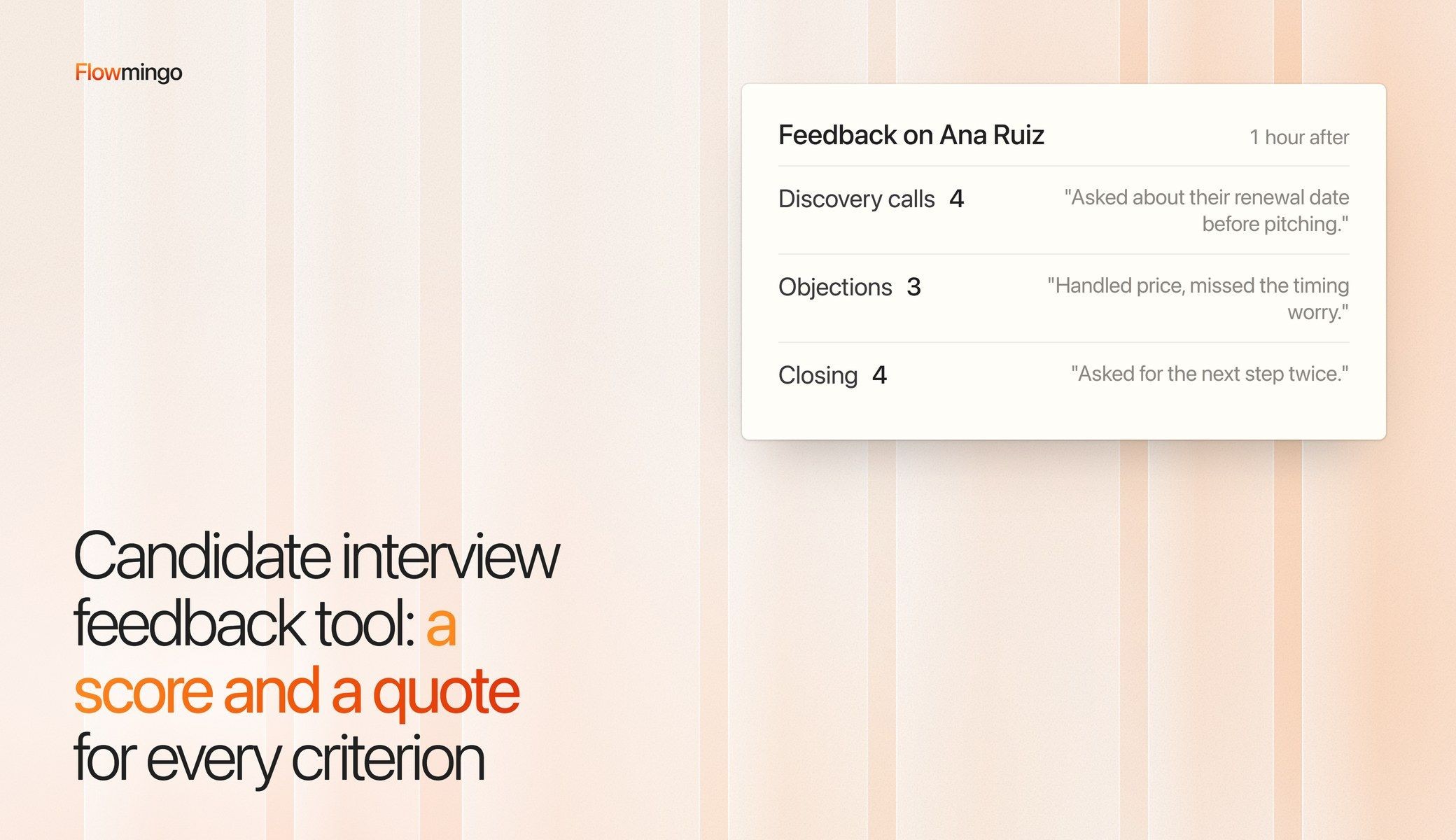
Ask every interviewer for a score on the same 4 to 6 criteria, with 1 candidate quote behind each. "Good culture fit" with no quote is a feeling, and free-form impressions can make a decision worse.
The evidence comes from a foundational 2013 study by the researchers Dana, Dawes and Peterson, in which people predicted students' grades, some of them after an unstructured interview. It measured grades, not jobs.
Predictions made after the interview matched actual grades at .31, against .61 for those made without one, and the students' prior grades on their own matched at .65.
On that scale, 0 means no link and 1 a perfect one. So the interview cut the match by about half, and the conversation added noise rather than information.
Even so, people kept trusting the interview: 96 of 169 (57%) still preferred an interview in which the student's answers were random to no interview at all.
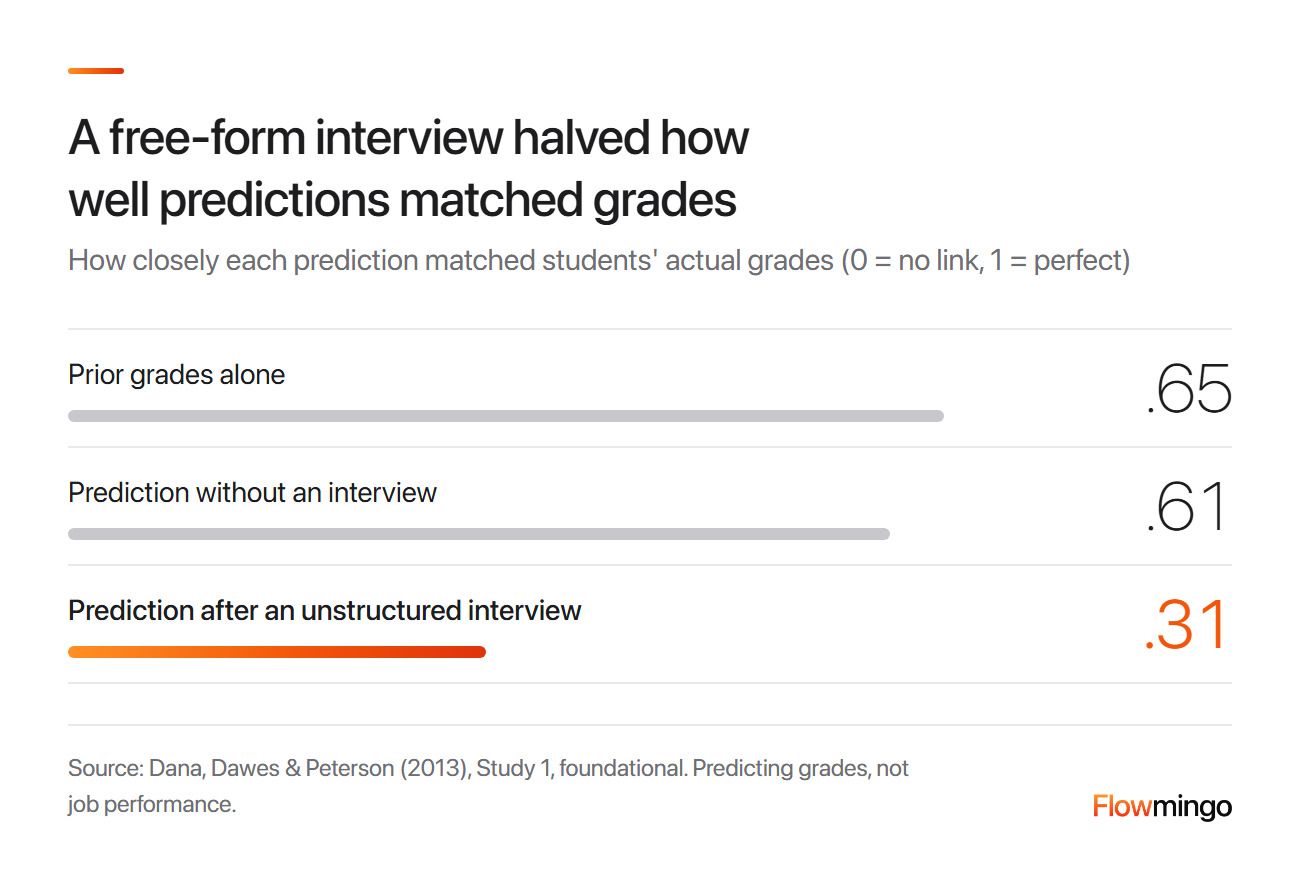
Unstructured interview chart: predictions after a free-form interview matched grades at .31, against .61 without one and .65 for prior grades (foundational).
The practical fix is a quote rule. A poster on Reddit whose hiring committee kept getting write-ups saying "I liked them" began requiring at least 1 direct candidate quote in each, and the quality changed (r/recruiting).
The same thinking applies to the criteria. Replace "culture fit" with the behaviour the job needs: "explains a decision to a customer in plain words", for example, is a criterion 2 people can score.
A record tied to job criteria is also your evidence if a candidate challenges a rejection. Singapore passed its Workplace Fairness Act on 8 January 2025, as its Ministry of Manpower announced.
The law is expected to take effect by the end of 2027 and will cover 11 characteristics, such as age and race, according to Hawksford's guide for multinationals.
To see the difference, take a candidate for a Customer Support Team Lead role, written up twice. The first write-up reads: "Great candidate. Strong communicator. Good culture fit. Hire."
That is 4 judgements and no evidence. The second version, below, is illustrative rather than customer data, and every score in it rests on something the candidate said:
| Criterion (importance) | Score 0-10 | Evidence in the candidate's words | Concern or what to probe |
|---|---|---|---|
| Role and stage | -- | Customer Support Team Lead, 2nd interview (panel) | -- |
| Handling escalations (Must Have) | 8 | "I took the 3 angriest tickets each morning and wrote our reply macro" | How they teach it |
| Coaching a team (Very Important) | 5 | Described a weekly 1:1, no example of improving anyone | Name 1 agent they improved, and how |
| Using support metrics (Important) | 7 | "First-reply time went from about a day to 4 hours after we split the queue" | Check what "about a day" means |
| Writing for customers (Good To Have) | 6 | "I keep every escalation summary to 3 lines" | Ask for 1 real summary |
| Recommendation (written last) | -- | Proceed to the final round | Probe coaching first |
| Submitted before reading others | -- | Yes, 2 hours after the interview | -- |
Any scale works if every interviewer uses the same one: this table uses 0 to 10, and our interview scorecard template anchors a 1-to-5 scale.
2.1 How to provide feedback on an interview candidate?
Score each criterion right after the interview, while your memory is fresh and before you read anyone else's notes, then submit within 24 hours at the latest. A complete write-up has these 6 fields:
- Role and interview stage.
- A score on each agreed criterion, on your scorecard's scale.
- A quote or observed action behind each score.
- Concerns, written as what the next interviewer should probe.
- The overall recommendation, written after the scores.
- Submitted before reading anyone else's feedback: yes or no.
3. Does structured interview scoring actually predict who will do well in the job?
Yes. In a foundational 2022 re-analysis, structured interviews were the top-ranked predictor of job performance, at .42 against .31 for cognitive ability tests.
A structured interview is one in which every candidate answers the same job-related questions, and every interviewer rates the answers on the same scale.
The figures come from Sackett, Zhang, Berry and Lievens, who revisited earlier estimates of how well hiring methods predict performance. Both are correlations, where 0 means no link to later job performance and 1 a perfect link.
So .42 is not a 42% hit rate. It is the strongest link among the methods the study reviewed, as SIOP's summary for industrial-organizational psychologists explains.
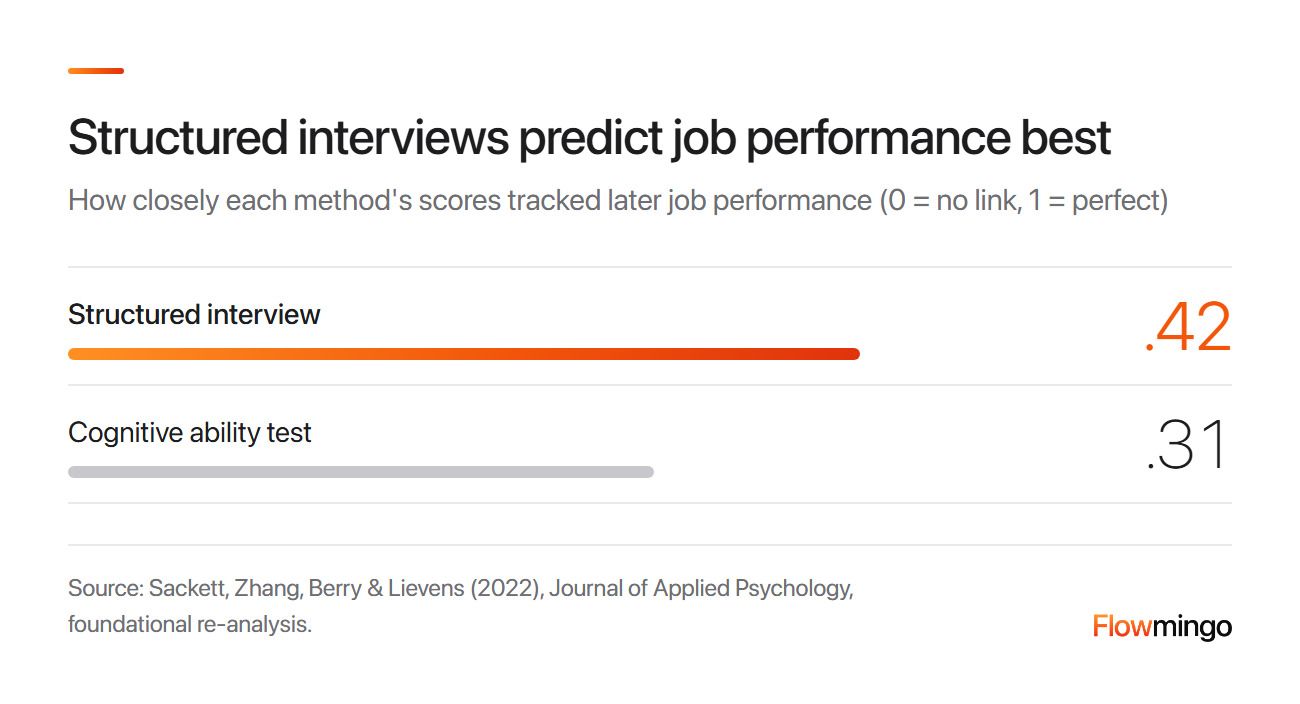
Predictor chart: the structured interview ranked first at .42, ahead of the cognitive ability test at .31 (foundational 2022 re-analysis, Sackett and colleagues).
A fair objection came in a 2020 post on the technology forum Hacker News, "Ask HN: Using Interview Scorecards for software candidates": scorecards put numbers on opinions. The numbers, though, give every candidate the same yardstick, with each criterion scored on its own.
Scoring each criterion separately also lets you combine the scores by a rule rather than by feel. In a foundational 2013 meta-analysis by Kuncel and colleagues, combining ratings with a fixed rule predicted job performance more than 50% better than holistic judgement.
Holistic judgement means forming an overall view from everything, and it lost even when experts made it. The rule wins because it weighs the same evidence the same way for everyone.
Here is how it works, with illustrative numbers and 4 criteria weighted 4, 3, 2 and 1 for Must Have, Very Important, Important and Good To Have, as in section 2's table.
The panel agrees on the weights before the interviews. A weighted average then multiplies each score by its weight and divides the total by the sum of the weights, which is 10 here.
Finalist A scores 5 on the Must Have and 8, 7 and 7 on the rest, so 20+24+14+7 = 65 and 6.5 overall. Finalist B scores 8 on the Must Have, then 6, 7 and 6, so 32+18+14+6 = 70 and 7.0 overall.
The panel's gut picked A, who won 2 of the other 3 criteria. The rule picks B, because B's 3-point lead on the Must Have counts 4 times and outweighs A's wins on 2 lighter criteria.
If the panel still leans to A, the Must Have scores are what the debrief should test, not the overall feel.
Writing the questions is a separate job, which our structured interview guide covers. In any candidate interview feedback tool, no score per criterion means no structured interview.
4. Note-taker, scorecard, AI writer, AI interviewer or survey: which candidate interview feedback tool do I need?
Each of the 5 kinds fixes something different, but only 3 fix a failure from section 1. Scorecards fix vague feedback, note-takers fix forgotten details, and AI interviewer reports fix late and vague feedback at round 1.
Text generators fix only the wording, and candidate surveys solve a different problem altogether. The fourth failure, a debrief won by the loudest voice, needs a process (section 9) rather than a tool.
Vendor pages rarely say which failure they fix. A recruiter comparing 3 AI note-takers, BrightHire, Metaview and Otter, found their sites "all vague about AI" and had to ask what the tools actually do (r/recruiting).
So the table below sets each of the 5 kinds against the failure it fixes, if it fixes one. It starts with the scorecard inside your applicant tracking system (ATS), the software that holds every candidate record.
| Kind of tool | Failure it fixes | Leaves broken | Examples |
|---|---|---|---|
| ATS scorecard | Vague, with 1 format in 1 place | Late or empty forms, no evidence | Greenhouse, Ashby |
| AI note-taker | Forgotten details | Judgement and scoring | Metaview, BrightHire |
| Feedback-text generator | None of the 4: messy wording only | Missing evidence | TalentEconomy, Easy-Peasy |
| AI interviewer with a scored report | Late and vague, with evidence at round 1 | The human final round | HireVue |
| Candidate survey | None: candidate experience is a different problem (section 8) | Interviewer judgement | Survale, Typeform |
ATS scorecards, or a Slack form such as Polly, put feedback in 1 format and 1 place, but a reminder email does not make anyone fill one in.
A new team lead on Reddit says their talent acquisition colleague still cannot get developers to submit feedback, even after several follow-ups (r/recruiting).
Another Reddit poster, a Greenhouse user, went looking for a report of candidates whose scorecards nobody had submitted (r/recruiting). So check that any tool shows who has not submitted.
AI note-takers record the call and draft notes from it. Metaview, which makes one, publishes a comparison page of 7 tools that ranks Metaview first, so read it as a vendor's view.
What a note-taker adds is the quote. If your interviewers already score but cite nothing, a transcript gives them the words to cite.
Feedback-text generators turn pasted notes into tidy text. TalentEconomy's generator, a free tool, promises results "in seconds" and cites no research. To test one, feed it notes that hold no quote and check that the result adds nothing you did not write.
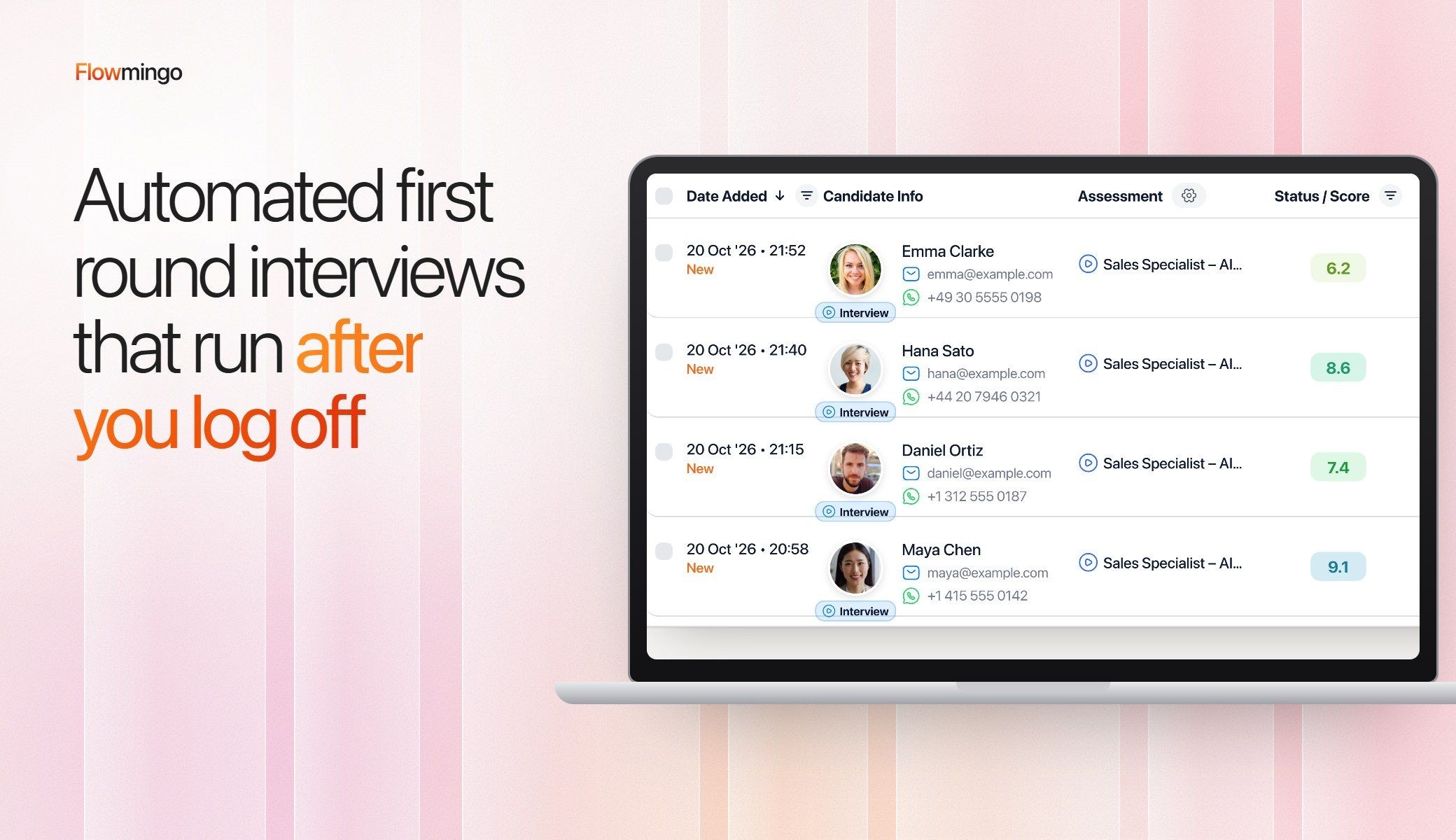
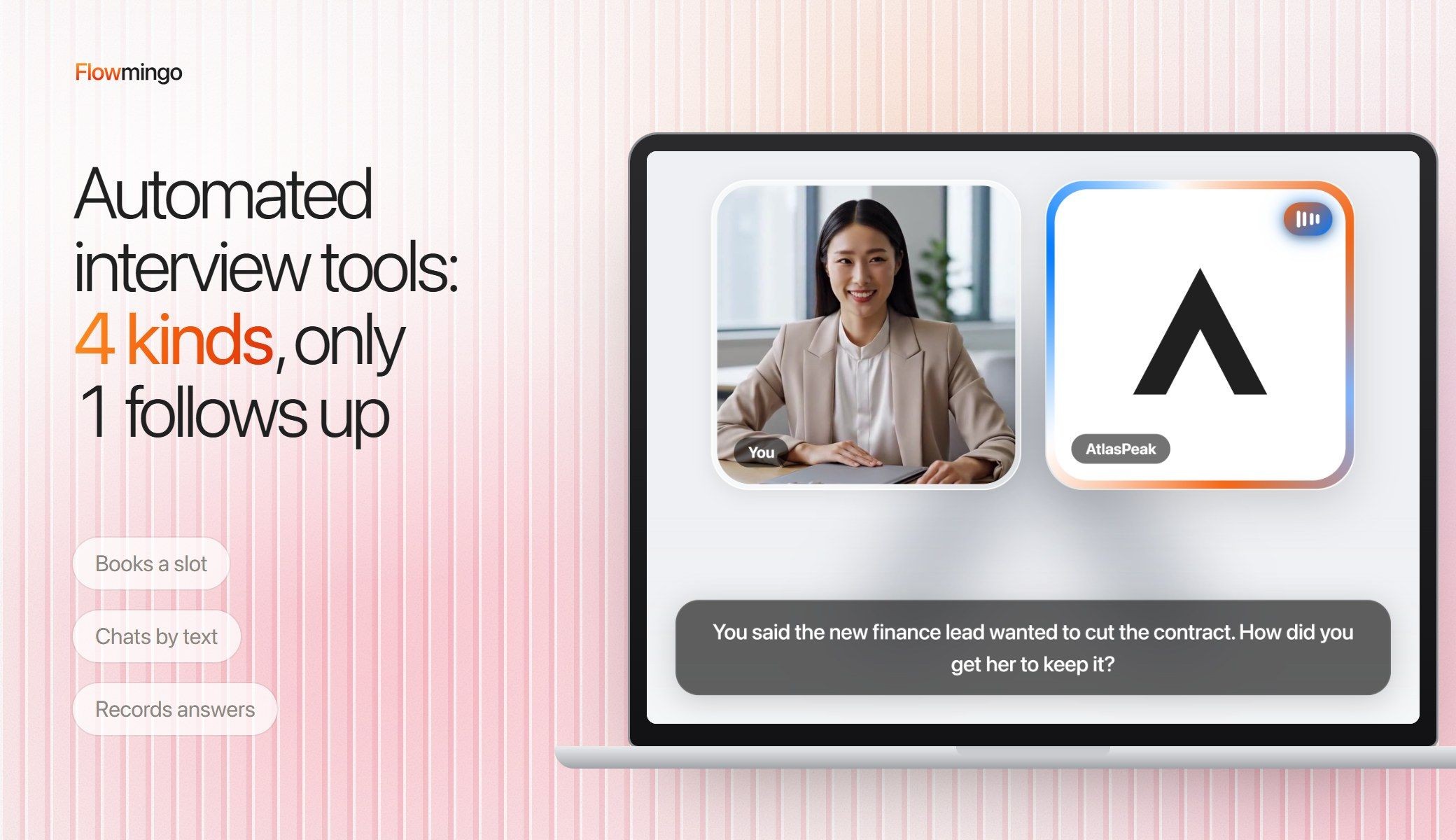
AI interviewers, such as HireVue's AI interviewer, run a structured first interview and return a score per criterion, with reasons and a transcript. Because nobody on your team writes round 1 up, the check moves to the report: make sure you can see the words behind every score.
Candidate surveys measure how candidates felt about your process (section 8), not how well anyone judged them.
So before you buy interview feedback software, name the failure you see most often, because that names the row of the table to shop from.
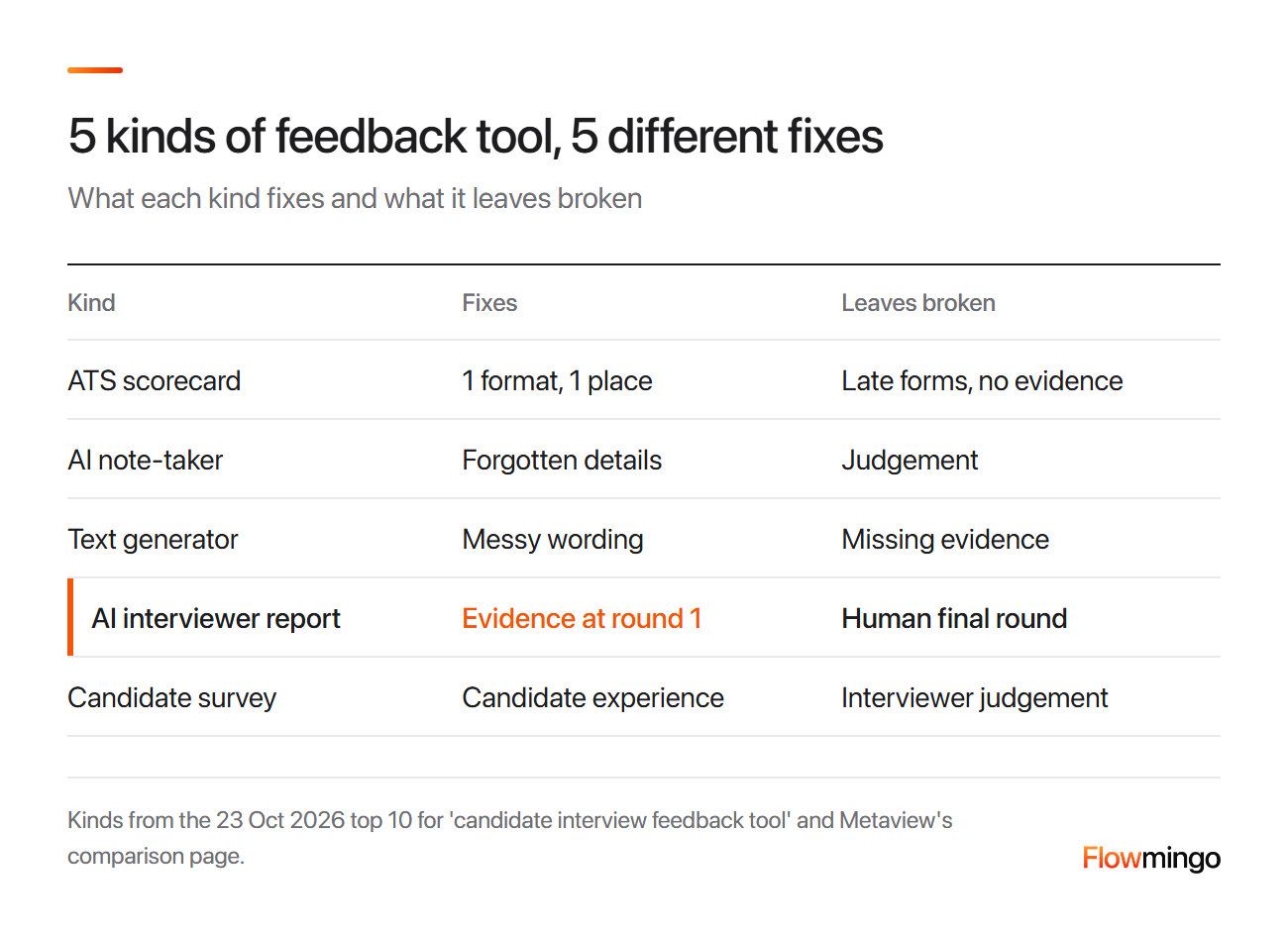
Tool map: ATS scorecard fixes 1 format, 1 place, AI note-taker fixes forgotten details, and text generator fixes messy wording. AI interviewer report fixes evidence at round 1, and candidate survey fixes candidate experience.
5. Is an AI note-taker like Metaview worth it, or will my ATS scorecard do?
A note-taker fixes forgetting, not judging. Add one if interviewers already score in the ATS but lose details, because a transcript won't make anyone fill in a skipped scorecard.
The distinction comes from a foundational 2002 experiment by Middendorf and Macan. Taking notes improved how accurately interviewers recalled an interview, but not how accurately they judged it.
Reviewing their notes did help judgement, but only for interviewers who had taken conventional notes. That study used handwritten notes, so applying it to AI transcripts is our inference, not its finding.
Either way, recall helps only if someone then scores against criteria. So the ATS scorecard should own the criteria and the scale, and a note-taker should write into it.
That makes the link to your ATS a real test. As a recruiter put it: "Metaview doesn't integrate with our ATS but Quil does" (r/recruiting).
Then check the price. Metaview's comparison table, read on 23 Oct 2026, lists Metaview as free with a work email and HireLogic, another tool on its list, from $69 per user a month. Our Metaview pricing breakdown found the free tier capped at 25 calls per user a month, with 14 days of history.
Where a tier is free, check what it stores, and for how long, because recording an interview also means consent and a retention rule.
The UK's data protection regulator, the Information Commissioner's Office (ICO), audited AI recruitment tools and announced its findings in November 2024. It found that some tools kept candidate data indefinitely, and it made almost 300 recommendations.
To test whether a note-taker is worth it, have each interviewer score 3 interviews from memory, then again with the transcript. If quotes appear the second time, the note-taker earns its place.
How Flowmingo helps
Flowmingo scores its own AI interview. It does not record, transcribe or score your live or panel interviews, so a note-taker and Flowmingo do different jobs.
6. Can AI write my interviewers' feedback for them, and is that a good idea?
AI can tidy the wording, but it can't add evidence the interviewer never wrote down. Use a generator only after the scores and quotes exist, never in place of them.
TalentEconomy's own FAQ says its generator does not add information you did not provide. Easy-Peasy's generator, a similar free tool, takes just 2 inputs: a job title and your notes.
Polly's feedback template, a form that runs in Slack or Teams, is not a generator at all: it gathers a panel's feedback in 1 place.
Its weakness is the questions. It asks for 1 overall rating with no anchors, meaning no description of what each score stands for, and it ends on "Hire or no hire?".
If you use it, drop its "would enjoy working alongside this candidate every day" item, which is a culture-fit question by another name.
The real risk with generators is subtler than bad writing. Polished text built from vague notes reads like evidence, though it changes nothing the interviewer saw.
Used after the scoring, though, AI writing helps in 2 places. It can turn a finished scorecard into a summary for a manager who missed the interview, and it can draft questions from the "what to probe" line.
For example, a note that says "no example of coaching" can become 2 final-round questions: which agent the candidate improved, and how that agent's numbers changed.
There is a privacy cost as well, because pasting candidate notes into a public chat tool sends personal data to a third party.
7. Can I trust an AI interviewer's scored report, and see why it scored someone that way?
Trust it as far as you can check it. Every score should name the criterion, give a written reason and lead you to the candidate's own words, and a person should make the call.
Early independent evidence comes from a 2026 working paper by Rubin and Grissom, not yet peer-reviewed. In it, 6 language models scored aspiring school principals' answers to a hiring assessment.
The answers included a structured interview question, and the researchers compared the models' scores with those of trained human scorers. The setting is education hiring, and none of the models were Flowmingo's.
Of the 6 models, 3 often agreed with the human average more closely than the trained scorers agreed with each other. So rubric scoring by AI can be consistent, more so on concrete criteria than subjective ones.
That means your lever is the criteria, so write them as concrete behaviours, as in section 2.
Americans, meanwhile, are wary of who makes the decision. In a foundational Pew survey of 11,004 US adults from December 2022, 71% opposed AI making the final hiring decision.
Yet 47% thought AI would do better than people at evaluating all job applicants in the same way, and 15% said it would do worse.
Fewer opposed AI reviewing applications (41%) than making the final decision (71%), so people seem readier to accept AI as a consistent scorer than as the one who decides.
Keep a person deciding, then, and tell candidates how you use AI. Run these 5 checks on any AI interviewer's report:
- A score per criterion, not just an overall number.
- A written reason for each score.
- Quotes that are exact phrases from the transcript.
- Weights you can see, so you can recompute the overall.
- A person can override, and the tool rejects nobody automatically.
How Flowmingo helps
Flowmingo's AI interview asks every applicant the same questions, drafted from your job description. It scores each of your criteria 0 to 10, with written reasons, strengths, gaps and a recommendation.
The recording and transcript sit behind every score, so your team can check and override it. How we score shows the weights, from Must Have x4 to Good To Have x1.
A highlight must be an exact transcript phrase. Must Have does not auto-reject, and AI interviews suit high-volume, entry to mid-level roles, not a senior hire's final round.
Flowmingo's public sample report, below, shows each criterion's score and reason. The exact quotes sit in the transcript view, which the image does not show.
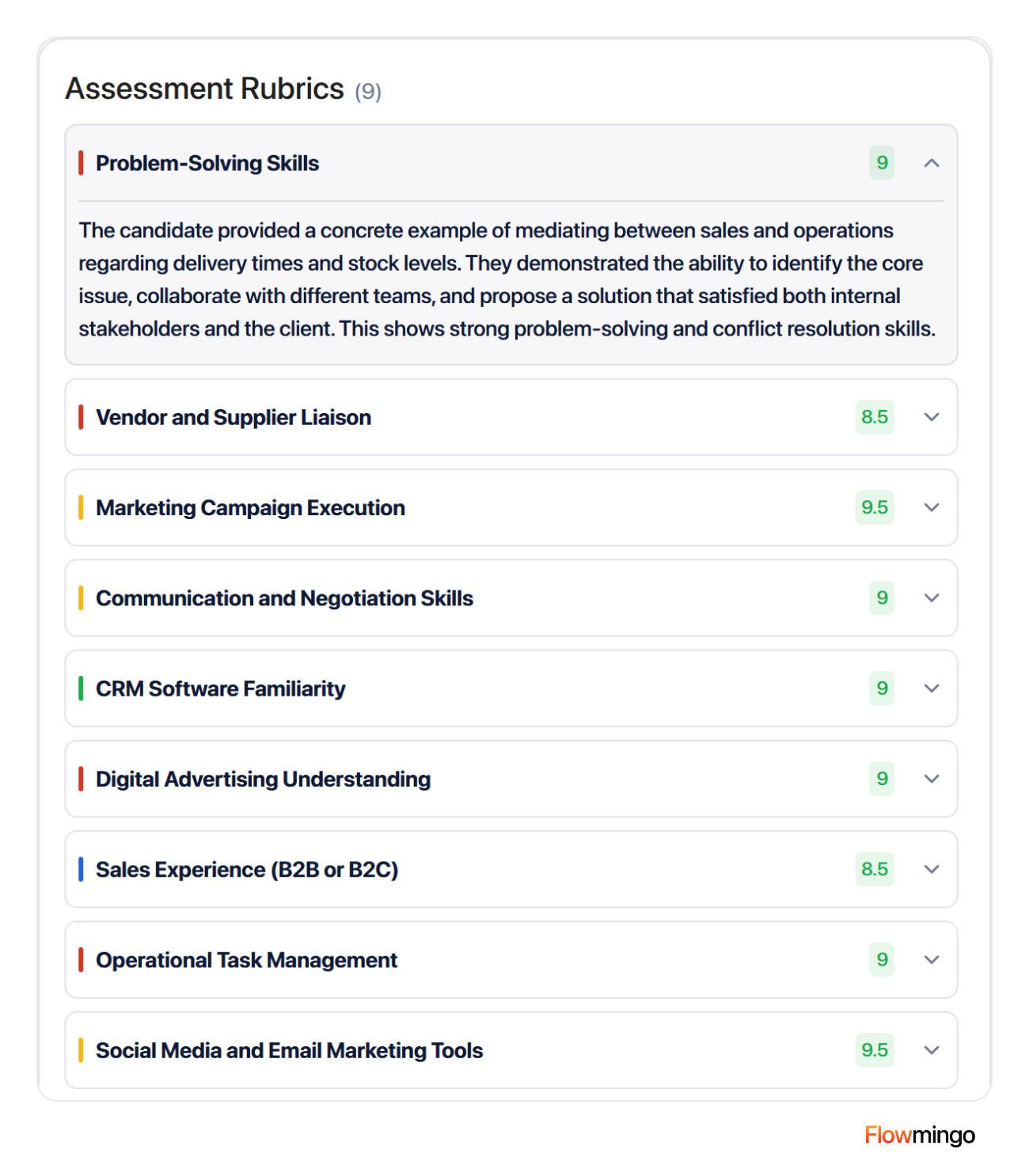
Sample report: each criterion gets a 0 to 10 score and a written reason drawn from the candidate's answers (public demo report, not customer data). The exact quotes sit in the transcript view, not shown here.
Flowmingo data · 49,475 completed AI interviews · 925 companies · 1 Jul to 15 Oct 2026
- 99.96% of these AI interviews came back with an overall score plus written strengths, gaps and recommendations.
- 9 criteria was the median number each AI interview report rated, with the middle half between 8 and 10.
- 99.95% of 515,787 criterion ratings carried a written reason of at least 40 characters.
AI reports on AI interviews, not human feedback or decisions. Criteria figures cover the 49,463 interviews (924 companies) with criterion results. A reason's presence does not measure its quality.
Criteria are drafted by AI from the job description and recruiters can edit them, so 9 is what reports contain, not what recruiters chose.
Ratings are AI scores, not job performance, and these figures do not show whether a recruiter read the report.
8. Do I need a candidate experience survey, or does that solve a different problem?
A candidate survey solves a different problem, because it tells you how candidates felt about your process, not whether your interviewers judged well. Buy one when candidates go silent or drop out.
Survey tools are built to find the stages where that happens. Survale, a candidate survey vendor that now runs the CandE candidate experience benchmark, triggers short surveys at application, interview, offer and hire.
Typeform's candidate feedback page, from the online form maker, names 2 weak spots: low response rates, and answers biased by whether the candidate got an offer.
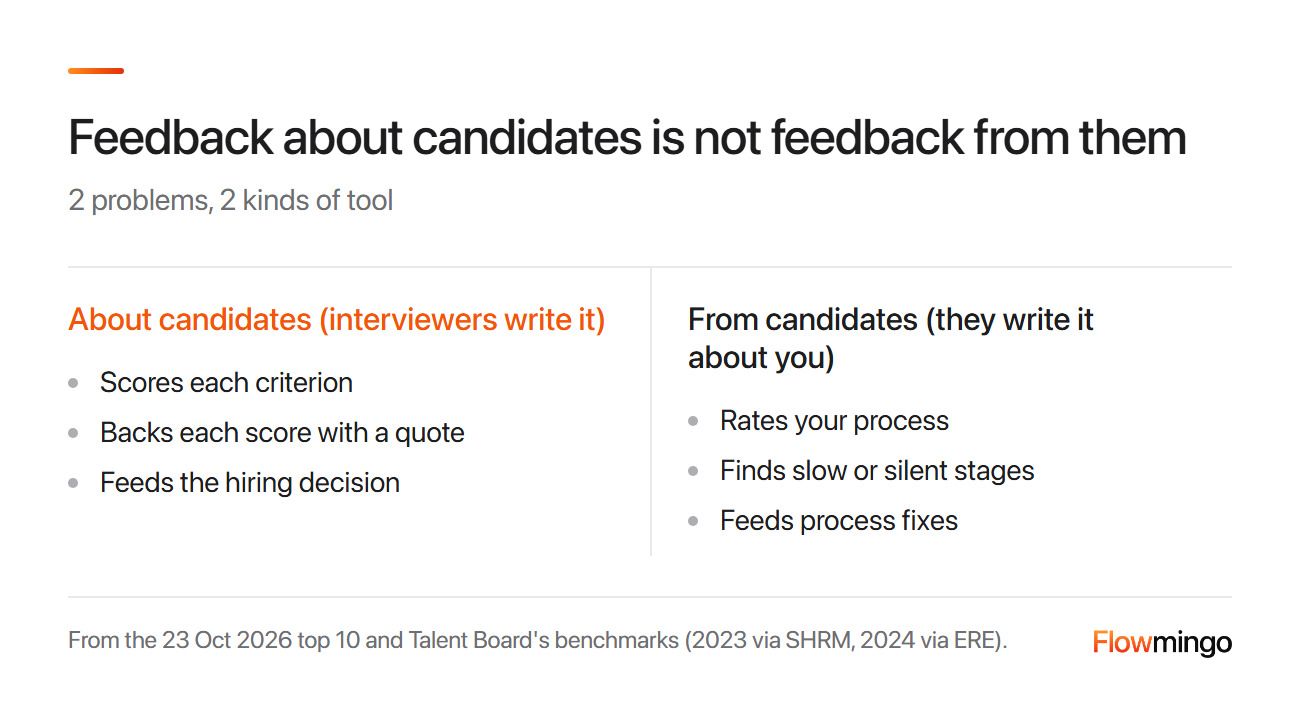
Feedback comparison: feedback about candidates scores each criterion, backs each score with a quote and feeds the hiring decision. Feedback from candidates rates your process, finds slow or silent stages and feeds process fixes.
The 2 kinds of feedback meet in 1 place: the stage where candidates wait longest. Add this question to your survey to find it:
- "How long did you wait to hear back after your interview?"
If the answer is over a week, the fix is probably your 24-hour scorecard deadline, not the survey, so check your candidate interview feedback tool for late scorecards at that stage.
Long waits are common. Talent Board, which founded CandE, found in its foundational December 2024 report that 24% of North American candidates were still waiting 2+ months after applying (Talent Board and ERE).
Its earlier, foundational 2023 benchmark of 240,000 candidates found 36% of US candidates unanswered 1 to 2 months after applying (SHRM, April 2024). That figure covers 1 country and a shorter wait, so it does not compare directly with the 24%.
If what you need is the feedback you send rejected candidates, our guide to candidate interview feedback covers it.
9. Our debriefs are won by the loudest voice. Should scores come in before the meeting?
Yes. Have every interviewer submit scores and quotes before the meeting, then discuss 1 criterion at a time, starting with the evidence only 1 person heard.
Without that rule, the meeting decides by volume. A team on Reddit says its decisions go to "whoever talked the loudest in the room" (r/recruiting).
Talking first fails because groups spend their time on what everyone already knows. In a foundational 2012 meta-analysis by Lu, Yuan and McLeod of 65 lab studies and 3,189 groups, shared facts got far more airtime.
When key facts were split, with each member holding a piece, groups were 8 times less likely to find the right answer than groups that saw everything. These were lab groups solving set problems, not hiring panels.
In a debrief, the fact that only 1 interviewer heard is the one that gets lost.
The original experiment on this effect, a foundational 1985 study by Stasser and Titus, had groups simulate a political caucus. Discussion tended to keep distorted views of the political candidates, not correct them.
That is why the debrief should start from the weighted average in section 3, whose weights the panel agreed before the interviews, and spend its time only on the criteria where scores split.
The method follows the Mediating Assessments Protocol, a foundational 2019 idea from Kahneman, Lovallo and Sibony that the book Noise also describes. People judge each assessment alone before they discuss it.
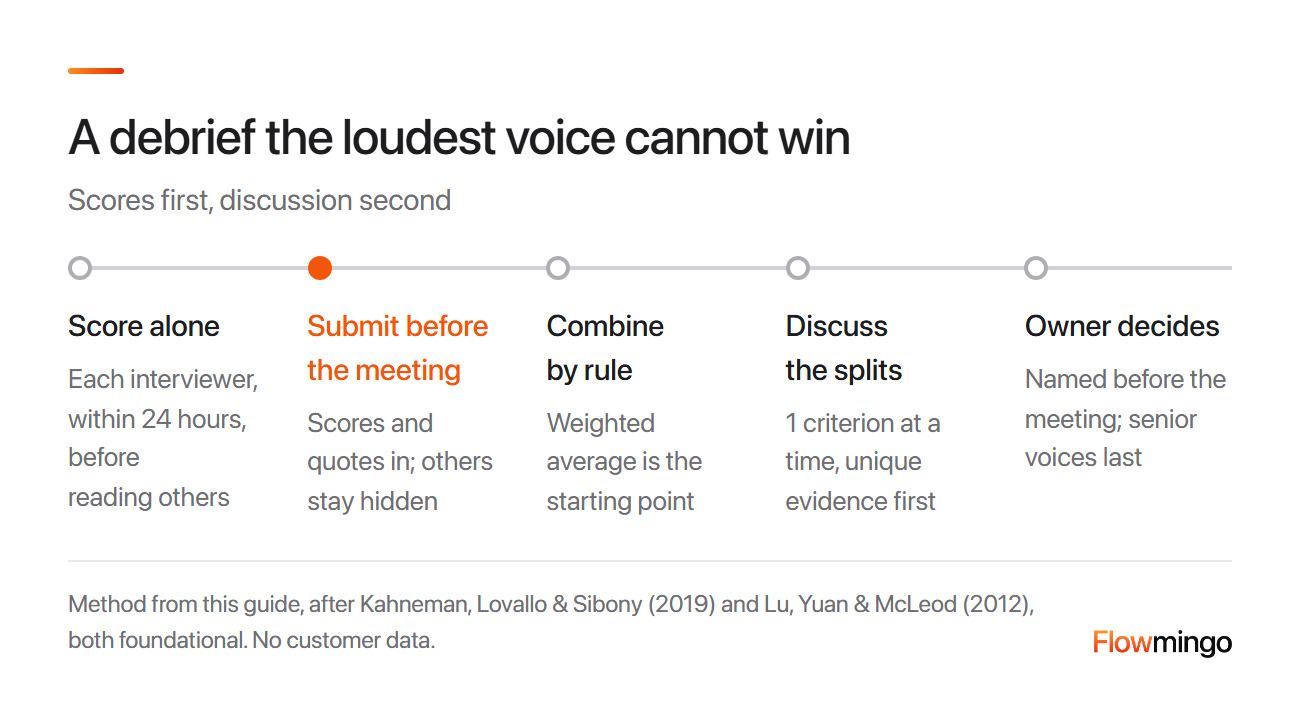
Debrief flow: score alone, submit before the meeting while others stay hidden, and combine by rule. Then discuss the splits 1 criterion at a time, and the owner decides.
In the meeting itself, unique evidence goes first and senior voices speak last, and the team names the decision's owner beforehand.
Loud voices are only 1 of the ways a panel goes wrong, and our guide to interview bias covers the other traps.
10. What should a candidate interview feedback tool include before I pick one?
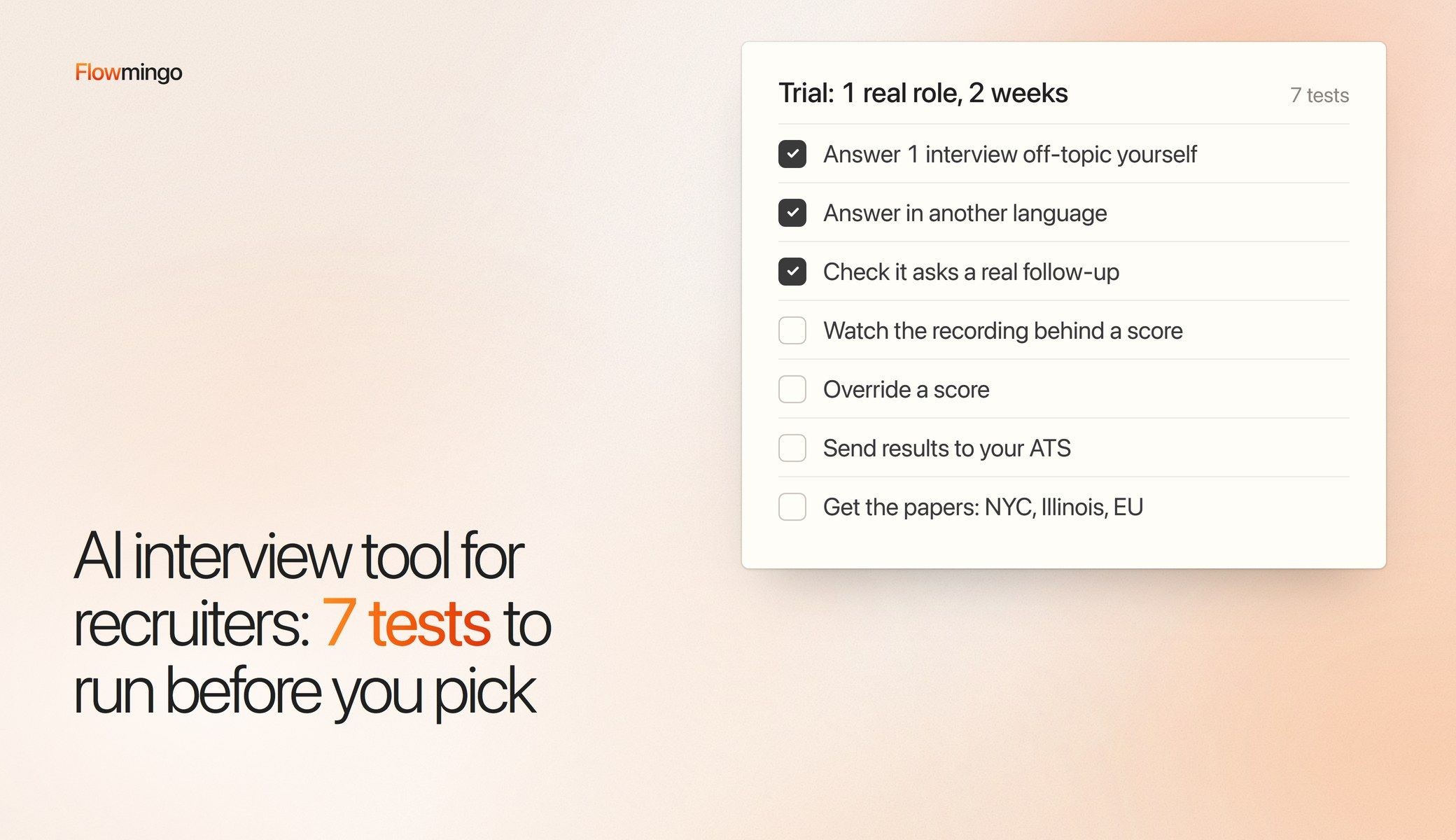
Test 9 things in a 1-week trial before you buy. Each row says what to look for, why, and how to test it:
| Look for | Why | Test it in 1 week |
|---|---|---|
| A score per criterion, not 1 overall rating | Rule-based combining beat holistic judgement (Kuncel, section 3) | Score 2 past candidates in it |
| Evidence attached to each score | Free-form interviews weakened grade predictions (.31 vs .61, Dana, foundational) | Find the words behind any score |
| A post-interview prompt and a missing-scorecard list | 1 team went from 3 days on average to 2 minutes the first time (section 1), and 1 Greenhouse user went looking for this report (r/recruiting) | Run 1 loop and see who gets chased |
| Other scores hidden until you submit | Groups miss facts split among members (Lu, section 9) | Submit as 2 test interviewers |
| Weights you can see | The overall should be checkable | Recompute 1 overall by hand |
| Export or API to your ATS | Notes in a side tool get ignored | Push 1 report into your ATS |
| Consent, retention and deletion | Illinois requires deletion within 30 days, and the ICO found data kept indefinitely | Ask how deletion works |
| An independent audit for bias, and a person deciding | NYC Local Law 144, the EU AI Act and the Mobley v. Workday lawsuit, explained below | Ask for the audit summary |
| Price at your volume, and a free tier | The FAQs at TalentEconomy, Easy-Peasy and Metaview all answer whether it is free | Price 12 months at your interview count |
For the last row, add your team size too, because a per-seat fee grows with every interviewer you add.
None of this is legal advice, and each law below covers 1 city, state or bloc. NYC Local Law 144, enforced since July 2023 and foundational, covers NYC roles when a tool substantially assists or replaces the hiring decision.
Where it applies, the law requires an independent audit for bias within 1 year before use, a public audit summary, and candidate notice 10 business days ahead.
Illinois's AI Video Interview Act requires consent before AI analyses a video interview, and deletion within 30 days of a request. In Europe, the EU AI Act lists AI that evaluates candidates as high-risk.
Those high-risk rules are due to apply from 2 December 2027, after a delay written into Regulation (EU) 2026/1744, the Digital Omnibus on AI, in force since 27 July 2026.
Bias claims against AI hiring tools have reached court, too. In Mobley v. Workday, a US court let an alleged age-bias claim proceed as a nationwide collective action, as the law firm Holland & Knight reports.
If your next problem is the pile of CVs that comes before the interviews, our guide to candidate shortlisting covers it.
How Flowmingo helps
Flowmingo is a free AI hiring platform, and its AI interview, which applicants take in their own time, writes the first-round feedback for you.
Paid plans add video storage, branding and downloads, not more screening.
Flowmingo connects to 20+ ATSs, Greenhouse, Lever and Workday included, and a REST API, webhooks and MCP are free on every plan. Your team makes every decision. Try it as your candidate interview feedback tool for the first round on Flowmingo.
11. Sources
Every study, law and vendor page in this guide is listed below; community quotes link to their threads in the text. Flowmingo figures come from Flowmingo's own platform data.
- Dana, J., Dawes, R., & Peterson, N. (2013). Belief in the unstructured interview: The persistence of an illusion. Judgment and Decision Making, 8(5), 512-520.
- Easy-Peasy.AI. (n.d.). Interview feedback generator. Retrieved October 23, 2026.
- EU Artificial Intelligence Act. (n.d.). Annex III: High-risk AI systems referred to in Article 6(2). Retrieved October 23, 2026.
- European Parliament and Council. (2026). Regulation (EU) 2026/1744, the Digital Omnibus on AI. Official Journal of the European Union.
- Greenhouse. (2024, December 10). Greenhouse 2024 state of job hunting report. Greenhouse.
- Hawksford. (n.d.). Singapore Workplace Fairness Act: A guide for multinationals. Retrieved October 23, 2026.
- HireVue. (n.d.). AI interviewer. Retrieved October 23, 2026.
- Holistic AI. (n.d.). Illinois Artificial Intelligence Video Interview Act. Retrieved October 23, 2026.
- Holland & Knight. (2025, May 27). Federal court allows collective action lawsuit over alleged AI hiring bias. Holland & Knight LLP.
- Information Commissioner's Office. (2024, November 6). ICO intervention into AI recruitment tools leads to better data protection for job seekers. ICO.
- Kahneman, D., Lovallo, D., & Sibony, O. (2019, March 4). A structured approach to strategic decisions. MIT Sloan Management Review.
- Kahneman, D., Sibony, O., & Sunstein, C. R. (2021). Noise: A flaw in human judgment. Little, Brown Spark.
- Kuncel, N. R., Klieger, D. M., Connelly, B. S., & Ones, D. S. (2013). Mechanical versus clinical data combination in selection and admissions decisions: A meta-analysis. Journal of Applied Psychology, 98(6), 1060-1072.
- Lu, L., Yuan, Y. C., & McLeod, P. L. (2012). Twenty-five years of hidden profiles in group decision making: A meta-analysis. Personality and Social Psychology Review, 16(1), 54-75.
- Maurer, R. (2024, April 9). Candidate experience: Talent Board research (CandE). SHRM.
- Metaview. (n.d.). 7 top interview quality tools for better hiring decisions. Retrieved October 23, 2026.
- Middendorf, C. H., & Macan, T. H. (2002). Note-taking in the employment interview: Effects on recall and judgments. Journal of Applied Psychology, 87(2), 293-303.
- Ministry of Manpower, Singapore. (2025, January 8). Passing of Workplace Fairness Bill marks next step in building fair and harmonious workplaces. MOM.
- New York City Department of Consumer and Worker Protection. (n.d.). Automated employment decision tools (AEDT). Retrieved October 23, 2026.
- Pew Research Center. (2023, April 20). AI in hiring and evaluating workers: What Americans think. Pew Research Center.
- Polly. (n.d.). Interview feedback template. Retrieved October 23, 2026.
- Rubin, J. M., & Grissom, J. A. (2026). Leveraging large language models to assess short text responses (EdWorkingPaper No. 26-1385). Annenberg Institute at Brown University.
- Sackett, P. R., Zhang, C., Berry, C. M., & Lievens, F. (2022). Revisiting meta-analytic estimates of validity in personnel selection: Addressing systematic overcorrection for restriction of range. Journal of Applied Psychology, 107(11), 2040-2068.
- SIOP. (n.d.). Is cognitive ability the best predictor of job performance? New research says it's time to think again. The Industrial-Organizational Psychologist.
- Stasser, G., & Titus, W. (1985). Pooling of unshared information in group decision making: Biased information sampling during discussion. Journal of Personality and Social Psychology, 48(6), 1467-1478.
- Survale. (n.d.). Candidate experience surveys. Retrieved October 23, 2026.
- Talent Board & ERE Media. (2024, December). What sets CandE award winners apart: 2024 CandE benchmark research. ERE Media.
- TalentEconomy.ai. (n.d.). Interview feedback generator. Retrieved October 23, 2026.
- Typeform. (n.d.). Candidate feedback. Retrieved October 23, 2026.
- Flowmingo. (n.d.). How we score. Retrieved October 23, 2026.
- Flowmingo. (n.d.). FAQ. Retrieved October 23, 2026.
- Flowmingo. (n.d.). Pricing. Retrieved October 23, 2026.