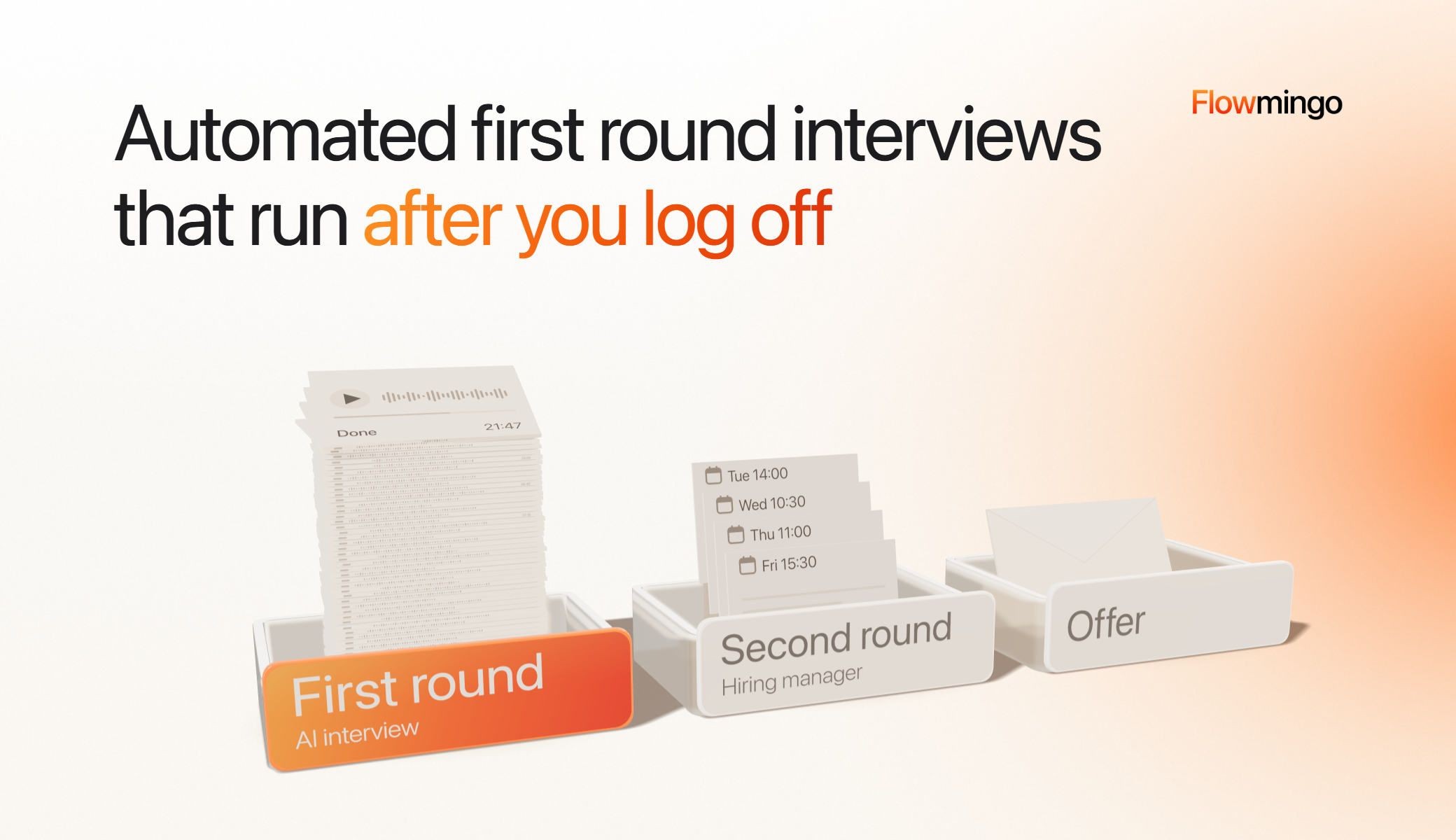
Your candidate finishes round 1 at 21:47, long after you have logged off. With automated first round interviews, nobody had to book that call.
In a 2026 Greenhouse survey, 38% of US job seekers had walked away from a hiring process over an AI interview.
Many of those walk-aways come from how the step is run. In the same survey, the top triggers were a pre-recorded video with no human present (33%) and no word on how AI is used (27%).
The upside is real. In a field test of 67,056 randomly assigned applications, AI-run first rounds led to 12% more offers, with people deciding. It is a working paper from 1 firm hiring entry-level customer-service staff.
This guide shows what to hand over, how to tell candidates, and how to prove it on 1 role.
Key takeaways
- Are automated first round interviews legit? Yes. In a field test of 67,056 randomly assigned applications, AI-run first rounds led to 12% more offers, with people deciding.
- What should the automated round do? Ask everyone the same 4 to 6 core questions, follow up, and quote the evidence.
- What must stay with a person? Every rejection, the shortlist, round 2 and the offer: 71% of US adults oppose AI making the final call.
- How do I stop candidates thinking it is a scam? Say upfront what it is, how long it takes and who reviews it: 70% were never clearly told.
- How do I know it is working? Track 5 numbers on 1 role for 2 weeks. 83.5% of Flowmingo finishers are done within 72 hours.
1. Are automated first round interviews legit, and will my candidates think they are?
Yes, when candidates know what it is, how long it takes and that a person reviews every result. Automated first round interviews look like a scam only when they arrive unexplained.
In a November 2025 Greenhouse survey, 70% of hiring managers said AI helps them hire faster and better. Only 8% of job seekers said AI makes hiring fairer.
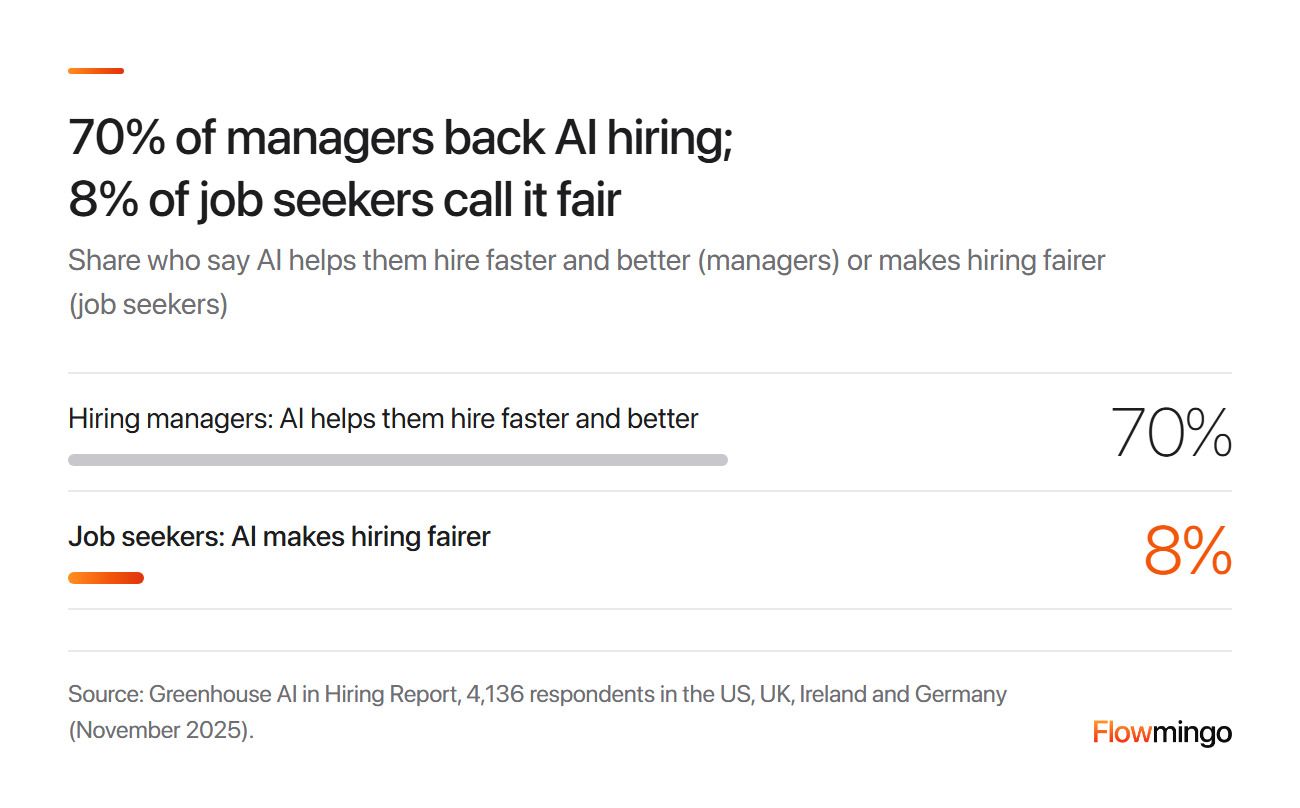
Trust gap in AI hiring: 70% of hiring managers back it, and 8% of job seekers call it fair (Greenhouse, November 2025).
The largest field test we found is a working paper by Jabarian and Henkel, on 70,884 applications for entry-level customer-service jobs in the Philippines. Of these, 67,056 were randomly assigned to an AI voice interviewer, a recruiter or a free choice. The AI arm got more offers, 9.73% against 8.70%, while human recruiters made every decision.
Given the choice, 78% of applicants picked the AI. In a survey that 14% answered, they rated it about the same as a human on stress and comfort, but less natural.
An October 2024 job-seeker thread on Reddit is older but foundational here, because its complaints match Greenhouse's 2026 top triggers. Commenters objected to no person in sight and no word on who watches the recording.
So every step below keeps the same questions for all and a person on every decision, and says both upfront. Our guide to automated interview tools covers choosing the software.
2. Which parts of my 15 to 30 minute first-round call can I hand to an automated interview?
Hand over the part that repeats: knock-out facts, the same 4 to 6 core questions, follow-ups and a first scoring pass. Keep what needs judgement or selling: rejections, the shortlist, round 2 and the offer.
Most of your call repeats. At 20 minutes each, 30 calls take 10 hours a week.
One recruiter on Reddit describes the same 6 to 8 questions on every call, plus phone tag over salary. That is an anecdote, not data.
The same job-related questions, scored the same way, ranked first among common selection methods in a foundational 2022 re-analysis by Sackett and colleagues. Our structured interview guide shows how to write them.
Knock-out facts, such as location, hours, right to work and pay, belong in pre-screening interview questions in the application. You then check the first scoring pass: 0 to 10 per criterion, each with its quote.
The calendar part goes, because candidates choose their own time. In the card below, nearly half (45.1%) finished outside 09:00 to 18:00 local time, and 18.2% on a Saturday or Sunday.
Other posts here count weekday 9-to-5 and find about 6 in 10 outside it. With the day ending at 18:00, 55.0% fell outside office hours or at a weekend.
Flowmingo data · 51,884 completed AI interviews · 954 companies · 1 Jul to 23 Oct 2026
- 45.1% of finished interviews were completed outside 09:00 to 18:00 in the candidate's local time.
- 55.0% were completed outside those hours or at a weekend.
- 7.5% were completed between midnight and 06:00 in local time.
Local time comes from the candidate's connection, and office hours differ by country.
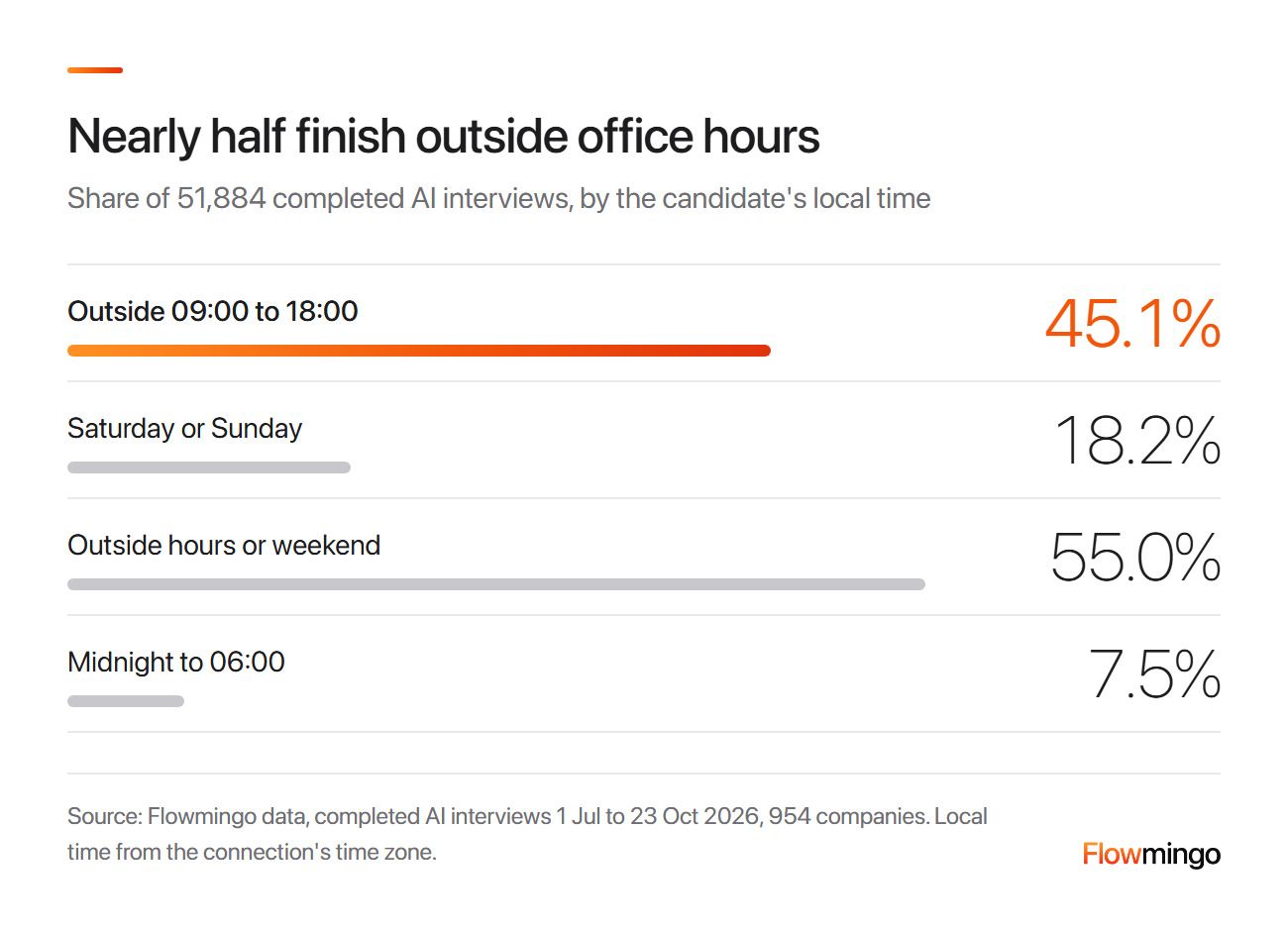
When candidates finish: 45.1% outside 09:00 to 18:00, 18.2% at a weekend, 55.0% either, and 7.5% between midnight and 06:00.
How Flowmingo helps
Flowmingo's AI Interviewer drafts 1 to 30 questions from your job description, which you edit. Every applicant gets the same set, in a browser on a phone or laptop.
3. Can an automated interview ask follow-up questions the way I would on a call?
Yes, if the tool is built to probe. A good one asks a follow-up on the same topic when an answer misses.
Follow-ups matter because first answers often stay thin. A foundational 2014 review by Levashina and colleagues treats planned probing as part of interview structure.
For example, a candidate says they always stay calm with angry customers. The follow-up asks for 1 real time a customer stayed angry.
A strong reply names the problem, the words used and the result, so the score rises. A thin "Not really" keeps it low, and the quote shows why.
In the field experiment, candidates rated the AI's follow-up flow about the same as a human's. The limit: a planned follow-up stays on its question, so an unexpected story waits for round 2.
3.1 Is a one-way video interview the same as an AI interview, and which do candidates dislike?
No. A one-way video interview records answers to fixed prompts and never replies, while an AI interview with follow-ups responds.
In 2 foundational 2019 studies by Hiemstra and colleagues, panelists and real applicants rated one-way interviews negatively on fairness. Real applicants were the most negative.
Greenhouse's 2026 survey agrees: its top walk-away trigger was an AI-scored pre-recorded video with no human present. So use one-way video only where first answers say enough.
How Flowmingo helps
When an answer misses the question, Flowmingo's AI Interviewer asks a follow-up on the same topic, and the score reflects the whole exchange.
4. How long should automated first round interviews be before candidates stop finishing them?
Aim for 15 to 20 minutes and 4 to 6 core questions, our rule of thumb, not a study result. Shorter than your call is fine, because candidates skip the small talk.
Starting matters more than length. In the card below, most who started went on to finish.
Our pre-screening interview questions guide suggests 6 to 10 questions, knock-outs included. Move the knock-outs into the application, and 4 to 6 scored questions remain.
From opening to finishing, the median session took 26.6 minutes, longer than the interview itself, and 5.2% stretched past 3 hours, so people pause.
For example, 5 questions at about 3 minutes each, plus a minute per follow-up, make about 20 minutes of answers. Add sign-in and the camera check, and allow 30 minutes.
1stRoundHR notes that demos often quote 85% completion or more. Ask for completion by candidate group, and make 3 cuts:
- Drop any question the CV or knock-outs answered.
- Drop anything you would not score.
- Keep 1 follow-up per question, because it earns the evidence.
Then state both times in the invite. A stated time makes the step look legit, because a scam rarely says how long it takes.
Flowmingo data · 23,408 invited candidates who started · invites from 955 companies · 1 Jul to 9 Oct 2026
- About 84% of invited candidates who started a Flowmingo AI interview went on to finish it within 14 days.
- 26.6 minutes was the median time from start to finish across a wider set of 51,884 interviews finished 1 Jul to 23 Oct 2026 at 954 companies.
Counted from opening the link, our AI interview tool guide found 80.3%.
How Flowmingo helps
On Flowmingo's AI Interviewer, an interview can run up to 20 minutes on Free, 30 on Starter and 60 on Growth. Free's cap fits the 15 to 20 minutes recommended here.
5. How do I know an AI interview score is right, and what evidence should it show me?
Trust a score only when it points to the candidate's own words. It needs the quote that earned it, the recording to check it, and a reason.
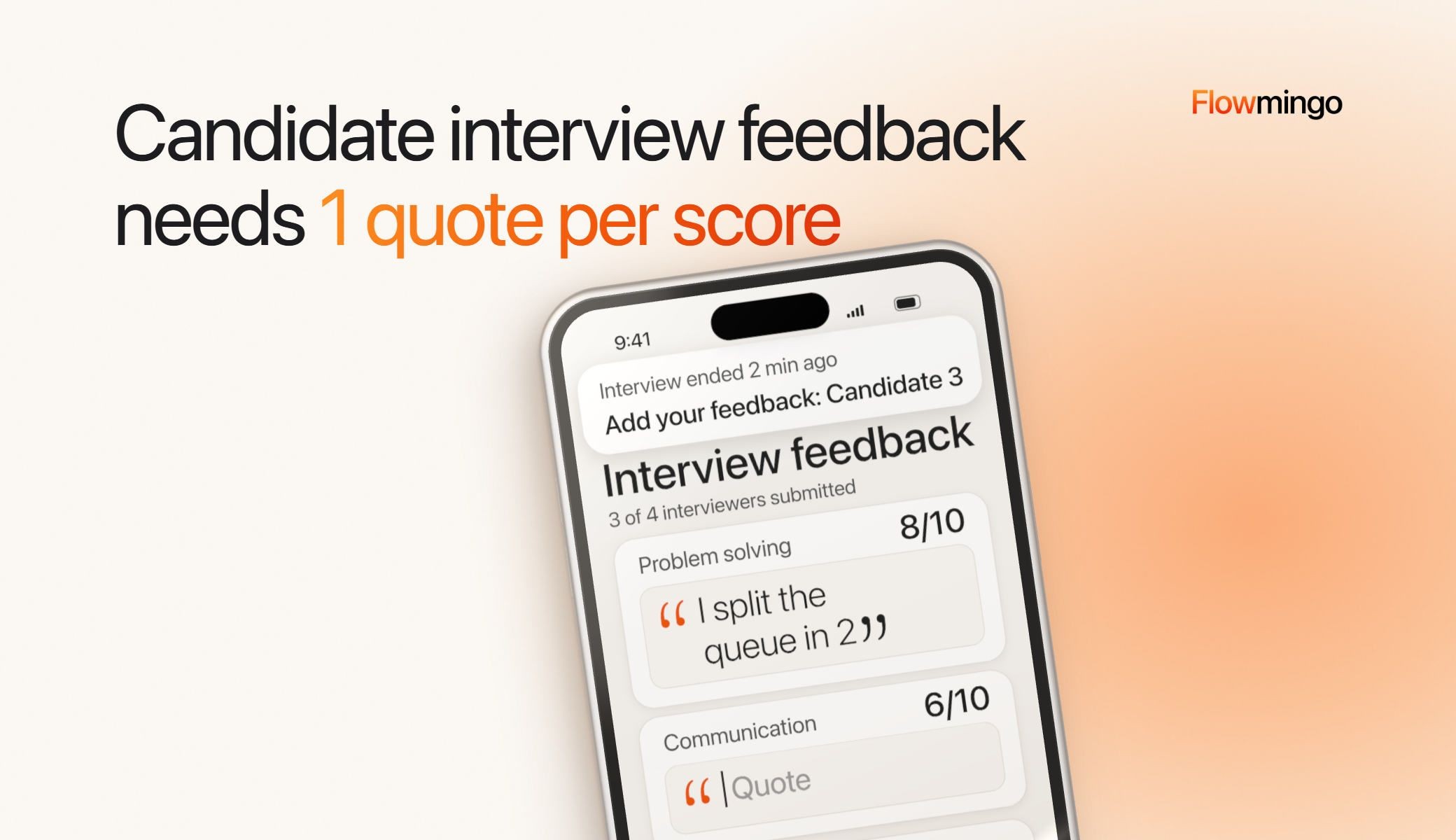
In this worked example (illustrative, not customer data), a support role asks about an angry customer, and de-escalation is a Must Have. The strong reply scores 8: "I escalated to my lead and called back within 2 hours. He kept his subscription."
The thin "Not really" scores 3, which is not a rejection. You play the 40 seconds behind a score, then agree or change it.
Weights of 4, 3, 2 and 1 then add the criteria up.
| Criterion (weight) | Candidate A | Candidate B |
|---|---|---|
| De-escalation (4) | 8 | 3 |
| Clear explanations (3) | 7 | 8 |
| Learns the product fast (2) | 6 | 7 |
| Uses a help-desk tool (1) | 5 | 9 |
| Weighted score /10 | 7.0 | 5.9 |
| Plain average /10 | 6.5 | 6.75 |
The formula is (4 x de-escalation + 3 x explanations + 2 x product + 1 x tool) / 10. B wins the plain average, 6.75 to 6.5, but loses on what the job needs, 5.9 to 7.0.
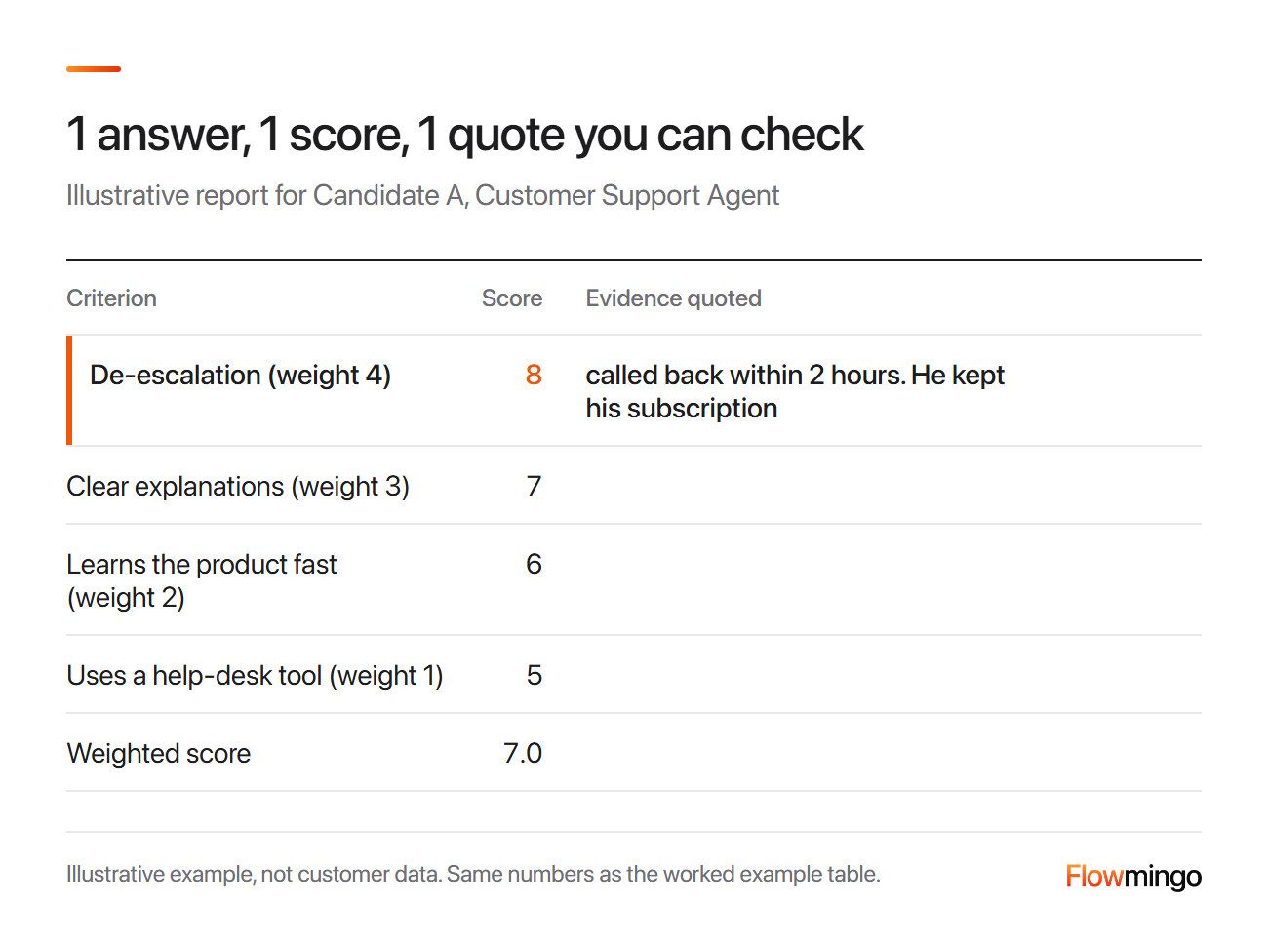
Sample report for Candidate A: de-escalation 8 with its quote, then 7, 6 and 5, for a weighted score of 7.0 (illustrative).
The UK ICO's November 2024 audit found that where human review was not a formal, trained step, staff did not complete reviews consistently (ICO).
Our rule of thumb: re-score 1 in 5 interviews, at least 10, before you see the AI score. A gap of 2 points or less counts as agreement, because a 3-point gap moves a candidate across the shortlist line.
How Flowmingo helps
After each interview, Flowmingo's AI Interviewer gives you the recording, the transcript and a 0 to 10 rating per criterion, each with written reasons. Each criterion is weighted from Good to Have up to Must Have, and the report ranks the candidate among everyone who took the same interview.
6. After automated first round interviews, what should still be decided by a person?
A person decides every rejection, the shortlist, every later round and the offer. The AI asks, follows up and scores, and it never closes a door on its own.
In a foundational 2023 Pew Research Center report, 71% of US adults opposed AI making the final hiring decision.
Rejections need a person most, because they hurt most. Across 53 studies in a 2026 review, algorithm-made HR decisions drew worse reactions on fairness and trust. The effect depended on how much the algorithm decided (Moritz and colleagues).
The law points the same way. GDPR Article 22, a foundational 2016 text, restricts decisions based solely on automated processing with significant effects.
If AI alone picks who gets an in-person interview, Section 20 of Illinois's foundational video interview law asks for yearly race and ethnicity reports. Our reading: a person approving the shortlist is cleaner.
In Greenhouse's 2026 survey, 51% never heard back after an AI interview. Our candidate rejection email templates help.
In the flow below, the AI asks, follows up and scores with the quote, and a person checks the recording.
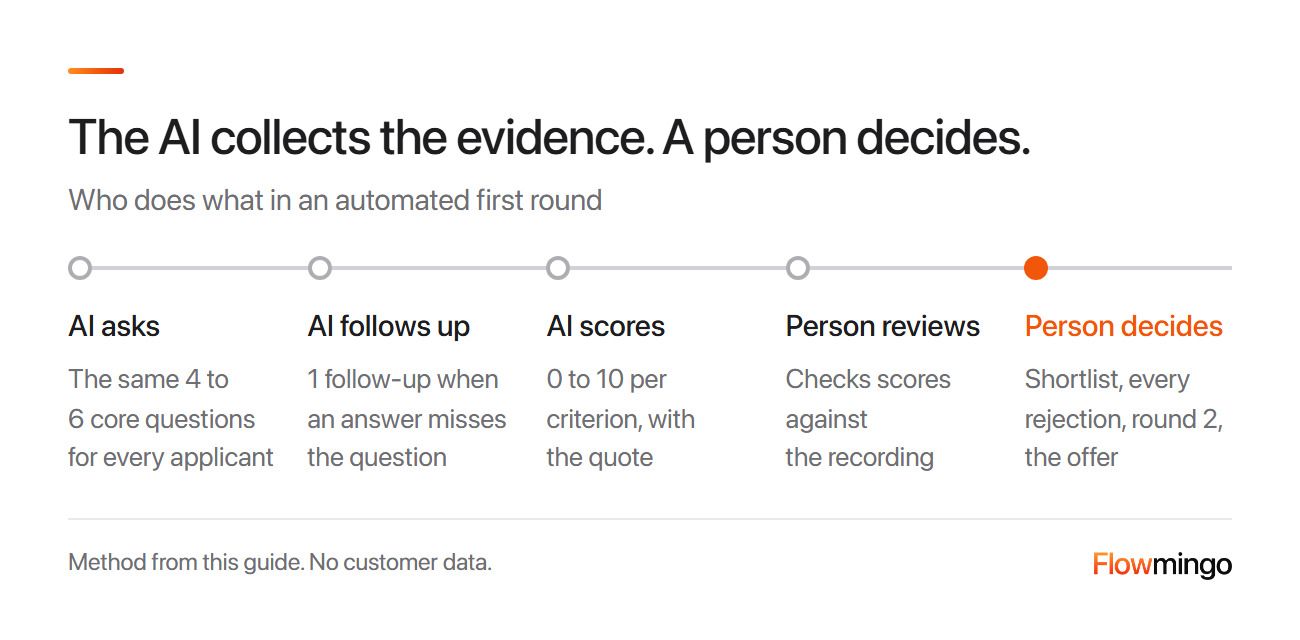
Who decides in round 1: the AI asks, follows up and scores with the quote. A person reviews and decides the shortlist, every rejection, round 2 and the offer.
How Flowmingo helps
Flowmingo's AI Interviewer does not decide who gets hired or rejected, and nobody gets rejected automatically. Your team can check and override any score against the recording and transcript.
7. How do I tell candidates about an AI first round interview so they see it as legit?
Tell them 4 things before they click: what it is, how long it takes, who reviews it, and how to reach a person. No disclosure is the second-biggest walk-away trigger in Greenhouse's 2026 survey (27%).
Both top triggers are fixable: no human present (33%) and no disclosure. Surprise is common, because 70% of candidates surveyed were never clearly told upfront that AI would evaluate them.
Timing matters too. 21% found out only after the interview had started, so the disclosure belongs in the invite, before the click.
Asked what builds trust, candidates wanted a human interview option (46%), to be told upfront (44%) and an explanation of what the AI measures (39%). They also wanted proof a human reviews before any decision (38%) and evidence of a bias audit (29%).
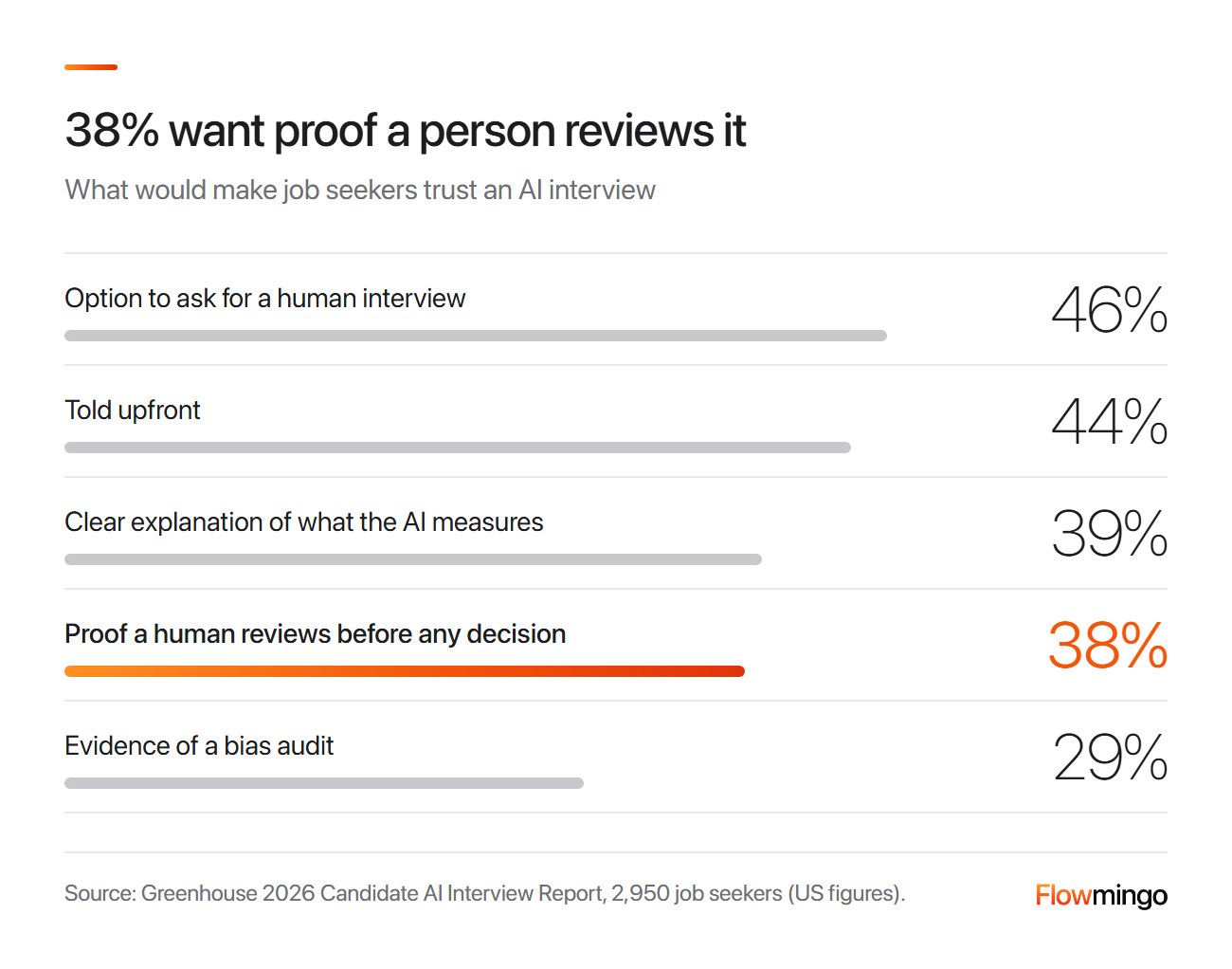
Trust builders for an AI interview: human option 46%, told upfront 44%, what it measures 39%, human review 38%, bias audit 29% (Greenhouse 2026).
Here is an AI first round interview invite that covers every item (illustrative, not customer data), sent by a named person.
Subject: [Role] at [company]: AI interview, about 30 minutes, open until [date]
[NYC roles: send the Local Law 144 notice 10 business days before this email.]
Hi [first name], thanks for applying for [role]. Next is an AI interview with about 20 minutes of questions, on a phone or laptop. Allow 30 minutes in all, with the camera check, any time before [day, date, 18:00 your time].
Link: [link]. Sign in with this email address so your answers reach us.
It asks the 5 questions we ask every applicant, and maybe a follow-up. It scores your answers on [3 to 4 criteria, e.g. handling an upset customer, explaining clearly].
I review every interview and decide who moves on, and the AI rejects nobody.
If you prefer a person, or need more time or captions, just reply and I will arrange it.
For Illinois roles: I will ask your consent first, and we delete recordings within 30 days of a request.
You will hear from me within 3 working days of finishing.
[Your name], [job title], [company]
The reminders follow our interview invitation email templates: 2 days after the invite and 2 days before the 7-day deadline.
If your tool already sends 2 reminders, skip your own. If it sends 1, send only the last nudge, so candidates never get the same message twice.
8. What do I legally owe candidates before AI interviews in Illinois, NYC or the EU?
In Illinois, explain the AI and get consent. In New York City, a tool in scope needs a yearly bias audit, and the EU expects human oversight from December 2027.
This is general information, not legal advice. A vendor does not move the risk, because the duties sit with you.
In May 2025, a preliminary US ruling, which Workday disputes, let an age claim over its AI screening proceed (Holland & Knight).
| Where | Rule | What you owe before round 1 |
|---|---|---|
| Illinois | AI Video Interview Act, since 1 Jan 2020 | Notice, explanation and consent; delete within 30 days of a request |
| Illinois | HB 3773, from 1 Jan 2026 | Notice, no discriminatory effect, no zip code as a proxy |
| New York City | Local Law 144, since 5 Jul 2023 | If in scope: yearly bias audit, public summary, notice 10 business days ahead |
| EU | AI Act Article 5, since 2 Feb 2025 | No AI that infers emotions at work |
| EU | Annex III and Article 26, from 2 Dec 2027 (Regulation 2026/1744) | Trained human oversight; tell workers and candidates |
| Singapore | Workplace Fairness Act, MOM aims for end-2027 | No hiring decision on protected traits such as age, race, nationality or disability; firms under 25 staff exempt 5 years |
The older texts here are foundational, and they still apply.
Take 1 support role open in Chicago, Brooklyn and Berlin. Chicago needs notice, an explanation of what the AI scores, and consent.
Brooklyn needs the Local Law 144 notice 10 business days ahead if the tool is in scope. That depends on how much its output drives the decision. Berlin rules out emotion inference now and needs trained oversight by 2 Dec 2027.
8.1 Is an automated first round fair to candidates with an accent, stutter or second language?
Only if you build the route around them. In Greenhouse's November 2025 survey, 35% of US job seekers said AI moved bias from humans to algorithms.
In the same October 2024 thread, a candidate with a stutter called it a nightmare, and others worried about accents. Build in 4 steps:
- Score content, not delivery, so a stutter costs nothing.
- Offer the languages the role allows, since a second language can undersell a strong answer.
- Put an accommodation and human-route line in the invite, so people ask before they start.
- Check every low score against the recording, because an accent can be misheard.
How Flowmingo helps
Every candidate on Flowmingo's AI Interviewer gets the same questions and written criteria, in a language you allow. Flowmingo says that does not make bias impossible and it has not measured the effect, so run the section 10 check.
9. How do I run a 2-week pilot of automated first round interviews on 1 role?
Pick 1 role with at least 30 applicants, our rule of thumb, and run it for 2 weeks with a person on every decision. Compare it with your last similar role.
A pilot beats a debate because gut feel was wrong in the largest field test we found, a working paper at 1 firm. Before it, 36% of 173 surveyed recruiters expected lower offer rates, and offers rose instead.
2 weeks is enough for round 1, because candidates answer fast. In the card below, the median finisher was done 26.3 hours after the invite, and 83.5% of finishers within 72 hours.
It proves round 1 only: offer acceptance and 30-day retention need about 4 weeks plus 30 days after the start date.
1stRoundHR, a guide from the vendor Humanly, describes a 30-day randomised pilot with a few hundred candidates per arm. This plan fits 1 recruiter and 1 role, so treat its result as directional.
With 60 or more applicants, our rule of thumb is to alternate them between a phone screen and the automated round. That way you automate first round interviews 1 change at a time.
The plan below is illustrative.
| Day | You do |
|---|---|
| 1 | Write 4 to 6 core questions and criteria with the hiring manager |
| 2 | Take the interview yourself, then write the invite |
| 3 | Invite everyone past the knock-outs, 7-day deadline |
| 5 and 8 | 2 reminders, skipping any your tool sends |
| 3 to 13 | Review within 2 working days, reply within 3, re-score 1 in 5 blind |
| 10 to 12 | The hiring manager runs round 2 |
| 14 | Section 10 scorecard: keep, change or stop |
Flowmingo data · 19,615 invited candidates who completed · 562 companies · invites 1 Jul to 9 Oct 2026
- 26.3 hours was the median time from invite to a finished AI interview.
- 45.3% finished within 24 hours of the invite, and 83.5% finished within 72 hours.
Invite to finished interview, not to a score. Our AI interview tool guide measured 25.0 hours from 1 June.
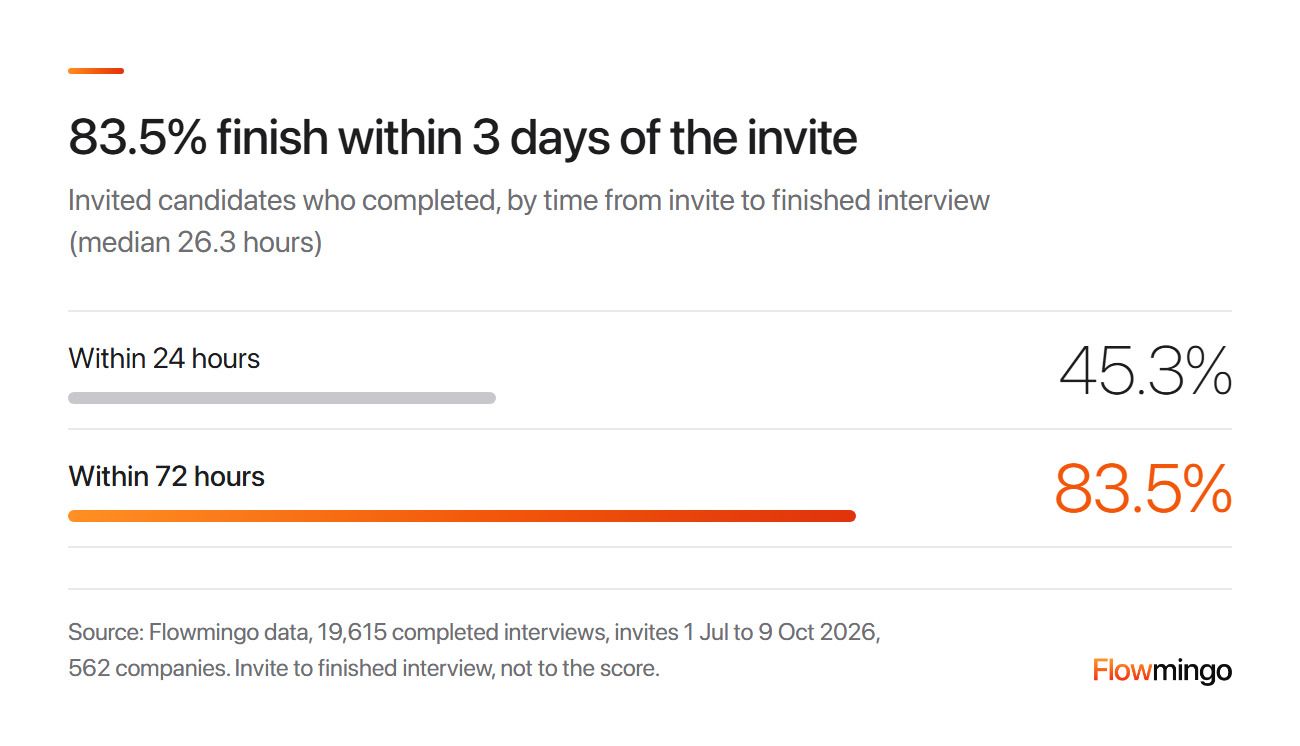
Time to finish: 45.3% of finishers within 24 hours and 83.5% within 72 hours of the invite, median 26.3 hours.
10. What should I measure to prove automated first round interviews are working?
Measure 5 things: completion, time to shortlist, your hours on round 1, score agreement and pass rates by group. Also ask 1 candidate question and send every outcome.
Count completion 2 ways: from the start, against the 4-in-5 go signal, and from the invite, against your own baseline only.
In the figure, of 98,558 invited, 76.2% never started, unread invites included. Of the 23.8% who did, most finished, so the loss is the invite, not the interview.
US agencies treat a group passing at under 4/5 of the top group's rate as evidence of adverse impact. That rule of thumb comes from foundational 1978 guidelines.
For example, if 12 of 40 men pass and 8 of 40 women, that is 30% and 20%. 20% divided by 30% is 67%, so review the criterion.
Ask candidates if it felt fair (1 to 5). In Talent Board's North American benchmark, those asked for feedback were 126% more likely to refer others (ERE).
| Metric | How to count | Go signal (our rule of thumb) |
|---|---|---|
| Start rate | Started / invited, within 14 days | Higher than your last role |
| Finish rate | Finished / started, within 14 days | About 4 in 5 or better (Flowmingo: about 84%) |
| Time to shortlist | Days from application to shortlist | Faster than last time |
| Your hours on round 1 | Review time against call time | Half or less |
| Score agreement | Blind re-score against the AI's | 4 of 5 re-scores within 2 points |
| Pass rate by group | Shortlisted / finished, where lawful | 4/5 of the top group's rate |
| Outcome sent | Finishers who got a reply | 100% within 3 working days |
Flowmingo data · 98,558 invited candidates · 955 companies · invites 1 Jul to 9 Oct 2026
- 19.9% of invited candidates completed the AI interview within 14 days.
- 23.8% of invited candidates started the AI interview within 14 days.
Every invite sent counts, unread emails included, so it does not measure interest.
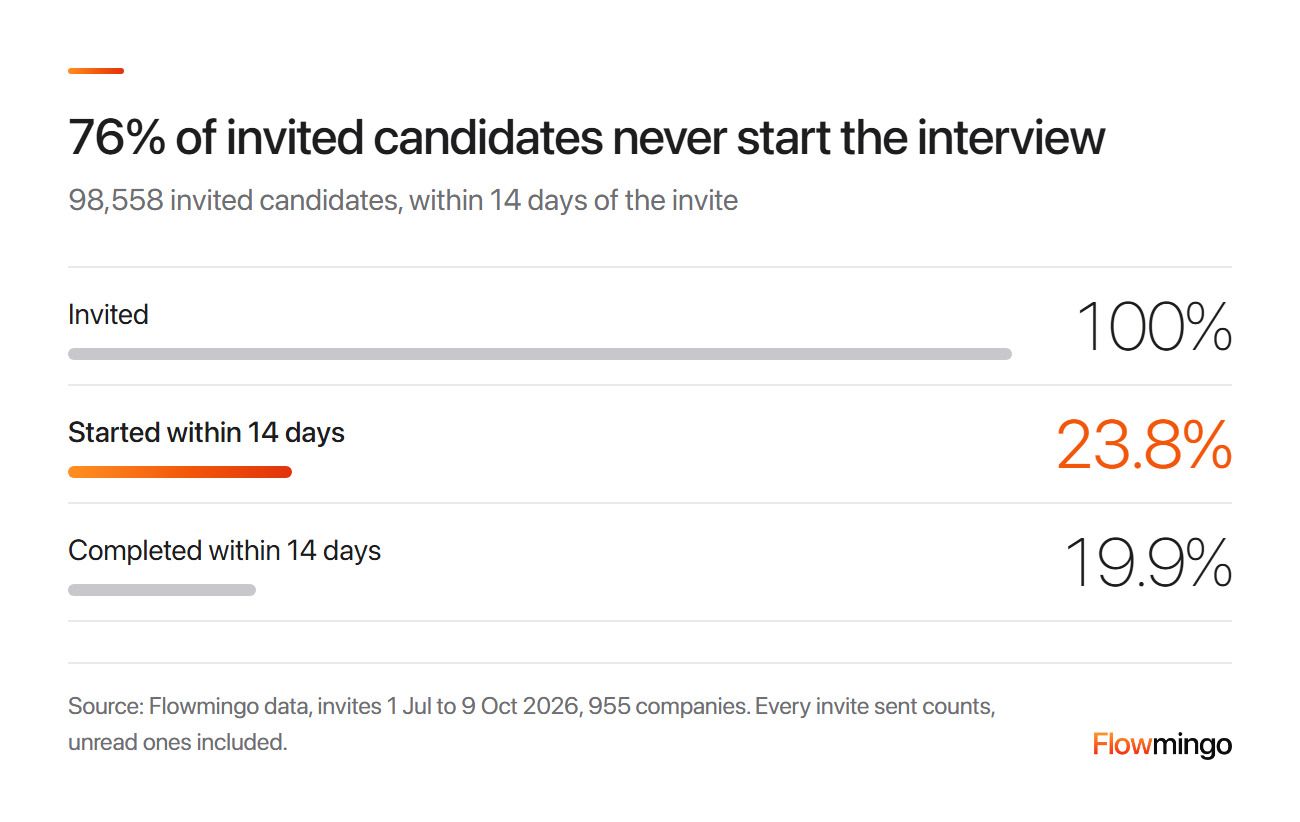
Invite to finish: of 98,558 invited (100%), 76% never started, 23.8% started and 19.9% completed within 14 days.
10.1 Will the strongest applicants skip an automated round, and how would I know?
Some will, so measure it. Beyond those who had already walked away, another 12% in Greenhouse's 2026 survey said they would.
The funnel puts the loss before the first question, so run 3 checks:
- Check completion among top-band CVs: if 8 of 20 finish against 40 of 100 overall, your best people are not skipping.
- Count who takes the human route in the invite.
- Ask the hiring manager to compare the shortlist with last time's.
How Flowmingo helps
Flowmingo is a free AI hiring platform, led by its AI Interviewer, with AI interviews unlimited on every plan. Paste its link into your ATS email, since there is no native sync. CV Evaluation can sit before it, so try Flowmingo on 1 role as your first step to automated first round interviews.
11. Sources
Every study, law and survey in this guide links to a source below; Flowmingo figures come from Flowmingo's own platform data.
- 1stRoundHR (n.d., read 2026). AI first-round interviews for TA teams. Humanly, via 1stRoundHR.
- Crowell & Moring (2024). Artificial intelligence in employment update: Illinois requires notice and prohibits discriminatory impact in use of AI. Crowell & Moring LLP.
- European Union (2016). General Data Protection Regulation, Article 22: Automated individual decision-making, including profiling. GDPR text.
- European Union (2024). Artificial Intelligence Act, Annex III: High-risk AI systems referred to in Article 6(2). Unofficial text.
- European Union (2024). Artificial Intelligence Act, Article 26: Obligations of deployers of high-risk AI systems. Unofficial text.
- European Union (2024). Artificial Intelligence Act, Article 5: Prohibited AI practices. Unofficial text.
- European Union (2026). Regulation (EU) 2026/1744, the Digital Omnibus on AI. Official Journal of the European Union.
- Greenhouse (2025, November 19). An AI trust crisis. Greenhouse newsroom.
- Greenhouse (2026, May 1). 63% of job seekers have faced an AI interview. Most haven't had a good one yet. Greenhouse 2026 Candidate AI Interview Report.
- Grossman, K. (2025, January 23). 12 key takeaways from the 2024 Candidate Experience Benchmark research. ERE.
- Hiemstra, A. M. F., Oostrom, J. K., Derous, E., Serlie, A. W., & Born, M. Ph. (2019). Applicant perceptions of initial job candidate screening with asynchronous job interviews. Journal of Personnel Psychology, 18(3), 138-147.
- Holland & Knight (2025, May). Federal court allows collective action lawsuit over alleged AI hiring bias. Holland & Knight.
- Illinois General Assembly (2020). Artificial Intelligence Video Interview Act, 820 ILCS 42. ETO AGORA copy.
- Illinois General Assembly (2021). 820 ILCS 42/20, reporting of demographic data (P.A. 102-47). ETO AGORA copy.
- Information Commissioner's Office (2024, November). AI tools in recruitment: Audit outcomes report. ICO.
- Jabarian, B., & Henkel, L. (2026). Voice AI in firms: A natural field experiment on automated job interviews (working paper, arXiv:2607.28222v2). arXiv.
- Levashina, J., Hartwell, C. J., Morgeson, F. P., & Campion, M. A. (2014). The structured employment interview: Narrative and quantitative review of the research literature. Personnel Psychology, 67(1), 241-293.
- Ministry of Manpower, Singapore (2025, November 4). Workplace Fairness (Dispute Resolution) Bill press release. MOM.
- Moritz, J. M., Pomrehn, L., Steinmetz, H., & Wehner, M. C. (2026). A meta-analysis on reactions to algorithmic decision-making in human resource management. Human Resource Management Review, 36(2), 101135.
- NYC Department of Consumer and Worker Protection (2023). Automated employment decision tools (AEDT). City of New York.
- Pew Research Center (2023, April 20). AI in hiring and evaluating workers: What Americans think. Pew Research Center.
- r/Recruitment (2026). How much of your week actually goes into first-round screening [online forum post]. Reddit.
- r/recruitinghell (2024, October 18). Just had an AI interview first round interview [online forum post]. Reddit.
- Sackett, P. R., Zhang, C., Berry, C. M., & Lievens, F. (2022). Revisiting meta-analytic estimates of validity in personnel selection: Addressing systematic overcorrection for restriction of range. Journal of Applied Psychology, 107(11), 2040-2068, via SIOP.
- U.S. Equal Employment Opportunity Commission and others (1978). Uniform Guidelines on Employee Selection Procedures, 29 CFR 1607.4. Legal Information Institute.