Say you must pick 1 AI interview tool for recruiters this quarter. You search for the best AI interview tool. Only 3 of the top 10 results compare tools, and 1 of those is a vendor's guide that lists itself first.
Most of the rest are vendor pages, and the ones written for employers all promise you 4 things. You get interviews around the clock, consistent scores, a human making the call and a link to your ATS.
Most hide the price behind a demo, so you can't compare AI interview software for recruiters on cost. The top result is not even for you: it sells candidates live answers and calls itself undetectable.
Pick wrong and you find out after you sign. 1 commenter in a recruiting forum on Reddit said only 50% of candidates took the AI interview at a Fortune 500 company.
This guide gives you 3 moves. Run 7 tests on 1 real role in 2 weeks, and get the right papers for NYC, Illinois and the EU. Then compare 6 named tools on the same criteria.
Key takeaways
- Which AI tool is best for recruiters? The one that passes 7 trial tests on your own role.
- Is there an AI tool that runs the interview itself? Yes. In a field experiment at 1 firm, with 67,056 randomly assigned job applications, applicants interviewed by AI got 12% more job offers.
- How do I test an AI interview tool in a trial? Answer 1 interview off-topic yourself. In 1 press test, a tool still scored German answers 6 out of 9 for English.
- Will candidates finish an AI interview? Most who open it do: 80.3% of Flowmingo candidates who opened one finished within 14 days.
- What papers should the vendor hand me? For NYC, a bias audit from the last year. For Illinois, notice, a plain explanation and consent first, and deletion within 30 days on request. EU duties apply from 2 December 2027.
1. Which AI interview tool for recruiters fits an agency desk, and which fits an in-house team?
No single tool wins for every team, so match it to your desk first. Enterprise teams lean to HireVue or Eightfold, staffing desks to HeyMilo, and small teams with no budget to a free plan.
So pick the tool that passes the 7 trial tests in section 3.
Team type matters because each vendor built for a different buyer. HireVue says it serves "40% of Fortune 100", while HeyMilo lists Bullhorn as a "Staffing & recruiting CRM".
On an agency desk you need a client-ready report and a price that follows volume, because volume swings with each client.
An in-house team at a large employer needs governance papers, single sign-on and many ATS connections. Eightfold puts its interviewer inside a talent platform, and BrightHire Screen replaces the phone screen, sold with the full BrightHire platform or on its own.
Paradox calls itself a "Conversational ATS" for frontline workers, and Workday bought it on 1 October 2025. It chats by text and books slots, so it runs no spoken, scored interview.
The table sorts the tools by the team that should trial them first. For hundreds of applicants a role, add our high-volume recruiting plan.
| Team | What you need most | Trial first |
|---|---|---|
| Agency or staffing desk | Client-ready report, staffing ATS, price that follows volume | HeyMilo, Flowmingo |
| In-house enterprise TA | Governance papers, single sign-on, long ATS list | HireVue, Eightfold |
| Team already on BrightHire | Phone screen replaced in the same system | BrightHire Screen |
| Small team with no ATS | Free plan, built-in tracker | Flowmingo |
2. Is there an AI tool that runs the interview, not just schedules it or takes notes?
Yes. HireVue, HeyMilo, Eightfold, BrightHire Screen and Flowmingo ask the questions and score the answers, while chat assistants, schedulers and notetakers do not.
The split matters because many "AI interview" tools only help with interviews people run. Our guide to automated interview tools compares the 4 kinds.
For example, Employ's AI Interview Companion says it "does not provide candidate scoring or hiring recommendations". It helps your team but never asks the candidate anything.
The best evidence comes from a 2026 field experiment by Jabarian and Henkel. The experiment covered 70,884 applications for entry-level customer service jobs. The 67,056 eligible ones were randomly assigned to an AI voice agent, a recruiter, or a free choice between the 2.
Applicants interviewed by the AI were 12% more likely to get a job offer: 9.73% against 8.70%. They were also 18% more likely to start the job and to still be employed after 1 month.
Recruiters made every decision, and 78% of applicants picked the AI when given the choice. The authors trace the gain to consistency, because the AI interviews were more structured.
It is a working paper from 1 recruitment firm in the Philippines, using voice rather than video. Treat it as a signal, not proof. Use AI interviews to pick who meets a person, not for a senior final round.
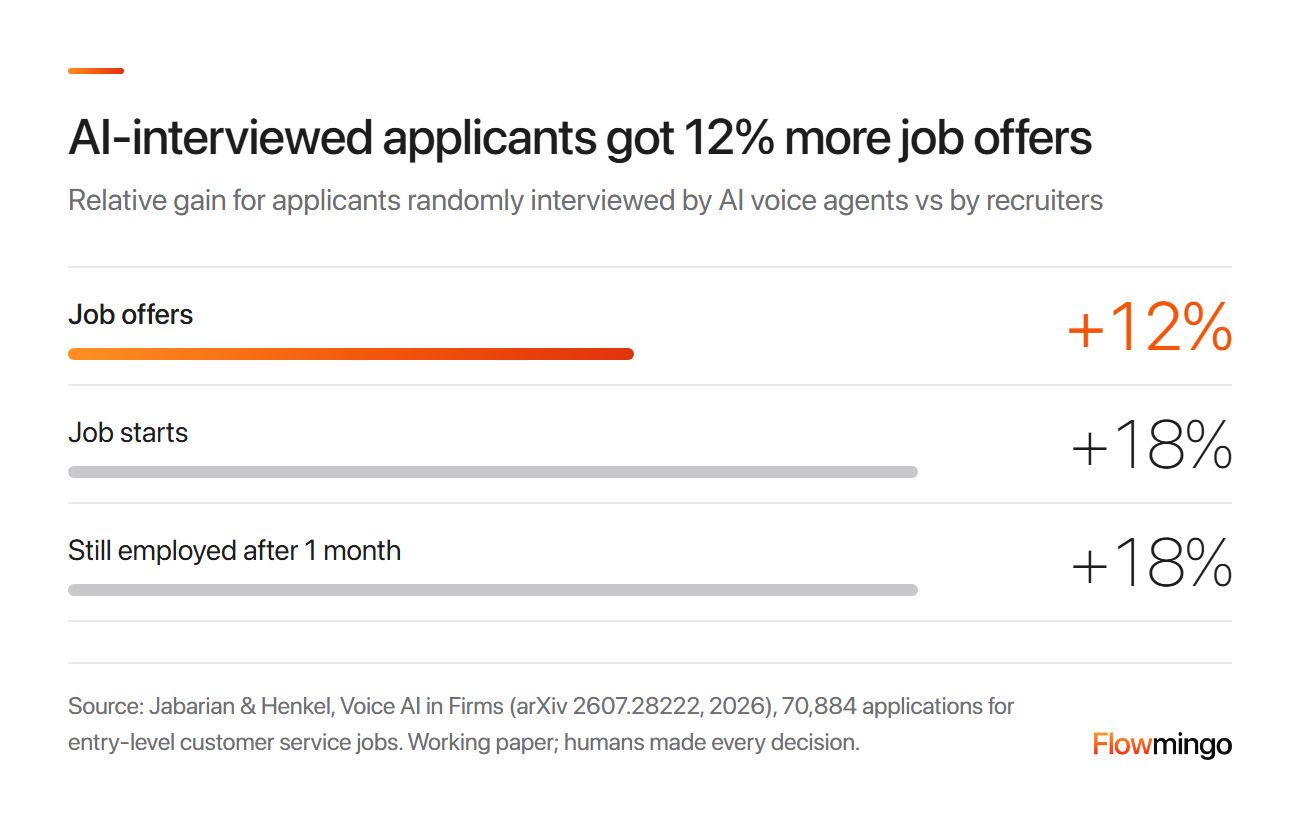
Field experiment results: AI-interviewed applicants got more offers (9.73% against 8.70%), 18% more job starts and more 1-month retention.
3. How do I test an AI interview tool for recruiters in a trial?
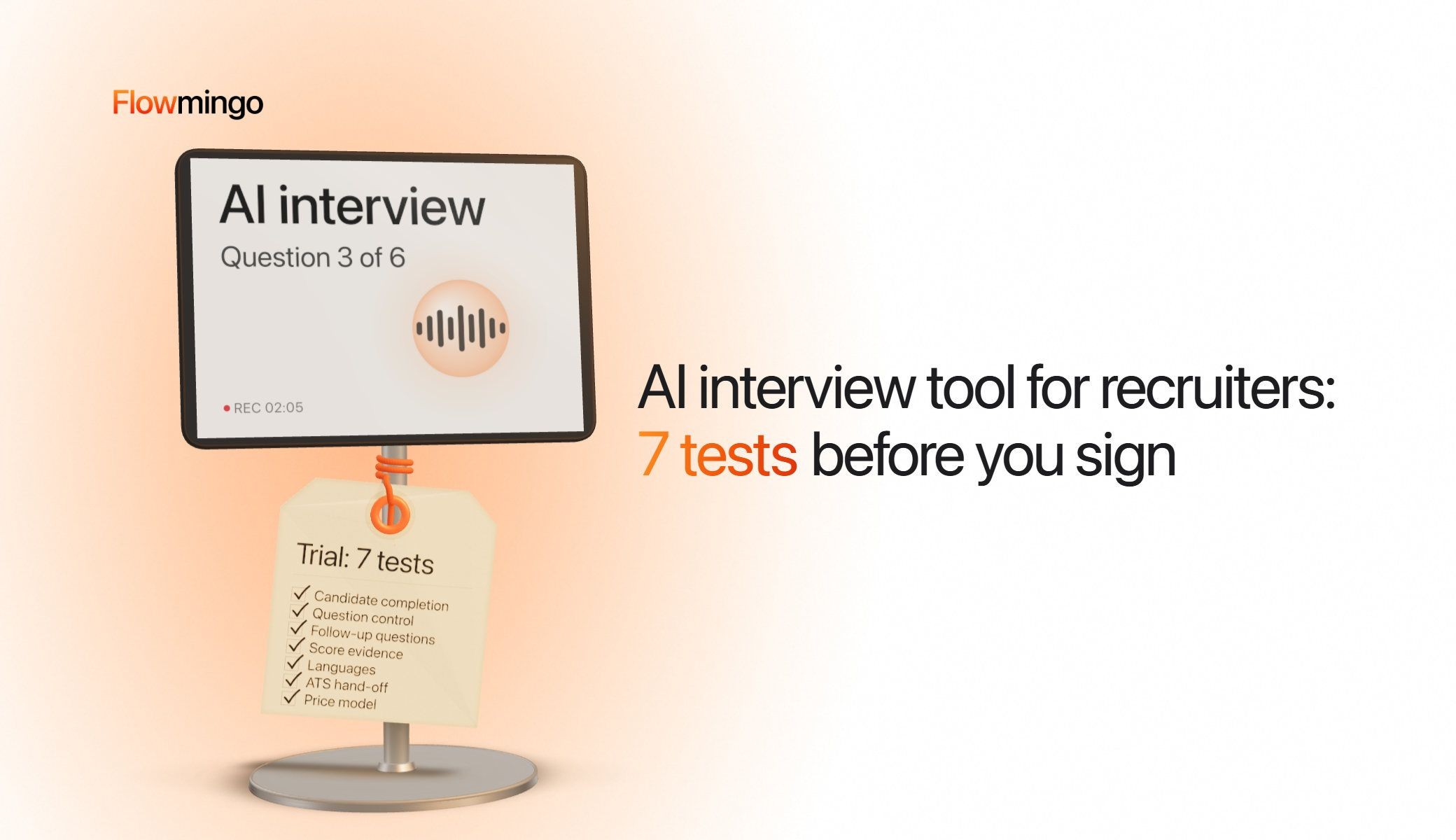
Run 1 live role for 2 weeks and score the tool on 7 tests, from candidate completion to price model. Add 1 trap: answer an interview off-topic yourself and see if it still scores well.
A demo runs the vendor's best candidate through the vendor's script, so it cannot show completion, languages or the ATS hand-off on your own role. Those 3 tests are most likely to fail after you sign.
The trap comes from a foundational 2021 test by MIT Technology Review. A reporter answered an English interview in German. 1 tool still scored her English 6 out of 9, and another rated her a 73% match.
That means those tools measured something other than her answers. If your trial tool rewards an off-topic answer, stop the trial there.
| Test | How to run it | Pass if | Tool A | Tool B |
|---|---|---|---|---|
| Candidate completion | Send to real applicants, wait 3 days | Most who open the link finish | ||
| Question control | Edit 1 question and 1 weight | Change reaches the next candidate | ||
| Follow-up questions | Give a vague answer yourself | AI asks again on the same topic | ||
| Score evidence | Answer 1 interview off-topic | Score drops, reasons quote the answer | ||
| Languages | Run 1 interview per hiring language | Questions and score in that language | ||
| ATS hand-off | Push 1 candidate to your ATS | Score, reasons and recording link land | ||
| Price model | Price your last 3 months of volume | Cost known before you sign |
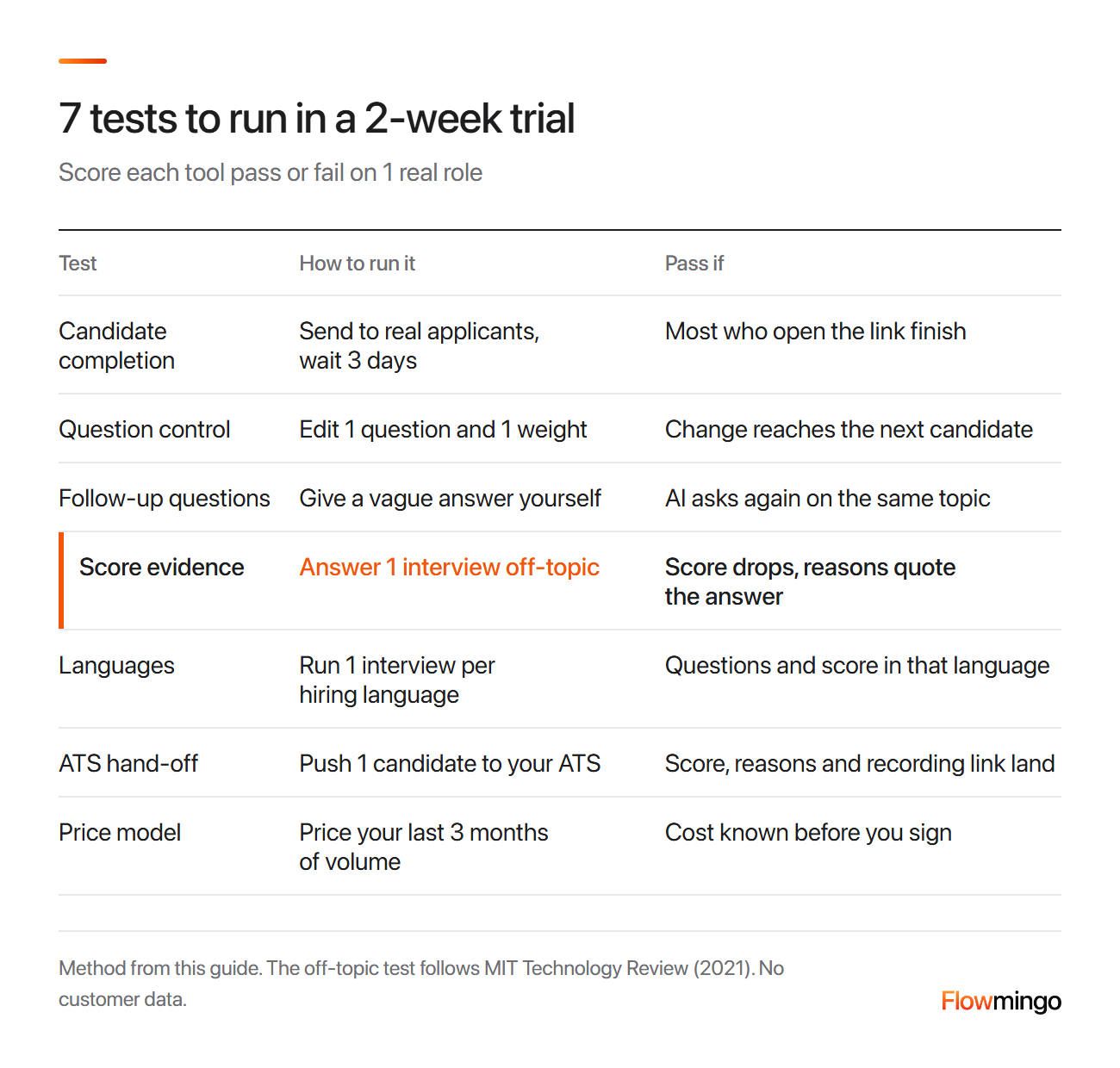
Trial scorecard: 7 tests, each with how to run it and its pass condition, from candidate completion to price model.
3.1 The 2-week trial plan
First write down your screening hours per role, so the trial has a baseline.
- Day 1: build the interview from your own job description and criteria.
- Days 2 to 3: take it yourself twice, once well and once off-topic.
- Days 3 to 7: invite real applicants with a 7-day deadline, as our interview invitation guide suggests.
- Days 11 to 14: compare the AI's top 10 with your own read, and check pass rates for interview bias.
Wait at least 3 days before you judge completion, because candidates finish over several days.
Flowmingo data · 19,645 invited candidates who finished within 14 days · 508 companies · invites 1 Jun to 8 Oct 2026
- 25.0 hours was the median time from invite to a finished AI interview.
- 85.4% of these finishers were done within 72 hours of the invite.
Finishers only: how fast candidates respond, not how fast teams decide. A newer window than our invitation guide, so shares differ by under 1 point.
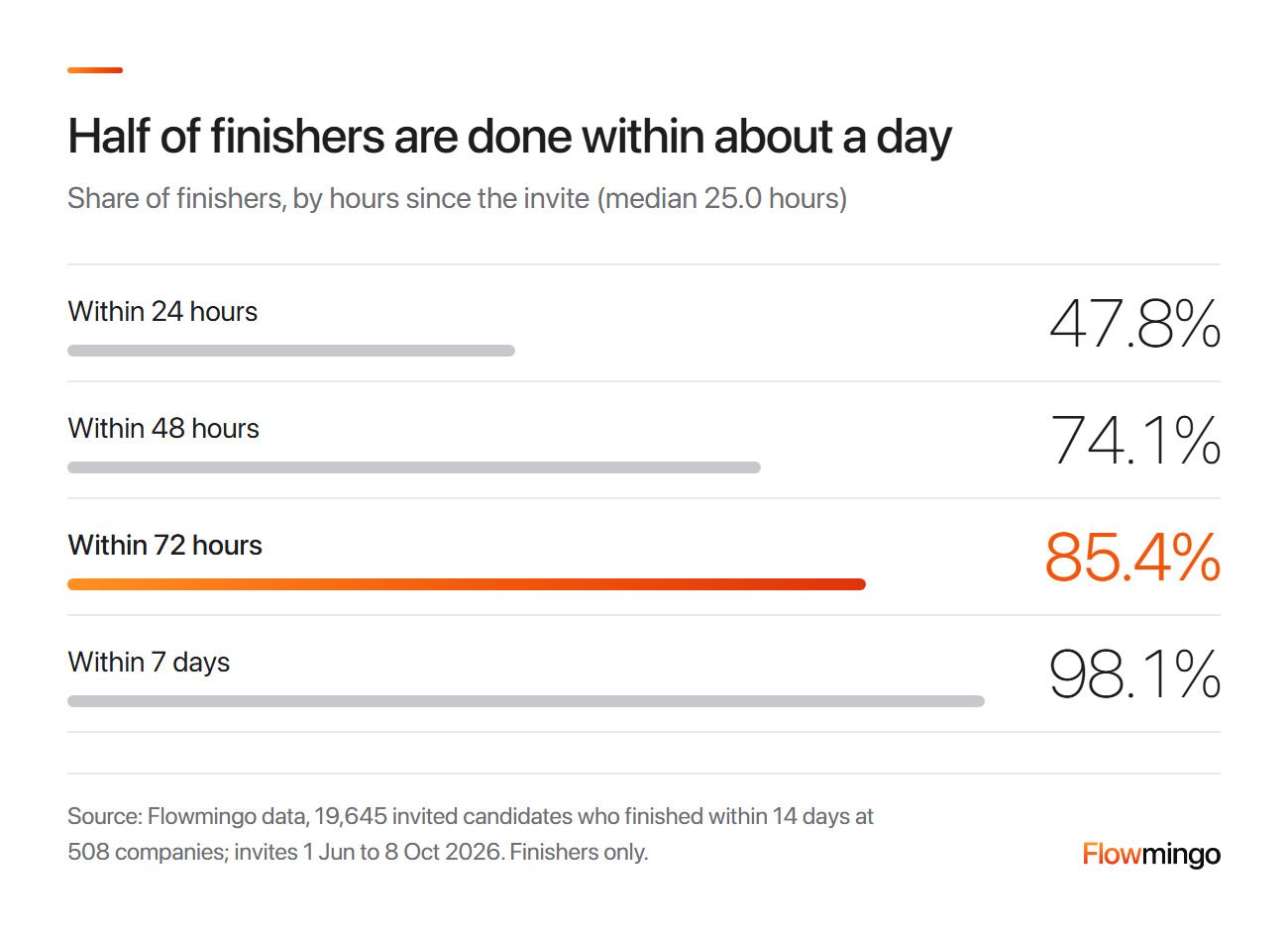
Finish time after the invite: 47.8% of finishers within 24 hours, 74.1% within 48 hours, 85.4% within 72 hours, 98.1% within 7 days.
4. Can I write my own questions and must-ask criteria, or does the AI pick them?
You should be able to write, edit and lock every question and criterion yourself. If the vendor's AI picks them and you can't, scores stop being comparable.
Control matters because structure is what makes an interview predict the job. A foundational 2022 re-analysis by Sackett and colleagues ranked 5 common methods by their link to job performance.
On a scale where 0 means no link and 1 a perfect one, structured interviews came first at 0.42. Job knowledge tests scored 0.40, biodata 0.38, work sample tests 0.33 and cognitive ability tests 0.31.
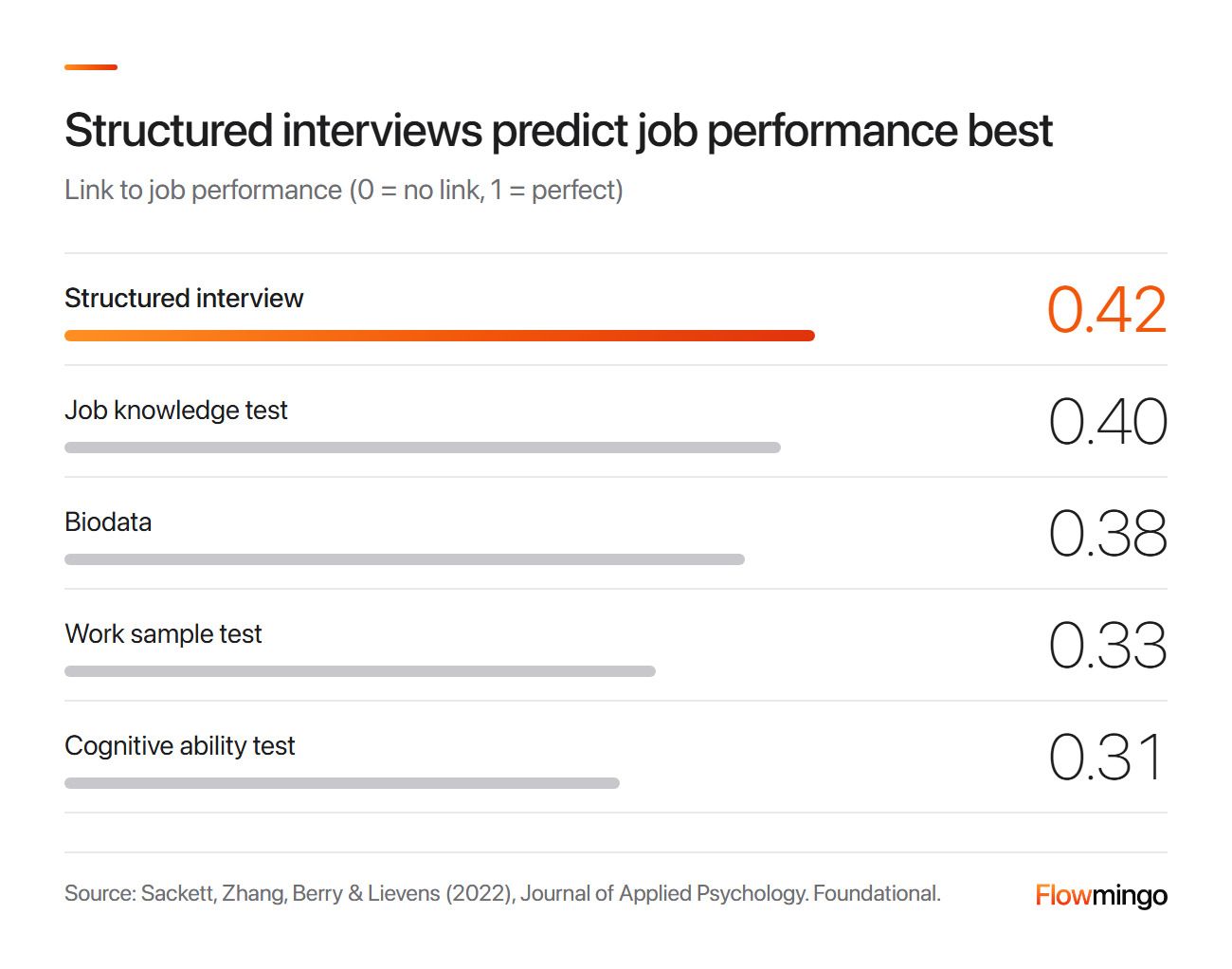
Link to job performance by method: structured interview 0.42, job knowledge test 0.40, biodata 0.38, work sample test 0.33, cognitive ability test 0.31.
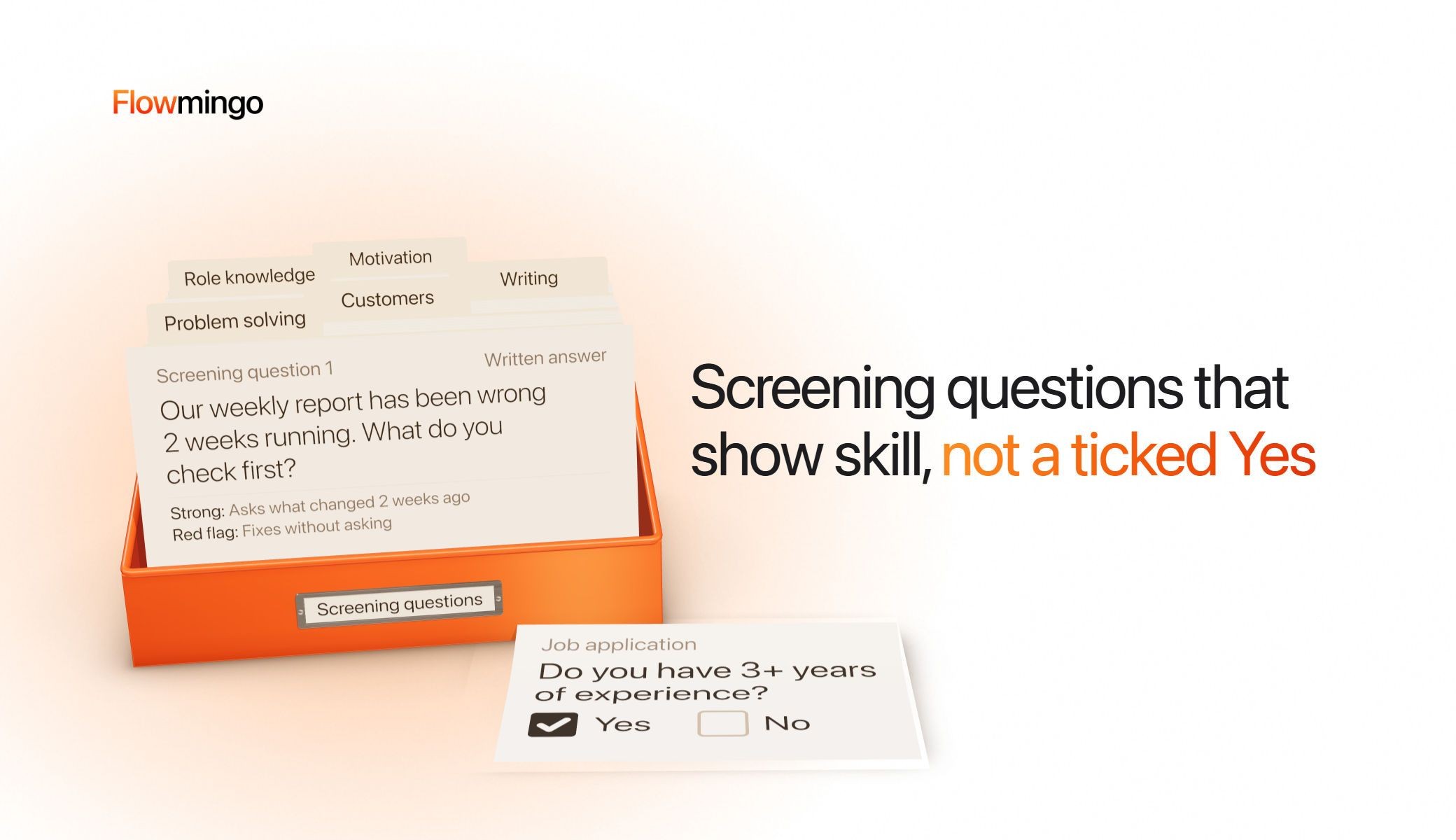
In practice, write 2 kinds of item before the first invite. Must-ask facts, such as shift and the right to work where lawful to ask, are pass or fail.
Then write 3 to 6 scored criteria with weights, as our interview scorecard template and structured interview guide show.
HireVue's video interviewing page lists "interview guides, standard rating scales, and shared scorecards", for example.
Your trial test: change 1 question and 1 weight after setup. Then check the change reaches the next candidate and the score breakdown. Here is a rubric for a support role (illustrative, not customer data).
| Criterion | Type | Weight | A strong answer |
|---|---|---|---|
| Can work the evening shift | Knockout fact | Pass/fail | Yes, names the days |
| Calms an upset customer | Must Have | Highest | A real case, what they said, the outcome |
| Solves the problem, not just the ticket | Very Important | High | How they found the cause |
| Writes clear replies | Important | Medium | Checks a reply before sending |
How Flowmingo helps
Flowmingo's AI Interviewer drafts 1 to 30 questions from your job description, and you can edit, reorder or replace them. The same set goes to every applicant for the role, so scores stay comparable.
5. Does the AI ask real follow-up questions, or just read my script back?
Some tools do, and 1 minute shows it: give a vague answer and watch for a second question. If every candidate gets the same script with no follow-up, you bought a one-way video form.
Follow-ups matter because first answers are often thin. "I'm a team player" tells you nothing, and a good human screener would ask for an example.
Answer 1 question with a vague sentence, then check 3 things: a follow-up comes, it stays on topic, and both answers reach the transcript.
BrightHire Screen says it can "Auto-generate follow-up, scoring, and probing logic for each role". HeyMilo says candidates answer in "a more interactive/adaptive manner".
There is a risk to test too. A commenter in a recruiter forum on Reddit called this conversation path bias. An easy first answer can draw easy follow-ups, and a complex one harder ones.
That means 2 candidates could face interviews of different difficulty for the same role. Keep the core fixed: the section 2 experiment traced its gain to consistent interviews.
Before you sign, ask each vendor whether the score covers the whole exchange or only the first answer. Also ask whether you can switch follow-ups off for a role.
How Flowmingo helps
When an answer does not address the question, Flowmingo's AI Interviewer asks a follow-up on the same topic before moving on. Both answers appear in the transcript, and the score reflects the whole exchange.
6. Will candidates finish an AI interview, and can they answer in their own language?
Most candidates who open the interview finish it, as long as it fits their time and their language.
Completion matters because a tool that loses good people filters by patience, not fit. And candidates start out wary: only 26% trust AI to judge them fairly, a July 2025 Gartner survey found.
A foundational 2019 experiment by Langer and colleagues explains part of it. People rating highly automated interviews for high-stakes jobs felt less in control, and accepted the process less.
So give candidates control back. Check for a practice question before anything counts, a plain line on who decides, and no fixed time slot.
Flowmingo data · 24,476 invited candidates who opened an AI interview · 577 companies · invites 1 Jun to 8 Oct 2026
- 80.3% of invited candidates who opened their AI interview finished it within 14 days.
- 61.7% of finishers did so outside Monday to Friday, 9am to 5pm, in their local time.
- 28.7% of finishers did so on a weekday evening, between 6pm and midnight.
- 19.8% of finishers did so on a Saturday or a Sunday, their local time.
Base: candidates who opened the link, not everyone invited. Times cover 19,624 finishers at 508 companies, 57.9% on India time (60.1% outside office hours without India).
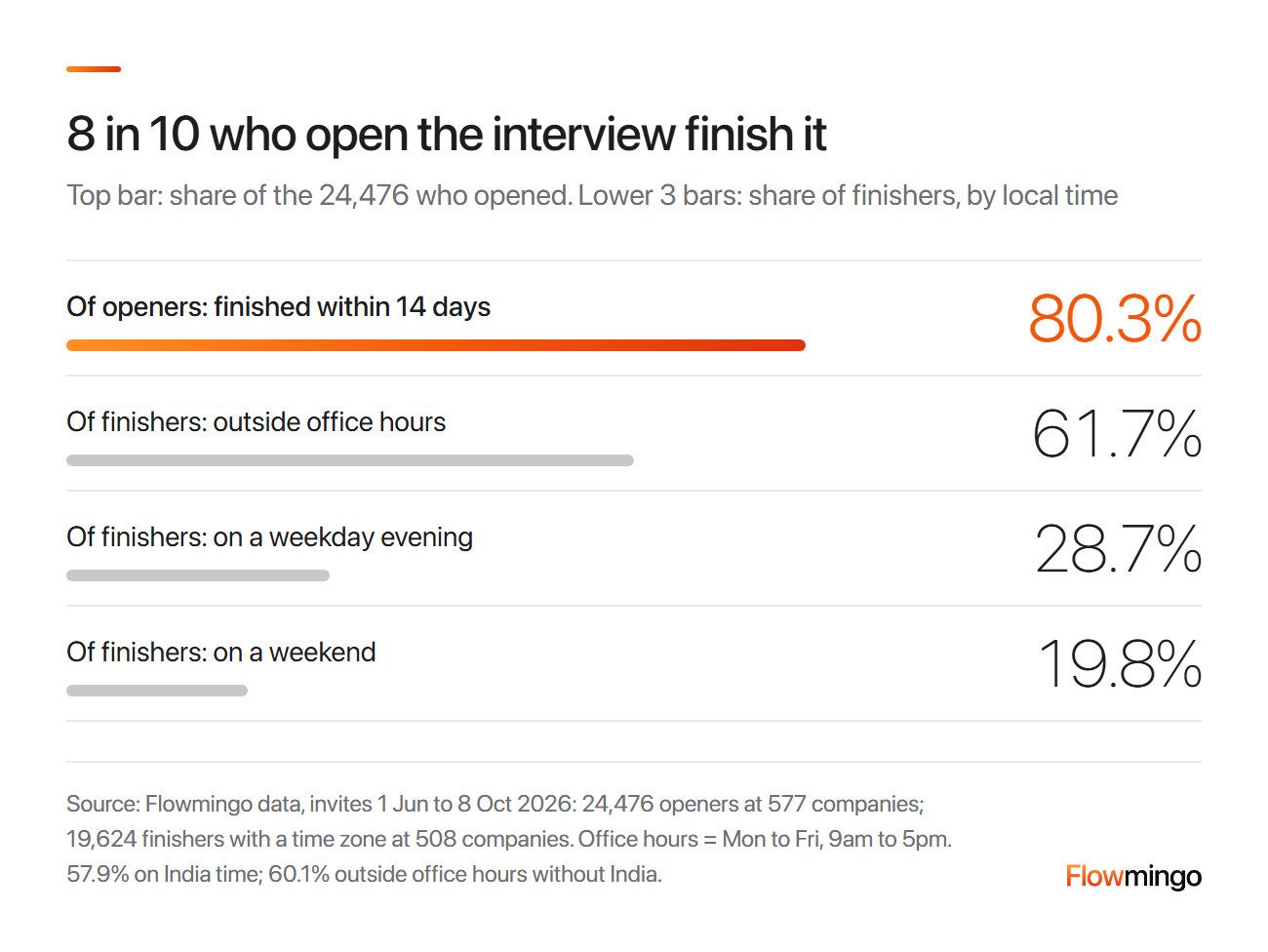
When candidates finish: 80.3% of openers finished within 14 days, 61.7% finished outside office hours, 28.7% on a weekday evening and 19.8% on a weekend.
Office hours fill only 40 of the week's 168 hours, so candidates aren't tied to your working day. Our recruiting automation guide found the same pattern on an earlier window: 60.6% of 41,126 completed AI interviews finished outside weekday office hours. Measured by start time, and counting 5pm to 6pm as office hours, the share is lower, at 53.9% in our automated interview tools guide.
Vendor pages give very different language counts: Eightfold 24+, HeyMilo 20+, Paradox 100+ for text translation and Flowmingo 60+.
Translating a text chat is not scoring a spoken answer, though. So run 1 interview per hiring language with your AI interview tool for recruiters, and check the follow-up and score arrive in it.
Compare your completion with our AI interview completion data. Then use an invite like this one.
Hi [First name], thanks for applying for [role] at [company]. Your first round is a recorded AI interview, on camera in your browser, any time before [day, date, time, time zone].
It takes about [20] minutes, checks included. You get a practice question first, and it does not count. Everyone gets the same questions, and the AI may ask a follow-up. You can answer in [languages].
The AI scores your answers against the job's requirements. A person on our team reviews every result and makes the decision.
Questions, or need another format: reply to this email.
For Illinois roles, add the consent step and explanation that section 9 describes. For NYC roles, send the Local Law 144 notice at least 10 business days before this invite.
7. Can I see the recording and the reasons behind a 2.9, and override it?
You should get the full recording, the transcript and a written reason under every score, and the power to override it. A number you can't trace to the candidate's words is not evidence for a client.
A score means nothing without its scale, weights and reasons, so ask each vendor for a 1-page explanation of the scale.
The recording matters more now, because scripted answers are common. In a November 2025 survey by Greenhouse, an ATS vendor, 65% of US hiring managers had caught deceptive AI use. In 32% of those cases, candidates read AI-written scripts.
LockedIn AI, the top result for this search, sells job seekers live answers and calls itself "Undetectable". So check that the recording plays end to end, and each score points to the answer behind it.
What the AI scores matters too. HireVue's explainability statement says its AI "relies only on what is said by the candidate", not faces or tone. That is the safer design.
A foundational 2022 study by Hickman and colleagues found video personality scores leaned mainly on verbal cues, such as how long the answers were. It never tested them against job performance, and told organisations to "proceed cautiously".
In November 2024 the UK's ICO found tools that guessed gender and ethnicity from a name. So ask what your tool infers, then change 1 score and check the audit trail logs it.
How Flowmingo helps
Flowmingo's AI Interviewer returns the recording, the transcript and a report rating each criterion 0 to 10, with written reasons. Nothing about face or appearance counts, and your team can override any score. Free keeps your latest 300 videos for 30 days, and scores stay.
8. Will an AI interview tool for recruiters send results to my ATS, and at what cost?
Ask for the exact hand-off into your ATS by name, and pick the price model that matches how often you hire.
The hand-off matters because candidates get lost in a second inbox. If someone copies scores by hand, the rollout stalls.
HireVue says it "Enriches 45+ ATS", and HeyMilo names Workday, Greenhouse and Bullhorn among others. BrightHire Screen names Greenhouse, Ashby, Workday and SmartRecruiters.
So push 1 finished candidate into your ATS in the trial. Check that the score, reasons and recording link land, and a stage change flows back.
Price is harder to test, because most vendors don't publish it. The HireVue and BrightHire pricing pages ask for a demo, and Eightfold has no pricing page.
So judge the price model now:
- Per seat fits steady hiring by a fixed team.
- Per interview fits swinging volume, but check the cost in your busiest month.
- Free or flat fits small teams, once you check what the free plan caps.
Price your last 3 months of interviews under each quote. Our AI interview cost per candidate guide works it at 100, 1,000 and 10,000 interviews.
How Flowmingo helps
Flowmingo's AI Interviewer works alongside your ATS. Paste the link into the email your ATS already sends, invite through the API, or get results by signed webhook. There is no native sync with Greenhouse, Lever or Workday today, and AI interviews are unlimited on every plan.
9. What must an AI interview vendor hand me for NYC, Illinois and the EU?
For NYC, get a bias audit from the last year and a notice to send 10 business days ahead. For Illinois, get a consent step and a way to delete videos within 30 days on request, plus a plan for EU high-risk duties.
These papers matter because the law puts the duty on you, not the vendor. This is not legal advice, so check each rule with counsel.
Under New York City's foundational Local Law 144, duties apply when the AI score substantially helps decide who moves on. You then need a yearly bias audit, a public summary and notice 10 business days ahead.
Few employers have it yet. A foundational 2024 study found only 18 of 391 New York City employers had posted an audit (Wright and colleagues).
For Illinois-based roles, the foundational 820 ILCS 42 asks for notice, a plain explanation of the AI and consent. On request, you delete videos within 30 days, backups included.
In the EU, the AI Act treats AI that evaluates candidates as high-risk. Regulation 2026/1744 moved those duties to 2 December 2027, and a tool you buy now will still run then.
Security belongs here too: in June 2025, researchers got into Paradox's McHire panel with the login 123456 (Carroll and Curry). Paradox fixed it the next day. So wherever the role is, also ask for single sign-on or MFA, a current security certificate, and who owns the vendor.
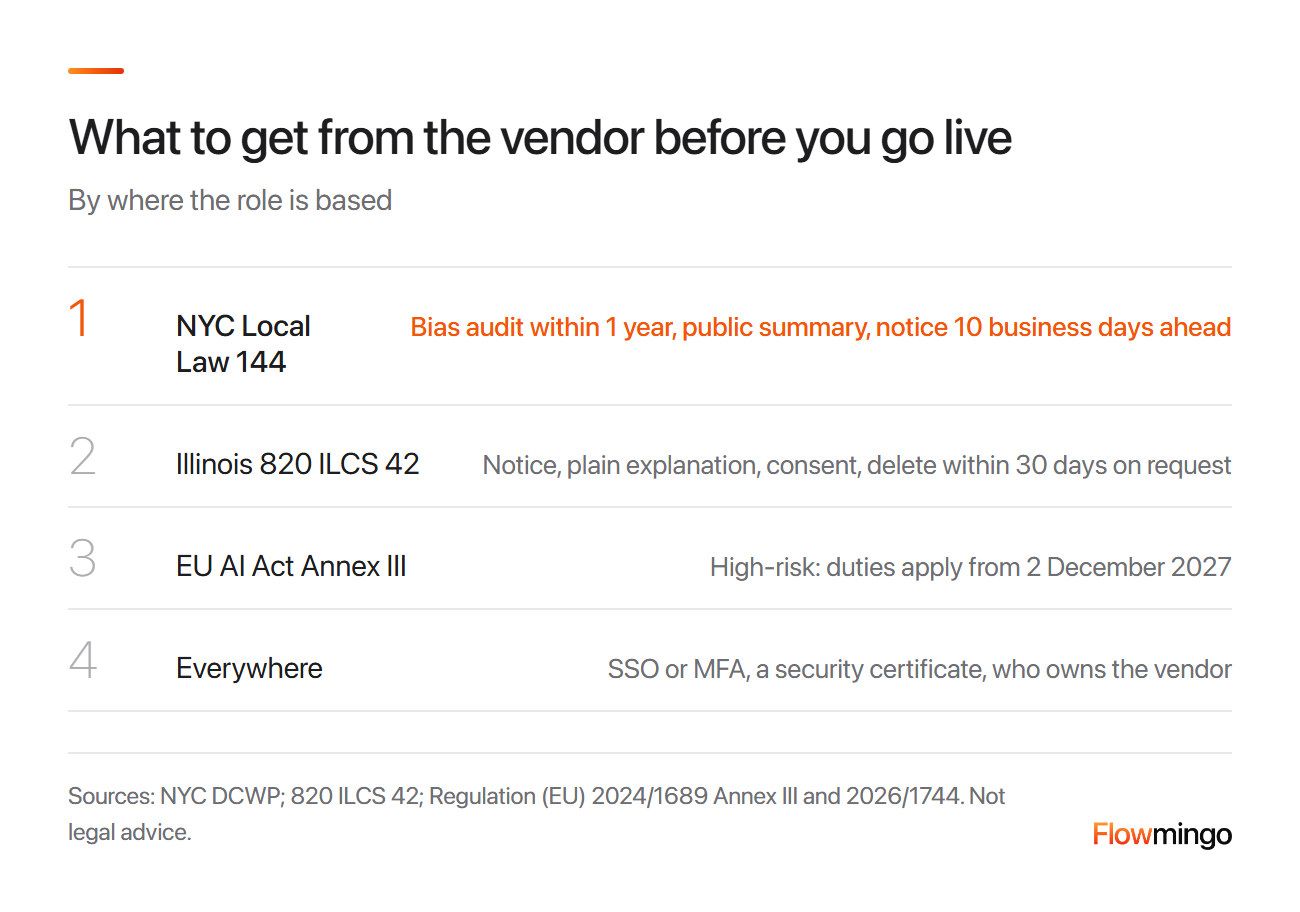
Vendor papers by place: NYC wants a yearly bias audit and notice. Illinois wants consent and deletion within 30 days on request, the EU high-risk duties from 2 December 2027.
10. HireVue, HeyMilo, BrightHire, Eightfold and others: which AI interview tool for recruiters is best at what?
HireVue fits enterprise scale, HeyMilo staffing volume, BrightHire Screen a BrightHire stack and Eightfold a talent platform. Paradox screens frontline roles by text, and Flowmingo gives small teams unlimited interviews.
Each cell comes from that vendor's own page, read 23 October 2026. Treat every cell as a claim to test, because no vendor page shows test data.
| Tool | Interview format | Follow-ups | Languages | ATS hand-off | Public price |
|---|---|---|---|---|---|
| HireVue | 24/7 AI screening interview, video | Yes, "probing follow-up questions" (AI Interviewer page) | Not stated | 45+ ATS | No, request demo |
| HeyMilo | Voice, video, SMS, forms | Says adaptive vs one-way video | 20+ | Bullhorn, Greenhouse, Workday and more | No, book demo |
| BrightHire Screen | Voice or video, async | Yes, per role | Not stated | Greenhouse, Ashby, Workday, SmartRecruiters | No, request demo |
| Eightfold AI Interviewer | Coding, soft skills, volume roles | Not stated | 24+ (FAQ 22+) | Existing ATS or invite link | No pricing page |
| Paradox | Text chat and scheduling, not a spoken interview | Chat flow | 100+ (text translation) | Keeps your ATS, Workday | No, request demo |
| Flowmingo | Video, async, in browser | Yes, when an answer misses the question | 60+ | API, webhooks, MCP; no native sync | Free $0; Starter $49 a month ($42 billed yearly) |
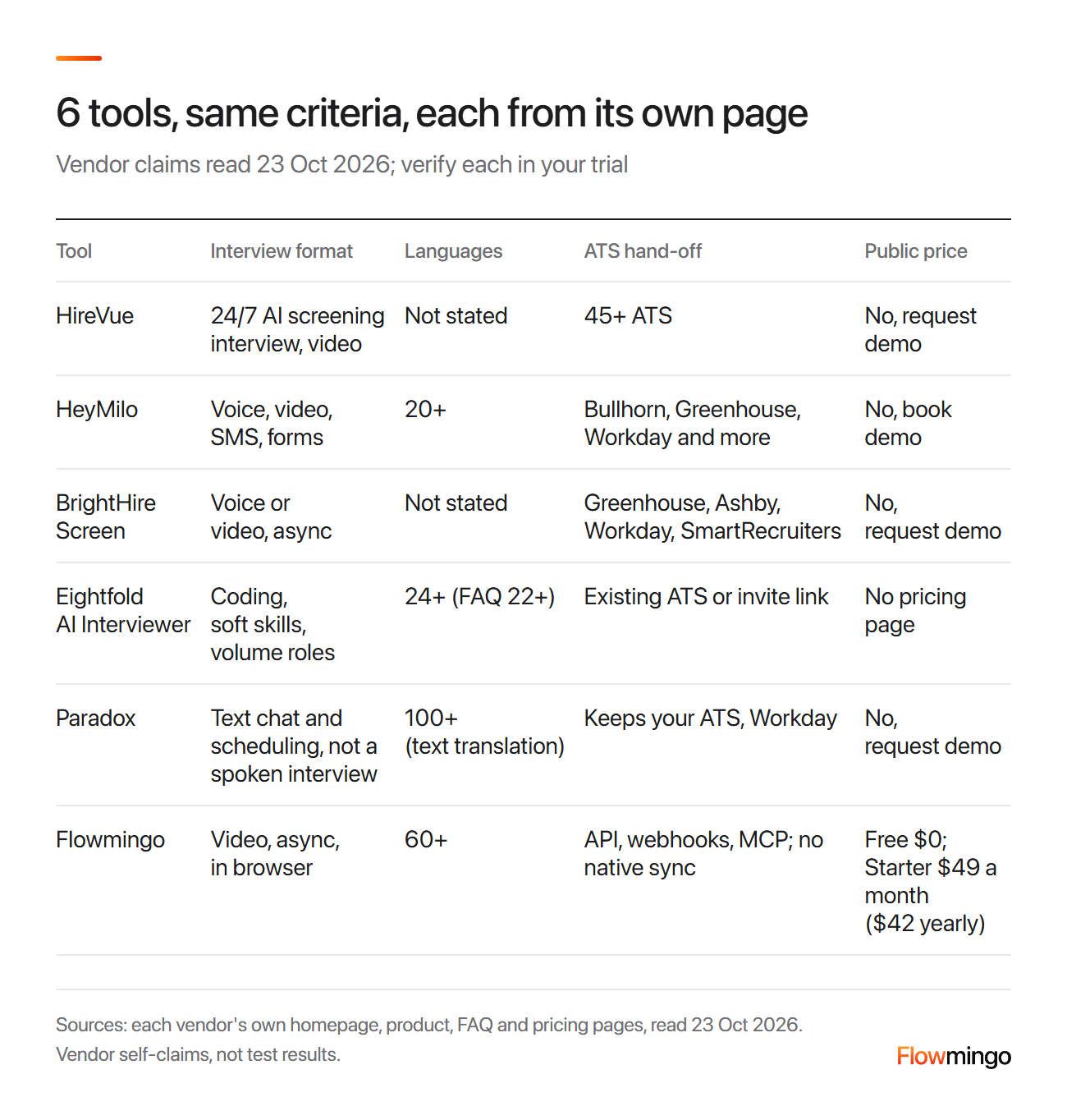
Shortlist at a glance: 6 tools on format, languages, ATS hand-off and public price, each cell from the vendor's own page on 23 October 2026.
- HireVue suits enterprise teams that need a long ATS list. It publishes no price, so you cannot budget before a demo. Test its explainability statement against 1 real report, and give a vague answer to check how deep its follow-ups go.
- HeyMilo suits staffing desks, with voice, video, SMS and forms in 1 flow. Its 4.6 out of 5 candidate rating is self-reported, so measure completion on your own applicants.
- BrightHire Screen suits teams replacing the phone screen inside BrightHire. Its own buyer's guide lists it first, so test how deep its follow-ups go on a vague answer.
- Eightfold suits large employers buying a whole talent platform. Its page and FAQ give different language counts, so test every language you hire in.
- Paradox suits frontline hourly hiring by text and booked slots. It runs no spoken, scored interview, so first decide whether your roles need one.
Flowmingo is the last row, judged on the same criteria, with its limits in the box below. Shortlist 2 tools, run the section 3 trial on both, and keep the one with more passes.
How Flowmingo helps
Flowmingo's AI Interviewer suits high-volume hiring for entry to mid-level roles. It is not a good fit for the final round of a senior hire. It has no native ATS sync, and Free caps each interview at 20 minutes and shows Flowmingo's brand beside yours. Flowmingo has no published bias audit, so for NYC roles you would arrange the Local Law 144 audit yourself.
If a free plan is on your list, run the 7 tests on Flowmingo and judge it like any other AI interview tool for recruiters.
11. Sources
Every study, law and vendor claim in this guide links to a source below; Flowmingo figures come from Flowmingo's own platform data.
- BrightHire (n.d., read 2026). BrightHire Screen: AI interviewer for automated candidate screening. BrightHire.
- BrightHire (n.d., read 2026). Pricing. BrightHire.
- Carroll, I., & Curry, S. (2025). Would you like an IDOR with that? Leaking 64 million McDonald's job applications. ian.sh.
- Eightfold AI (n.d., read 2026). AI Interviewer. Eightfold AI.
- Employ (n.d., read 2026). AI Interview Companion. Employ.
- European Parliament and Council (2024). Regulation (EU) 2024/1689, the Artificial Intelligence Act, Annex III. Unofficial text.
- European Parliament and Council (2026). Regulation (EU) 2026/1744, the Digital Omnibus on AI. Official Journal of the European Union.
- Gartner (2025). Gartner survey shows just 26% of job applicants trust AI will fairly evaluate them. Gartner newsroom.
- Greenhouse (2025). An AI trust crisis. Greenhouse newsroom.
- HeyMilo (n.d., read 2026). Leading AI recruiter for high-volume hiring. HeyMilo.
- Hickman, L., Bosch, N., Ng, V., Saef, R., Tay, L., & Woo, S. E. (2022). Automated video interview personality assessments: Reliability, validity, and generalizability investigations. Journal of Applied Psychology.
- HireVue (n.d., read 2026). Home and Pricing. HireVue.
- HireVue (n.d., read 2026). AI interviewer. HireVue.
- HireVue (n.d., read 2026). Online video interviewing software. HireVue.
- HireVue (2026). 2025 AI short-form explainability statement. HireVue.
- Illinois General Assembly (2019). Artificial Intelligence Video Interview Act, 820 ILCS 42. Illinois Compiled Statutes.
- Information Commissioner's Office (2024). ICO intervention into AI recruitment tools leads to better data protection for job seekers. ICO.
- Jabarian, B., & Henkel, L. (2026). Voice AI in firms: A natural field experiment on automated job interviews (working paper). arXiv.
- Langer, M., König, C. J., & Papathanasiou, M. (2019). Highly automated job interviews: Acceptance under the influence of stakes. International Journal of Selection and Assessment.
- NYC Department of Consumer and Worker Protection (2023). Automated Employment Decision Tools. City of New York.
- Paradox (n.d., read 2026). Conversational hiring software that gets work done for you. Paradox.
- Reddit r/recruiting (2026). Anyone used AI video interviews for high volume screening? Looking for honest takes. Reddit.
- Reddit r/RecruitmentAgencies (2026). Recruiters, would you trust an AI resume + interview score if you could see exactly why it gave that score? [thread started by a vendor; comment cited]. Reddit.
- Sackett, P. R., Zhang, C., Berry, C. M., & Lievens, F. (2022). Revisiting meta-analytic estimates of validity in personnel selection: Addressing systematic overcorrection for restriction of range. Journal of Applied Psychology.
- Wall, S., & Schellmann, H. (2021). We tested AI interview tools. Here's what we found. MIT Technology Review.
- Workday (2025). Workday completes acquisition of Paradox. Workday newsroom.
- Wright, L., et al. (2024). Null compliance: NYC Local Law 144 and the challenges of algorithm accountability. ACM FAccT 2024.