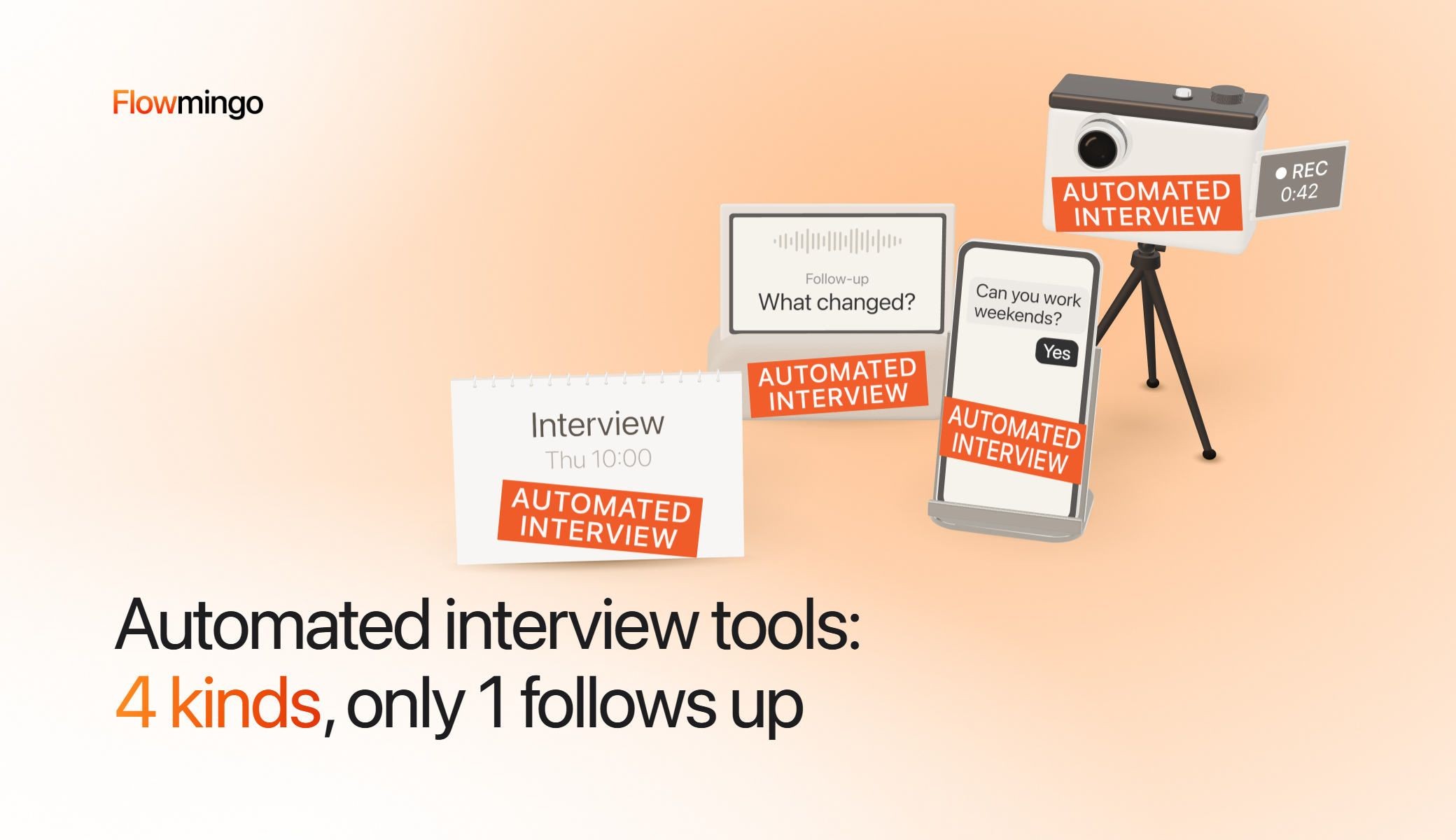
You have 200 applicants for 1 role and 4 vendor demos booked this week. All 4 sell automated interview tools. Yet the first books calls, the second records answers, the third chats by text and the fourth asks follow-up questions.
The labels are the problem, not you. Vendors sell 4 different jobs as automated interview software, and comparison lists mix them.
Pick the wrong kind and you pay twice. A scheduler alone still leaves you 40 identical phone screens, about 13 hours of talking.
The wrong format costs candidates. In Greenhouse's 2026 survey of 1,200 US job seekers, AI-scored recorded video with no person was the top trigger for walking away (33%). Greenhouse sells an AI interview product and does not say what that share is of.
This AI interview tools comparison fixes that in 3 moves. Find where your hours go, match the tool to the role, then test completion, cheating and scoring.
Key takeaways
- Which kind of automated interview tool should I start with? Match where your hours go: 40 phone screens of 20 minutes take about 13 hours and call for an interview tool, while a booking backlog calls for a scheduling bot.
- Does an AI interviewer beat a recruiter's phone screen? In 1 field test of 67,056 applications, voice AI interviews led to 12% more job offers, with recruiters making every decision.
- Will candidates finish an automated interview? Most who start do: in our data, candidates finished 84.6% of 50,271 AI interviews begun, but only 73.1% on a phone.
- Which format puts candidates off most? AI-scored recorded video with no person, the top trigger for walking away (33%) in Greenhouse's US survey. So offer a route to a person.
- Do I need consent before AI scores a video interview? For Illinois-based roles, yes: notice, a plain explanation and consent first, then deletion within 30 days on request.
1. Which automated interview tools fit my roles: one-way video, AI interviewer, chatbot or scheduling bot?
Match the tool to what round 1 must decide. Chatbots check requirements and scheduling bots book calls, while only one-way video and AI interviewers assess answers.
This comes first because vendors blur the kinds. Spark Hire says its one-way video gives every candidate "the same questions under the same conditions". HireVue's AI Interviewer instead asks "probing follow-up questions".
Paradox says its chatbot screens "for role requirements" by text, while schedulers such as GoodTime only book and remind.
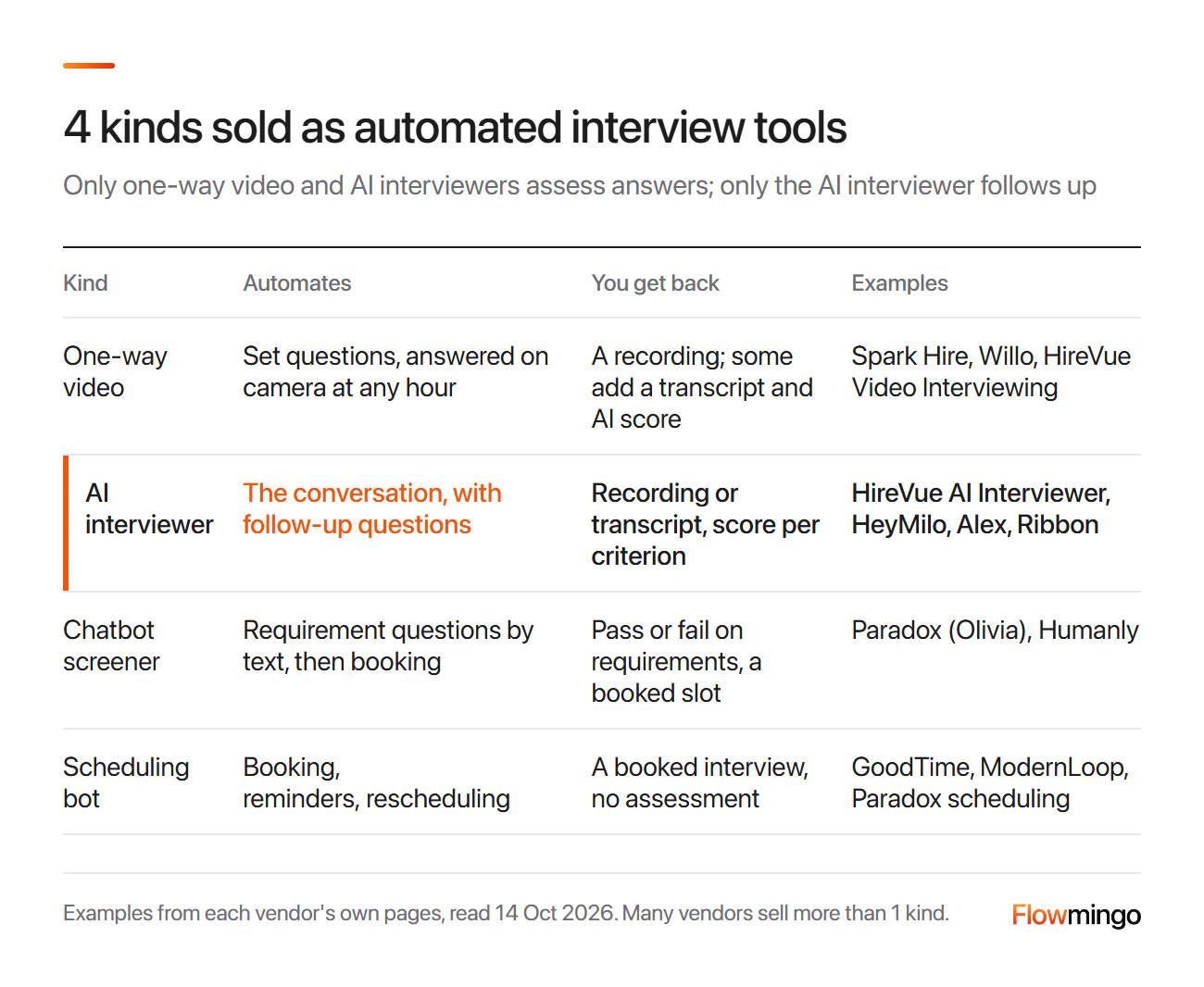
4 kinds of automated interview tool: one-way video and AI interviewers assess answers, chatbots check requirements, and scheduling bots only book.
| Kind | Automates | You get back | Examples |
|---|---|---|---|
| One-way video | Set questions, answered on camera at any hour | A recording, some with a transcript and AI score | Spark Hire, Willo, HireVue Video Interviewing |
| AI interviewer | The conversation, with follow-up questions | Recording or transcript, score per criterion | HireVue AI Interviewer, HeyMilo, Alex, Ribbon, Sapia.ai (text chat) |
| Chatbot screener | Requirement questions by text, then booking | Pass or fail on requirements, a booked slot | Paradox (Olivia), Humanly |
| Scheduling bot | Booking, reminders, rescheduling | A booked interview, no assessment | GoodTime, ModernLoop, Paradox scheduling |
Where each kind falls short decides which roles it fits:
- One-way video: nobody asks a follow-up, so pick it for volume roles where a few set questions tell you enough.
- AI interviewer: follow-ups differ by candidate, so spot-check scores against recordings, and pick it for entry to mid-level roles where polish hides thin experience.
- Chatbot screener: it judges facts rather than skill, so pick it for hourly roles where shifts and location decide round 1.
- Scheduling bot: it assesses nobody, so pick it for panels and senior rounds, where booking eats your hours.
Structured interviews ranked first for predicting job performance in a foundational 2022 review (Sackett and colleagues). An assessing tool inherits that only if everyone gets the same job-related questions and scoring guide, as our structured interview guide explains.
2. Do I need automated interview tools at all, or would scheduling software fix my bottleneck?
Count where your hours went on the last role. If booking and chasing calls ate them, start with scheduling, and if repeated first-round talks did, automate the interview.
Say you held 40 phone screens of 20 minutes each. That is 800 minutes, about 13 hours of talking, while booking adds about 2 hours per open role by Metaview's estimate.
Metaview, which ranks its own tool first, says recruiting schedulers pay off at 200+ hires a year. In the 2025 CandE benchmark, 32% of candidates who withdrew blamed time disrespected during interviews and appointments.
Interview scheduling software fixes booking and reminders, not late interviewers or extra rounds. MindHunt adds a skip rule for AI screening: below 5 hires a quarter, or for senior roles.
A self-paced interview needs no slot, so candidates choose when to start.
Flowmingo data · 50,115 AI interviews · 936 companies · 15 Jul to 12 Oct 2026
- 53.9% of AI interviews began outside weekday office hours, in the candidate's local time.
- 46.1% of AI interviews began on a weekday between 9:00 and 17:59.
- 84.2% of interviews begun in office hours were finished, against 85.2% on weekday evenings and early mornings and 84.5% at weekends.
Local time comes from the candidate's IP address when the interview began, and VPNs or mobile networks can misplace it. In this period, 58.4% began in India or Nigeria and nothing adjusts for that mix, so this is not a global average. Public holidays count as weekdays, some countries rest on Friday and Saturday, and this shows when candidates chose to start.
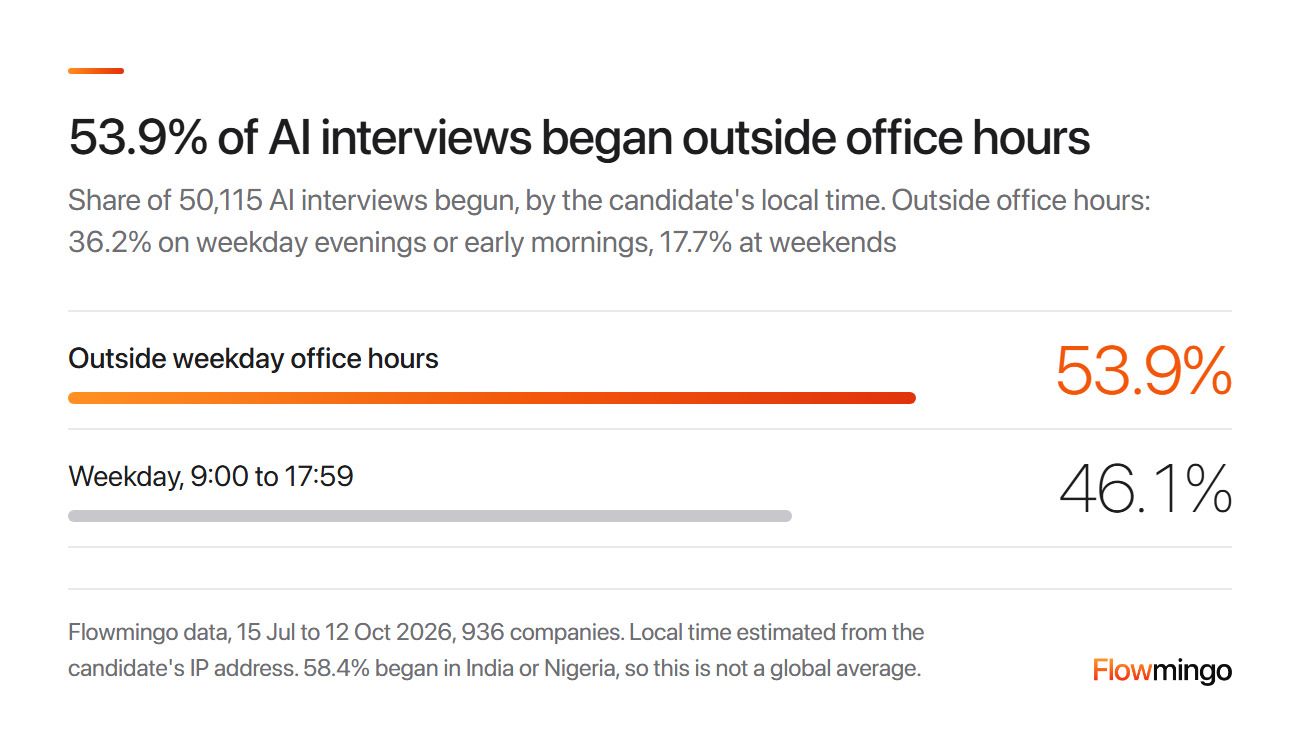
When candidates start AI interviews: 53.9% began outside weekday office hours and 46.1% on weekdays from 9:00 to 17:59. Outside those hours, 36.2% began on weekday evenings or early mornings and 17.7% at weekends.
Finish rates barely moved between those bands, so an evening start is as likely to be finished. Our other guides, such as recruiting automation, give a higher share because they count only finished interviews and end office hours at 17:00. 2 of them also time the finish rather than the start, and 2 read the device's time zone rather than the IP address.
3. Should I send a one-way video interview or an AI interviewer that asks follow-up questions?
Use one-way video when a few set questions tell you enough on the first try. Use an AI interviewer that follows up when polished first answers hide thin experience.
One-way video cannot catch what 1 manager on r/managers saw: impressive CVs crumbling at the first follow-up. For example, a candidate claims better retention, and the AI asks what changed.
A foundational 2024 study of 27,809 one-way video applicants tied retakes and thinking time to better reactions, more questions to worse ones (Tilston and colleagues). In the 2025 CandE benchmark, candidates rated one-way video as fair as live interviews for the first time. Survale, which runs it, says the likeliest reason is more salaried candidates struggling to get any reply.
Keep an AI interviewer's base questions and criteria the same for everyone so scores stay comparable, and plan for the candidate's real time.
Flowmingo data · 50,271 AI interviews begun, 42,521 finished · 15 Jul to 12 Oct 2026
- 25.9 minutes was the median a 16-20 minute setting took of the candidate's time.
- 14.2 minutes was the median time for interviews set to 10 minutes or less.
Wall-clock time from start to end, including the AI interviewer's own turns and pauses. The setting is the interview's current length, which a recruiter may have edited after some candidates took it.
So if you set 20 minutes, tell candidates to allow 25 to 30.
3.1 Which kind works for technical roles?
Pair a conversation with a skills test that records the work, because talk alone cannot judge technical skill. 1 non-technical recruiter hiring 30-40 developers a year asked for that on r/recruiting.
For example, give a developer 1 AI interview about a past project, then 1 coding task, the same for everyone. Coding needs a computer, so say so in the invite.
How Flowmingo helps
Flowmingo's AI Interviewer drafts the questions and weighted criteria from your job description, and you can edit, reorder or replace them. When an answer does not address the question, the AI asks a follow-up on the same topic, and the score reflects the whole exchange. Flowmingo's menu also lists a Technical Test: "Real code, run and scored in the browser".
4. Is a phone-based AI interview better than video for hourly or contact-centre roles?
In the only randomised field trial we found, a voice AI interviewer that asked follow-ups beat recruiter-led first rounds on offers, starts and 30-day employment. We found no study comparing voice with video.
A contact-centre recruiter with 300+ candidates in the speaking backlog asked on r/recruiting whether AI scores hold up on the floor. Pick the channel by role: audio when only speech matters, as on a phone line, and video when you must also see the candidate.
Jabarian and Henkel randomly assigned 67,056 applications for entry-level customer-service jobs to an AI voice interviewer, a recruiter or a free choice. Recruiters made every hiring decision.
With the AI, 9.73% of applicants got a job offer against 8.70%, which is 12% more. Starts rose from 5.65% to 6.71% and 30-day employment from 4.98% to 5.89%, each about 18% more.
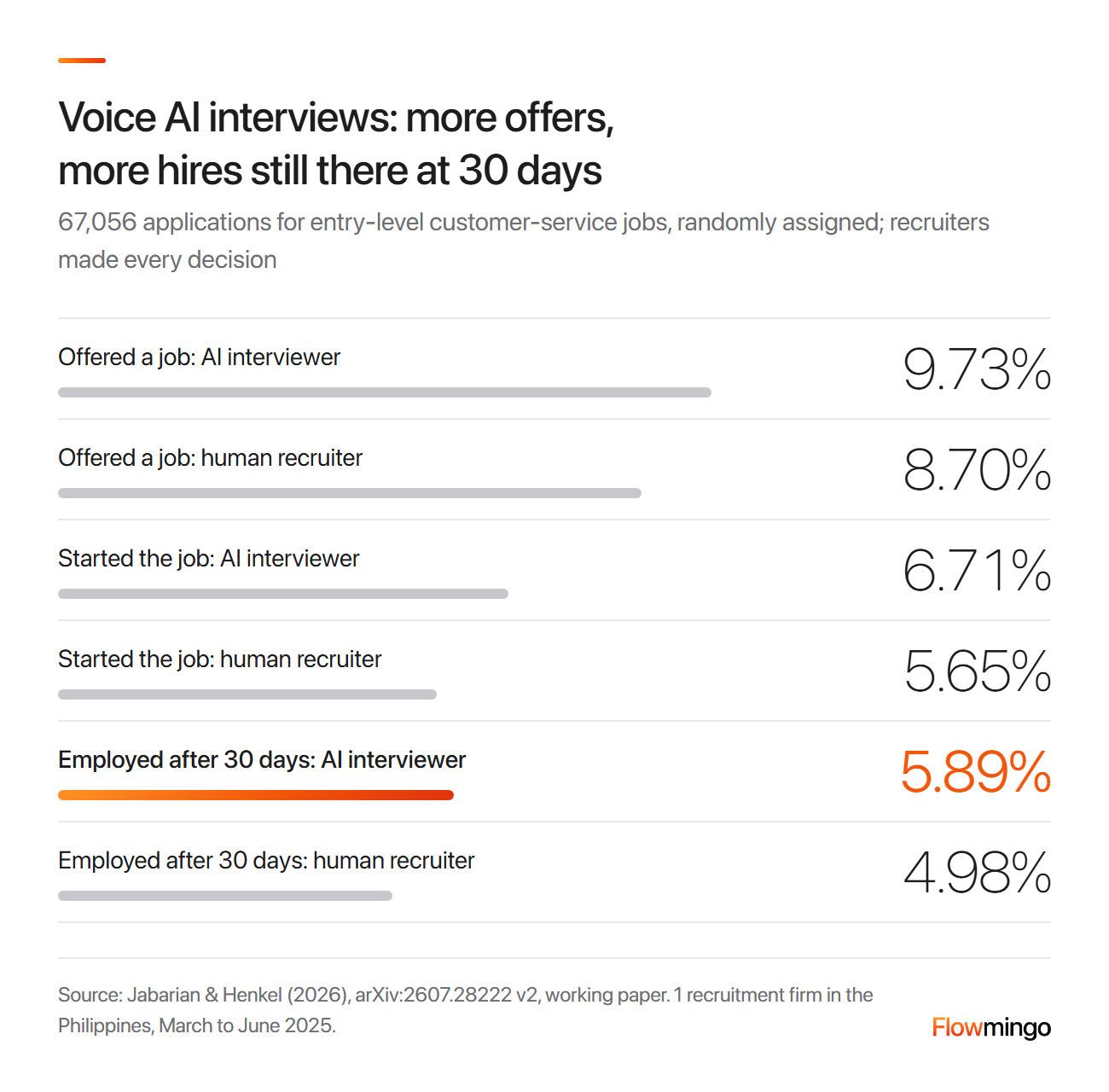
Philippine trial results: with an AI voice interviewer, 9.73% got offers (8.70% with recruiters) and 6.71% started (5.65%). 5.89% were still employed after 30 days (4.98%).
It may have worked because the AI covered more planned topics on average, 45% against 38%. Still, it is a working paper from 1 firm and 1 kind of job. The lead author later took an unpaid Chief Economist role there.
So pilot it on 1 batch: send half of the 300 a voice interview and half a video one. Compare who finishes, then your hires' 30-day retention.
Vendors such as HeyMilo and Ribbon run voice interviews. Video needs a camera and a steady connection, and some video-based automated interview tools score on-camera presence, so ask what counts.
5. When does a recruiting chatbot beat an AI interview for high-volume hiring?
A chatbot wins when round 1 is about requirements: shifts, location, right to work and availability. Judging how someone handles customers or problems needs an interview.
Paradox says its chatbot, Olivia, screens candidates "with a simple text conversation", books those who qualify and can "respectfully disposition" the rest. In the 2025 CandE benchmark, candidates who could ask a chatbot questions rated the application at a Net Promoter Score of 71 against 45.
That gap compares groups, so it proves no cause. The bigger issue is automatic disposition, because a knockout answer becomes an automated rejection.
In May 2025, a federal court let applicants aged 40 and over pursue an age claim against Workday as a collective action (Fisher Phillips). So keep knockouts to facts the job cannot flex on, and review who gets dropped.
For example, 300 hourly applicants answer 3 knockout questions by text, and only those who can work the shifts get the interview. You read the dropped list weekly, and our pre-screening interview questions guide lists good knockouts.
Data is a risk too. In June 2025, 2 researchers got into McHire, Paradox.ai's recruitment chatbot for McDonald's franchisees, with the default login 123456 (Carroll and Curry). They said personal data on more than 64 million applicants, estimated from record numbering, was reachable.
So ask any chatbot vendor how staff sign in, when test accounts close and who can pull applicant records.
6. Which automated interview tools do candidates finish when hundreds apply, and how long is too long?
Most candidates who start an AI interview finish it, so the bigger losses come elsewhere: people who never start, and people on phones. Length mattered less, and settings above 30 minutes finished least often.
Flowmingo data · 50,271 AI interviews begun · 937 companies · 15 Jul to 12 Oct 2026
- 84.6% of AI interviews that candidates began were finished, 42,521 of 50,271.
- 88.7% of AI interviews begun on a desktop or laptop were finished.
- 73.1% of AI interviews begun on a phone were finished, and phones carried 25.9% of interviews begun.
- 78.3% of interviews set to more than 30 minutes were finished, against 88.5% for those set to 10 minutes or less.
- 87.0% of interviews set to 21-30 minutes were finished, above 81.0% at 11-15 minutes and 82.6% at 16-20 minutes.
Of candidates who began, not of everyone invited; counting people who pressed start but left before the first question, it is 82.3%. The device is from the interview's device check, and the length is the current setting. Both are associations: companies that set different lengths also differ in role, seniority and audience.
Far fewer of everyone invited finish, as the invite-to-finish rates in our high volume recruiting guide show.
Candidates on a computer finished more often than those on a phone. Recommend a computer in the invite and keep the phone route open, because phone users may differ in other ways too.
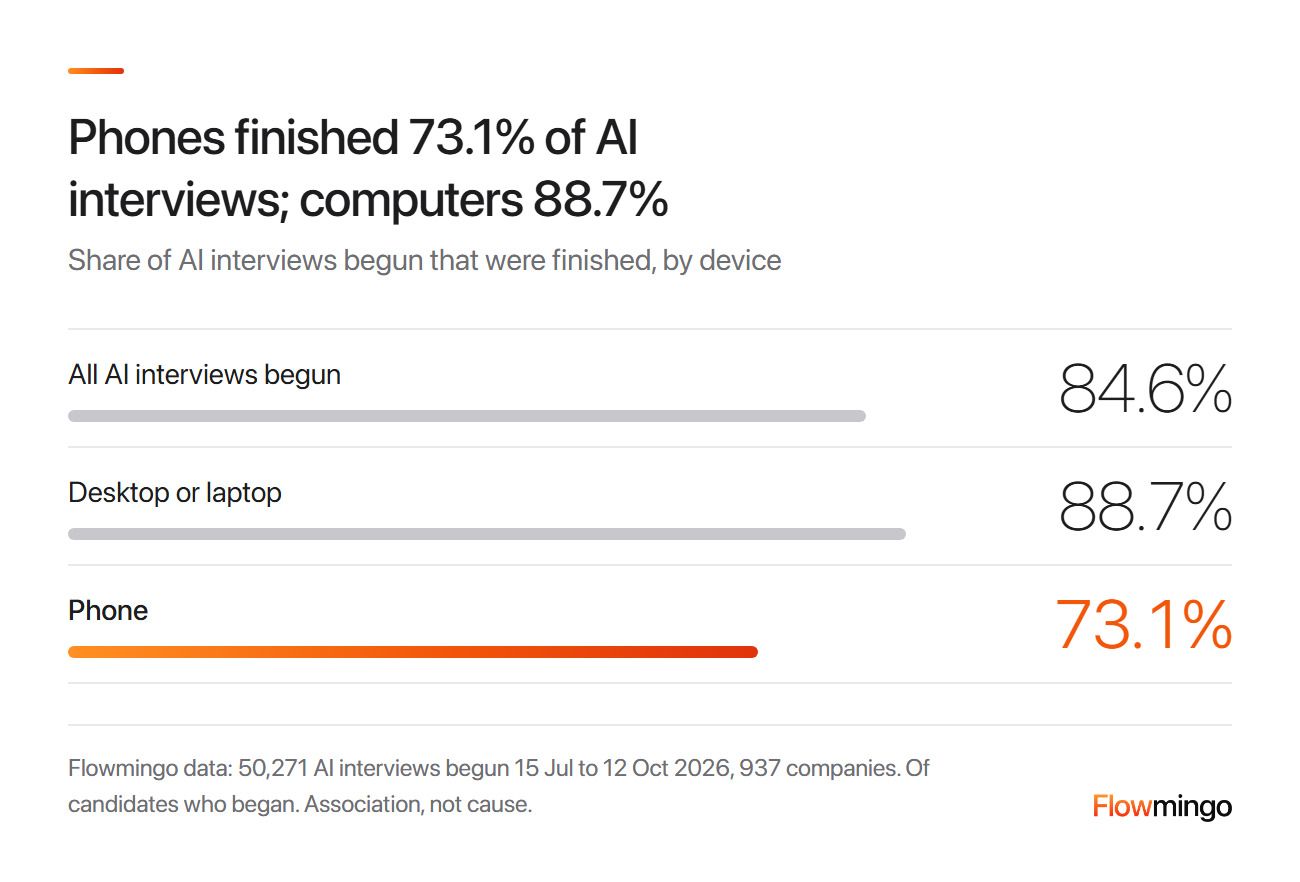
Completion by device: of 50,271 AI interviews begun, 84.6% were finished, with 88.7% on a desktop or laptop and 73.1% on a phone.
Many losses come before the first question. In Greenhouse's 2026 survey, 38% of US job seekers had walked away over an AI interview. 70% were never clearly told upfront that AI would evaluate them.
No independent study compares completion by tool type, so use this checklist:
- Say upfront that AI runs the interview and how it is scored.
- Recommend a computer, and keep the phone option open.
- Keep the base questions few, and allow thinking time and retakes.
- Offer a person on request, and name who runs it.
- Leave evenings and weekends open.
- Ask vendors for finished-of-started and finished-of-invited rates.
7. A candidate read ChatGPT answers on camera: which automated interview format is hardest to fake?
Candidates can do it in every format: 2 of the top 10 Google results for this search sell live answer tools. No format is fake-proof, so judge a tool by its follow-ups, integrity flags and identity checks.
1 hiring manager on r/humanresources watched a candidate read AI answers on video until unexpected questions broke the script. In Gartner surveys reported by ICT Business, 6% of 3,000 candidates admitted interview fraud: posing as someone else, or having someone pose as them. That counts impersonation, not reading AI answers.
In a 2025 field study of 144 interview pairs, candidates faked less in one-way video than in live video calls (Suen and Hung). But interviewers spotted deception poorly in every format except heavy faking in one-way video, and the study predates real-time answer tools.
HireVue says to explain its identity, environment, audio, screen and browser checks upfront. It then uses snapshots and browser-focus flags to confirm the same person stays present. Alex says it checks a government ID against a live selfie during the interview.
The best defence is a follow-up that asks for something you can check, for example a number, a date or a name. Follow-ups raised faking in 1 foundational study our pre-screening guide cites, and a live answer tool can invent detail too. So verify the claims that matter, ask about the candidate's own past work, and treat any flag as a reason to watch the recording.
How Flowmingo helps
Flowmingo's AI interview flags tab switches, a second window, screenshot shortcuts, an extra monitor, and missing or extra faces for your team to review. A signal is never an automatic penalty, and the AI interview rejects nobody.
8. How do automated interview tools score candidates, and can I shortlist on that score?
Most score a transcript of each answer against your criteria, and the better ones show the evidence behind each number. Shortlist on a score only after checking a sample against the recordings.
An agency recruiter on r/recruiting found an automated English check's verdict "does not match what actually happens" with a senior interviewer.
In a foundational 2024 study by 4 HireVue researchers and 1 academic, automated scores agreed with trained raters at .66 (Liff and colleagues). On a scale from 0 (no link) to 1 (perfect), retest stability was .72. Across 5 employers, the link to job outcomes was .24.
Scores matched trained raters fairly well and held on a retest, but said little about later job performance. The fairness results rest partly on demographics guessed from video thumbnails.
A tool also rated journalist Hilke Schellmann's English "competent" when she answered in German, per a Publishers Weekly review of her foundational January 2024 book.
Public bias audits are rare: a foundational 2024 study found 18 of 391 New York City employers had posted one (Wright and colleagues). Employers decide whether their tool is in scope, so a missing audit proves no breach.
Ask each vendor for 6 things: rater agreement, retest stability, the job-outcome link, transcript errors by accent, a wrong-language test and a public bias audit.
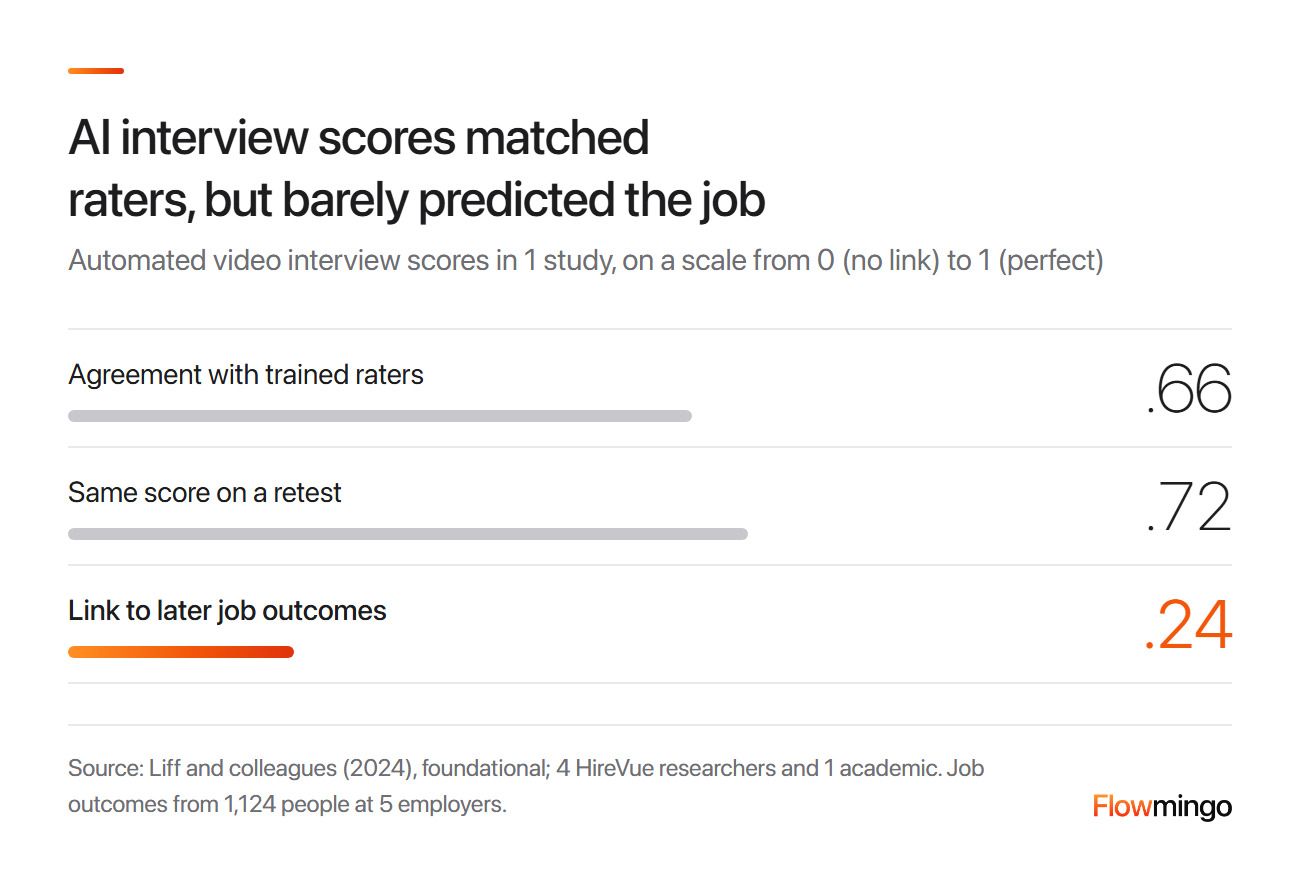
Score evidence from 1 study: automated scores agreed with trained raters at .66 and with themselves on a retest at .72. Their link to later job outcomes was only .24.
Then score 20 candidates, read 5 recordings across the range and compare. Use the score to order your reading, and write the criteria with our interview scorecard guide.
8.1 My candidates answer in 2 languages: can the score still be fair?
It can, if you check transcripts, because speech-to-text errors feed the score. HireVue's own foundational 2022 figures, reported by Sheard in 2025, put word errors under 10% for US English speakers and 12-22% for non-native speakers.
So allow only your candidates' languages, and ask each to answer in their chosen language. Then read the transcript of any low or missing score, because a mishearing looks like a weak answer.
How Flowmingo helps
For every candidate, you get the recording, the full transcript and a Flowmingo report that rates each criterion 0 to 10 with written reasons. The recording sits beside every transcript, because transcripts can mishear accents. An answer that cannot be transcribed gets no per-answer score. Flowmingo has not commissioned a third-party bias audit, so test it as this section describes.
9. Hiring in Illinois or NYC: is it legal to use automated interview tools on video?
Usually yes, but AI-scored recorded video carries the most duties: notice, an explanation and consent in Illinois, and a bias audit in NYC. This is general information, not legal advice.
Illinois' foundational AI Video Interview Act, passed in 2019, has been in force since 1 January 2020 (Sterling). It covers only AI-analysed recorded video for Illinois-based roles. Employers must give notice, explain how the AI works, get consent first and delete videos within 30 days of a request.
A second Illinois law, HB 3773, has covered every tool type since 1 January 2026, per a foundational 2024 Crowell & Moring alert. It requires notice of AI use in recruitment or hiring, and bars AI with a discriminatory effect or zip-code proxies.
For a Chicago role scored on AI video, the notice, explanation and consent box go in the invite, and 1 named person handles deletions.
New York City has enforced its foundational 2021 law since 5 July 2023 (DCWP). It requires a yearly bias audit, a public summary and notice 10 business days before use.
California's rules, in force since 1 October 2025, cover any automated decision in hiring by employers with 5+ staff (Duane Morris). They flag face, voice and accent analysis as potentially discriminatory, and employers must consider accommodations and keep records for 4 years.
The EU has banned AI that infers emotions at work, hiring included, since 2 February 2025 (AI Act Article 5). Recruitment AI faces high-risk duties from 2 December 2027 (National Law Review). Singapore's TAFEP guidance says to "let AI inform decisions, not make them" and to keep records.
As the figure shows, booking-only schedulers carry the fewest duties, because they score nobody.
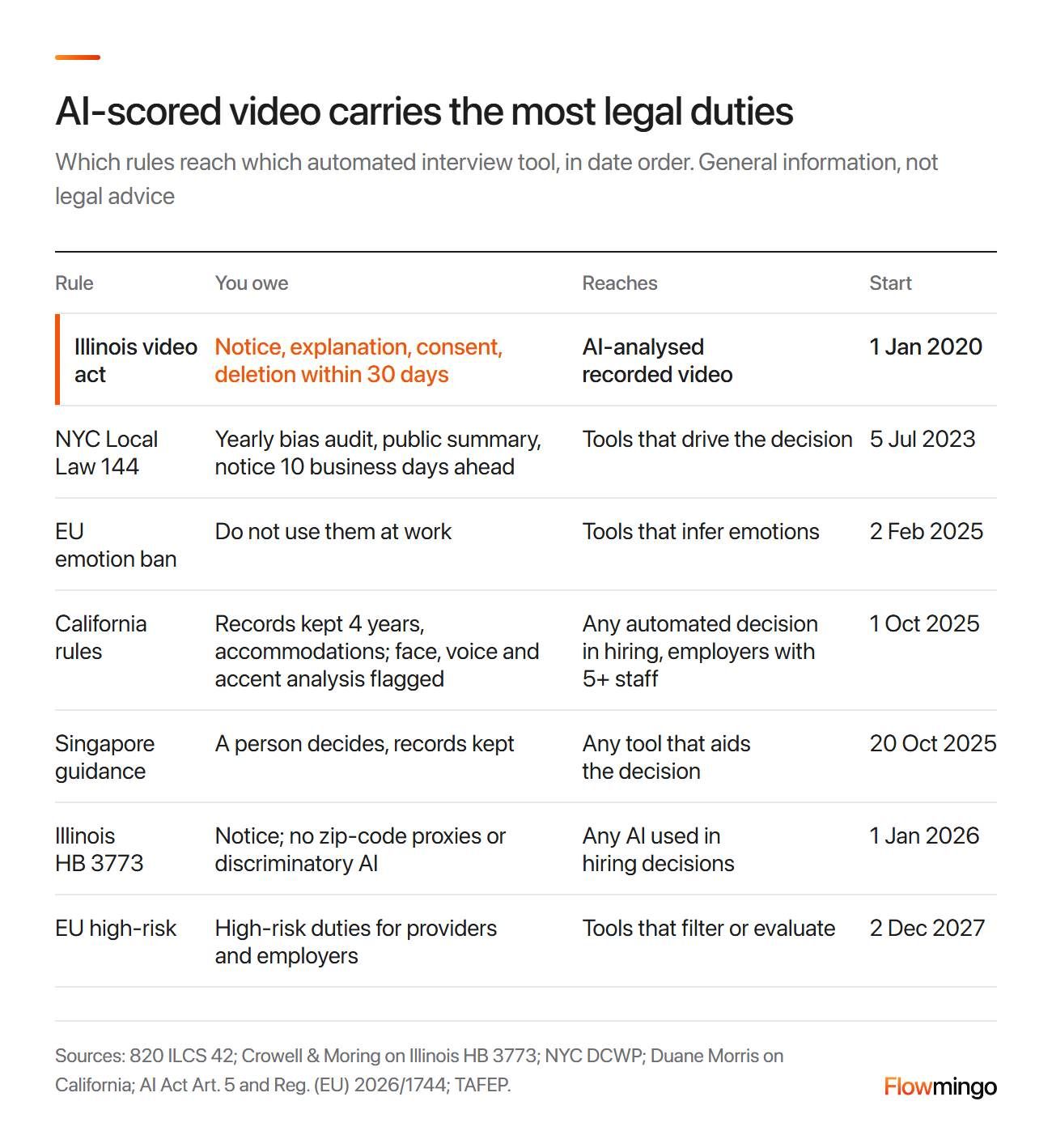
Rules by tool type: Illinois' AI Video Interview Act (in force since 2020) needs notice, explanation, consent and deletion within 30 days for AI-analysed video. Illinois HB 3773 and California's rules reach any AI or automated decision in hiring.
9.1 Who runs the human fallback when a candidate opts out?
Name that person before launch, and use the same questions and criteria, so the choice never counts against anyone. In Greenhouse's 2026 survey, 46% of US job seekers wanted the option of a human interview.
For example, your recruiter runs a 20-minute call with the same questions and scorecard, which never records the opt-out.
10. What do automated interview tools cost per role, and does any stay free after a month?
Published prices run from free schedulers to enterprise contracts, and some interview vendors publish none. Count the cost per finished interview, and check what a free plan limits.
1 owner on r/recruiting, hiring for 1 part-time role all year, found free plans lasted "at most a month, and then it's a jump to $70 a month".
People Managing People's affiliate-funded guide lists basic plans at $50-$300 a month, professional at $70-$599 and enterprise at $1,499+ a month. Metaview puts GoodTime at typically $5K-$15K a year minimum.
The number that matters is what you pay in a month divided by interviews finished that month. Say a $300 plan brings 120 finished interviews, so each costs $2.50, but at 30 each costs $10. That means a flat price gets cheaper per interview as volume grows, while per-interview pricing does not.
Before you rely on a free plan, check 5 things:
- Whether free is a plan or a trial that ends.
- The cap on interviews and on interview length.
- How long videos are kept.
- Whether downloads are paid.
- Whether candidates see the vendor's branding or offers.
How Flowmingo helps
Flowmingo is a free AI hiring platform. Its AI Interviewer is free on a plan, not a trial, with unlimited interviews and team members. Starter ($49 a month) and Growth ($99) add video storage, branding, downloads and longer assessments, not more screening. An AI interview runs up to 20 minutes on Free, 30 on Starter and 60 on Growth. On Free, Flowmingo keeps your latest 300 videos for 30 days, and downloads are paid. On a free session, candidates see Flowmingo's brand beside yours and may see optional offers. They take the interview without paying, though Flowmingo may later offer them paid extras, such as retaking answers. Try Flowmingo on your next role, and test it like the other automated interview tools on your list.
11. Sources
Every study, law and survey in this guide links to a source below; Flowmingo figures come from Flowmingo's own platform data.
- Alex (2026). Alex: AI recruiter for hiring great people. Product page, read 14 October 2026.
- Carroll, I., & Curry, S. (2025). Would you like an IDOR with that? Leaking 64 million McDonald's job applications. ian.sh.
- Crowell & Moring (2024, September 23). Artificial intelligence in employment update: Illinois requires notice and prohibits discriminatory impact in use of AI. Crowell & Moring LLP.
- Duane Morris (2025, October 3). AI catches up with California employers: Regulations on automated-decision systems now in effect. Duane Morris LLP.
- European Parliament and Council (2024). Artificial Intelligence Act, Article 5: Prohibited AI practices. AI Act Explorer.
- Fisher Phillips (2025, May 20). Discrimination lawsuit over Workday's AI hiring tools can proceed as class action: 6 things. Fisher Phillips.
- GoodTime (2026). Smarter interview scheduling, better experiences. Product page, read 14 October 2026.
- Greenhouse (2026, May 1). 63% of job seekers have faced an AI interview. Most haven't had a good one yet. Greenhouse 2026 Candidate AI Interview Report.
- HeyMilo (2026). AI phone interview. Product page, read 14 October 2026.
- HireVue (2026a). AI interviewer. Product page, read 14 October 2026.
- HireVue (2026b). Cheating and fraud. Product page, read 14 October 2026.
- HireVue (2026c). Video interviewing. Product page, read 14 October 2026.
- Humanly (2026). AI recruiting platform for high-volume hiring. Product page, read 14 October 2026.
- ICT Business (2025, August 3). Only a quarter of job applicants trust AI will fairly evaluate them. Reporting Gartner's 31 July 2025 release.
- Jabarian, B., & Henkel, L. (2026). Voice AI in firms: A natural field experiment on automated job interviews (arXiv:2607.28222v2). Working paper.
- K&L Gates (2026, July 31). EU Digital Omnibus on AI enters into force. The National Law Review.
- Liff, J., Mondragon, N., Gardner, C., Hartwell, C. J., & Bradshaw, A. (2024). Psychometric properties of automated video interview competency assessments. Journal of Applied Psychology, 109(6), 921-948.
- ModernLoop (2026). Automated interview scheduling. Product page, read 14 October 2026.
- Metaview (2026, May 31). 14 automated interview scheduling tools recruiting teams use in 2026. Metaview.
- MindHunt (2026, March 15). AI interview screening tools 2026: 8 best platforms compared. MindHunt.
- NYC Department of Consumer and Worker Protection (n.d., read 2026). Automated employment decision tools (AEDT). City of New York.
- Paradox (2026). Candidate screening software. Product page, read 14 October 2026.
- People Managing People (2026). Best AI interview software. Archived 17 April 2026.
- Publishers Weekly (2023, October 31). Review of The algorithm: How AI decides who gets hired, monitored, promoted, and fired, by H. Schellmann. Publishers Weekly.
- Ribbon (2026). Ribbon AI recruiter for interviews, email and SMS. Product page, read 14 October 2026.
- Sackett, P. R., Zhang, C., Berry, C. M., & Lievens, F. (2022). Revisiting meta-analytic estimates of validity in personnel selection: Addressing systematic overcorrection for restriction of range. Journal of Applied Psychology, 107(11), 2040-2068.
- Sapia.ai (2026). AI interview platform for enterprise hiring. Product page, read 14 October 2026.
- Sheard, N. (2025). Algorithm-facilitated discrimination: A socio-legal study of the use by employers of artificial intelligence hiring systems. Journal of Law and Society, 52(2), 269-291. Reports HireVue's 2022 disclosure.
- Spark Hire (2026). One-way video interview software. Product page, read 14 October 2026.
- Sterling (n.d., read 2026). Illinois AI Video Interview Act. Sterling.
- Suen, H.-Y., & Hung, K.-E. (2025). Comparing job applicant deception in asynchronous vs synchronous video interviews, with and without AI-assisted assessments. Information Technology & People, 38(2), 963-983.
- Survale (2026, July 21). 2025 candidate experience (CandE) benchmark research: Key statistics. Survale.
- Tilston, O., Krings, F., Roulin, N., Bourdage, J. S., & Fetzer, M. (2024). Reactions to asynchronous video interviews: The role of design decisions and applicant age and gender. Human Resource Management, 63(2), 313-332.
- Tripartite Alliance for Fair and Progressive Employment Practices (2025, October 20). Fair hiring first, AI second. TAFEP.
- Willo (2026). Screen at scale. Shortlist with confidence. Product page, read 14 October 2026.
- Wright, L., Muenster, R. M., Vecchione, B., Qu, T., Cai, P., Smith, A., Metcalf, J., & Matias, J. N. (2024). Null compliance: NYC Local Law 144 and the challenges of algorithm accountability. Proceedings of the 2024 ACM Conference on Fairness, Accountability, and Transparency.