
The conversation flowed, you liked the candidate, and 3 months later the hire isn't working. A structured interview is the best-supported method we know to stop that from happening again.
It isn't a verdict on your judgment, because the same thing happens to careful, experienced interviewers too. The trouble is that an unstructured interview, the free-flowing conversation, feels informative even when it isn't.
In a foundational 2013 experiment, some interviewees secretly switched to random yes-or-no answers halfway through. Their interviewers still found the interview just as useful.
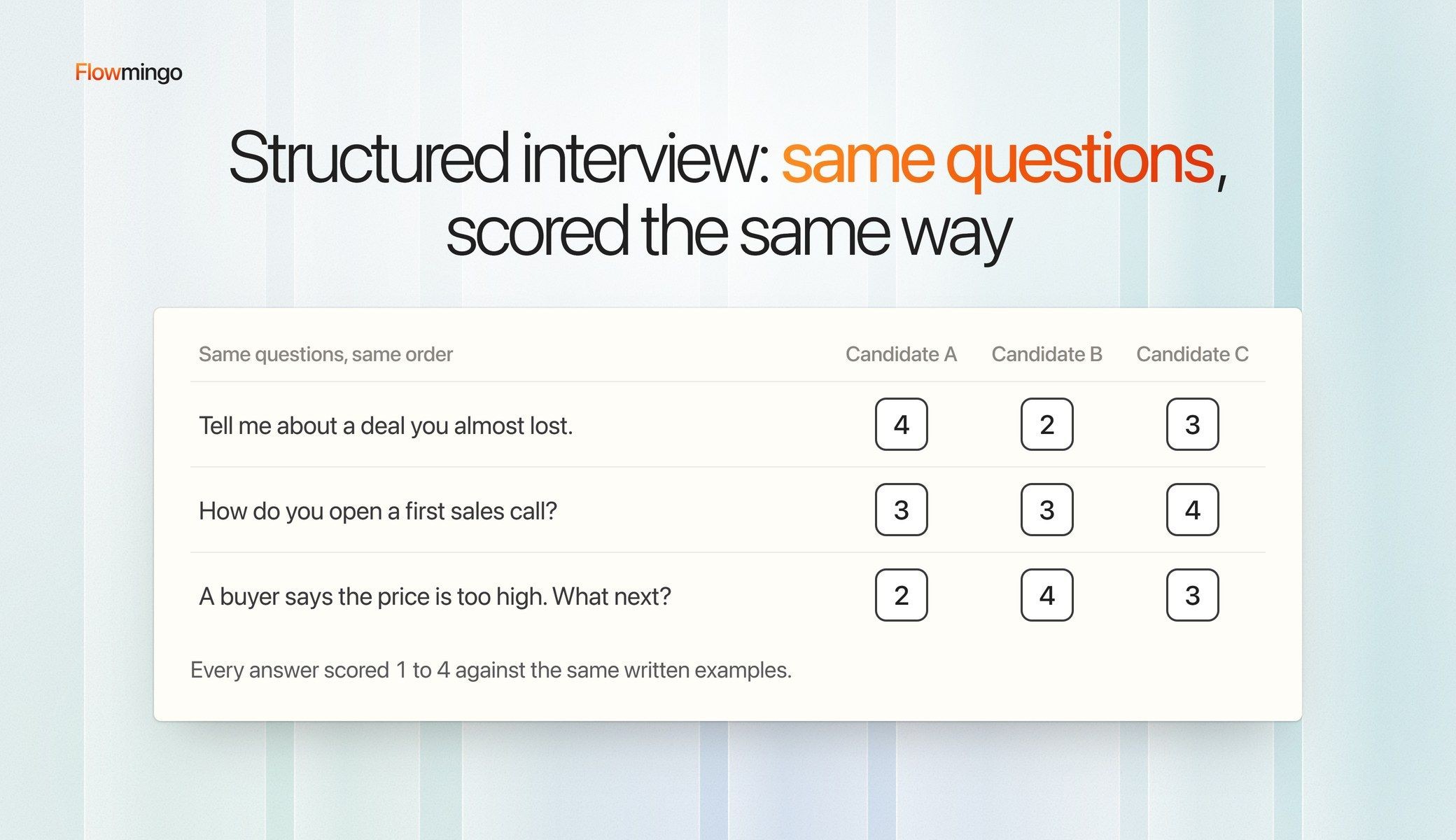
A structured interview changes what you collect. Every candidate gets the same questions in the same order, and you score every answer against written examples before anyone compares notes.
Key takeaways
- Do structured interviews really predict job performance? Yes. They ranked first of the hiring methods compared in a 2022 review of decades of studies, about twice as predictive as free-form interviews.
- Will it feel robotic to candidates? Not with a short, warm, unscored welcome. In Google's data, rejected candidates who had a structured interview were 35% happier than those who didn't.
- How much work is it to build? About 12 questions and 30 short example answers (5 per skill), written once per role and reused.
- How many interviewers do I need? Up to 4, each scoring alone before the debrief. In Google's data, each interview after the 4th added under 1% to predicting the hire decision.
- Can AI run it? It can ask the same questions and score against your criteria, but keep a person on every decision. NYC, Illinois, California and the EU add notice, audit or record duties.
1. Does a structured interview actually predict job performance better, and how solid is the evidence?
Yes, and the evidence is decades deep. In Sackett and colleagues' foundational 2022 re-analysis of hiring studies, structured interviews ranked first of the hiring methods it compared.
The measure behind that ranking is validity, which shows how closely a method's scores line up with how people later perform in the job, from 0 (no link) to 1 (a perfect match). Structured interviews scored .42 against .19 for unstructured ones.
No method in the re-analysis gets near 1, so the gap is what counts, and the structured version's link is more than twice as strong. Of the 4 other methods in the chart below, a job knowledge test (.40) comes closest.
Keyed biodata, a scored background questionnaire, follows at .38, then work samples at .33 and cognitive ability tests at .31.
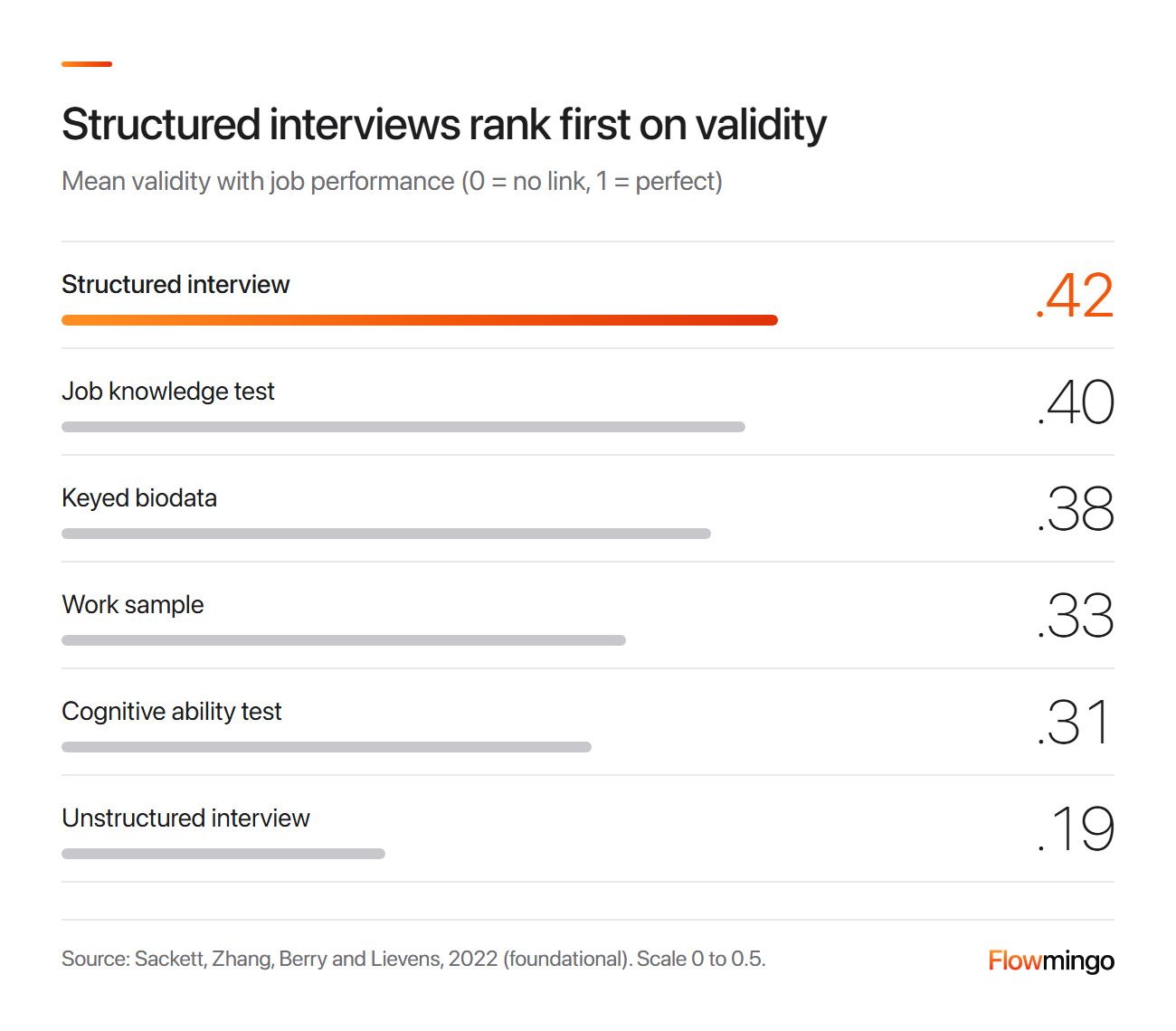
Hiring methods ranked by validity: the structured interview leads at .42 and the unstructured interview trails at .19. Source: Sackett and colleagues, 2022.
Most of these figures are lower than earlier estimates, because the re-analysis revisited the statistical corrections that had inflated them. After fixing an over-correction in older studies, most methods dropped .10 to .20, while the structured interview dropped only .09.
The opening experiment shows what a free-form chat can do to a decision. In Dana, Dawes and Peterson's foundational 2013 study, 76 students predicted classmates' grades with each one's past grades in hand, and for some predictions they also held a 20-minute interview first.
The interview made things worse: predictions made after one matched real grades at .31, against .61 without one, because the chat distracted the students from the better evidence in hand, the past grades. The study used students, not hiring managers, so treat it as a warning, not proof.
For real hiring, Daniel Kahneman and his 2 co-authors write in Noise that if 1 candidate simply interviewed better than another, the chance they're truly the better one is only about 56% to 61% (NPR). A coin flip gets you 50%.
2. Our last hire interviewed brilliantly and then flopped: what should a structured interview test instead?
Test the work, not interview skill. Ask how candidates last did the job's core tasks, score their answers against written examples, and add a short work sample.
That kind of flop hurts, and the reason behind it is simple. A free-form chat rewards people who interview well, but being fluent in a meeting is a different skill from doing the job.
That's why, in section 1's ranking, a job knowledge test (.40) and a work sample (.33), which test the job's own knowledge and tasks, beat the free-form chat (.19). Only the structured interview (.42) beat both, so ask about the work in a structured interview and add a work sample.
Say you're hiring for customer support. Ask "Tell me about the last time your queue was more than you could clear. What did you answer first?" Then score what they did, not how well they told the story.
A strong answer names the order and the result, as in "I answered the 3 customers threatening to cancel first." A general answer such as "I always stay calm and prioritize" scores lower, however well told.
For the work sample, use a small, real piece of the job, such as 3 customer emails to answer in writing. Run it live or recorded, and ask the candidate to explain 1 choice they made, because a copied answer is easy to paste but much harder to defend out loud.
3. Won't a structured interview feel robotic to me and to the candidate?
It doesn't have to. Keep the welcome warm and unscored, allow planned follow-ups, and take the candidate's questions at the end.
The worry is fair, and Kahneman met it first-hand. When he built a structured interview for the Israeli army in 1955, his interviewers felt "reduced to unthinking robots", as he recalls in his Nobel Prize autobiography.
But structure fixes the questions and the scoring, not the tone, so you can still sound like yourself. The table below shows what each of the 3 interview styles holds fixed.
| What is fixed | Unstructured | Semi-structured | Structured |
|---|---|---|---|
| Questions and order | Free | Core set fixed | Fixed |
| Follow-ups | Free | Free | Planned, same for all |
| Scoring | 1 overall rating | Often overall | Each answer, anchored scale |
As the table shows, structure doesn't ban follow-ups; it plans them. Huffcutt and Arthur's foundational 1994 meta-analysis pooled 114 results from earlier studies of entry-level jobs and sorted them into 4 levels by how fixed the questions and scoring were.
At level I, the loosest, interviewers could ask anything and gave 1 overall rating, and validity was .20. Each level up added structure, and validity climbed with it, to .35 at level II and .56 at level III.
Level IV, the strictest, used identical questions, no custom follow-ups and answers scored against pre-set examples, yet reached only .57, just .01 more than level III. The authors write that this suggests a ceiling effect for structure.
Because the levels differed in several ways, though, that last step does not isolate the effect of follow-ups. What the numbers do show is that the big rise came between levels I and III.
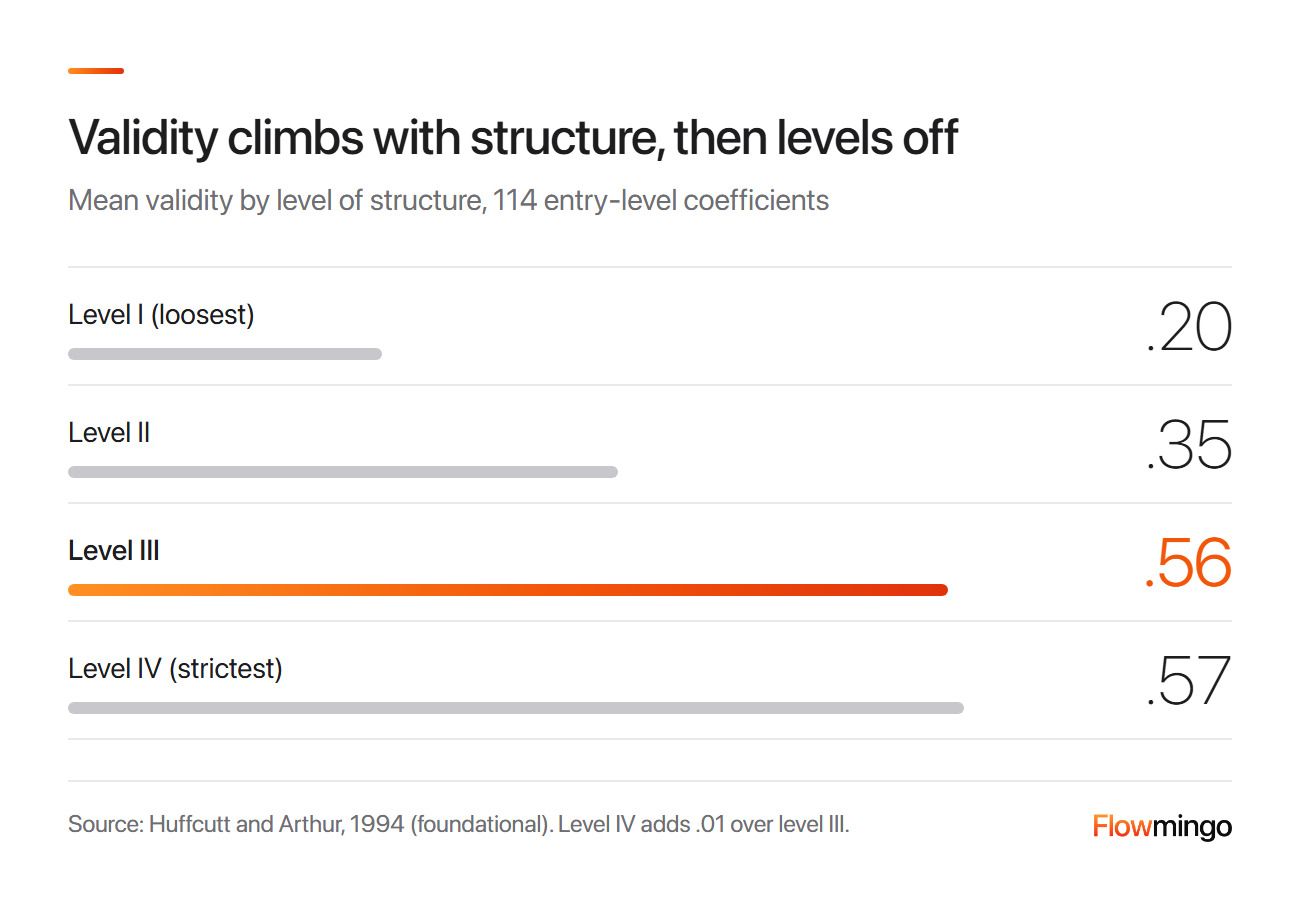
Interview validity by level of structure: it climbs from .20 at level I to .56 at level III, then flattens. Source: Huffcutt and Arthur, 1994.
Follow-ups still need a rule, so that they stay fair. The guide from OPM, the US Office of Personnel Management, says to decide the range of probing in advance and use very similar probes for everyone.
Like any method, structure has costs, so weigh them against what it gives you. You gain validity of .42 against .19, answers you can compare, a written record and smaller group gaps than ability tests.
You pay in stiffness, leaked questions, build time and pushback. The figure below sets the 2 sides together, and the table under it gives a fix for each cost.
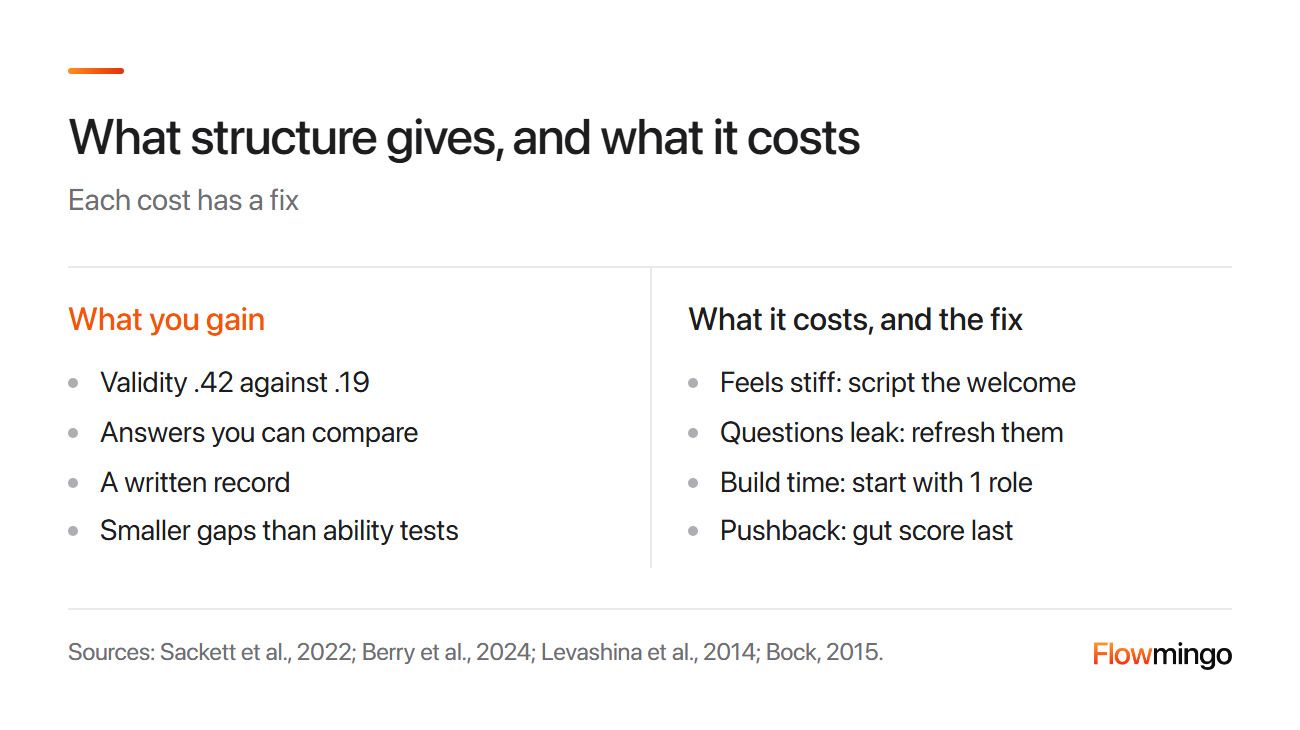
Structured interview pros and cons: 4 things you gain, and 4 costs with a fix for each.
| Drawback | Fix |
|---|---|
| Feels stiff | Keep the welcome short and scripted, as Levashina and colleagues' 2014 review suggests |
| Questions leak | Refresh them and ask for specifics (see section 6) |
| Takes time to build | Start with 1 role and reuse its interview scorecard |
| Interviewers push back | Let them add a gut score after the ratings (see 5.1) |
Candidates don't seem to mind the structure either. Google's re:Work guide reports that rejected candidates who had a structured interview were 35% happier than those who did not. It's Google's own figure, so treat it as a signal, not independent proof.
4. How do I build a structured interview for the role I'm hiring now?
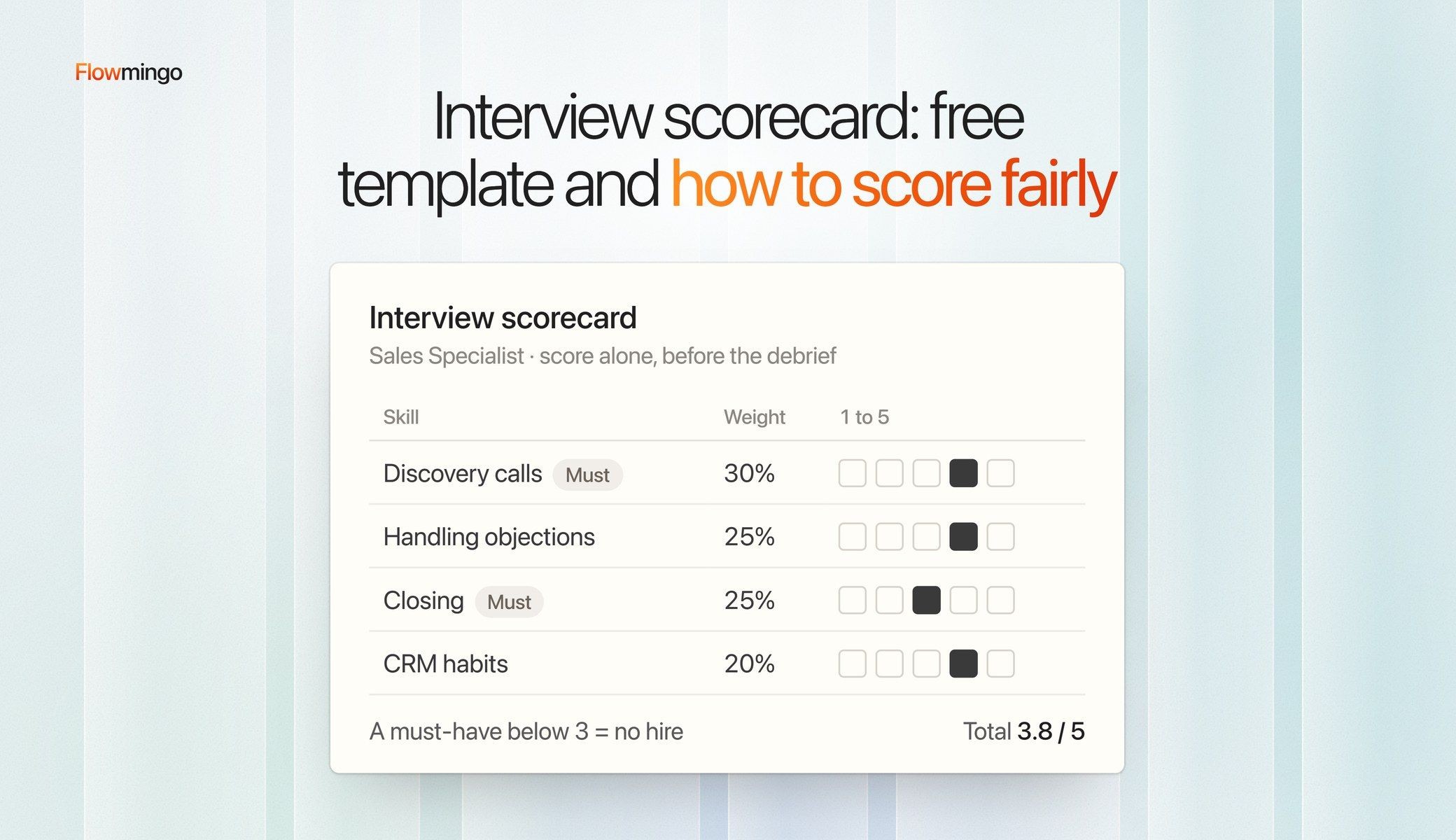
Write a scorecard, pick about 6 skills, and write questions and 5 anchors, or example answers, for each skill. Then run it the same way for everyone and score alone.
It sounds like a lot, but you write it once per role and reuse it. The 6 steps below follow an illustrative example, a support hire at a small company.
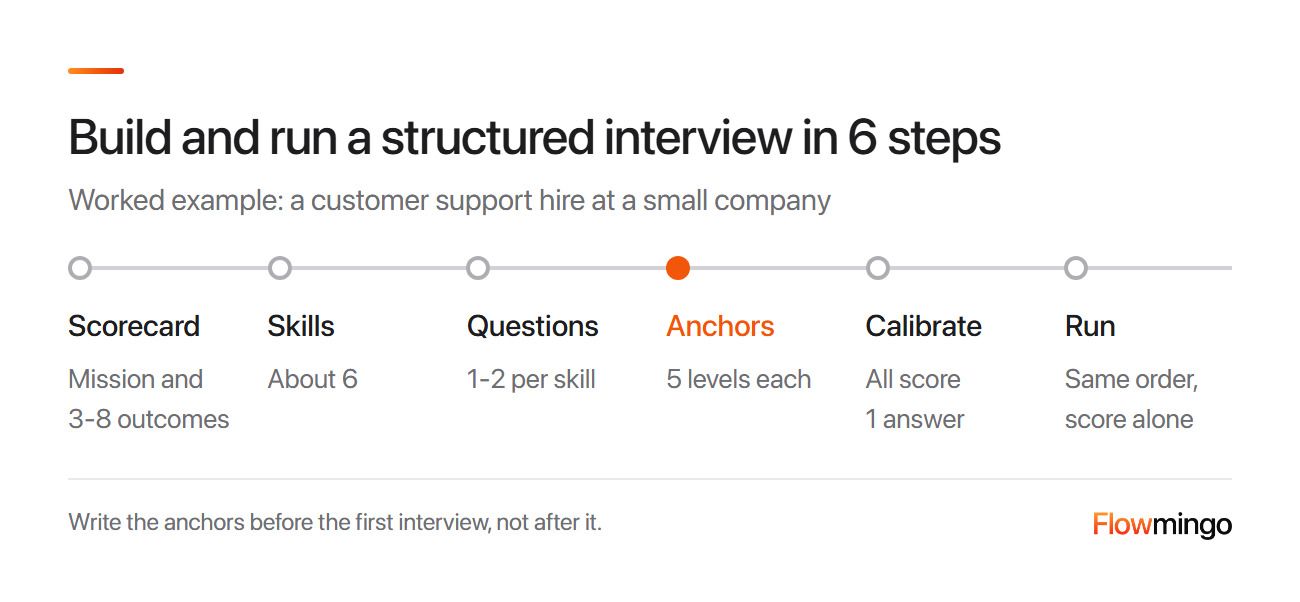
Structured interview build in 6 steps: from the role scorecard to running it and scoring alone.
- Write a scorecard. Smart and Street's 2008 book Who starts with a mission and 3 to 8 ranked outcomes. For our support hire, the top outcome is a same-day first reply to every ticket (illustrative). Every question should trace back to 1 of these.
- Pick about 6 skills. Kahneman's 2011 book Thinking, Fast and Slow suggests about 6 traits, each scored on its own. That stops 1 strong impression from coloring the rest.
- Write 1 or 2 questions per skill, with planned probes (see 4.2).
- Write 5 anchors per skill. An anchor describes what an answer at that level shows.
- Calibrate. Have every interviewer score 1 recorded answer, then compare. If 1 person gives a 2 and another a 4, agree on why and tighten that anchor first.
- Run it the same way, and score alone. Section 5 shows how 1 answer becomes 1 score.
4.1 How many questions, interviewers and minutes do I need?
Plan about 12 questions and no more than 4 interviews. Length matters less than you'd expect.
Thorsteinson's foundational 2018 meta-analysis found no link between interview length and how consistent or predictive the scores were. In practice, a short, well-built interview does as well as a long one.
On the number of interviews, Google studied 5 years of its interview data to find when extra interviews stop helping. The scores from 4 interviews predicted the final hire-or-reject call with 86% confidence.
Each extra interview after the 4th added less than 1% to that prediction. That measures agreement with the panel's decision, not how the hire later performed.
4.2 What are 12 structured interview questions for a support hire?
The table below gives 2 questions for each of the 6 support skills: 1 behavioral and 1 situational. Behavioral interview questions ask what someone did before, so use them for experienced applicants. Situational ones describe a scenario and ask what they'd do, which suits first-timers.
| Skill | Behavioral | Situational |
|---|---|---|
| Empathy | "Tell me about a time a customer was upset about something you could not fix." | "A customer writes in capitals about a late refund. What is your first reply?" |
| Prioritizing | "Tell me about a day your queue was more than you could clear." | "You have 40 open tickets and 1 customer threatens to cancel. What do you do first?" |
| Written replies | "Tell me about a reply you rewrote before sending." | "A customer misread the pricing page. Explain it in 3 sentences." |
| Product learning | "Tell me about a tool you had to learn quickly for a job." | "A new feature ships tomorrow and you have not used it. How do you prepare?" |
| Ownership | "Tell me about a problem you flagged that was not yours to fix." | "You see the same bug in 5 tickets today. What do you do?" |
| Teamwork | "Tell me about a time you disagreed with a teammate about a customer." | "A colleague gave your customer a wrong answer. What do you do?" |
Both kinds work, and past-behavior questions predict slightly better: .31 against .25 before statistical corrections, per Taylor and Small's foundational 2002 meta-analysis. All 12 are for the main interview; for first-round screens, see our pre-screening interview questions.
5. How do I get my interview panel to score a structured interview the same way?
Give them a 5-level scale written as observable behavior, have them score 1 recorded answer together, then score each skill before moving on.
Without a shared scale, 1 interviewer's 4 is another's 3, and the debrief turns into an argument about numbers. An anchored interview rating scale fixes that, because it writes out what each level shows, as in this one for product learning, 1 of the 6 support skills.
| Level | What the answer shows |
|---|---|
| 1 | Names no tool they learned, or waited to be taught |
| 2 | Learned the basics when told to |
| 3 | Learned it by using it and asking specific questions |
| 4 | Learned ahead of need and kept their own notes |
| 5 | Learned fast, then taught others or improved the guide |
Say a candidate learned a new help-desk tool before launch and kept their own notes. That matches level 4, so it's a 4, whoever runs the interview.
The figure below follows 1 answer to its score. You ask in the same words and order, using only planned probes, then note what the candidate said and match it to the closest written level.
You score it 1 to 5 now, before the next question. Iris Bohnet of the Harvard Kennedy School recommends that timing, so a vivid later story can't crowd out a strong early one.
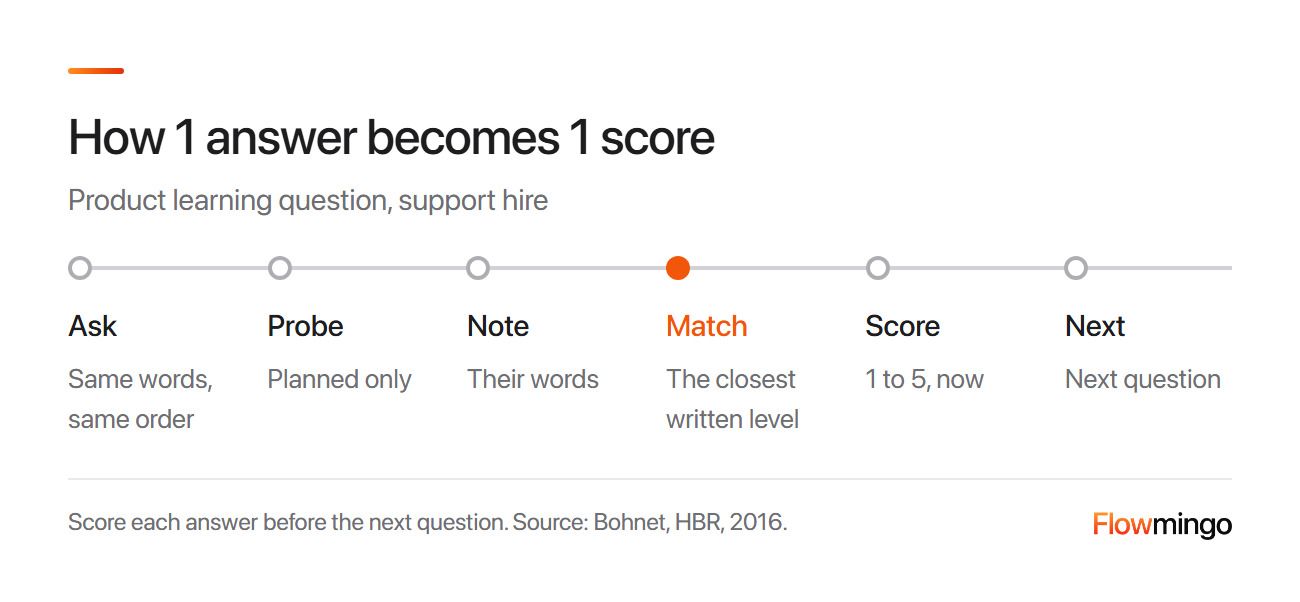
How 1 answer becomes 1 score: 6 steps from asking the question to moving on to the next one.
5.1 Is there any place for gut feel?
Yes, but last. Kahneman put his rule in a conversation with Behavioral Scientist: "Do not eliminate intuition but delay it."
His army interview shows how that works. There, interviewers first scored 6 traits, then closed their eyes and gave 1 overall score from 1 to 5 (Ed Batista). That gut score predicted as well as the sum of the 6 trait ratings.
The order is what made it work, because by then their gut was reacting to evidence they had just scored. So record your gut score last, and hire the highest total even if you like another candidate more.
5.2 Why should each interviewer score alone before the debrief?
Because once anyone has spoken, say the most senior person, the others are no longer scoring independently. The figure below, based on OPM's panel guidance, compares the 2 orders.
Score alone first, and the scores go in before the meeting, so the debrief explains the gaps between them and records a consensus. Debrief first, and the panel talks before anyone rates, so gaps between interviewers' views are never explored.
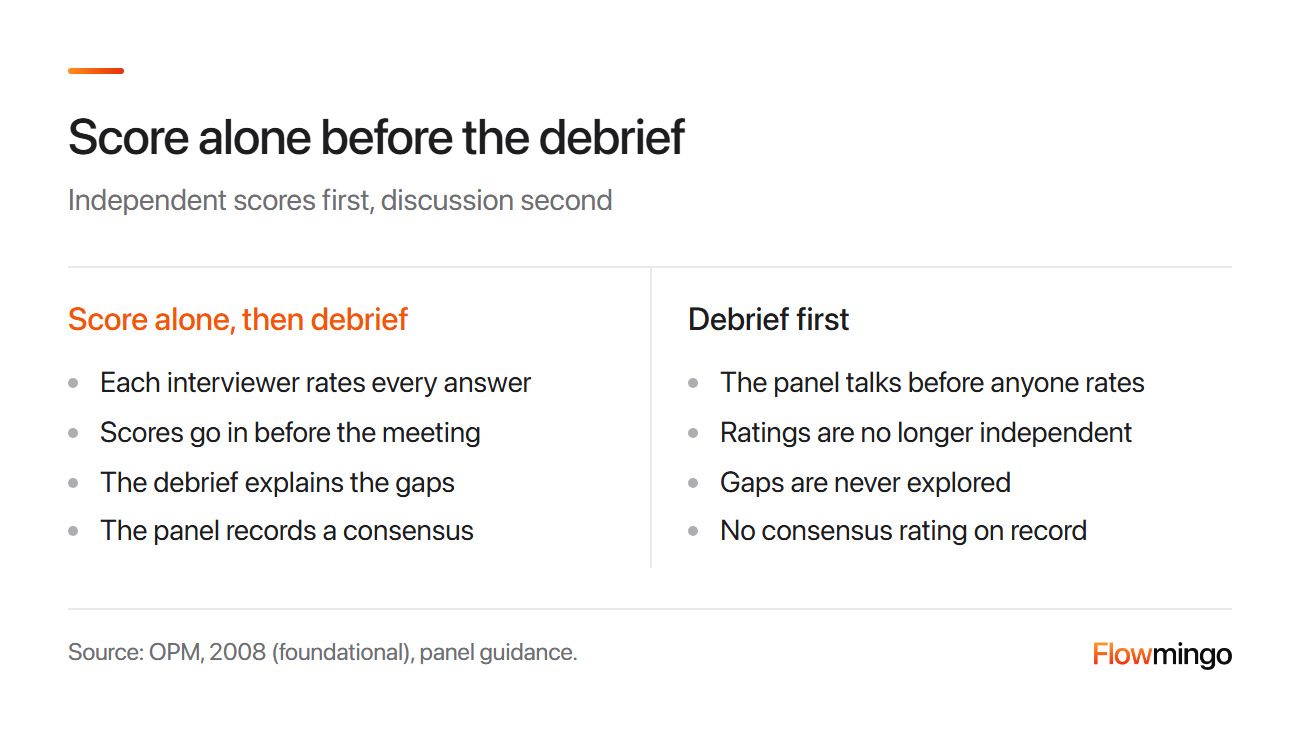
Score alone before the debrief: the 2 orders compared, based on OPM panel guidance.
In the debrief, compare answer by answer, as Bohnet recommends in HBR: all answers to question 1, then all to question 2, rather than 1 candidate at a time. Her foundational 2016 lab study with 2 colleagues tested the side-by-side part of that advice.
In it, people chose candidates by past task scores. When each person judged 1 candidate alone, 62% of those shown a stronger performer chose them, and so did 52% of those shown a weaker one, only 10 points apart.
Shown candidates side by side, 54% picked the stronger performer, only 8% the weaker and the rest neither. The study used task scores, not interviews, so applying it here is our inference.
6. Is a structured interview still worth it if candidates can feed our questions into ChatGPT?
Yes, because its strength is the scoring, not secret questions. Refresh questions as Google does, ask for concrete examples and verify important claims.
It's a fair worry. In Gartner's surveys of job applicants, 39% of candidates used AI in their applications, and 6% admitted to interview fraud, such as posing as someone else. So assume some candidates have seen your questions or rehearsed with a chatbot.
A leaked question ruins a quiz, where the answer is a fact. It hurts a structured interview less, because your anchors reward specifics: what the candidate did, what happened and what changed as a result.
Say a candidate gives a polished answer about calming an angry customer. Ask what the customer did next and what the candidate changed in their own process afterwards. A script can invent that detail too, so use the answers to identify claims to verify, not as proof of authenticity.
Refreshing the questions helps as well. In his 2015 book Work Rules!, now more than 10 years old, Laszlo Bock, who led people operations at Google, describes Google refreshing its questions often.
That way candidates can't compare notes, and while it won't catch every coached candidate, it makes coaching less useful.
7. Does a structured interview protect us if a rejected candidate claims discrimination?
It helps: research links structure to smaller rating gaps between groups and better court outcomes. It removes neither risk.
Nobody enjoys thinking about claims mid-hire, but a scored record is what you'll want if one arrives. Here is what the research found on each risk.
- Group gaps: Berry and colleagues put the gap between Black and White candidates' average scores at .24 standard deviations in structured interviews. That is under a third of the .79 for cognitive ability tests.
- Court cases: Williamson and colleagues' foundational 1997 study read US federal court cases about interviews. Employers won more often with more structure, and most of all with objective, job-related interviews.
Those court cases covered 2 kinds of claim: 84 where a candidate said an employer treated them differently because of a trait such as race or sex, and 46 where candidates said a neutral-looking step screened out their group.
US rules also treat an interview much like a test. Under the US Uniform Guidelines, even an unscored interview counts as a selection procedure, so the rules for hiring tests cover it too. Their key idea is adverse impact: 1 group passing at a much lower rate than another.
Say 30 of 100 men pass your interview and 18 of 100 women do: women pass at 0.60 of the men's rate, and federal agencies generally treat anything below 0.80 as evidence of adverse impact. Per-answer scores can then show which question drives the gap.
8. Can a one-way or AI interview run our structured interview, and what do the 2026 rules require?
It can, with a person on every decision, but the evidence on AI scoring is early. A 2026 study found several AI models, averaged together, may score as well as 1 human rater, but urged caution for high-stakes use.
In that study, Stockdale, Hickman and Liu tested large language models, the technology behind ChatGPT, as scorers on 2 sets of interviews, with 954 and 144 people. The best results came from averaging several larger, newer models, each told in detail what the score measures.
This means the AI, like a person, needs a clear written description of each skill. So in practice, let AI ask the same questions and draft scores against your criteria, then have a person review the recording and decide.
Score what the candidate said, not emotions a tool guesses from their face or voice, and the law points the same way. The main rules as of September 2026 cover notice and consent, bias audits, records and human oversight, plus 1 outright ban:
| Rule | What it requires |
|---|---|
| EU AI Act, Article 5 (guidelines) | No AI that infers candidates' emotions from biometric data, such as facial expressions, since 2 Feb 2025 |
| EU AI Act, high-risk duties (AI Omnibus) | Human oversight, logs kept 6+ months and notice, from 2 Dec 2027 |
| NYC Local Law 144 | An audit for bias in the year before use, a posted summary and 10 business days' notice |
| Illinois AI Video Interview Act | Notice, an explanation and consent; deletion within 30 days on request |
| California ADS rules, from 1 Oct 2025 | Records, including automated-decision data, kept 4 years |
The NYC rule only covers a tool you rely on alone, weight above every other criterion, or let overrule people. That's another reason to keep the AI score as 1 input among several, weighted no higher than the rest. Anti-discrimination law still applies to an AI score, however you weight it.
How Flowmingo helps
Flowmingo's AI Interviewer runs a structured, spoken interview that each applicant does in their own time. AI drafts the questions and criteria from your job description, and you edit both and mark the must-ask ones.
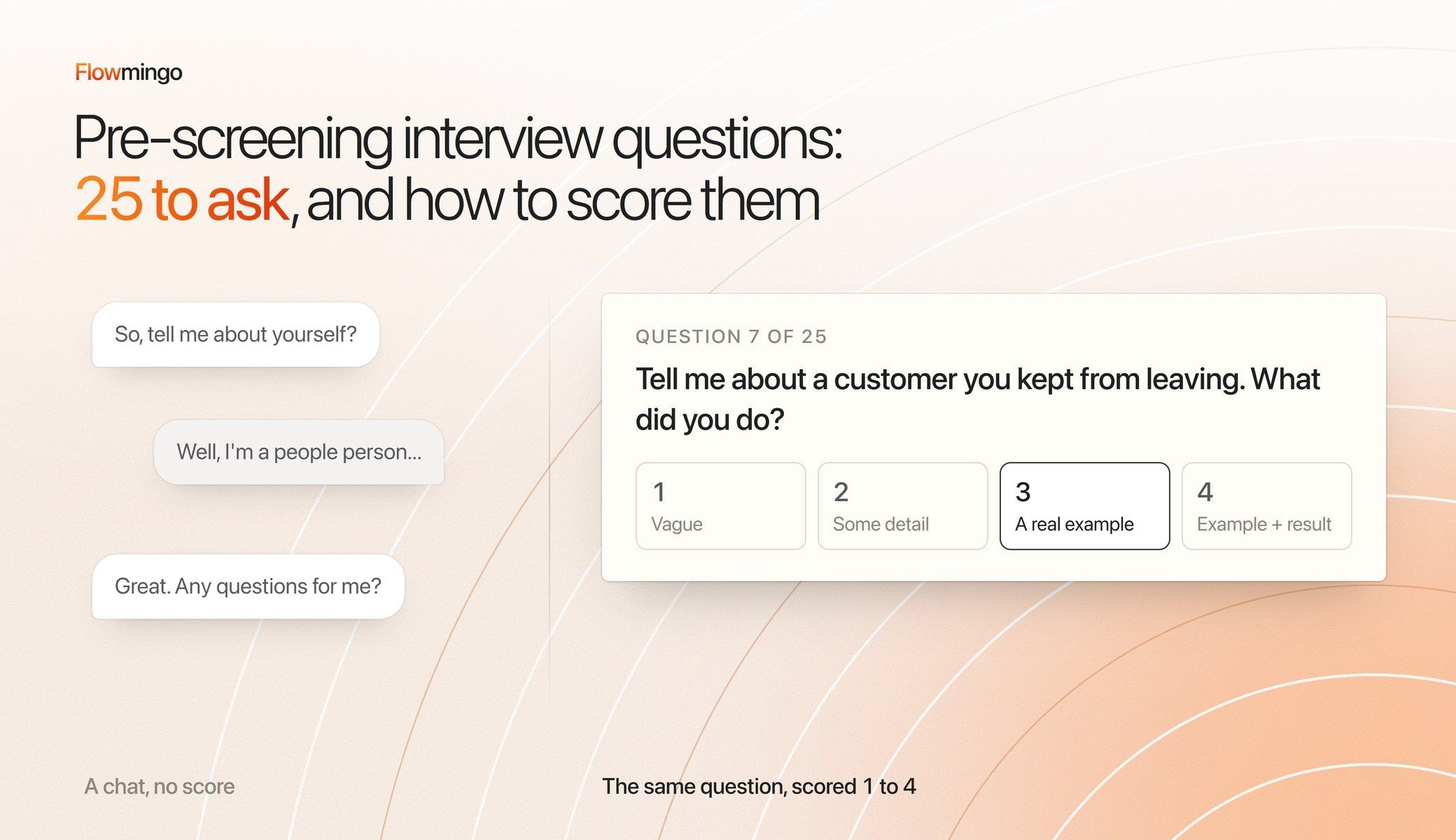
The AI Interviewer asks a follow-up when an answer is thin, so follow-ups differ between candidates. Each criterion gets a 0 to 10 score with a written justification, weighted by importance, next to the recording and transcript. You decide who gets hired.
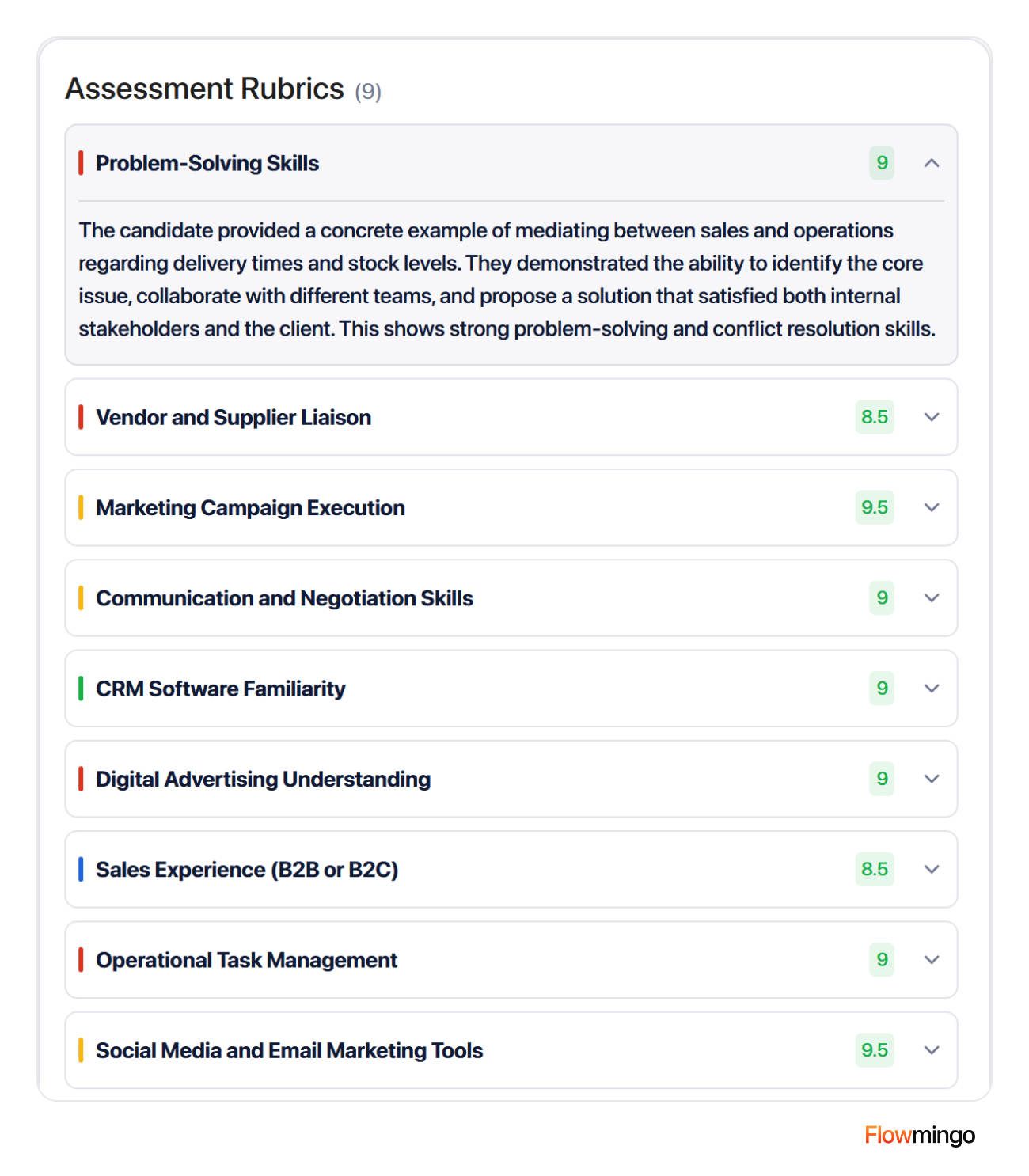
Flowmingo sample report: importance, a 0 to 10 score (finer than 1 to 5) and justification per criterion.
On that 0 to 10 scale, top scores are rare in our data.
Flowmingo data · 86,638 AI-interviewed candidates · 2,574 companies · Jul 2025 to Sep 2026
- 3.8 to 7.8 out of 10 is where the middle 80% of AI interview scores fell.
- 6.4% of candidates scored 8 or more out of 10 in the AI interview.
AI interview scores against each job's own criteria, not job performance, and not comparable across jobs.
9. How do I check whether our interviews are structured enough?
Check your process against the 15 components in Campion and colleagues' foundational 1997 review: 7 on what you ask, 8 on how you score.
This check matters because results vary widely from one job and employer to the next, and design is part of the reason. In Sackett and colleagues' figures, about 10% of such settings can expect a structured interview's validity to be .18 or less, no better than a free-form chat's .19.
| What you ask | How you score |
|---|---|
| 1. Questions from a job analysis | 8. A rating for each answer |
| 2. The same questions for all | 9. Anchored rating scales |
| 3. Limited prompting | 10. Detailed notes |
| 4. Better question types | 11. Several interviewers |
| 5. More questions or time | 12. The same interviewers for all |
| 6. Controlled extra information | 13. No discussion between interviews |
| 7. Applicant questions at the end | 14. Interviewer training |
| 15. Scores combined by formula |
Give yourself 1 point for each component you do every time. A step you only do sometimes doesn't count, because inconsistency is exactly what structure removes.
Say your team asks the same questions (2), uses anchored scales (9) and has 2 interviewers (11). If they chat about candidates between interviews, number 13 is your first fix.
For a benchmark, Levashina and colleagues' foundational 2014 review looked at 104 interviews from research articles. On average they used 5.74 of the 15 components, about 6, so if you score 6, you're typical of the interviews researchers studied, not advanced.
If you're not sure where to start, write anchors. Across 19 past-behavior studies, Taylor and Small found validity of .35 with anchored scales, against .26 without them. Those studies differed in other ways too, so treat the gap as a strong hint, not a controlled test.
10. Where should my team start this week?
Start with 1 role: a scorecard, about 6 skills and 5 anchors each. Then score every answer before anyone talks.
You don't need to change your whole process at once. A realistic first week looks like this:
- Pick the role you'll hire for next, ideally one with plenty of applicants, so the work pays back quickly.
- Write the scorecard and the 6 skills with the hiring manager in 1 sitting, so you agree on what good looks like.
- Adapt the 12 questions above and write 5 anchors for each skill.
- Calibrate on 1 recorded answer with everyone who will interview, and talk through any gap of 2 points or more.
- Run the next few candidates through it, and collect every score before the debrief.
It won't feel smooth the first time, because real answers will show you where an anchor is vague. That's why 1 role comes first: you fix those gaps once, then copy the approach.
After a few hires, compare how your top scorers perform with how your old gut calls did. That comparison, not a feeling, will tell you whether the new process is working.
How Flowmingo helps
Send each applicant a Flowmingo AI interview with your must-ask questions, and get back a scored report, free for unlimited applicants. Try Flowmingo for your next structured interview.
11. Sources
Every research number in this guide comes from 1 of these sources. The data card in section 8 is Flowmingo's own, and numbers in the examples are illustrative.
- US Office of Personnel Management (2008). Structured Interviews: A Practical Guide. OPM.
- US Office of Personnel Management (n.d.). Structured Interviews. OPM.
- Huffcutt and Arthur (1994). Hunter and Hunter (1984) revisited: Interview validity for entry-level jobs. Journal of Applied Psychology.
- Sackett, Zhang, Berry and Lievens (2022). Revisiting meta-analytic estimates of validity in personnel selection. Journal of Applied Psychology.
- Dana, Dawes and Peterson (2013). Belief in the unstructured interview: The persistence of an illusion. Judgment and Decision Making.
- Kahneman, Sibony and Sunstein (2021). Noise: A Flaw in Human Judgment, as quoted by NPR Planet Money. Little, Brown Spark.
- Kahneman (2002). Daniel Kahneman: Biographical. Les Prix Nobel 2002, Nobel Foundation.
- Campion, Palmer and Campion (1997). A review of structure in the selection interview. Personnel Psychology.
- Levashina, Hartwell, Morgeson and Campion (2014). The structured employment interview: Narrative and quantitative review of the research literature. Personnel Psychology.
- Smart and Street (2008). Who: The A Method for Hiring. Ballantine Books.
- Kahneman (2011). Thinking, Fast and Slow, chapter 21, as quoted by Ed Batista. Farrar, Straus and Giroux.
- Thorsteinson (2018). A meta-analysis of interview length on reliability and validity. Journal of Occupational and Organizational Psychology.
- Shaper (2017). How many interviews does it take to hire a Googler. re:Work, Google.
- The re:Work Editorial Team (2026). A guide to structured interviewing for better hiring practices. re:Work, Google.
- Gartner (2025). Gartner survey shows just 26% of job applicants trust AI will fairly evaluate them. Gartner newsroom.
- Taylor and Small (2002). Asking applicants what they would do versus what they did do. Journal of Occupational and Organizational Psychology.
- Bock (2015). Work Rules!, excerpt in WIRED. Hachette Book Group.
- Nesterak (2021). A Conversation with Daniel Kahneman About Noise. Behavioral Scientist.
- Bohnet (2016). How to Take the Bias Out of Interviews. Harvard Business Review.
- Bohnet, van Geen and Bazerman (2016). When Performance Trumps Gender Bias: Joint vs. Separate Evaluation. Management Science.
- Berry, Lievens, Zhang and Sackett (2024). Insights from an updated personnel selection meta-analytic matrix. Journal of Applied Psychology.
- Williamson, Campion, Malos, Roehling and Campion (1997). Employment interview on trial: Linking interview structure with litigation outcomes. Journal of Applied Psychology.
- EEOC, Civil Service Commission, Department of Labor and Department of Justice (1978). Uniform Guidelines on Employee Selection Procedures, 29 CFR Part 1607. eCFR.
- Stockdale, Hickman and Liu (2026). Scoring employment interviews with large language models. Journal of Applied Psychology.
- European Parliament and Council (2024). Regulation (EU) 2024/1689, the AI Act. Official Journal of the European Union.
- European Commission (2025). Guidelines on prohibited artificial intelligence practices established by Regulation (EU) 2024/1689 (AI Act). European Commission.
- European Parliament and Council (2026). Regulation (EU) 2026/1744, the AI Omnibus. Official Journal of the European Union.
- Office of the New York State Comptroller (2025). Enforcement of Local Law 144: Automated Employment Decision Tools. OSC.
- NYC Department of Consumer and Worker Protection (2023). Notice of Adoption of Final Rule: Use of Automated Employment Decision Tools, 6 RCNY §5-300. DCWP.
- Illinois General Assembly (2019). Artificial Intelligence Video Interview Act, 820 ILCS 42. ILGA.
- California Civil Rights Council (2025). Final Text of Proposed Employment Regulations Regarding Automated-Decision Systems. Civil Rights Department.