
You post 1 role and it pulls 244 applications, the average per job in 2025. That is 243 people waiting on a rejection email, from a recruiting team 56% smaller than in 2022 (Greenhouse).
Nobody sets out to ghost anyone, and nobody enjoys telling 243 people no. The no waits for the hire, the hire slips, and the candidate rejection email is the first task to fall off the week.
Your candidate experience pays for it. In Talent Board's 2024 survey, 24% of North American candidates were still waiting 2+ months after applying (Talent Board and ERE).
About 1 in 7 (14%) ended up resentful. They'd stopped doing at least 1 of these: applying again, referring others, speaking well of you or buying from you. At CandE award winners, the best-rated employers in the same benchmark, it was 9%.
The fix takes 3 habits: 1 template per stage, a decision in week 1, and 1 job-related reason, never a verdict on the person.
Key takeaways
- Do I have to answer applicants I never interviewed? Usually not. Ontario employers with 25+ staff must tell interviewees for publicly advertised roles within 45 days whether they've decided.
- How fast should a rejection email go out? Within a week of your decision. 24% of North American candidates still wait 2+ months.
- Should I give a reason? 1 sentence: what the hired person had, or an outside reason. Told of a hiring freeze, applicants were over 2x as likely to reapply (foundational 2001 study).
- Should I send candidates their scores? No. Finalists who got job-related feedback were over 50% more willing to refer others. Scores made people feel worse (foundational 2004 study).
- What if AI screened them? Say what you assessed and who decided. An explained AI rejection scored about 25% higher on "would recommend".
1. 300 applicants, a tiny team: how do I send every rejection email without losing a week?
Write 1 template per tier, based on how much the candidate gave you, and send each tier in a batch.
That works because a rejection email only has to match the effort the candidate put in. The chart below shows the 4 tiers.
Tier 1 is anyone you screen out on the application: 2 to 3 kind sentences, in a batch within 3 to 5 days. Tier 2 is anyone who took a test or AI interview, so thank them for that time and say what you assessed, within 7 days.
Tier 3 is anyone who spoke to someone on your team: add 1 line that shows you listened and 1 job-related reason, within 7 days. Tier 4 is your finalists: call first, then email the same day.
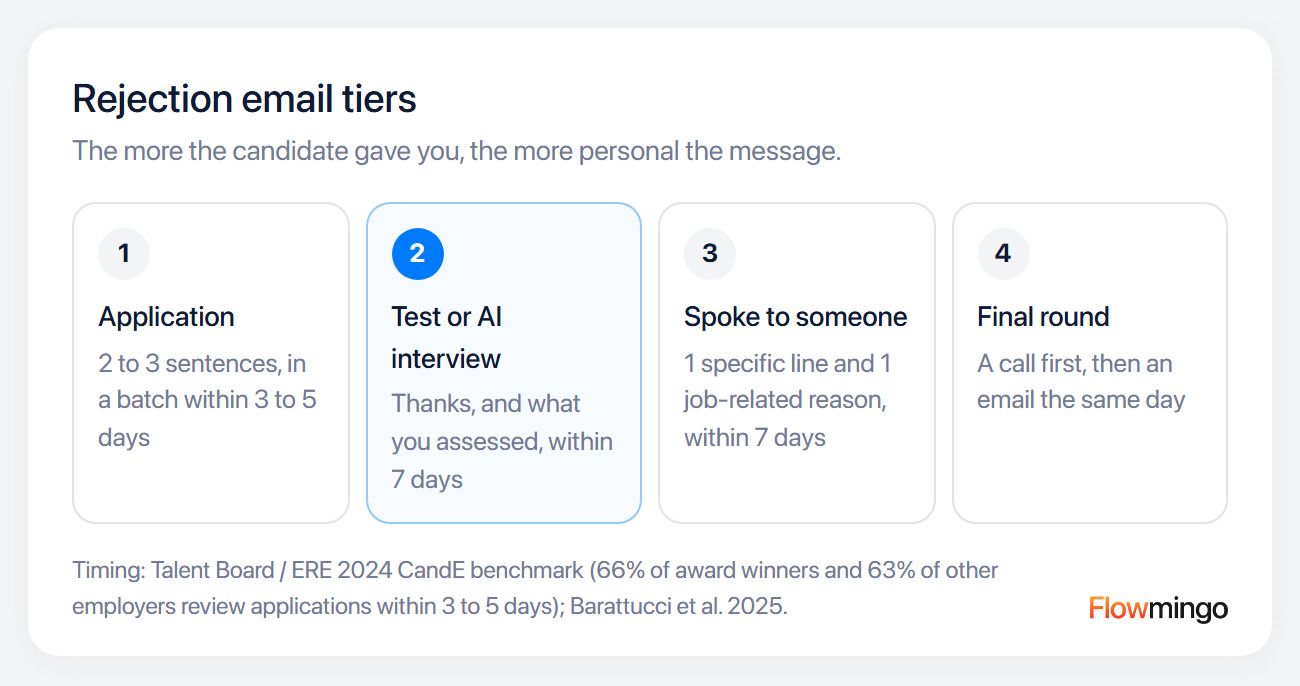
Rejection email tiers: the more a candidate gave you, the more personal the message.
Say you're hiring a bookkeeper and 244 people apply. 201 fall out on the CV, 30 after the skills test, 10 after a first interview and 2 in the final round. That is 243 no's, but only 2 batch templates, 10 short edits and 2 calls.
Short does not have to mean cold. In a 2026 study, 236 workers and students rated employers before and after reading a made-up rejection letter (Fijneman-Ghielen and colleagues). For strong brands, a boilerplate letter made people like the company less.
A warm letter that thanked them for their effort may fully make up for that drop. The letters were made up, so treat this as a hint, not proof.
Flowmingo data · 11,345 candidates moved to Rejected · 766 hiring projects · 334 companies · 27 Feb to 9 Jun and 26 Aug to 25 Sep 2026
- 49.0% of candidates moved to Rejected had already finished the AI interview.
- 37.8% were rejected before any Flowmingo AI interview, and 82.1% of those had done another assessment first.
- 9.9% of the 11,345 candidates moved to Rejected had a stage email sent through Flowmingo within 1 hour (8.6% confirmed).
These teams use Flowmingo mainly for AI interviews, so after-interview rejections are over-represented. Many teams email from their own inbox, so a missing email does not prove silence.
How Flowmingo helps
In Flowmingo's CV Evaluation, filter CVs by score band to batch your tier 1 no's. Every CV stays in your list. Optional free CV feedback reaches applicants about an hour after applying, but it is not a decision, so you still send your own rejection email.
1.1 Rejection email after an application
Use it for anyone screened out on the CV or your knockout questions.
Subject: [Role] at [Company]: our decision
Hi [First name],
Thank you for applying for [Role]. We've checked your application against the role's must-haves, and we won't be taking it forward.
With [244] applicants for 1 opening, we chose people with the most experience in [must-have].
[Your name], [Title]
1.2 Rejection email after a test or AI interview
Use it when the candidate gave you their time.
Subject: [Role] at [Company]: an update
Hi [First name],
Thank you for the time you put into the [AI interview / skills test] for [Role]. We assessed every candidate on the same [5] requirements, and you're not going through to the next round.
The people we chose showed more depth in [requirement]. [Name] made this decision, and if you'd like a person to look again, just reply.
[Your name]
2. Must I send a rejection email to applicants I never interviewed, or is silence legal?
Usually not: the laws we checked don't require a reply before an interview, except Colorado from 2027 if AI helped reject them. After an interview for a publicly advertised role, Ontario employers with 25+ staff must say within 45 days whether they've decided.
Ontario's rule started on 1 January 2026, and video and phone interviews count (Hicks Morley). A short written note that says so is enough.
Beyond these 2 rules, a reply is good practice rather than law. Singapore's fair-employment body, TAFEP, asks employers, as a courtesy, to tell unsuccessful candidates too.
The chart below shows how common silence is. Across all employers, 24% of candidates were still waiting, against 13% at CandE award winners. Small and large employers sat at 31% and medium ones at 47%, all above the overall 24%, and the report doesn't say why.
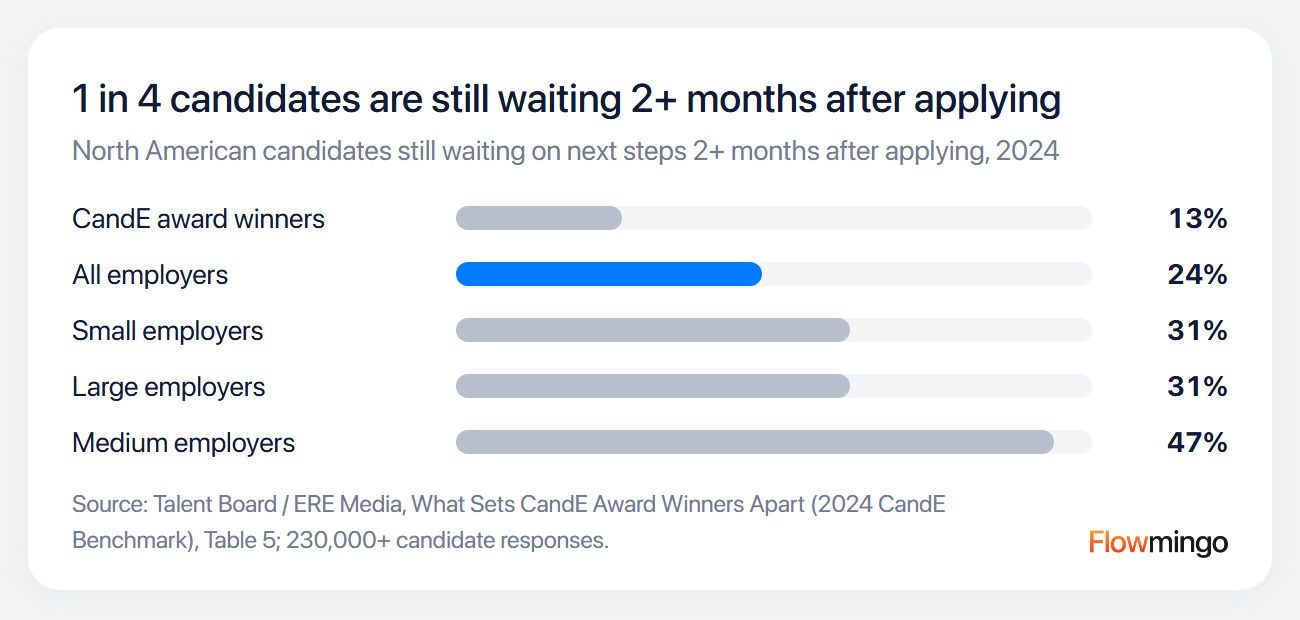
Still waiting 2+ months: North American candidates with no next step 2 months after applying, by type of employer, 2024.
You might expect silence to hurt more than a no. A foundational 2023 study had 554 unemployed people apply for a made-up job (Wood and colleagues). Each then got silence, a standard rejection or personal feedback.
On a standard measure of basic psychological needs, the silent group felt no worse than the rejected ones. This means the case for replying isn't about protecting feelings. It rests on fairness, what candidates tell others about you and, in Ontario, the law.
Flowmingo data · 33,037 candidates who finished an AI interview · 1,836 hiring projects · 765 companies · 1 Jun to 25 Aug 2026
- 64.3% of 33,037 candidates who finished an AI interview still sat in Unassigned on 25 Sep (40.5% in teams using the board).
No stage move recorded in Flowmingo; teams also decide outside it, so this does not prove silence.
3. Can I let AI screening reject applicants automatically, and must I tell them AI was used?
You can automate the sending, but keep a named person accountable for every no. Where the law asks, tell candidates about AI before you use it.
Trust is low on both sides. Only 26% of candidates trust AI to judge them fairly (Gartner). Only 21% of recruiters are very sure their systems aren't rejecting qualified people (Greenhouse).
The chart below comes from a 2025 experiment with 921 Austrian adults (Malin and colleagues). Each read a rejection scenario and rated, out of 5, how likely they'd recommend the employer.
An AI rejection with no explanation scored lowest, at 1.49, and a human one 1.75. With an explanation, the AI rejection scored 1.86, about 25% higher, and even beat the unexplained human one. A human rejection with an explanation scored 1.94.
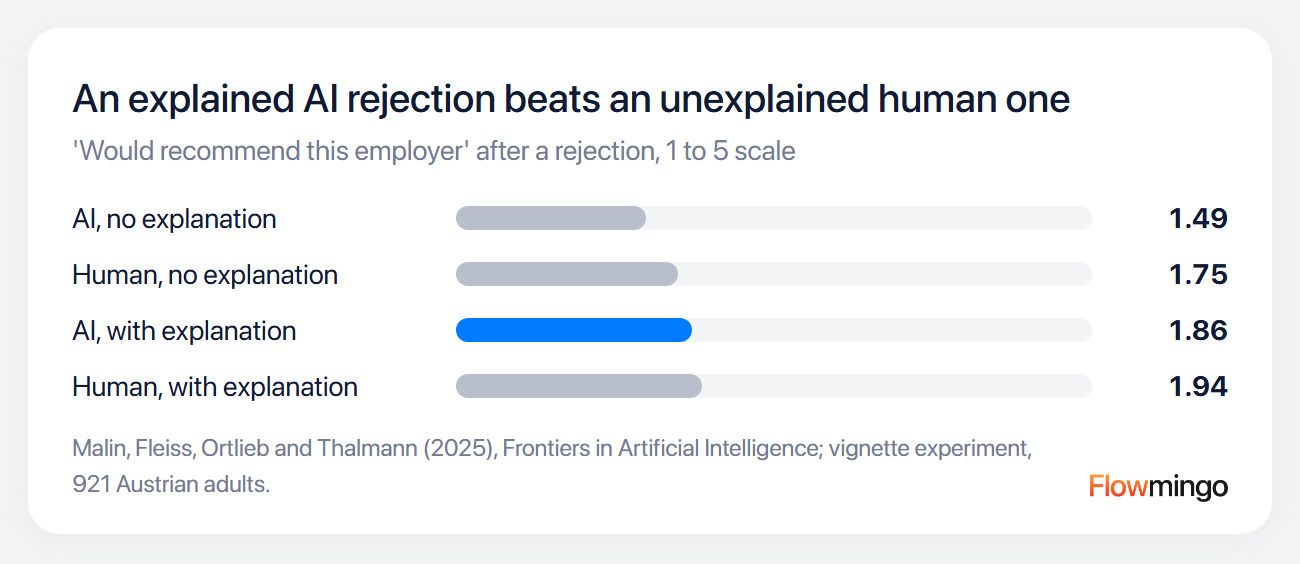
Would recommend after a rejection: ratings out of 5 for AI and human rejections, with and without an explanation.
This means the explanation did more than who made the call. For example: "We assessed every applicant on the same 5 requirements. [Name] reviewed the results and made this decision." People read made-up scenarios, not real letters, so trust the direction more than the exact numbers.
In New York City and Ontario, you give notice before the AI step. Colorado, the UK and the EU add duties after the no, such as an explanation or a human review.
| Where | When | What you owe |
|---|---|---|
| New York City | Since 5 Jul 2023 | Notice 10 business days before an automated tool assesses residents; a published yearly audit for bias |
| Ontario | From 1 Jan 2026 | Disclose AI screening in the job post |
| Illinois | From 1 Jan 2026 | Notice, and no AI with a discriminatory effect |
| Colorado | From 1 Jan 2027 | A plain explanation within 30 days; human review if commercially reasonable |
| UK and EU | Now | On request: human review of a fully automated no, how it was reached, the data used |
A US court let applicants aged 40+ pursue a case against Workday as a nationwide group in May 2025. They claim its screen turned older people away at a higher rate, even without intent. It is an allegation, not a finding, but it's why a named person should own every no.
How Flowmingo helps
Flowmingo's CV Evaluation and AI Interviewer never reject anyone: the report only recommends, and you decide. Chat Screening is the exception: miss a knockout question and it marks the applicant Rejected, keeping every answer. Only qualified applicants see your next-step message, so the rest need your email.
4. When should I reject candidates: once I screen them out, or once the role is filled?
As soon as you know: screen-outs within 3 to 5 days of applying, everyone else within a week of the decision. Hold only your 1 or 2 back-ups until your first choice accepts.
Speed is part of the kindness, because waiting keeps someone's plans on hold. In 2 studies of 264 and 259 mid-level candidates, a timely no felt fairer and made people likelier to reapply (Barattucci and colleagues).
Our own numbers show why week 1 matters. Of 6,175 candidates who finished an AI interview, 22.6% had a decision recorded within 1 day, 35.3% within 3 days and 42.8% within 7. After that the bars barely grow: 45.8% by day 14 and 48.1% by day 30.
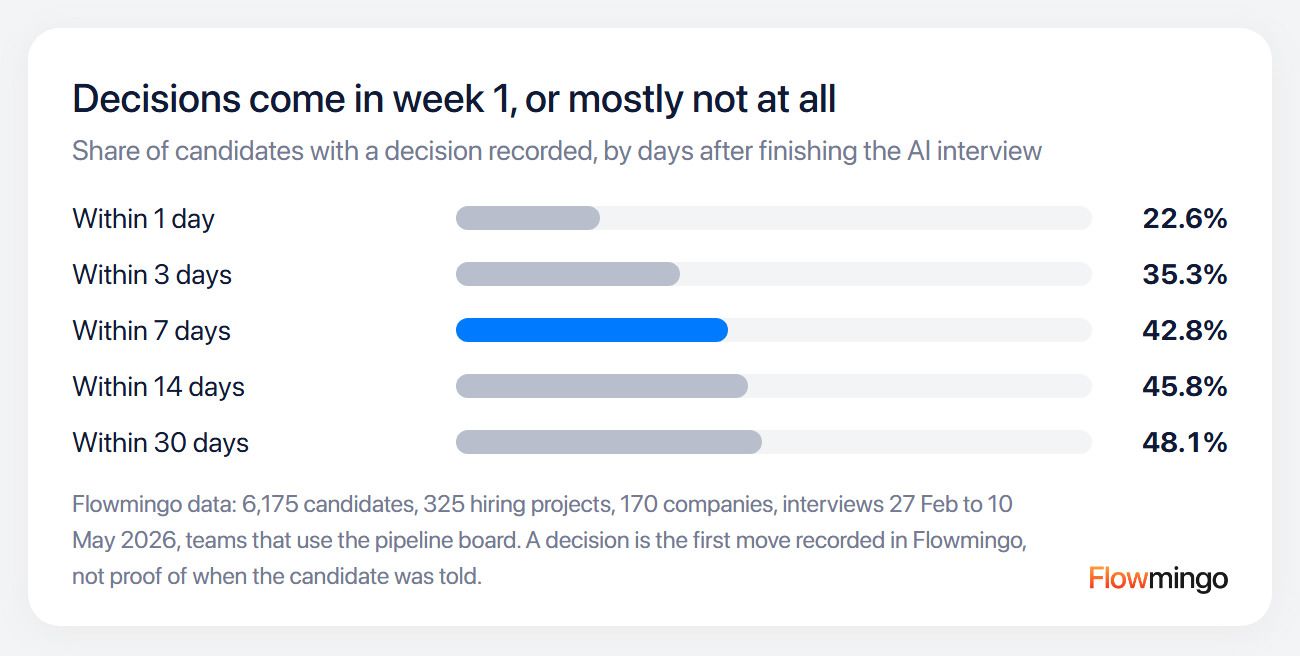
Decisions after the AI interview: the share of 6,175 candidates with a decision recorded, from 1 day to 30 days after they finished.
So 88.9% of the decisions recorded within 30 days came in week 1. That counts moves forward too, and teams also decide outside Flowmingo.
In practice, say final interviews end on Thursday: decide on Friday, send every no except your back-ups, and tell them once your first choice signs.
Flowmingo data · 6,175 candidates who finished an AI interview · 325 hiring projects · 170 companies · 27 Feb to 10 May 2026 · teams using the pipeline board · of them, 1,817 moved to Rejected within 30 days · 90 companies, 1 of which made 44% of these rejections
- 42.8% of candidates had a decision recorded within 7 days of finishing the AI interview, and only 48.1% by day 30.
- 1.3 days was the median time from AI interview to Rejected for the 1,817 moved there (2.1 days without the largest company).
A decision is the first move recorded in Flowmingo, including moving someone forward, not when the candidate heard.
4.1 When the role is paused or cancelled
Tell everyone still in process, with the outside reason, because it tells them the no is not about them. A foundational 2001 study compared rejection letters (Gilliland and colleagues). Applicants given an outside reason, such as a hiring freeze, were over 2x as likely to reapply as those sent a standard letter.
Subject: An update on the [Role] role
Hi [First name],
We've paused hiring for [Role] because [the team's budget is frozen]. This isn't a decision about you.
If the role reopens before [month], I'll contact you first.
[Your name]
5. Should my rejection email give the real reason, or does that invite a discrimination claim?
You don't have to give one, but 1 honest, job-related sentence makes a no feel fairer. Leave out anything personal, from culture fit to age or race.
In the UK, "Employers do not have to explain their reasons" (Acas). A reason still helps: in the same foundational 2001 study, naming what the hired person had made a no feel less unfair.
The chart below sorts reasons into 2 columns. Say what the hired person had ("They had 5 years running the month-end close"), an outside condition ("We've paused hiring for the role"), the same requirements for everyone, or 1 real strength you saw.
Leave out culture-fit or personality comments, because they give the person nothing to act on and can sound like cover for bias. The same goes for anything touching age, disability, race, religion or sex.
Scores, rankings, a critique of the person or a comparison with a named candidate all invite an argument. A background-check reason also needs the US notices in 5.2.
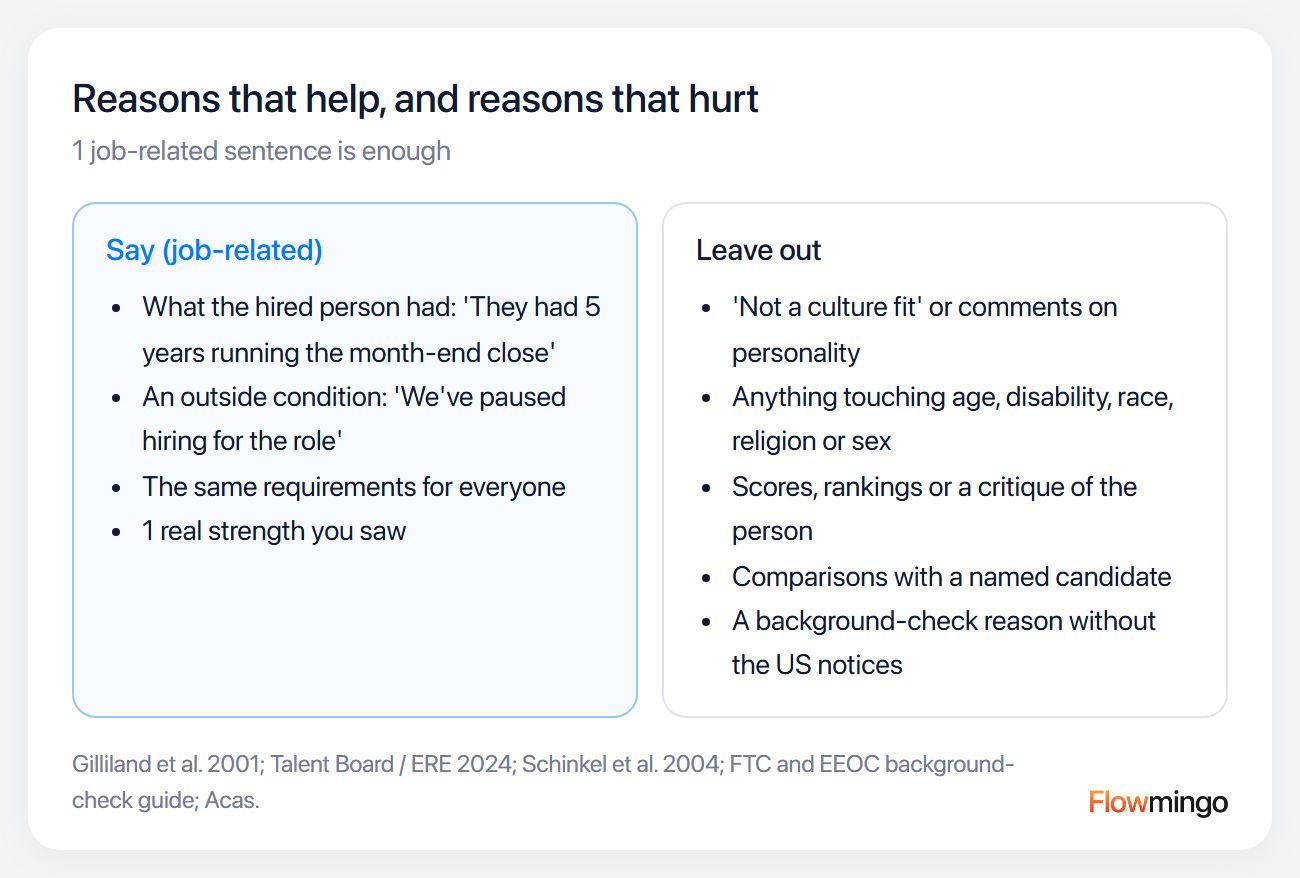
Reasons that help and reasons that hurt: job-related reasons to give, and personal ones to leave out.
For example, "We chose someone who has run payroll for 50+ staff" is fine. "We wanted someone younger" is the sentence that ends up in a claim.
Write notes as if the candidate will read them, because a UK candidate can request them (ICO). In Germany, once facts suggest discrimination, you must prove there was none (AGG).
How Flowmingo helps
Flowmingo's AI Interviewer scores each criterion you set from 0 to 10, with a 3 to 5 sentence justification. You see which requirement a no came down to. The report is for you and your hiring managers; write the candidate's sentence yourself.
5.1 Interview rejection email after a first interview
Take the specific line from your interview scorecard notes.
Subject: Your interview for [Role]
Hi [First name],
Thank you for talking with [interviewer] on [day]. We've offered the next round to candidates with more hands-on experience in [requirement], so we won't take things further.
[1 specific line, e.g. Your example about rebuilding the month-end close stayed with us.]
[Your name]
5.2 When the reason is culture fit, a bad reference or a background check
Give only the job-related part, such as "we needed stronger evidence of [skill]".
If a US background check drove the no, a rejection email alone is not enough. The Fair Credit Reporting Act requires 2 notices (FTC and EEOC).
First send a "pre-adverse action" notice with a copy of the report and a summary of their rights. It lets them see the report before the no is final.
Then send an "adverse action" notice naming the background-check company and saying it didn't make the decision. It also tells them they can dispute the report and get a free copy within 60 days.
6. Should I call a finalist to reject them, or is a rejection email enough?
Call finalists and internal candidates, then confirm by email the same day, and email everyone else. If a call would raise false hope, ask at the first screening call how they'd like to hear back.
A finalist has given you several rounds and several hours, so a call matches the effort. It also lets them react and ask questions, which an email can't do.
Homerun and Indeed advise phoning finalists first, and TalentHR says internal candidates should hear in a meeting. One manager on r/managers learned why: an internal candidate who heard by email felt insulted.
That's because an internal candidate still works with the team on Monday. How they hear the news shapes that working relationship, not just this hire.
Keep it short and open with the news: "I'm sorry, we've offered the role to someone else." Then give 1 reason and 1 real strength, and let them talk. Don't debate it, because arguing turns a kind call into a negotiation.
6.1 Confirming email after a final-round call
This email is your written record of the call, so keep it short and match what you said. Put the news first, as Homerun's People Ops Manager says: "Start with the news and then give a short explanation of the why."
Subject: Following up on our call today
Hi [First name],
As we discussed today, we've offered the [Role] role to another candidate, whose experience in [requirement] was closer to what the team needs now.
Thank you for the call. [Specific strength] stood out to every interviewer.
[Your name], [direct phone]
7. How do I write a rejection email to a strong finalist I'd like to hire later?
Make the open door specific: the role, who will get in touch and when, and consent to keep their details. A vague "we'll keep you in mind" reads as a polite exit.
A former recruiter tells candidates to read that line exactly that way, unless it names a role, a person or a next step (Mehta).
In Laszlo Bock's foundational 2015 book, 80% of rejected Google interviewees would still recommend a friend apply (Wired). It is Google's own figure, so read it as possible, not typical.
France's data regulator, the CNIL, allows a talent-pool CV for up to 2 years from last contact. That's why the template asks for a yes and names a time limit.
Say your runner-up for a senior accountant role was strong on audit prep, and an audit lead role opens in March. Your email can say: "Your audit prep is what the March audit lead role needs. I'll email you before we post it."
7.1 Rejection email for the runner-up
Use it for the 1 or 2 people you'd hire next, if the next role is real. If it isn't, call them and send template 6.1 instead.
Subject: [Role]: our decision, and a next step
Hi [First name],
We've offered the [Role] role to another candidate, and I wanted you to hear it from me. [Specific strength] is what we'll need for [the role we're opening next].
When it opens, around [month], I'll email you before we post it. If you'd like that, reply yes and I'll keep your details until then, up to [12] months.
[Your name]
8. A rejected candidate asks for feedback, but someone else was simply better. What do I say?
Say exactly that, in job terms: what the hired person brought, 1 real strength and 1 thing to build. Give it once, in writing, without scores.
Only 22% of North American candidates got any feedback, yet finalists who did were over 50% more willing to refer others (CandE).
The same benchmark says good feedback is short and about the job: what was missing and what to go and get. Your lawyer may insist on none, and if so, follow that.
Scores are different. In a foundational 2004 lab study of 119 rejected people, those also shown their scores thought less of themselves (Schinkel and colleagues). A number reads as a verdict on the person, so give the job-related reason instead.
One manager on r/managers found that "the more honest and constructive I am, the more counter arguments I get back". That's why you reply once, in writing, and then close the thread.
For example, for a sales role: "The person we hired had 3 years selling to hospitals. Your discovery calls were the strongest we heard. Hospital experience would make you stronger next time."
8.1 Reply when a rejected candidate asks for feedback
Use it when someone else fit the role better and nothing went wrong.
Subject: Re: [their subject]
Hi [First name],
Thank you for asking. You did nothing wrong: we had 1 opening, and the person we hired had [3 years running X], which the team needs from day 1.
What stood out: [1 real strength]. What would make you stronger for a similar role: [1 job-related skill].
[Your name]
9. A rejected candidate keeps emailing, calling us racist or threatening to sue. How should I respond?
Reply once, briefly and neutrally: confirm the decision is final and name a contact for a formal complaint. Then stop, and keep every record once someone threatens a claim.
You're not alone: one poster on r/humanresources had 3 hostile replies to rejections in 6 months. Stay calm, because how fairly you treat people counts most when the news is bad, and a rejection always is (Brockner, a foundational 2010 book). Keep every record for as long as the table below shows.
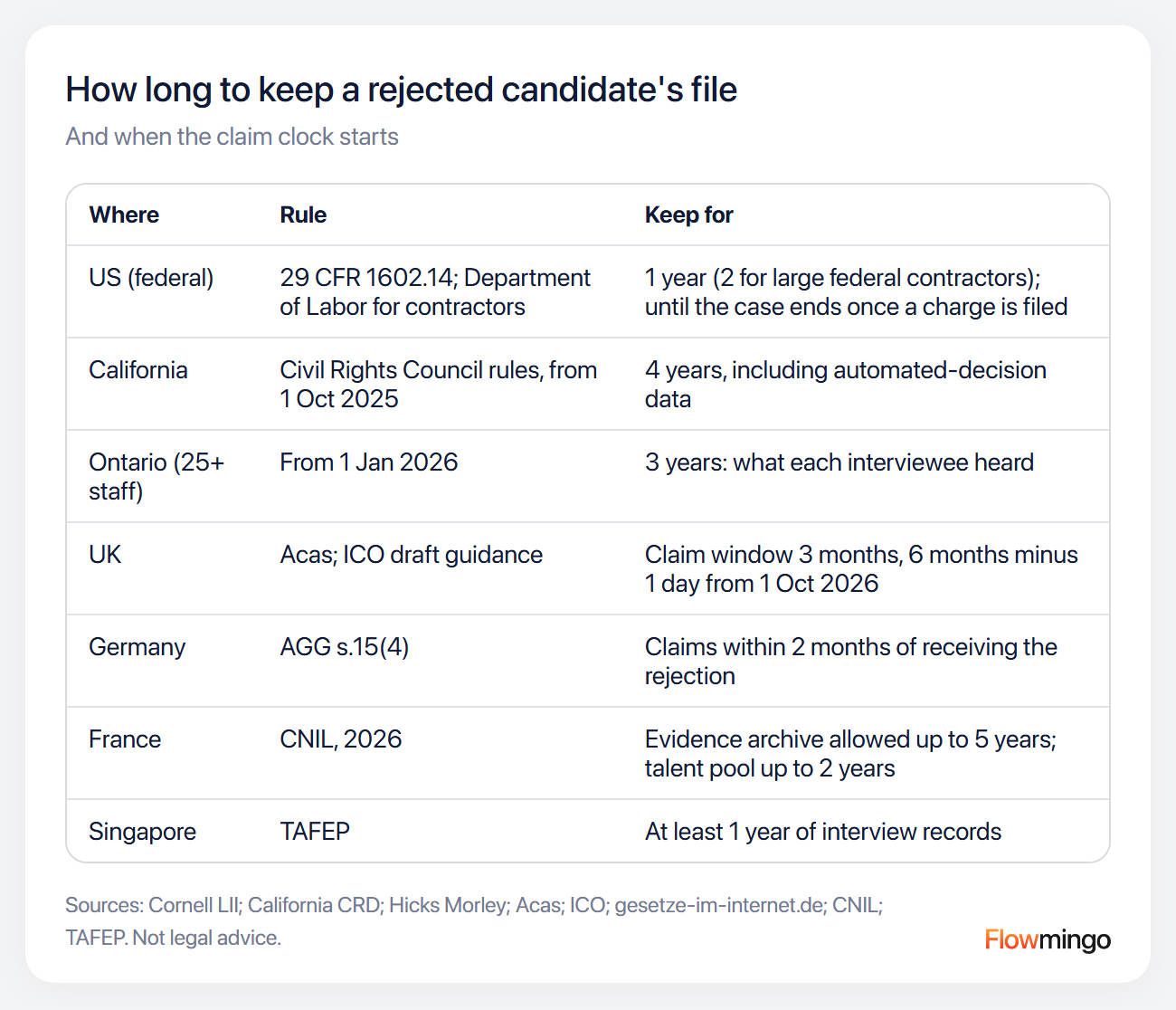
Records by country: how long to keep a rejected candidate's file, and when the claim clock starts.
In the US, keep hiring records for 1 year, and until the case ends if someone files a charge (29 CFR 1602.14). Federal contractors with 150+ staff and a $150,000+ contract keep 2 years under Labor Department rules (FTC and EEOC).
California's rules ask for at least 4 years, including automated-decision data, from 1 October 2025. Ontario asks for 3 years of what each interviewee heard (Hicks Morley), and Singapore's TAFEP at least 1 year of interview records.
From 1 October 2026, most UK claims can arrive up to 6 months minus 1 day after a rejection, instead of 3 months (Acas). Early conciliation, the Acas step before a tribunal claim, pauses that clock.
In Germany, a claim must arrive in writing within 2 months of receiving your rejection (AGG), so note the date you sent it. France allows a 5-year evidence archive (CNIL). Delete only after the window for that country closes.
9.1 Reply to a hostile message
Send it once, then pass any threat to HR or legal.
Subject: Re: [their subject]
Hi [First name],
Thank you for your message. I understand the decision is disappointing. We assessed every candidate for [Role] on the same requirements, and the decision is final.
For a formal complaint, contact [name, email], who will reply within [10 working days].
[Your name]
How Flowmingo helps
Send applicants an AI interview scored on your criteria, then write each no from its report. Try Flowmingo free before your next rejection email.
10. Sources
Every study, law and quote in this guide links to a source below; Flowmingo figures come from Flowmingo's own platform data.
- Acas (2026). Employment tribunal time limits. Acas.
- Acas (n.d., read 2026). Being rejected or told not to apply: rejected job applications. Acas.
- Barattucci, M., Russo, A., Grobelny, J., Santisi, G., & Ramaci, T. (2025). Candidates' reactions to job application rejections at different phases of the recruitment process. Journal of Management & Organization.
- Bock, L. (2015, April 7). Here's Google's secret to hiring the best people. Wired.
- Brockner, J. (2010). A contemporary look at organizational justice: Multiplying insult times injury. Routledge.
- Bundesministerium der Justiz (n.d., read 2026). General Act on Equal Treatment (AGG), English translation. gesetze-im-internet.de.
- California Civil Rights Department (2025). Civil Rights Council secures approval for regulations to protect against employment discrimination related to artificial intelligence. California Civil Rights Department.
- CNIL (2026). Référentiel: les durées de conservation, gestion des ressources humaines. CNIL.
- Colorado General Assembly (2026). SB26-189 Automated decision-making technology. Colorado General Assembly.
- Court of Justice of the European Union (2025). Judgment in Case C-203/22 Dun & Bradstreet Austria, press release 22/25. CJEU.
- Federal Trade Commission & Equal Employment Opportunity Commission (n.d., read 2026). Background checks: What employers need to know. FTC.
- Fijneman-Ghielen, S., De Cooman, R., & Schumacher, D. (2026). High expectations, higher stakes? Changes in organizational attractiveness after receiving a rejection letter. International Journal of Selection and Assessment.
- Gartner (2025). Gartner survey shows just 26% of job applicants trust AI will fairly evaluate them. Gartner newsroom.
- Gilliland, S. W., Groth, M., Baker, R. C., Dew, A. F., Polly, L. M., & Langdon, J. C. (2001). Improving applicants' reactions to rejection letters: An application of fairness theory. Personnel Psychology.
- Greenhouse (2026). The Hire Standard: hiring benchmarks 2026. Greenhouse.
- Greenhouse (2025). An AI trust crisis: 70% of hiring managers trust AI to make faster and better hiring decisions. Greenhouse newsroom.
- Hicks Morley (2025). New year, new rules: Ontario job posting requirements take effect January 1, 2026. Hicks Morley.
- Holland & Knight (2025). Federal court allows collective action lawsuit over alleged AI hiring bias. Holland & Knight.
- Homerun (n.d., read 2026). Candidate rejection email templates. Homerun.
- Illinois General Assembly (2024). Public Act 103-0804. Illinois General Assembly.
- Indeed (n.d., read 2026). Rejection letter samples. Indeed for Employers.
- Information Commissioner's Office (n.d., read 2026). Keeping recruitment records, draft guidance. ICO.
- Information Commissioner's Office (2026, March 31). Here's what jobseekers need to know about automated recruitment decisions. ICO.
- Legal Information Institute (current text). 29 CFR 1602.14: Preservation of records made or kept. Cornell Law School.
- Malin, C., Fleiss, J., Ortlieb, R., & Thalmann, S. (2025). Rejected by an AI? Comparing job applicants' fairness perceptions of artificial intelligence and humans in personnel selection. Frontiers in Artificial Intelligence.
- Mehta, S. (2026). I analyzed 50+ rejection emails. Here's what they actually mean. LinkedIn.
- NYC Department of Consumer and Worker Protection (2023). Automated employment decision tools: Frequently asked questions. City of New York.
- r/humanresources (2025). Just venting - candidate response to rejection [N/A] [Online forum post]. Reddit.
- r/managers (2025). Internal candidate rejection mess up [Online forum post]. Reddit.
- r/managers (2025). Giving feedback to unsuccessful candidates [Online forum post]. Reddit.
- Schinkel, S., van Dierendonck, D., & Anderson, N. (2004). The impact of selection encounters on applicants: An experimental study into feedback effects after a negative selection decision. International Journal of Selection and Assessment.
- Talent Board & ERE Media (2024). What sets CandE award winners apart: 2024 candidate experience benchmark research. ERE Media.
- TalentHR (n.d., read 2026). Rejection email template. TalentHR.
- Tripartite Alliance for Fair and Progressive Employment Practices (n.d., read 2026). How to conduct fair job interviews. TAFEP.
- Wood, N., Leckfor, C., Wicks, S., & Hales, A. (2023). Ghosting from the workplace: The impact of feedback (or lack thereof) on applicants' psychological needs satisfaction. Routledge Open Research.