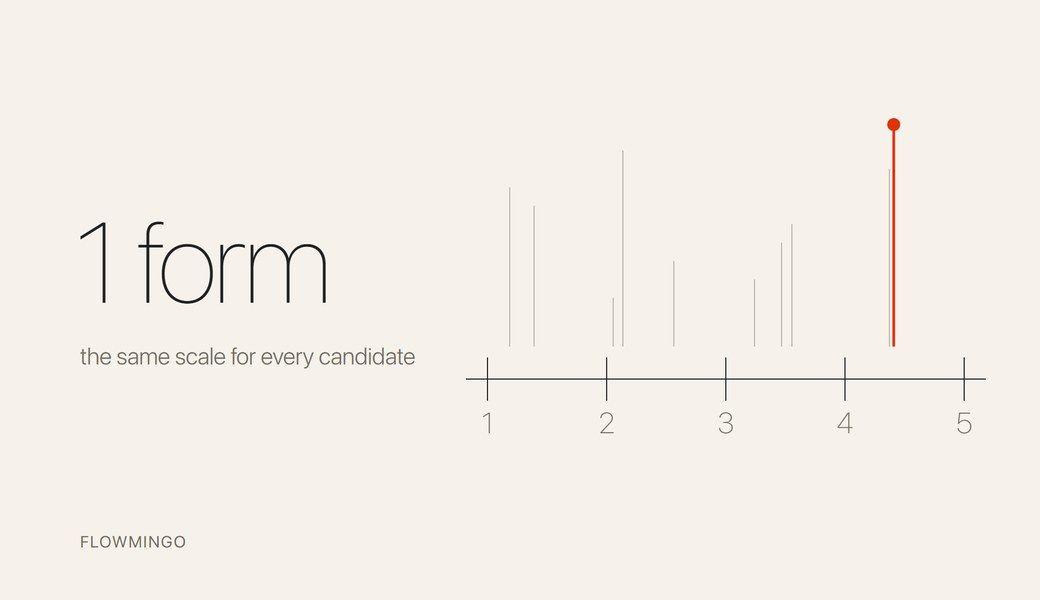
An interview scorecard is a short form that every interviewer fills in for every candidate. It holds the same 4 to 6 criteria, a rating scale with written examples, a weight per criterion and an evidence box.
It lets 2 interviewers compare notes on the same terms, whether the team uses a paper interview scorecard template or software. The decision then rests on what the candidate said, not on who the interviewer liked.
This guide includes a free interview scorecard template, the rating anchors behind it and a filled-in candidate evaluation form. It ends with the 4 mistakes that make a scorecard useless.
Key takeaways
- Use 4 to 6 criteria, each taken from the job and weighted from 1 to 4.
- Write an anchor for every rating level before the first interview.
- Make the evidence box required: no note, no rating.
- Each interviewer scores alone, before any discussion.
- Review scores against job performance after 6 months, then adjust.
1. Why an interview scorecard matters
Interviews predict job performance much better when they are structured: the same questions, and answers rated against the same standard. The interview scorecard is the part of that structure that is easiest to skip.
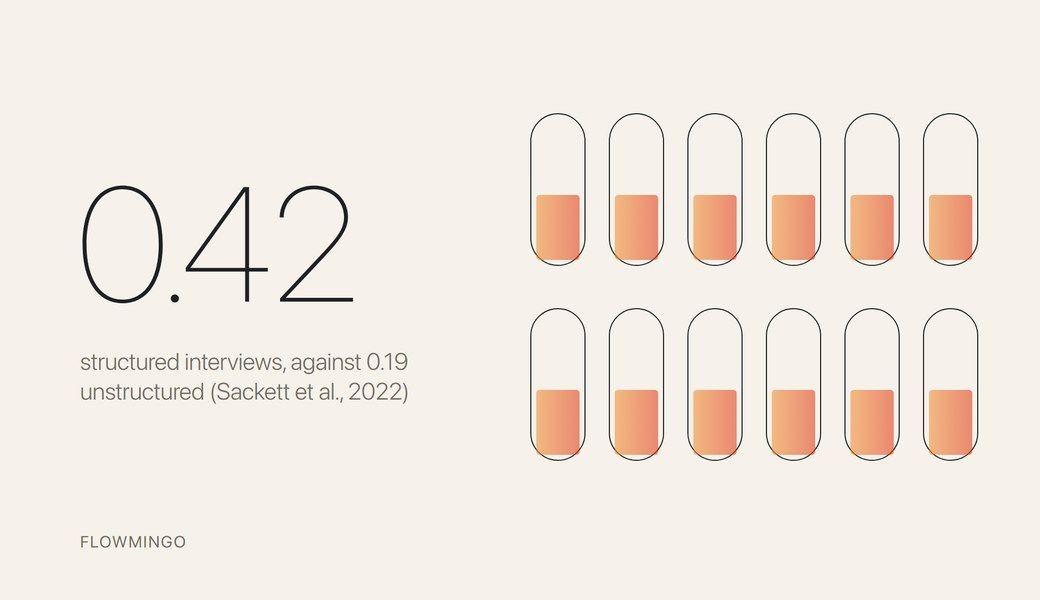
The foundational re-analysis of selection research by Sackett and colleagues (2022) puts structured interviews at a 0.42 correlation with job performance. Unstructured interviews came out at 0.19.
Without a scorecard, the same questions still get judged by gut feel. With one, every rating points to evidence that someone else can check.
2. The interview scorecard template
The interview scorecard template below fits on 1 page. Copy it into a document or spreadsheet, and fill in the criteria from the job description before the first interview.
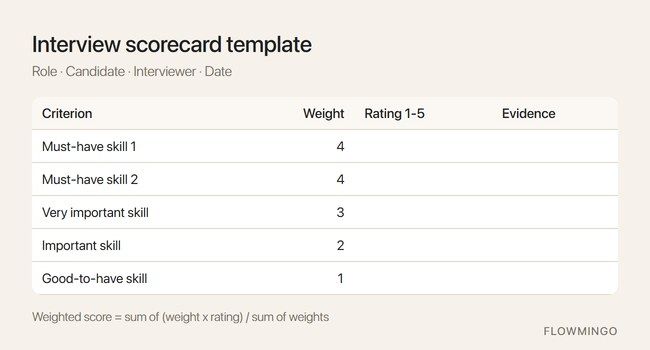
A blank interview scorecard: criteria, weights, ratings and evidence on 1 page.
The header records the role, the candidate, the interviewer and the date. Under the table, each interviewer adds a recommendation: strong yes, yes, no or strong no. They also note the biggest strength, the biggest gap and 1 thing to check next round.
The weighted score is the sum of weight times rating, divided by the sum of the weights. A Must Have carries a weight of 4 and a Good to Have a weight of 1, so the must-haves drive the result.
2.1 How to choose interview scorecard criteria
Good criteria come from the job, not from the interviewer's taste. Start with the tasks the person will do in their first 6 months.
Turn each task into a behaviour that an interview can test: "resolves an escalated complaint without a manager" instead of "good with people". Then rank the criteria by importance and give each a weight from 1 to 4.
Stop at 6. Past that point, interviewers stop rating and start guessing, and every extra line on the interview scorecard makes the others less reliable.
3. The rating scale behind every interview scorecard
A bare 1 to 5 scale means different things to different people. Written anchors fix that, and they are what turn a list of questions into an interview rubric.
The general version below works as a starting point. For each criterion, rewrite the 5 levels in terms of that criterion before the first interview.
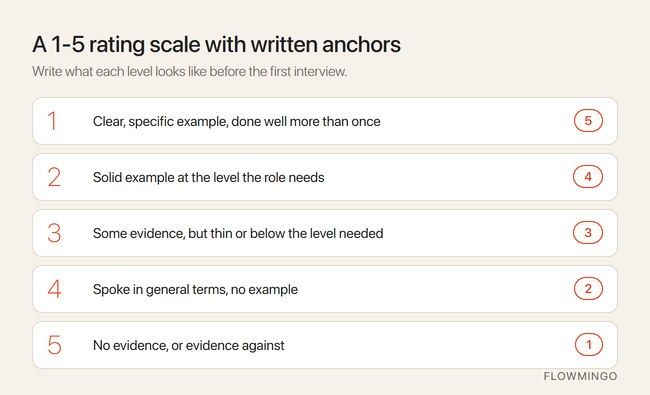
Anchors make a 4 from 1 interviewer mean the same as a 4 from another.
Without anchors, a generous interviewer and a strict one produce different shortlists from the same candidates. With them, the interview scorecard compares candidates instead of interviewers.
3.1 Writing anchors for 1 criterion
Take "written communication" for a support role as an example. A 5 is a clear, short written answer with no jargon and the right tone for an upset customer.
A 3 is an answer that is correct but long, or correct but cold. A 1 is an answer that is confusing or leaves the customer without a next step.
Write the 1, 3 and 5 first, then fill in 2 and 4 as the levels between them. That takes about 10 minutes per criterion.
4. A worked interview scorecard example
The example below scores 1 candidate for a customer support specialist role. The criteria and weights come straight from the job description.
- Resolving a complaint end to end: weight 4
- Written communication: weight 4
- Working in a ticketing tool: weight 3
- Product learning speed: weight 2
- Second language: weight 1
The candidate described a refund dispute where they checked the order, offered a partial credit and kept the customer. Their written sample was 4 short sentences with 1 apology, a next step and a time.
They had used a help desk tool for 6 months but could not describe service-level targets. They learned a new billing system in 1 week, and their second language was basic.
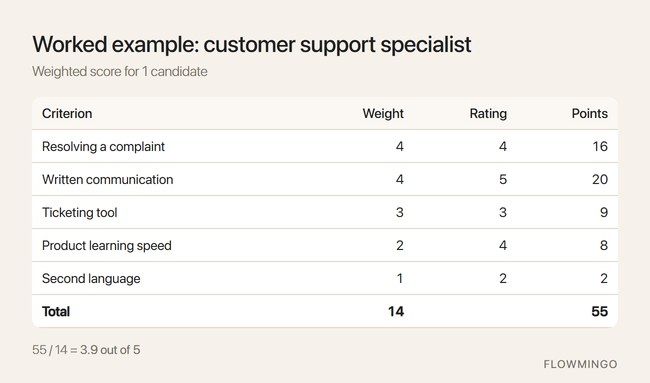
The weighted score for this candidate: 55 points over 14 weights, or 3.9 out of 5.
The evidence column is the part that matters most. A hiring manager who disagrees with a rating can read what the candidate said and decide for themselves.
5. 4 mistakes that make an interview scorecard useless
Scorecards tend to fail in a few predictable ways. Each of the 4 below has a simple fix.
- Too many criteria. Merge overlapping criteria and drop the ones no question tests.
- Criteria that describe a person, not the job. "Confident" and "good energy" are where bias gets in, so rate what the job requires.
- Scoring after the debrief. Each interviewer submits their interview scorecard first, then the panel discusses.
- No evidence. A rating without a note cannot be checked or defended, so make the evidence box required.
The third mistake is the easiest to miss in a panel. Once interviewers talk, the loudest opinion anchors everyone else.
6. How to run a debrief with an interview scorecard
A debrief is where a good interview scorecard pays off or gets ignored. The order of the meeting decides which.
Collect every interview scorecard before the meeting starts. The recruiter then shares the ratings side by side, criterion by criterion, so the panel sees where it agrees and where it does not.
Spend the meeting on the gaps. Say 1 interviewer gave a 2 and another a 5 for the same criterion. Each reads out their evidence, and the panel decides which is stronger.
6.1 When interviewers disagree
A wide gap usually means 1 of 3 things. The interviewers asked different questions, they read the anchors differently, or 1 of them saw something the other missed.
The first 2 are process problems, and the fix is to tighten the questions or the anchors for the next candidate. The third is new information, and it belongs in the evidence column of the interview scorecard.
Record the final decision and the reason for it in 1 or 2 sentences. That note is what the team reads later if the hire goes well or badly.
7. Keeping interview scorecards on record
Completed scorecards are hiring records. Store them with the candidate's file for as long as your local rules and your own retention policy require.
Keep the language factual. Every line of an interview scorecard should describe what the candidate said or did. A candidate may one day ask to see what was written about them.
Review the scorecards of recent hires after 6 months. Compare the top scorers on each criterion with the people doing best in the job. If they differ, change the criterion or its anchors.
8. Interview scorecard, rubric or evaluation form
The terms overlap, and teams use them loosely. The distinction below keeps a hiring team's documents consistent.
A rubric is usually the scale and its anchors: what a 1, 3 or 5 looks like. An interview scorecard applies the rubric to 1 candidate, with weights and evidence.
A candidate evaluation form is often the same thing under an HR name, and an interview feedback template is usually the free-text part of it. For writing anchors that hold up to scrutiny, see how to design fair and defensible interview rubrics.
9. How Flowmingo fills in the interview scorecard
In Flowmingo's AI Interviewer, the scorecard is set up once per role and applied to every applicant the same way. Paste the job description, and AI drafts the interview questions and the criteria.
You edit both and mark each criterion's importance. Every applicant then does the same structured, spoken interview in their own time.
Each interview comes back with every criterion rated 0 to 10 with a written justification, and an overall score weighted by importance. A Must Have counts 4 times as much as a Good to Have. The report adds strengths, gaps and a recommendation next to the recording and transcript.
The AI does not decide who is hired. It fills in the same scorecard for every applicant and shows its evidence, and who moves forward is your call.
10. Conclusion
A useful scorecard has 4 to 6 weighted criteria from the job, a 1 to 5 scale with anchors and a required evidence box. Each interviewer fills it in alone, before any discussion.
That structure is what lets a team compare candidates fairly and explain every decision later. To apply the same criteria to every applicant automatically, with evidence for each rating, try Flowmingo and build your first interview scorecard free.