Pre-screening interview questions check the few facts that end a candidacy on their own: schedule, location, pay, the right to work and 1 must-have skill. They run before the first real interview, so that interview time goes only to people who could accept an offer.
This guide gives recruiters 25 pre-screening questions grouped by what each one checks. It also covers the 5 knockout questions that work best, the phone screening questions to avoid, and a simple order for high-volume roles.
A good screen saves interview time for everyone. It is also an easy place for unfair questions to slip in, so the wording matters.
Key takeaways
- Ask 5 to 8 factual questions, worded the same for every applicant.
- Use knockouts only for true job requirements, and write the passing answer first.
- Keep every answer on record, including the answers of people screened out.
- Leave age, family, health, religion and origin out of every question.
- Screen in writing for volume roles, and save phone calls for small senior searches.
1. What pre-screening interview questions are for
A pre-screen answers 1 thing: whether any fact rules the applicant out. It does not decide who is best, and it should not try to.
The split below keeps the screen short and fair. Everything in the right-hand column belongs to a later stage.
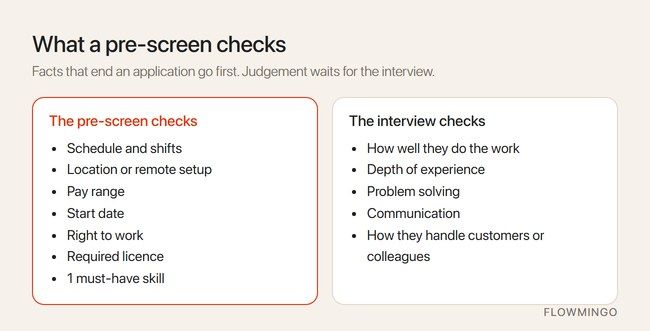
What a pre-screen checks, and what it leaves to the interview.
Keep the screen to 5 to 8 questions. Each extra question costs applicants, because people drop out of long forms.
A phone screen of 15 questions is a first interview in disguise. That longer conversation deserves its own slot, its own scorecard and its own decision.
2. 25 pre-screening interview questions by what they check
The 25 pre-screening interview questions below fall into 6 groups. Pick 1 or 2 from each group that matters for the role, and ask every applicant the same wording.
2.1 Pre-screening interview questions on schedule and location
Schedule questions come first, because a person who cannot work the hours cannot do the job. Questions 1 to 4 cover most shift patterns.
- This role works [days and hours]. Can you work that schedule?
- Are you available for [night shifts / weekends / on-call]?
- When is the earliest date you could start?
- Do you have any planned time off in the first 3 months that we should know about?
Location questions matter most for on-site and hybrid roles. For remote roles, question 7 replaces the commute question.
- This role is based in [city] and on site [N] days a week. Does that work for you?
- Can you reliably get to [site] for a [start time] start?
- For remote roles: do you have a quiet place to work and a stable internet connection?
- Are you open to travel for [N]% of the time?
2.2 Pre-screening interview questions on pay and requirements
Pay questions prevent the most painful late-stage "no". State the range yourself, then ask whether it works.
- The pay range for this role is [range]. Is that in line with what you are looking for?
- This is a [full-time / part-time / fixed-term / contract] role. Is that the type of work you want?
- Do you have a notice period with your current employer, and how long is it?
Requirement questions cover licences, legal status and physical demands. These belong in the screen only when the job truly needs them, and each one should name the exact requirement.
- Are you legally able to work in [country] without sponsorship?
- This role requires [licence / certification]. Do you hold it today?
- The role involves [lifting 20 kg / standing for a full shift / driving]. Can you do that, with or without reasonable adjustment?
- Are you able to pass [background check / medical check] if it is a condition of the offer? (Ask only where the law allows it for this role.)
2.3 Pre-screening interview questions on experience and motivation
Experience questions test 1 skill the role cannot train. Keep them factual, so the answer is easy to compare across applicants.
- How many years have you worked in [the 1 skill the role cannot do without]?
- Have you used [tool or system] in a job, and what did you use it for?
- Tell me about the last time you did [core task of the role].
- What size of [team / budget / caseload] have you handled?
- Which of these languages can you work in: [list]?
Motivation questions are not knockouts. They show who is still interested before anyone spends 30 minutes on an interview.
- What made you apply for this role?
- What do you know about what the job involves day to day?
- What would make you turn down an offer from us?
- Are you interviewing elsewhere, and what is your timeline?
- Is there anything about this role you want to know before we go further?
3. The 5 knockout questions in a pre-screen
A knockout question is one where a single answer ends the application. It must be a fact the job truly requires, asked the same way to every applicant.
Write the passing answer down before the first applicant replies. The graphic below shows the 5 knockout questions that hold up best.
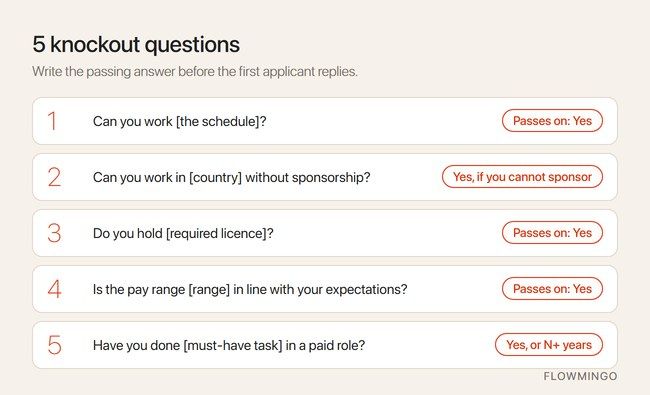
Each knockout ties to a hard requirement of the job, not a preference.
2 rules keep knockouts fair. First, every knockout must be tied to the job, not to a preference. "Available for weekend shifts" is a job requirement, while "has a degree" often is not.
Second, keep the rejected answers. A knockout decides who moves on, but a recruiter should still be able to review the answers of someone who was screened out.
4. Questions to leave out of any screen
Some pre-screening interview questions expose an employer to a discrimination claim, however kindly they are meant. The list below covers the usual risks.
- Age, date of birth or graduation year
- Marital status, children or plans for a family
- Pregnancy, health or disability beyond the job's real demands
- Religion, national origin, race or ethnicity
In the United States, the EEOC's guidance on prohibited practices sets out what employers may not base decisions on. Other countries have their own rules, so check them before you write the form.
Each risky question has a job-related version that gets the same fact. The table swaps them, so the screen stays focused on the job.
| Instead of | Ask |
|---|---|
| "Do you have children?" | "Can you work this schedule?" |
| "How old are you?" | "Are you at least [legal minimum age] for this role?" (only where a legal minimum exists) |
| "Where are you from?" | "Are you legally able to work in [country]?" |
| "Do you have any health problems?" | "Can you do [the physical task], with or without reasonable adjustment?" |
5. Phone screen or written pre-screen
A phone screen lets a recruiter hear how someone communicates. The cost is time: at 15 minutes a call, 200 applicants take 50 hours, before voicemail and rescheduling.
A written pre-screen, as a form or a chat, sends the same pre-screening interview questions to everyone at once. Applicants answer when it suits them, and the answers arrive already sorted.
The trade-off is that you do not hear the person. That is what the first interview is for, so the 2 formats work best in sequence.
Short screens also protect your response rate. In Flowmingo's own data on 63,068 invited applicants (June to September 2026), only 26.2% started a first-round interview within 14 days (full data).
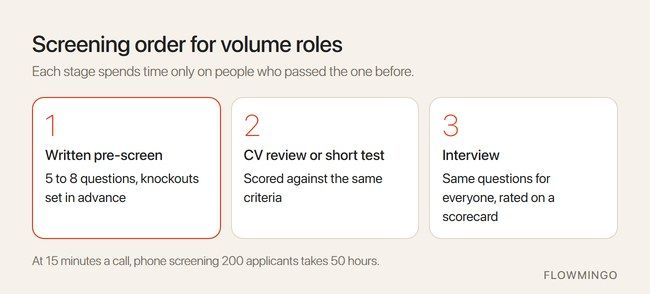
For volume roles, the written screen comes first and the interview comes last.
For senior roles with 20 applicants, a 15-minute call is often still the right tool. For roles with hundreds of applicants, the written screen protects the recruiter's week.
6. How to write your own pre-screening interview questions
The 25 examples above work as screening questions for recruiters in any industry. Still, your own pre-screening interview questions should come from the job itself, starting with the 3 to 5 facts that would end an application.
Turn each fact into 1 question with a clear yes or no, or a number. Then write the passing answer next to it, before the screen goes live.
Test the wording on a colleague who does not know the role. Fresh eyes catch jargon and double meanings that the hiring team no longer notices. A question that gets a long, uncertain answer is either 2 questions or a question for the interview.
7. How Flowmingo runs pre-screening interview questions
Flowmingo's Chat Screening runs the written pre-screen for you. Applicants open 1 link or QR code and answer in a short chat.
AI drafts 4 to 6 questions from the job description, including at least 2 knockouts. You edit them, set what passes, and write the message that qualified applicants see at the end.
Each response comes back as Qualified or Rejected, with every answer kept for review. Everyone who qualifies can move straight to a structured AI interview, which each applicant does in their own time. Both are free for unlimited applicants.
8. Conclusion
A strong pre-screen asks 5 to 8 factual questions, the same way, to every applicant. It uses knockouts only for true requirements, keeps every answer on record, and leaves judgement of skill to the interview.
Start with the 25 examples, keep the knockouts tied to the job, and drop any question about protected characteristics. To send the screen as a chat and pass qualified applicants straight to an AI interview, try Flowmingo free for your pre-screening interview questions.