
If you hire hourly staff for 20 locations, someone has probably told you to look at Olivia. Olivia is the chatbot behind Paradox recruiting software. It texts each applicant, asks your screening questions and books the interview, the chasing a store manager would otherwise do by phone.
The trouble starts when you try to find out what it costs. Paradox publishes no price, and a search mostly turns up news: Workday, the HR software giant, bought the company in 2025 for about $1.1 billion and now sells the product as Workday Paradox.
In the same year, security researchers got into the staff side of McDonald's hiring site, which runs on Olivia, by typing "123456" as the password. None of that tells you what you will pay, or what you are agreeing to.
The answers exist, but in documents most buyers never open. They matter more than the demo, too: sign an order form on Paradox's standard terms, and you can owe a full year of fees after you stop using the product.
So we read 5 primary documents: Paradox's terms, Workday's annual report, the federal spending record, the status page and the researchers' account of the breach.
Flowmingo, the company publishing this guide, sells a competing product, so every figure below links to its source.
The question that decides the rest is whether your bottleneck is booking interviews, which Olivia does well, or judging them, which it leaves to your managers.
Key takeaways
- How much does Paradox recruiting software cost? Paradox only quotes on request. Rival vendors cite review-site listings from about $1,000 a month, and the only public order, a 2021 federal purchase of a single module, was $22,500 for 1 year.
- Did Workday buy Paradox? Yes. Workday paid $1,063 million, announced on 1 October 2025 that the deal had closed, and now sells the product as Workday Paradox.
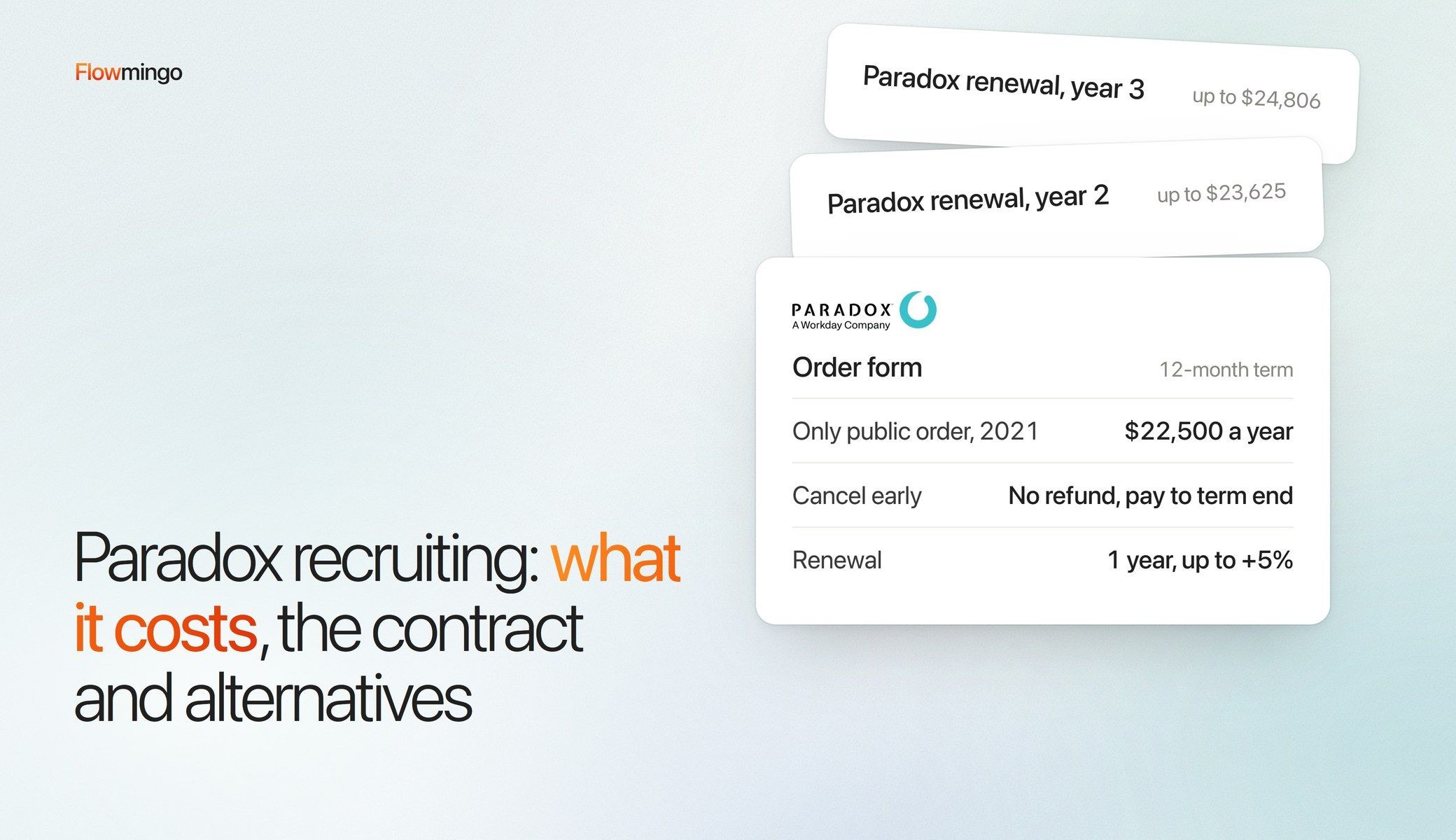
- Can we cancel a Paradox contract early? You can stop at any time, but Paradox refunds nothing and you pay to the end of the term. Renewals run a year at a time, at up to 5% more each year.
- Does Paradox score candidates in an AI interview? Not on the 3 product pages we read. There, Olivia screens applicants by chat and books the interview, and your managers still run it and decide.
- Was Paradox breached? In June 2025 researchers said a "123456" login to McHire, McDonald's hiring site on Olivia, reached records on an estimated 64 million applicants. Paradox says most held no personal details and 5 candidates' details were viewed.
1. Before we book a demo, what does Paradox recruiting software do for frontline hiring?
Paradox recruiting software runs the conversation with each applicant by text, from the first question to a booked interview and, later, the offer. Its assistant, Olivia, does the follow-up that would otherwise fall to your managers.
Since 2016, Paradox, which is based in Scottsdale, Arizona, has built for frontline, high-volume hiring in restaurants, retail, healthcare, hotels and logistics.
That focus explains the whole design, because in hourly hiring the slow part is rarely deciding whom to hire. It is calling 60 applicants back between shifts, and that is the job Olivia takes over.
For the applicant, it starts with almost no effort.
They scan a QR code in a store, text a keyword or click apply on Indeed, and Olivia opens a chat by text message, WhatsApp, Messenger or web chat, with no account or password to create. Paradox says a text application takes under 3 minutes.
From there, Olivia asks your knockout questions, the pass-or-fail checks that rule an applicant in or out, then offers interview times from the manager's calendar and handles any rescheduling. Once you decide to hire, it texts the offer and the I-9 forms too.
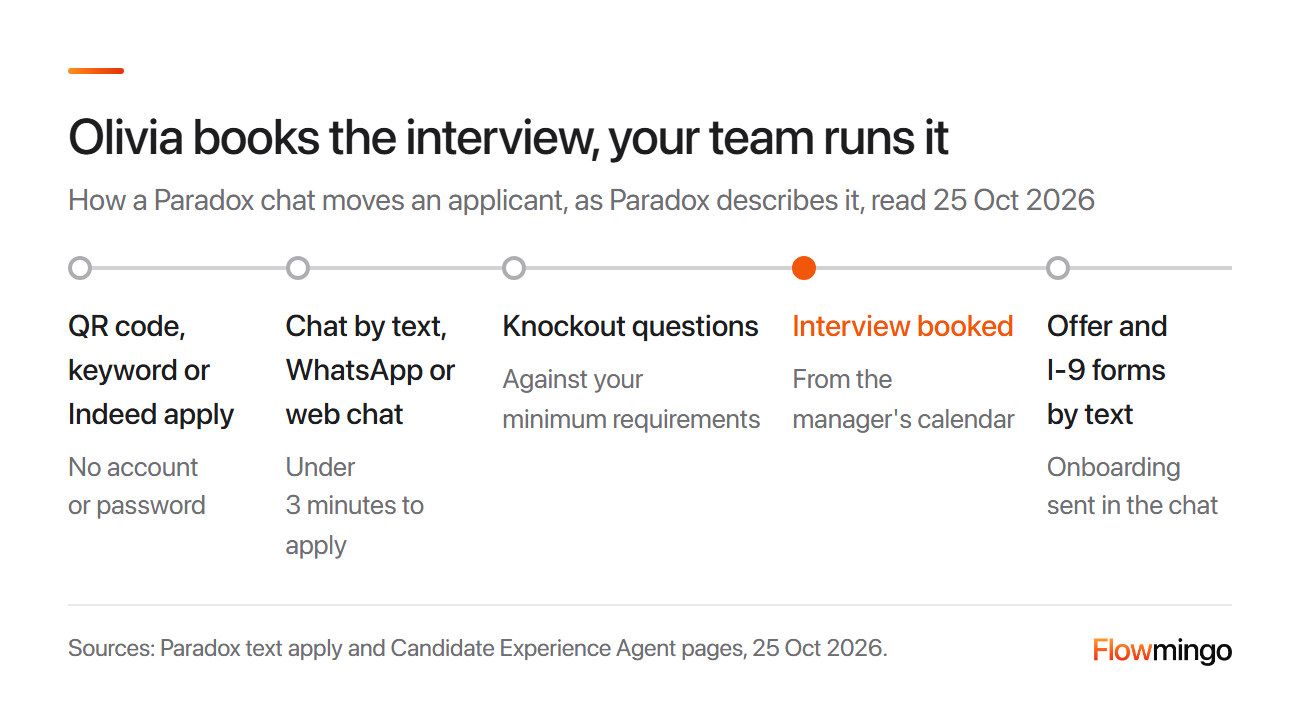
Olivia's applicant flow: QR code, keyword or Indeed apply with no account, a chat under 3 minutes, then knockout questions. Olivia books the interview from the manager's calendar and texts the offer and I-9 forms.
The customer list shows who it is built for.
Paradox's home page names Chipotle, 7-Eleven, General Motors, Compass Group and Wendy's. McHire, the hiring system that the security researchers Ian Carroll and Sam Curry say 90% of McDonald's franchisees use, runs on Olivia too.
On that home page, Compass Group, the food-service company, says it hires 120,000 workers a year with a recruiting team of 20. That is 6,000 hires per recruiter, a pace only possible when software handles the scheduling and follow-up.
One of Paradox's own claims changes from page to page, so check it. The home page says Olivia can detect more than 100 candidate languages, while its product and Workday pages say it supports 30 or more. Ask which figure is true for the languages your applicants speak.
2. Workday bought Paradox: what changes for us, especially if we don't run Workday?
Workday, which sells HR and finance software to large employers, agreed to buy Paradox on 21 August 2025 and announced on 1 October 2025 that the deal had closed. It now sells the product as Workday Paradox, to existing and new customers, through either company.
For buyers, the sale changes 3 things. The first is what your contract points to.
You still sign with Paradox, LLC, but its terms define the product documentation as Workday's administrator guide. In other words, the official description of what you bought is a Workday guide that Paradox may update from time to time.
The second is where your applicants' data can travel. Paradox's August 2026 sub-processor list, the companies allowed to handle customer data on its behalf, names 44 entities, and 25 of them are Workday affiliates.
Ask which of them will process your data, and watch for the 30 days' notice the data processing addendum gives before a new one is added.
The third is the roadmap, which now belongs to Workday. In November 2025, a month after the Paradox deal closed, Workday also bought Sana, a maker of AI search and learning tools for staff.
Together, Paradox and Sana brought in under 1% of Workday's revenue in the year to 31 January 2026, according to Workday's annual report, though that counts only the months after each deal closed.
That makes Paradox a small part of a much larger company, which matters most if you run a different HR system.
Paradox still lists an integration with SAP SuccessFactors, a rival HR system. If you run anything other than Workday, write that integration into the order form for the full term.
Paradox's terms say the order form wins over them, and Paradox can change its standard terms for new orders, so anything you rely on belongs in that document.
As for the price, the same annual report puts it at $1,063 million, about $1,043 million in cash plus a $20 million stake Workday already held, and only $133 million of it was booked as developed technology.
The biggest share, $780 million, is goodwill, which is what accountants call the value of the team and the expected fit with Workday's products.
The breakdown also lists $75 million of cash. That is Paradox's own money, which came with the company, not the cash Workday paid. Take off $94 million of liabilities, and the items below add up to the full price.
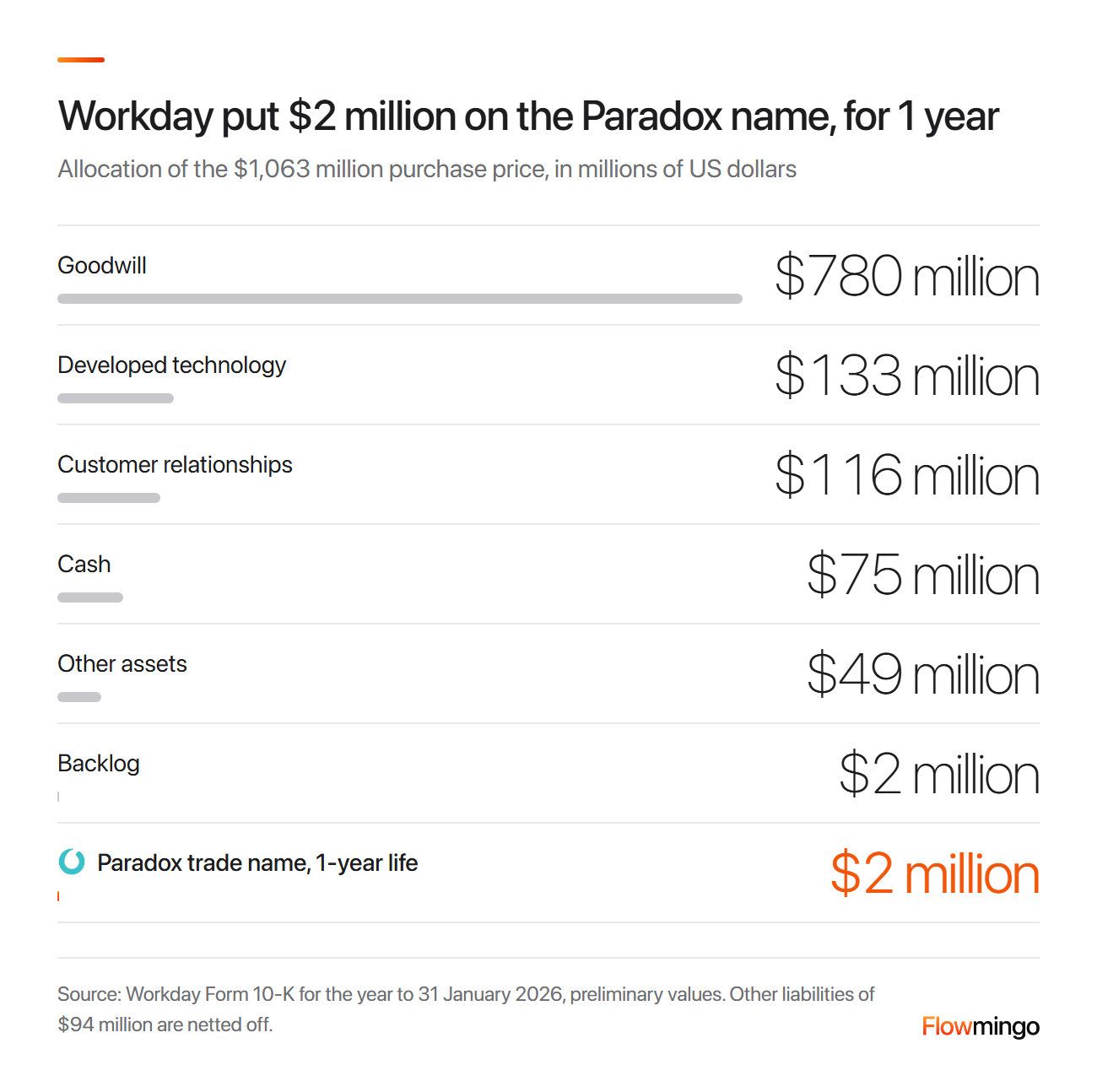
What Workday paid for: goodwill $780 million, developed technology $133 million, customer relationships $116 million, Paradox's own cash of $75 million, other assets of $49 million, backlog $2 million and the $2 million trade name, less $94 million of liabilities.
One small line in that breakdown says more about the future than the headline price.
Workday valued the Paradox name itself at just $2 million and gave it a useful life of 1 year. That is an accounting estimate rather than an announcement, but it fits what buyers can already see, because the product is being folded into the Workday brand.
3. How much will Paradox recruiting cost our 20-location business in year 1?
Paradox publishes no price, so any figure for Paradox recruiting costs is a range built from outside estimates rather than a quote. By our arithmetic, year 1 would land somewhere between about $27,000 and about $170,000.
Every price figure in circulation comes from outside the company, mostly from smaller rival vendors that have written about Paradox's pricing on their blogs.
Hirevire and Truffle both cite software review sites that list a starting price of about $1,000 a month, or $12,000 a year. Truffle puts setup fees at $15,000 to $35,000, so the cheapest plausible year 1 is that $12,000 plus the lowest setup fee, about $27,000.
The top of the range comes from estimates for bigger deals. Noon and Prepzo, also rival vendors, put mid-market contracts at $30,000 to $80,000 a year, with setup at $25,000 to $75,000, while Truffle puts mid-market deals as high as $95,000 a year.
Take the highest yearly estimate, Truffle's $95,000, and the highest setup fee, $75,000, together, and year 1 reaches about $170,000. Noon puts large multi-location programs higher still, at $150,000 to $500,000 or more a year.
None of these estimates comes with a contract behind it: on 7 October 2026, Hirevire wrote that it had found no contract or filing to support such ranges.
When we checked on 25 October 2026, paradox.ai/pricing redirected to the home page, where the only next step is a demo request, so your price is whatever the order form lists.
We did find a real order in the US federal spending record, though it dates from 2021. USAspending.gov shows that the Department of Veterans Affairs medical center at Bay Pines, Florida, ordered a "virtual job fair hosting service" for $22,500.
The contract ran from 21 January 2021 to 20 January 2022, about $1,875 a month. The VA received only 1 offer, with no competition, so the price was never tested against a rival.
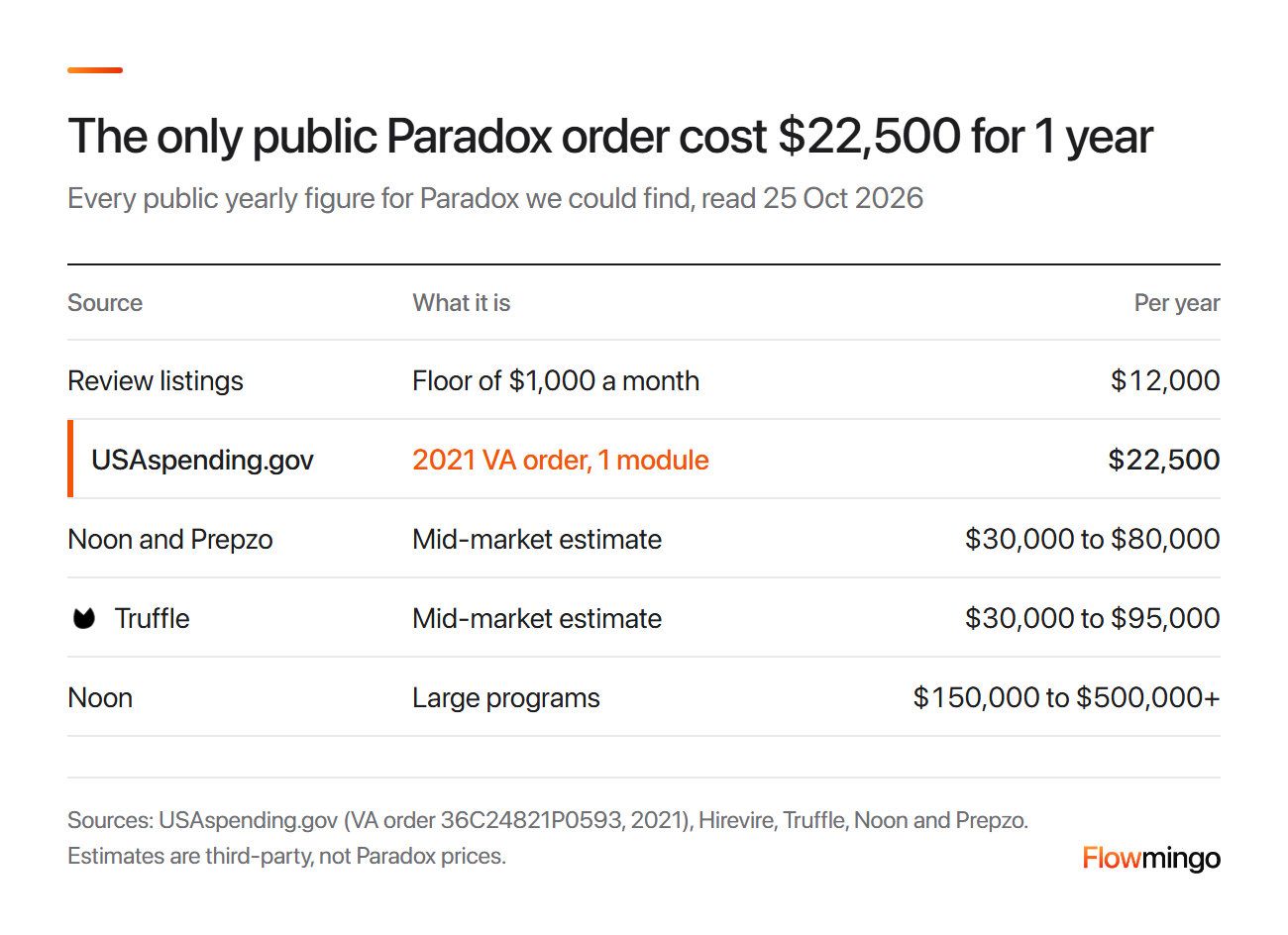
Every public yearly figure for Paradox: review listings $12,000 and the 2021 VA order $22,500. Estimates run $30,000 to $80,000 or $95,000 mid-market, and $150,000 to $500,000+ for large programs.
Treat that 2021 order, now more than 4 years old, as a data point, not a quote. It bought a single module, virtual events, for a single medical center during the pandemic, so a full rollout across your locations will cost more.
And because no public source prices Paradox per location, and the setup fees are estimates too, ask the sales rep to price your 20 sites line by line, so you can test the quote against both ends of the range.
4. Which Paradox contract terms should we negotiate before we sign the order form?
Negotiate 3 things first: renewal, cancellation and what happens to your data. Paradox's standard terms renew every year unless you give 30 days' notice, allow a capped price rise at each renewal and refund nothing if you leave.
They come from Paradox's Terms of Service, updated on 12 January 2026, and your order form can override them, which is why they are worth reading before the demo rather than after.
4.1 Renewal and the yearly cap
After the first term, the subscription renews 1 year at a time. To stop it, you have to email renewal@paradox.ai at least 30 days before the term ends, so put that date in a calendar on the day you sign.
At each renewal, Paradox may move your fees up toward its list prices, but by no more than 5% a year.
HireVue, a video-interview vendor, is stricter. It adds a fixed 10% a year at renewal under its master services agreement (version 2.2), renews for the longer of the first term or 1 year, and needs 60 days' notice to cancel.
To see what the cap means in money, take a 3-year first term at $50,000 a year, a round number for illustration rather than a quote, and renew it 3 times.
At Paradox's 5% cap, years 4 to 6 cost $52,500, $55,125 and $57,881, which is $15,506 more than another 3 years at a flat $50,000. At HireVue's rate, the same 3 years would add $32,050.
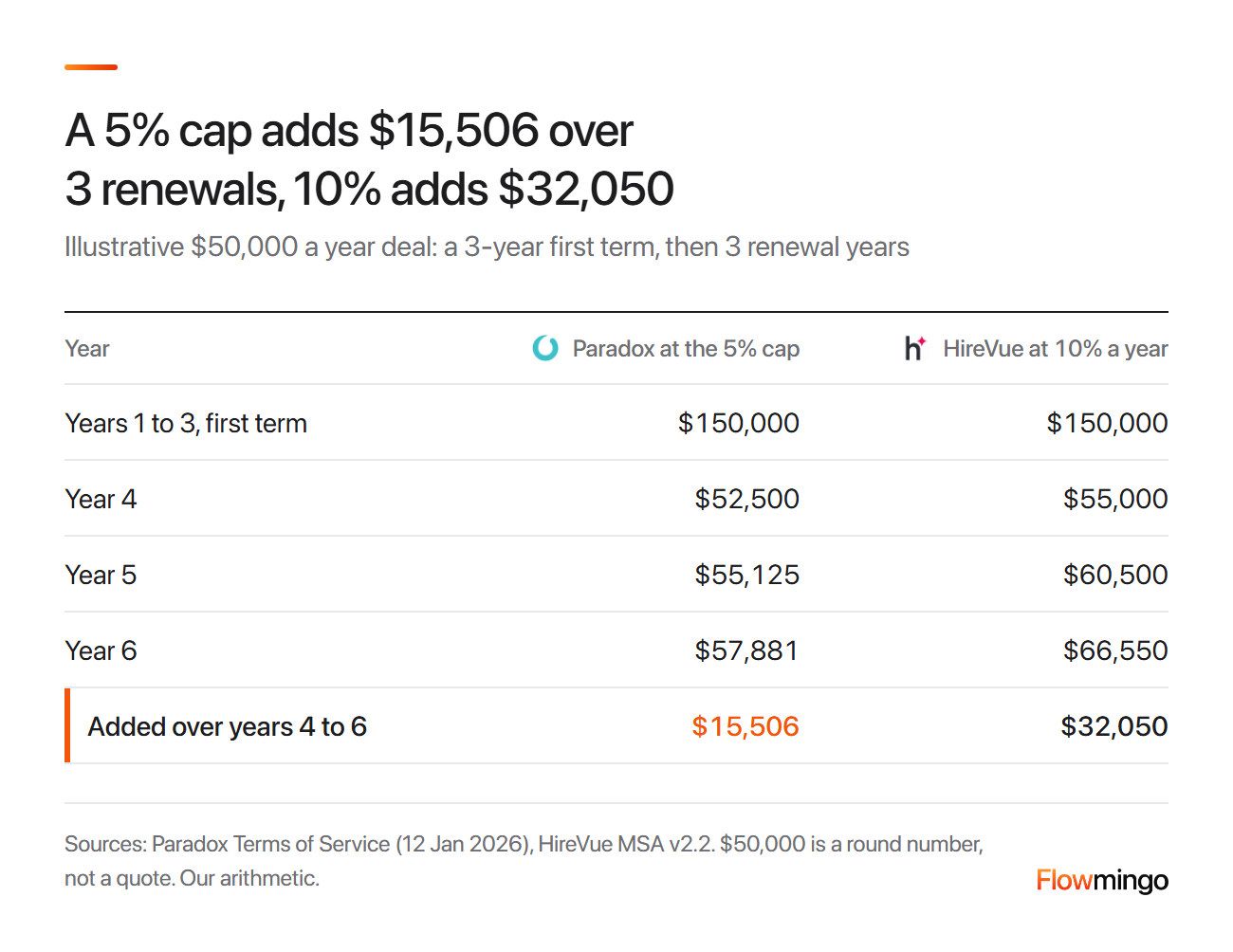
Renewal cost of a $50,000 deal: at Paradox's 5% cap, years 4 to 6 cost $52,500, $55,125 and $57,881, adding $15,506. At HireVue's 10% a year they cost $55,000, $60,500 and $66,550, adding $32,050.
4.2 Cancelling early
You may end the subscription whenever you like, but Paradox refunds nothing, and you still owe every fee through the end of the term.
Imagine you sign a 3-year deal and close half your sites in year 2. You would still owe year 3 in full, because the standard terms have no clause that lowers fees when locations close. Ask for one.
Paradox also bills each year in advance and accepts invoice disputes only within 10 days, so make sure someone checks every invoice on the day it arrives.
4.3 Your data, during the contract and after it
Paradox may strip the identifying details from your data and use what remains to improve its products. That includes training its natural language processing, the part of the software that reads and writes chat messages.
Paradox owns that "Improvement Data", and it keeps it after you leave.
The clause opens with "notwithstanding anything to the contrary". That legal wording puts it above other parts of the contract, so a general data clause may not limit it. Ask your lawyer to limit it by name in the order form.
When the contract ends, Paradox offers your data as a .csv file for 30 days and then deletes it.
If your term ends on 31 March, for example, you have until 30 April to download it, and on 1 May it is gone. Book the export before you give notice, and ask whether chat transcripts and videos come in the file.
4.4 Liability and breach costs
The terms cap what each side can claim from the other at 12 months of fees, or 24 months for a security or privacy breach. On the $50,000 deal above, that means $50,000 for most claims and $100,000 for a breach.
Paradox also commits to pay for the forensic investigation, breach notices, 1 year of credit monitoring and a call center after any breach it causes. That clause protects your applicants, so keep it.
One duty stays with you, though. The terms make you responsible for complying with the Telephone Consumer Protection Act, the US law on texting people, so ask how each QR code and keyword flow records the applicant's consent to be texted.
5. Can Paradox replace our ATS, or does it sit on top of Workday?
It can do either. Paradox sells its own applicant tracking system, or ATS, the database that holds every candidate record, and many large customers instead run Olivia on top of Workday.
Workday's annual report lists the Paradox Conversational Applicant Tracking System among its recruiting products. Paradox's own site pitches both uses at once: "the ATS that automates, not frustrates", and better hiring "without replacing your system of record".
The right choice follows from what you already run. If your records live in Workday, SAP or another enterprise ATS, buy Olivia as a layer on top and keep them where they are.
A 30-store franchise group with no ATS is in a different position, because for it the Conversational ATS is the whole product. Our AI hiring platform guide covers that choice.
For Workday customers, the connection is close. Paradox says its scheduling integration is Workday Certified, so when Olivia books an interview, the candidate's status updates in Workday Recruiting.
Recruiters can also text candidates from a browser extension without leaving Workday. Dell, Johnson Controls and Schnucks run it this way, according to Paradox and Workday.
As a full system, the Conversational ATS suits operators with many sites and no recruiter at each one.
Paradox says Olivia supports more than 50,000 franchise locations and owner-operators. A FedEx HR services manager, writing on the review site SelectSoftware Reviews, said they used it as the ATS almost every day, for posting jobs, scheduling, background checks, offers and hires.
6. Does Paradox score candidates in an AI interview, or only book the interview?
On the pages we read, Paradox recruiting software books interviews rather than scoring them. Olivia screens applicants with chat questions, and Paradox can also collect recorded video answers, but your team watches those and decides.
To check, we read Paradox's screening, video and scheduling pages. Screening compares each applicant with your requirements, and those who qualify go straight to a booked interview. Paradox says gender, race and ethnicity never factor in.
With video, you add short prompts to the chat and watch the answers whenever it suits you. Workday's solution brief lists "recorded interviews" among the scheduling formats, and it says the AI never makes hiring decisions on its own.
Scoring sits elsewhere. Workday sells AI matching of candidates to jobs as a separate product, HiredScore, and Paradox's own assessment, Traitify, which it bought in 2021, is a short personality test built on images rather than a scored interview.
The difference matters once you do the arithmetic. Say you get 400 applicants for summer roles and 60% pass the knockout questions (illustrative numbers). Olivia books all 240 interviews without a recruiter touching a calendar, and that is a real saving.
Your managers, however, still run those 240 interviews, and at 15 minutes each that comes to 60 hours of their time. So if booking is your pain, Paradox solves it. If judging the answers is the pain, you need a tool that scores them.
Our guide to automated interview tools sorts chatbots, schedulers and AI interviews by what each one hands back to you.
How Flowmingo helps
Flowmingo is a free AI hiring platform, and its AI interview covers the judging step that booking leaves open.
Each applicant answers your questions in their own time, in 60+ languages, and your team gets a recording, a transcript and a scored evaluation for each one. That way your managers spend their time on the strongest answers instead of running 240 calls.
7. After the McHire breach, is Paradox safe enough to hold our applicant data?
It can be, if your contract asks for proof of the security checks that failed at McHire.
Paradox's security page says its security has been certified by outside auditors. Even so, it had a serious lapse at McHire in June 2025 and a separate one, involving a developer's passwords, reported in July.
In June 2025, Ian Carroll and Sam Curry tried 123456 as both the username and the password on the staff login of McHire, the hiring site McDonald's franchisees use. It worked, and it made them administrators of a test restaurant.
From there they found an internal interface that returned any applicant by ID number, with names, contact details, home addresses and login tokens. Judging by how the records were numbered, they estimated that more than 64 million applicants were within reach.
Paradox's own account agrees on the cause, a test account nobody had used since 2019. It says the researchers viewed 5 candidates' details and downloaded 7 chat records, all at a single client.
Paradox adds that the system held chat records rather than job applications, and that most of them held no personal details. So the 2 numbers measure different things: 64 million is what the researchers estimate was reachable, and 5 is what Paradox says was actually opened.
The response was fast. The login stopped working 1 hour 45 minutes after the researchers reported it on 30 June 2025, and the next day Paradox confirmed that both problems, the weak login and the open interface, were fixed.
A separate problem surfaced weeks later. In July 2025, the security journalist Brian Krebs reported on KrebsOnSecurity that malware on a Paradox developer's device had exposed hundreds of weak, recycled passwords.
He found that the developer had reused the same short password on Paradox accounts set up for client companies, including Aramark, Lockheed Martin, Lowe's and Pepsi.
Paradox told Krebs that few of those passwords still worked, and that it has required single sign-on with multi-factor authentication for its partners since 2020.
Its July 2025 post also promised a bug bounty program, which pays outsiders for reporting flaws, but we could not find a public page for one.
Before you sign, ask in writing for Paradox's latest independent security audit report: its terms oblige it to provide one on written request, as confidential information.
7.1 How often has Paradox gone down since the Workday deal?
Paradox's public status page has logged 49 incidents since 2017, and the pace has picked up since the deal.
It posted 14 between 1 October 2025, the day Workday announced the deal had closed, and 25 October 2026, against only 3 in the 12 months before. That means 2026, with 12 incidents by 25 October, has already passed the previous calendar-year high of 10, set in 2023.
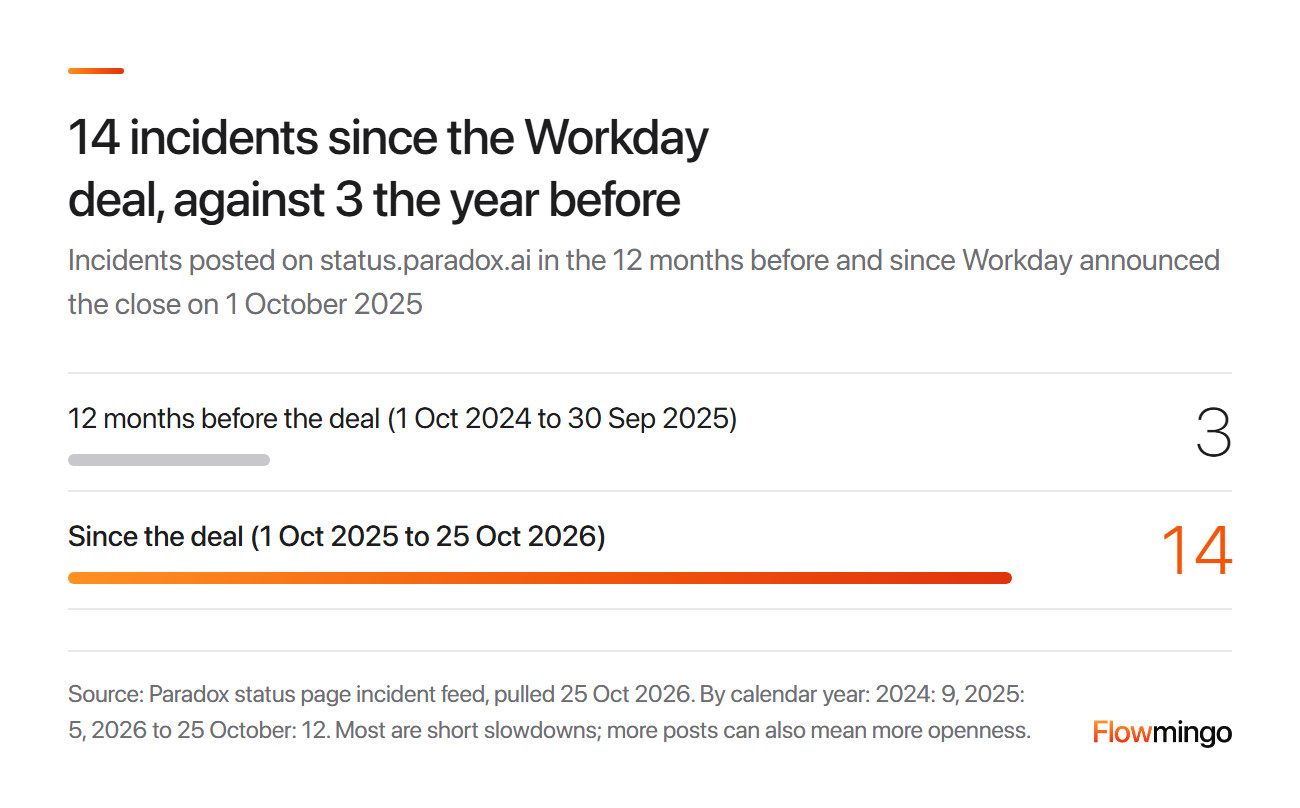
Status incidents: 3 from 1 Oct 2024 to 30 Sep 2025, against 14 from the deal to 25 Oct 2026. By calendar year from 2020: 2, 2, 6, 10, 9 and 5, then 12 in 2026 up to 25 October.
Most of the recent incidents were slowdowns rather than outages. Of the 14 since the deal, 8 describe slowness, 7 of them in the Candidate Experience Manager, the app recruiters work in. The worst, on 4 June 2026, took the app and its API down for about 18 minutes.
More posts can mean more openness, not only more failures. Still, for a team that hires through the night, it is worth getting the uptime commitment and service credits in writing.
8. What do Paradox recruiting reviews say about scheduling, reporting and support?
Reviewers praise Olivia's scheduling, the text-first experience for candidates and the support team. The complaints that repeat are weak reporting, candidate questions the bot cannot answer, and a price that is high for small teams.
SelectSoftware Reviews publishes 3 named user reviews, from an HR representative at Dollar General, an HR freelancer and the FedEx HR services manager.
The freelancer and the FedEx manager praise how it keeps candidates engaged, the Dollar General reviewer praises its efficiency during mass hiring, and 2 of the 3 single out the scheduling.
The same reviewers raise 2 recurring problems, each mentioned twice: the AI struggles with complex or unusual candidate questions, and reporting or filtering falls short.
The Dollar General reviewer adds that candidates sometimes felt less committed and missed interviews.
The site's editors praise the implementation team, which often fixes problems the same day, but they find the analytics weak. On G2, a large software review site, Paradox averages 4.5 out of 5 across 94 reviews, by Hirevire's count.
Applicants see Paradox from the other side. The Reddit searches Google suggests for Paradox are candidates' questions, such as "is paradox ai legit", and Paradox even keeps a fraud page warning about fake recruiters who use its name.
That points to something easy to forget: your applicants meet your assistant before they meet you.
Paradox lets you set its voice, tone and photo, and on the Conversational ATS page, for example, applicants at Flynn Group, a restaurant franchise operator, hear from "Frankie". Put your own brand on the first text, and tell applicants that a real manager will follow.
Olivia can also work a little too well. One franchise on Paradox's franchise hiring page switched off its assistant, "Mia", because applications flooded in. Size your managers' interview slots before you switch it on, because Olivia can fill a calendar faster than a store can staff interviews.
Then use the demo to test the weak spots the reviews describe. Ask the rep to filter last month's applicants by experience and skills, the report the FedEx reviewer could not run, and ask what Olivia does with a question it cannot answer.
9. Which Paradox recruiting alternatives publish prices for a team that hires less?
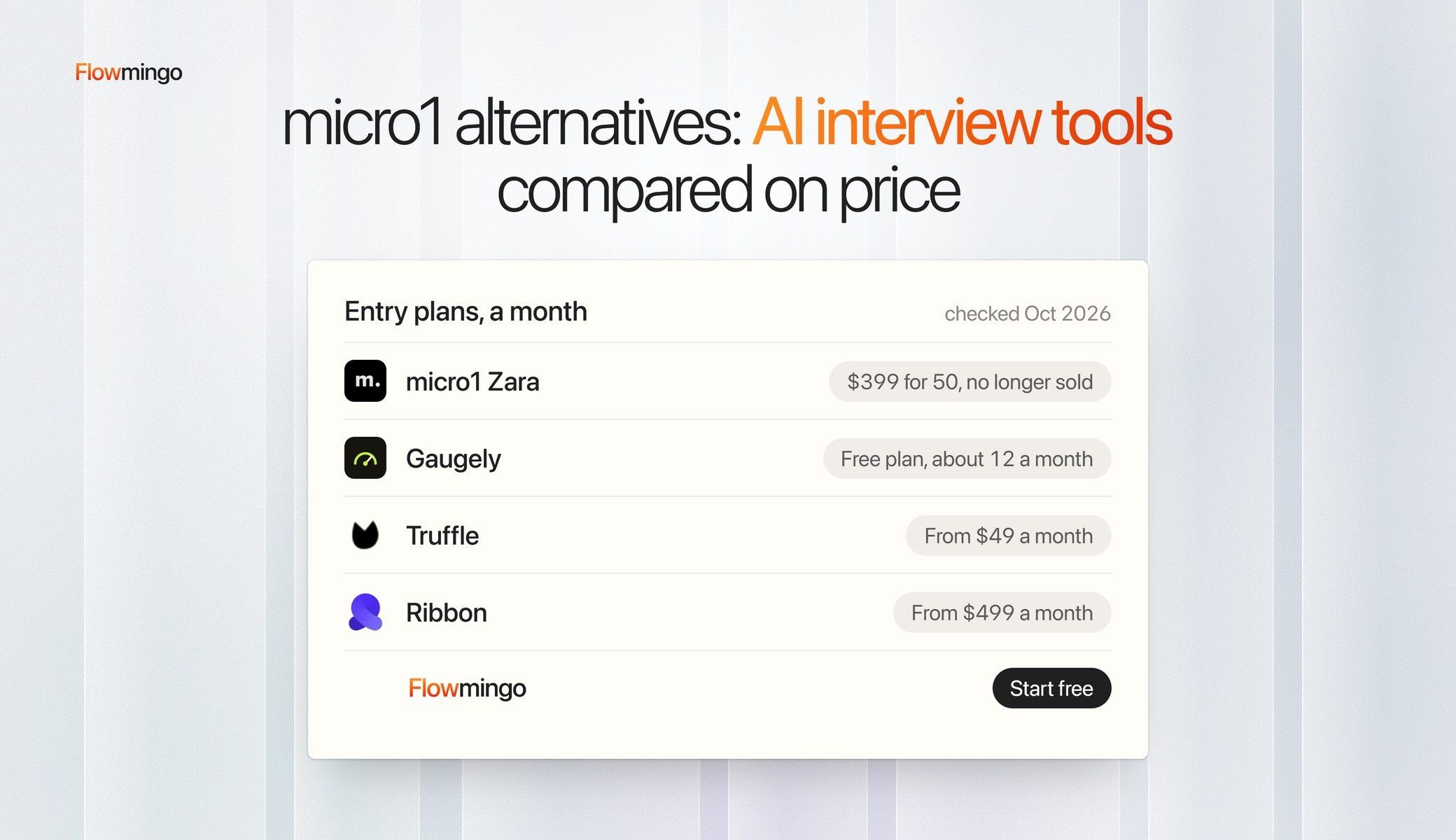
If you want what Olivia does across many sites, Fountain is an option, and it does not publish a price either. If what you need is help judging candidates without a yearly order form, 4 tools we read publish their prices, from $39 to $499 a month.
None of them is a like-for-like copy, because Paradox handles texting and scheduling across thousands of sites, while most priced tools are built around a self-paced interview, the step that took 60 manager hours in the section 6 example.
The table below reads each vendor's own pricing page.
| Tool | Main job | Published price, 25 October 2026 | Limit that bites first | Trial |
|---|---|---|---|---|
| Hirevire | One-way video interviews, scored against your rubric | From $39 a month, billed yearly | 1 job and 300 interviews a year on the entry plan | 7 days |
| Truffle | CV screening, one-way interviews and assessments | From $49 a month, billed monthly only | Starter: 200 credits a month, about 40 finished interviews, no overage | 7 days, 30 credits |
| Spark Hire | Live and one-way video interviews | From $249 a month billed yearly ($299 month to month) | Month-to-month plan: 5 jobs and 5 users | None listed; monthly plan bought online |
| Ribbon | AI voice and video interviews, SMS and WhatsApp outreach | From $499 a month, billed yearly | 2 seats, 2 roles, 100 interviews a month | 7 days |
| Fountain | Frontline hiring, onboarding and retention | Quote only | Price after a demo | Not listed |
Of the 4 priced tools, 3 let you try them for 7 days before you pay, while Paradox's standard terms bill a full year up front.
Volume changes the maths, and so does timing. Suppose you need 1,200 first-round interviews a year. Ribbon's $499-a-month plan in the table, which it calls Growth and which includes 100 interviews a month, covers them for $5,988 a year, but only if they arrive evenly through the year.
Bunch them into a 3-month summer peak of 400 a month instead: that is 300 over the plan's 100-a-month allowance each month, or 900 in all.
Each of those costs Ribbon's overage fee, $4 an interview on its pricing page, which adds $3,600 and brings the year to $9,588. Our AI interview cost per candidate guide explains that peak effect, and prices the same plans at 100, 1,000 and 10,000 interviews a year.
At the cheap end, Hirevire's Professional plan, the step above the $39 entry plan in the table, covers 1,200 interviews for $99 a month, or $1,188 a year. Paradox's reported floor is about 10 times that yearly price before any setup fee, and it buys scheduling rather than scored interviews.
10. Is Paradox worth it at our hiring volume, or do we need something lighter?
Paradox recruiting software is worth it if you hire hundreds of hourly workers a month across many sites, especially if you already run Workday. If you hire a few dozen people a year, a 5-figure floor buys automation you will barely use, because Paradox prices for scale.
Its strengths are real. Chipotle's chief human resources officer, Ilene Eskenazi, says in Workday's August 2025 release that time-to-hire fell 75%, from 12 days to 4.
By August 2025, Paradox had powered more than 189 million AI-assisted conversations with candidates, and a customer on Paradox's Workday page saved about $2 million on admin in under a year.
The case against is just as concrete: no published price, no refund if you cancel early, and interviews your managers still have to judge. The McHire lapse is a reason to insist on a security review, and the rising incident count is a reason to insist on an uptime clause.
Chipotle, which took 12 days to hire before Paradox, is the kind of customer Paradox is built for. For a 20-location business, the test is your own numbers, not Chipotle's.
If your sites together hire hundreds of hourly workers a month and booking is the bottleneck, a pilot makes sense. If either is not true, start with the priced tools in section 9.
Anyone hiring a few dozen people a year, from an agency recruiter to a 200-person company with 15 open roles, usually needs something lighter.
If you already run Paradox recruiting software, set a reminder 60 days before your renewal date, so the 30-day notice is never a rush. Our high volume recruiting guide covers the rest of the hiring funnel around it.
How Flowmingo helps
Flowmingo has no yearly order form to sign. Free costs $0 with no term, paid plans cancel anytime, and every price is on the pricing page. Every plan includes unlimited AI interviews, CV evaluation, tests and a full applicant tracking system for unlimited team members.
The trade-off on Free is branding: its sessions show Flowmingo's brand next to yours, and candidates may see optional offers. Paying $0.49 to sponsor an interview on the Free plan removes both from that interview.
On the Scale plan, at $4,069.80 a year, every interview is sponsored that way at no extra cost, within a fair-use limit. Before you sign a yearly order form for Paradox recruiting, test your next open role on Flowmingo.
11. Sources
Every price, clause and figure in this guide links to a source below, read on 25 October 2026 unless dated otherwise.
- Carroll, I., & Curry, S. (2025). Would you like an IDOR with that? Leaking 64 million McDonald's job applications. ian.sh.
- Fountain. (2026). Pricing. Retrieved October 25, 2026.
- HireVue. (n.d.). Master services agreement, version 2.2. Retrieved October 25, 2026.
- Hirevire. (2026). Pricing. Retrieved October 25, 2026.
- Hirevire. (2026, October 7). Paradox.ai review 2026: Pricing, reviews and alternatives. Hirevire.
- Krebs, B. (2025, July 17). Poor passwords tattle on AI hiring bot maker Paradox.ai. KrebsOnSecurity.
- Noon. (2026). Paradox AI pricing 2026. Noon.
- Paradox. (2025, July 9). Responsible security update. Paradox.
- Paradox. (2026). Home page, Text apply, Candidate Experience Agent, Screening and Video. Retrieved October 25, 2026.
- Paradox. (2026). Franchise hiring and Conversational ATS. Retrieved October 25, 2026.
- Paradox. (2026). Paradox for Workday, Security, US data processing addendum and Fraud notice. Retrieved October 25, 2026.
- Paradox. (2026, January 12). Terms of service. Paradox, LLC.
- Paradox. (2026, August 5). Sub-processor list. Paradox.
- Paradox. (2026). Status page incident history. Retrieved October 25, 2026.
- Prepzo. (2026). Paradox AI pricing. Prepzo.
- Ribbon. (2026). Pricing. Retrieved October 25, 2026.
- SelectSoftware Reviews. (2026). Paradox reviews. Retrieved October 25, 2026.
- Spark Hire. (2026). Pricing. Retrieved October 25, 2026.
- Truffle. (2026). Pricing. Retrieved October 25, 2026.
- Truffle. (2026, October 7). Paradox AI pricing in 2026, now under Workday. Truffle.
- USAspending.gov. (2021). Contract 36C24821P0593: Virtual job fair hosting service, Department of Veterans Affairs. Retrieved October 25, 2026.
- Workday. (2025, August 21). Workday signs definitive agreement to acquire Paradox [Press release, Form 8-K exhibit 99.1]. U.S. Securities and Exchange Commission.
- Workday. (2025, October 1). Workday completes acquisition of Paradox. Workday Newsroom.
- Workday. (2025, November 4). Workday completes acquisition of Sana. Workday Newsroom.
- Workday. (2026). Annual report on Form 10-K for the fiscal year ended January 31, 2026. U.S. Securities and Exchange Commission.
- Workday. (2026). Paradox for Workday Recruiting [Solution brief]. Retrieved October 25, 2026.