
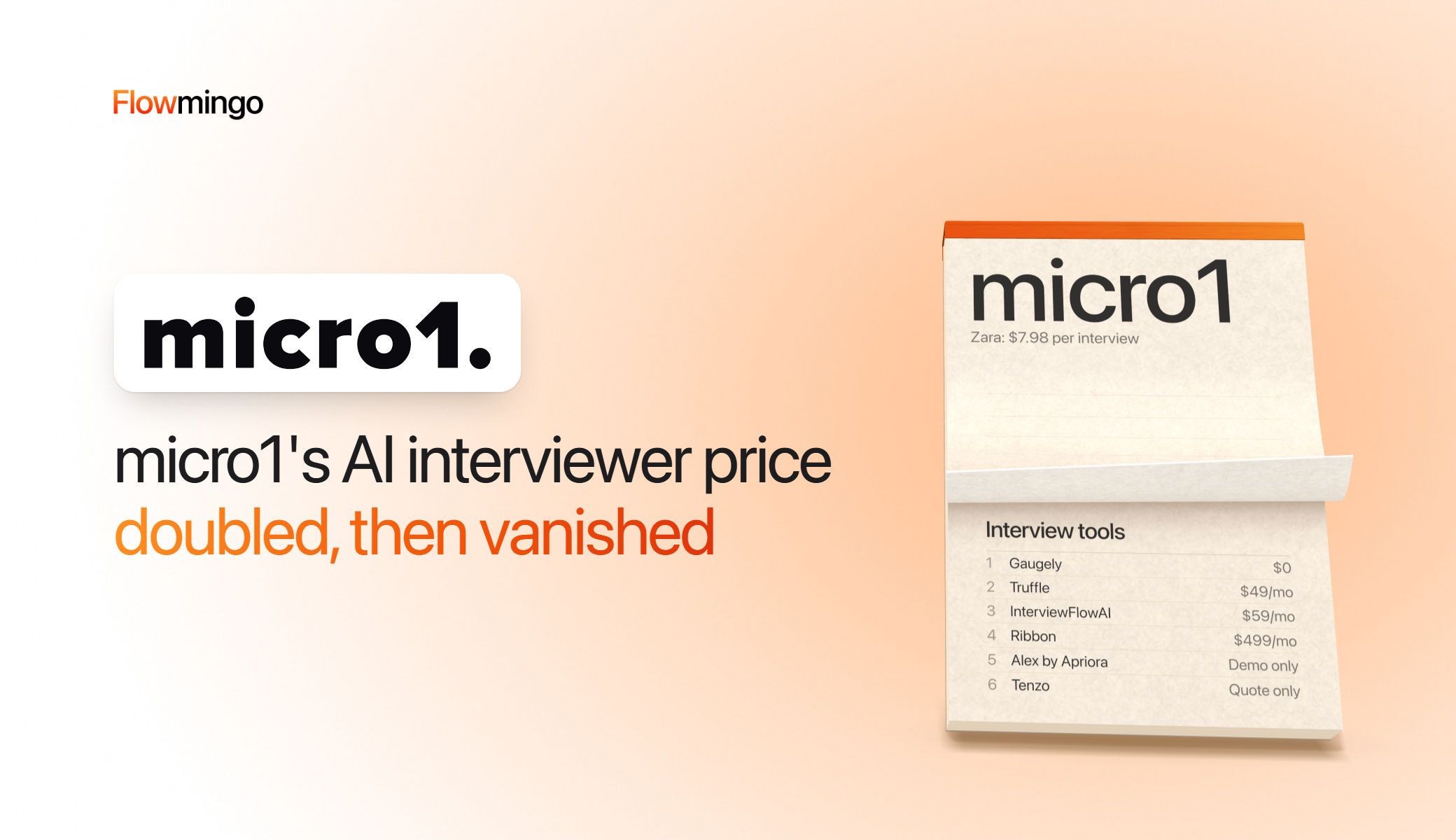
You run first-round screens on Zara, and your renewal is close. You open micro1.ai to price micro1 alternatives against it, and land on a page about AI training data.
That redirect is not a glitch. The micro1 Zara product page, its pricing page and the AI interviewer page all redirect now. The employer contract has left micro1's Legal Center too.
The last public plan gave you 50 AI interviews a month for $399, the price that bought 100 in July 2025. The archived contract let micro1 delete your data 30 days after the term ends, so a late switch can cost you every report and recording.
This guide fixes that in 3 moves: date what changed, price Zara against its rivals, and switch without losing reports. The rivals are 5 AI interview tools and Truffle's one-way video. We sell a competing product, so every number links to a source.
Key takeaways
- Can we still buy Zara from micro1? Not from its sales pages. The main /zara page has redirected to the homepage since at least 25 May 2026, and no price is published, though the sign-up page still loads.
- What did the micro1 Zara AI interviewer cost? $399 a month for 50 AI interviews in January 2026, or $7.98 each. In July 2025 the same price bought 100.
- Which micro1 alternatives publish a price? 4 of the 6 rivals we checked, with entry plans from $0 to $499 a month.
- Are there free micro1 alternatives? Yes. Gaugely's $0 plan covers about 12 interviews a month, and ours has no interview cap.
- Who owns our applicants' interview results? Unclear. micro1's candidate terms of 21 July 2026 give it the results, but the archived employer contract said you own your data, so ask in writing.
1. We screen applicants on Zara: do we need micro1 alternatives now?
Yes: every page that sold Zara on micro1's website now redirects to the homepage, the main /zara page since at least 25 May 2026. Only the sign-up page and the API docs still load.
We requested each page on 25 October 2026 and recorded the status code it returned. A 301 means the page has moved for good, a 404 means it no longer exists, and a 200 means it loads.
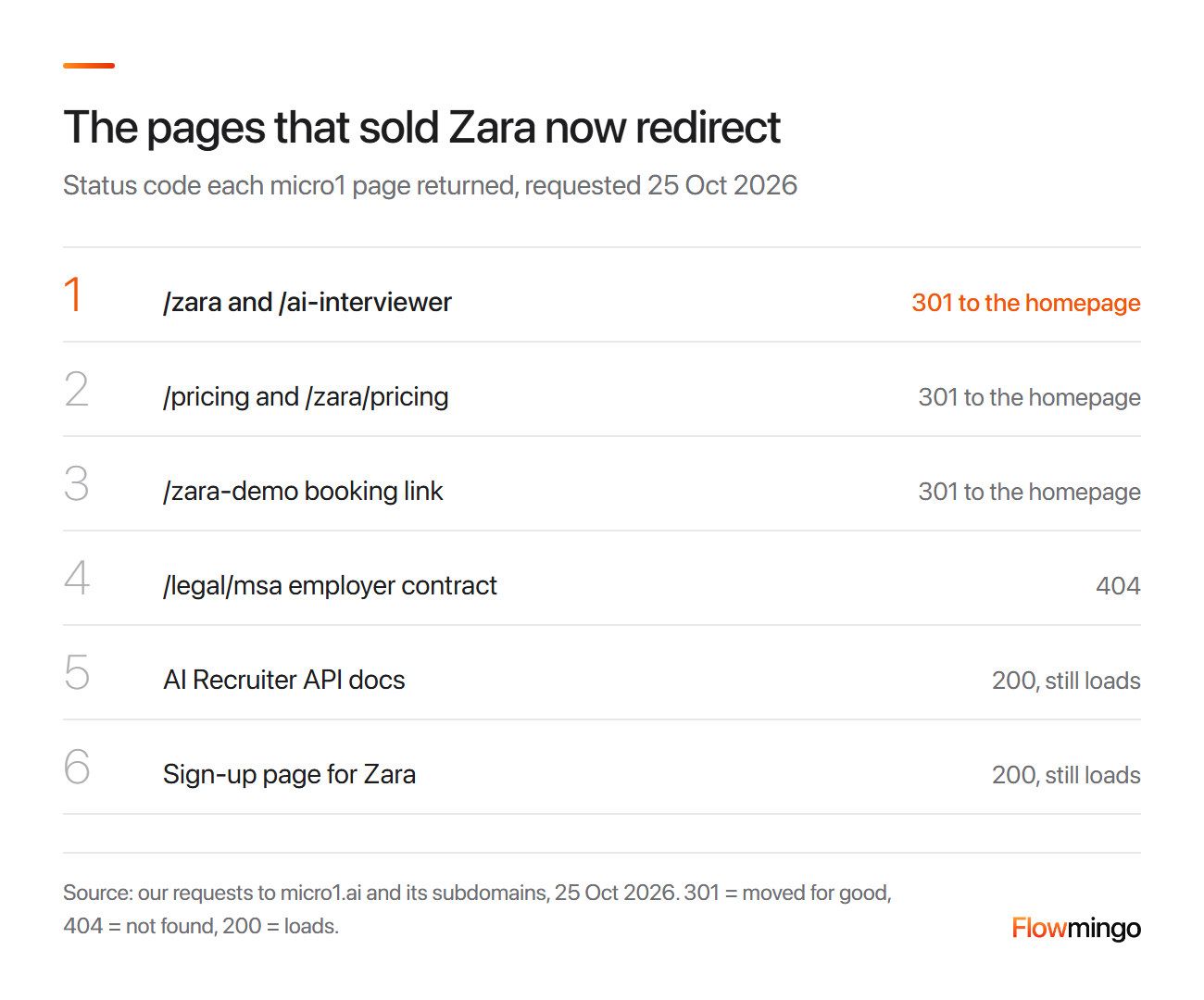
Zara's pages on 25 Oct 2026: 5 sales pages, from /zara and /ai-interviewer to the /zara-demo booking link, return 301 to the homepage. The /legal/msa employer contract returns 404, while the API docs and sign-up page return 200.
The Wayback Machine dates the change. Its last capture of a live Zara page is from 19 February 2026, and its first capture of the redirect is from 25 May 2026.
We found no announcement that Zara is closing. The live AI Recruiter API docs suggest some customers still use it, because they still list calls to fetch reports and recordings. So the honest answer is narrower than "Zara is dead": the company stopped marketing Zara and publishing its price and contract.
If you run Zara today, ask your micro1 contact 3 things in writing. Ask whether Zara is still sold to outside employers, what support covers the rest of your term, and how you export every report and recording. The answers tell you whether you have a year or a month, and the email in section 9 asks all 3.
2. Is micro1 still an AI recruiter, or an AI data company now?
It is an AI data company now. Its homepage title reads "Data lab to train frontier models & evaluate agents", and Zara mainly vets experts for the company's own projects.
The company began as an AI recruiting business, and employers paid a monthly plan to run Zara on their own applicants. Then AI labs started paying for expert human data from doctors, lawyers and scientists. Because it already had a machine for vetting experts at scale, it pointed that machine at its own hiring.
TechCrunch reported in December 2025 that Zara "now interviews and vets applicants seeking expert roles on the platform". You can watch the shift on the homepage, whose June 2025 title read "AI recruitment engine to hire top global talent". We counted the word "Zara" in each Wayback capture since.
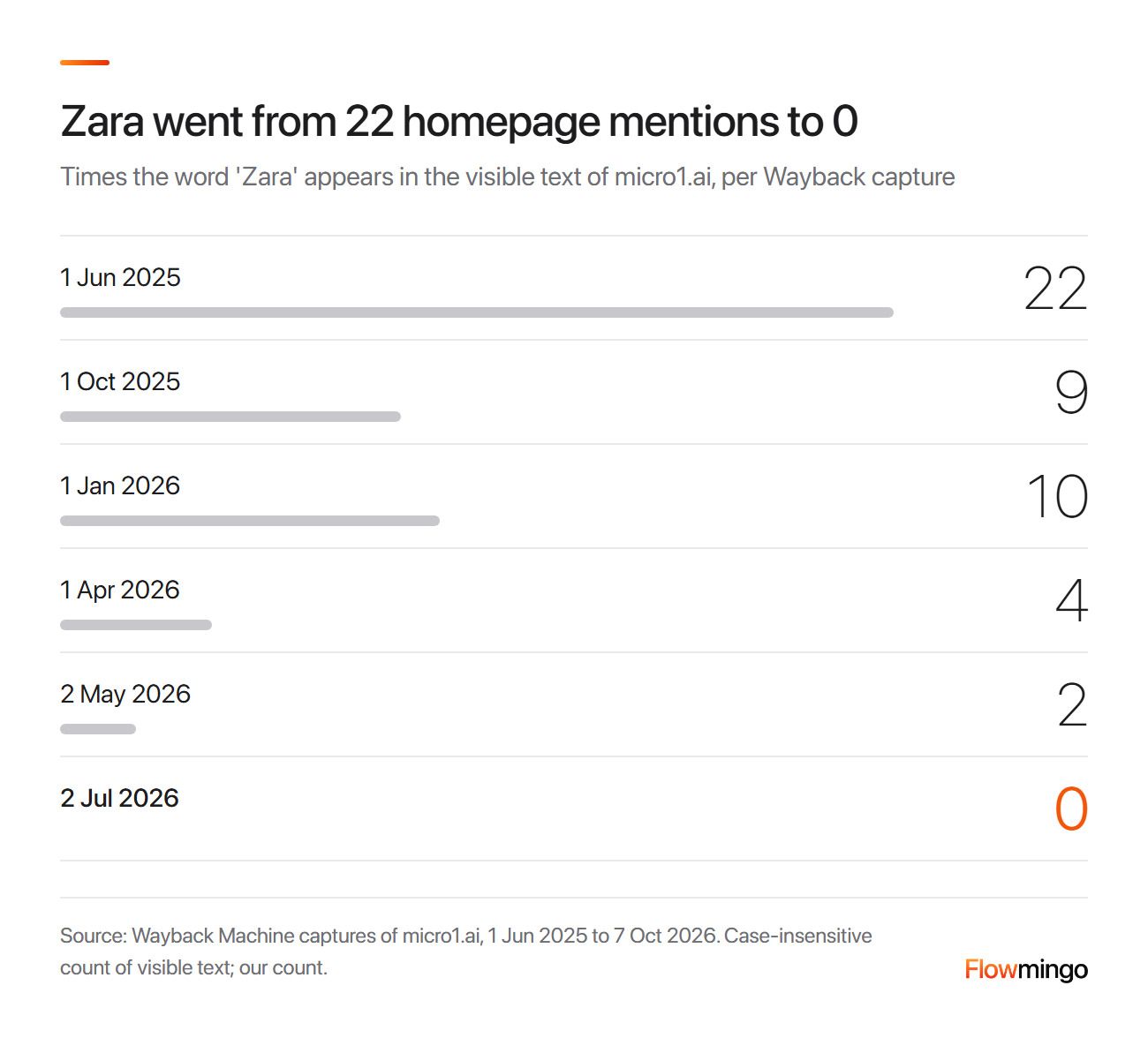
Zara on micro1's homepage: 22 mentions (1 Jun 2025), 9 (1 Oct 2025), 10 (1 Jan 2026) and 4 (1 Apr 2026). Then 2 (2 May 2026) and 0 from 2 Jul 2026.
The count halved between June and October 2025 and held near 10 into January 2026. It fell to 4 in April and 2 in May, the month /zara began redirecting, and reached 0 by July. It stayed at 0 through October 2026, and here is the full record.
| Date | What changed | Source |
|---|---|---|
| 16 Jul 2025 | Pricing page lists 2 Zara plans, at $89 and $399 a month | Wayback |
| 12 Sep 2025 | $35M Series A at a $500M valuation, AI interviews 1 of 3 pillars | micro1 |
| 4 Dec 2025 | Says it passed $100M in annual recurring revenue | TechCrunch |
| 14 Jan 2026 | Zara Growth cut from 100 to 50 interviews a month, same monthly price | Wayback |
| 25 May 2026 | /zara first captured as a redirect | Wayback |
| 2 Jul 2026 | Homepage first captured with the title "Data lab to train frontier models & evaluate agents" | Wayback |
| 20 Aug 2026 | $500M gross annual run rate | TechCrunch |
| 23 Sep 2026 | Over $100M raised at a $4B valuation | Forbes Australia |
Forbes Australia, citing 2 people familiar with the deal, reports the $4 billion raise. It describes the original recruiting business as earning roughly $7 million a year.
TechCrunch puts the gross run rate at $500 million in August 2026. In our reading, Zara is now an internal tool with some outside users, and its roadmap likely follows the experts micro1 vets for AI labs.
3. What did the micro1 Zara AI interviewer cost per interview?
There is no price on micro1.ai today. The last public plan, captured on 14 January 2026, worked out at $7.98 an interview on monthly billing, double the July 2025 price.
Both pricing pages now redirect, so the archive is the only record. The table works out the cost of 1 interview from each plan's price and monthly allowance.
| Plan, date captured | Monthly | Yearly | AI interviews a month | Per interview, monthly or yearly billing |
|---|---|---|---|---|
| Early stage, 16 Jul 2025 | $89 | $801 | 20 | $4.45 or $3.34 |
| Growth, 16 Jul 2025 | $399 | $3,591 | 100 | $3.99 or $2.99 |
| Growth, 14 Jan 2026 | $399 | $3,591 | 50 | $7.98 or $5.99 |
| Custom, 14 Jan 2026 | Quote | Quote | "Higher Interview Volumes" | Not published |
| Any plan, 25 Oct 2026 | Not published | Not published | Not published | Not published |
Yearly figures divide the yearly price by 12 months of allowance, by our arithmetic. The sources are Wayback captures of micro1's pricing page on 16 July 2025 and the Zara pricing page on 14 January 2026.
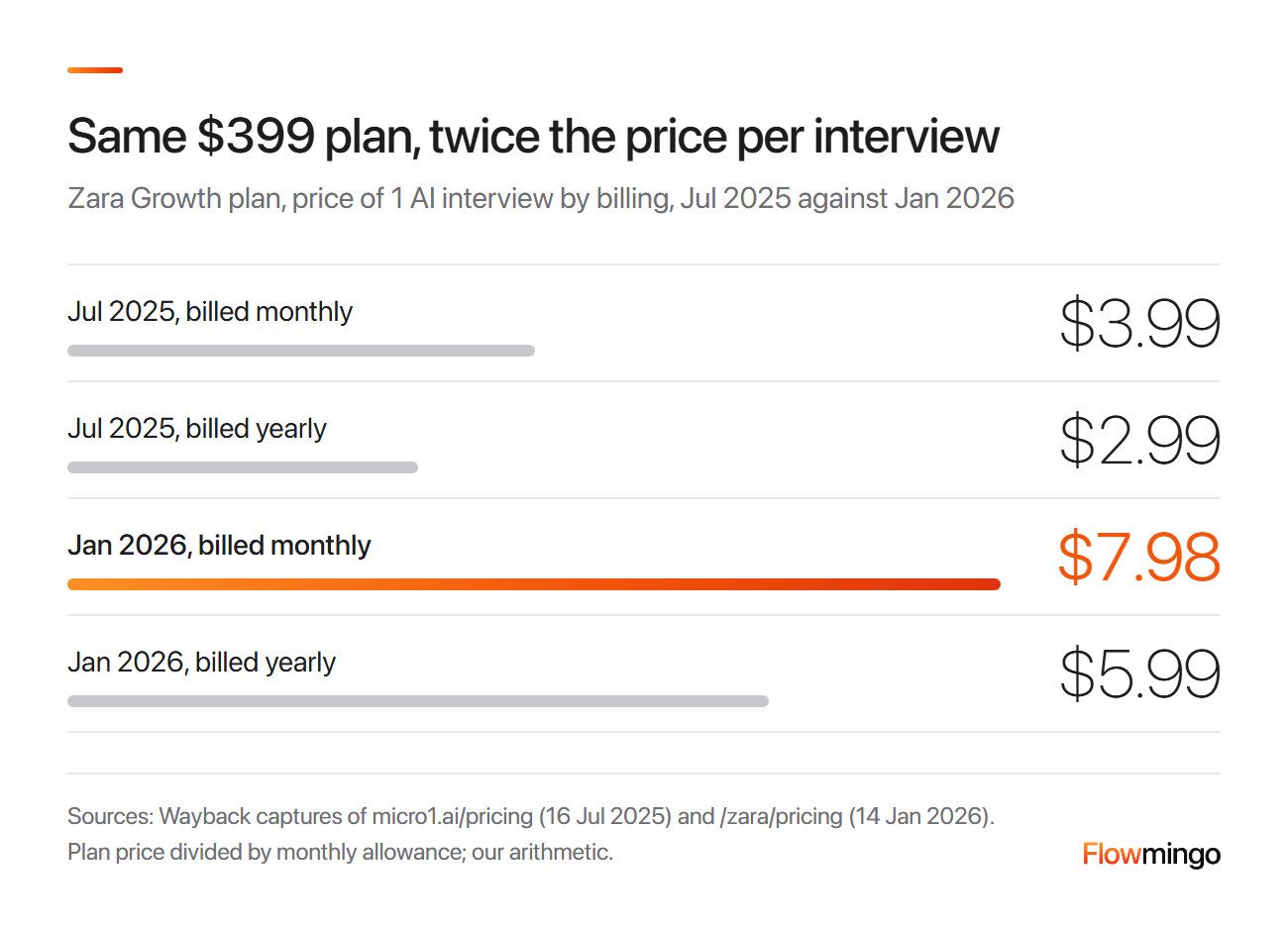
Zara Growth, price per AI interview: $3.99 billed monthly and $2.99 billed yearly in July 2025. In January 2026, the same plan cost $7.98 monthly and $5.99 yearly.
4 things changed between those 2 captures. The $89 entry plan disappeared, and the Growth plan kept its price but halved its allowance from 100 to 50 interviews.
The 3-day trial button became "Get Started". The custom plan, which in July 2025 started above 100 interviews a month, now promised only "Higher Interview Volumes" with no number.
The January plan still bundled unlimited AI resume screening, ATS import, skill assessments and screening questions. It also listed checks in 33+ candidate languages and 5 exercise types.
Here is a worked example. Say you screen 50 a month on yearly billing. The July 2025 yearly fee covered 1,200 interviews, or $2.99 each, while the January 2026 fee covered 600, or $5.99 each.
Grow to 80 a month and the only plan above Growth's 50 was Custom, with no public price to hold other tools against. HeroHunt also reports an earlier product, GPT-Vetting, at $149 a month with the first 10 interviews free.
4. Which micro1 alternatives can run AI interviews on our own applicants?
5 micro1 alternatives run AI interviews for employers the way Zara did, and Truffle records one-way video answers rather than running an AI conversation. Gaugely, InterviewFlowAI, Truffle and Ribbon publish prices, while Alex by Apriora and Tenzo quote after a demo.
Most lists of micro1 alternatives mix expert data platforms like Mercor with recruiting tools you run on your own applicants. If you used Zara to screen candidates, only the second kind replaces it.
| Tool | Entry price | Interviews included | Trial or $0 plan |
|---|---|---|---|
| Gaugely | $0, or Pro at $75 a month | About 12 a month free, about 100 on Pro | $0 plan |
| InterviewFlowAI | Pilot at $59 a month | 20 credits, or 303 on Growth at $299 | 7 days, 10 credits |
| Truffle (one-way video) | Starter at $49 a month, billed monthly | 200 credits, 5 per video interview | 7 days, 30 credits |
| Ribbon | Growth at $499 a month, billed yearly | 100 a month, then $4.00 each | 7 days |
| Alex by Apriora | Demo only | Not published | Not listed |
| Tenzo | Quote only | Not published | Not listed |
Prices come from the Gaugely, InterviewFlowAI, Truffle, Ribbon, Alex by Apriora and Tenzo pricing pages, read on 25 October 2026. On yearly billing, Gaugely Pro drops to $60 a month, InterviewFlowAI Growth to $250 and Ribbon Growth to $499, from $599.
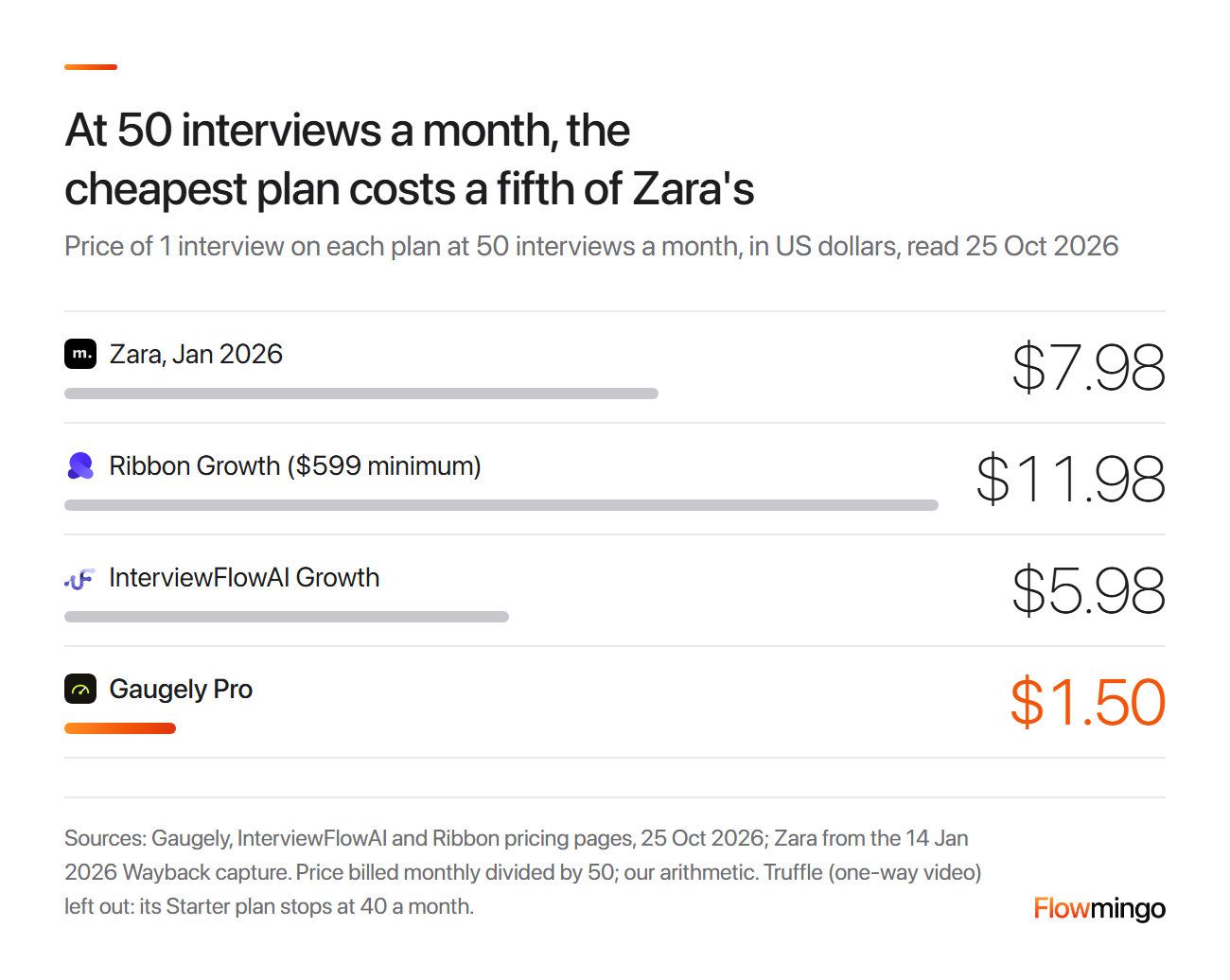
Price of 1 interview at 50 a month, billed monthly: Zara's January 2026 plan cost $7.98. Ribbon Growth works out at $11.98, InterviewFlowAI Growth $5.98 and Gaugely Pro $1.50.
The chart prices every plan at Zara's 50 interviews a month, billed monthly. Ribbon Growth works out at $11.98 an interview, above Zara's $7.98, because you pay for 100. InterviewFlowAI Growth comes to $5.98, and Gaugely Pro to $1.50, about a fifth of Zara's price.
Volume changes the order. Use the whole allowance and Ribbon drops to $5.99 an interview, InterviewFlowAI Growth to $0.99 and Gaugely Pro to about $0.75.
Truffle is left out because its Starter plan stops at 40 finished interviews a month. It states its own range of $0.62 to $1.25 for a one-way video interview with no AI conversation.
Then check the limits. Ribbon offers video and voice in 10+ interview languages but allows 2 seats and 2 active roles. Gaugely caps minutes and InterviewFlowAI caps credits.
At 50 a month, Zara's January plan cost $3,591 a year, Ribbon Growth $5,988 (its minimum, up to 100) and Gaugely Pro $720. For the same method at 100, 1,000 and 10,000 interviews, see our guide to AI interview cost per candidate.
5. Are there free micro1 alternatives for a small hiring team?
Yes, Gaugely has a $0 plan for about 12 interviews a month, and the 7th tool, Flowmingo, is in the box below. Zara's last public plan, in January 2026, showed no trial and no $0 tier.
Read the limit before you start, because a trial ends on a date and a free plan ends at a volume or not at all.
The July 2025 Zara plan had a 3-day trial. InterviewFlowAI, Truffle and Ribbon each offer 7 days, and those trials cap volume too. InterviewFlowAI's gives 10 credits to an eligible business email, and Truffle's gives 30 credits, enough for 6 video interviews, with no card.
Gaugely, the only $0 plan among the 6 rivals, gives a pool of 120 interview minutes a month, roughly 12 interviews. For example, a role with 40 applicants would use about 3 months of that pool if every applicant interviewed.
That is fine for a slow role and too slow for a busy one. Count your monthly applicants before you rely on any capped plan, and start a 7-day trial on a role with applicants already waiting.
How Flowmingo helps
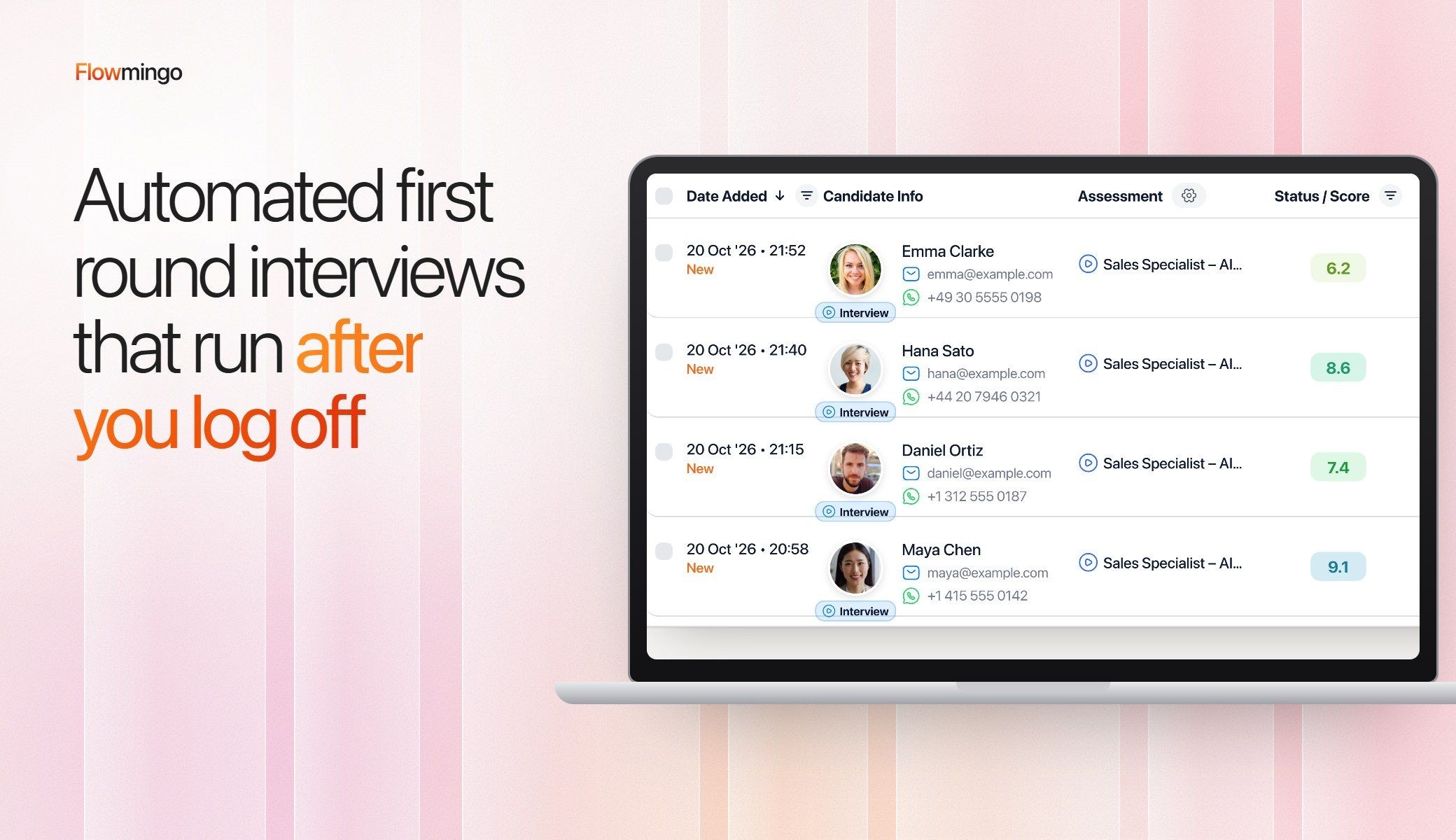
Flowmingo is a free AI hiring platform, and its Free plan has no cap on AI interviews and no end date. Each applicant takes the AI interview when it suits them, and you receive the recording, a transcript and a scored evaluation. The interview runs in 60+ languages.
On Free, results, scores and transcripts are kept, while video keeps the latest 300 recordings for 30 days. Downloads of reports and videos start on Starter, so move to a paid plan before you need older recordings.
The trade-off sits on the pricing page: free sessions show Flowmingo's brand beside yours, and candidates may see optional offers. Sponsoring a session removes both, at $0.49 on Free, $0.44 on Starter or $0.39 on Growth, and technical tests cost double. Our Flowmingo vs micro1 page lines the 2 up feature by feature.
6. Who are micro1's competitors, and which of them sell AI interviews?
In AI training data, the press names Scale AI and Mercor as micro1 competitors. For AI interviews on your own applicants, the micro1 alternatives we could check and price are in section 4.
Google suggests Mercor, Data Annotation, Scale AI, Outlier, Alignerr, Turing and Handshake after "micro1 vs", and each runs paid expert or contractor work for AI. "micro1 vs mercor" gets about 110 searches a month worldwide, by Google Keyword Planner's 12-month average.
The press agrees. A September 2025 TechCrunch headline called it "a competitor to Scale AI". Its August 2026 report says "Like Mercor, Micro1 began as an AI recruiting startup."
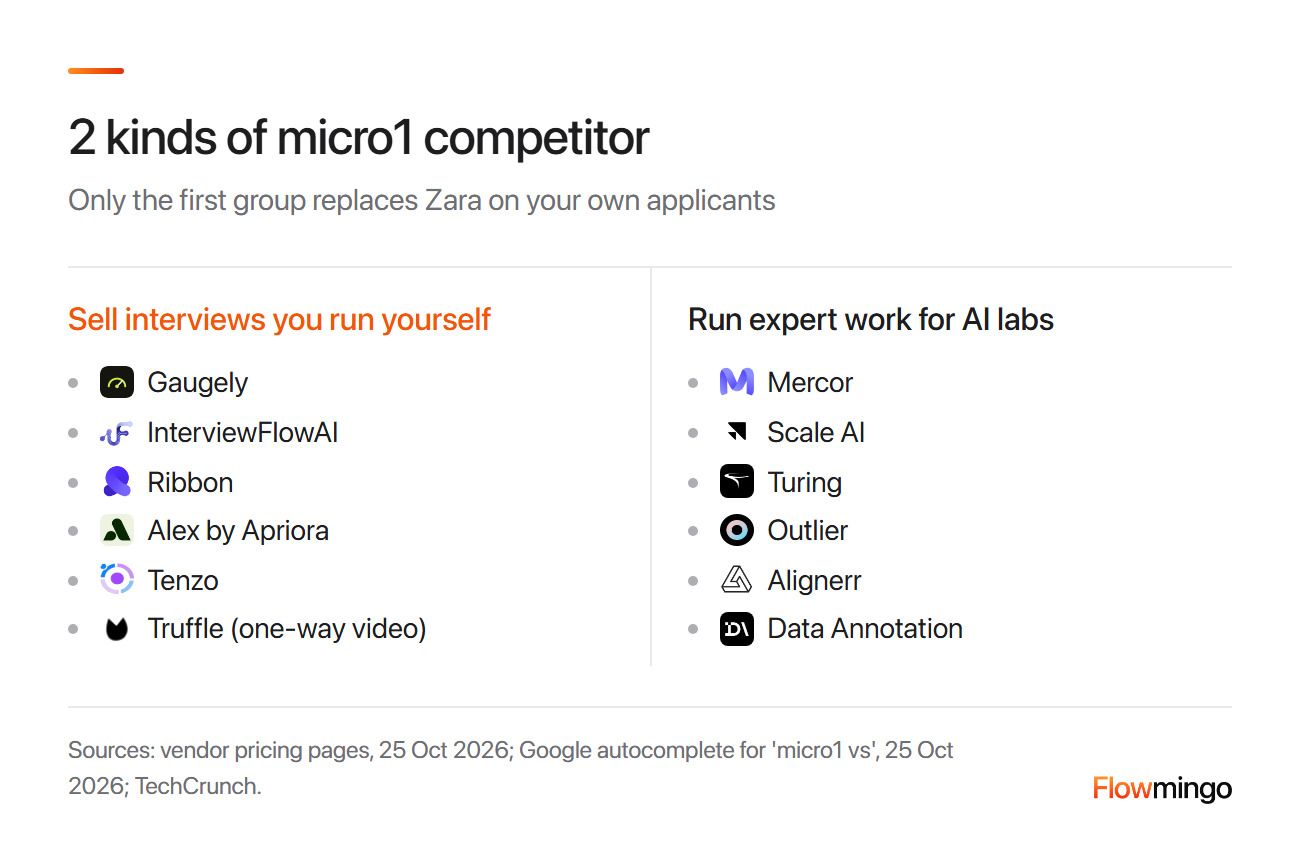
micro1 competitors: Gaugely, InterviewFlowAI, Ribbon, Alex by Apriora and Tenzo sell AI interviews you run yourself, and Truffle sells one-way video. Mercor, Scale AI, Turing, Outlier, Alignerr and Data Annotation run expert work for AI labs.
We did not verify whether Mercor or Scale AI sell an AI interviewer to outside employers, and neither publishes a price for one. So split your shortlist by the job you need done:
- You are an AI lab or a model team. You need experts to write or grade tasks, so compare micro1, Mercor, Scale AI and Turing.
- You need contract engineers. Developer marketplaces such as Arc.dev, Toptal and Turing fill 3 of the top 10 lists, from eesel, Second Talent and ReactSquad.
- You recruit for your own roles. You have 300 applicants and need a first-round screen, so compare the tools in section 4.
That is why the top results disagree. Troveo lists data providers, eesel and ReactSquad list developer marketplaces, and Interview Sidekick lists interview copilots for job seekers. The data vendors are the wrong comparison for a recruiter, because Second Talent lists Mercor, Scale AI and Turing as sales-led with no published price.
7. What do micro1 reviews say from employers, not just candidates?
Most micro1 reviews come from candidates and contractors, not employers. Trustpilot showed 10,995 reviews and a 4.7 TrustScore on 25 October 2026.
"micro1 reviews" gets about 1,600 searches a month worldwide, by Google Keyword Planner's 12-month average. Google's suggestions add reddit, glassdoor, philippines and jobs, so these are people deciding whether to apply for paid expert work.
Of the 10,995 Trustpilot reviews, 83% gave 5 stars and 3% gave 1 star. The reviews we read come from candidates and contractors, and we found none from hiring companies.
That view still matters, because your candidates sit the interview. A high score from thousands of candidates and contractors suggests the company treats the people it vets well. The score covers its paid work as well as Zara.
Capterra and G2 both blocked our automated check, so we do not quote their numbers. InterviewFlowAI's alternatives page says the Capterra reviews come mostly from contractors and annotators.
The February 2026 Zara page carried 3 named customer quotes. The COO of LegalSoft wrote that they "reduced our interview staff from 33 to 12" while running 10,000 interviews a month. Treat vendor quotes as claims, and ask each vendor for a reference call too.
8. Is micro1 legit, and who owns our candidates' interview data?
Yes, it is a real, well-funded company, so the open question is the contract. Its employer terms left the Legal Center by September 2026, and its candidate terms give it ownership of interview results.
The company announced a $35 million Series A at a $500 million valuation on 12 September 2025. Its CEO told TechCrunch in December 2025 that it had passed $100 million in annual recurring revenue.
Until at least 16 June 2026, the Legal Center listed "Master SaaS Terms of Service", the employer agreement for Zara. By 5 September 2026 it had gone, leaving website, candidate, contractor and referral terms.
8.1 What did the archived employer contract say?
The archived copy from 12 December 2025 is the last public version. Fees fell due 30 days after the invoice, could not be cancelled or refunded, and late invoices carried up to 1.5% interest a month.
The company could delete all customer data 30 days after the agreement ended. Its liability stopped at 12 months of fees, or $1,000 if greater. It also promised not to train any large language model on customer data.
Current customers may have signed this version or an older one, so ask micro1 for the copy you actually signed.
8.2 What do candidates agree to today?
The candidate terms, updated 21 July 2026, cover the "micro1 Zara Platform". Candidates consent to the recording of their answers, audio and video, and the terms give micro1 "all rights, title, and interest" in their interview results. It may use those results internally to improve its products, and a candidate's damages claim stops at $100.
The 2 documents clash: the employer contract said the customer owns its data, while the candidate terms give the results to micro1. This means you should ask in writing who owns your applicants' recordings and scores, and put the same question to each vendor you test.
The archived data processing addendum promised breach notice within 24 hours and 30 days' notice before a new sub-processor. Ask whether it still applies to your account.
9. How do we switch to micro1 alternatives without losing Zara reports?
Export first, then switch. The API docs still list calls for completed reports, interview recordings and saved interviews, and the archived contract allowed deletion 30 days after the end.
Cancel first and you may find nothing left to export, so make the export step 1:
- Pull your history. Use "Get all completed reports" and "Get interview recording" to save every report and video, starting with candidates still in process.
- Copy your question sets. "Get all saved interviews" returns the interviews you built, so paste their questions and skills into the new tool.
- Run 1 role in parallel. Keep Zara on your other roles and send the next 30 applicants for 1 open role through the new tool only. That beats InterviewFlowAI's 10 trial credits, Truffle's 6 trial interviews and Gaugely's 12 free a month. Use a paid month or an uncapped plan, and compare completion rate and time to shortlist with Zara's last 30.
- Update the candidate notice. Your careers page and invite emails should name the tool and say that AI records and scores the interview.
- Close the account in writing. Ask micro1 to confirm the end date, the deletion date and that your export is complete.
Say your Zara term ends on 31 December. Export in November, run the parallel role in early December, then move every new role before the term ends. Our guide to automated interview tools lists what to check in the parallel role.
Send this email to your micro1 account manager before you cancel anything, because the answers set your export deadline:
Subject: Zara account: support, export and data before our renewal
Hi [First name],
We are reviewing our Zara account before renewal. Please answer these in writing:
- Is Zara still sold to outside employers, and will it be for the rest of our term?
- What support covers our account until the term ends?
- How do we export every report and recording, by API or as a bulk export by email?
- Who owns our applicants' recordings and scores, our company or micro1?
- Can you send the copy of the contract we signed?
- Does the data processing addendum still apply to our account?
- What is our term's end date, and on what date will you delete our data?
- Will you confirm in writing once our export is complete?
Please reply by [date, 2 weeks before the renewal date].
[Your name], [Company]
It asks every question this guide raised, in order, in writing and before anything is cancelled, and it sets a reply date.
10. When is micro1 still the right choice for our hiring?
Choose micro1 if you need vetted experts or AI training data, which is its main business now. Choose it for AI interviews only if you already run Zara and get a written support commitment.
Be fair about what Zara does well. Its February 2026 product page listed interviews in 33+ candidate languages and anti-cheat checks for tab-switching, ChatGPT and an external monitor. It also listed an AI match score and claimed 650,000+ interviews run.
The January 2026 plan also listed coding and personality exercises. If you hire engineers in many countries, that feature set is the main reason to stay. For example, the February 2026 Zara page pitched vetting a support lead in Japan and a Python engineer in Brazil at the same time.
1 case study describes hiring 250 annotators in 30 days, with 25,000+ applications, 4,000+ AI interviews and 290 people sent to the client.
The case against is about fit, not quality. Zara now serves the company's own expert hiring first, its public price rose per interview and then disappeared, and its employer contract is offline.
If micro1 is your expert or data supplier, stay and compare it with Mercor and Scale AI. If Zara runs your first-round screen, keep it until your term ends and test 1 tool from section 4 on your next open role.
How Flowmingo helps
If you are choosing for the first time, run the section 9 parallel test on a plan whose price you can read today. Flowmingo's plans are public: Free at $0, Starter $42, Growth $84 and Scale $339 a month billed yearly, with cancellation anytime. Its AI Interviewer runs on your own applicants, so test it beside the other micro1 alternatives on Flowmingo.
11. Sources
Every price, date and quote in this guide links to a source below. Per-interview prices are our arithmetic: each plan's price divided by the interviews it includes.
- Apriora. (2026). Alex AI: Book a demo. Retrieved October 25, 2026.
- eesel. (2026). micro1 alternatives. Retrieved October 25, 2026.
- Forbes Australia. (2026, September 23). This 25-year-old raised US$100 million for his AI startup at a US$4 billion valuation. Forbes Australia.
- Gaugely. (2026). Pricing. Retrieved October 25, 2026.
- Google. (2026). Autocomplete suggestions, US English. Retrieved October 25, 2026.
- Google. (2026). Keyword Planner, 12-month averages. Retrieved October 25, 2026.
- HeroHunt. (n.d.). micro1 recruiting pricing. HeroHunt. Retrieved October 25, 2026.
- Internet Archive. (2025-2026). Wayback captures of the micro1.ai homepage. Wayback Machine.
- Interview Sidekick. (2026). micro1 alternatives. Retrieved October 25, 2026.
- InterviewFlowAI. (2026). 15 best micro1 alternatives in 2026. InterviewFlowAI.
- InterviewFlowAI. (2026). Pricing. Retrieved October 25, 2026.
- micro1. (2025, September 12). micro1 raises $35M. micro1.
- micro1. (2025, November 25). Master SaaS terms of service. Archived December 12, 2025, Wayback Machine.
- micro1. (2025). Data processing addendum. Archived December 12, 2025, Wayback Machine.
- micro1. (2025). Pricing. Archived July 16, 2025, Wayback Machine.
- micro1. (2026). Zara pricing. Archived January 14, 2026, Wayback Machine.
- micro1. (2026). Zara. Archived February 19, 2026, and redirect captured May 25, 2026, Wayback Machine.
- micro1. (2026, July 21). Candidate terms and conditions. Retrieved October 25, 2026.
- micro1. (2026). Legal Center. Retrieved October 25, 2026, with Wayback captures of June 16 and September 5, 2026.
- micro1. (2026). AI Recruiter API: Introduction. Retrieved October 25, 2026.
- micro1. (2026). Volume hiring case study: 250 annotators in 30 days. Retrieved October 25, 2026.
- ReactSquad. (2026). micro1 alternatives. Retrieved October 25, 2026.
- Ribbon. (2026). Pricing. Retrieved October 25, 2026.
- Second Talent. (2026, October). micro1 alternatives for startups. Second Talent.
- TechCrunch. (2025, September 12). micro1, a competitor to Scale AI, raises funds at $500M valuation. TechCrunch.
- TechCrunch. (2025, December 4). micro1, a Scale AI competitor, touts crossing $100M ARR. TechCrunch.
- TechCrunch. (2026, August 20). AI data startup micro1 reaches $500M gross run rate amid AI training boom. TechCrunch.
- Tenzo. (2026). AI recruiter pricing. Retrieved October 25, 2026.
- Troveo. (2026). micro1 alternatives. Retrieved October 25, 2026.
- Truffle. (2026). Pricing. Retrieved October 25, 2026.
- Trustpilot. (2026). micro1 reviews. Retrieved October 25, 2026.