
A realistic job preview is an honest picture of a job, its good and its hard parts, given to applicants before they accept it. That way, people who would not like the job can step out early.
Recruiters shorten the name to RJP. One is worth building when your new hires quit in their first weeks because the job was not what they pictured. That pattern is common in contact centres, retail and shift work, where weekends, targets and upset customers come with the role.
Key takeaways
- What does an RJP show? The good and the hard parts of the job. The US Office of Personnel Management (OPM) lists videos, talks, job tours and written brochures as formats.
- Why do early quits matter in shift work? In August 2026, by preliminary figures, 3.0% of US retail workers quit in a single month, against 1.9% across all jobs.
- Does a preview cut turnover? It can. A foundational 2011 review of 52 studies found it works mainly because the employer seems honest.
- When should applicants see it? Before the offer, as OPM advises, so people can still step out. Repeat it after hire too: the same review found the most effective preview may be an oral or written one given then.
1. What is a realistic job preview in recruitment?
A realistic job preview is a recruiting step that tells applicants what the job is really like, including the parts they may dislike. Its purpose is to help people decide for themselves, not to screen them out.
The US Office of Personnel Management (OPM) puts it the same way: use a preview as a self-evaluation tool rather than a selection device, so the applicant does the judging.
In practice, a preview covers the facts a job ad leaves out: the shift pattern, the pace, the hardest moments and the pay. It can be a short video, a page of text, a job tour or a talk with someone who does the work.
Those facts make a preview different from a job description, which lists duties and requirements. It is not employer branding either, because branding shows the best side and a preview shows both sides.
An early test of the idea was a foundational 1973 field experiment by John Wanous at a telephone company. Of 80 newly hired telephone operators, those who watched a realistic film about the job had more realistic expectations than those who watched a traditional one.
That result matters because many early quits come from a job that was not what the new hire pictured. Later research, covered in section 4, found that previews work mainly by making the employer seem honest.
2. What is an example of a realistic job preview?
A good realistic job preview is short, specific and full of numbers. The example below is for a contact centre role, worked through with illustrative numbers.
Say you are hiring 20 inbound customer service agents for a weekend rota. In your last group of 20, 6 left within 30 days, and their exit notes named weekend shifts and upset callers.
That is 3 in 10 new agents gone within a month, the pattern a preview is meant to break. So you write a 1-page preview and record a 3-minute video with an agent who has done the job for a year.
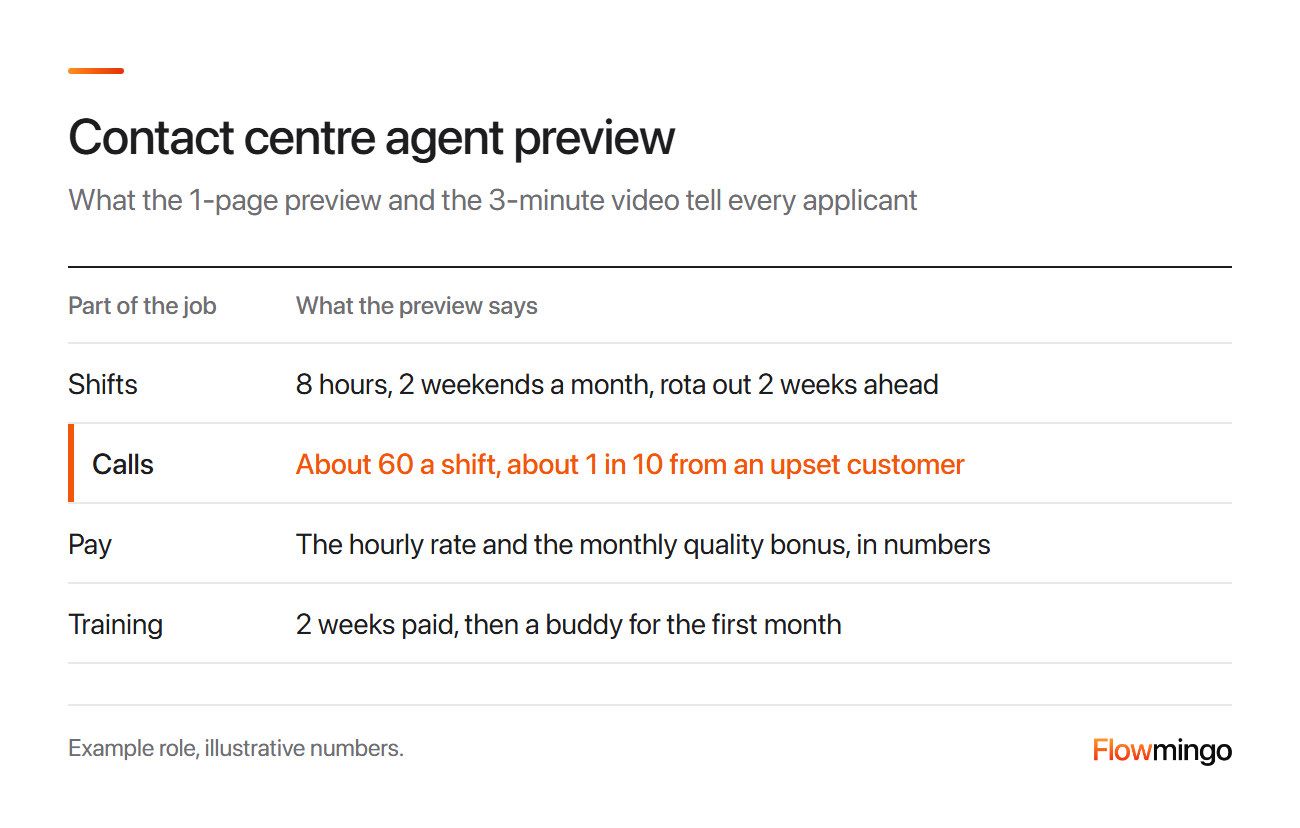
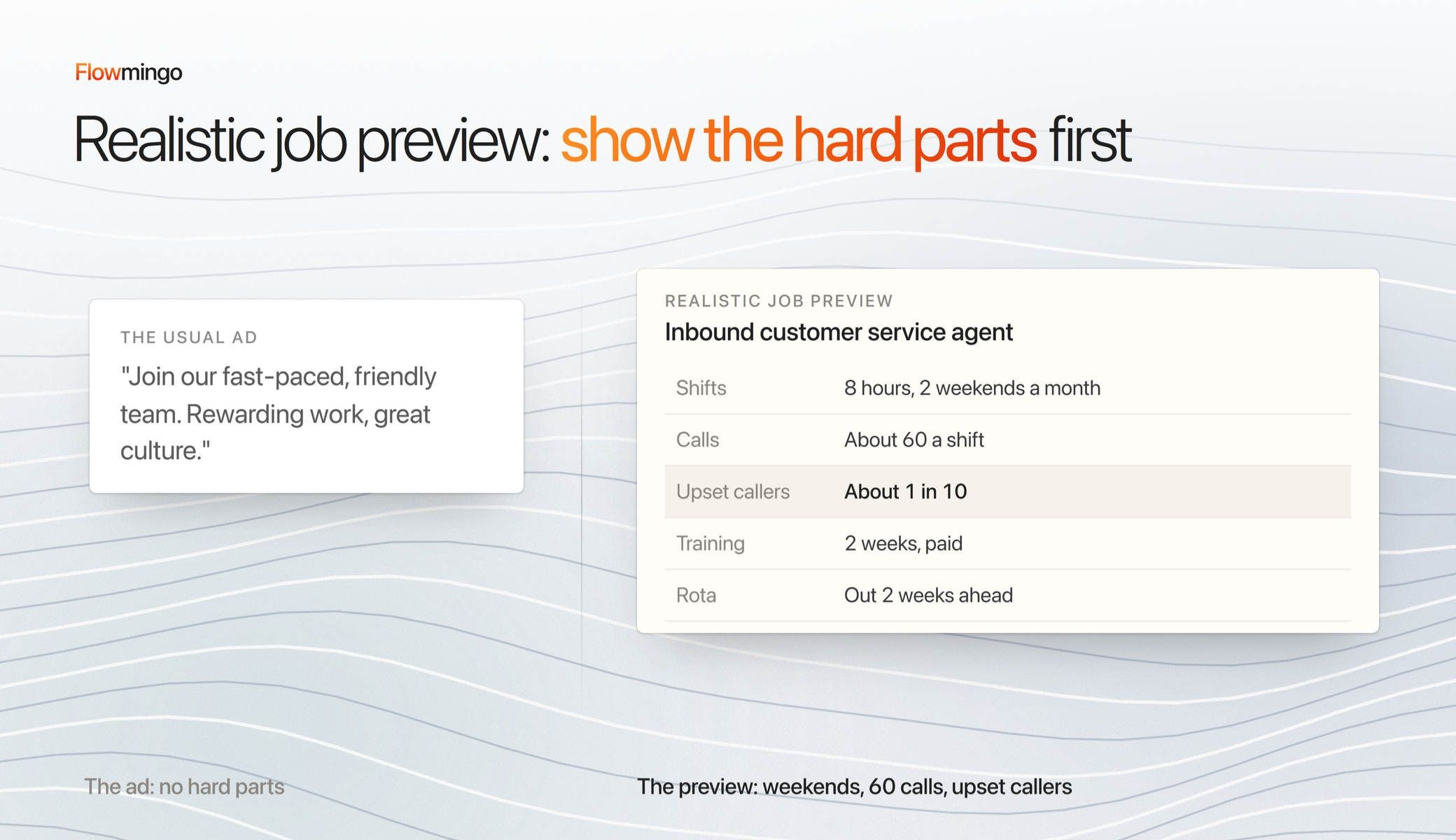
Contact centre agent preview: 8-hour shifts, 2 weekends a month, about 60 calls a shift and 2 weeks of paid training.
The preview states each fact plainly. It gives the hourly rate and the monthly quality bonus in numbers, says the rota comes out 2 weeks ahead, and explains that after training a buddy sits with each new agent for the first month.
It is just as plain about the hardest part. About 1 in 10 callers is upset, so the video shows how the agent handles one.
Of 140 applicants who see the preview, 21 withdraw before the interview. That may look like a loss, but those are 21 people who did not want weekend calls, and they leave before you spend an interview slot on them.
So you decide to keep the preview and test it: compare 30-day quits among the next 20 hires with the 6 from the last group.
3. How do you build an RJP, step by step?
Start from the reasons people quit, not from the job ad, because those reasons are what a preview has to answer. Then show them early, in plain numbers, to every applicant.
- Read the exit notes of your 30-day leavers first. The top 2 or 3 reasons they left are what the preview must cover, like the weekend shifts and upset callers in the example.
- Ask people who do the job to describe a normal shift. Their words carry the details a manager forgets, such as the first hour of a Monday.
- Put numbers on the hard parts. An applicant learns more from "about 60 calls a shift" than from "a fast-paced role", because a number lets them judge whether they could do it.
- Show it to every applicant before the interview. OPM advises that the preview come before a job offer, so people can decide whether to withdraw. Showing it before the interview is earlier still, and it saves your interview slots as well.
- Track 30-day and 90-day quits for each hiring group. Comparing the groups shows whether the preview helps, so you can change it if it does not.
If you hire a whole group at once, our seasonal hiring guide shows how to plan their start dates and rotas.
3.1 What are the disadvantages of an RJP?
The main cost is fewer applicants. Some people step out after the preview, as 21 of 140 did in the example, which hurts when you have more shifts to fill than people.
Tone is the second risk. A list of nothing but negatives reads like a warning, so pair each hard part with what helps, such as the buddy for the first month or the quality bonus.
The third risk is using the preview as a screen. It exists so applicants can select themselves out, which means the judging belongs to interview questions that stay on the must-haves.
4. Does a realistic job preview reduce early turnover?
A realistic job preview can reduce early turnover, and the research suggests it works mainly because the employer comes across as honest. Treat it as 1 part of an early-turnover fix rather than the whole fix.
The finding about honesty comes from a foundational 2011 meta-analysis by Earnest, Allen and Landis, which pooled 52 studies covering about 17,000 people. Previews cut voluntary turnover, it found, mainly through a sense that the employer was honest.
The same review seems to clash with OPM on timing. It found the most effective design may be an oral or written preview, given after hire and designed to signal honesty, whereas OPM advises one before the offer.
You can follow both. Keep the preview before the interview, as in step 4, so people can still step out, then go over its hard parts again in the first week, spoken or written.
The evidence is not uniform, though. Solove, in a foundational 2015 doctoral dissertation at Colorado State University, tested a preview with call centre employees.
The effect on voluntary turnover pointed the expected way, but it was too small to be statistically significant, which means it could have been chance.
For a contact centre like the one in the example, that is a reason to measure your own 30-day quits rather than assume the preview works.
Measuring matters most in shift work, where quits run high. In August 2026, 3.0% of US retail workers and 3.5% of those in accommodation and food services quit within the month, against 1.9% across all jobs.
Those are preliminary figures from the Job Openings and Labor Turnover Survey of the US Bureau of Labor Statistics, published on 29 Sep 2026. Each quit is a role to fill again, so a step that keeps even a few new starters counts for more in these industries.
5. How do you run a realistic job preview with Flowmingo?
Put the preview's facts in the job description, then let your first-round questions check the must-haves those facts imply. That way the preview stays a self-check for the applicant, and the questions stay on the job.
For example, if the preview says 2 weekends a month, ask whether the applicant can work that rota. You can also ask how they would calm an upset caller, since that is the hardest part of the role.
Keep every question tied to what the job needs, because a preview that turns into a test of enthusiasm stops being honest.
How Flowmingo helps
Paste your job description, preview facts included, into Flowmingo's AI interviewer, and it drafts 1 to 30 questions that you edit and share in a single link.
Applicants answer in their own time, and you get the recording, the transcript and a scored report. Every hiring decision stays with your team.
Sign up free and pair your next realistic job preview with a first round on Flowmingo.
6. Sources
Every study, survey and guideline in this glossary entry links to its source below.
- Earnest, D. R., Allen, D. G., & Landis, R. S. (2011). Mechanisms linking realistic job previews with turnover: A meta-analytic path analysis. Personnel Psychology, 64(4), 865-897. DOI
- Solove, E. D. (2015). Too legit to quit? How realistic job previews affect early turnover decisions [Doctoral dissertation, Colorado State University]. Mountain Scholar
- U.S. Bureau of Labor Statistics. (2026, September 29). Job openings and labor turnover, August 2026, Table 4: Quits levels and rates by industry and region, seasonally adjusted [News release]. BLS
- U.S. Office of Personnel Management. (n.d.). Realistic job previews. Retrieved 26 October 2026. OPM
- Wanous, J. P. (1973). Effects of a realistic job preview on job acceptance, job attitudes, and job survival. Journal of Applied Psychology, 58(3), 327-332. DOI