
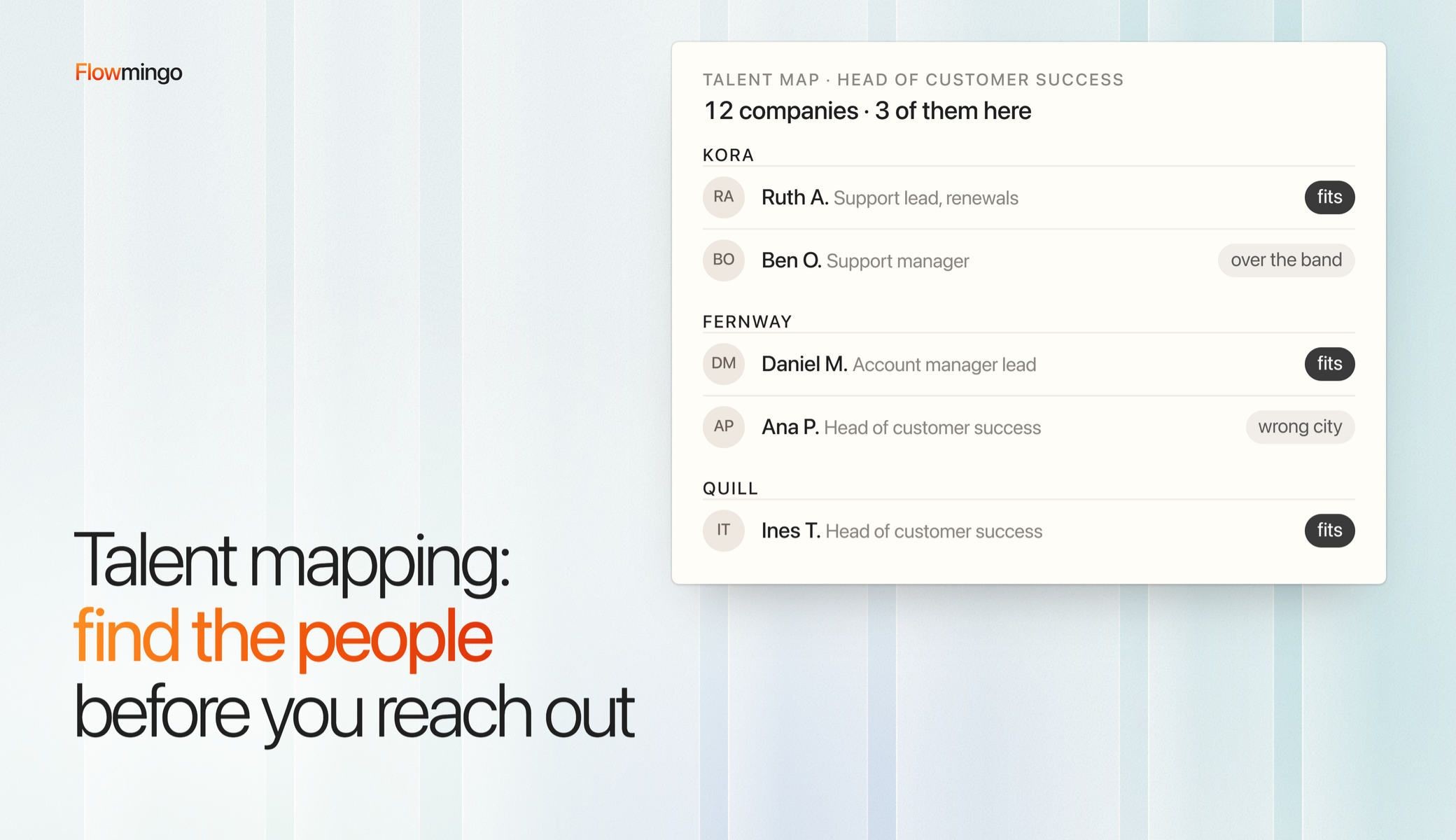
Talent mapping is research that lists the people who could fill a role, where they work now and how they fit, before anyone is contacted. It turns a hard search into a known market of names.
When a client hands you a brief that nobody applies to, you build a talent map first. It shows who exists, which companies hold them and whether the client's title and salary can reach them.
Key takeaways
- What does a talent map hold? 1 row per person: employer, title, skills, location and a fit note against the brief, all built before any outreach.
- Why map skills, not titles? Skills find more people. LinkedIn estimates potential skills-based talent pools at a median 6.1 times the size of title-based ones.
- Is it the same as the 9-box grid? No. The 9-box rates your own staff on performance and potential, while a talent map in recruitment looks outside the company.
- What does the map give an agency? A pitch and a plan. In the example below, 38 people held the exact title, and mapping by skills found 190.
1. What is talent mapping in recruitment?
In recruitment, talent mapping is market research on people. You list everyone who could do the role and where they work, before any message goes out.
The result is a talent map, usually a spreadsheet you keep and update. A map holds the target companies and, for each person, their title, skills, location, time in post and a fit note. Because it comes before outreach, it also shows the market: how many people exist, which titles they use and how hard they are to move.
Talent mapping is not sourcing, which contacts the people on the map. It is not a talent pool either, which holds candidates you have already found or assessed and keep on file for future roles. The map comes first, and the pool keeps the people the map turns up.
2. What does a talent mapping example look like?
A talent mapping example starts with the client's brief and ends with a few named, interested people. The numbers below are illustrative, for 1 hard search.
For example, a software client asks your agency for a head of customer success, and 3 weeks of job ads bring no fit. You agree 12 target companies with the client and find 38 people who hold or held the exact title in the last 5 years.
Then you map by skills instead and add support and account management leads who have run renewals and a team. The map grows to 190 people, and 22 fit the location, the salary band and the 3 must-have skills.
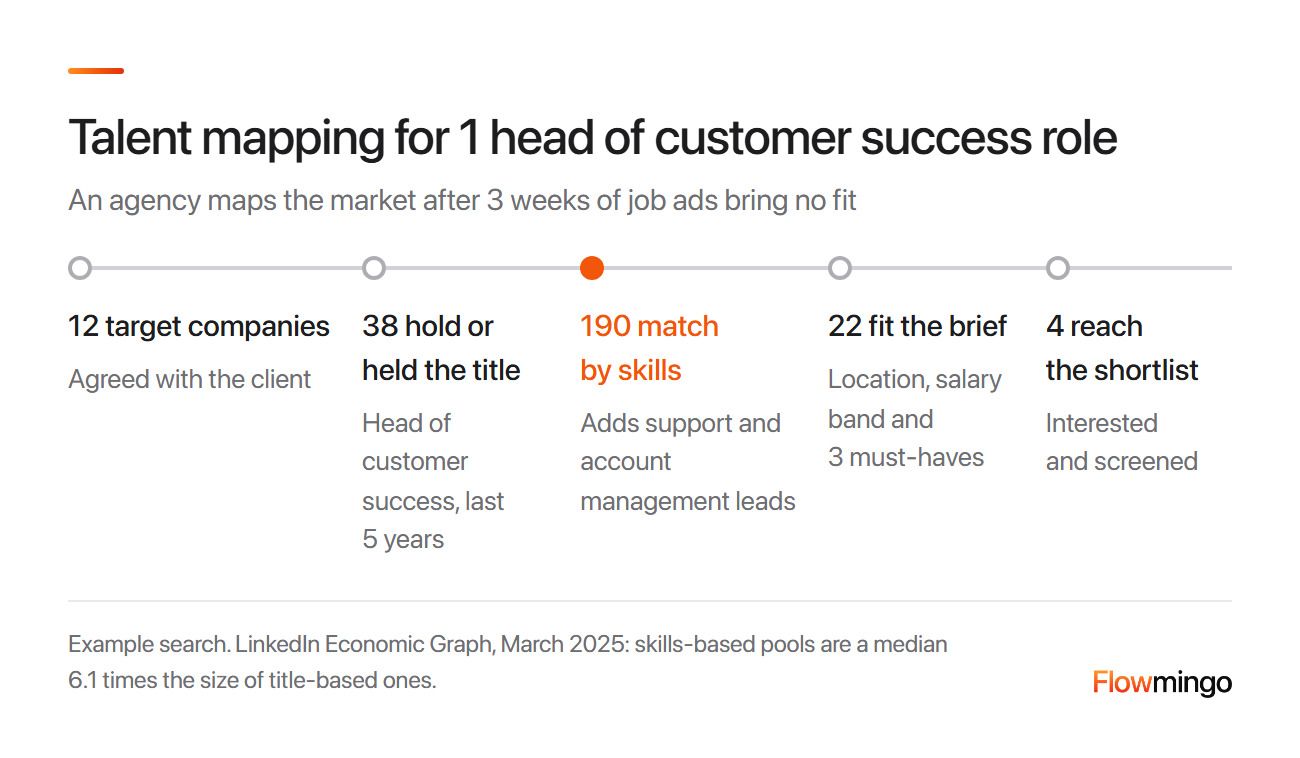
Talent mapping for 1 head of customer success role: 12 companies, 38 with the exact title, 190 by skills, 22 fits and 4 shortlisted.
You approach the 22, 9 reply with interest and 4 reach a client-ready shortlist after screening. The map also changed the brief: with only 38 people holding the title, the client accepted 2 finalists from support leadership.
3. How do you build a talent map, step by step?
Agree the brief and the target companies with the client, then map people by skills and score each one the same way. Each step below makes the map useful for the pitch as well as the search.
- Turn the brief into 3 to 5 must-have skills. Skills travel across job titles, so they find people a title search misses.
- Agree the target companies with the client. Include competitors and adjacent firms, and ask which companies are off limits, because a map built on a no-go company wastes the week.
- Search by skills first, then by title. LinkedIn estimates potential skills-based talent pools at a median 6.1 times the size of title-based ones.
- Score each person against the brief. Use the same fit note for everyone, for example "3 of 3 skills, in range, 4 years in post", so the map sorts cleanly.
- Show the client the market before the shortlist. Share the counts, titles and salary signals, because they show whether the brief can reach the market at all.
In a LinkedIn survey of 8,035 HR professionals in 17 markets, 64% said qualified talent had become harder to find in the past year. Our guide to the hiring process steps shows where the map sits in the wider process.
3.1 What goes in a talent mapping template?
A talent mapping template needs 1 row per person and 8 columns. Use name, current company, title, location, must-have skills met, years in post, fit note and the date you last checked the profile.
Add a status column once outreach starts, so the same sheet becomes your contact log. Keep only what the search needs, and refresh the map before you reuse it for the next similar role.
4. How is talent mapping different from the 9-box grid?
The 9-box grid rates your own staff for succession, while talent mapping in recruitment looks at people outside the company. Both sort people by fit for a future role, which is why the terms get mixed up.
The 9-box is a succession planning tool: it places each employee on a 3 by 3 grid of performance and potential. For example, a foundational University of South Carolina worksheet has succession planners rate leadership performance and potential before placing anyone on the grid.
Agencies meet the 9-box when a client's succession plan shows a gap with no internal successor. That gap becomes your brief, and the external talent map is how you fill it.
5. How do you run talent mapping with Flowmingo?
Build the map yourself, then use Flowmingo for the first round with the people who agree to talk. The shortlist you send the client then carries the same evidence for every name.
Before you start, have the must-have skills from step 1 and the list of interested people from the map. Turn those skills into the interview questions, so each score lines up with your fit notes. Keep the map in your own records, because it is your research and the start of your next pitch.
How Flowmingo helps
Paste the job description, and the AI drafts the interview questions to send through 1 link to the people on your map. Every candidate comes back with the video, the transcript, a score for each skill and the reason behind it. Client links show names as initials and remove the email, phone and CV, so your client can't go around you. Sign up free to turn your next talent mapping into a client-ready shortlist on Flowmingo.
6. Sources
Every report, survey and worksheet in this glossary entry links to its source below.
- LinkedIn. (2025, January 15). More applicants but harder to hire: Majority of job applications do not meet listed criteria, finds LinkedIn. LinkedIn
- LinkedIn Economic Graph. (2025, March 3). Skills-based hiring: Increasing access to opportunity [Research note]. LinkedIn. LinkedIn Economic Graph
- University of South Carolina. (n.d.). Performance-potential assessment: Worksheet for populating the performance and potential 9-box grid. Retrieved 26 October 2026. University of South Carolina