
A candidate persona is a short, research-based profile of the person a role needs, used to write the job ad and the outreach. It covers their skills, where they work now, what would make them move and what rules them out.
You reach for one when a hiring manager asks for "someone like our last great hire" and the job ad draws the wrong people. A talent persona, as some teams call it, turns that wish into a person you can find, message and screen.
Key takeaways
- What does a candidate persona describe? 1 target hire in 5 parts: skills, current employers, goals, the trigger to move and deal-breakers.
- Is a candidate persona the same as a job description? No. The job description speaks to applicants, while the persona tells the recruiter who to find.
- Why does a persona matter for outreach? It tells you who to source and what to write first. Sourcing pays off: in the 2025 benchmark of recruiting software maker Gem, 44% of sourced candidates passed the first stage, against 6% of inbound ones.
- What should a candidate persona leave out? Age, race, gender and other personal traits. Singapore's TAFEP lists "Below 30 only" among phrases not to state.
1. What is a candidate persona in recruitment?
A candidate persona is a 1-page picture of the hire a role needs, which you write before sourcing starts. Recruiters build it from facts about real people: recent hires, people who left and the hiring manager's intake notes.
It has 5 parts. The first 2 are the skills the role needs and where these people work now. The other 3 are what they want from a move, what would trigger it and what rules them out.
It is not a job description, which tells applicants what the role is. It is not a candidate profile either, because a profile describes 1 real applicant after they apply. The persona is an internal brief that decides who you look for and what you say first.
The term comes from product design. The Nielsen Norman Group calls a persona "a fictional, yet realistic, description of a typical or target user" and says it must rest on research. Recruitment kept the method and swapped the customer for the hire.
2. What does a candidate persona look like for a real role?
A useful candidate persona fits on 1 page and changes what you write, which matters most in outreach.
In Gem's 2025 benchmark of 140M+ applicants, 44% of sourced candidates passed the first stage, against 6% of inbound applicants. Here is 1 example for a hard role, with illustrative numbers, worked through to the message it changed.
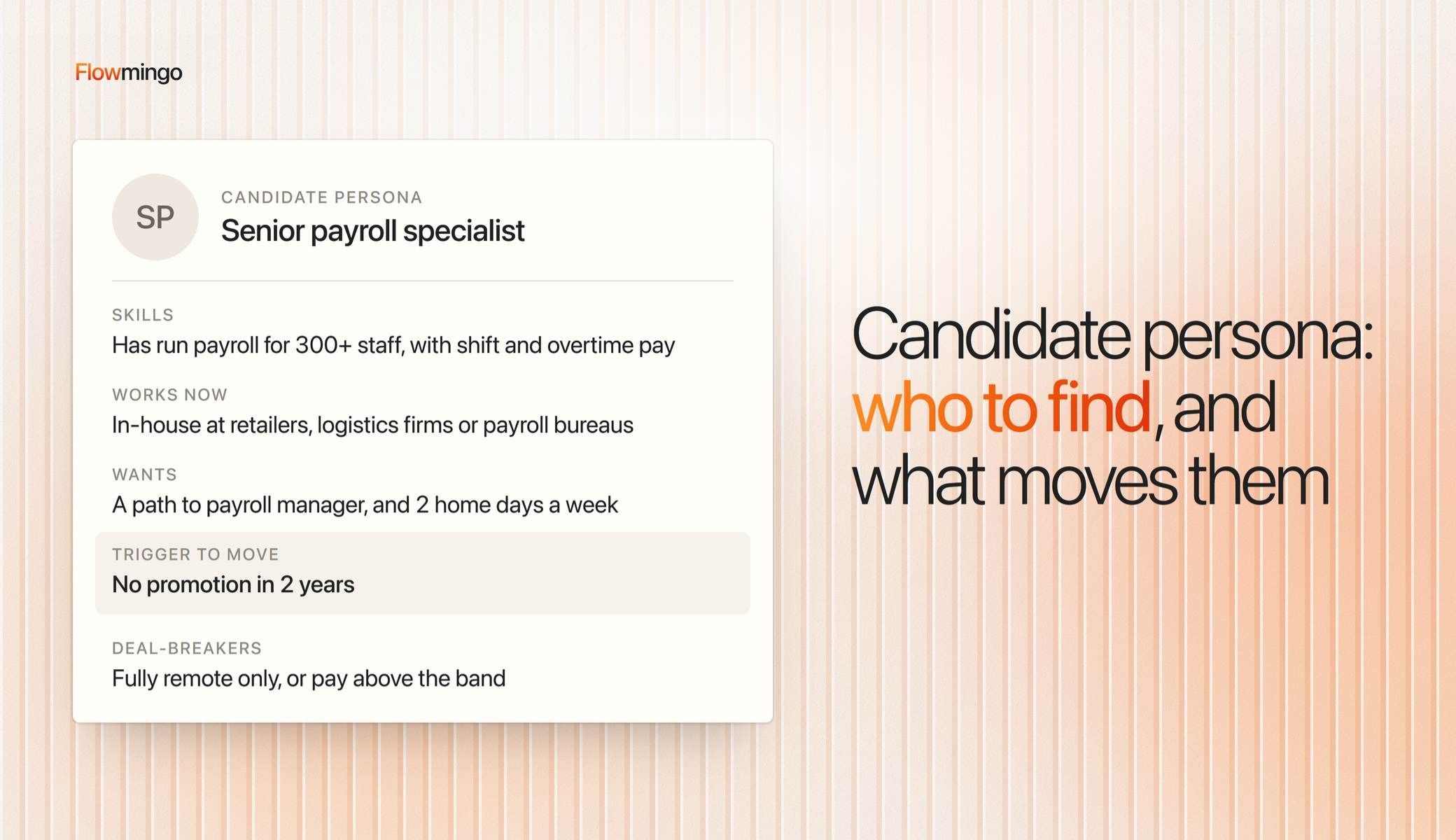
Say you recruit a senior payroll specialist for a 400-person logistics client. The skills line reads: has run payroll for 300+ staff, with shift and overtime pay. You fill in the rest from the hiring manager's intake call, 3 recent hires and 2 exit interviews.
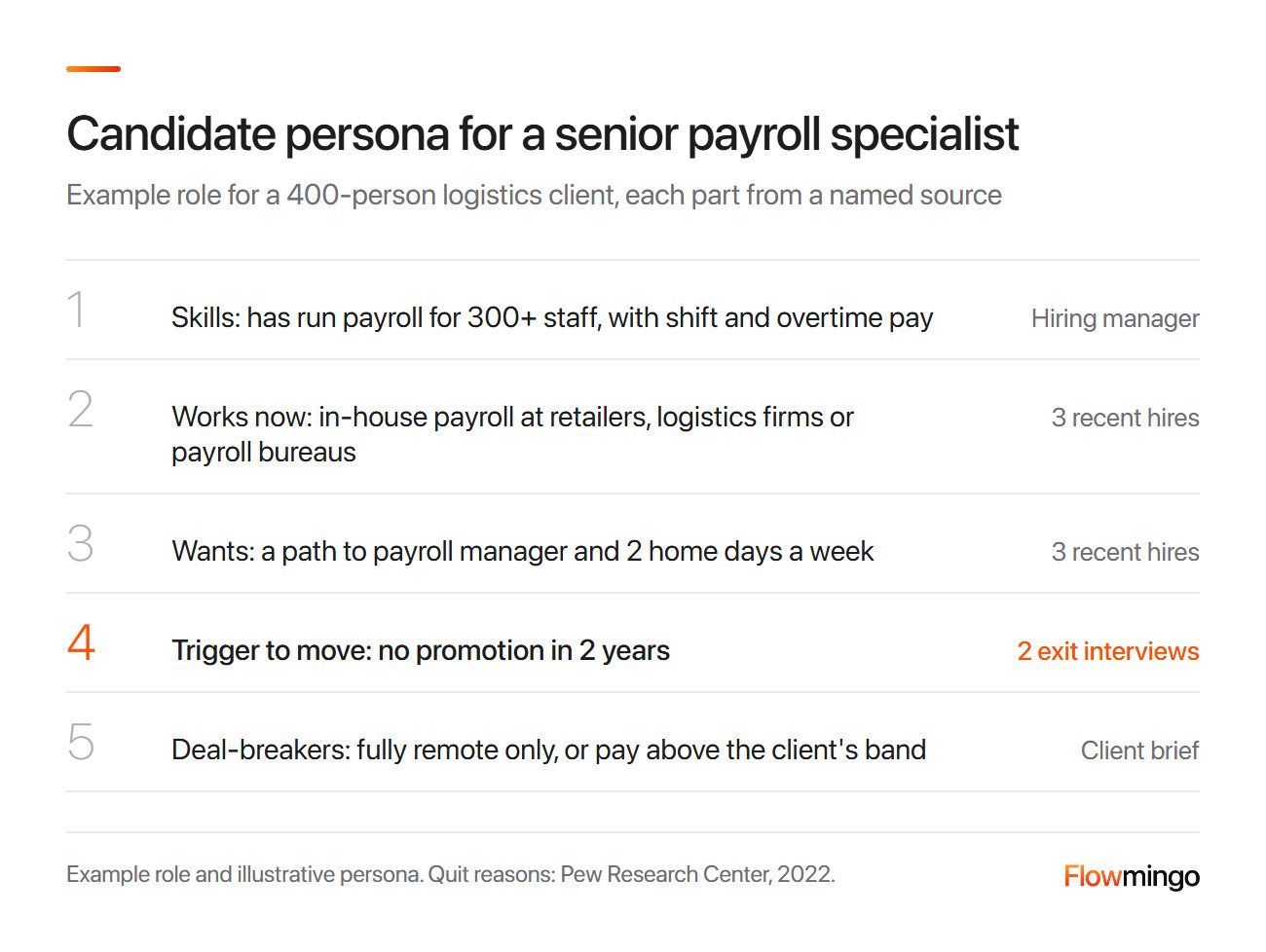
Candidate persona for a senior payroll specialist: 5 parts, each from a named source, with "no promotion in 2 years" as the trigger to move.
The 3 recent hires came from in-house payroll at retailers, logistics firms or payroll bureaus, so that is where you search. They want a path to payroll manager and 2 home days a week. The client brief rules out anyone who needs fully remote work only, or pay above the client's band.
The trigger row changed the outreach, because both exit interviews named a stalled promotion. In a foundational 2022 Pew Research Center survey, 63% of US workers who quit in 2021 cited no chance to advance. Low pay drew the same 63%, so your first message leads with the path to payroll manager and still states the pay band.
In this illustrative example, a generic note drew 6 replies from 60 payroll specialists, or 10%. The persona-led note drew 17 of 60, or 28%, above the 26% reply target in Gem's 2025 benchmark for a 3-step sequence. You keep the persona-led note for the rest of the search.
3. How do you build a candidate persona, step by step?
Build it from evidence about real people, then test it on real outreach. These 5 steps run from the intake call to the first batch of messages.
- Start from the hiring manager's must-haves. Ask for 3 to 5 skills the person must show in the first 90 days, because these become your search terms and screening questions.
- Study 3 to 5 people who already do the job well. Recent hires show where these people worked before and why they joined, which is research rather than a guess.
- Ask leavers and people who declined for their reasons. Exit interviews and turned-down offers reveal the triggers and deal-breakers that no job description shows.
- Write it on 1 page with the same 5 fields every time. A fixed candidate persona template keeps personas comparable across roles and recruiters.
- Test it on 1 outreach batch, then rewrite it. A reply rate far below the 26% target in section 2 means the persona or the message is off.
Copy this candidate persona template, then fill each field from the source named next to it.
| Field | What to write | Where it comes from |
|---|---|---|
| Role | Job title, team and location | Hiring manager |
| Skills | 3 to 5 things the person has done, not a count of years | Intake call |
| Works now | Employers, teams or job titles where these people sit today | Recent hires |
| Wants | What they want from their next move | Recent hires |
| Trigger to move | The event that makes them start looking | Exit interviews, declined offers |
| Deal-breakers | Yes-or-no facts that rule someone out, such as home days or the pay band | Client brief |
| Leave out | Age, gender, race, religion, marital status and other personal traits | Section 3.1 |
3.1 What should a candidate persona leave out?
Leave out age, race, gender, religion, marital status and other personal traits, even when your recent hires share them. Singapore's TAFEP guide to fair job posts says fair ads do not discriminate on age, gender, race, religion, marital status, family responsibilities or disability. It lists "Below 30 only" among phrases not to use.
A persona that says "late 20s" leaks into the ad, the outreach list and the screen. Write the job need instead, such as night shifts, a licence or a payroll system the person must know.
Our guide to writing a job description turns the persona's must-haves into the ad. Our employer branding guide covers the story you tell the people you message.
4. How do you use a candidate persona with Flowmingo?
Turn the persona's must-haves into the questions of your first interview round, and ask its deal-breakers first as yes-or-no questions on the application form. Every applicant who passes then answers the same interview questions, so you compare them with the persona, not with a gut feel.
Before you start, have the 1-page persona and the job description ready. Write 1 plain question per must-have skill and 1 per deal-breaker, for example on home days or the pay band. The persona's goals belong in your ad and outreach, not the scoring, because they explain why someone moves, not whether they can do the job.
How Flowmingo helps
Paste your job description and the Flowmingo AI interviewer drafts between 1 and 30 questions, which you edit to match the persona. Applicants answer in their own time, and you get the recording, the transcript and a scored report. Every hiring decision stays with your team, so sign up free and put your next candidate persona to work on Flowmingo.
5. Sources
Every survey, benchmark and guide cited in this glossary entry links to its source below.
- Dykes, T. (2025, October 3). Personas make users memorable. Nielsen Norman Group. NN/g
- Gem. (2025). 2025 recruiting benchmarks report. Gem
- Pew Research Center. (2022, March 9). Majority of workers who quit a job in 2021 cite low pay, no opportunities for advancement, feeling disrespected. Pew Research Center
- Tripartite Alliance for Fair and Progressive Employment Practices. (n.d.). Guide to writing fair job posts and advertisements. Retrieved 26 October 2026. TAFEP