
If you hire a few hundred frontline staff a year, Sapia says its AI chat interview can screen every applicant you get. This Sapia AI review starts where your first sales call stalls: the price.
Sapia AI pricing appears nowhere on Sapia's website. A pricing guide on page 1 of Google, written by HeroHunt, which sells a rival recruiting tool, says no public Sapia rate card exists.
So you could sign up for a yearly fee with no public price to check it against.
There is a rate card, though. Sapia filed one on the UK government's G-Cloud marketplace in May 2024, and it is still online.
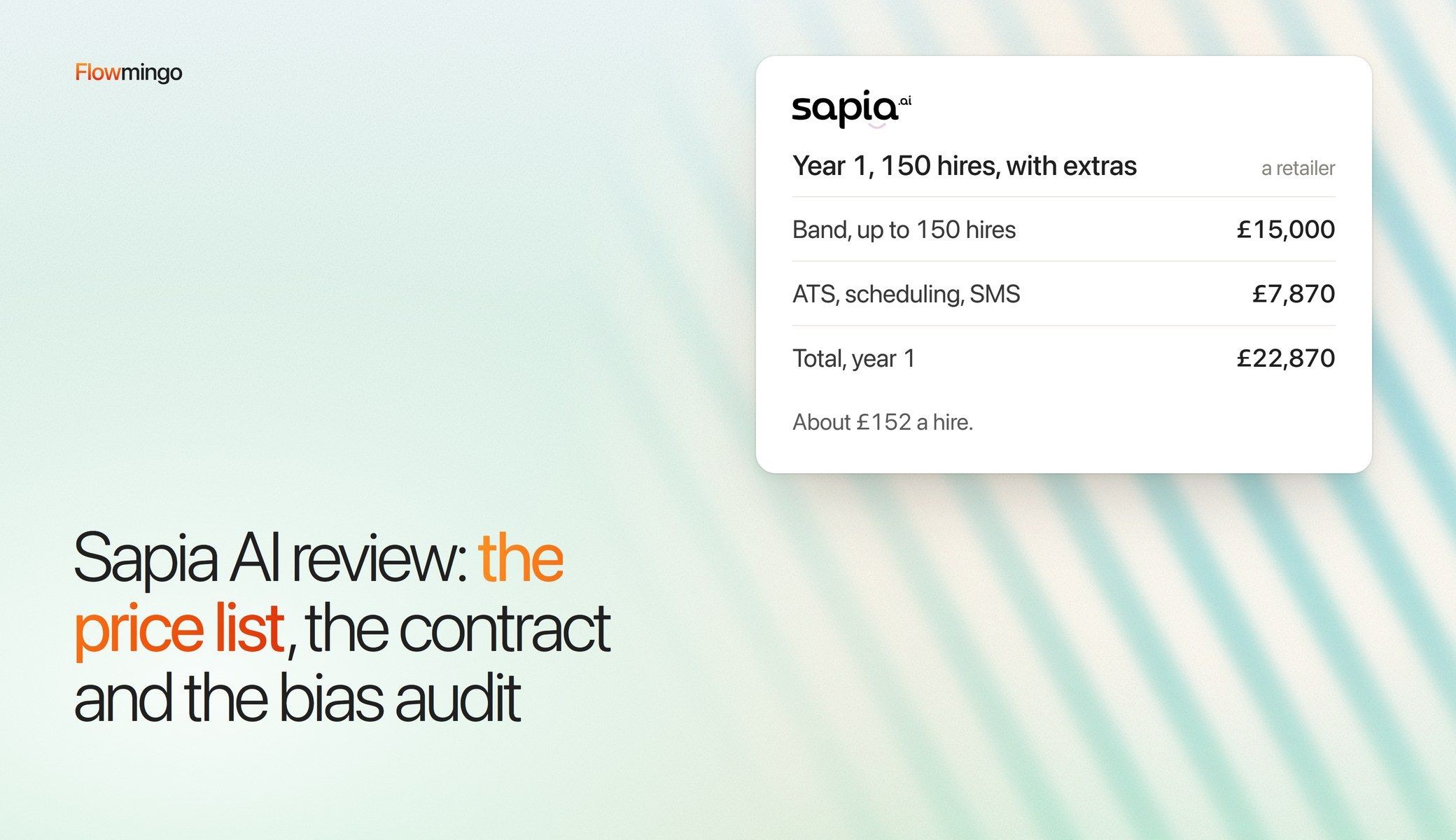
The list also shows that the fee is only the start: on Starter, Sapia's smallest package, 3 extras turn £100 a hire into about £152.
That list is more than 2 years old, and its prices were set for UK public buyers, so read them as a yardstick for any quote, not as today's price. Still, it is the only Sapia price list we found in public.
What decides whether Sapia is worth it is what you would pay per hire once the extras are in, and what the contract and the bias audit let you check. So this Sapia AI review checks all 3, along with the evidence behind its personality scores, its AI detection and its buyer reviews.
Flowmingo, the company publishing this guide, sells a competing product, so every number below links to its source, and we say where Sapia wins.
Key takeaways
- How much does Sapia AI cost? Sapia's 2024 UK price list asks £15,000, £28,000 or £75,000 a year for up to 150, 500 or 1,000 hires, which is £56 to £100 a hire at full use.
- Is Sapia really pay per hire? Not quite. The same list sells a yearly fee for a band of hires, paid upfront, so if you hire half the band, each hire costs twice as much.
- What do the extras add? A retailer making 150 hires that adds integration with its applicant tracking system (ATS), scheduling and SMS pays £22,870 in year 1, about £152 a hire.
- Has Sapia been audited for bias? Once in public: 72 tests on US and Canada models in December 2022 found no group scored meaningfully worse.
- Does Sapia catch ChatGPT answers? It reports 98% caught and 1% false positives. If 8% of 10,000 applicants use AI, as Sapia also reports, about 1 flag in 10 (92 of 876) still lands on an honest applicant.
1. Sapia AI review: what does Sapia sell, and is it the same company as PredictiveHire?
Sapia sells a text-based AI chat interview to employers that hire frontline staff in high volume. It is the same Australian company as PredictiveHire, the name it traded under until 26 April 2022.
The old name has not gone away: it still draws about 140 searches a month worldwide. Any review or contract you find under PredictiveHire describes the same vendor, under its old name.
Sapia's press releases record the rename and, in November 2022, a Series A funding round. Macquarie Capital and W23, part of Woolworths Group, led that round.
Sapia's homepage says the company has built AI interviews since 2018 and assessed more than 10 million candidates. It quotes 4 customers by name: Holland & Barrett in the UK, David Jones and Regis Aged Care in Australia, and Spark NZ in New Zealand.
Google's search suggestions pair Sapia's name with more employers, Starbucks, Costa, Woolworths and Concentrix, and all 4 appear among the 19 employer logos on Sapia's homepage, beside Tesco and Qantas.
So those are places where applicants are likely to meet Sapia. The industries Sapia targets point the same way. Its industry pages cover retail, contact centres, healthcare, airlines, rail, graduate programs and food and beverage.
Its pricing page is just as clear about size, saying the product is "designed to best serve companies that hire more than 500 people per year".
Put together, that describes an employer filling large groups of similar jobs, which Sapia's price list calls role families. For example, if you hire for 2 or 3 of them, such as store staff and contact-centre agents, Sapia built its product for you.
If you hire 40 people a year across 15 roles, read section 9 on alternatives first.
2. How does the Sapia AI interview work for our applicants?
Each applicant opens 1 link and types answers to 5 structured questions in an untimed chat, with no camera and no voice. The AI scores the answers and sorts applicants into Yes, Maybe and No.
The link sits in your job ad or in your applicant tracking system (ATS), the software that holds your candidate records. Sapia's chat interview page promises no login, no download and no booking.
Applicants can answer in the language they are most comfortable in. Sapia's candidate explainer tells them to allow 20 to 30 minutes and suggests 50 to 100 words per answer, up to 500, with no time limit.
Once the answers are in, Sapia's own scoring engine takes over. Its science page calls the engine SAIGE and says it uses large language models "as reasoning engines".
SAIGE scores each answer against the competencies chosen for the role. Recruiters then see a ranked list, with each score and the applicant's own words behind it.
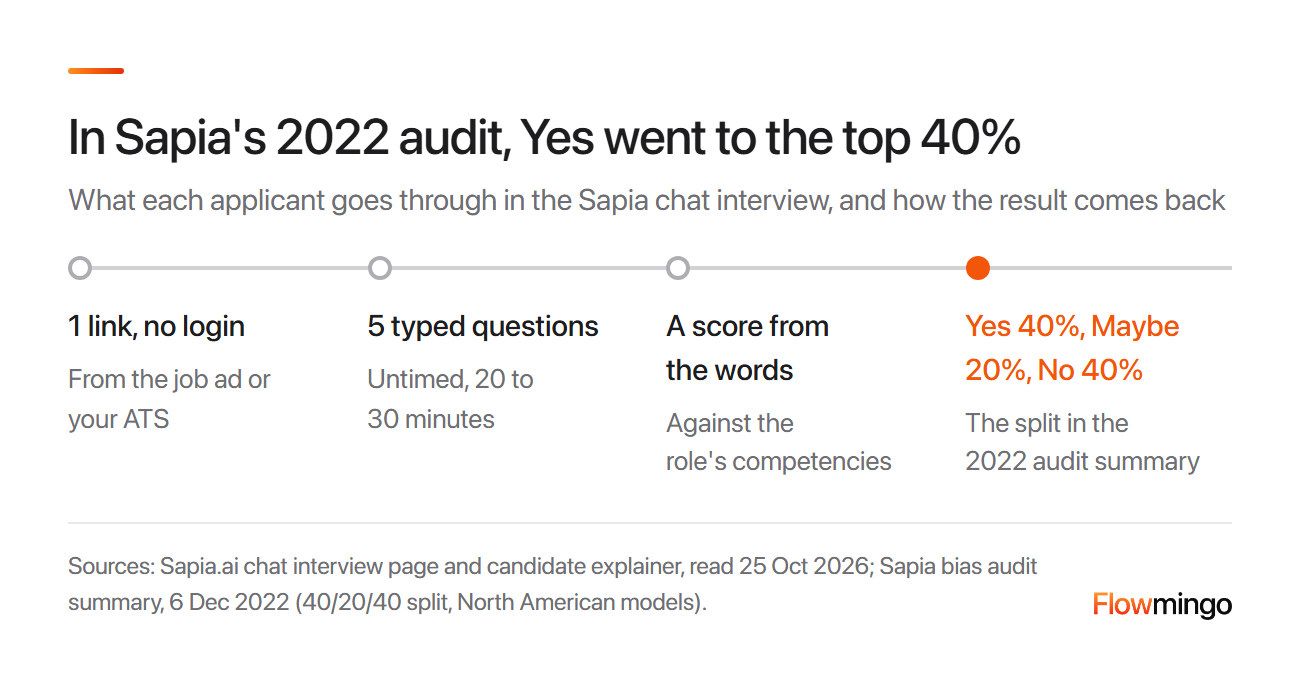
Sapia chat interview flow: 1 link, 5 typed questions over 20 to 30 minutes and a score. In the 2022 audit, Yes went to the top 40%, Maybe to the next 20% and No to the bottom 40%.
That 40, 20 and 40 split comes from the summary of a bias audit Sapia published in 2022, which section 6 covers. The summary is now more than 3 years old, and it describes the split for the North American models it audited.
It does not say whether the bands are shares of each applicant pool or of a benchmark group, and that difference decides how many applicants you see as a Yes.
Say you open a new store and 2,000 people apply. If the bands are shares of each pool, you would get about 800 Yes, 400 Maybe and 800 No, whatever their quality.
So ask Sapia how the bands are set today, and set your own threshold for each role. The summary leaves that choice to you, saying employers may use the scores "however they see fit".
3. Sapia AI review of pricing: what does Sapia cost for 150, 500 or 1,000 hires?
Sapia's May 2024 price list sells 3 yearly packages: Starter £15,000 (about $20,052), Pro £28,000 ($37,430) and Enterprise £75,000 ($100,260) a year, before VAT. They cover up to 150, 500 and 1,000 hires.
The list is Sapia's G-Cloud 14 pricing document, dated 7 May 2024. Sapia's G-Cloud listing ended on 18 August 2026, but the PDF is still public.
Dollar figures use the European Central Bank's rate of $1.3368 per pound on 23 October 2026 (Frankfurter).
The list also shows what "per hire" means. Sapia's pricing page says you pay only for the people you end up hiring, but the 2024 list charges a fixed yearly fee upfront for a band of hires, with unlimited applicants inside it.
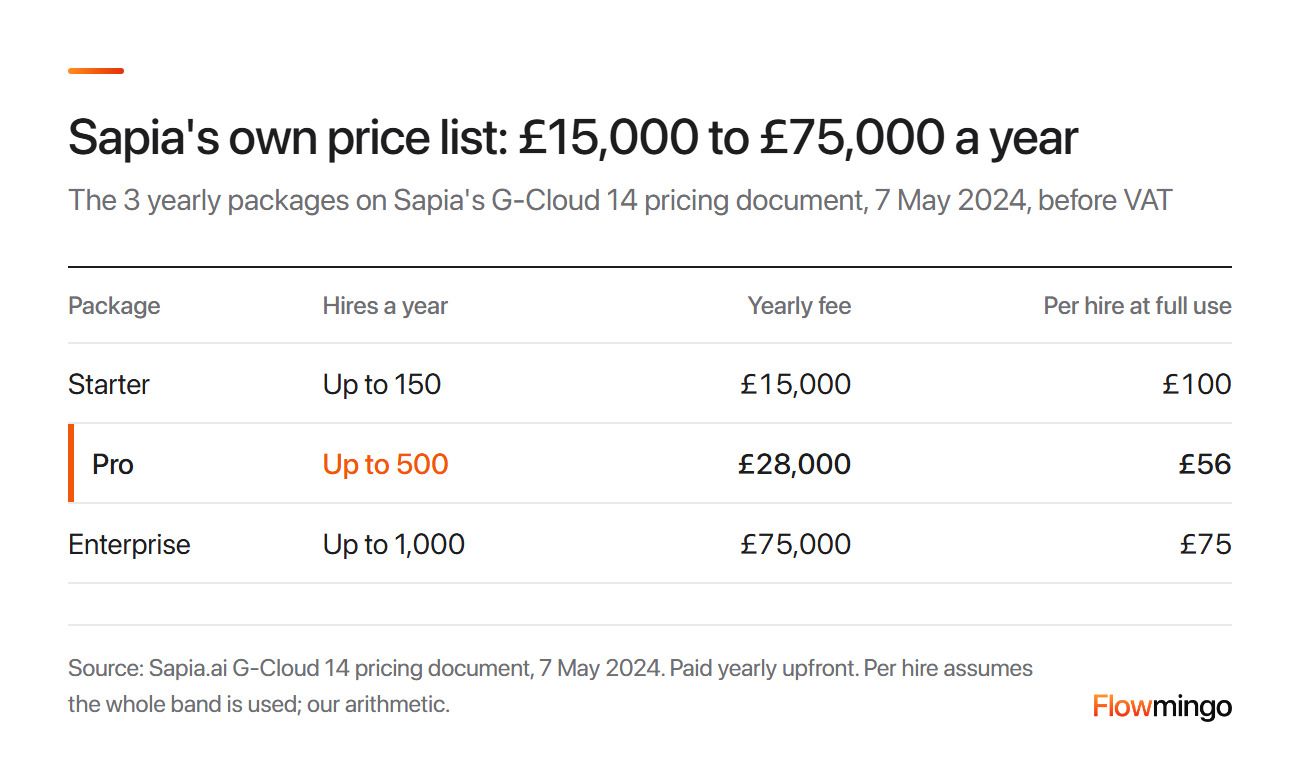
Sapia's 3 packages: Starter costs £15,000 for up to 150 hires, or £100 a hire. Pro costs £28,000 for up to 500 (£56) and Enterprise £75,000 for up to 1,000 (£75).
Those per-hire figures hold only if you fill the band, because the fee stays the same however many people you hire. Say you buy Pro and make 200 hires: your £28,000 works out to £140 a hire, not £56.
Buy Starter and make 60 hires, and each costs £250 instead of £100. So size the band to the hires you are sure of, because a hiring freeze does not shrink the fee.
Longer terms cut the yearly fee. The list takes 10% a year off a 2-year term and 20% off a 3-year term, so Pro on 3 years drops to £22,400 a year, or £67,200 in total.
That discount buys a longer commitment, and the current terms give no exit for convenience, as section 4.2 explains.
A private quote in 2026 may differ from these UK public prices. Still, Sapia's May 2025 contract terms name the same 3 tiers, and we found no other public Sapia price.
3.1 What does each Sapia package include?
Starter covers 1 role family, such as retail frontline, with no video interview and no data export. Pro adds both, and covers 2 role families or 1 custom model, a model for your role that Sapia's people scientists design with you.
Enterprise covers 5 role families or 2 custom models, plus a custom ATS integration.
These limits pick your tier as much as volume does, and audit management appears only on Enterprise. Without data export on Starter, you cannot pull scores into your own reporting or check them against who later did well.
For example, a chain hiring store and warehouse staff needs 2 role families, which means Pro at £28,000, even below 150 hires.
3.2 Can we try Sapia before signing a yearly contract?
Sapia's website offers a demo. Its 2024 G-Cloud listing offered UK public buyers a trial, while Capterra, a software review site, lists none, so ask for a pilot with an end date, a fixed price and 1 success measure.
A pilot matters here because the band is paid upfront for a year. If the shortlist disappoints in month 3, the fee is spent, and the current terms give no exit for convenience.
For example, run 1 store on a fixed fee, ending a few weeks after Sapia's estimated 6-week implementation. Then measure 1 thing: how many Yes applicants pass your hiring manager's interview.
4. Which add-on fees and contract terms push up the Sapia AI pricing?
The price list adds 5 extras: ATS integration, interview scheduling, SMS notices, consulting and language scoring. Under the current terms, you cannot leave mid-term for convenience.
ATS integration is the only one-off. A standard ATS connection costs £2,750 once and a custom one £11,000, while every other line recurs each year.
Interview scheduling costs £5,000 a year on Starter, £7,000 on Pro and £15,000 on Enterprise. SMS notices, the text messages sent to applicants, cost £120, £500 or £1,000 a year by tier.
Consulting costs £5,000, £8,400 or £21,000 a year. CEFR language scoring, which grades each applicant's language level, costs £45,000 a year, more than the whole Pro package.
Which extras you need depends on what you already run. Take the ATS link if you want scores in your ATS, because otherwise recruiters move them by hand.
Scheduling on Pro adds £7,000 a year, a quarter of the package price, so check whether your ATS already books interviews.
The last 2 extras suit narrow cases. CEFR scoring suits only a contact centre hiring for spoken language, and consulting suits a team without its own people analyst.
4.1 What does year 1 cost a retailer making 150 hires?
About £22,870 before VAT, or £152 a hire, for a chain that adds the standard ATS integration, interview scheduling and SMS notices to Starter.
| Line | Year 1 | Year 2 |
|---|---|---|
| Starter package, up to 150 hires | £15,000 | £15,000 |
| Standard ATS integration, one-off | £2,750 | £0 |
| Interview scheduling | £5,000 | £5,000 |
| SMS notices | £120 | £120 |
| Total, before VAT | £22,870 | £20,120 |
| Cost per hire | £152 | £134 |
In dollars, year 1 comes to $30,573. In year 2 the total falls to £20,120, or £134 a hire, because the ATS fee is paid only once.
Even then, the retailer still gets no video interview, because that starts at Pro, £28,000 a year before any extras.
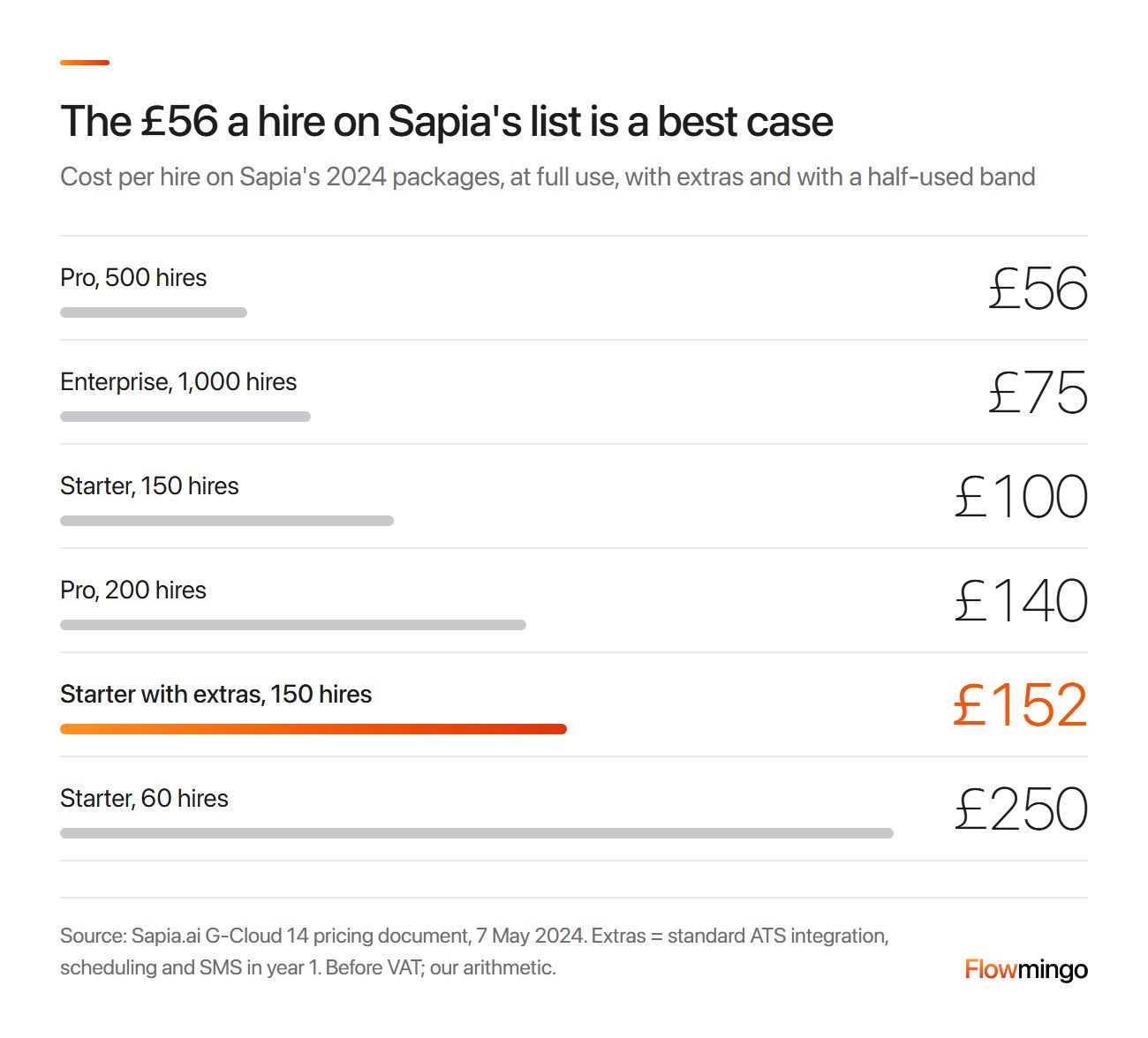
Cost per hire in practice: Pro at 500 hires costs £56, Enterprise at 1,000 costs £75 and Starter at 150 costs £100. Starter with extras costs £152, Pro at 200 hires £140 and Starter at 60 hires £250.
4.2 Can we leave a Sapia contract early?
Not for convenience under the current terms. Sapia's Software Terms, version 2 from May 2025, run for the term in your order form and then expire unless the form sets a renewal.
That beats a contract that renews by default, because nothing rolls over unless your order form says so. Leaving early is harder: either side can end the deal only for a breach not fixed in 14 days, insolvency or a legal problem.
The older contract was more flexible. Sapia's 2022 master services agreement, which it filed on G-Cloud, let you exit on 60 days' notice.
That exit had a price. Before the minimum term ended, you owed 75% of the whole term's fees, less fees already paid, so leaving a 3-year Pro order of £67,200 early cost £50,400 in total.
The current terms also limit what you can recover. Sapia caps its liability at 1 year of licence fees, so on a £15,000 Starter order, Sapia's cover for a data incident runs only up to £15,000.
Unused SMS credits do not roll over, either. And the 2025 terms name Anthropic PBC as the foundation model provider, the company whose AI model the platform builds on.
If Sapia changes that provider and the change would materially harm you, you have 7 days from its notice to end the AI part of your order, with a pro-rata refund for that part. Keep using the platform past day 7, and you have accepted the change.
After you leave, Sapia deletes your data within 40 days of a request, but it may keep de-identified data to train its models.
5. What does Sapia AI look for, and how accurate is its personality scoring?
Sapia scores the words in each answer against the competencies and traits chosen for the role. Its own peer-reviewed study found its personality estimates match applicants' self-ratings at an average of 0.37, a moderate signal rather than a precise profile.
A correlation of 0.37, on a scale where 0 means no link and 1.0 a perfect match, points the right way across a big pool. But for any 1 applicant the profile can be wrong on a trait, so use it to choose interview questions, and do not rely on it to reject anyone.
Sapia's own marketing claims more. Its G-Cloud listing says its Smart Interviewer "can accurately profile the personality traits of applicants".
The candidate explainer gives the method: Sapia infers the 6 traits of the HEXACO personality model, from Honesty-Humility to Openness, through "linguistic analysis" of the chat answers.
The best public test of that claim is more than 3 years old: Sapia's own 2022 study in Frontiers in Psychology, a peer-reviewed journal. It used answers from more than 58,000 applicants.
Each applicant also rated 2 to 6 of their own traits, so between 8,317 and 23,293 people rated each trait. The model's estimates matched those self-ratings at 0.28 to 0.45 by trait, with an average of 0.37.
Openness matched best and Agreeableness worst, as the figure shows.
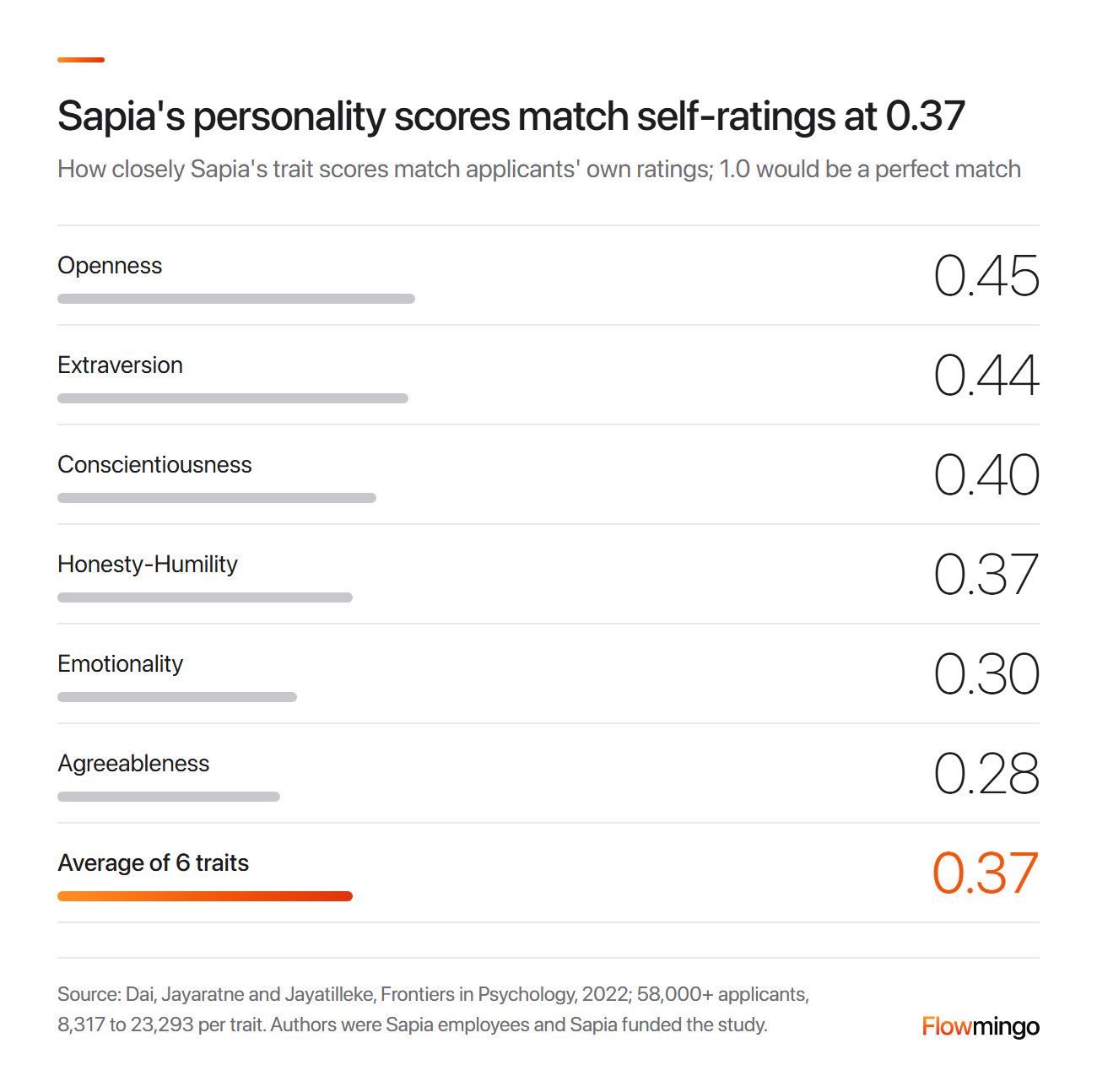
Personality match by trait: Openness 0.45, Extraversion 0.44, Conscientiousness 0.40, Honesty-Humility 0.37, Emotionality 0.30 and Agreeableness 0.28. The average is 0.37, from 8,317 to 23,293 applicants per trait.
Set against those numbers, "accurately profile" oversells the method. All 3 authors also worked for Sapia, Sapia funded the study, and the data stay private.
Still, the method is public and peer-reviewed, which means your own analyst can check how the work was done.
For this Sapia AI review, 0.37 is the best public evidence on the profile. The outcome figures on Sapia's homepage are customer quotes rather than studies, such as an 89% drop in early churn at Holland & Barrett.
So ask Sapia for a validation study on roles like yours.
6. Has Sapia AI been independently audited for bias, and does the audit cover our country?
Yes, once in public: BLDS, a US statistics firm, ran 72 tests on Sapia's US and Canada models and found no practically significant disparate impact. The summary dates from 6 December 2022, and we found no newer public audit.
Disparate impact means a hiring step screens out applicants from a protected group at a higher rate than others. BLDS checked for it with standard methods: 23 tests of score gaps between groups and 49 tests of who got a Yes, or a Yes or Maybe.
That 2022 result covered every protected group assessed, according to Sapia's audit summary, so treat it as a starting point for your own checks.
The scope is narrow, though. The audit covers US and Canada models, while the customers quoted on Sapia's homepage sit in the UK, Australia and New Zealand.
Even so, it is the audit Sapia points buyers to: on 25 October 2026, the "Independent bias audit" link in Sapia's footer still led to this summary.
The audit's age matters if you hire for jobs in New York City. The city's Local Law 144 can cover Sapia and other automated employment decision tools used on NYC candidates.
It requires a bias audit within 1 year before use, a public summary and notice to applicants 10 business days ahead, and the city has enforced it since 5 July 2023.
For example, an audit from December 2022 cannot cover NYC hiring in 2026, and that duty sits with you, the employer. So ask in writing for the latest audit of your exact models, in your country, with its firm and date.
Ask too how often Sapia rechecks adverse impact, the kind of group gap the audit tested for, once you are live.
Enterprise includes "management of independent bias audits as required", meaning when needed, plus ongoing bias monitoring and an adverse impact analysis. On smaller packages, ask what your order covers.
7. Does Sapia AI detect ChatGPT answers, and how often does it flag honest applicants?
Yes: Sapia says its detector catches 98% of AI-assisted answers with a 1% false-positive rate, tested on more than 25,000 responses. If 8% of 10,000 applicants use AI, as Sapia reports, about 1 flag in 10 would still land on an honest applicant.
The figures come from Sapia's blog post of 26 November 2024 on the second generation of its detector. Sapia tested it on answers written by people and by GPT-4, Claude 3.5 and Llama 3.
In that post, an AI user is anyone who uses tools like GPT-4 for 3 or more answers. When the detector flags an answer, the applicant sees a warning and can revise it or submit it as it is.
Flagged answers show up highlighted in the applicant's Talent Insights profile, which your recruiters read, and nobody gets disqualified.
We found no independent test of the detector, only Sapia's own figures. Its launch post of June 2023 reported a ROC-AUC, a measure of how well a model tells AI answers from human ones, above 95%.
Its G-Cloud service definition of May 2024 gives an accuracy rate of 92% for its plagiarism tool, which also flags answers copied from another candidate and junk responses.
Neither the 95% nor the 92% contradicts the newer detection rate, because each one measures something different. Both are also more than 2 years old, published before the November 2024 detector existed.
For example, take those 10,000 applicants again. If 800 of them use AI, the detector flags 784 and lets the other 16 slip through.
It also flags 92 of the 9,200 honest applicants. That makes 876 flags, so about 1 flag in 10 lands on an honest applicant.
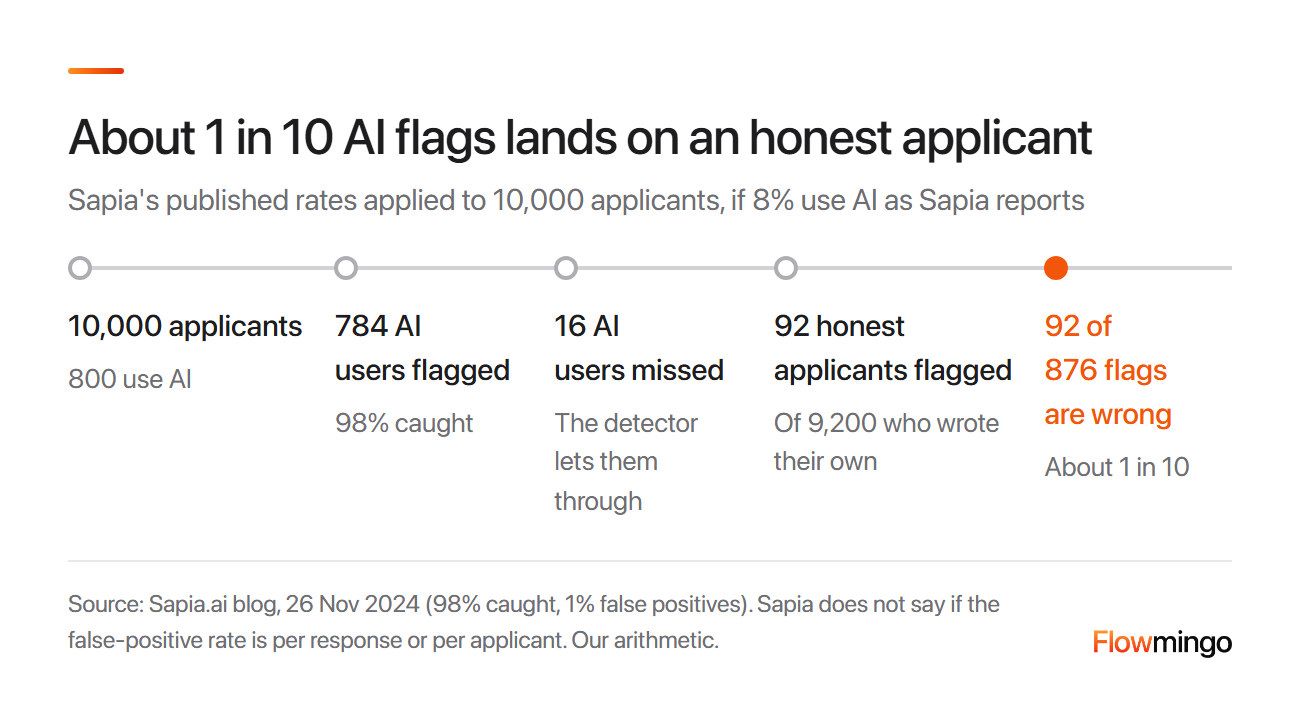
AI flags at 10,000 applicants: of 800 AI users, the detector flags 784 and misses 16. It also flags 92 of 9,200 honest applicants, so 92 of 876 flags are wrong.
Treat that 1-in-10 figure as a rough guide, because the units are unclear. Sapia frames its detection rate per response, but it does not say whether the false-positive rate is per response or per applicant.
The warning lets an honest applicant reword the answer, but a flag left in place still reaches your recruiters. So read a flagged answer before you decide anything about the person who wrote it.
Ask Sapia, too, for its false-positive rate on applicants writing in a second language.
8. Do Sapia's buyer reviews still describe the product we would buy today?
Not reliably: every written Sapia AI review on Capterra predates the rename, and the newest dates from 25 October 2021. Capterra shows 4.6 out of 5 from 18 reviews, and 7 of the 10 newest carry its "Vendor Referred" label, which means Sapia invited the reviewer.
For a buyer today, that makes them evidence about the older PredictiveHire product: the 10 newest written reviews run back to April 2020, and even the newest is more than 5 years old.
The praise on Capterra is consistent. Reviewers liked the candidate experience, the speed of shortlisting and how quickly the team shipped fixes.
The ratings agree. In a copy of Capterra's page that the Wayback Machine saved on 12 September 2026, the 18 ratings split into 13 of 5 stars, 3 of 4 stars and 2 of 3 stars, so none is below 3 stars.
The complaints are about plumbing, meaning how Sapia connects to the rest of your systems: 2 reviewers wanted it linked to their ATS, 1 of them still waiting on an integration with LiveHire, the ATS that reviewer's team used.
Another wrote that data "was hard to get and slow" and arrived as "just a dump". Those notes predate both the 2024 AI detector and the 2025 terms, so ask current customers whether they still hold.
Sapia's own figure for applicants is more recent: its G-Cloud service definition reports 9.2 out of 10 candidate satisfaction.
OMR Reviews, another software review site, lists Sapia with 0 reviews. G2 and Gartner also list Sapia, and G2's page led Google's results for "sapia ai review" on 25 October 2026, so check the dates of G2's newest reviews before you rely on them.
Applicants also coach each other. Google's search suggestions for "sapia ai interview" include tips, buzzwords and how to pass it on Reddit, so when you call references, ask how scores held up once applicants learned the format.
9. Which Sapia AI alternatives publish a price if we hire fewer than 500 people a year?
Several do: Hirevire starts at $39 a month and Hireflix at $75, both billed yearly, and Willo charges $59 (£49) per live role a month. HireVue and Paradox, the enterprise peers, sell on quotes.
We read each vendor's pricing page on 25 October 2026. Format matters as much as price, because Sapia's chat is text only, which suits applicants without a quiet room or a good camera.
Most low-cost tools build around recorded answers instead. Hirevire takes video, text and audio answers and also scores the text ones, which makes it the closest format match on a small budget.
| Tool | Published entry price | Main limit | Trial |
|---|---|---|---|
| Hirevire | $39 a month ($468 a year) | 1 open role, 300 interviews a year | 7 days |
| Hireflix | $75 a month ($900 a year) | Companies under 50 employees | 1 month |
| Willo | $59 (£49) per live role a month, or from $3,799 (£2,999) a year | Per-role plan has no contract | Not listed |
| HireVue | Quote only | Vendr: median $20,900, average $49,855 from 5 deals | Not listed |
| Paradox | Quote only | Demo first | Not listed |
| Sapia | Quote only, 2024 list £15,000 to £75,000 a year | 150 to 1,000 hires per package | Demo on website; trial for UK public buyers on the 2024 G-Cloud listing |
Prices come from Hireflix, Willo and Paradox. HireVue publishes none, so its row uses Vendr, which reports prices from software deals.
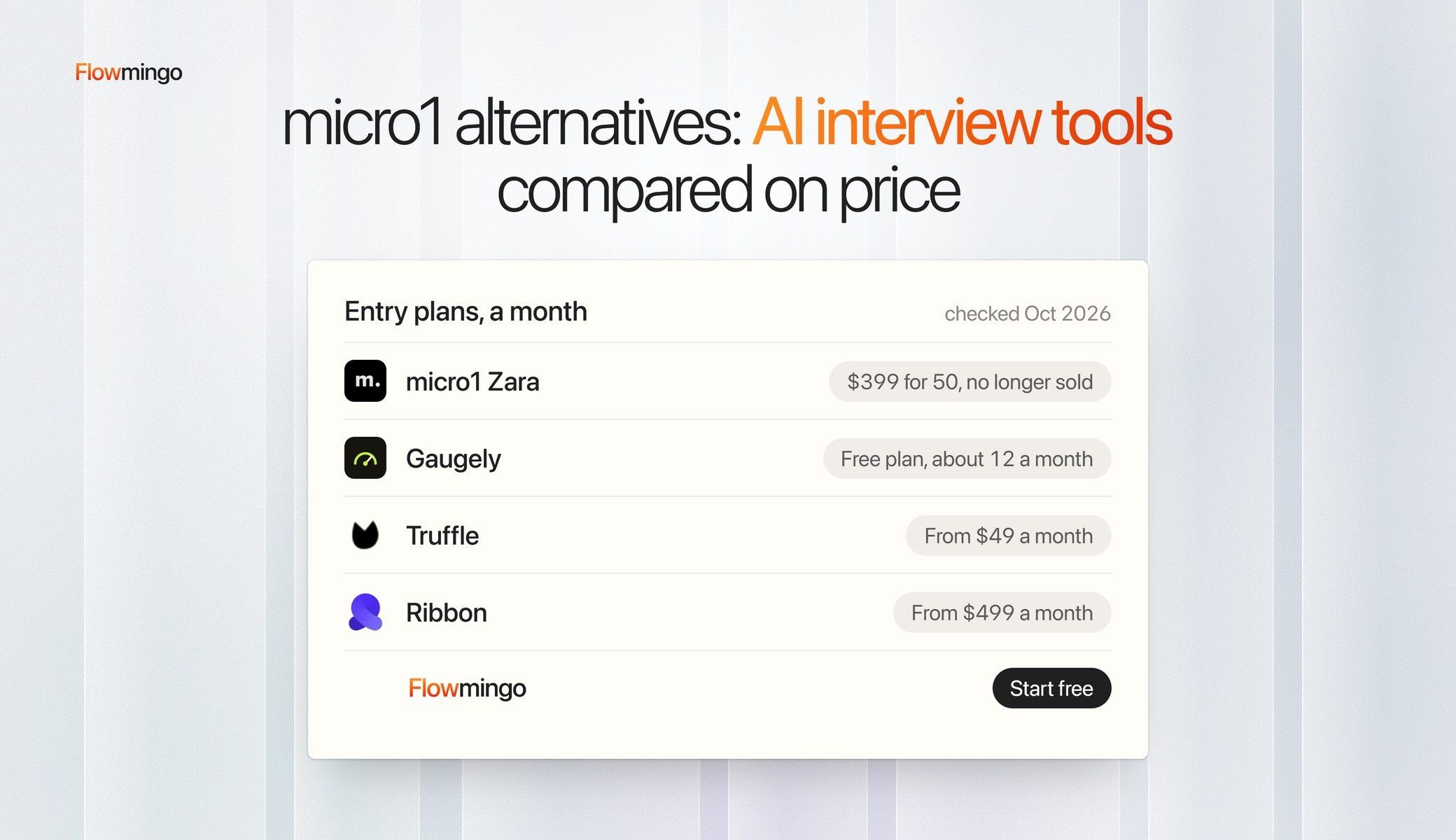
Vendr shows a median of $20,900 a year on its marketplace page, and its buyer guide reports a $49,855 average from 5 deals at 3 buyers. Our micro1 alternatives guide prices 4 more tools.
The pick comes down to 2 things. The first is volume: an agency filling 40 roles a year would pay Starter's £15,000 for a band it uses less than a third of.
The second is format. If text answers matter, check each tool's answer types, because Sapia builds for text and Hirevire also takes it.
If a recorded answer is fine, our guide to automated interview tools maps the categories.
How Flowmingo helps
Flowmingo is a free AI hiring platform. Its Free plan costs $0, and paid plans run $499.80 to $4,069.80 a year on its pricing page.
With its AI Interviewer, each applicant answers in their own time, and you get the recording, the transcript and a scored evaluation, in 60+ languages.
AI interviews, CV evaluation, tests and the applicant tracking system stay unlimited on every plan. For a row-by-row view, see Flowmingo vs Sapia.
10. Sapia AI review verdict: is Sapia worth it for my team?
Sapia is worth it if you hire 500 or more people a year into a few frontline role families. Below 150 hires, its 2024 list puts you at £100 or more a hire before extras.
Its strengths are real. Sapia publishes peer-reviewed research, and it commissioned a third-party bias audit and published a summary of the method.
Its chat needs no camera, which helps applicants in shared homes. Its terms expire instead of renewing by default, and on Pro and Enterprise its people scientists can design a custom model for your role.
For a large retailer that fills the Pro band, all of that can be good value, because at full use Pro works out to £56 a hire.
The case against is about size. If what you need is a fair first round, in which every applicant answers the same questions and you read a scored shortlist, that job does not need a £15,000 package.
Nor does it need the estimated 6-week implementation in Sapia's terms. A yearly band only pays off at volume, so compare any Sapia quote with per-interview plans in our AI interview cost per candidate guide.
If Sapia is already on your list, take these asks into the call:
- A package for the hires you are sure of, with every add-on on a separate line.
- A pilot with an end date, a fixed price and 1 success measure.
- A convenience exit, such as the 2022 agreement's 60 days' notice.
- How the Yes, Maybe and No bands are set today.
- A validation study on roles like yours.
- The latest audit of your exact models, in your country, with its firm and date.
- How often Sapia rechecks adverse impact once you are live.
- Its false-positive rate on applicants writing in a second language.
- Contacts at 2 current customers, to ask about ATS integration, data export and scores once applicants learned the format.
How Flowmingo helps
Below Sapia's 500 hires, you can start on Flowmingo's Free plan, which has no end date.
Free sessions carry Flowmingo's brand next to yours and may show candidates optional offers, and sponsoring a session at $0.49 removes both.
Run your next role beside a Sapia pilot, score both shortlists with the checks in this Sapia AI review, and start free on Flowmingo.
11. Sources
Every price, contract term, study and rating in this review links to a source below, read on 25 October 2026 unless dated otherwise.
- Capterra. (2026, September 12). PredictiveHire (Sapia.ai) reviews [Archived copy]. Wayback Machine.
- Dai, Y., Jayaratne, M., & Jayatilleke, B. (2022). Explainable personality prediction using answers to open-ended interview questions. Frontiers in Psychology, 13.
- European Central Bank, via Frankfurter. (2026, October 23). GBP to USD reference rate. Frankfurter.
- HeroHunt. (2025). Sapia.ai recruiting pricing 2025: What does it cost you. HeroHunt.
- Hireflix. (2026). Pricing. Retrieved October 25, 2026.
- Hirevire. (2026). Pricing. Retrieved October 25, 2026.
- NYC Department of Consumer and Worker Protection. (n.d.). Automated employment decision tools (AEDT). City of New York.
- OMR Reviews. (2026). Sapia.ai. Retrieved October 25, 2026.
- Paradox. (2026). Paradox homepage. Retrieved October 25, 2026.
- Sapia.ai. (n.d.). Press releases. Sapia.ai.
- Sapia.ai. (2022, December 6). Sapia.ai releases its independent bias audit. Sapia.ai.
- Sapia.ai. (2022). EMEA master services agreement, version 202209. Filed on G-Cloud 14.
- Sapia.ai. (2023, June 21). Sapia.ai launches world-first model to detect AI-generated content in online chat interviews. Sapia.ai.
- Sapia.ai. (2024, May 7). G-Cloud 14 pricing document. UK Digital Marketplace.
- Sapia.ai. (2024). Assessments (Smart Interviewer), G-Cloud 14 service. UK Digital Marketplace.
- Sapia.ai. (2024). Internal mobility, G-Cloud 14 service. UK Digital Marketplace.
- Sapia.ai. (2024, November 26). Keeping interviews real with next-gen AI detection. Sapia.ai.
- Sapia.ai. (2025, May). Software terms and conditions, version 2. Sapia.ai.
- Sapia.ai. (2026). AI chat interview. Retrieved October 25, 2026.
- Sapia.ai. (2026). Candidate explainer. Retrieved October 25, 2026.
- Sapia.ai. (2026). Homepage. Retrieved October 25, 2026.
- Sapia.ai. (2026). Pricing. Retrieved October 25, 2026.
- Sapia.ai. (2026). Science. Retrieved October 25, 2026.
- Vendr. (2026). HireVue software pricing and buyer guide. Retrieved October 25, 2026.
- Vendr. (2026). HireVue marketplace pricing. Retrieved October 25, 2026.
- Willo. (2026). Pricing. Retrieved October 25, 2026.