
You asked HireVue, the video interviewing and assessment vendor, for a price and got a demo invite instead. So you searched HireVue pricing and found 3 answers that cannot all be right: $35,000 a year, $35,000 a month and about $50,000.
The gap between those answers is your budget, because the monthly one comes to $420,000 a year. Take the wrong HireVue cost into a budget meeting, and you could ask finance for $35,000 against a quote 12 times that size.
The answers disagree for plain reasons. Most pages repeat the same small sample of 5 deals, and 1 review site lists the $35,000 as a monthly price rather than a yearly one.
So we checked 2 sources anyone can open. The first is USAspending.gov, the US government's public record of what its agencies spend, which holds 23 orders for HireVue since 2020.
The second is HireVue's Master Services Agreement, version 2.2, the standard contract that its order forms sit on. Flowmingo, which publishes this guide, sells a competing product, so every number links to its source, and we say where HireVue is the better buy.
What those documents show is that the renewal clause matters more than the year-1 quote, because the contract adds 10% a year after the first term, while several federal buyers renewed at a flat price.
Key takeaways
- How much is HireVue pricing per month for 1 team? About $1,742 at Vendr's median of $20,900 a year, and $4,163 on the FDA order that renewed at $49,950 a year. HireVue publishes no monthly plan.
- Is HireVue free for employers? No. It is free for candidates only, and a paid Air Force pilot program of 100 licenses cost $178,628.
- What does HireVue cost per interview or per hire? Public orders work out to $77.89 per interview or assessment and $87.25 per hire.
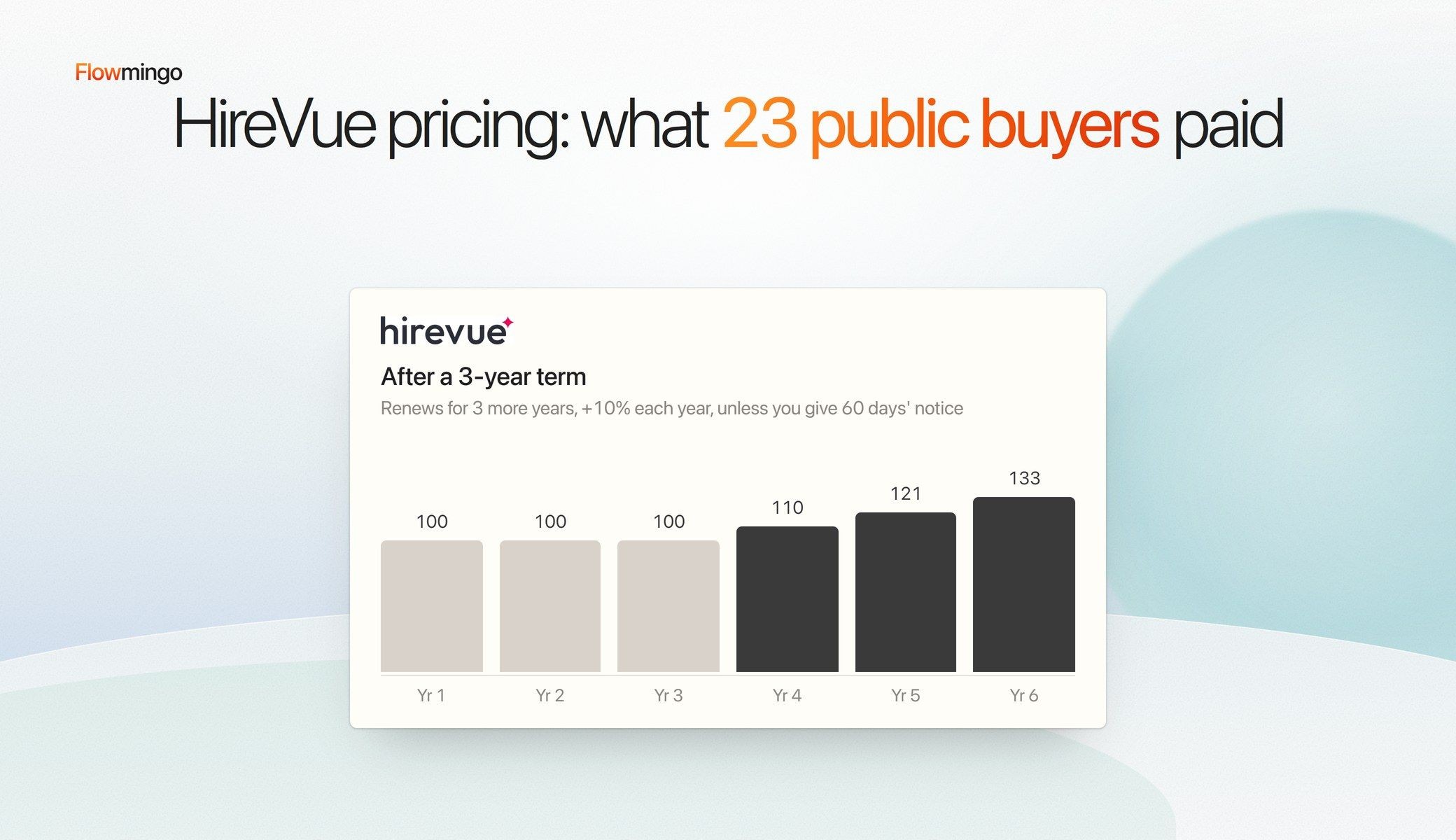
- What happens after a 3-year HireVue contract ends? It renews for 3 more years at 10% more each year, unless you give 60 days' notice. Year 6 costs 33% more than year 1.
- Are there cheaper tools with published prices? Yes. The 4 we read cost $468 to $3,799 for a year, each less than 4 weeks of that FDA order.
1. How much is HireVue pricing per month for 1 recruiting team?
HireVue pricing per month runs from about $1,742 to $4,163 for 1 team. HireVue publishes no monthly plan, so these are 2 yearly prices divided by 12: the $20,900 median at Vendr, a software buying service, and an FDA order's $49,950 renewal year.
Vendr needs a closer look, because it shows 2 different numbers on 2 pages. Its marketplace page says the median buyer pays $20,900 a year, in a range from $9,794 to $41,056.
Its buyer guide reports a higher average contract, $49,855 a year, but that average rests on 5 deals at 3 buyers.
Vendr does not say whether the 2 figures come from the same deals. Still, an average far above the median usually means a few large deals pull it up, so a typical team likely pays nearer $20,900.
The top of that range, $49,950 a year, comes from the public record, not from Vendr. The US Food and Drug Administration (FDA) renewed 1 HireVue order at that price in 2022, 2023 and 2024 (USAspending.gov, order 75F40121P00148).
That amount is 1 order, not the agency's whole bill, because the FDA ran other, larger HireVue orders at the same time.
Some pages say $35,000 a month because SelectSoftware Reviews, a software review site, lists HireVue's Essentials plan as starting "at $35,000 per month".
Most other guides give the same figure as a yearly price, and the difference is large. A monthly price that size means $420,000 a year, which only the largest federal orders reach, such as the Army's.
Those federal orders are price evidence any buyer can check. On USAspending.gov, 23 orders since 2020 name HireVue, and together they commit $19.1M. Of the 23, 10 were not competed, which means no rival bid against them.
So read the amounts on those 10 as HireVue's asking price. Across all 23, whole orders run from $58,200 (an FDA subscription, July 2020 to March 2021) to $3,996,237 (Customs and Border Protection, September 2024 to September 2027).
The figure below shows 1 year on 8 of those 23 orders.
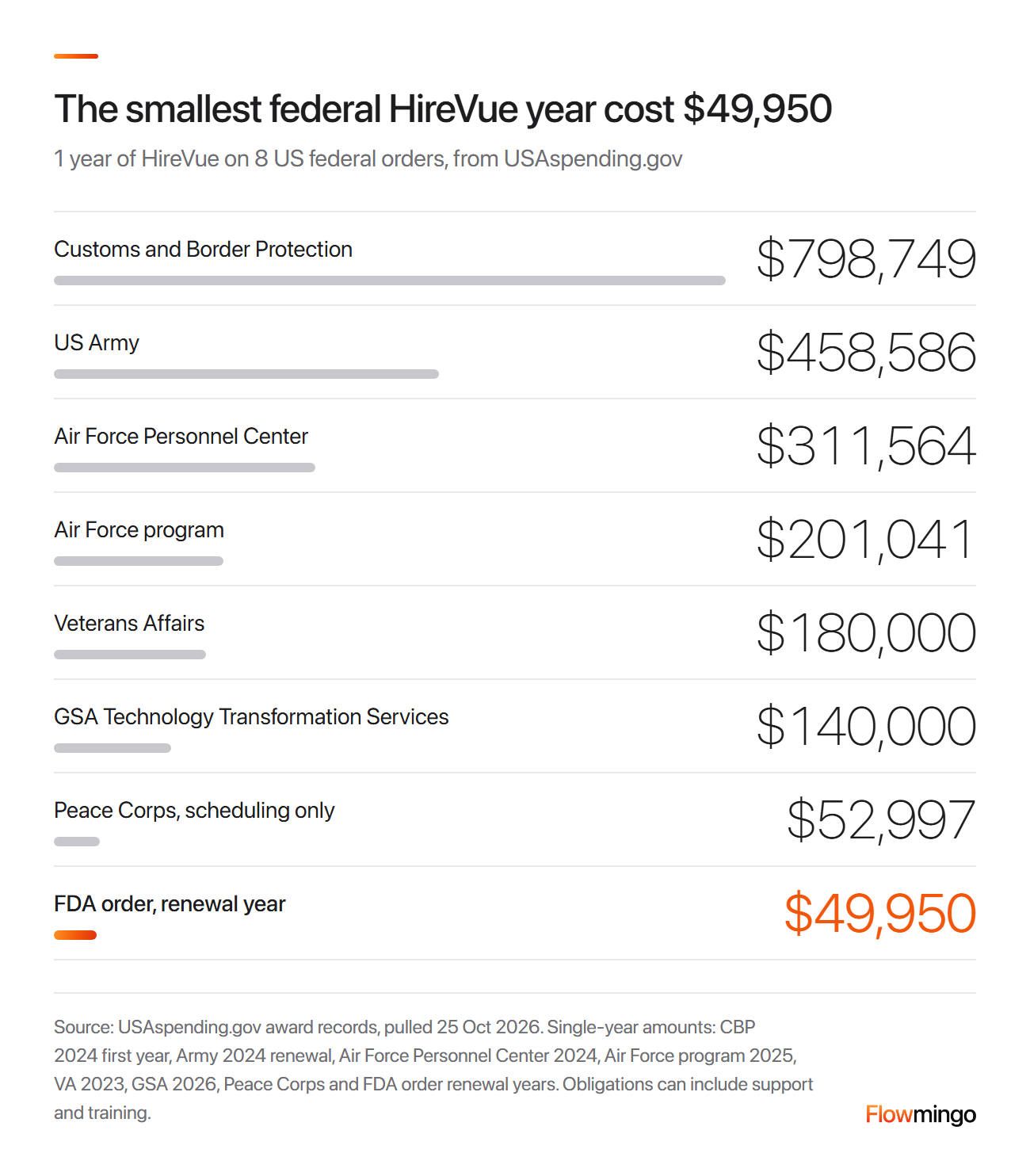
HireVue for 1 year on 8 US federal orders: Customs and Border Protection $798,749, Army $458,586, Air Force Personnel Center $311,564, Air Force program $201,041. Then VA $180,000, GSA $140,000, Peace Corps $52,997 and $49,950 on an FDA order.
Read as monthly prices, those bars show how wide the federal range runs. At the top, Customs and Border Protection's first year, from September 2024, cost about $66,600 a month, and the Army's 2024 renewal comes to about $38,200 a month.
In the middle, an Air Force program renewed at $201,041 in 2025. The Department of Veterans Affairs (VA) paid $180,000, or $15,000 a month, for 1 year from June 2023.
Below them, the Technology Transformation Services of the General Services Administration (GSA) pays $140,000, about $11,700 a month, for the year from April 2026.
At the bottom sit the FDA order's renewal year, at $4,163 a month, and the Peace Corps, whose $52,997 bought scheduling only.
None of this means a company will pay federal prices. Those prices may carry the cost of FedRAMP approval, the US government's security approval for cloud software, and of long procurement cycles, so HireVue may quote a private company less.
For your budget, start from Vendr's $20,900 median, and treat the smallest federal HireVue year ($49,950) as a reference point.
2. How does HireVue pricing work when there is no price list?
HireVue sells a yearly subscription on a custom quote, priced on what its contract calls your Parameters of Use, such as headcount, access rights, uses or hires.
That wording comes from HireVue's Master Services Agreement, version 2.2, which took effect on 10 February 2025. Under it, fees follow the scope in your order form.
That is why 2 companies buying the same features can pay different amounts. It is also why the HireVue pricing page shows no number at all.
Instead, the page offers a demo, an ROI calculator and the line that HireVue is built "from mid-market to enterprise".
The public orders use 3 of those kinds of unit. The Army's order adds hires, an Air Force pilot bought licenses, and the Air Force Personnel Center buys interviews and assessments.
Before you compare 2 quotes, ask which unit each one uses and how many units it includes. The unit changes the bill. For example, for 250 hires from 1,000 interviews, section 6 prices the per-interview bill at more than 3 times the per-hire one.
The contract has 2 more rules that shape the budget. It makes fees non-refundable "including for under-utilization", so if you buy 500 hires and make 300, you still pay for 500.
It also renews by itself, with a price rise written in, which section 7 covers.
3. Which HireVue plan, Essentials, Enterprise or Premium, fits a team that needs AI scoring?
HireVue's pricing page named no plans when we read it on 25 October 2026. Third-party guides describe 3 tiers: Essentials at about $35,000 a year, Enterprise at $50,000 to $100,000 or more, and Premium above $200,000.
The tier names come from review sites and from other vendors' guides, such as HappyRobot and Pin. HireVue confirms none of it, so treat each line below as reported, and check it in your quote.
| Plan, as reported | Reported price | Reported contents | Reported fit |
|---|---|---|---|
| Essentials | About $35,000 a year | Live and on-demand video interviews, SSO and branding. Scheduling costs extra, and AI scoring is not included | 2,500 to 7,500 employees |
| Enterprise | $50,000 to $100,000+ a year | Adds AI screening and benchmarking, chatbot and text-to-apply, analytics and deeper ATS integrations | More than 7,500 employees |
| Premium | $200,000+ a year | Adds the full assessment suite, often on 2- to 3-year contracts | Very large employers |
Even those guides disagree on where a tier starts. Xobin, another vendor, starts Enterprise at $75,000 and HappyRobot at $50,000, so treat any tier price as a range.
3.1 Does HireVue's AI scoring cost extra?
On the reported tiers, yes, because AI scoring starts at Enterprise, and Essentials buys video interviews without scores. If you want AI evaluation, get a quote at the tier that includes it.
The public record shows add-ons priced as their own changes to an order. In September 2024, the US Cybersecurity and Infrastructure Security Agency (CISA) added a self-scheduling tool to its HireVue order for $41,114 (order 70RCSJ24FR0000032).
The Peace Corps paid $52,997 a year, 4 years running, for licenses to HireVue Coordinate, a scheduling tool, and nothing else. So scheduling alone cost it more than the $49,950 renewal year on the FDA order in section 1.
Not every addition costs money, though. When the Army added HireVue's CodeVue subscription to its order for technical hiring in April 2023, the change cost $0.
Because an add-on can cost $41,114 or nothing, a team that wants AI scores and self-scheduling on 1 contract should price both lines before comparing HireVue with rivals.
4. How much does HireVue cost per interview or per hire at my hiring volume?
Of the public orders, 3 name a unit, and they work out to $77.89 per interview or assessment, $87.25 per hire and $1,786 per license.
The cleanest of the 3 is the Army's. A change order dated 13 September 2023 reads "addition of 250 hires" and adds $21,811.50, or $87.25 per hire (USAspending.gov, order W911SD23P0036).
The per-interview rate needs more care. In December 2024, the Air Force Personnel Center renewed "video interview 2000 and assessments 2000", meaning 2,000 interviews and 2,000 assessments, for $311,563.55.
That renewal sits on order FA300224F0024. Split across those 4,000 units, each costs $77.89, or about $156 for a candidate who takes both.
The license rate comes from a pilot. An Air Force unit bought a "HireVue pilot program (100 licenses)" for $178,628.40, or $1,786 a license (order FA441722F0204).
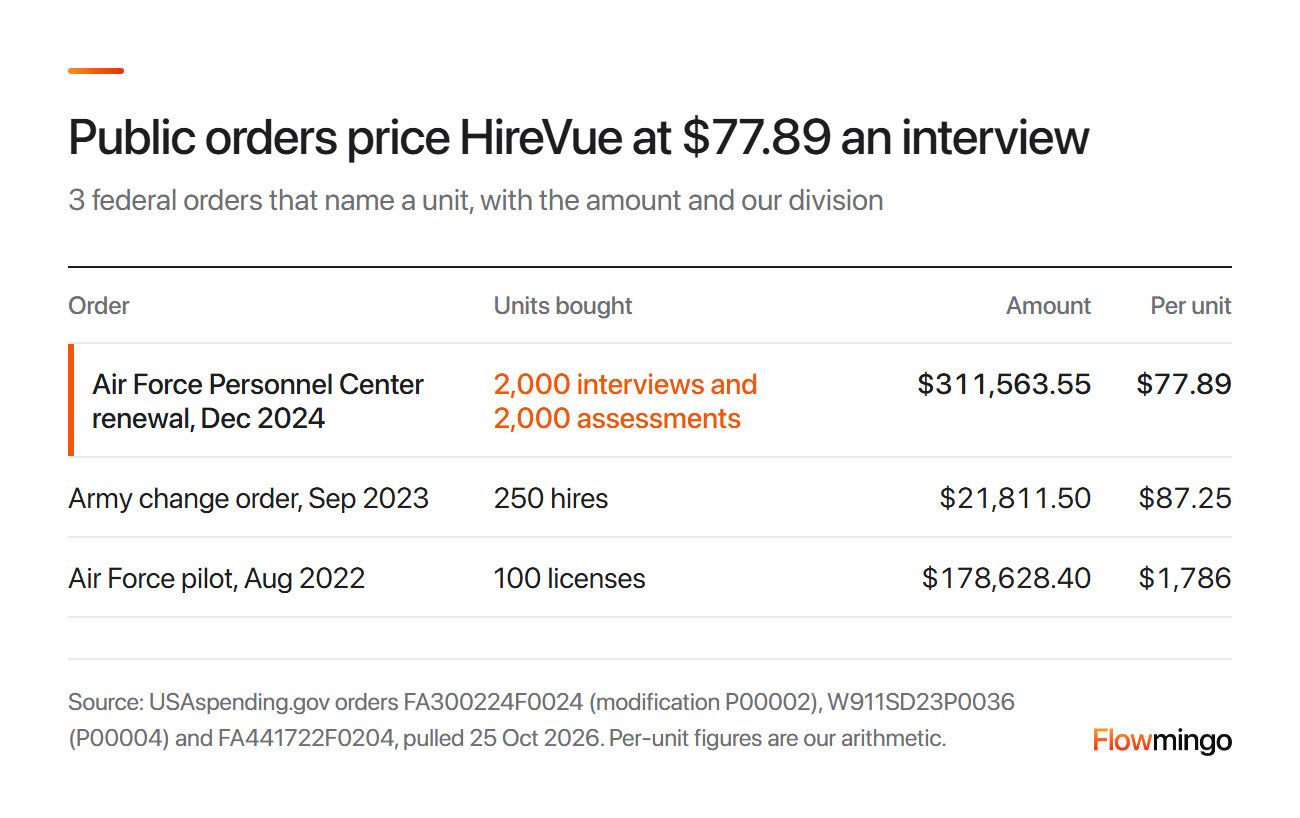
HireVue cost per unit: $311,564 for 2,000 interviews and 2,000 assessments is $77.89 each. Then $21,812 for 250 hires is $87.25, and $178,628 for 100 licenses is $1,786.
One guide offers far cheaper HireVue pricing per interview. HappyRobot puts it at "roughly $5 to $30" and credits that to "third-party procurement estimates", but it cites no order or deal we could find.
Against that range, the public interview rate sits 2.6 to 15.6 times higher, so a budget built on the estimate would cover only a fraction of what 1 agency paid.
Part of the gap may have a reason. HireVue's site cites more than 1,300 validation studies behind its assessments, so part of each unit may pay for that research, not only the software.
At low volume, a yearly minimum can matter more than the unit rate. For example, 500 interviews at $77.89 come to $38,945, which sits inside the yearly range in section 1.
So ask whether your quote follows a unit rate or a yearly minimum.
5. Is HireVue free for employers, or can my team trial it first?
HireVue is free for candidates, never for employers, and it lists no trial you can start yourself. Teams that want to test it buy a paid pilot, and 1 public pilot cost $178,628.
SelectSoftware Reviews and HappyRobot both report that HireVue offers no trial, and its pricing page leads only to a demo. The same page says HireVue "is free for candidates", who also need no app download, so the free part sits on the candidate's side.
The public record shows what a test costs. In August 2022, an Air Force unit paid $178,628.40 for the 100-license pilot in section 4.
In November 2023, the same contracting office ordered a full HireVue program at $195,889 for its first year (order FA441724F0012).
Set side by side, the pilot cost 91% of a full year, which means the decision is nearly paid for before you make it.
So if you pilot HireVue, get 3 things written into the pilot. The first is what it must show, such as completion rate and time to shortlist, and the second is an end date with no automatic conversion.
The third is an agreement that the pilot fee counts toward year 1 if you continue.
If what you want to try is one-way AI interviews on your own roles, you can test more cheaply. Of the one-way interview tools, Hirevire offers a 7-day trial, and Hireflix a 1-month trial capped at 15 candidates.
Ask Hireflix to raise that cap to 30 before you run 1 real role, because 30 applicants is the rule-of-thumb minimum for a pilot in our guide to automated first round interviews. Our guide to choosing an AI interview tool for recruiters then lists 7 tests to run on that role over 2 weeks.
6. What will HireVue pricing cost my team over a 3-year contract?
For a team making 250 hires from 1,000 interviews a year, expect about $145,000 to $517,000 over 6 years. That covers a 3-year term plus the 3-year automatic renewal at 10% a year.
The table prices that team twice, once per hire and once per interview, at the public unit rates and the contract's default renewal.
| Line | Priced per hire | Priced per interview |
|---|---|---|
| Rate used | $87.25 a hire (Army) | $77.89 an interview (Air Force) |
| Year 1 | $21,812 | $77,890 |
| Years 1 to 3 | $65,435 | $233,670 |
| Years 4 to 6, +10% a year | $79,416 | $283,597 |
| 6 years in all | $144,851 | $517,267 |
| 6 years with 0% renewal | $130,869 | $467,340 |
Priced per hire, year 1 comes to $21,812, close to Vendr's $20,900 median. Priced per interview, the same team pays $77,890, because that rate counts every interview, not only the ones that end in a hire.
Now set the renewal rise to 0%. The 6-year total drops by $13,982 on the per-hire price and by $49,927 on the per-interview price.
That difference is the value of 1 clause, which is why section 8 puts the renewal before the year-1 discount.
The table also leaves out 2 costs. Implementation, reported at $15,000 to $40,000, comes on top in year 1, and overage can lift later years if you pass your volume, as section 7 shows.
So put the 6-year view, not the year-1 quote, in front of the finance team. Our guide to AI interview cost per candidate shows how to turn it into a cost per hire.
7. Which fees come on top of HireVue pricing when I review the order form?
The yearly quote leaves out 4 costs: implementation, a 10% yearly rise at renewal, overage that carries into later years and an export fee. Most guides cover only the first.
The last 3 sit in HireVue's contract, version 2.2, and only your order form can change them.
7.1 Implementation fees
Several guides, including Pin and HappyRobot, report a 1-time implementation fee of $15,000 to $40,000. By their account it covers setup, ATS integration and training, and HireVue does not publish it.
Ask for it as its own quote line, and ask whether year 1 can absorb it. On a year the size of the FDA order's renewal, a $40,000 fee adds 80% to the first invoice.
7.2 The automatic renewal and its 10% rise
HireVue's contract renews each order for "the longer of" your first term or 1 year. In practice, a 3-year order renews for 3 more years, and each renewal year costs 10% more than the year before.
To stop it, you must email renewals@hirevue.com at least 60 days before the term ends.
Even a negotiation guide can miss it. Costbench, in its guide to negotiating with HireVue, says the company "has no published price escalation schedule", but the current contract writes 1 in.
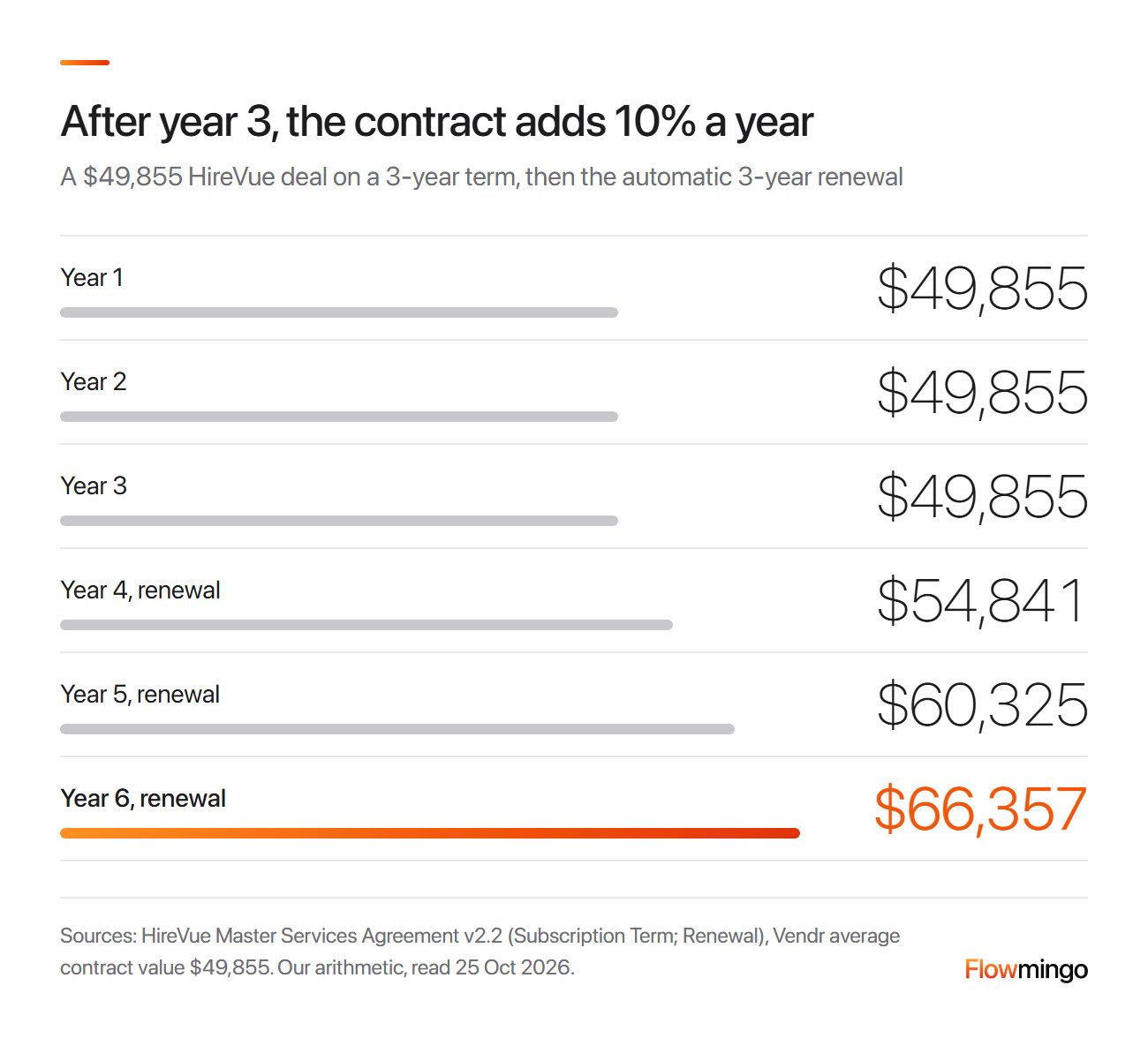
A $49,855 deal over 6 years: years 1 to 3 cost $49,855 each, then $54,841, $60,325 and $66,357. Years 4 to 6 total $181,522, which is $31,957 more than years 1 to 3.
The figure runs Vendr's $49,855 average through those default terms. Year 6 costs 33% more than year 1, and the renewal term costs $31,957 more than the first.
7.3 Overage that carries into later years
If you pass your Parameters of Use, the contract lets HireVue invoice the higher level for the rest of the year, and later years of the term may bill at that higher rate.
For example, a retailer contracts for 250 hires, then adds 300 seasonal hires in the 4th quarter. At $87.25 a hire, the extra 300 cost about $26,175, and next year's invoice can stay at the new level.
7.4 Data export when you leave
HireVue stores your data for 2 years from first storage, then may delete it. After your order ends, it has no duty to keep that data.
Because that clock starts at first storage, it runs while you are still a customer. On a 3-year term, HireVue may delete a video recorded in month 1 in month 25, so a team rehiring for the same role in year 3 may find its first shortlist gone.
You can export through its API, or by another method "for such fee" as your order sets. Before you sign, agree a free export of videos and scores within 30 days of the end.
8. How do I negotiate HireVue pricing before we sign or renew?
Negotiate the renewal terms first and the year-1 discount second, because the renewal is the easiest term to put in money. On the section 6 example, a 0% cap on the renewal rise saves about $14,000 over 6 years when the team pays per hire, and $50,000 when it pays per interview.
A 5% cap saves about $7,200 and $25,800.
Ask for a way out before you sign, too. Federal buyers kept one. In February 2025, CISA ended its 2024 order, the one with the self-scheduling tool, early for the government's convenience, and in March 2025 the FDA ended a December 2024 order the same way.
HireVue's contract gives a private buyer no such right, because order obligations are "final and non-cancelable". The exit has to go into your order form, as asks 2 and 3 show.
Bring 8 asks, in this order:
- A renewal rise capped at 0% to 5% a year, or a fixed price for every year.
- A renewal term of 1 year, not the full length of the first term.
- An opt-out at each anniversary, with the 60-day notice date and renewals@hirevue.com on the order.
- Overage billed for the current year only, at the contract unit rate, never carried into later years.
- A volume you can lower at each anniversary, or unused units rolled into the next year.
- Implementation as its own line, waived or credited in year 1.
- Pilot terms: what it must show, an end date with no automatic conversion, and the fee credited to year 1.
- A free export of videos and scores within 30 days of the end.
Federal orders show what ask 1 looks like in practice. An option year is a further year that an agency may choose to buy on an order it already holds, and agencies agree its price when they sign the order.
On 7 orders, those of the FDA, the Peace Corps, the Army, CISA, the Air Force Personnel Center and 2 other Air Force units, no option-year renewal rose by the 10% default. On several, the price stayed flat or fell.
The FDA order's first year cost $59,922, and its 3 renewals cost $49,950 each, about 17% less. The Peace Corps paid the same $52,997 for 4 years, and the Army's 2025 option year matched its 2024 price.
A subscription bought through CISA renewed at the same $265,000 in 2023 (order 70RCSA22P00000019).
Where option-year prices in those 7 orders rose, they rose by less than the contract default. The Air Force program's 2025 year cost 4.9% more, and an Air Force order bought through a reseller rose about 4% a year.
That reseller order, FA701424F0137, paid $759,612 for its first year in 4 equal parts, then $791,259 in 2025 and $826,468 in 2026.
Other rises shrink once you count the volume an agency added during the year. The Army's 1st option year cost 5.0% more than its base price, which is exactly the base plus the 250 hires added in September 2023.
The Air Force Personnel Center's 2024 renewal rose 8.4% over its base price, but 4.8% once you count a $9,650 addition in October 2024.
Much larger rises followed work an agency had added mid-year, as at Customs and Border Protection and, on its next order, the Air Force Personnel Center. That is the pattern the overage rule in section 7.3 allows, not the renewal rate: volume added mid-year lifted the next year's price.
Customs and Border Protection added $798,740 of work in March 2026, halfway through a $798,749 year, so that year cost $1,597,489 in all. Its 2026 option year then cost $1,600,000 (order 70B06C24C00000182), about the same.
The Air Force Personnel Center shows the same pattern. It added $73,009 in April 2026, and its next 1-year order, from June 2026, cost $450,466, 45% above its $311,564 year (order FA300226P0005).
The Army's 2025 addition shows that added work need not raise the next year's price. It added $156,250 of hires in September 2025, yet its January 2026 option-year line stayed at $458,586. It did buy $412,060 more of those hires in 2026, but on separate lines.
Added work, then, raised the next year's price at Customs and Border Protection, at the Air Force Personnel Center and once at the Army, after its September 2023 addition, but not after its September 2025 one.
Ask which of those 2 outcomes your order form sets, and use ask 4 to keep overage in the year it happens.
9. Before my sales call, what do Reddit and reviewers say about HireVue pricing?
On Reddit, most HireVue threads come from candidates, but the few buyer posts call the price steep at volume. On SelectSoftware Reviews, all 3 user reviews fault the cost, including 2 that rate it 8 out of 10.
Buyers post rarely. In Arctic Shift, a searchable archive of Reddit, 56 posts in r/recruiting, a forum for recruiters, mention HireVue, and 8 of them touch on price or cost.
In March 2026, a recruiter with about 4,000 applications for 50 spots wrote that the "per-candidate pricing on hirevue nearly killed our budget" (r/recruiting).
In June 2026, another said that pricing from HireVue and from Spark Hire, a rival video interview vendor, "gets pretty steep" at decent volume (r/recruiting). This means the price bites hardest on high-volume roles, where a per-candidate price grows fastest.
Reviewers on SelectSoftware Reviews also fault the price, mostly for smaller companies. A Grant Thornton reviewer writes that HireVue "can be extremely expensive", and an HR freelancer says the same for "a small company like ours".
Both still rate it 8 out of 10, though both also list product gaps, such as an interface that "could be improved". A Merit America reviewer rated it 5 out of 10 and switched after about a month to "a more affordable alternative".
The renewal clause shows up in the reviews too. Costbench cites a review on Trustpilot from a customer who missed the 60-day window and paid 2 full annual invoices for an unused product.
That is 1 account, but it matches the current contract.
10. Is HireVue worth the price, or will a cheaper alternative do?
HireVue is worth its price if you need FedRAMP approval, validated assessments at enterprise scale and 24/7 support. If you need recorded, scored first-round interviews for 1 recruiting team, published plans cost from a few hundred to a few thousand dollars a year, as the 4 below show.
HireVue says it is the only virtual interviewing and assessment provider that is FedRAMP certified, which helps explain its 23 federal orders. It also offers 24/7 customer support and cites more than 1,300 validation studies.
If you need those, use this guide as a budget, not an exit.
Many teams need something narrower. For example, an agency recruiter or a 200-person company usually needs every applicant to answer the same questions in their own time.
The team then reads scored answers instead of booking 40 phone screens, a job that needs no 3-year order form.
For that job, we read 4 vendors' pricing pages on 25 October 2026, and each entry price limits something different, such as jobs, company size or live roles.
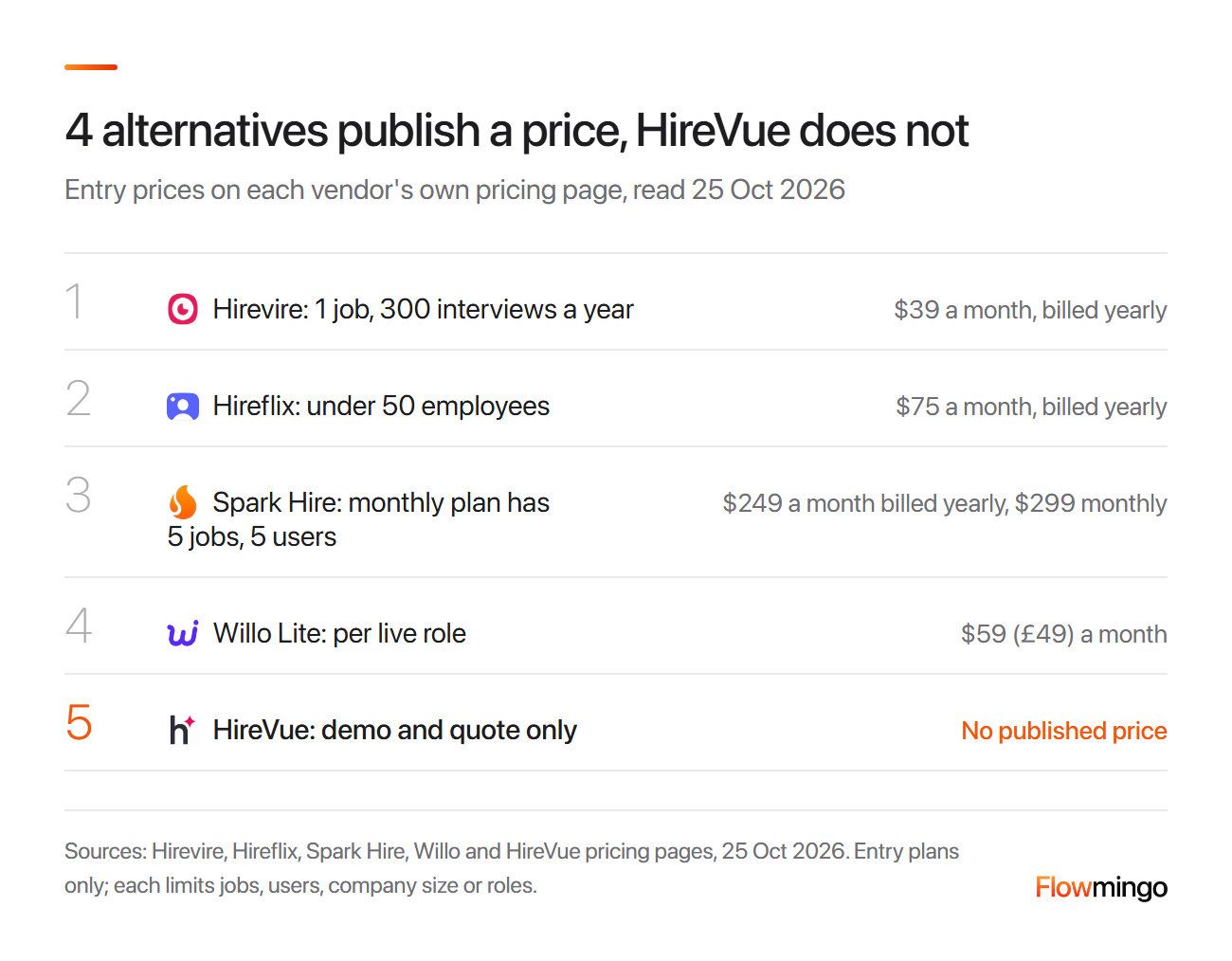
Published entry prices, 25 October 2026: Hirevire $39 a month for 1 job and Hireflix $75 under 50 employees, both billed yearly. Spark Hire $249 billed yearly or $299 monthly, Willo Lite $59 per live role, HireVue no price.
At the low end, Hirevire charges $39 a month billed yearly, or $468 a year, for 1 job and 300 interviews a year. Hireflix charges $75 a month billed yearly for companies under 50 employees.
Spark Hire starts at $249 a month billed yearly, or $299 billed monthly with 5 jobs and 5 users. Willo Lite costs £49 ($59) per live role a month, and its Enterprise plan starts at £2,999 ($3,799) a year.
For scale, the smallest federal HireVue year ($49,950) works out to about $960 a week, and each of the 4 costs less for a year than 4 weeks of it.
Not every rival publishes a price. Like HireVue, micro1 shows none for Zara, its AI interviewer, as our micro1 alternatives guide reports.
A lower price is not the whole test, though. Before you switch, list the 3 features you use every week and test each tool on those.
How Flowmingo helps
Flowmingo is a free AI hiring platform that prints its price list on its pricing page. The Free plan costs $0 and includes unlimited AI interviews, CV evaluation, tests and a full applicant tracking system, with unlimited team members.
Each applicant takes the AI interview in their own time, in 60+ languages. You get back the recording, the transcript and a scored evaluation.
The catch is printed there too. Free sessions show Flowmingo's brand beside yours, and candidates may see optional offers.
Sponsoring a session for $0.49 removes both, so 2,000 sponsored interviews, the Air Force Personnel Center's yearly count, cost $980 a year.
Our Spark Hire alternatives page compares Spark Hire with Flowmingo.
Free keeps the latest 300 videos for 30 days, while results, scores and transcripts are kept forever. Scale costs $4,069.80 a year billed yearly and covers unlimited sponsored sessions under fair use.
To see the gap for your volume, run your next role on Flowmingo and set it beside your HireVue pricing.
11. Sources
Every HireVue amount in this guide links to a public order or page below. Unit costs and multi-year totals are our arithmetic on those amounts.
- Arctic Shift. (2026). Reddit archive search: r/recruiting posts mentioning HireVue. Retrieved October 25, 2026.
- Costbench. (2026). HireVue negotiation: Beat auto-renewal traps. Retrieved October 25, 2026.
- HappyRobot. (2026). HireVue reviews and pricing (2026): Real costs, plans, and alternatives. Retrieved October 25, 2026.
- Hireflix. (2026). Pricing. Retrieved October 25, 2026.
- Hirevire. (2026). Pricing. Retrieved October 25, 2026.
- HireVue. (2025, February 10). Master services agreement, version 2.2. Retrieved October 25, 2026.
- HireVue. (2026). Pricing. Retrieved October 25, 2026.
- Kline, C. (2026, June 8). HireVue pricing 2026: Video interview platform costs. Pin.
- r/recruiting. (2026, March 13). Need help w hiring software but at a budget. Reddit.
- r/recruiting. (2026, June 29). Anyone used AI video interviews for high volume screening? Looking for honest takes. Reddit.
- SelectSoftware Reviews. (2026). HireVue reviews and pricing. Retrieved October 25, 2026.
- Spark Hire. (2026). Pricing. Retrieved October 25, 2026.
- USAspending.gov. (2026). Award search, keyword "HireVue", contracts, 23 orders, January 2020 to September 2026. Retrieved October 25, 2026. FDA orders: 75F40121P00148 and 75F40125F80008. Army: W911SD23P0036. Air Force: FA300224F0024, FA300226P0005, FA441722F0204, FA441724F0012 and FA701424F0137. CBP: 70B06C24C00000182. VA: 36C10A23F0064. GSA: 47QPCA26F0016. Peace Corps: 140D0421F0626. CISA: 70RCSA22P00000019 and 70RCSJ24FR0000032.
- Vendr. (2026a). HireVue software pricing and plans [Buyer guide: average contract value]. Retrieved October 25, 2026.
- Vendr. (2026b). HireVue [Marketplace: median buyer price]. Retrieved October 25, 2026.
- Willo. (2026). Pricing. Retrieved October 25, 2026.
- Xobin. (2026). HireVue pricing and review: Is it a good value for money. Retrieved October 25, 2026.