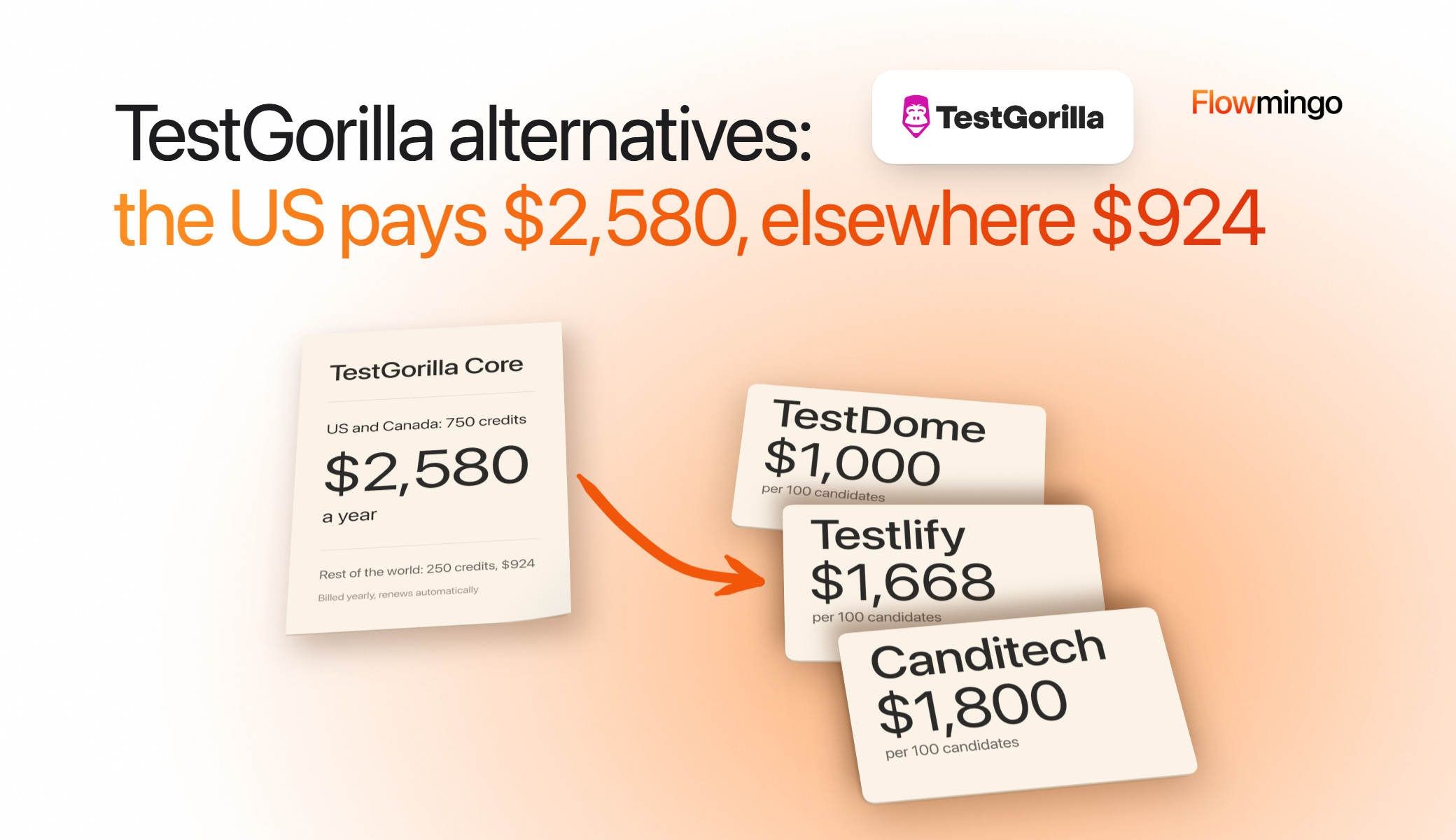
You started pricing TestGorilla alternatives when the smallest Core plan came back at $2,580 a year. A colleague in Singapore, where the page shows US dollars, saw $924.
Both numbers are real, because TestGorilla pricing sets which credit tiers you may buy by your country. In the US and Canada, the website sells Core from 750 credits. Test 100 candidates on 3 tests each, and you use 300 credits while 450 expire, about $1,550 of what you paid.
Compare on the headline price and you pay for credits you never use, then again at renewal at the then-current list price. Some guides still quote $142 a month, a Core price TestGorilla retired between August and October 2026. Others quote about $135 a month, today's price for 450 credits, which only buyers outside the US and Canada can choose.
The fix takes 3 moves: price your volume on TestGorilla's tier table, read the terms, then compare priced tools. We sell a competing product, so every number links to a source.
Key takeaways
- Which TestGorilla alternatives publish a price? Of the tools we priced, Testlify, TestDome, Canditech, Adaface, Codility and HackerRank. The 3 that price per candidate charge $1,000 to $1,800 for 100 candidates a year.
- What does TestGorilla cost in 2026? Core starts at $2,580 a year in the US and Canada and $924 elsewhere, in US dollars. Plus starts at $6,240 a year.
- Can I pay TestGorilla monthly? Yes. Core costs $287 a month for 50 credits, which beats the US yearly floor if you need 50 credits a month or fewer for under 9 months.
- Do I need Plus for AI interviews? On a paid plan, yes. Core has no AI interviews, and Plus charges 2 credits per candidate.
- Can I get a refund if I cancel? No. Fees are non-refundable, and 8 of 11 recent 1-star reviews from employers describe a charge.
1. Which TestGorilla alternatives publish a price I can budget 100 candidates against?
Of the tools we priced, Testlify, TestDome, Canditech, Adaface, Codility and HackerRank publish prices. The 3 that price per candidate charge $1,000 to $1,800 for 100 candidates a year, less than TestGorilla Core in the US.
In the 11 employer 1-star reviews we read (section 6), 8 were about charges and none about the test library. Price floor, per-test credits and renewal billing are the 3 reasons this guide prices.
We kept tools that publish a price, read on 25 October 2026. Our guide to skills-based hiring covers choosing the tests themselves.
| Tool | Entry price | What 1 unit buys | Try first |
|---|---|---|---|
| Testlify | $1,668 a year, 100 credits | 1 candidate, any number of tests | 7-day trial |
| TestDome | $7 to $20 per candidate | 1 candidate, prepaid packs | Trial offered |
| Canditech | $1,800 a year (Team) | Priced for 100 candidates a year | Trial, no card |
| Adaface | $180 a year, 12 credits | 5 credits once per ready-made test, 1 per invite | 14-day trial |
| Codility | $1,200 a year, 120 invites | 1 coding invite | Through sales |
| HackerRank | $948 a year, 60 attempts | 1 completed test or interview | Free account |
The table cannot show test quality, so run 1 sample assessment before you buy.
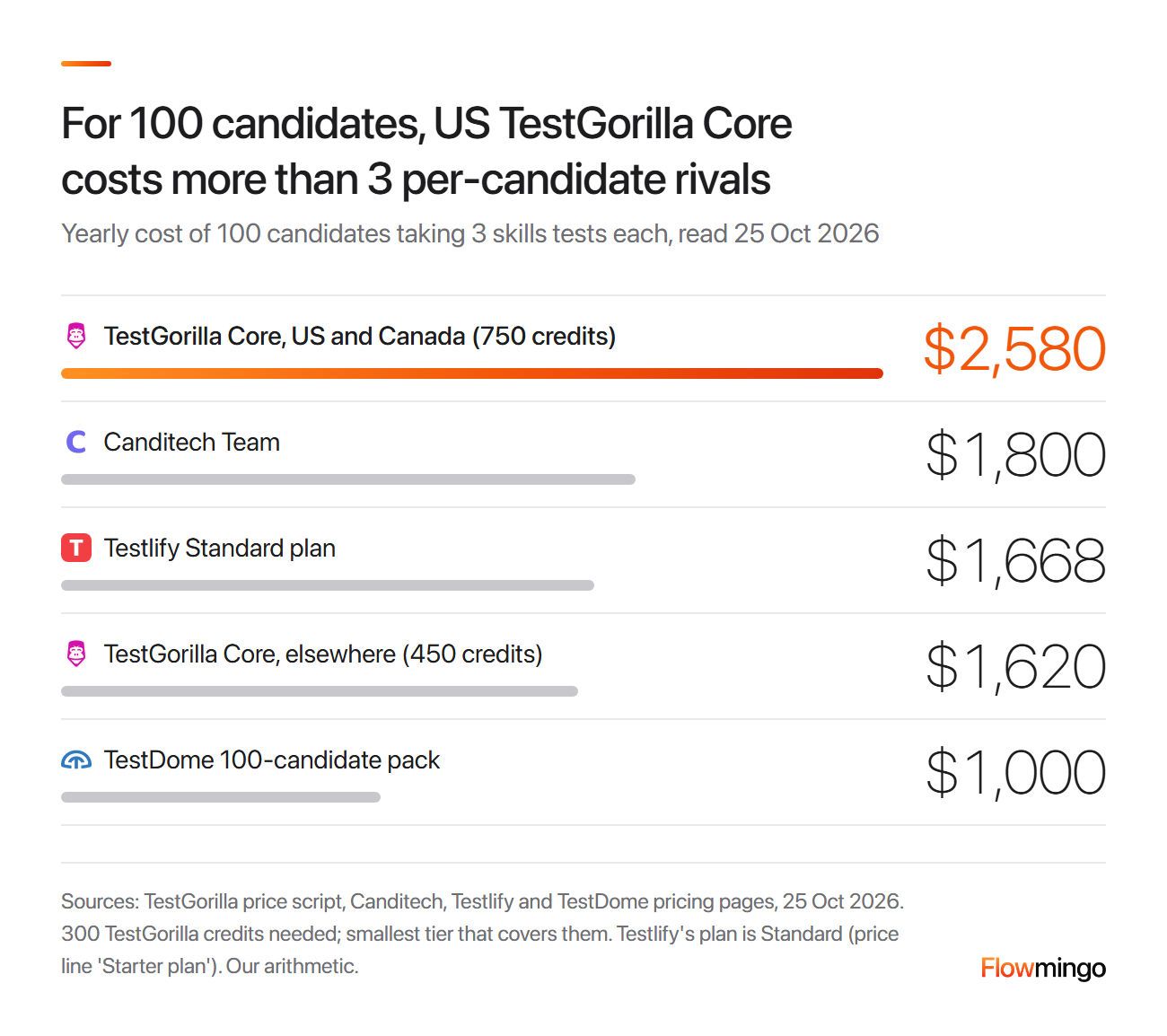
Cost of 100 candidates: TestGorilla Core costs $2,580 in the US and Canada (750 credits) and $1,620 elsewhere (450 credits). Canditech Team costs $1,800, Testlify Standard $1,668 and a TestDome 100-candidate pack $1,000.
For 100 candidates taking 3 tests, you use 300 TestGorilla credits, so a US buyer must take the 750-credit tier at $25.80 a candidate. Outside the US and Canada, the 450-credit tier brings that to $16.20.
Testlify charges 1 credit per candidate whatever the test count, so the same 100 cost $16.68 each. Codility and HackerRank sit outside the chart because they test developers only.
Adaface sits outside it because it charges 5 credits once per ready-made test, plus 1 per invite. For 100 candidates on 3 tests, that is 115 credits, just over its $900 Pro plan of 100. Rerun the sum with your own volume, because TestGorilla wins at times (section 8).
2. What does TestGorilla pricing look like in 2026, and why is my US quote higher?
Core costs $924 to $3,360 a year by credit tier in US dollars, and Plus costs more. Your US quote is higher because US and Canadian visitors can only buy the 750-credit and 1,000-credit tiers on the website.
Gorilla Sourcing, its candidate search, is a separate product at $888 a year per Sourcing seat on its Core plan. This guide prices Gorilla Assessments only.
The pricing page shows "from $215 a month". Its price script holds the full tier list and a region rule.
Visitors in the US and Canada choose 750 or 1,000 credits, while everyone else chooses 250, 450 or 750. In US dollars, a tier costs the same in both regions, so the difference is which tiers you may buy.
The page also sells in euros, pounds, Australian dollars and rupees at their own prices. For example, 250 credits cost €792 or £696, and those currencies add a 20-credit monthly tier at €88 or £78.
| Core credits a year | Price a year | Per month | Per credit | Who can buy it |
|---|---|---|---|---|
| 250 | $924 | $77 | $3.70 | Outside the US and Canada |
| 450 | $1,620 | $135 | $3.60 | Outside the US and Canada |
| 750 | $2,580 | $215 | $3.44 | Everyone |
| 1,000 | $3,360 | $280 | $3.36 | US and Canada |
When the script cannot read your country, it shows the US tiers. So a small US team pays for at least 750 credits online. In the US or Canada, ask sales in writing whether an Order Form can give you the 250 or 450 tier.
2.1 What does 1 TestGorilla credit buy?
A credit pays for 1 tool, for 1 candidate, when that candidate starts the assessment. Inviting is free, and so are resume scoring, qualifying questions and custom questions.
A skills test or video questions cost 1 credit, and an AI interview or a Plus job simulation costs 2. So a 4-test assessment costs 4 credits for every candidate who begins it.
The page contradicts itself here. One line says 2 skills tests plus an AI interview cost 4 credits per candidate. A worked example lower down prices the same assessment at 3 credits, or 150 credits for 50 candidates.
The published rates, 1 credit a test and 2 an interview, add up to 4. So budget on 4, and ask sales to confirm the rate in writing.
2.2 How has TestGorilla's entry price changed since 2020?
We read 23 snapshots of the pricing page in the Wayback Machine. The cheapest paid year for a US buyer rose from $270 in October 2020 to $2,580 in October 2026, nearly 10 times.
The snapshots from 2020 to 2024 are foundational records, kept for the trend. TestGorilla priced by candidates included in 2020, by assessments and candidates in 2022, by company size from December 2023 and by credits from autumn 2025.
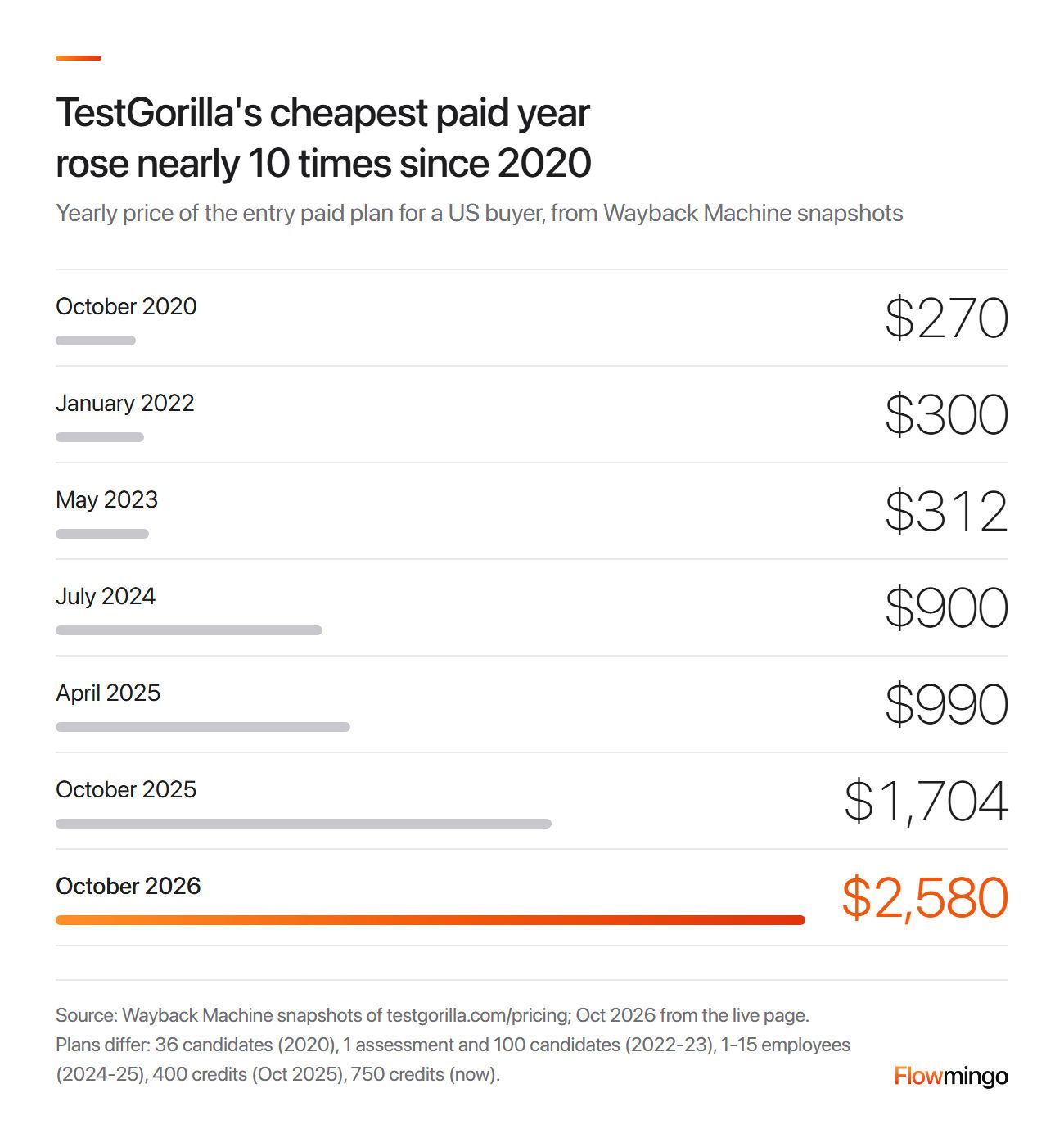
Cheapest paid year: $270 in October 2020, $300 in January 2022 and $312 in May 2023. Then $900 in July 2024, $990 in April 2025, $1,704 in October 2025 and $2,580 in October 2026.
Read this as the price of entry, not like for like. The 2020 plan covered 36 candidates, and the 2022 and 2023 plans 1 assessment and 100 candidates. The 2024 plan covered a company of 1 to 15 staff.
To be fair, the price per credit fell: in October 2025, $1,704 bought 400 credits, or $4.26 each. What rose is the US minimum spend and the cost of long assessments. A 5-test assessment used 3 credits in 2025 and uses 5 today, so it costs $17.20 a candidate instead of $12.78.
3. Can I pay TestGorilla monthly for a short hiring push instead of a full year?
Yes: under the page's Pay monthly toggle, Core costs $287 a month for 50 credits or $374 for 75. Monthly wins when you test in fewer than 9 months a year.
The catch is the rate: 50 monthly credits work out at $5.74 each, against $3.44 on the yearly 750 tier. Monthly credits also reset every month, so a quiet month wastes them.
Say you hire for 3 months, with 15 candidates a month taking 3 tests each. That is 45 credits a month, so the 50-credit tier fits. Over 3 months you pay $861, which is $1,719 less than the US yearly floor.
The US floor divided by the monthly price is about 9. So monthly wins if you need 50 credits a month or fewer for under 9 months.
Outside the US and Canada, the 250-credit yearly tier beats monthly after about 3 months. If your hiring comes in waves, our seasonal hiring guide helps you size each wave first.
Plus works the same way, at $694 a month against $520 billed yearly. A 3-month push costs $2,082, about a third of the yearly Plus floor, so monthly Plus wins too if its credits cover your volume.
Before you choose monthly, read section 7, because a monthly plan keeps renewing until you cancel it.
4. Is TestGorilla's free plan enough for a small team hiring a few roles a year?
It is enough for 1 or 2 roles a year if the 5 essential tests cover them, because those tests cost no credits. Everything else draws on 10 credits a month that reset monthly.
The free tests are Problem Solving, Communication, Time Management, Big 5 personality and Motivation. You also get resume scoring, qualifying questions, 5 preset custom questions and 1 premium user.
Each test from a limited library of 180+ costs 1 credit per candidate with fewer questions, and a custom AI interview costs 2. So 10 credits buy 5 AI interviews or 10 test sittings a month.
For example, 25 applicants for 1 role taking 2 limited-library tests each use 50 credits, or 5 months of allowance. Most small teams will stay on the 5 free tests or upgrade, and that is where many start comparing TestGorilla alternatives.
The terms let TestGorilla end a free plan product "at any moment" (section 7.5), and 1 employer's July 2026 review says the free plan changed.
The page offers no timed trial of Core or Plus today, though a foundational December 2023 snapshot shows a 15-day trial. Ask sales whether one is still possible.
5. Do I need TestGorilla Plus to send candidates AI video interviews?
On a paid plan, yes: Core has no AI interviews in the compare table, and Plus charges 2 credits per candidate from $6,240 a year. The Free plan allows limited custom AI interviews at the same 2 credits.
The product itself is strong. TestGorilla's AI interviews ask follow-up questions in the moment, offer 100+ expert tracks and score answers against 1 rubric, with identity checks.
The catch is the plan. Core video questions come only from TestGorilla's library. Among paid plans, custom video questions, custom AI interviews and the 100+ track library start on Plus.
The April 2026 snapshot listed "one-way AI video interviews" on Core at 1 credit. Its description matches what the page now calls video questions, which Core still has, and conversational AI interviews were already Plus-only then.
For example, 300 applicants a year, each taking an AI interview and 2 tests, use 1,200 credits. The page does not say how many credits the $6,240 Plus floor includes, so ask whether it covers 1,200 and what each extra credit costs.
Get that count in writing before you compare Plus. Our guide to AI interview cost per candidate converts each vendor's quote to 1 unit.
The terms also say the average AI interview "should not exceed 20 minutes" (section 16.14.1), applied at TestGorilla's sole discretion.
If your average runs well above that, TestGorilla may first ask you to cut usage within 2 business days. After that, it may charge more, cut your credits or suspend the feature.
6. What do employer reviews say that pushes teams toward TestGorilla alternatives?
Employer complaints are mostly about money: 8 of the 11 employer reviews among the 40 newest 1-star Trustpilot reviews describe a charge. Most 1-star reviews (26 of the 40 newest) come from candidates, not buyers.
On 25 October 2026, TestGorilla held a TrustScore of 3.6 from 1,737 Trustpilot reviews. Of those, 62% were 5-star and 20% were 1-star.
We read the 40 most recent 1-star reviews, from 29 September 2025 to 22 October 2026, and sorted each by who wrote it. That gave 26 from candidates, 11 from employers and 3 unclear.
Candidates complain about tight timers, generic questions and cheating flags. That matters because they are your applicants, and a test unrelated to the job loses good people.
Employers complain about something else. Of the 11, 8 name a yearly renewal, a cancellation that did not stop billing, or a plan changed without approval.
A review from 25 September 2026 is titled "Watch out for the renewal". The other 3 employer reviews cover price, a free plan that changed and a search filter limit.
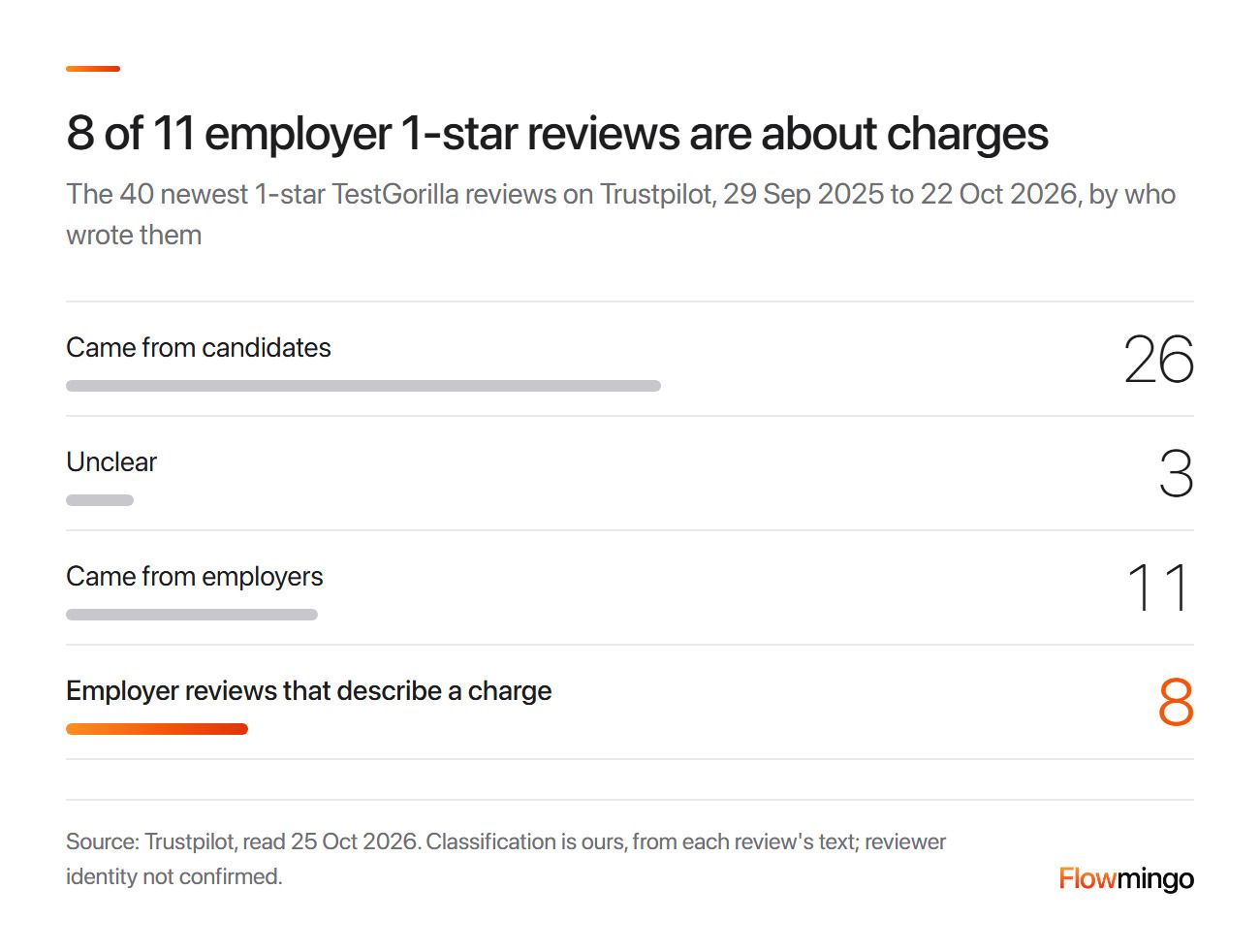
40 recent 1-star reviews: 26 came from candidates, 3 were unclear and 11 came from employers. 8 of the 11 employer reviews describe a charge at renewal, after cancelling or after a plan change.
Keep the scale in view: 11 is a small sample, and we could not confirm each reviewer's identity. Still, the billing pattern matches the contract terms in the next section.
So note the renewal date the day you sign, cancel in writing and check your next card statement.
7. If I cancel TestGorilla, can I get a refund, and what happens to my data?
You can stop a plan from renewing up to the last day of its term, but you cannot get money back. Fees are non-refundable, unused credits expire, and TestGorilla deletes your data within 60 days of the end.
These 7 clauses in TestGorilla's Customer Terms of Service, version 4.2 of August 2026, decide what a plan really costs:
- No refunds (8.3). Fees, once paid, are non-refundable.
- Automatic renewal (14.3). A plan renews for the length of its first term unless you cancel by the last day.
- Renewal at list price (14.4). Renewals use the then-current list price.
- Notice of increases (8.13). Fees may rise each year after the first term, with 30 days' notice.
- Credits expire (8.6). Credits end with the term and have no cash value.
- No downgrades (8.17). Smaller tiers wait for the end of a term.
- Data after you leave (14.8, 8.16). TestGorilla deletes your data within 60 days, unless it offers you an access-only plan for a yearly fee.
Under section 2.2, agencies that screen for clients may use credit-based plans only.
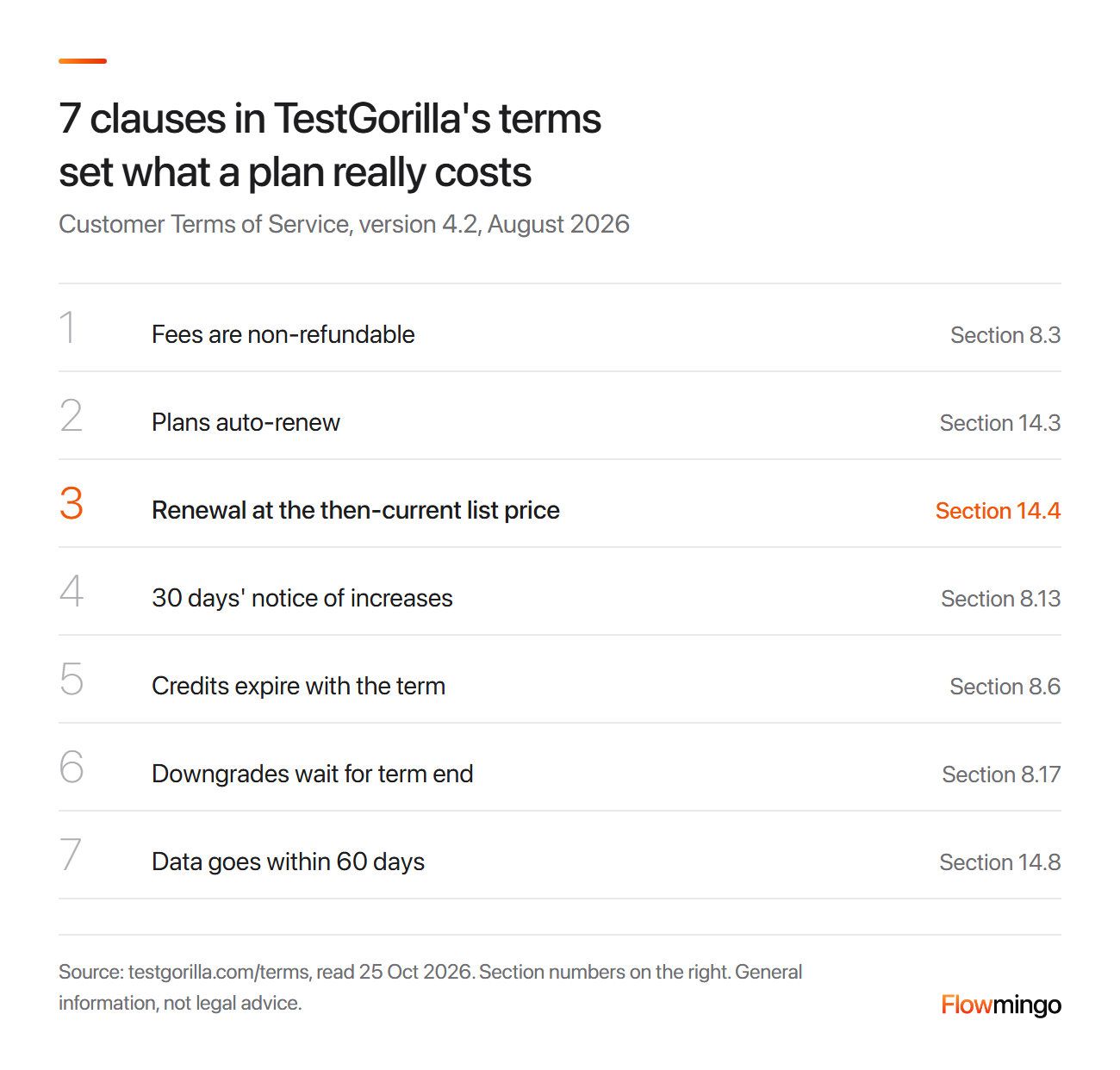
7 contract clauses: fees are non-refundable (8.3), plans auto-renew (14.3) at the then-current list price (14.4), with 30 days' notice of increases (8.13). Credits expire (8.6), downgrades wait for term end (8.17) and data goes within 60 days (14.8).
For example, a US team that buys the 750-credit tier and uses 400 lets 350 expire, about $1,200 of value.
The 30-day notice in 8.13 only helps if you see it in time. Set a reminder 45 days before renewal, so a price rise reaches you before your cancel deadline.
Section 14.4 has an exit, though. Your Order Form can set a different renewal price, so ask for a capped renewal before you sign.
Section 16.4 lets TestGorilla invite your candidates into its talent pool after their assessment. Candidates you mark as hired within 14 days stay out.
8. TestGorilla vs Testlify vs HackerRank: which costs less for my mix of tests?
Testlify costs less when each candidate takes several tests, because it charges 1 credit per candidate. TestGorilla costs less outside the US for 1 test at low volume, while HackerRank suits developer hiring only.
The 3 tools count differently. TestGorilla charges per test and Testlify per candidate, both at the start, while HackerRank counts each completed test or interview.
Testlify's Standard plan, shown as "Starter plan" on its price card on 25 October 2026, costs $1,668 a year for 100 credits. Extra credits cost $21 each, and the page says each credit costs less on bigger plans.
Take 100 candidates taking 5 tests: that is 500 TestGorilla credits, the 750-credit tier anywhere, against 100 Testlify credits. Now take 100 candidates taking 1 test.
In the US you still buy the 750-credit tier, so Testlify's Standard plan wins. Outside the US and Canada, the 250-credit tier at $924 beats Testlify by $744.
At higher US volume, the order flips again. For 300 candidates on 3 tests, you need 900 credits, which fits TestGorilla's 1,000-credit tier at $3,360. Topping up Testlify's Standard plan for those 300 costs $5,868, so ask Testlify for its mid-volume price first.
| What you compare | TestGorilla | Testlify | HackerRank |
|---|---|---|---|
| Entry yearly price (US) | 750 credits, the US floor | $1,668, 100 credits | $948, 60 attempts |
| 1 unit | 1 test, at start | 1 candidate, at start | 1 completed test or interview |
| 100 candidates, 3 tests each | 750-credit tier | Standard covers it | Pro, $5,028 (300 attempts) |
| AI interviews | Plus only, 2 credits | Video, audio and phone | Every plan |
| Users included | 2 premium roles on Core | 3, then $15 a seat a month | Unlimited |
| Unused credits | Expire at end of term | Expire at cycle end | Not stated |
| Refunds | Non-refundable (8.3) | 30-day money-back offer | Not stated |
Testlify also adjusts prices by region: in 1 market we checked, its page showed a 29% regional cut, to $1,188 a year. So buyers outside the US and Canada should check their own Testlify quote too.
HackerRank's pricing page showed prices in a browser on 25 October 2026. Pro includes 360 attempts, and each extra attempt costs $20.
For 100 candidates taking 1 developer test, Starter plus 40 extra attempts costs $1,748. If each candidate takes 3 separate tests, 300 attempts make Pro the cheaper plan.
Codility's Starter plan costs $1,200 a year for 120 invites and 1 platform user. If you hire only engineers, compare HackerRank and Codility among the TestGorilla alternatives.
9. Are there free TestGorilla alternatives that can screen 300 applicants a year?
Not among the paid tools priced here: TestGorilla Free covers about 60 AI interviews a year, and Testlify's trial lasts 7 days. For 300 a year, you need a free plan with no per-candidate meter, and the box below shows one.
Free options differ in what they cap: a credit plan caps volume, while a trial caps time.
A trial helps you test a tool, but it cannot run a hiring year for you. Canditech offers a trial with no card and prices paid plans by candidates assessed a year. Its page does not say how long that trial lasts or how many candidates it covers.
Say you screen 300 applicants a year with 1 AI interview each, at 2 credits per candidate, which is 600 credits in all.
TestGorilla's Free plan gives 120 credits a year, enough for 60 of those interviews. The other 240 applicants would need Plus. Our guide to high-volume recruiting covers the rest of a funnel this size.
That gap is why steady-volume teams search for free TestGorilla alternatives. Check 3 things on any free plan: what it caps, whose brand candidates see, and what happens to your data when you leave.
How Flowmingo helps
Flowmingo is a free AI hiring platform, and its Free plan has no credits to run out of. AI interviews, tests and a full applicant tracking system come with unlimited team members for $0. Each applicant answers the AI interview in their own time, and you get a recording, a transcript and a scored evaluation in 60+ languages.
For the 300 applicants above, that is $0 instead of 600 credits. The trade-off sits on the pricing page: free sessions show Flowmingo's brand next to yours, and candidates may see optional offers. Sponsoring a session removes both, at $0.49 an AI interview on Free, or $147 for all 300.
Free also keeps only your latest 300 videos, for 30 days each, while results, scores and transcripts are kept forever.
10. Is TestGorilla still worth it for my team, or should I switch to TestGorilla alternatives?
TestGorilla is worth it if you want a large science-backed test library, a sourcing database and native ATS links from 1 vendor. For low-volume first-round screening in the US, a 750-credit floor is hard to justify.
Its Core library holds 350+ science-backed tests, and Plus adds job simulations, custom tests and custom coding challenges. Its anti-cheating set covers webcam snapshots, disabled copy and paste, location logging and question exposure monitoring.
Plus connects natively to Workday, Greenhouse, Lever, BambooHR and Ashby, and every plan gets 24/7 live chat and email support.
If those are your must-haves, TestGorilla earns its price at volume, where the 1,000-credit tier gives its cheapest rate per credit.
It fits less well for seasonal teams, whose yearly credits expire unused. It fits less well for teams that mainly want AI interviews, because those start on Plus.
It also fits less well for agencies that screen for clients. Section 2.2 limits them to credit-based plans, so their bill rises with every test a candidate starts.
If you already pay for TestGorilla, start with your renewal date. Price last term's credit use on the tier table in section 2, then run your next role through 1 of the alternatives in parallel.
How Flowmingo helps
If AI interviews are the reason you are pricing Plus, compare a plan that does not meter them. Flowmingo's Free plan never counts AI interviews. Removing our brand costs $0.49 a sponsored interview on Free, or $0.44 on Starter at $499.80 a year.
Scale, at $4,069.80 a year, covers unlimited sponsored sessions under fair use. Paid plans cancel anytime, and results, scores and transcripts stay on every plan.
Send your next role's applicants the AI Interviewer and read their recordings beside your current test scores. Then decide on renewal day with your own numbers, setting your list of TestGorilla alternatives beside Flowmingo.
11. Sources
Every price, clause and count above links to a source below, read on 25 October 2026 unless stated. Per-candidate and per-credit figures are our division of the published price by the published quantity.
- Adaface. (2026). Pricing. Retrieved October 25, 2026.
- Canditech. (2026). Pricing. Retrieved October 25, 2026.
- Codility. (2026). Pricing. Retrieved October 25, 2026.
- HackerRank. (2026). Pricing. Retrieved October 25, 2026.
- Internet Archive. (2020, October 21). TestGorilla pricing page snapshot. Wayback Machine.
- Internet Archive. (2022, January 27). TestGorilla pricing page snapshot. Wayback Machine.
- Internet Archive. (2023, May 9). TestGorilla pricing page snapshot. Wayback Machine.
- Internet Archive. (2023, December 8). TestGorilla pricing page snapshot. Wayback Machine.
- Internet Archive. (2024, July 16). TestGorilla pricing page snapshot. Wayback Machine.
- Internet Archive. (2025, April 11). TestGorilla pricing page snapshot. Wayback Machine.
- Internet Archive. (2025, October 26). TestGorilla pricing page snapshot. Wayback Machine.
- Internet Archive. (2026, April 15). TestGorilla pricing page snapshot. Wayback Machine.
- Internet Archive. (2026, August 2). TestGorilla pricing page snapshot. Wayback Machine.
- Internet Archive. (2026, October 2). TestGorilla pricing page snapshot. Wayback Machine.
- TestDome. (2026). Pricing. Retrieved October 25, 2026.
- TestGorilla. (2026). AI interviews. Retrieved October 25, 2026.
- TestGorilla. (2026, August). Customer terms of service, version 4.2. Retrieved October 25, 2026.
- TestGorilla. (2026). Pricing. Retrieved October 25, 2026.
- TestGorilla. (2026). Pricing page price script, chunk 3081. Retrieved October 25, 2026.
- Testlify. (2026). Pricing. Retrieved October 25, 2026.
- Trustpilot. (2026). TestGorilla reviews. Retrieved October 25, 2026.
- Trustpilot. (2026). TestGorilla 1-star reviews, newest first, pages 1 and 2. Retrieved October 25, 2026.