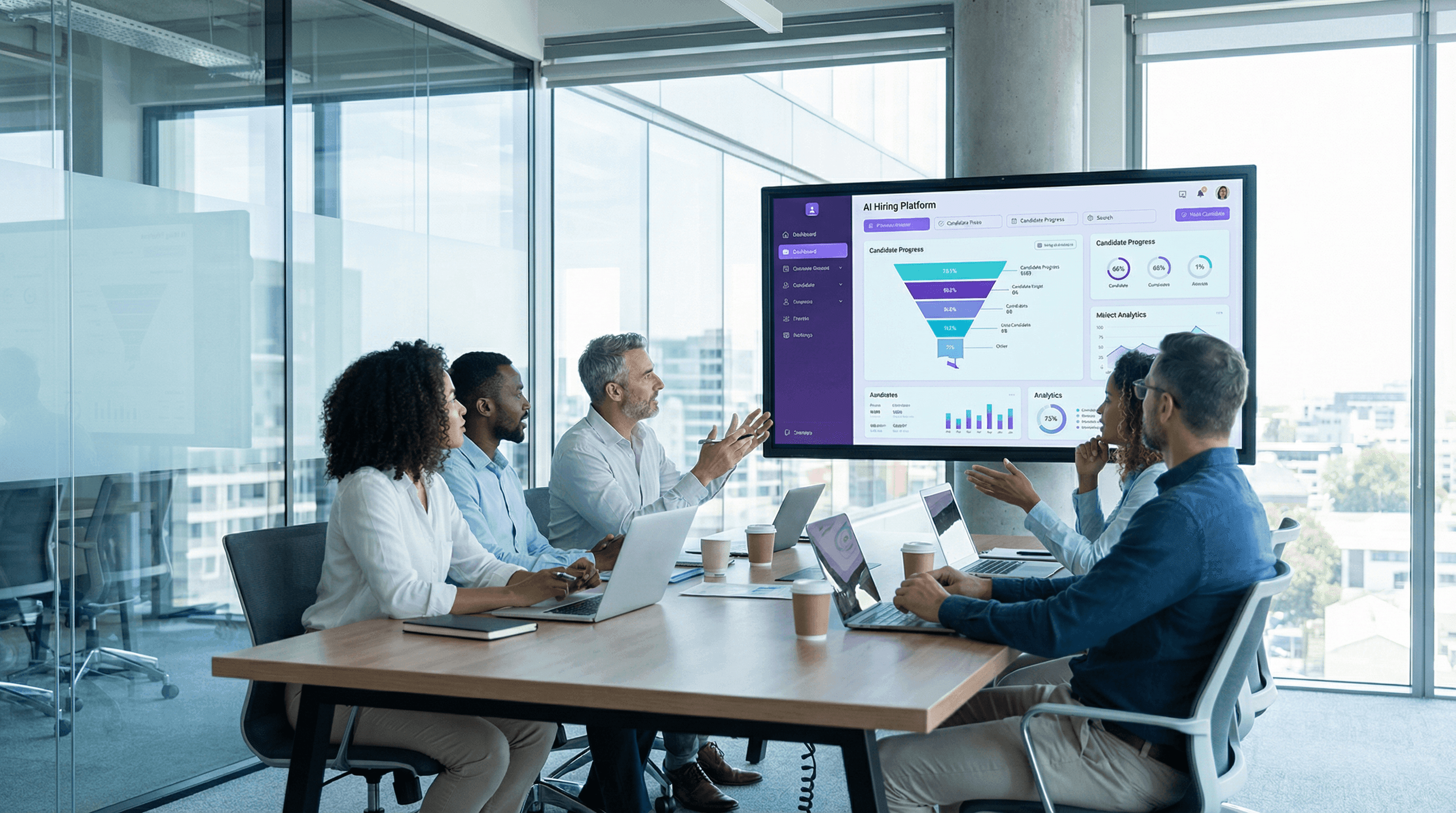

Overview: Why Bias and Consistency Matter More in 2025
Human interviewers introduce significant subjectivity into hiring decisions. Research consistently shows that traditional interviews suffer from 40–60% scoring variability, driven by inconsistent question delivery, unconscious bias, and interviewer fatigue.
AI interview platforms aim to address these issues by delivering standardized questions, structured scoring, and data-driven evaluation. In 2025, adoption of AI-led interviews has grown 35–50% year over year, largely because hiring teams report:
- The same questions, in the same order, whoever the candidate is
- 40–60% reductions in evaluator variance
- More defensible and repeatable hiring decisions
This analysis examines where bias enters traditional interviews, how structured AI interviews can reduce it, and what to ask any vendor, Flowmingo included.
Key Takeaways
- Human interviews introduce large scoring variability at scale
- Bias often comes from inconsistency, not intent
- AI interviews standardize evaluation across candidates
- Structured scoring reduces variance by up to 60%
- AI does not remove bias on its own: structure, clear criteria and human review do the work
Q: Where does bias come from in traditional interviews?
Bias enters hiring through multiple well-documented mechanisms. In unstructured interviews, these effects compound quickly.
Tone and first-impression bias
Research shows interviewers often form opinions within the first 7–30 seconds. These early impressions influence how later answers are interpreted.
Interviewer fatigue
Scoring accuracy drops:
- 15–25% late in the day
- After repetitive or back-to-back interviews
Fatigue leads to harsher or less consistent evaluations.
Inconsistent question delivery
Candidates frequently receive:
- Different questions
- Different follow-ups
- Different time allowances
This reduces fairness and increases evaluation noise.
Unstructured evaluation criteria
Without clear rubrics, 2 interviewers may rate the same response 30–50% differently, making comparisons unreliable.
Q: How do AI interview platforms reduce bias and inconsistency?
AI interview platforms standardize the entire evaluation process. Teams using structured AI interviews report 40–60% lower scoring variance compared to traditional interviews.
Standardized question delivery
- Every candidate receives identical prompts
- Same timing and instructions
- No interviewer-driven variation
This alone removes the largest source of variation between 2 candidates' scores: which interviewer they happened to get.
Structured scoring models
AI evaluates responses using:
- Competency frameworks
- Behavioral indicators
- Job-specific criteria
This reduces subjective interpretation by 40–50%.
Elimination of emotional and situational bias
AI does not react to:
- Accent or tone
- Mood or small talk
- Appearance or nervousness
Structured questions reduce these effects; they do not remove them.
Uniform evaluation at any scale
AI does not experience:
- Fatigue
- Attention drift
- Mood variation
Scoring remains consistent whether evaluating 10 or 10,000 candidates.
Q: Does AI actually improve predictive accuracy?
Yes. When properly configured, AI interview platforms outperform unstructured human interviews.
Correlations with job performance, from the largest re-analysis of the selection literature (Sackett et al., 2022):
- Unstructured interviews: 0.19
- Structured interviews: 0.42
No published study measures the validity of an AI-run interview. The figure belongs to the structure, not to the software that enforces it.
Higher consistency leads directly to better prediction and more defensible decisions.
Q: What do 2 AI interview vendors publish about fairness?
Flowmingo wrote this page. HireVue's details come from its own pages, read on 22 Sep 2026.
Flowmingo
- Every applicant for a role gets the same questions, with a follow-up when an answer misses the question.
- Each criterion you set gets a 0–10 rating with written reasons, so a reviewer can check why.
- Integrity signals, such as a second window or an extra face, are shown for your review, never scored as a penalty.
HireVue
- Publishes 1,300+ validation studies and 20+ years of I-O psychology on its compliance page.
- Says of its AI interviewer: "AI Informs. Humans decide."
- How Flowmingo compares with HireVue
Q: What does Flowmingo do to keep the first round consistent?
Flowmingo's AI Interviewer keeps 3 things the same for every applicant to a role: the questions, the criteria and their weights, and the way each criterion is rated, from 0 to 10 with written reasons. Your team makes the decision; the ratings and any integrity signals are there for review.
Conclusion
Bias in hiring is rarely intentional—it is structural.
In 2025, AI interview platforms reduce bias and improve consistency by removing interviewer variability, standardizing evaluation, and grounding decisions in data. When designed transparently and used with human oversight, AI interviews are more fair, more consistent, and more defensible than traditional screening methods.
Flowmingo demonstrates how structured AI interviewing can raise hiring quality while reducing bias at scale.
Ready to standardize hiring without sacrificing fairness?
Try Flowmingo free and read the reasons behind every rating.