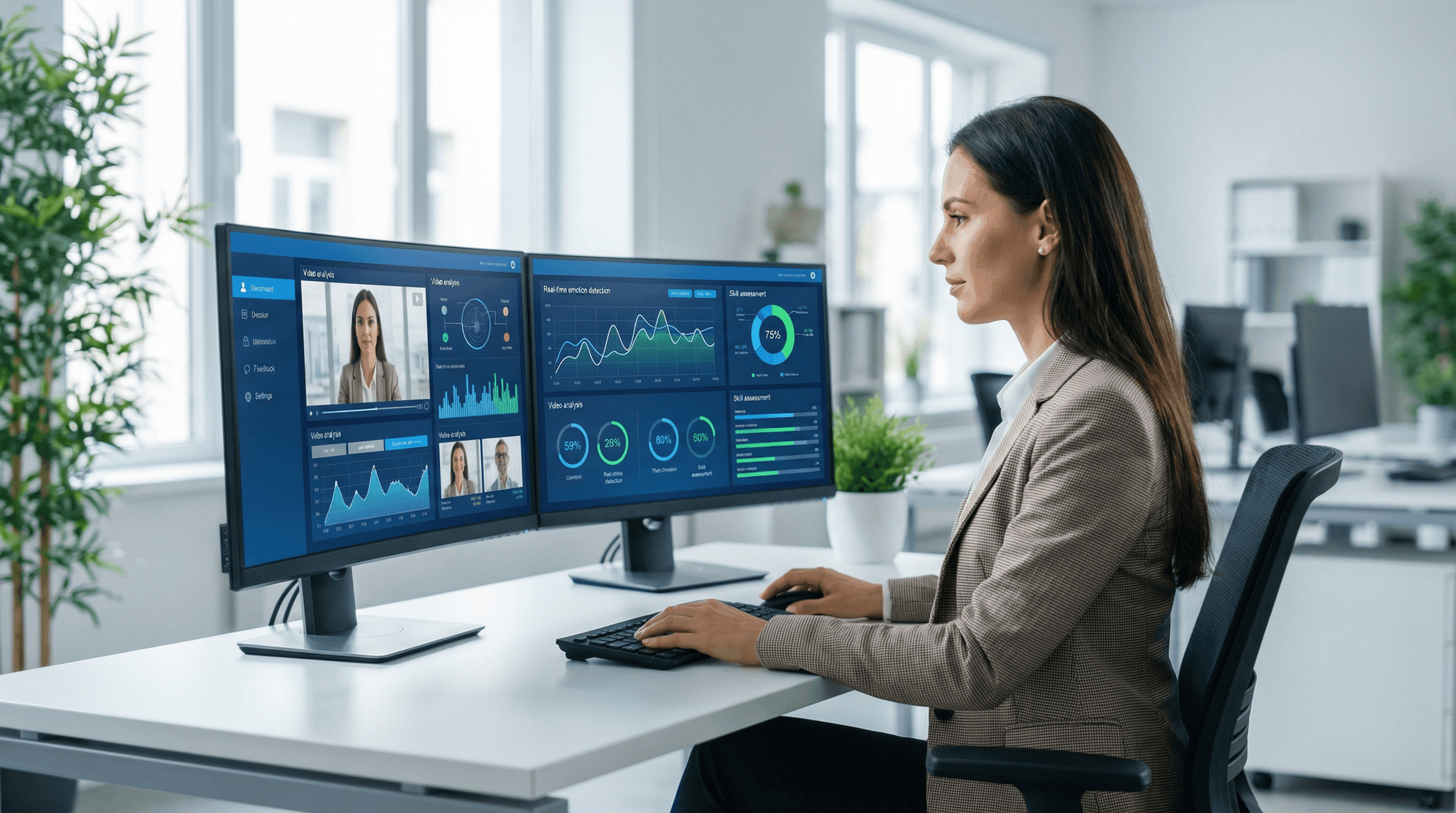

Overview: First-Round Screening in 2025
First-round phone screens have been a standard hiring practice for decades. But in 2025, hiring teams are increasingly replacing them with asynchronous AI interviews.
The shift is driven by measurable outcomes. Compared to live phone screens, async AI interviews are:
- 3–7 days faster end-to-end
- 70–90% cheaper per candidate
- 40–60% more consistent in evaluation quality
As hiring volumes increase and candidate expectations rise, early-stage screening has become a major bottleneck.
This article compares async AI interviews and traditional phone screens across speed, cost, candidate experience, and decision quality, using real hiring benchmarks to explain why teams are making the switch.
Key Takeaways
- Phone screens introduce major scheduling and consistency delays
- Async AI interviews eliminate first-round scheduling entirely
- AI screening reduces cost per candidate by up to 90%
- Structured evaluation improves fairness and decision quality
- Async AI interviews outperform phone screens for high-volume hiring
Q: What is a live phone screen?
A live phone screen is a recruiter-led, synchronous interview designed to filter candidates before later stages.
Typical characteristics include:
- Manual scheduling between recruiter and candidate
- A 10–20 minute live call
- Subjective note-taking
- Manual evaluation and shortlist decisions
Typical phone screen metrics
- Scheduling delay: 2–5 days
- Screen length: 7–12 minutes
- Recruiter capacity: 30–50 screens per day
- Cost per screen: $2.50–$6.00 in recruiter labor
For a role with 500 applicants, phone screens alone can consume 50–100 recruiter hours.
Q: What is an async AI interview?
An async AI interview allows candidates to complete a structured interview on their own time. AI systems then:
- Analyze responses
- Score candidates against role-specific competencies
- Generate summaries and rankings
- Produce hiring-manager-ready shortlists
Typical async AI interview metrics
- Setup time: <5 minutes
- Candidate time: a median of 25.7 minutes on Flowmingo (benchmark)
- Evaluation latency: Instant to <1 minute
- Recruiter review time: <30 seconds per candidate
Q: How do async AI interviews compare to phone screens on speed?
Speed differences are most visible at the earliest stages of the funnel.
| Metric | Live Phone Screen | Async AI Interview |
|---|---|---|
| Scheduling required | Yes | No |
| Time to first screen | 2–5 days | Same day |
| Time to shortlist | 5–10 days | As applicants finish: a median of 26.3 hours after the invite, on Flowmingo |
| Candidates screened per day | 30–50 | 500–2,000+ |
Q: How do costs compare per candidate?
Phone screens scale linearly with recruiter time. Async AI interviews do not.
| Cost Component | Phone Screen | Async AI Interview |
|---|---|---|
| Recruiter time | $2.50–$6.00 | $0.05–$0.20 |
| Scheduling overhead | High | None |
| Re-screening due to inconsistency | Common | Rare |
| Marginal cost at scale | Increases | Near zero |
At 1,000 candidates, async AI interviews typically save $2,000–$5,000 per role in direct screening costs.
Q: Which approach delivers better evaluation quality?
Limitations of phone screens
Phone screens suffer from:
- First-impression bias
- Interviewer fatigue
- Inconsistent question phrasing
- Variable scoring standards
Studies show that human interview scoring varies by 40–60% depending on interviewer and timing.
How async AI improves consistency
Async AI interviews use:
- Standardized questions for all candidates
- Structured scoring rubrics
- Competency-based evaluation
- Consistent weighting across responses
AI-based screening reduces scoring variance by 40–60% and improves quality-of-hire outcomes by 20–35%.
Q: How does candidate experience compare?
Candidate experience plays a growing role in early-stage completion and employer brand.
| Factor | Phone Screen | Async AI Interview |
|---|---|---|
| Scheduling friction | High | None |
| Time zone flexibility | Low | High |
| Finished on a phone | Not measured | 73.5% on Flowmingo |
| Completion rate | Not measured | 85.0% of those who begin, on Flowmingo |
Candidates increasingly prefer async formats for early rounds because they eliminate scheduling stress and allow flexibility.
Q: Which tools enable async AI interviews?
Different platforms support async interviews with varying levels of automation.
Flowmingo
- An AI interviewer that drafts 1–30 questions from your job description
- Automated scoring and summaries
- Competency-based rankings
- Unlimited candidate volume
- Free plan at $0, with no per-candidate fees
HireVue
- Async video interviews
- Enterprise-grade analytics
- Partial AI scoring depending on plan
- No public price (how Flowmingo compares with HireVue)
SparkHire
- Async video interviews
- AI transcription, summary and auto-score (Spark Hire one-way video)
- Video interviews from $249 a month billed annually, or $299 monthly, 5 jobs and 5 users (Spark Hire pricing)
Q: When do phone screens still make sense?
Phone screens may still be useful for:
- Final-round conversations
- Relationship-driven roles
- Small candidate pools (fewer than 20 applicants)
For high-volume or early-stage screening, phone screens are no longer efficient.
Q: Why are hiring teams switching to async AI interviews?
Hiring teams report that async AI interviews:
- Cut screening time by 70–90%
- Reduce recruiter burnout
- Deliver faster, more defensible shortlists
- Scale effortlessly during peak hiring seasons
For organizations processing hundreds or thousands of candidates, async AI interviews outperform phone screens on every measurable dimension.
Conclusion and next steps
Live phone screens were built for a low-volume hiring environment that no longer reflects reality.
In 2025, async AI interviews offer a faster, cheaper, and more consistent way to evaluate candidates at scale. By eliminating scheduling delays and standardizing evaluation, hiring teams can move from weeks to hours in early-stage screening—without sacrificing quality.
Ready to replace phone screens with async AI interviews? Try Flowmingo — it’s free to start.
Frequently asked questions
Do async AI interviews replace recruiters?
No. They eliminate repetitive screening so recruiters can focus on strategy, candidate relationships, and final decisions.
Are async interviews fairer than phone screens?
Yes, in 1 specific way: every candidate answers the same questions and is scored against the same written criteria, so the interviewer's mood, fatigue and running order stop moving the score. How much bias that removes is not something we have measured.
How long should an async AI interview be?
Most teams see the best results with 6–10 minutes total interview time.
Do candidates still get human interaction?
Yes. Async AI works best for early rounds; humans remain critical in later stages.
Can async AI interviews handle thousands of candidates?
Yes. Modern platforms can process 10,000+ candidates without performance degradation.