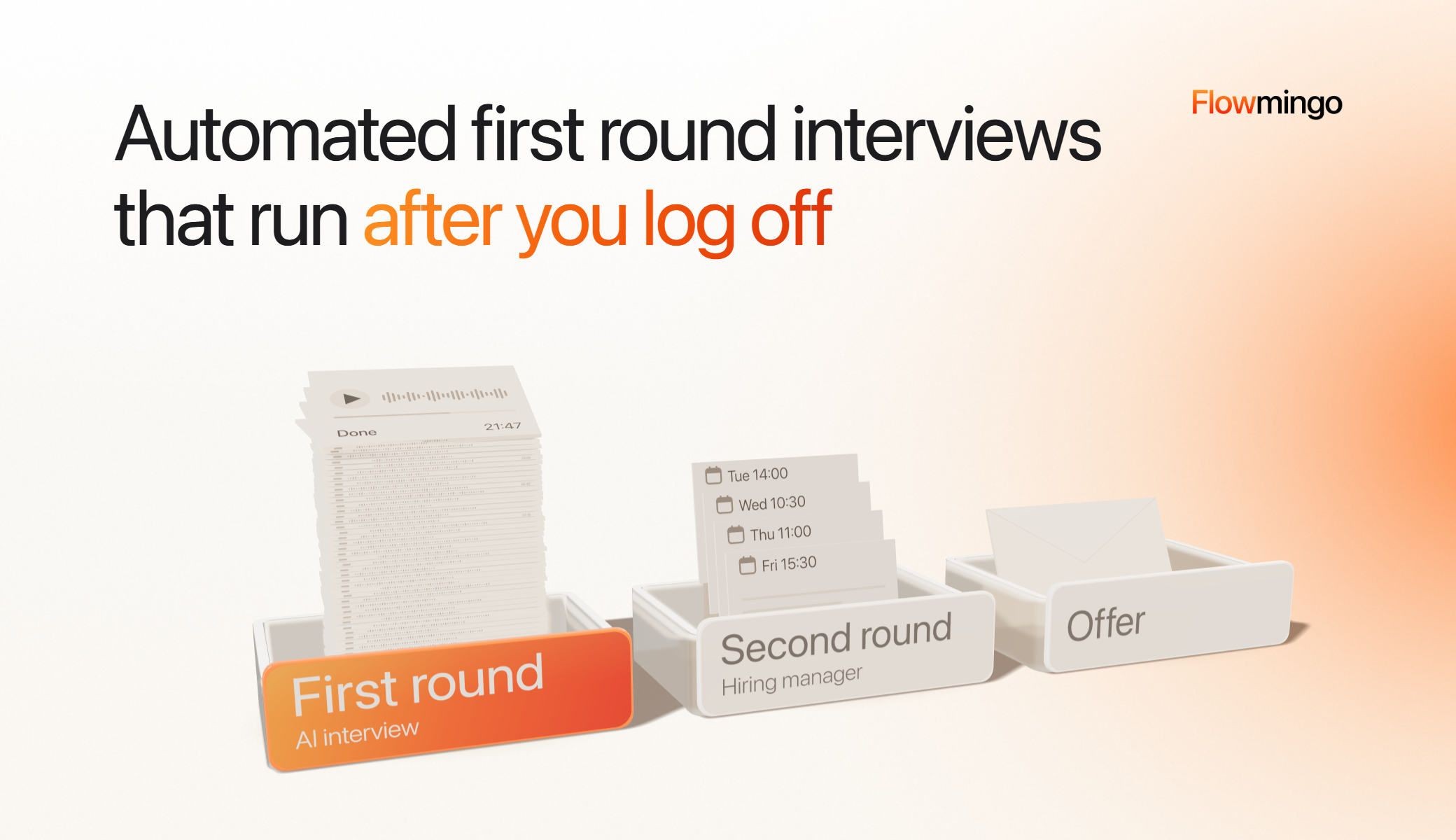

Hiring with AI interviewers works best as 10 steps in order: define the role, source and screen candidates with AI, pre-screen and schedule without back-and-forth, run an AI interview for every applicant, then use the scores to decide, check references and onboard. Each step below says what to do and which part AI can take over.
1. Define the Job Requirements
Begin by setting clear expectations: list essential skills, experience levels, responsibilities and outcomes for the role. A strong job description enables your AI tools to match candidates more accurately and avoid mismatches. With Flowmingo, you can even generate a robust job description effortlessly using our built-in prompt engine.
2. Source Candidates with AI
Rather than manually trawling job boards, use AI to scan platforms (LinkedIn, Indeed, etc.), filter by core criteria and rank fits across hundreds of candidates in minutes. Organizations using AI sourcing often see ~30% faster candidate funnel movement.
3. Automate Resume Screening
AI-driven screening tools evaluate resumes for relevant skills, patterns, experience and role-fit. For example, Flowmingo's AI CV evaluation screens every CV against the role.
4. Conduct Pre-Screening
Use chat pre-screening for the first conversation: availability, role expectations, basic fit questions. These bots can screen out unqualified candidates early and reduce drop-off. Some companies report as much as an 80% reduction in early candidate churn through bots.
5. Schedule Interviews Efficiently
Interview scheduling is often a manual bottleneck—use AI scheduling, calendar integrations and candidate self-signup links to eliminate delays. Companies using automated scheduling report ~35% time savings in this phase alone.
6. Run AI-Driven Interviews
Next comes the AI interview: candidates respond to structured questions (video or text), and the system evaluates responses for communication, content, fit and other metrics. Flowmingo's AI Interviewer runs this step: it asks each question aloud, follows up when an answer misses, and scores every applicant against your criteria.
7. Generate Real-Time Insights
As the interview concludes, pull in analytics: candidate scores, trend insights, comparison to benchmark candidates. Real-time dashboards help hiring teams decide faster—with better data.
8. Enhance Decision-Making
Go beyond raw scores. Analyze patterns across candidates, roles and departments. Understand which competencies correlate with success, identify bias risks, and make forecasting decisions.
9. Background & Reference Checks
Once your short-list is ready, automate the tedious checks: background verification, reference calls, credential confirmation. This phase often slows time-to-offer—automating it keeps momentum.
10. Streamline Onboarding
Hiring doesn’t end at offer acceptance. Use AI to manage onboarding workflows: role-specific content delivery, internal account setup, team intros and success tracking. A smooth onboarding reflects positively on candidate experience and retention.
⸻
Final Thoughts
In 2025, recruiting with AI isn’t optional—it’s essential if you want to hire faster, more fairly and at scale. But technology alone won’t solve everything. You need thoughtful implementation: clear job design, defined decision-criteria, strong analytics, and human oversight. With Flowmingo powering your AI interviews and downstream workflows, you can build a hiring engine that’s efficient, data-driven and grounded in fairness.