
Your AI interview cost per candidate is the 1 number finance wants before you sign. You hold 1 quote at $0.99 an interview and another at $499 a month.
The quotes do not share a unit. AI interview pricing per interview can mean per invite, start or finished interview. An unlimited AI interviews plan caps jobs, users or company size instead.
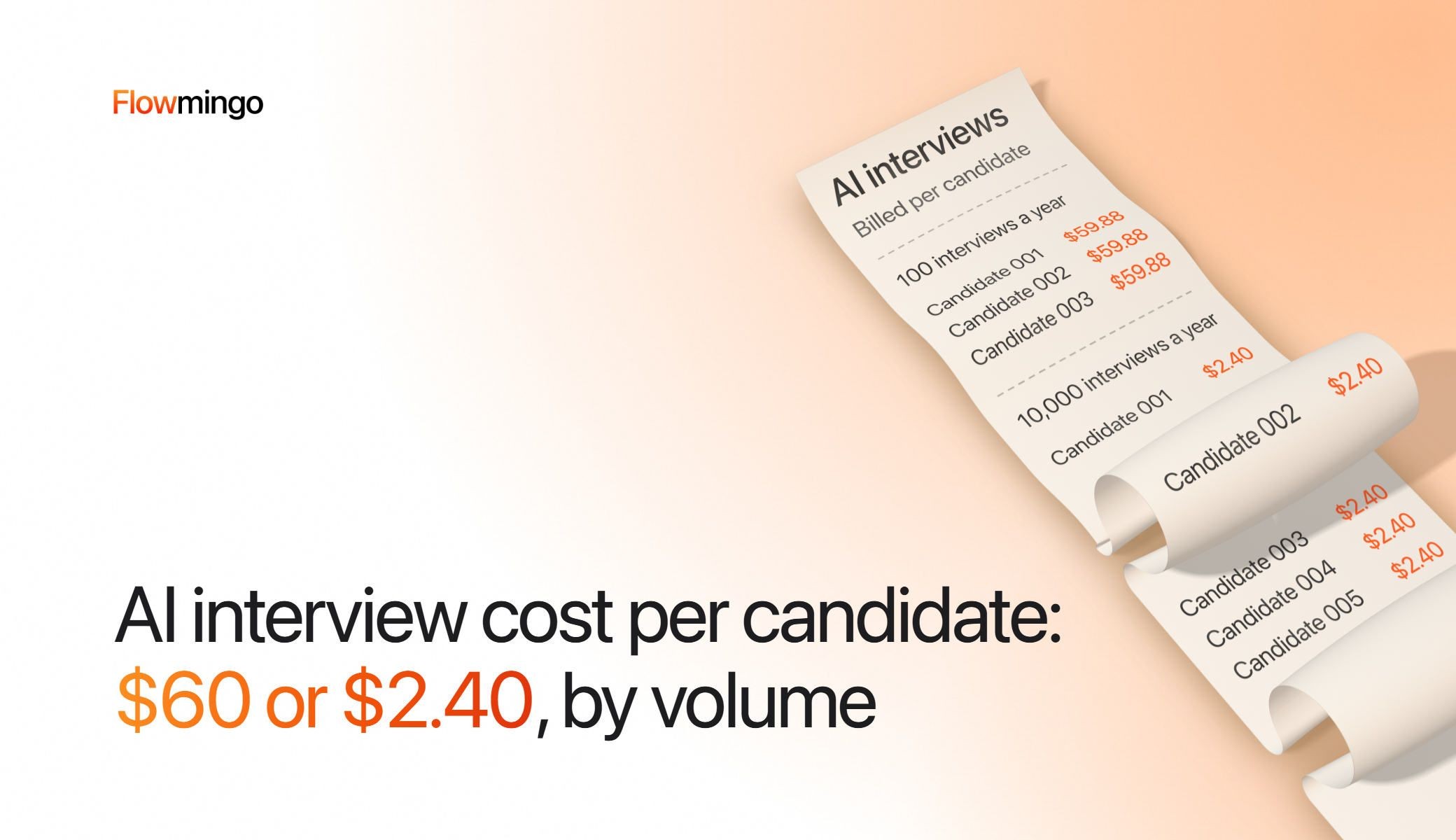
Choose on the headline and you pay for it. At 100 interviews a year, the $0.99 quote really costs $7.08 each and the $499 plan $59.88. A meter on every candidate also tends to make teams interview fewer of them.
This guide fixes it in 3 moves. Convert every quote to a cost per finished interview at your volume, read what unlimited caps, then price the behaviour it creates.
Key takeaways
- What does an AI interview cost per candidate on published plans? From under $1 to about $60: 1 Ribbon plan costs $59.88 at 100 a year and $5.99 at 1,000.
- Does paying per invite cost more than paying per finished interview? About 4.5 times, at our pooled rate of 22.4 finished per 100 Flowmingo AI interview invites.
- Will a per-candidate fee make my team interview fewer applicants? Expect it to. The cut lands on the CV screen, where 1 Fortune 500 firm rejects 95% to save interview time.
- What does an 'unlimited AI interviews' plan usually cap? Jobs, users, company size, length or a fair use clause, such as 5 jobs and 5 users on Spark Hire's monthly plan.
- Is an AI interview cheaper than a recruiter phone screen? At 1,000 a year, yes, on every plan we priced. A 15-minute phone screen costs about $13 of recruiter time.
1. Before budgeting, what is a normal AI interview cost per candidate, and what counts as 1?
On published plans, an AI interview costs from under $1 to about $60, depending on the plan and your yearly volume. Before you compare, write down what each vendor counts as 1.
The unit matters because AI interview per candidate pricing can bill different events. The figure below shows when 5 vendors charge, per their pricing pages on 14 Oct 2026.
Interviewer.AI holds a credit when you invite and uses it when the candidate finishes, returning it after 30 days unfinished. Testlify spends 1 credit when a candidate starts.
Truffle charges 5 credits per finished one-way video interview and nothing for anyone who never finishes. Willo Lite bills £49 per live role a month, while Spark Hire counts jobs and users, not interviews.
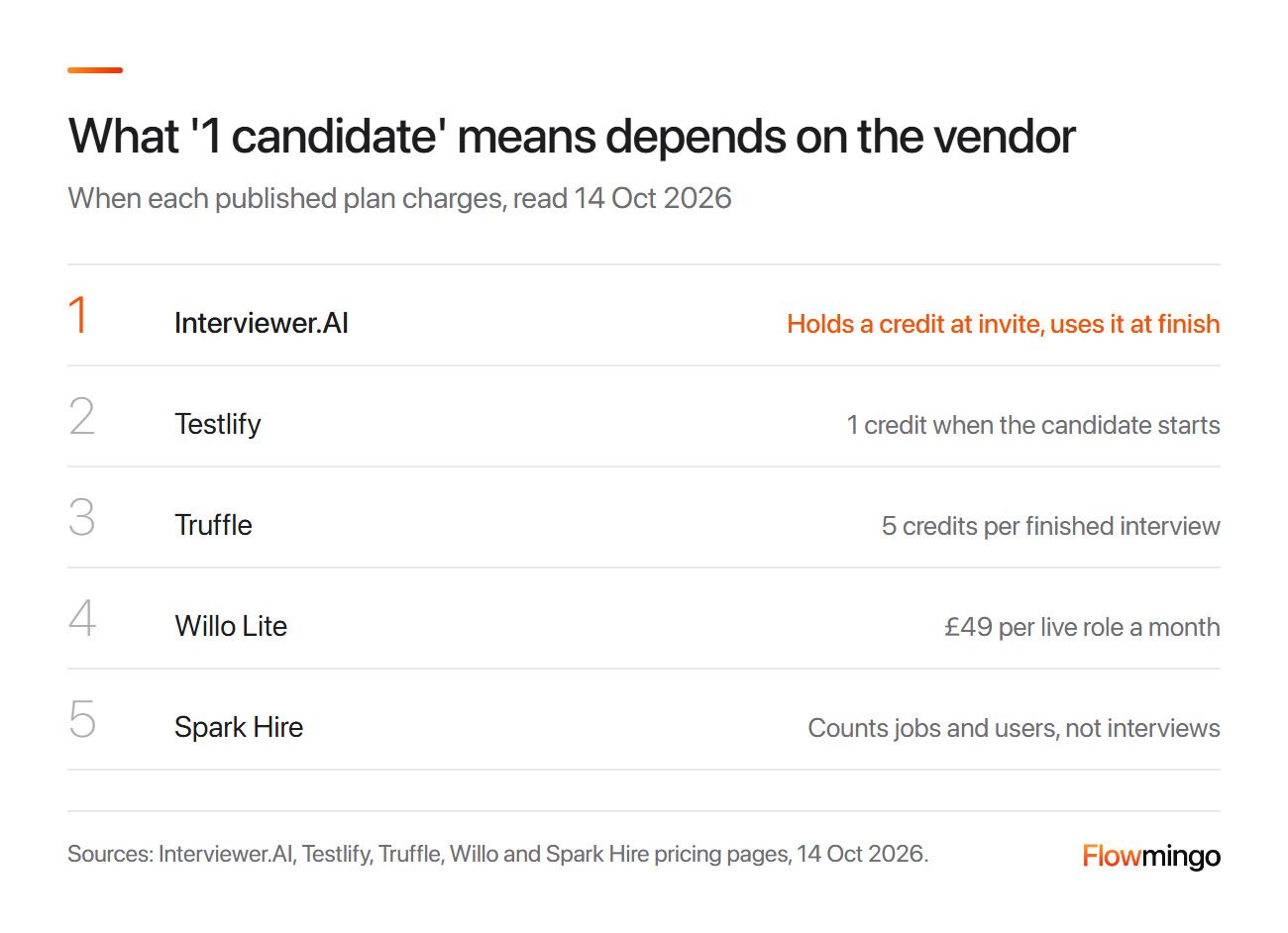
What counts as 1: Interviewer.AI holds a credit at invite and Testlify charges at start. Truffle charges only for a finished interview, and Willo charges £49 per live role a month.
Ask every vendor what triggers the charge, because the number it multiplies keeps growing. Ashby counts 291 applications per hire today, after more than 300 through 2025 and about 100 in early 2021. Run on everyone, the same per-candidate price makes a hire's interview bill nearly 3 times what it was.
Compare 1 number from here on: the cost per finished interview at your yearly volume, with every extra added in.
2. Per interview, per seat or flat fee: which costs least at 100, 1,000 or 10,000 interviews?
Small pay-per-use plans cost least at 100 interviews a year, about $6 to $7 each. At 10,000, per-interview plans fall to 65 cents (Truffle, one-way video) to $2.40.
A flat video plan can reach about 30 cents, if its starting price fits your company size. The table prices 6 plans published on 14 Oct 2026, at even monthly volume before extras, by our arithmetic.
It uses annual billing where offered, except InterviewFlowAI at monthly prices.
| Plan and billing | 100 a year | 1,000 a year | 10,000 a year |
|---|---|---|---|
| Ribbon, allowance plus overage | Growth $5,988 ($59.88 each) | Growth $5,988 ($5.99) | Scale tier $23,988 ($2.40) |
| InterviewFlowAI, per credit, monthly | Pilot $708 ($7.08) | Pilot plus credits $2,988 ($2.99) | About $9,890 ($0.99) |
| Truffle, one-way video, finished interviews only | Starter $588 ($5.88) | Core $1,188 ($1.19) | About $6,490 ($0.65) |
| Interviewer.AI, one-way (conversational = 2 credits) | Essential $1,990 ($19.90) | Professional $3,990 ($3.99) | Custom quote |
| Spark Hire, flat video plan, starting price | From $2,988 ($29.88) | From $2,988 ($2.99) | From $2,988 ($0.30) |
| Hireflix, flat by headcount | $900 or $1,800 ($9 or $18) | $900 or $1,800 ($0.90 or $1.80) | Custom quote |
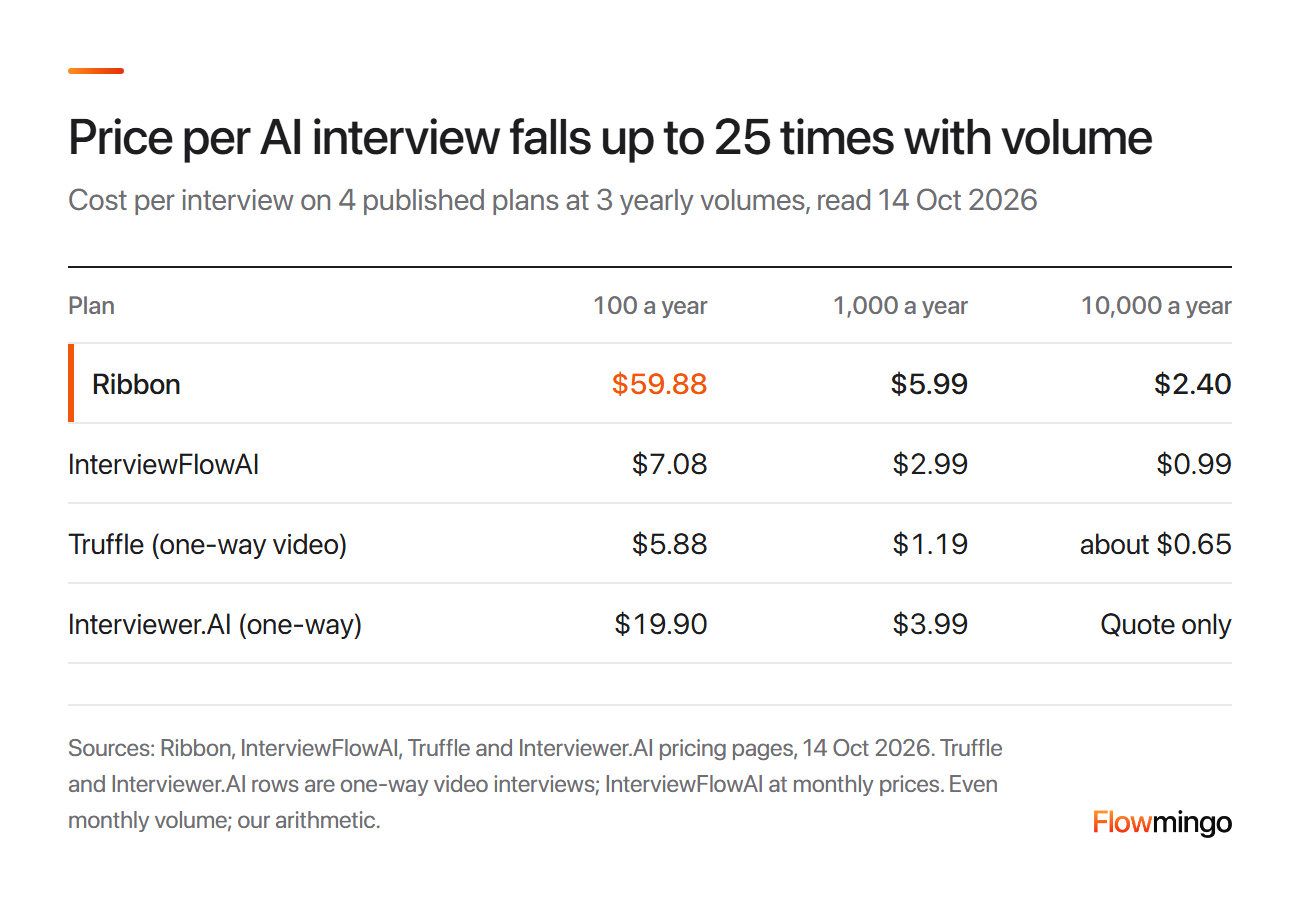
Price per interview by volume: Ribbon's AI interviews cost $59.88 each at 100 a year and $2.40 at 10,000. Truffle's one-way video interviews run from $5.88 to about $0.65, by our arithmetic.
Ribbon shows why volume decides. Its Growth tier includes 100 interviews a month, so 100 a year costs the same as 1,000. The price per interview falls 10 times, and about 25 times by 10,000 on Scale.
InterviewFlowAI's $0.99 rate starts at 303 credits a month, so 100 a year costs $7.08 each, billed monthly. Billed yearly, its FAQ puts Growth at $250 a month and Scale at $416.60, which it says makes each interview $0.83.
Spark Hire and Hireflix sell recorded or live video interviews by company size, not use. Like Truffle's one-way interviews, they have no AI holding the conversation.
In a foundational 2006 study, up to 46.4% of a European internet provider's customers chose a bigger flat plan than they needed (Lambrecht and Skiera). Up to 5.8% erred toward pay-per-use. That is consumer internet, not hiring software.
Flowmingo data · 2,463 hiring projects at 1,009 companies, created 1 Apr to 31 Aug 2026 · 870 companies' interviews, Jul to Sep 2026
- 4 finished AI interviews was the median for a job with at least 1 finished interview.
- 26 or more finished AI interviews a quarter put a company in the top quarter of 870 companies.
Finished AI interviews, not applicants or hires. 58.4% of the 5,925 projects created in the window had none yet.
By our arithmetic, 100 a year is about 25 a quarter, just under that top-quarter line, in the table column where each interview costs most.
2.1 A vendor will only give us an annual quote: how do we compare it?
Divide the whole first-year cost by the finished interviews you will run, then test what the quote assumes.
- Add every first-year line: licence, setup, seats, add-ons, format (conversational or one-way), length, retakes and credit expiry.
- Ask what volume the quote assumes, what counts as 1 and what overage and renewal cost.
- Divide by your invites times your finish rate.
- Price your peak month, not the average.
For example, Willo's Enterprise plan starts at £2,999 a year: about £10 an interview for 300 finished interviews, and £1 for 3,000.
3. Does paying per candidate make my team interview fewer applicants than it should?
It likely does: broadband users cut back near a usage limit, and we think interview meters push the cut onto the CV pile. Budget for every applicant you want to hear from.
That is a foundational 2016 study of 42,485 broadband subscribers (Nevo, Turner and Williams). Broadband is not hiring, but in our reading the interviews dropped first are the borderline applicants a CV undersells.
The cut moves to the weakest step. A Fortune 500 firm hiring for high-skill consulting, financial analysis and data science roles rejected 95% of applicants at CV review. Its reason, in a study of 88,666 applications, was that interviews pull staff off other work (Li, Raymond and Bergman).
Only 10% of applicants human screeners picked to interview got the job, against an estimated 27% to 32% for models built on that firm's data.
Say a role draws 291 applicants and your budget covers 20 interviews at $4. The CV screen then rejects 93% of them unheard.
If you tighten the CV cut to save fees, check each group's pass rate there, because that filter is a selection step too. As general information, the foundational 1978 US Uniform Guidelines treat a pass rate under 80% of the top group's as evidence of adverse impact. The rule is still in the regulations but under federal review in 2026, so keep it as your own monitor.
Breadth pays. Standard selection formulas, foundational since 1949, say more candidates per hire give better hires than random choice, with diminishing returns (selection utility formulas). For example, hiring 1 of 10 beats 1 of 3 by more than 1 of 100 beats 1 of 30.
The step to widen is a structured interview, which ranked first for predicting job performance in a foundational 2022 review (Sackett and colleagues).
A working-paper field experiment with 67,056 randomized applications found AI-interviewed applicants got 12% more offers and 18% more starts, with people deciding. It covered entry-level Philippine customer service, after an initial screen (Jabarian and Henkel).
Flowmingo data · 2,463 hiring projects · 1,009 companies · created 1 Apr to 31 Aug 2026 · 48,889 finished interviews
- 3.2% of jobs had 100 or more finished AI interviews, and they held 55.2% of all finished interviews.
- 15.7% of jobs had 20 or more finished AI interviews, and they held 81.3% of all finished interviews.
Per-project counts to 13 Oct 2026. A project can be a campaign; this shows where volume sits, not the typical customer.
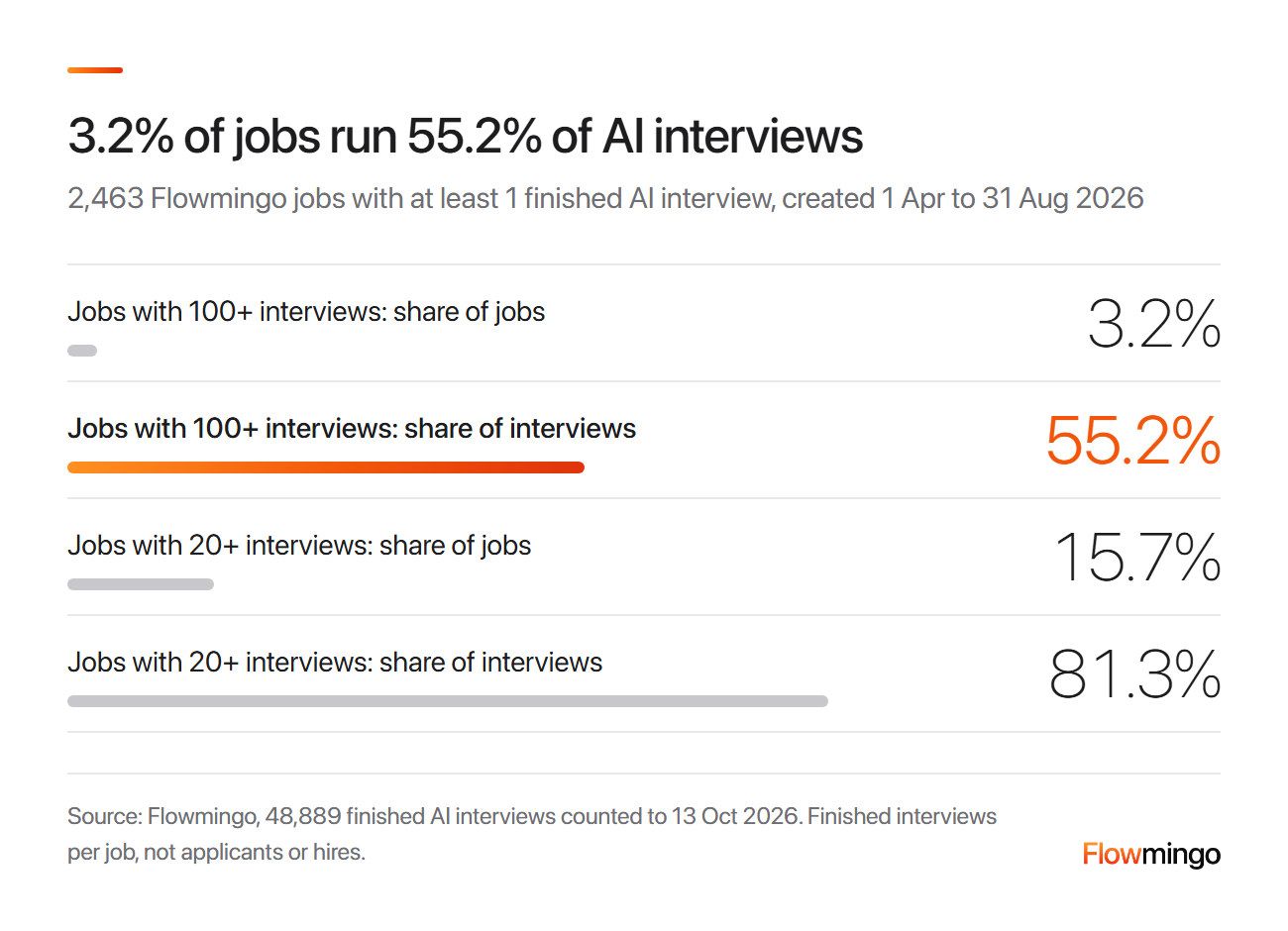
Where interviews sit: jobs with 100 or more finished AI interviews were 3.2% of jobs but held a 55.2% share of interviews. Jobs with 20 or more were 15.7% of jobs and held 81.3%.
So a fee per candidate likely lands hardest on the few big jobs, where interviewing more matters most.
4. Do we pay for candidates who open the AI interview link but never finish?
It depends on the trigger: of the vendors we read, Interviewer.AI and Truffle charge for a finished interview, and Testlify for a start. If a contract bills per invite, our pooled 22.4% finish rate makes each finished interview cost about 4.5 times the price.
Flowmingo data · 65,344 AI interview invites · 820 companies · sent 1 Jul to 15 Sep 2026, each followed for 14 days
- 22.4 of every 100 AI interview invites ended in a finished interview, so 4.46 invites bought 1.
- 27.8 of every 100 invited applicants opened the link and entered their email, 26.6 pressed start and 84.3% of those finished.
- 12.5% of invites finished at the median company with 20 or more invites.
- 1.5 of every 100 invites led to a finished AI interview scored 8 or more out of 10.
Every invite sent, once per email per interview, Matched Talent and bounced invites included, so it runs below the 30.9% of recruiter-sent invites in our recruiting metrics guide. Scores are Flowmingo AI scores, not hires.
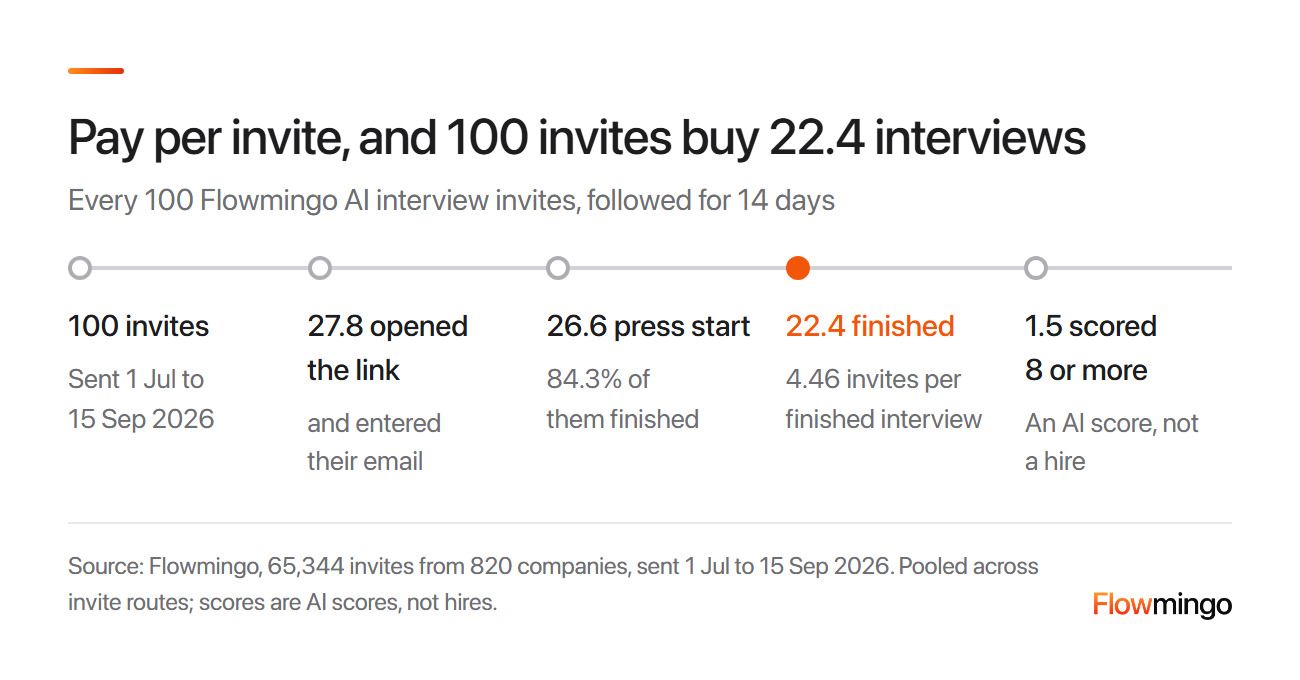
Invite to finish: of 100 AI interview invites, 27.8 applicants opened the link, 26.6 pressed start and 22.4 finished: 4.46 invites per finished interview.
The table runs Ribbon Growth's $4 overage rate through the same funnel. No vendor we read bills every invite, so the first row is arithmetic, not a measured price.
| Billed per | Units paid per 100 invites | Bill | Cost per finished interview |
|---|---|---|---|
| Invite | 100 | $400 | $17.86 |
| Start | 26.6 | $106.40 | $4.75 |
| Finished interview | 22.4 | $89.60 | $4.00 |
At the median company's 12.5% finish rate, per-invite billing makes each finished interview cost $32, or 8 times the price. At the 30.9% our recruiting metrics guide found for recruiter-sent invites, 15 Jun to 13 Sep 2026, it costs about 3.2 times.
Retakes are a second meter: Interviewer.AI charges 1 credit for each retake, up to 5 per candidate.
Raising your finish rate is the cheapest fix, because every unfinished invite costs money on a per-invite plan. Our interview invitation email and recruitment funnel guides show where applicants drop out.
Ask for 4 clauses in writing:
- Charge only for finished interviews.
- Return credits for expired invites automatically.
- Count a retake as part of the same interview, or cap what retakes cost.
- Say who pays when an interview fails for a technical reason.
5. Which hidden fees push our real AI interview cost per candidate above the price page?
Format, length, seats, add-ons and credit expiry move the real price more than the headline rate. Add them to the quote before you divide by your finished interviews.
Vendor pages listed these extras on 14 Oct 2026:
- Format: Interviewer.AI charges 2 credits for a conversational interview and 1 for one-way video.
- Length: Interviewer.AI caps interviews at 20 minutes on Essential and 30 on Professional.
- Seats: Testlify includes 3 users, then charges $15 a seat a month.
- Add-ons: Testlify charges $2,388 a year each for integrations or white label.
- Phone minutes: Testlify bills phone interviews at $0.18 a minute.
- Expiry: Testlify credits expire at the end of each cycle, while Interviewer.AI's roll over.
The next candidate can cost more. Testlify's Standard tier gives 100 candidate credits a year for $1,668, or $16.68 each, but candidate 101 costs $21.
Say you need 200 candidates: that is $3,768, or $18.84 each, though Testlify says larger plans lower the credit price. Add the integrations add-on ($2,388) and 2 extra seats ($360 a year), and the quote reaches $6,516. That is $32.58 a candidate, about twice the headline, by our arithmetic.
Flowmingo data · 44,468 AI interviews finished · 870 companies · 1 Jul to 30 Sep 2026
- 20 minutes was the median AI interview length that recruiters set for candidates.
- 93.1% of finished AI interviews ran on a setting of 30 minutes or less.
The length the recruiter set, not how long candidates took.
About 7 in 100 interviews ran on settings above 30 minutes, so a 30-minute cap would bind for them. If your roles need 45 minutes, that cap moves you up a tier or to another vendor.
6. What does an 'unlimited AI interviews' plan really cap, and which fair use terms matter?
Unlimited usually means the vendor stops counting interviews and limits something else: open jobs, users, company size, interview length or a fair use clause. Get that limit as a number in the contract.
The figure shows what 4 unlimited offers cap instead, beside 2 fair use policies. Spark Hire promises "Unlimited live and one-way video interviews", yet its monthly plan allows 5 jobs at a time and 5 users.
Hireflix prices unlimited responses by headcount. Testlify meters 100 candidate credits a year beside unlimited assessments, and Ribbon's Enterprise tier lists "Overage: Custom or waived".
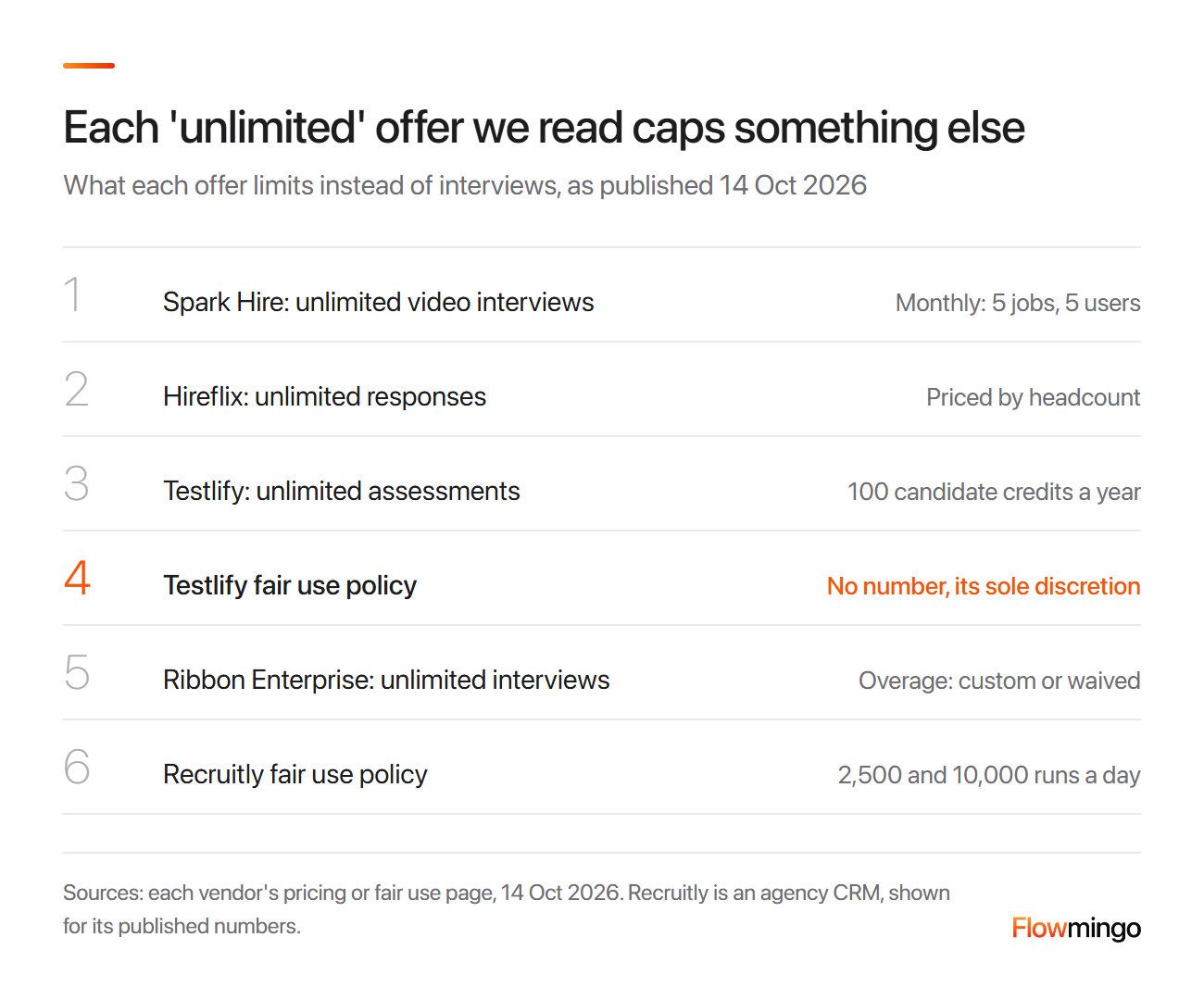
What unlimited caps: Spark Hire's monthly plan caps jobs and users, Hireflix prices headcount, Testlify meters 100 credits a year and Ribbon's overage is custom. Testlify's fair use names no number; Recruitly's names 2,500 and 10,000 runs a day.
The fair use clause is where unlimited ends. Testlify's fair usage policy excludes recruiting agencies without written consent and allows suspension "at our sole discretion", with no number.
A fair clause publishes its limits, because you build your process on them. Recruitly, an agency CRM, sets a review point and a ceiling per resource, such as 2,500 and 10,000 AI agent runs a day.
None of the 9 top Google results we read mentions fair use. So get 5 answers in writing before you sign an unlimited AI interviews plan:
- The number behind unlimited, and what follows past it: a charge, a slow-down or a suspension.
- Who decides what counts as excessive, and with what notice.
- Whether agency or client work falls outside the plan.
- What else has a cap: jobs, users, length, storage or downloads.
- What happens to your recordings and results if you leave.
How Flowmingo helps
Flowmingo has no charge per candidate or limit on team members, and its homepage says screening is never rate-limited. It caps length instead: up to 20 minutes on Free, 30 on Starter and 60 on Growth. Free keeps your latest 300 videos viewable for 30 days, results and transcripts stay on every plan, and downloads need a paid plan.
7. Does per-seat pricing stop my hiring managers from watching the AI interviews?
It can, because a seat price charges for every person who watches, not for every candidate. Count reviewers before you count interviews, and check whether a shared report link needs a seat.
Seat rules differ widely. Testlify includes 3 users and Interviewer.AI 15 or 25 user licences. Ribbon bundles 2, 5 or 10 seats, while Hireflix and Truffle set no limit on users.
Say you add 10 hiring managers on Testlify at $15 a seat a month. That costs 10 x $15 x 12, or $1,800 a year. On Standard's 100 candidate credits a year, that adds $18 a candidate.
On Ribbon, a 3rd reviewer or open role means Business, about twice the price at $11,988, if every reviewer needs a seat.
Seat fees weigh most on small teams. In SHRM's 2025 benchmarks, a dedicated recruiter carried a median 20 requisitions a year, but only 6 at firms under 100 staff. So a small firm spreads the same seat fee over less than a third as many roles.
Per-seat pricing charges for how many people have access, regardless of interview volume (Expert Hire). That makes it the mirror of a per-candidate meter: one rations candidates, the other rations reviewers. A score helps only when the hiring manager reads the evidence, as on an interview scorecard.
8. Our hiring is seasonal: which pricing keeps the AI interview cost per candidate lowest?
Price the plan on your peak month, not your yearly average. Allowance plans bill overage in the peak, hard caps stop you and expiring credits waste quiet months, so per-role, rollover or flat plans suit bursts.
Say you run 1,000 interviews a year on Ribbon Growth, which includes 100 a month: spread evenly, they cost $5.99 each. Bunch them into 3 peak months, and 700 pay the $4 overage. That adds $2,800, for $8,788 in all, or $8.79 each.
Hard caps stop you instead. Truffle's Starter allows 200 credits a month with no overage, which is 40 finished interviews, and then you wait.
Expiry rules differ too. From Truffle's Core tier up, credits roll over for 12 months, up to 3 months' worth.
Some plans charge only in the months you hire. Willo Lite bills £49 per live role a month with no contract, for up to 5 live roles and 150 assessed candidates per role. Spark Hire costs from $299 a month billed monthly, against $249 a month billed annually.
Even steady users leave allowance unused: broadband subscribers in the foundational 2016 study used 46% to 49% of theirs on average. A quiet hiring month likely wastes more. Our seasonal hiring guide plans the peak itself.
9. Is an AI interview cheaper than a recruiter phone screen once I count recruiter time?
At volume, yes: a 15-minute phone screen costs about $13 of a US HR specialist's time, benefits included. At 1,000 interviews a year, every published plan in our table costs less.
US HR specialists, recruiters included, earned a median $36.51 an hour in May 2025 (BLS). Benefits were 29.8% of private employers' compensation cost in June 2025 (BLS employer costs).
Loaded, that comes to about $52 an hour, or $13 for 15 minutes. We assume 15 minutes because a human interview took 10 to 20 minutes in the field experiment above.
So 100 screens take 25 hours, 1,000 take 250 and 10,000 take 2,500, about 1.2 full-time recruiter years. The 4 per-interview plans in section 2 cost $1,188 to $5,988 at 1,000. Truffle's $1,188 buys one-way video, so the cheapest AI-led plan is InterviewFlowAI at $2,988.
At 100 a year, the answer flips for several plans. Ribbon Growth ($5,988), Spark Hire (from $2,988), Interviewer.AI Essential ($1,990) and Hireflix's $1,800 tier cost more than $1,300 of phone screens.
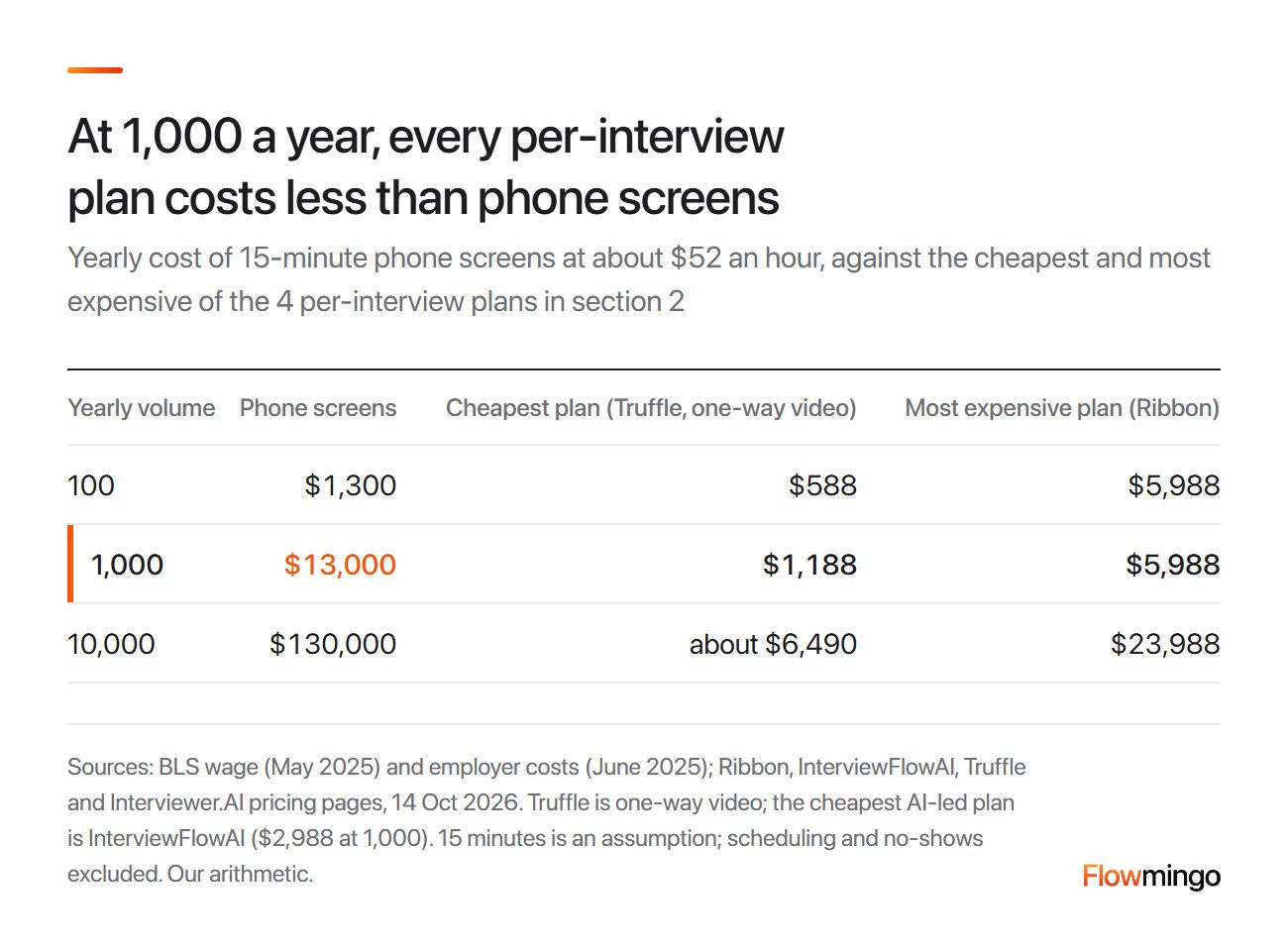
Phone screens or AI: 15-minute screens cost $1,300 for 100, $13,000 for 1,000 and $130,000 for 10,000. Per-interview plans cost $588 (Truffle, one-way) to $5,988 (Ribbon) at 100, $1,188 to $5,988 at 1,000 and about $6,490 to $23,988 at 10,000.
Neither side is complete: phone screens add scheduling and no-shows, and someone still reads each AI report, a cost no source measures.
In that experiment, 78% of applicants picked the AI interviewer when given the choice, though they rated AI interviews less natural than human ones. AI interviews suit high-volume, entry to mid-level first rounds, as our high volume recruiting guide explains.
10. How do I turn AI interview cost per candidate into a cost per hire for finance?
Multiply your price per finished interview by interviews per hire, and add that line to cost per hire. At $4 an interview, Gem's 20 interviews per hire add $80, but inviting all 291 applicants on a per-invite meter adds $1,164.
The table uses the same $4 before extras, against SHRM's 2025 median non-executive cost per hire of $1,200. That is down from $1,244 in SHRM's foundational 2022 report (data collected in 2021), which our cost per hire guide uses. SHRM's 2026 benchmarking keeps its full report for members, saying non-executive costs stayed relatively stable.
| Scenario at $4 a unit | Units per hire | AI interview line per hire | Share of $1,200 |
|---|---|---|---|
| 20 interviews per hire, all rounds (Gem) | 20 | $80 | 6.7% |
| UK graduate vacancy, every applicant per invite (ISE) | 140 | $560 | 46.7% |
| All 291 applicants (Ashby), per finished interview | About 65 | $261 | 21.7% |
| All 291 applicants, per invite | 291 | $1,164 | 97.0% |
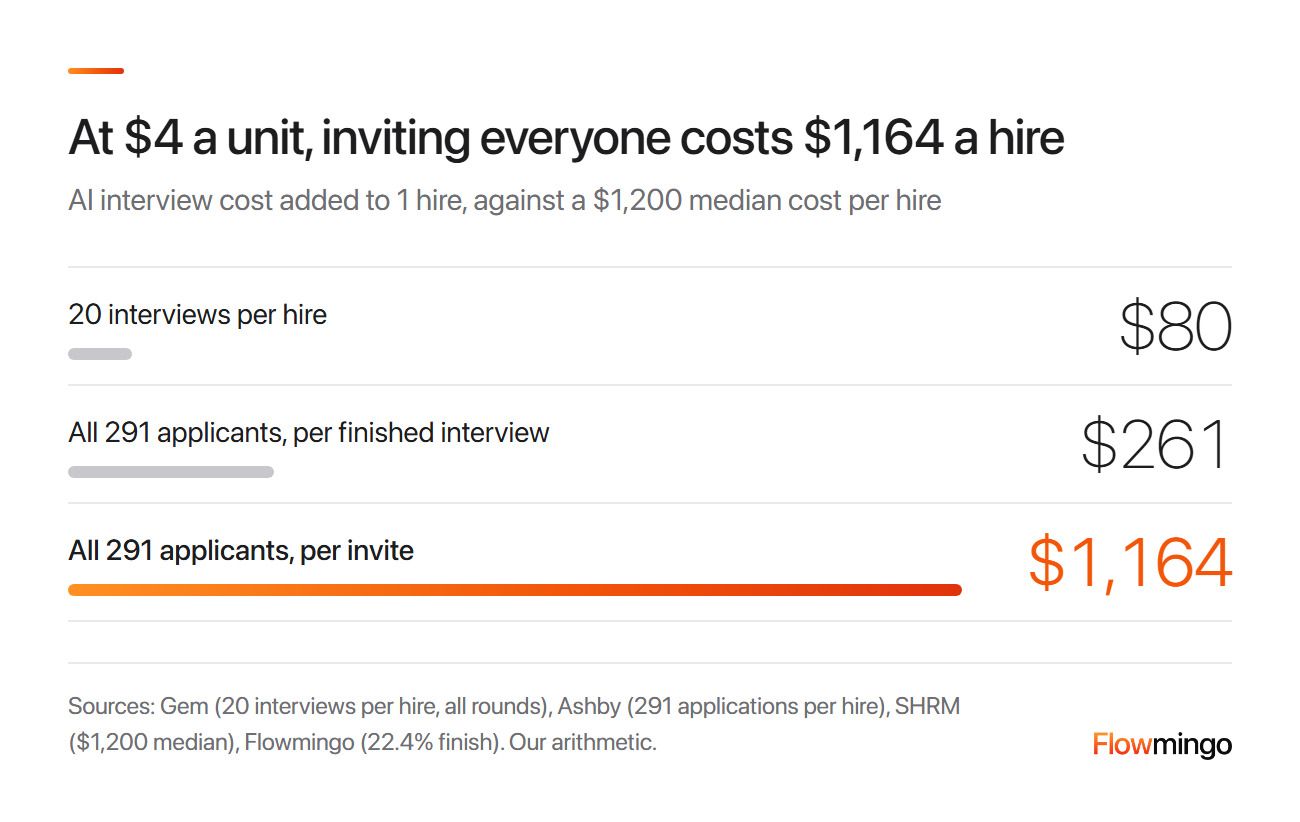
AI interview line per hire: at $4 a unit, 20 interviews per hire add $80 to a hire. Inviting all 291 applicants adds $261 billed per finished interview, or $1,164 billed per invite.
The meter, not the price, decides the line. Billed per finished interview, the same 291 applicants yield about 65 interviews at section 4's 22.4% finish rate.
SHRM's cost per hire may include talent acquisition system costs, so the AI interview line belongs inside it. Tell finance your volume assumption too, because Gem saw interviews per hire rise from 14 in 2021 to 20 in 2024. Gem counts every round, not unique people, so 20 first-round AI interviews per hire is a planning figure, not a benchmark.
10.1 How much should we budget for AI interviews at 20 hires a year, or 200?
At Gem's 20 interviews per hire, 20 hires mean 400 interviews and 200 hires mean 4,000.
| Plan, 14 Oct 2026 | 20 hires: 400 interviews | 200 hires: 4,000 |
|---|---|---|
| Truffle, one-way video | Starter $588 ($1.47 each) | Team about $2,888 ($0.72) |
| InterviewFlowAI | Pilot $1,188 ($2.97) | Growth about $3,948 ($0.99) |
| Ribbon | Growth $5,988 ($14.97) | Business $11,988 ($3.00) |
At 20 hires, the most expensive plan costs about 10 times the cheapest. Figures assume even monthly volume before extras, with InterviewFlowAI at monthly prices, and rank no vendor.
How Flowmingo helps
Flowmingo is a free AI hiring platform. Each structured AI interview you send returns a recording, a transcript and a score against your criteria. The finance line is the plan fee on Flowmingo's pricing page: $0 on Free, or $499.80 (Starter) and $1,009.80 (Growth) a year, billed annually. Optional sponsored sessions cost $0.39 to $0.49 each and remove Flowmingo's branding and candidate offers. A role with 4,000 applicants costs the same as one with 40, so work out your next AI interview cost per candidate on Flowmingo.
11. Sources
Every price, study and rule in this guide links to a source below; Flowmingo figures come from Flowmingo's own platform data.
- Ashby. (2026). Talent trends report: Recruiter productivity trends. Ashby.
- Expert Hire. (2026, July 25). AI interview platform pricing: What you're actually paying for. Expert Hire.
- Gem. (2025, January 16). 10 takeaways from the 2025 Recruiting Benchmarks Report. Gem.
- Hireflix. (2026). Pricing. Retrieved October 14, 2026.
- Institute of Student Employers. (2026, April 28). The application explosion: Key insights for employers. ISE.
- InterviewFlowAI. (2026). Pricing. Retrieved October 14, 2026.
- Interviewer.AI. (2026). Pricing. Retrieved October 14, 2026.
- Jabarian, B., & Henkel, L. (2026). Voice AI in firms: A natural field experiment on automated job interviews. arXiv working paper 2607.28222.
- Lambrecht, A., & Skiera, B. (2006). Paying too much and being happy about it: Existence, causes, and consequences of tariff-choice biases. Journal of Marketing Research, 43(2), 212-223.
- Li, D., Raymond, L., & Bergman, P. (2025). Hiring as exploration. The Review of Economic Studies.
- Nevo, A., Turner, J. L., & Williams, J. W. (2016). Usage-based pricing and demand for residential broadband. Econometrica, 84(2), 411-443.
- personnelSelectionUtility. (n.d.). Continuous and monetary utility: Naylor-Shine, BCG, Boudreau, and Sturman [R package vignette]. CRAN. Retrieved October 14, 2026.
- Recruitly. (2026, May 29). Fair usage policy. Recruitly.
- Ribbon. (2026). Pricing. Retrieved October 14, 2026.
- Sackett, P. R., Zhang, C., Berry, C. M., & Lievens, F. (2022). Revisiting meta-analytic estimates of validity in personnel selection: Addressing systematic overcorrection for restriction of range. Journal of Applied Psychology, 107(11), 2040-2068.
- SHRM. (2025). 2025 recruiting executives benchmarking: Insights to maximize recruitment. SHRM.
- SHRM. (2026). Recruiting executives benchmarking. SHRM. Retrieved October 14, 2026.
- Spark Hire. (2026). Pricing. Retrieved October 14, 2026.
- Testlify. (n.d.). Fair usage policy. Retrieved October 14, 2026.
- Testlify. (2026). Pricing. Retrieved October 14, 2026.
- Truffle. (2026). Pricing. Retrieved October 14, 2026.
- U.S. Bureau of Labor Statistics. (2025, September 12). Employer costs for employee compensation, June 2025. BLS.
- U.S. Bureau of Labor Statistics. (2026). Human resources specialists. Occupational Outlook Handbook.
- Uniform Guidelines on Employee Selection Procedures. (1978). 29 C.F.R. § 1607.4. Cornell Legal Information Institute.
- Willo. (2026). Pricing. Retrieved October 14, 2026.