
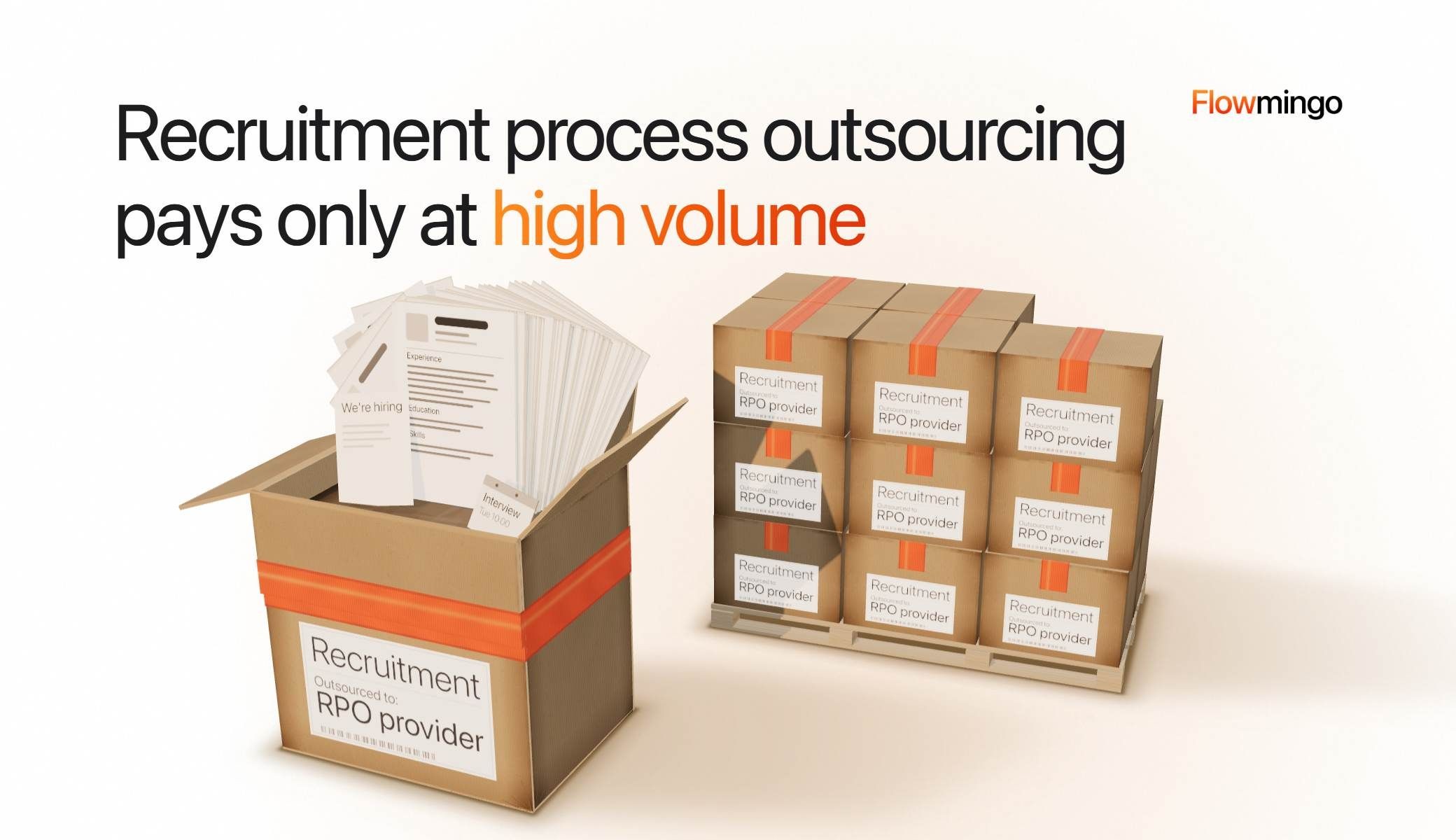
Buy recruitment process outsourcing at a small firm's 6 requisitions a year, and 1 recruiter's pay alone comes to $14,681 per requisition. That is 12 times the $1,200 median cost per hire.
You rarely see that sum, because RPO pricing hides the recruiters a provider assigns inside a monthly fee or a price per hire. The pitch also lands while each recruiter faces 2.7 times the applications of 3 years earlier, per Gem's benchmarks, vendor data on 1 million+ hires.
Sign the wrong deal and you pay a fixed fee for recruiters your volume cannot keep busy. At exit, you may also lose the talent pool. In Great Britain, your recruiting team may transfer to the provider by law when the deal starts.
The fix takes 3 moves. Price an RPO against your own volume, check whether screening is the real bottleneck, and write data and exit terms into the contract.
Key takeaways
- How many hires a year does RPO need to pay off? Usually 50 or more, a vendor says, and rarely under 20. At a medium firm's 22 requisitions, 1 RPO recruiter's pay alone is about $4,004 per requisition, against a $1,200 median cost per hire.
- Which parts of hiring should we keep in-house? The criteria, the final decision and the candidate data. Only 3 in 100 UK employers outsource everything.
- Which RPO pricing model is cheapest for us? A fixed fee per recruiter if your hiring is steady, cost per hire if it swings, because a fixed fee keeps billing you through slow months.
- Who owns the candidates when the contract ends? You do, if the provider acts only on your instructions as your processor. You then choose whether it returns or deletes the data.
- Could we fix the screening bottleneck without an RPO? Often. 34% of US recruiters spend up to half their week on junk applications, a step tools can score.
1. How many hires a year make recruitment process outsourcing pay off?
Recruitment process outsourcing pays when steady hires keep a dedicated recruiter busy. Pin, a recruiting-software vendor that sells an alternative to RPO, says it suits 50+ hires a year and rarely pays below 20.
Whatever the pricing, the fee covers the provider's recruiters, so your volume decides how much of that cost each hire carries. SHRM's 2025 brief, from 2,371 members, puts the median cost per hire at $1,200 for non-executive roles.
The median counts agency fees, job boards, recruiter pay and systems. That is down from $1,244 in SHRM's 2022 figures, the number our recruiting metrics guide uses.
Among the 55% of organisations with dedicated recruiters, the median in-house recruiter carries 20 requisitions a year. That is 6 at small firms, 22 at medium, 50 at large and 60 at extra-large. We assume an RPO recruiter carries a similar load, and 1 requisition can hold several hires.
Pin cites Glassdoor's $88,083 average pay for an RPO recruiter, about $7,300 a month. Providers add benefits, tools and margin, so pay is only the fee's floor.
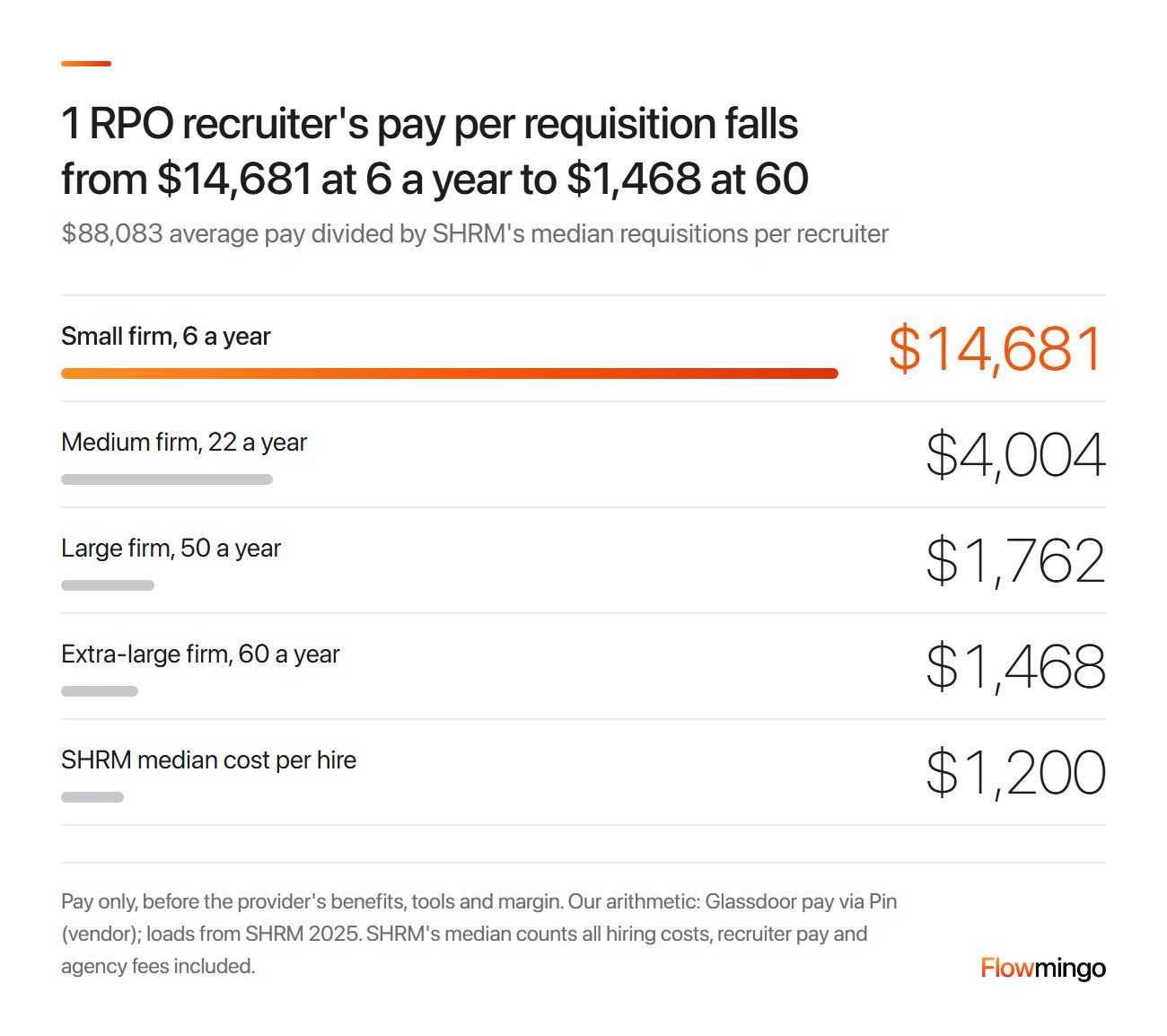
Pay per requisition chart: 1 RPO recruiter's pay is $14,681 per requisition at 6 a year and $4,004 at 22. It is $1,762 at 50 and $1,468 at 60, against a $1,200 median cost per hire.
By our arithmetic, pay per requisition falls from $14,681 at 6 a year to $4,004 at 22, $1,762 at 50 and $1,468 at 60. SHRM's 2026 summary puts extra-large loads 67% higher, about 100 a year, or $881 of pay each.
A provider bills that pay plus margin. So an RPO pays off against agency fees or hiring you cannot staff (section 6), not against a busy in-house team.
For example, 30 hires a year against a medium load of 22 is about 1.4 recruiters' work. Below about 1 recruiter's full load (22 a year at a medium firm), keep hiring in-house. Buy a project RPO for a spike, or fix screening (section 2).
2. Before we outsource hiring, is our real bottleneck screening volume we could fix in-house?
Often it is. Check whether first-pass screening is drowning your team, because tools can score that step while you keep the hire.
In Greenhouse's 2025 survey, a vendor study of 4,136 people, 34% of US recruiters spend up to half their week filtering junk applications. Of the 1,200 US job seekers in it, 49% send more applications than a year ago and 41% admit using prompt injections against AI filters.
So part of the flood is gamed. Gem puts the average recruiter at 2,500+ applications, while teams shrank from 31 to 24 people.
In the foundational CIPD 2024 report, 62% of UK employers used no AI in recruitment. Of the 281 that did, 66% said it raised hiring efficiency, though 47% said it also raised costs.
Check your last 3 months against 3 questions:
- What share of recruiter hours goes to first-pass screening?
- How long does it take from application to first interview?
- Does the hiring manager trust the shortlist?
If the first dominates, you have a screening problem. If the last one does, you have a criteria problem that no RPO fixes alone.
A foundational 2022 re-analysis by Sackett and colleagues ranked structured interviews first, so a structured first round keeps quality as you cut hours.
Flowmingo data · 111,707 applicants invited to an AI interview · 1,518 companies · 1 Jan to 22 Sep 2026
- 25.3 hours was the median time from invite to a finished AI interview, among 28,832 who finished within 14 days.
- 47.1% of those finishers completed it within 24 hours, and 73.3% within 48 hours.
- 98.1% of those finishers completed it within 7 days, and 84.9% within 3 days.
"Finished" means completed with a report produced. Most invited applicants never finish, and only the 25.8% who finished within 14 days are timed. This card counts every invite. Our recruiting metrics guide counted only invites recruiters sent themselves, 15 Jun to 13 Sep: 30.9% finished, in a median 24.8 hours. This shows an association only.
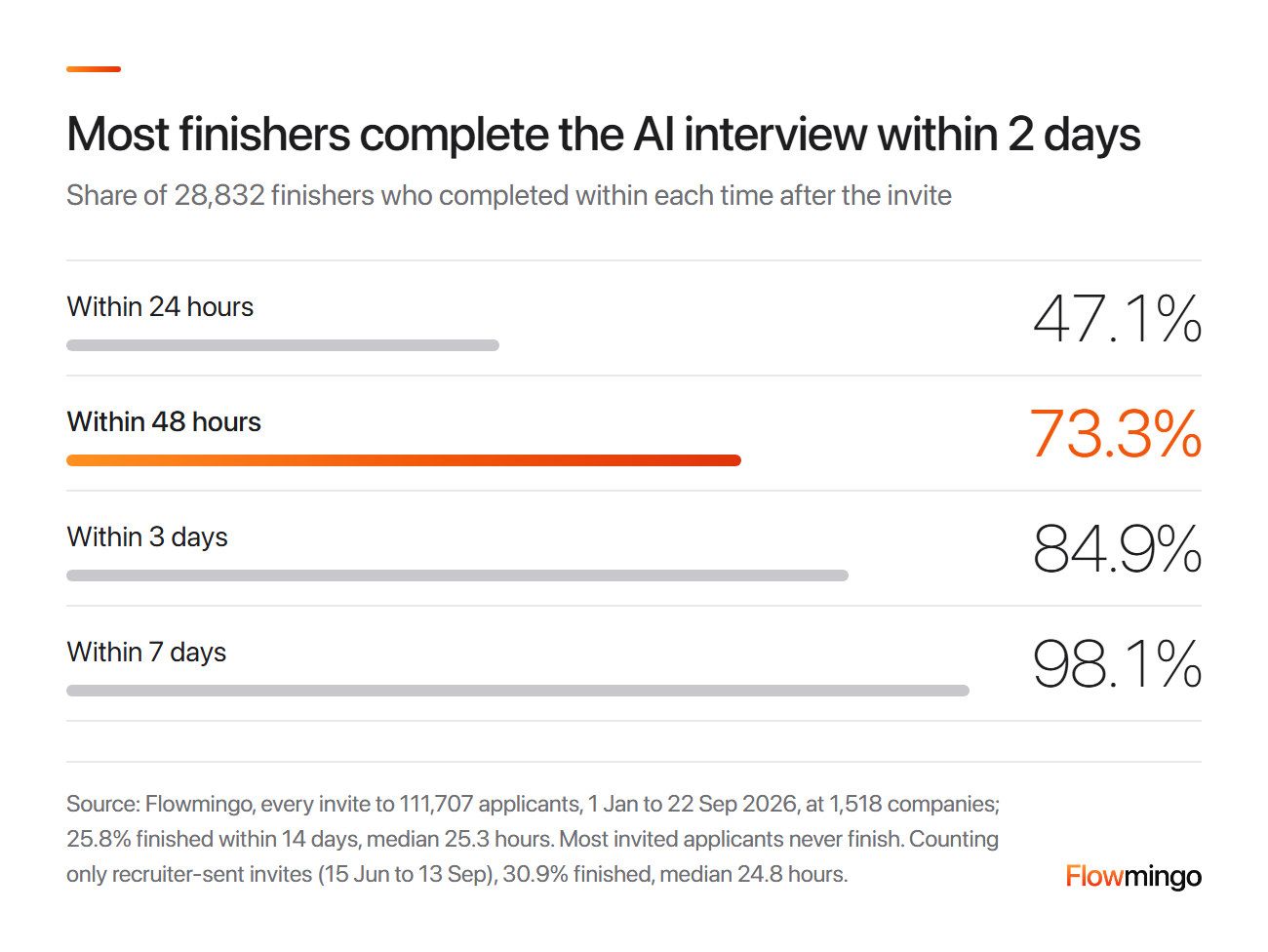
Invite-to-finish chart: of applicants who finished within 14 days, 47.1% did so within 24 hours and 73.3% within 48 hours. 84.9% did within 3 days and 98.1% within 7 days.
A link sent on Monday brings most finished interviews back by Wednesday, but plan for most of the pool not to finish.
How Flowmingo helps
With Flowmingo's AI Interviewer, you send every applicant 1 link to a structured, spoken interview they do in their own time. You get the recording, the transcript and a report scored against your criteria, and your team decides. It is unlimited on the Free plan.
3. Which parts of hiring should we hand to an RPO, and which should we keep?
Hand the RPO the volume work and keep the judgement. Adverts, sourcing, first-pass screening and scheduling can go, while the criteria, the final interview, the decision and the candidate data stay with you.
About half your peers use some outside help. In the CIPD survey of 1,016 UK employers, 47% recruit fully in-house with direct hiring, and 20% in-house with agencies. Another 31% mix in-house and outsourced work, and only 3% outsource all recruitment.
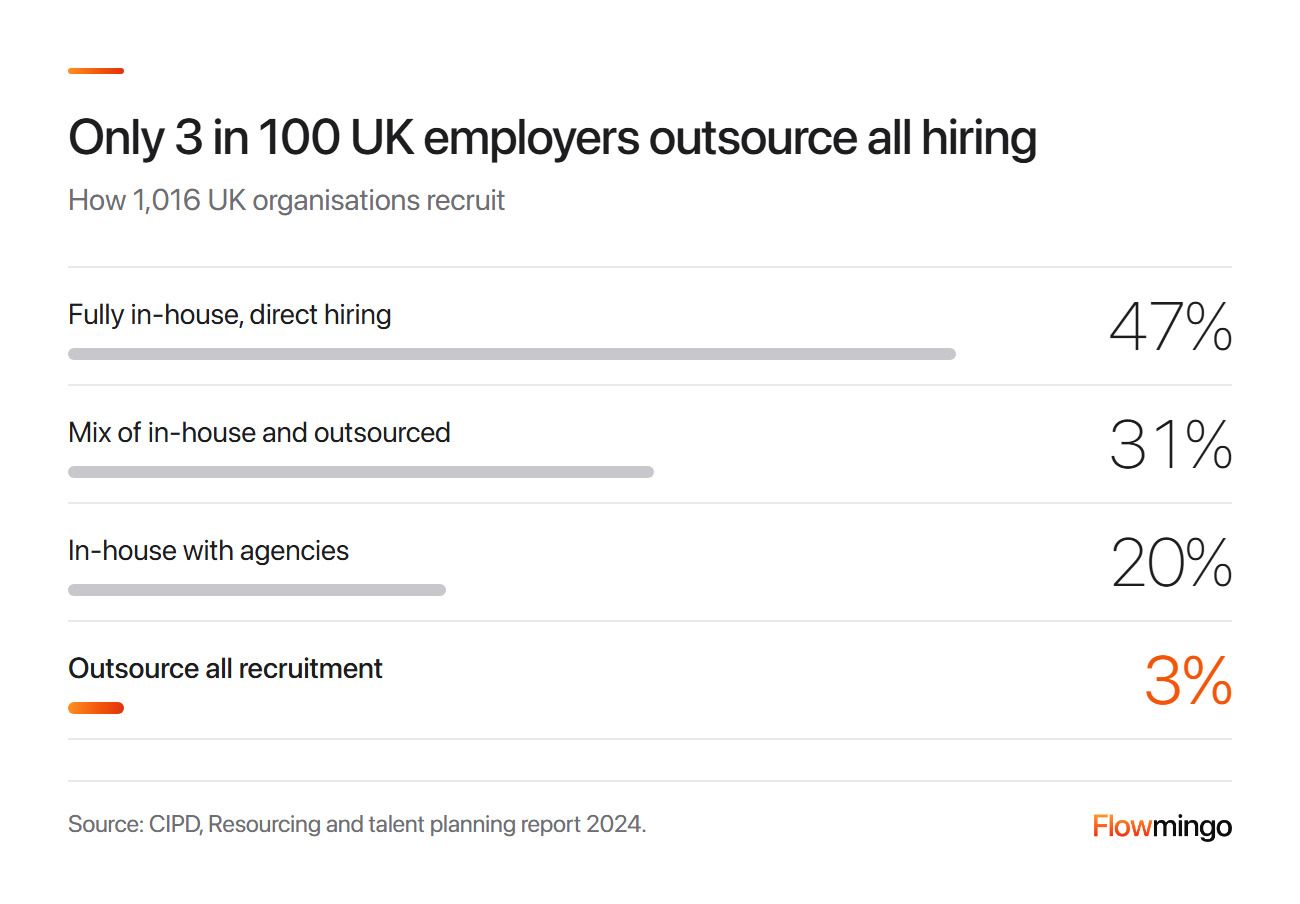
UK recruiting models chart: 47% of employers hire fully in-house and 31% mix in-house and outsourced work. 20% use in-house teams with agencies, and 3% outsource all recruitment.
In a foundational 2008 study of 276 firms, Ordanini and Silvestri found cost drove the outsourcing of job adverts and pre-screening. Strategy mattered more for interviews and the final choice.
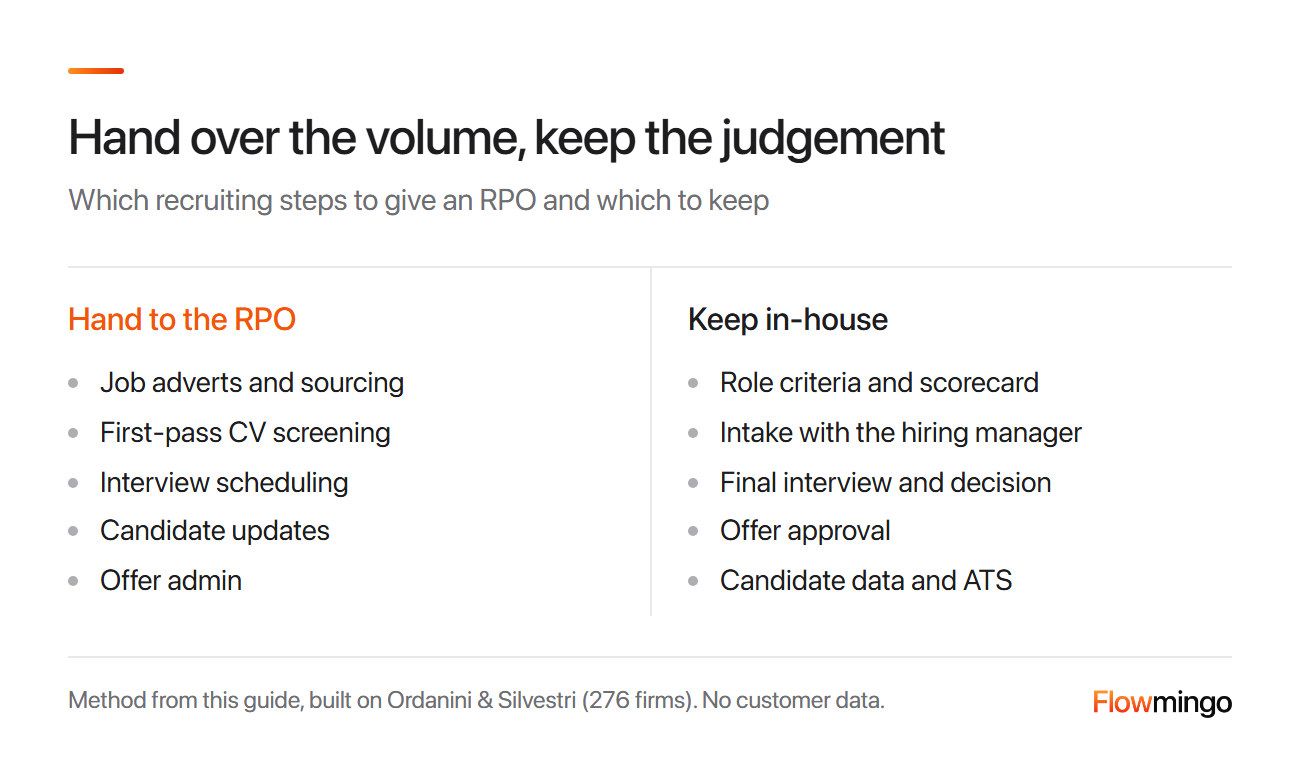
Keep-or-hand-over chart: hand over job adverts and sourcing, first-pass CV screening, interview scheduling, candidate updates and offer admin. Keep the role criteria and scorecard, intake, the final interview and decision, offer approval, and candidate data and ATS.
Whatever decides who gets hired, or whatever you need when the contract ends, stays in-house. For example, if the provider configures your ATS, that set-up stays yours.
Your side keeps working, too. In a foundational 2021 survey of 150 RPO projects, Liu, Chua and Hu found that client knowledge sharing and senior backing strengthened the partnership. That partnership went with better-fitting candidates.
Employers that do not use RPO name cost first and fear of losing control second. That comes from a foundational 2023 RPO Association and LHRA study reported by the RPO Association. This split is how you keep control.
4. How much does recruitment process outsourcing cost compared with hiring in-house?
No independent source publishes RPO prices, so compare your own full cost per hire with the quote, on the same number of hires. By the arithmetic in section 6, an RPO only beats contingency agencies when your volume keeps its recruiters busy.
Against SHRM's US median, the foundational CIPD 2024 report puts the UK median at £1,500 for most roles and £2,000 for senior managers. CIPD warns these come from small samples, 207 and 246 employers, so treat them as rough.
Medians ignore your volume, so work out your own with SHRM's definition, the first line below.
The worksheet below is illustrative, for 60 hires a year, not customer data. Contingency agencies charge 15% to 30% of an $80,000 salary, a vendor-stated range from Pin.
| Line | How to work it out | Example: 60 hires |
|---|---|---|
| Your cost per hire | All hiring costs over 12 months, divided by hires | $1,200 (SHRM 2025) |
| Total at the SHRM median | Cost per hire x hires | $72,000 |
| Agency route | Agency fee x hires | $720,000 to $1,440,000 |
| RPO fees | Monthly fee x 12, plus per-hire and other fees | From the quote |
| Your team's time | Intake, interviews, decisions | Hours x pay |
The SHRM median already includes agency fees, so the 2 totals overlap. Use your own figures, and note the RPO Association says there is no flat industry fee.
So ask for every quote per hire, knowing a per-recruiter fee sits above the pay floor in section 1. Add the hours your team still spends, because those never leave your payroll.
5. Management fee, cost per hire or hybrid: which RPO pricing model is cheaper for us?
Match the model to how steady your hiring is: a fixed fee per recruiter for steady volume, cost per hire for swings. A hybrid, a management fee plus a price per hire, splits the risk.
ADP names 4 models: cost per hire, cost per resource (a monthly rate per recruiter), hybrid, and per-transaction pricing. It says employers tend to prefer cost per hire, and that per-transaction pricing gets expensive at high volume.
In a foundational pricing guide first published in 2010, HRO Today says most RPO pricing follows hiring volume, per hire or per placement. In a mixed deal, the management fee normally falls within 20% to 40% of projected monthly fees.
The other common deal in that guide looks fully variable but carries a minimum volume and a year-end true-up.
Here is illustrative arithmetic at the pay floor, not a market rate. Say you plan 60 hires with 2 assigned recruiters at $7,300 a month each, then make only 42:
- Fixed fee per recruiter (cost per resource): you still pay $175,200 for the year, so each hire costs $4,171 instead of the planned $2,920.
- Hybrid, 30% as a management fee: you pay $52,560 fixed plus $2,044 per hire, so 42 hires cost $138,408, or $3,295 each.
- Cost per hire at $2,920: you pay $122,640, and the provider absorbs the gap, which it prices into the fee.
- Per hire with a 50-hire minimum: you pay $122,640, then a $23,360 true-up for 8 hires you never made.
Ask each proposal for its minimum volume and true-up, and what the fee covers. Ask how fees change if volume drops by a third, and who pays for job boards.
Everest Group reports another year of RPO market decline in 2024, with buyers seeking modular and project-based deals. Our inference: you have room to negotiate scope and term.
6. Is recruitment process outsourcing cheaper than a recruitment agency, and who keeps control?
At steady volume, an RPO can cost less than contingency agencies and give you more control, if the contract lets you set the process. For a few hard-to-fill roles a year, an agency's success fee can cost less.
By our section 1 arithmetic, pay only, 1 RPO recruiter costs $1,468 to $4,004 per requisition, at 60 or 22 a year. A contingency hire on an $80,000 salary costs $12,000 to $24,000, a range Pin takes from The Resource Company.
This means 1 contingency hire costs as much as RPO recruiter pay for 3 to 16 requisitions. Treat the agency range as an asking price, not survey data.
AMS, itself an RPO provider, calls an RPO an extension of your team, unlike a vacancy-focused agency. Its table omits cost and data ownership.
Control is a contract term, not a feature of the model. Spell out reporting, the hiring manager's veto and data ownership (sections 8 and 9).
| Situation | Best fit | Why |
|---|---|---|
| A few senior or niche roles a year | Agency | Success fee, no fixed cost |
| Steady volume across many roles | Enterprise RPO | Process and pipeline stay in 1 place |
| A spike, such as a new site or a season | Project RPO | Starts in about 2 weeks, ends with the project |
| Screening hours are the bottleneck | Tools in-house | Fixes the step without adding headcount |
The card below shows an agency's hiring project draws about as many applicants as an employer's. Outsourcing moves the screening work, it does not shrink it.
Flowmingo data · hiring projects with 5+ applicants · 1 Jul 2025 to 30 Sep 2026
- 18 applicants came into the median agency project (193 projects at 58 companies), against 16 in the median employer project (4,603 projects at 1,985 companies).
"Agency" means a company whose name says recruiting, staffing, placement, manpower, headhunting or outsourcing, because Flowmingo does not record whether a company recruits for clients. Without the largest agency, the agency median is 15. This shows an association only.
How Flowmingo helps
Flowmingo is a hiring platform that recruitment agencies use to screen their own applicants. A free client link shows a candidate's scored report with contact details and CV hidden. The Free plan has no charge per candidate.
7. Enterprise, project or on-demand RPO: which model fits our hiring, and how fast is setup?
Use enterprise RPO for steady hiring across teams, project or on-demand RPO for a spike, and hybrid or modular RPO for part of the process. An MSP, which manages contractors and temporary staff, is a separate purchase, because RPO mostly fills permanent roles.
The RPO Association gives a project RPO a Quick Start of about 2 weeks, and hybrid or modular RPO 4 to 8 weeks. It gives enterprise RPO 8 to 12 weeks. Robert Walters puts the same full RPO at 1 to 3 months, so read them as 1 model with 2 estimates.
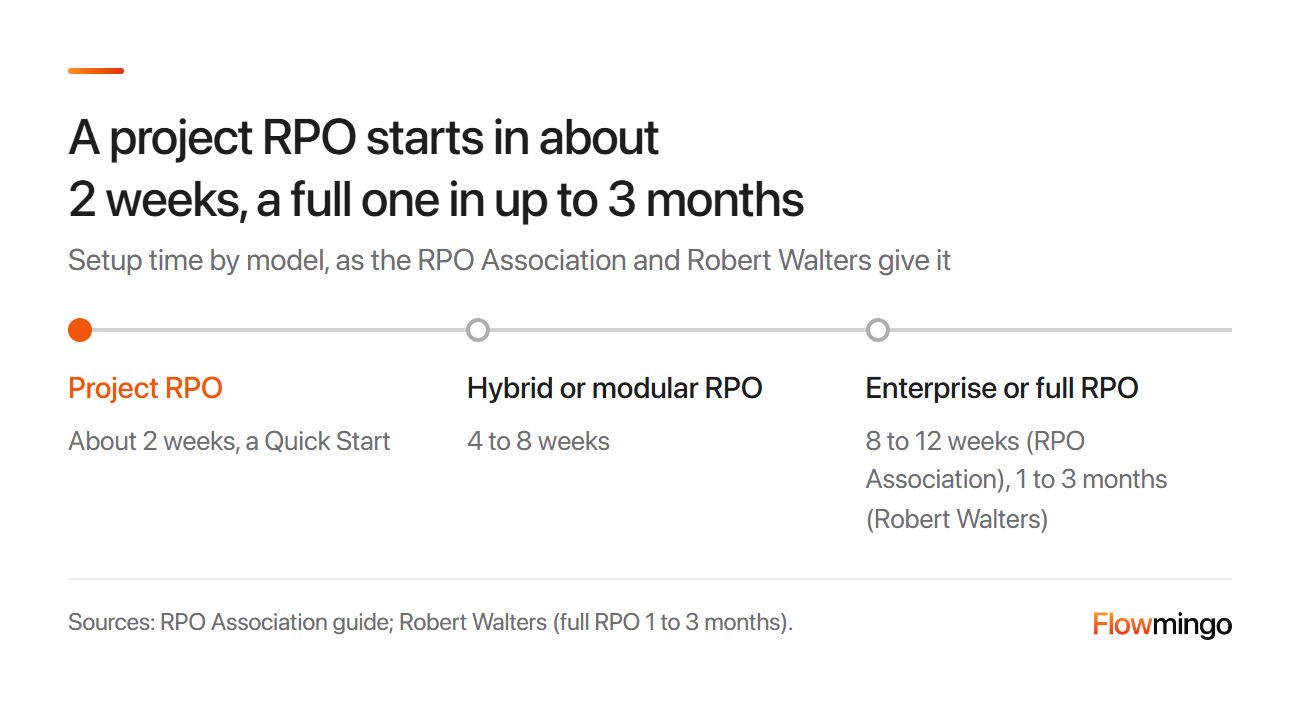
Setup time chart: project RPO about 2 weeks, hybrid or modular RPO 4 to 8 weeks. Enterprise or full RPO takes 8 to 12 weeks per the RPO Association, or 1 to 3 months per Robert Walters.
Staff transfer belongs in the choice. The RPO Association notes that enterprise RPO can include moving your recruiters to the provider, which in Great Britain may trigger TUPE (section 9).
A project RPO also makes a low-commitment trial before a multi-year deal, because it ends with the project, so you can judge its numbers first.
Some setup work stays yours from week 1: the criteria, the scorecard and the hiring managers' calendars. For example, a new site with 40 roles needs signed-off role profiles before sourcing starts.
8. Which KPIs and SLAs should we hold an RPO provider to?
Hold the provider to 6 lines: time to fill, offer acceptance, hiring-manager satisfaction, quality of hire, 90-day retention and screening evidence. Set each target from your own last 12 months, and review them at least every quarter.
SHRM's 2025 brief put median time to fill for non-executive roles at 44 days. Its 2026 benchmarking puts it at 39 days, the figure our hiring process guide uses.
In SHRM's 2025 brief, only 20% of organisations measure quality of hire. So an SLA on speed and cost alone says nothing about quality.
In a foundational 2016 case study, Sim and Vinayan found HR and line managers judged 1 RPO differently. So let managers score the shortlists.
The 6th line, screening evidence, is a scored record for every shortlisted candidate against your criteria. It is how you audit who screened whom and why, and section 10 shows why a regulator may ask.
| KPI | How to measure | Baseline | Review |
|---|---|---|---|
| Time to fill | Requisition opened to offer accepted | Your last 12 months (SHRM median 39 days) | Monthly |
| Offer acceptance | Offers accepted divided by offers made | Your last 12 months | Monthly |
| Hiring-manager satisfaction | Managers score each shortlist 1-5 | First quarter | Quarterly |
| Quality of hire | Manager rating at 90 days | First cohort | Quarterly |
| 90-day retention | Hires still employed at 90 days | Your last 12 months | Quarterly |
| Screening evidence | Scored record per candidate against your criteria | All shortlisted candidates | Monthly audit |
In your RFP, ask recruitment process outsourcing companies for references at your volume, and who screens and how. Ask which tools touch candidate data, and for their exit plan.
Re-price yearly, and turn up on your side too, because the Liu study shows client input shapes the shortlist.
How Flowmingo helps
Every Flowmingo AI interview report rates each criterion 0 to 10 with a written justification, plus a weighted overall score, strengths and gaps. You can share it with a hiring manager, and recordings, transcripts and reports belong to the hiring company.
9. What should a recruitment process outsourcing agreement say about candidate data and exit?
Make the provider your processor, keep the candidate records, ATS set-up and job content as yours, and fix how they return at exit. In Great Britain, also say what happens to any staff who transfer.
ADP says candidates are exclusive to the client but says nothing about exit. The ICO defines a controller as the party that decides why and how anyone processes the data.
Under GDPR Article 28, a foundational 2016 law, a processor acts only on your documented instructions. It must allow audits, and adds other processors, such as an AI screening tool, only with your written authorisation.
This matters because, in a November 2024 audit, the ICO found AI recruitment tools that kept data indefinitely to build candidate databases without people's knowledge.
| Clause | What it should say | Basis |
|---|---|---|
| Data roles | Provider is your processor for named activities | GDPR Art 28 |
| Exit | Returns or deletes all candidate data at your choice, by a set date | Art 28(3)(g) |
| Sub-processors | Listed, including any AI tool, and new ones need your written OK | Art 28(2) |
| Audit | You may audit and inspect | Art 28(3)(h) |
| ATS and content | Configuration, templates and job content belong to you | Your exit |
| Transition | Provider helps hand over for a fixed period | Open roles keep moving |
| Staff | Who may transfer, and who bears the cost | TUPE reg 3 |
Walk 1 exit through that table, as an illustration, not legal advice. Your provider gives notice, and the transition clause keeps open roles moving for a fixed period.
By the set date, it returns the candidate data in the agreed format or deletes it, as you choose. If 4 of its recruiters worked mainly on your account, TUPE may move them to you or your next provider.
9.1 Does TUPE apply if we outsource the recruitment team, switch provider or bring it back in-house?
It may, in all 3 cases. In Great Britain, regulation 3 of TUPE, a foundational 2006 law, treats each one as a service provision change.
Acas says it applies where an organised group of employees mainly works on your activities, and the work stays fundamentally the same. The rule excludes a single short-term task, so take employment-law advice before you sign.
9.2 Who owns the candidate data?
You do, as controller, when the provider acts only on your instructions. The contract should record that role, but the facts decide it. So ask the provider to confirm its role at each step in writing.
The role matters most at exit, because the controller chooses whether a talent pool built over years comes back or is deleted.
10. Our RPO screens with AI: are we still liable under EU and NYC rules?
Yes, in most cases you still are. EU law treats AI screening of applicants as high-risk, and New York City's rule covers agencies too.
Annex III of the EU AI Act lists AI that filters applications or evaluates candidates as high-risk. Under Article 26, deployers must assign human oversight, keep logs for at least 6 months and tell candidates. Regulation (EU) 2026/1744 moved those duties from 2 August 2026 to 2 December 2027.
New York City's Local Law 144, a foundational 2021 law, covers employers and employment agencies using automated tools. It requires a bias audit within 1 year before use, published results and 10 business days' notice. Penalties run from $500 to $1,500 a day.
A December 2025 State Comptroller audit found at least 17 potential violations where the city found 1. Weak enforcement is still no reason to skip it.
In the Mobley case, a court ruled in July 2024, now foundational, that the claim Workday acted as its customers' agent could go ahead (Cooley).
In May 2025 the court preliminarily certified a collective of applicants aged 40 and over (Fisher Phillips). That is not a finding of liability, but delegating the screening does not delegate the risk.
Singapore's Workplace Fairness Act, passed on 8 January 2025, covers hiring decisions, and MOM expects it in force by end-2027.
Here is an illustration, not legal advice. Your RPO screens applicants for New York City roles with an AI tool. The contract names who commissions the bias audit, who posts its summary and who sends the notice 10 business days ahead.
If the tool also screens EU applicants, it names who keeps the logs for at least 6 months.
Keep a person on your side who can see why each candidate moved on, because the duty stays with you.
How Flowmingo helps
Flowmingo returns a score with its reasons, and every decision stays with your team. It rejects nobody automatically, and your team can check and override any score. To test the screening step before you sign, try Flowmingo beside any quote for recruitment process outsourcing.
11. Sources
Every study, law and quote in this guide links to a source below. Flowmingo figures come from Flowmingo's own platform data.
- Acas (n.d.). Handling a TUPE transfer: Step by step. Acas.
- ADP (n.d.). What is RPO (recruitment process outsourcing). Retrieved October 7, 2026. ADP.
- AMS (n.d.). What is recruitment process outsourcing (RPO). Retrieved October 7, 2026. AMS.
- Chartered Institute of Personnel and Development (2024). Resourcing and talent planning report 2024. CIPD.
- Cooley (2024, July 24). California federal court clears path for software developers' potential employment discrimination liability. Cooley LLP.
- European Union (2016). Regulation (EU) 2016/679, General Data Protection Regulation, Article 28: Processor. gdpr-info.eu.
- European Union (2024). Artificial Intelligence Act, Annex III: High-risk AI systems. artificialintelligenceact.eu.
- European Union (2024). Artificial Intelligence Act, Article 26: Obligations of deployers of high-risk AI systems. artificialintelligenceact.eu.
- European Union (2026). Regulation (EU) 2026/1744 amending Regulation (EU) 2024/1689, the Digital Omnibus on AI. Official Journal of the European Union.
- Everest Group (2025, December 19). Recruitment process outsourcing (RPO) state of the market 2025 [Abstract]. Everest Group.
- Fisher Phillips (2025). Discrimination lawsuit over Workday's AI hiring tools can proceed as class action. Fisher Phillips.
- Gem (2025). 10 takeaways from the 2025 Recruiting Benchmarks Report. Gem.
- Greenhouse (2025, November 19). An AI trust crisis [Press release on the 2025 AI in Hiring survey]. Greenhouse.
- HRO Today (2010, December 29; updated 2024). The art and science of pricing. HRO Today.
- Information Commissioner's Office (2024). AI tools in recruitment: Audit outcomes report. ICO.
- Information Commissioner's Office (n.d.). What are controllers and processors. ICO.
- Liu, G., Chua, C. E. H., & Hu, Y.-X. (2021). Partnership in recruitment process outsourcing projects: The outsourcing firm perspective. Project Management Journal, 52(4), 354-366.
- Ministry of Manpower (2025, November 4). Workplace Fairness (Dispute Resolution) Bill [Press release]. MOM.
- NYC Department of Consumer and Worker Protection (n.d.). Automated employment decision tools (AEDT). City of New York.
- Office of the New York State Comptroller (2025, December 2). Enforcement of Local Law 144: Automated employment decision tools. Report 2024-N-6.
- Ordanini, A., & Silvestri, G. (2008). Recruitment and selection services: Efficiency and competitive reasons in the outsourcing of HR practices. The International Journal of Human Resource Management, 19(2), 372-391.
- Pin (2026). RPO guide for recruiters [Vendor blog]. Pin.
- Robert Walters (n.d.). What is recruitment process outsourcing. Retrieved October 7, 2026. Robert Walters.
- RPO Association (2013; updated 2026). What is recruitment process outsourcing (RPO). RPO Association.
- Sackett, P. R., Zhang, C., Berry, C. M., & Lievens, F. (2022). Revisiting meta-analytic estimates of validity in personnel selection. Journal of Applied Psychology, 107(11), 2040-2068.
- Sim, S.-C., & Vinayan, G. (2016). Recruitment process outsourcing: A case study in Malaysia. Personnel Review, 45(5), 1029-1046.
- Society for Human Resource Management (2025). 2025 recruiting executives benchmarking: Insights to maximize recruitment [Data brief]. SHRM.
- Society for Human Resource Management (2026). 2026 recruiting executives benchmarking. SHRM.
- UK Parliament (2006). The Transfer of Undertakings (Protection of Employment) Regulations 2006, regulation 3. legislation.gov.uk.