
You need 50 people in 6 weeks, and the first role already has 300 applicants. High volume recruiting at that pace breaks every habit built for hiring 1 person at a time.
It isn't your fault. Each hire took 203 applications in 2025, up 158% on 2022, while recruiting teams shrank 56% (Greenhouse). High volume hiring now lands on smaller teams, or on a founder with no recruiter at all.
Phone-screen 300 applicants at 20 minutes each, and you spend 100 hours before a hiring manager meets anyone. Meanwhile the strong ones accept other offers: 1 sourcer got through half of 200 CVs and found the good ones gone (r/recruiting).
This playbook fixes it in 3 moves. Plan the funnel backwards from your start date, and give every applicant the same short first round in their own time. Then count the invites it takes to get 1 finished interview.
Key takeaways
- How do I plan 50 hires in 6 weeks? Divide backwards from the start date. If 7 in 10 offers start and half of each round passes, you need about 292 finished first rounds.
- How many hires can 1 recruiter handle? About 5 a month at Greenhouse customers in 2025, so 50 hires in 6 weeks is roughly 7 recruiters' work.
- How many applicants must I invite to get 20 finished interviews? About 100 in a big project: in Flowmingo sets with 100 or more applicants, about 1 in 5 invited applicants finished within 14 days.
- Will an AI first round lower quality? Not in the largest field test so far: across 67,056 applications, AI-led interviews raised offers 12%, and the share of applicants still employed a month later 18%, with humans deciding.
- What do I owe candidates if AI screens them? Notice, a plain explanation and a human decision. New York City wants notice 10 business days ahead, and Illinois wants consent for AI video analysis.
1. We need 50 hires in 6 weeks: how do I plan high volume recruiting backwards?
Start from the start date and the headcount, then divide backwards through each stage's pass rate to get offers, interviews, finished first rounds and invites. Book the hours each stage needs before the first ad goes live.
This matters because high volume recruiting fails at the stage nobody counted. A plan that starts from "post the ad" finds out in week 4 that it never had the interview hours, and the start date slips.
Say you need 50 customer service starts in 6 weeks. At 1 Philippine recruiter, about 7 in 10 offers in the AI-interview group became starts (69%), by our arithmetic on Jabarian and Henkel's field data. So plan about 73 offers.
Then add your own ratios. If 1 in 2 final interviews gets an offer, you need about 146 finals. If 1 in 2 finished first rounds reaches a final, you need about 292 first rounds.
The last step is the one teams forget. In our big projects, only about 1 in 5 invited applicants finished the first round within 14 days (the card in section 5). So 292 finished first rounds take about 1,440 invites.
Mass hiring and bulk hiring drives follow the same chain. The figure below runs it from the target back to the invites:
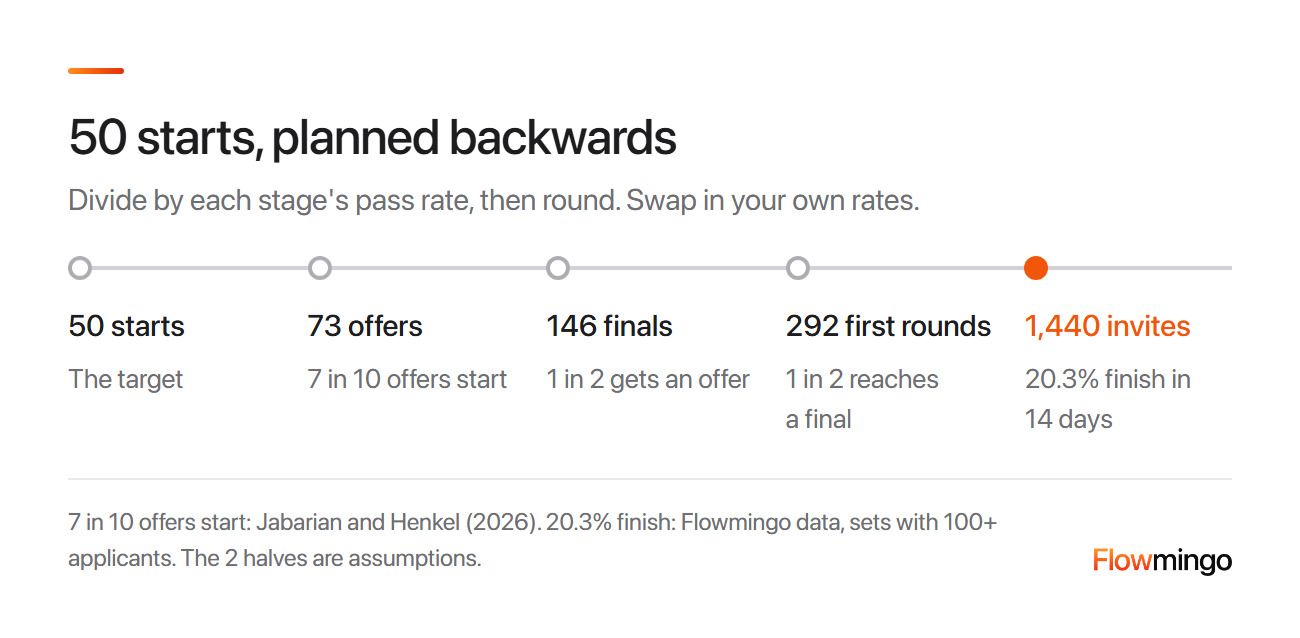
Backwards plan: 50 starts need 73 offers, 146 finals, 292 finished first rounds and 1,440 invites. It assumes 7 in 10 offers start, 1 in 2 passes each round and 20.3% finish in 14 days.
Only the 7 in 10 and the 1 in 5 come from data. Replace the 2 halves, which are our assumptions, with your own rates from last quarter.
2. How many hires can 1 recruiter handle in high volume recruiting, with no extra headcount?
Greenhouse customers averaged 4.9 hires per recruiter a month in 2025, so 50 hires in 6 weeks is about 7 recruiters' work. With 1 or 2 recruiters, take the repeated first-round calls off their plate rather than hiring more recruiters.
Counting requisitions hides the problem, because 1 high-volume requisition can hold 50 hires. In SHRM's 2025 benchmarking, 55% of organisations had dedicated in-house recruiters, each carrying a median 20 requisitions a year.
Hours tell the real story. Greenhouse counted 12.3 interview hours per hire in 2025, so 50 hires done the usual way cost about 615 hours of interviews across everyone involved.
Here is the section 1 plan in recruiter hours, with our assumed minutes per step:
| Step | Count | Minutes each | Hours |
|---|---|---|---|
| Live phone screens | 292 | 20 | 97 |
| Reading self-paced first rounds | 292 | 5 | 24 |
| Final interviews | 146 | 45 | 110 |
A self-paced first round saves about 73 of those hours, because the recruiter reads a scored report instead of holding the call. The final interviews stay human, and so does every decision.
2.1 We have no recruiter at all: who runs the screen?
The founder or hiring manager writes the criteria and 4 or 5 questions once, and every applicant answers the same ones in their own time. Then they read the ranked list in 1 fixed block a day.
This matters because 45% of organisations in SHRM's survey had no dedicated in-house recruiter. At firms under 100 staff, recruiters carried a median 6 requisitions a year, so a volume spike has nobody to absorb it.
Say a 20-person logistics firm needs 8 drivers. The owner writes the questions in 1 hour, puts 1 link in the job ad and reads the top 20 scored reports each morning. 1 owner on r/smallbusiness asked for exactly this: post a job, share the link and let a tool screen applicants.
3. 300 applicants per role: what should the first screen be when nobody can read every CV?
Ask 3 to 5 pass-or-fail facts in the form, then send everyone who passes the same short structured interview to take in their own time. Rank by score, and read only the top slice and the band just below it by hand.
Reading CVs in arrival order fails at volume, because the 200th CV gets a tired reader and AI-written CVs sound alike. A short structured round asks every applicant the same thing, so the ranking compares like with like.
Keep the form short. In Appcast's 2026 report, the apply rate fell from 5.37% for 1 to 5 minute applications to 3.09% for 16 minutes or more. It covers nearly 1,200 US employers.
Appcast's advice is to move non-essential questions later in the funnel. Keep the interview short too. A foundational study of 27,809 applicants at 33 companies linked more questions to worse reactions, especially over age 31 (Tilston and colleagues).
For a customer service role, the knockouts might be rotating shifts, working on site, a start date and the right to work. Our pre-screening interview questions guide lists 6 to copy.
The interview then asks 4 questions in about 15 minutes, such as the last time they calmed an angry customer. After that, rank and cut as in our candidate shortlisting guide, which reads the top slice by hand.
Design high volume recruiting for the big projects, because that is where applicants are:
Flowmingo data · 122,202 applicants · 3,335 AI interview sets · 1,314 companies · 24 Jun to 26 Sep 2026
- 7.9% of AI interview sets had 100 or more applicants in the window.
- 70.7% of all applicants sat in those sets with 100 or more applicants.
Counts applicants who reached an AI interview set by invite, public link or job post, not everyone who applied. A set is 1 interview, not always 1 job.
So about 7 in 10 applicants meet your process inside a big project.
How Flowmingo helps
Flowmingo's AI Interviewer drafts the questions and weighted criteria from your job description. Send 1 link or upload the CVs you already have, and candidates answer in their own time. Each report rates every criterion 0 to 10 with written reasons.
4. How do I keep quality of hire up when high volume recruiting forces us to rush?
Hold quality with structure, not extra interview hours: the same questions, the same written criteria and the same scoring anchors for every applicant. Structured interviews ranked first for predicting job performance in a foundational 2022 review.
Speed hurts quality when the bar drifts, not when the process is quick. By applicant 200, a tired interviewer asks different questions and scores on mood. 2 people with the same answers can then land on different sides of the line.
Sackett and colleagues re-checked decades of hiring research in that foundational 2022 review, and structured interviews came out on top.
Structure is also where AI can help. In the field test, the AI kept to the interview guide better than the average recruiter, and better than the top quarter (Jabarian and Henkel).
Define "high quality" before the campaign starts. 1 senior recruiter on r/recruiting needed 50 customer service reps in a month, while the company asked for higher-quality candidates. That only works if quality means written criteria.
For example, score 4 criteria from 1 to 4: calming an upset customer, following a process, clear writing and shift reliability. Write 1 line per level before the first applicant, as in our interview scorecard template.
Flowmingo data · 264 AI interview sets with 100+ applicants · 30,440 finished interviews · 161 companies · 24 Jun to 26 Sep 2026
- 41 finished interviews came back in the median big set, from a median of about 199 applicants.
- 6.1% of the 30,440 finished interviews scored 8 or more out of 10.
- 38.3% of sets with 100 or more applicants had no finished interview scoring 8 or more.
Flowmingo AI interview scores against each job's own criteria, not job performance. Strict criteria pull scores down.
So set your advance line from the role's criteria and the ranking, not from a fixed score. A rule of "only the 8s" would leave more than a third of these big sets with nobody to interview.
5. Candidates ghost and drop out: how many do I invite to get 20 finished interviews?
In a big project, plan on about 5 invites for each finished interview, as the card below shows. So 20 finished interviews take about 100 invites.
Volume brings weaker intent, because candidates now apply to more jobs than ever, as Greenhouse notes. Many applicants never open the invite.
Flowmingo data · 56,233 recruiter-invited applicants · AI interview sets · 24 Jun to 26 Sep 2026
- 20.3% of applicants invited to sets with 100 or more applicants finished within 14 days (43,106 invited, 114 companies).
- 36.5% of applicants invited to sets of 10 to 99 applicants finished within 14 days.
- 45.2% of applicants invited to sets under 10 applicants finished within 14 days.
Not causal: big and small sets differ in role, company and where the applicants came from. Our other guides pool all recruiter-sent invites (30.9% within 14 days), so compare sizes within this card.
The figure below puts the 3 project sizes side by side:
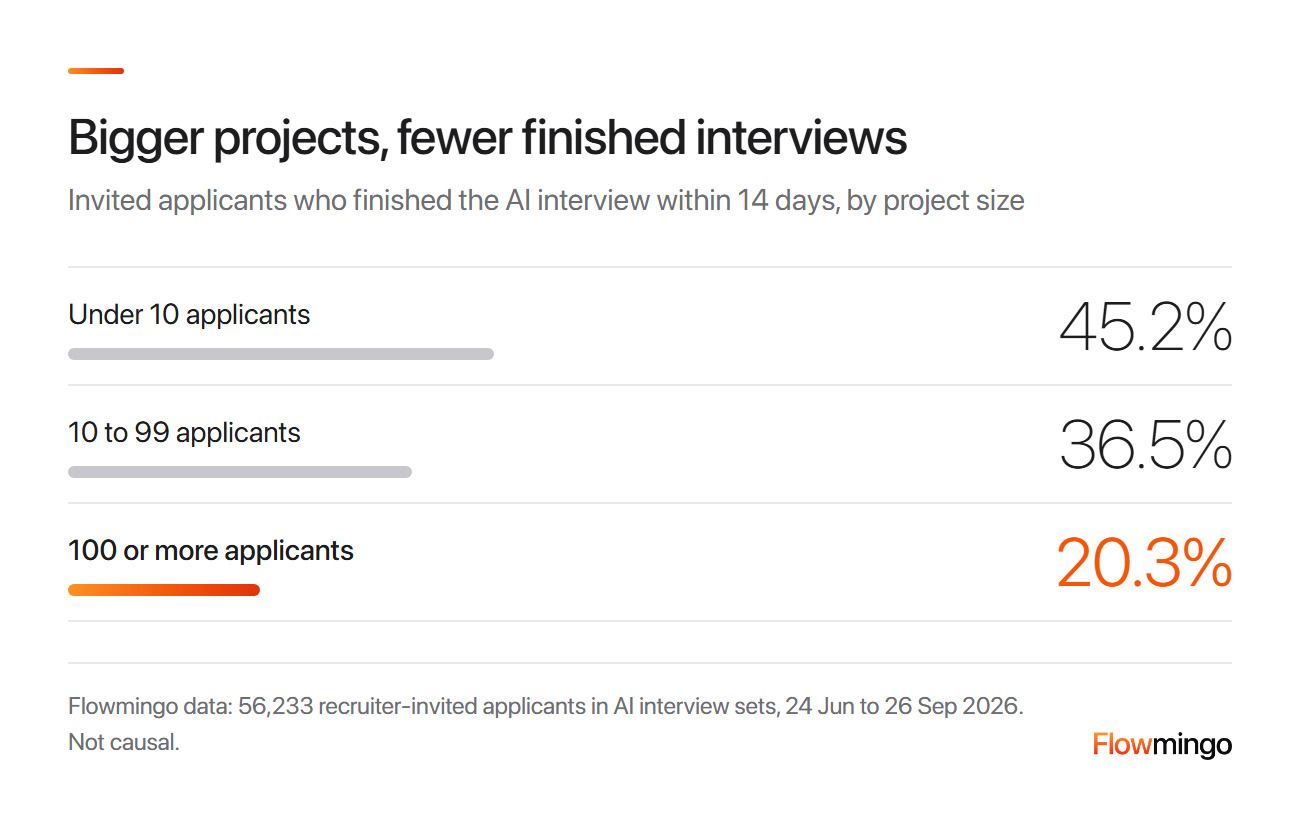
Finished by project size: within 14 days, 45.2% of invited applicants finished in projects under 10 applicants. It was 36.5% at 10 to 99 applicants and 20.3% at 100 or more.
In practice, count invites in batches of 100. Each batch should give you about 20 finished interviews within 14 days, so if you need 20 sooner, invite more people or invite them earlier.
Give a 7-day deadline with the date written out, then send 1 reminder on day 2 and a last nudge on day 5. Our interview invitation email templates follow the same schedule. A real date turns "later" into a plan, which matters when hundreds of people hold the same link.
A self-paced round also removes the classic no-show. 1 recruiter on r/recruiting booked 6 interviews and got 5 no-shows. In high volume recruiting with no slot to book, an applicant who vanishes costs you an email, not an hour.
6. How fast must we move before high-volume candidates take another offer?
Send the first-round invite the day someone passes the knockouts, and make offers within days of the final interview, because faster offers win more acceptances. A foundational 2010 field study of 3,012 candidates found people accepted earlier offers more often, with no difference in later performance or turnover.
That study, by Becker, Connolly and Slaughter, followed candidates at 1 large organisation. Speed did not cost quality there, so moving fast is not the risk it feels like.
The pool is also freshest at the start. In Appcast's 2026 data, 53.01% of an ad's applications arrived in its first 10 days, as the figure below shows:
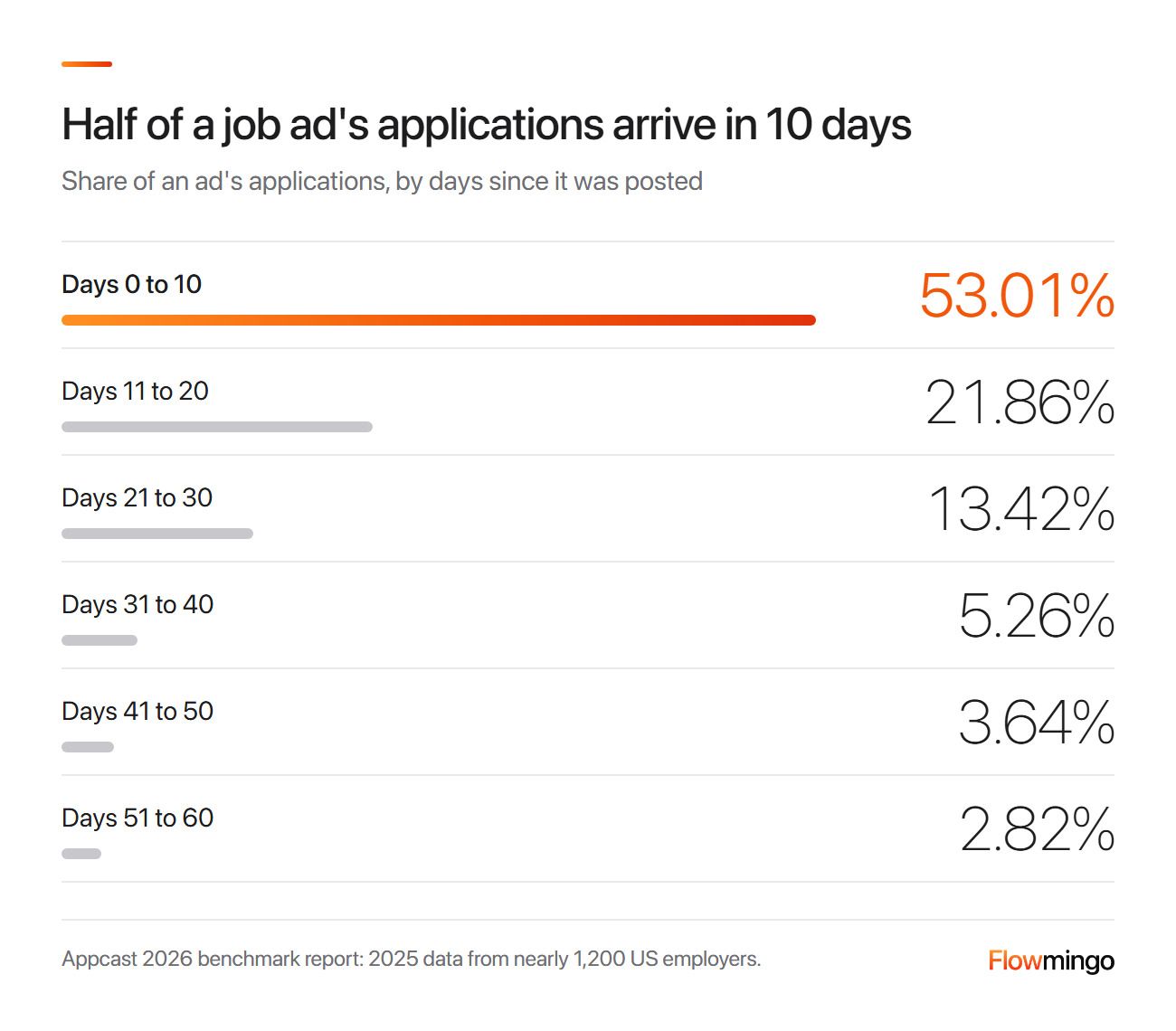
Applications by ad age: 53.01% arrive in days 0 to 10, 21.86% in days 11 to 20 and 13.42% in days 21 to 30.
After day 30 the flow thins: 5.26% in days 31 to 40, 3.64% in days 41 to 50 and 2.82% in days 51 to 60. This means your screening load peaks in the first 10 days of each ad.
If the first round waits for a recruiter's free afternoon, the best of that wave is already talking to other employers. In high volume recruiting, a slow first week costs more than a slow final round.
Flowmingo data · 127 AI interview sets that reached 100+ applicants and 20 finished interviews · 82 companies · sets created 24 Jun to 26 Sep 2026
- 5.0 days was the median time from a big set's first applicant to its 20th finished interview.
- 25% of these sets reached 20 finished interviews within 46 hours of their first applicant.
The clock includes however long each team took to send later invites, so it is not a candidate response time. 127 of the 201 big sets created in the window (63.2%) reached 20 finished interviews.
So in the big projects that got there, 20 finished interviews took a median of about 5 days from the first applicant. Our rhythm for each applicant, from practice rather than a study, keeps that pace:
- Day 0: they pass the knockouts and get the interview invite, with a deadline 7 days out.
- Days 1 to 7: you read new scored results every morning, not at the deadline.
- Within 2 days of a pass: hold the final interview.
- Within 1 day of the final: make the offer, or send a clear no.
7. Should an AI interview run our first round, or will good candidates walk away?
Use it for high-volume first rounds if you tell candidates upfront, offer a person on request and keep a human on every decision. In the largest field test so far, AI-led first interviews led to more offers and more people still in the job a month later.
The test ran at a Philippine recruitment firm hiring customer service staff for client companies. Jabarian and Henkel randomly assigned 67,056 applications to an AI interviewer, a human recruiter or a free choice, and recruiters made every hiring decision.
The table below compares the 2 groups:
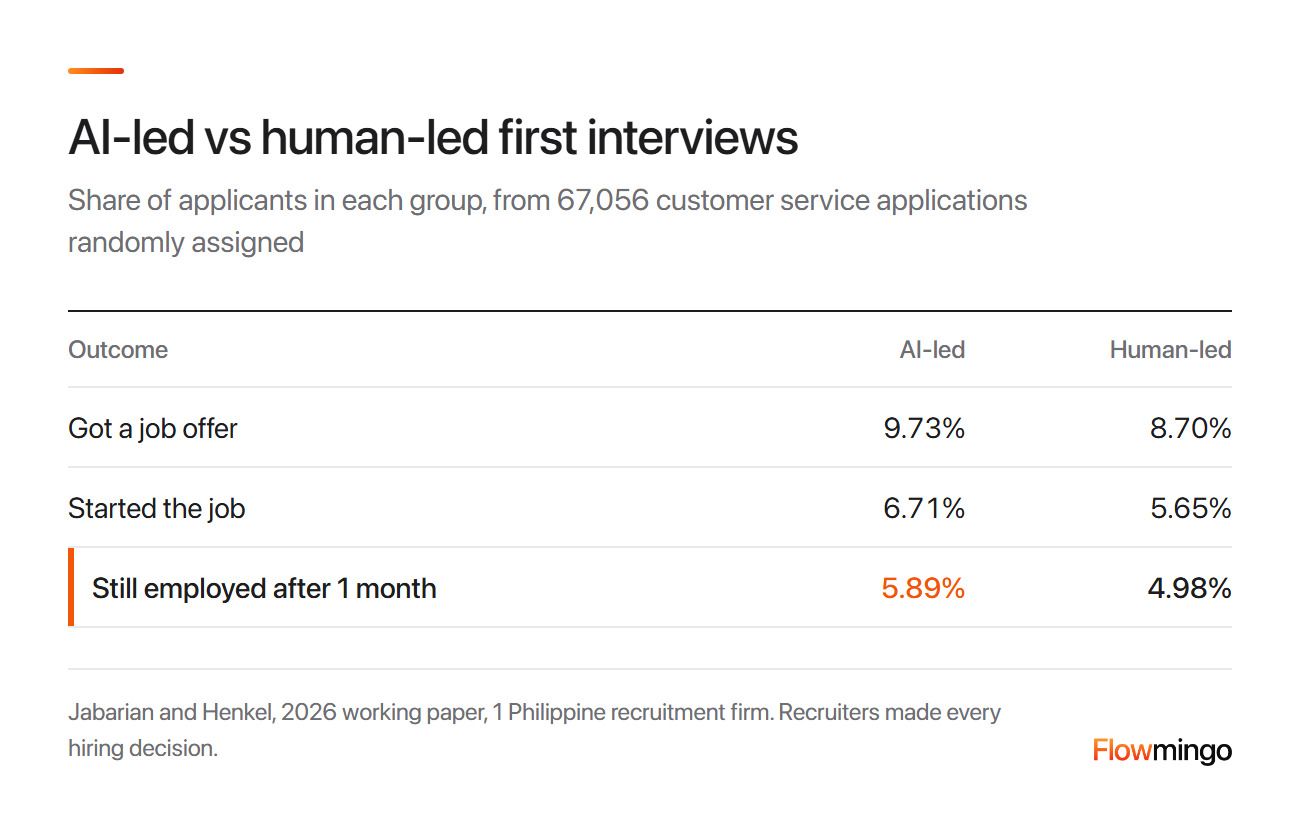
AI-led vs human-led first interviews: 9.73% vs 8.70% got a job offer and 6.71% vs 5.65% started the job. Still employed after 1 month: 5.89% vs 4.98%.
Job offers rose by 12%, from 8.70% to 9.73% of applicants. A month after starting, 5.89% of AI-interviewed applicants still held the job against 4.98%, which is 18% higher.
It is a working paper, not yet peer reviewed, from 1 firm and 1 country, and its AI spoke by voice. Applicants also rated AI interviews as less natural, even though 78% chose the AI when offered a choice.
Some candidates still walk away. In Greenhouse's 2026 survey, 63% of US job seekers had faced an AI interview, and 38% had walked away from a hiring process over one. Those shares come from its 1,200 US respondents, of 2,950 in 5 countries.
The same survey found 46% wanted the option of a human interview, and 44% wanted to be told upfront. So put both in your invite, for example: "The first step is a short AI interview on [the criteria you score], which you can take any time before [day, date and time]. A person reviews every result, and you can ask for a call instead."
How Flowmingo helps
Flowmingo's AI interviews are meant for high-volume, entry to mid-level first rounds, not the final round of a senior hire. Teams use them to decide who moves on to a human interview. Nobody is rejected automatically, and the recording and full transcript sit behind every rating.
8. We're an agency or BPO screening for several clients: how does high volume recruiting change?
Run 1 screen per client role, with that client's criteria signed off before invites go out, and send clients scored evidence instead of CV piles. Then track offers and starts per client, because each client's pool behaves differently.
Agency volume compounds. 10 clients with 20 seats each is 200 hires, and every client wants proof before they meet anyone.
In the Philippine trial, 43 of the 131 recruiters handled 90% of the 67,056 applications over 3 months (Jabarian and Henkel).
Agencies also carry the start-day risk. 1 agency recruiter on r/recruiting described spending 2 hours every morning backfilling seats after start-day confirmations fell apart.
So size offers from your measured offer-to-start ratio. If 7 in 10 offers start, as at the Philippine recruiter, make about 10 offers for every 7 seats. Keep the next 3 ranked candidates warm too.
Sign-off prevents the slow argument later. For example, before a telecom client's 40-seat campaign, agree the 4 criteria and the advance line in writing. If the client later asks for "better" candidates, you change 1 criterion for every applicant at once.
Share the evidence, not the contact details, until the client commits. A report with scores, reasons and a recording lets a client say yes or no without going around you.
How Flowmingo helps
For recruitment agencies, a one-click client link shows the candidate's scored report while hiding their contact details and CV, with the name reduced to initials. The Flowmingo FAQ explains how. There is no charge per candidate, so a role with 40 applicants costs the same as one with 4,000. "I used Flowmingo when I had 250+ candidates who had applied and I had to close the role in 3 days," says Davin Patel, Head HR at BPO firm Unilights, on our homepage.
9. Is it legal to screen hundreds of applicants with AI, and what do we owe them?
Yes in most places, but duties grow with the tool's role: notice, an explanation, sometimes consent, bias checks and a person who reviews decisions. This is general information, not legal advice.
High volume recruiting raises the stakes, because 1 flawed question repeats across thousands of people. Volume also gives you enough numbers to spot a problem in week 1 rather than in a lawsuit.
In New York City, Local Law 144 bars a covered automated tool without an independent audit for bias in the past year. The employer posts a summary of the results, and covered candidates get notice 10 business days before use.
Coverage turns on how much the tool's output decides, and human review alone is not an exemption. Check DCWP's scope and notice rules before you switch it on.
In Illinois, the AI Video Interview Act requires notice, an explanation of how the AI works and consent before AI analyses a video interview. The explanation covers the general traits it evaluates, and on request you must delete the videos within 30 days.
In the EU, the AI Act treats recruitment AI as high-risk, and Regulation 2026/1744 moved those duties to 2 December 2027.
At volume, check pass rates by group every week. Under the US 4/5 rule, a group passing at under 80% of the top group's rate is a warning sign. You must then justify the step by the job's needs.
Say 120 of 400 men pass the first round, but only 70 of 350 women: that is 30% against 20%. Divide 20% by 30% and you get 67%, under the line, so review the question behind the gap.
10. Which high volume recruiting numbers should I report each week, and what is good?
Track 6 numbers weekly: applications per opening, finished per 100 invited, days to first contact, pass-rate ratio by group, starts per offer and 30-day retention. Compare each with your own last 4 weeks first, then with an outside reference.
Weekly beats monthly at volume, because a broken step costs hundreds of applicants before a monthly report shows it.
Copy this scorecard into your weekly report:
| Number | How to count it | A reference point |
|---|---|---|
| Applications per opening | Applications ÷ openings | 244 per job (Greenhouse, 2025) |
| Finished per 100 invited | Finished first rounds ÷ invites × 100 | About 20 in big projects (section 5) |
| Days to first contact | Median days from applying to the invite | Your own last 4 weeks |
| Pass-rate ratio by group | Lowest group's pass rate ÷ highest | Under 80% means check the step |
| Starts per offer | Starts ÷ offers | 69% at the Philippine recruiter |
| Still there at 30 days | Still employed ÷ starts | About 88% at the Philippine recruiter |
The last 2 references come from the field test, by our arithmetic. Of the 2,691 AI-interviewed applicants who started, 2,363 still held the job after a month, and the human-interviewed group matched it at about 88%. Starts per offer counts offers made, while our recruitment funnel guide counts accepted offers and gets about 73% from the same study.
For example, if finished-per-100 drops from 20 to 12 in a week, check the invite first. Look at the subject line, the deadline and whether reminders went out. Our recruiting metrics guide gives the formulas, and the recruitment funnel guide shows how to find the leak.
If your volume comes in seasonal peaks, our seasonal hiring guide turns the same numbers into a shift plan.
None of this needs a bigger team. It needs a plan that counts backwards, a first round every applicant takes the same way, and 6 numbers you read every Monday.
How Flowmingo helps
Flowmingo is a free AI interviewer for recruiters. Each applicant does the interview in their own time, and you get a recording and a scored report for every one. Try Flowmingo for your next round of high volume recruiting.
11. Sources
Every study, law and survey in this guide links to a source below; Flowmingo figures come from Flowmingo's own platform data.
- Appcast (2026). 2026 recruitment marketing benchmark report: U.S. version. Appcast.
- Becker, W. J., Connolly, T., & Slaughter, J. E. (2010). The effect of job offer timing on offer acceptance, performance, and turnover. Personnel Psychology.
- European Parliament and Council (2026). Regulation (EU) 2026/1744, the Digital Omnibus on AI. Official Journal of the European Union.
- Greenhouse (2026). The Hire Standard: Greenhouse benchmark report, North America. Greenhouse.
- Greenhouse (2026). 63% of job seekers have faced an AI interview. Most haven't had a good one yet. Greenhouse 2026 Candidate AI Interview Report.
- Illinois General Assembly (2019). Artificial Intelligence Video Interview Act, 820 ILCS 42. Illinois Compiled Statutes.
- Jabarian, B., & Henkel, L. (2026). Voice AI in firms: A natural field experiment on automated job interviews. arXiv preprint.
- NYC Department of Consumer and Worker Protection (n.d., read 2026). Automated employment decision tools (AEDT). City of New York.
- r/recruiting (2025). Dealing with no shows [Online forum post]. Reddit.
- r/recruiting (2025). High volume customer service hiring [Online forum post]. Reddit.
- r/recruiting (2026). How do staffing agencies reduce no-shows / ghosting before day-1 [Online forum post]. Reddit.
- r/recruiting (2026). How is your team handling CV screening volume right now [Online forum post]. Reddit.
- r/smallbusiness (2026). How do you handle screening applicants when you don't have HR [Online forum post]. Reddit.
- Sackett, P. R., Zhang, C., Berry, C. M., & Lievens, F. (2022). Revisiting meta-analytic estimates of validity in personnel selection: Addressing systematic overcorrection for restriction of range. Journal of Applied Psychology.
- SHRM (2025). 2025 recruiting executives benchmarking: Insights to maximize recruitment. SHRM.
- Tilston, O., Krings, F., Roulin, N., Bourdage, J. S., & Fetzer, M. (2024). Reactions to asynchronous video interviews: The role of design decisions and applicant age and gender. Human Resource Management.
- U.S. Code of Federal Regulations (current text). 29 CFR 1607.4, information on impact. Legal Information Institute.