
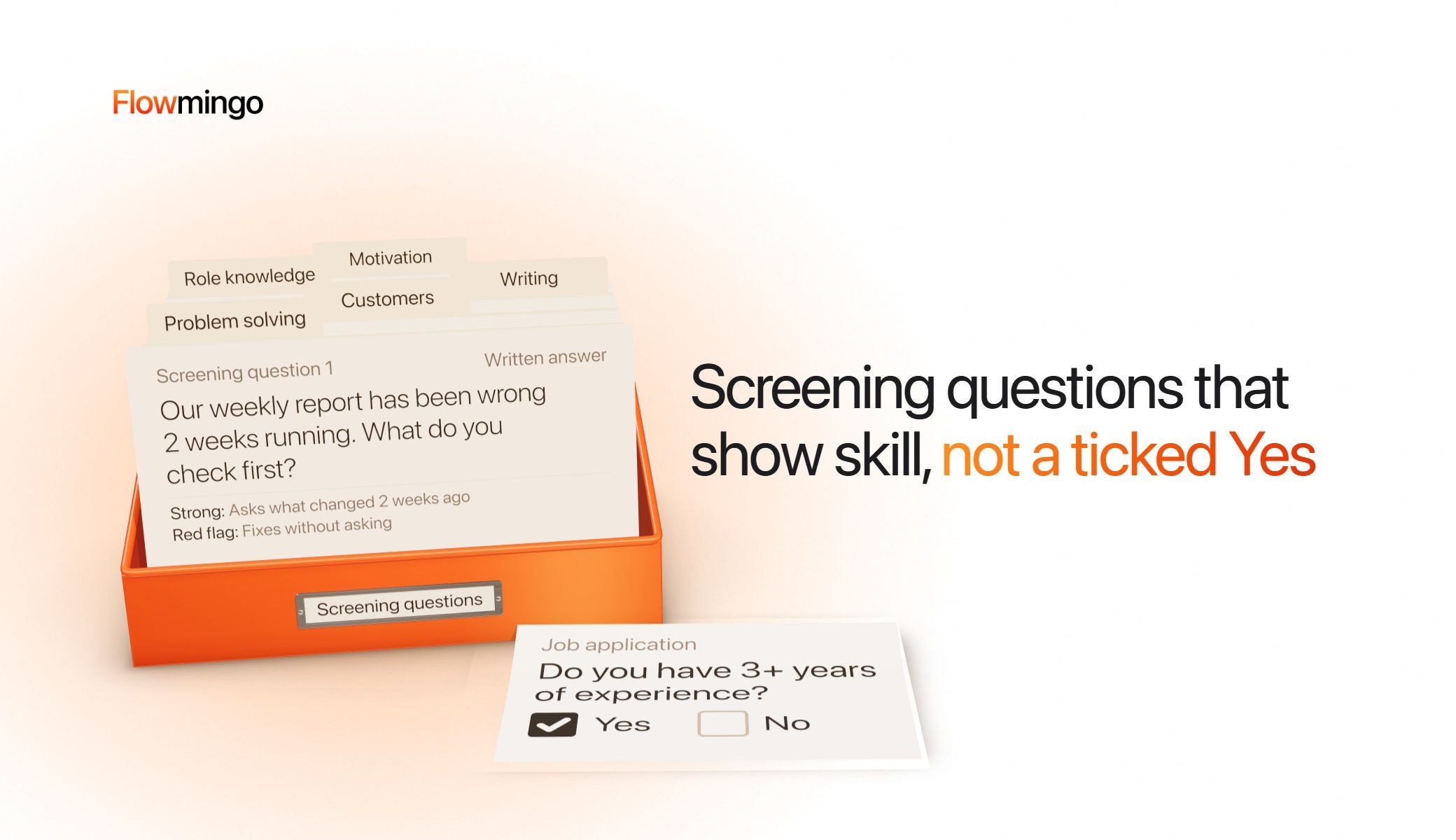
4 in 5 applicants tick Yes when you ask for minimum years of experience, so your screening questions for job applicants can't sort the pile. That pile can be huge: 1 recruiter on r/recruitinghell got 600+ applicants for a staff accountant role within 24 hours.
That isn't your fault. In Gartner's July 2025 report, 39% of 3,290 candidates used AI to apply, and 29% of those had it write assessment answers. Generic job screening questions now measure preparation.
So your interview hours go to whoever prepared best, like the r/managers poster's star interviewee, the "worst hire of my career".
Below are 20 skills screening questions in 5 groups. Then come 3 moves: match the format to the skill, keep the form to 5 minutes, and write the bar first.
Key takeaways
- Do yes/no screening questions show who has the skill? Rarely: on Flowmingo, 86.9% of yes/no answers were Yes.
- How should I word a customer-handling question? Ask for their absolute best: in 1 study, strong answers rose from 12.2% to 25.8%.
- Can I trust an AI detector on written answers? Not reliably: in 1 test, 7 detectors wrongly flagged 61.3% of human-written essays by non-native English writers as AI, on average.
- How many screening questions can I add? About 5 minutes' worth: your knockouts plus 1 skill question.
- What does a strong answer look like? 1 real situation, what they did and how it ended: only 22% named a result before follow-ups, 59% after.
1. What are good screening questions for job applicants that show real skill, not rehearsed answers?
Good screening questions ask for 1 real event or a small job task, with details nobody can invent on the spot. Drop yes/no claims, because most applicants answer Yes.
Flowmingo data · 57,186 yes/no screening answers · 33,753 applicants · 1,021 companies · applications to 30 Sep 2026
- 86.9% of answers to yes/no screening questions were Yes, across 3,121 questions.
- 80.5% of answers were Yes when the question asked about the minimum years of experience.
Flowmingo data shows what applicants said, not whether it was true. It counts only applicants who submitted the form, not people who read the question and did not apply. Yes is usually, but not always, the qualifying answer. Questions may have been drafted by Flowmingo's AI, then kept or edited by the hiring team.
Even the figure's lowest row, certificate or licence, drew mostly Yes.
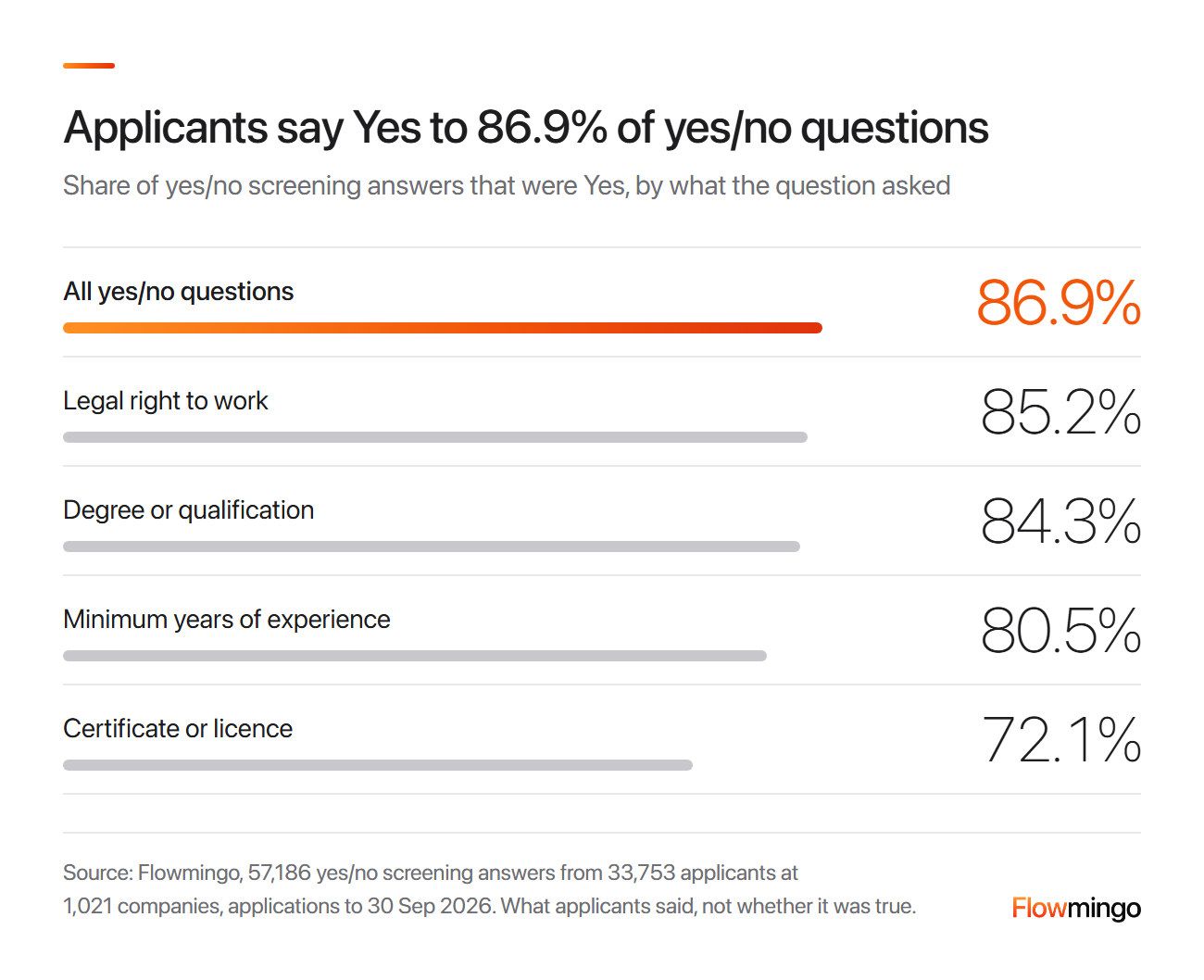
Yes rate by question topic: all yes/no questions 86.9%, legal right to work 85.2%, degree or qualification 84.3%. Minimum years of experience 80.5%, certificate or licence 72.1% (Flowmingo data, to 30 Sep 2026).
Sackett and colleagues' foundational 2022 re-analysis, summarised in a 2023 review, rates methods from 0 (no link to job performance) to 1 (perfect). Job knowledge tests scored 0.40, work samples 0.33 and scenario questions 0.26, against 0.07 for years of experience.
Every question below follows 4 rules:
- Ask for something to do, recall or choose, never a yes/no claim.
- Ask applicants to back each claim with details. In a foundational 2012 study of 16,304 applicants, that lowered scores, which the authors read as less faking (Levashina, Morgeson and Campion).
- Keep the right answer out: in Mark Murphy's foundational advice, "and how you resolved it" tips off the answer you want.
- Drop self-ratings, the easiest answers to inflate.
Knockouts belong in our guide to pre-screening interview questions.
1.1 What if applicants have no work experience?
Let applicants answer from school, part-time work or volunteering, using questions 1, 3, 7, 8 and 17 without its follow-up. Skill questions also widen the pool: LinkedIn estimates potential skills-based talent pools at a median 6.1 times the size of title-based ones.
2. How do I turn my job description into screening questions for job applicants?
Start from what the person must achieve in year 1, not from the duties list. Turn each goal into 1 question, then pick 3 to 5, 1 per skill group the job needs.
Recruiter Lou Adler's performance-based hiring starts from the 6 to 8 results the hire must deliver in year 1. His foundational Hire With Your Head (2007) and a World Economic Forum article then ask for a comparable past result per goal.
It is a consultant's method, not a study. For example, a support lead's "Handle escalated complaints" becomes "reply within 1 working day", which questions 5 and 7 test (illustrative, not customer data).
Our guide to writing a job description starts from 3 to 5 such outcomes, so you may already have them.
Then score each skill on its own. In Wingate and colleagues' 2025 meta-analysis of 37 studies, interview ratings covered task skills and teamwork-type skills.
Each predicted its own kind of job performance better than the other. Inside the interview, though, the 2 ratings moved together. Most of its 30,646 people come from 1 very large study.
3. Which screening questions for job applicants show real problem solving, not a memorised STAR story?
Give applicants a real problem from your job, or ask what they changed and the number before and after. Strong answers show a method, not just effort.
These screening question examples keep past-event questions but tie them to your material, a number or a date, so a memorised STAR story won't fit.
In a foundational 2014 study of 62 real interviews, applicants told a real story only 23% of the time (Bangerter, Corvalan and Cavin). The most common answer described a habit instead, and most applicants were students.
Skip puzzles too, because brainteasers lack evidence that they predict anything. In a foundational 2019 study of 736 working adults, people keener to ask them scored higher on narcissism and sadism (Highhouse, Nye and Zhang).
Questions 1 to 4 use your own material in the [brackets].
| # | Question | Follow-up | Strong answer | Red flag |
|---|---|---|---|---|
| 1 · Written | "Our [weekly report] has been wrong 2 weeks running. What do you check first?" | "Why that first?" | Asks what changed 2 weeks ago | Fixes without asking |
| 2 · Written | "Tell me about a process that kept failing at work or school. What was your part? (3-5 sentences)" | "What number moved, and when?" | Their own step, with a number | "We improved efficiency", no number |
| 3 · Task | "Here are 5 rows from our [order log]. Which looks wrong, and what would you do?" | "Who would you tell?" | Finds the row, asks before editing | Edits unchecked |
| 4 · Written | "Tell me about a problem you couldn't solve alone. What did you do, step by step? (3-5 sentences)" | "How did it end, and when?" | Tried 1 or 2 things, brought options | Escalated at once, or sat on it |
For example, "First I'd ask what changed 2 weeks ago" shows a method on question 1, unlike "I'd rebuild the report" (illustrative example).
Question 3 is our untested, 3-minute version of a work sample, which scored 0.33 as a full test.
Our guide to skills-based hiring covers longer tasks.
4. What screening questions show how an applicant will handle an upset customer before I meet them?
Ask for their absolute best handling of a difficult customer, then their worst, and have them reply to a real complaint. Strong answers stay specific.
Wording decides which story you get. Huffcutt, Howes, Murphy and Murphy asked 199 customer-facing workers about "a specific time you had to deal with a customer who was being difficult". They were paid study volunteers, not applicants.
With that standard wording, 12.2% of answers had a mean rating of 4 or higher out of 5. Wording that asked for their "absolute best" lifted that to 25.8%, in typed answers to recorded questions.
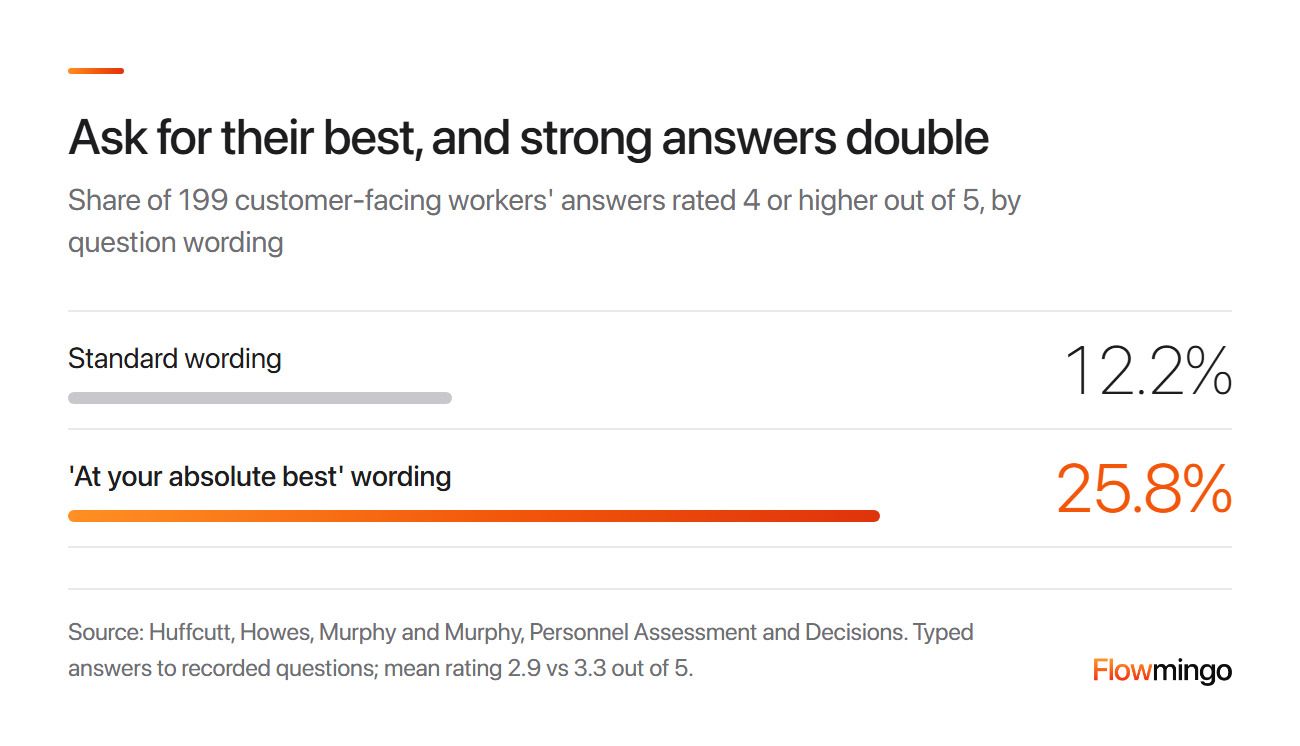
Customer question wording: standard wording 12.2% and 'at your absolute best' wording 25.8%. That is the share of answers rated 4 or higher out of 5, among 199 customer-facing workers.
The worst story then shows their floor and whether they learned. So question 6 drops "how you turned it around", which Murphy's foundational advice says tips off the answer.
Questions 5 to 8 cover the front line. Open answers also shrink group score gaps compared with multiple choice (section 8).
| # | Question | Follow-up | Strong answer | Red flag |
|---|---|---|---|---|
| 5 · Recorded | "Tell me about your absolute best handling of a difficult customer. How did it end?" | "When was it, and what happened next?" | Quotes what was said, clear ending | Still vague at their best |
| 6 · Recorded | "Tell me about the difficult customer you handled worst. What, if anything, have you changed since?" | "When did you last use that change?" | Owns their part, names 1 change | Blames the customer or "policy" |
| 7 · Written, recorded follow-up | "A customer writes: 'My order is late for the third time. I need it today.' You can't deliver today, but can offer [a next-day re-send]. Reply." | "Why open that way?" | Owns the 3 delays, offers the re-send and a time | Promises the impossible, or a pasted apology |
| 8 · Recorded | "1 customer is angry on the phone and 1 waits at the counter. What do you do first?" | "What do you tell the one waiting?" | Acknowledges both, gives the waiting one a time | Ignores 1, or "I'd stay calm" |
For example, a strong reply to question 7 reads: "I'm sorry this is the third delay. I can re-send it tomorrow morning and confirm by 3pm". A weak one: "We apologise for any inconvenience" (illustrative examples).
5. How do I test an applicant's writing when ChatGPT can polish every answer?
Test writing on a real, messy message from your job, then ask a 60-second recorded follow-up about it. Skip AI detectors.
In the same Gartner report, 36% of candidates who used AI made a writing sample with it.
On Freelancer.com coding jobs, employers stopped favouring tailored applications once AI writing tools arrived, a working paper by Galdin and Silbert finds. In their model, if written applications stopped signalling skill, the strongest fifth of workers would get hired 19% less often.
Detectors won't save you. Liang and colleagues ran a small experiment in a foundational 2023 opinion article. 7 detectors wrongly flagged 61.3% of human-written essays by non-native English writers as AI, on average.
| # | Question | Follow-up | Strong answer | Red flag |
|---|---|---|---|---|
| 9 · Timed, recorded follow-up | "Summarise this [10-line email thread] for your manager in 3 sentences, including what is still open." | "What would you ask next?" | Right facts, names the open item | Misses it, or adds facts |
| 10 · Written | "In 80 words or fewer, tell a [client] their [order] will be 2 days late." | "What did you leave out?" | News first, 1 reason, the new date | Buries the news, no date |
| 11 · Written | "Describe the last document you wrote that someone acted on. Who read it, and what happened? (3-5 sentences)" | "When was it, and what changed?" | Names the reader, the ask and the result | "I write lots of reports", no example |
| 12 · Recorded, 60 seconds | "Explain 1 choice you made in your written answer, and what you'd change." | Follow-up to 9 to 11 | Explains their own wording easily | Can't recall what they wrote |
Score clarity, accuracy and their own details, not polish. For example, naming question 9's open item beats a flawless summary that misses it.
If speed isn't the skill, drop question 9's timer or offer another way to answer. US disability law says a test must reflect the skill, not an impairment (42 USC 12112).
Weight writing only where the job needs it, because screening questions for job applicants should test the work, not a style.
6. What screening questions check role knowledge when I don't have that skill myself?
Swap "rate yourself" for a small task with a right answer, written by someone who does the job. Then ask for a past result that matches your year-1 goal.
Self-ratings cost nothing to inflate. When 152 people did a recorded interview once honestly and once trying to look ideal, self-report scales rose most (Hickman and colleagues, 2025).
They rose by 0.62, an effect size where higher means easier to inflate. Human interview ratings rose 0.22 and AI ratings 0.14, rises the authors call similar.
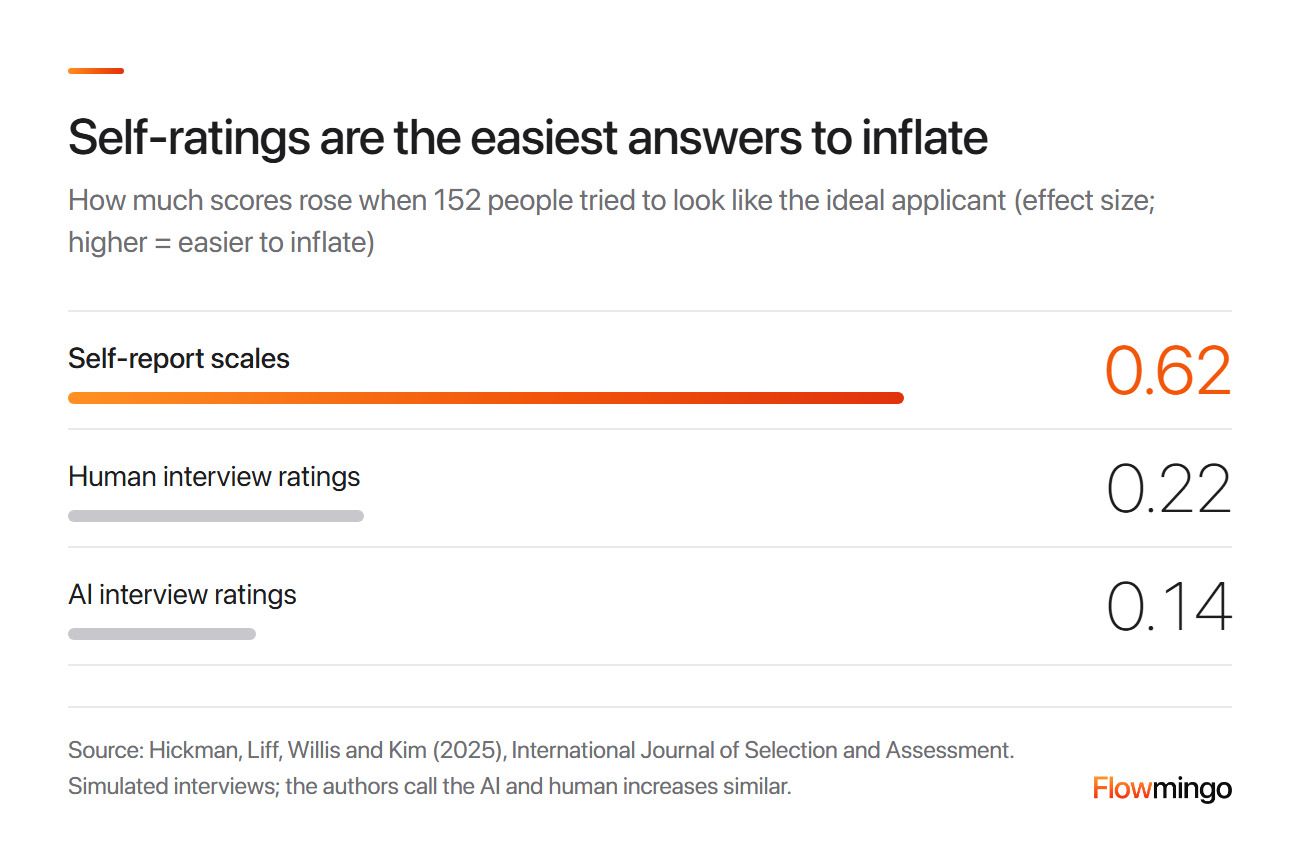
Score rise when faking: self-report scales 0.62, human interview ratings 0.22 and AI interview ratings 0.14. 152 people in a simulation, not real applicants, tried to look ideal.
32% of 2,200 US, UK and Irish job seekers in Greenhouse's 2025 vendor survey admit claiming AI skills they lack. A keyed task checks that, because a written answer key lets a non-expert score it.
Job knowledge tests scored 0.40 in the same re-analysis, so ask 1 person who does the job to write the key.
| # | Question | Follow-up | Strong answer | Red flag |
|---|---|---|---|---|
| 13 · Written | "In year 1 this role must [halve the ticket backlog]. What is the closest thing you've achieved? (3-5 sentences)" | "How big was the team, and how long?" | A comparable result with its scale | Matches none of your goals |
| 14 · Keyed task | "This [formula or process step] gives the wrong result. What's wrong, and what's the fix?" | "How would you check the fix?" | The error and a fix your expert accepts | Confident jargon, no working fix |
| 15 · Written | "Tell me about a mistake you saw a newcomer make in a role like this. How did you spot it? (3-5 sentences)" | "When was it, and what did it cost?" | A mistake insiders recognise, and the warning sign | Generic: "poor communication" |
| 16 · Single choice | "When [common situation] happens, which of these 4 steps comes first, and why?" | "Why not the second-best step?" | The right step for the right reason | The right step, wrong reason |
Test your key before you trust it, because a wrong answer can mean a strict key or unclear wording.
Flowmingo data · 3,752 applications · 87 companies · 30 Apr to 30 Sep 2026 · screening questions with a correct answer set by the hiring team
- 44.3% of applicants who faced 1 to 5 questions with a correct answer got at least 1 wrong, leaving out the largest company.
- 49.0% of applicants got it wrong when the form had just 1 question with a correct answer (2,059 applications, 63 companies).
- 77.2% of applicants got every keyed question right at the typical company, among the 31 companies with 20 or more such applicants. The middle half ranged from 35.5% to 92.8%.
Answer keys may be drafted by Flowmingo's AI and kept by the hiring team. Text answers are graded by AI. A wrong answer can mean a strict key or unclear wording, not only an unqualified applicant.
A range that wide suggests the keys and wording differ between companies, not only the applicants. So read 10 wrong answers before you reject anyone.
How Flowmingo helps
Flowmingo Tests are multiple-choice skills tests, scored automatically, so the 4-step choice in question 16 can run as one. Each result sits beside the candidate's interview report and CV score. You review any proctoring signals, and no timer fails a candidate. Tests are unlimited on every plan, including Free.
7. How do I screen applicants for motivation without getting 'I'm passionate about your company'?
Ask applicants to rank real tasks from the job and to name a requirement they don't yet meet. Strong answers are specific, even when that costs them.
"Why do you want to work here" measures how well someone researched you. Interest in the actual work scored 0.24 in the same re-analysis, against 0.07 for years.
Murphy's foundational advice drops "What are your weaknesses" too, because it draws canned answers such as "I work too hard". Question 19 asks about a real gap instead.
Skip the essay as well. In an r/recruitinghell thread from October 2024, 1 applicant refused a required 200-400 word "why us" essay. The thread's starter, a former recruiter, was fine with 1-line yes/no questions but objected to written interview questions on the application form.
Questions 17 to 20 test motivation through choices, not claims.
| # | Question | Follow-up | Strong answer | Red flag |
|---|---|---|---|---|
| 17 · Written | "Rank these 4 tasks, [A, B, C, D], from most to least appealing. Why the top and bottom? (about 50 words)" | "Where have you done the top one before?" | Real reasons, core task not last | The core task ranked last |
| 18 · Written | "What, if anything, have you done in the last 6 months to get better at [core skill]? (3-5 sentences)" | "Whose idea was it, and what can you show?" | A specific action, their own idea | "I'm always learning", no example |
| 19 · Written | "Which requirement in this ad do you not yet meet, and what would you do about it? (about 50 words)" | "What have you done so far?" | A real gap and a concrete plan | Claims to meet every requirement |
| 20 · Written | "Tell me about a dull, repetitive stretch of work. What happened to the quality of your work? (3-5 sentences)" | "How long, and how did you know?" | A concrete method and a result | Quit early, or blames the job |
For example, say live chat is 60% of the work in a support role. A strong answer ranks live chat first, with a reason from real experience. A red flag ranks it last (illustrative example, not customer data).
Question 18's follow-up shows whether the effort was their own idea.
8. Should applicants answer screening questions in writing, on video or in a test, when fairness matters?
Match the format to the skill: a keyed task for role knowledge, recorded answers for customer handling, written tasks for writing.
Open answers suit people skills, because they shrink group gaps. In foundational 2019 field studies, written answers cut the immigrant-native score gap from 0.92 to 0.28 standard deviations against multiple choice (Lievens and colleagues).
In a second group, video answers cut it from 0.41 to 0.09 against written ones, with prediction intact. Raters scoring transcripts of those video answers saw a bigger gap, so raters explain part of the drop.
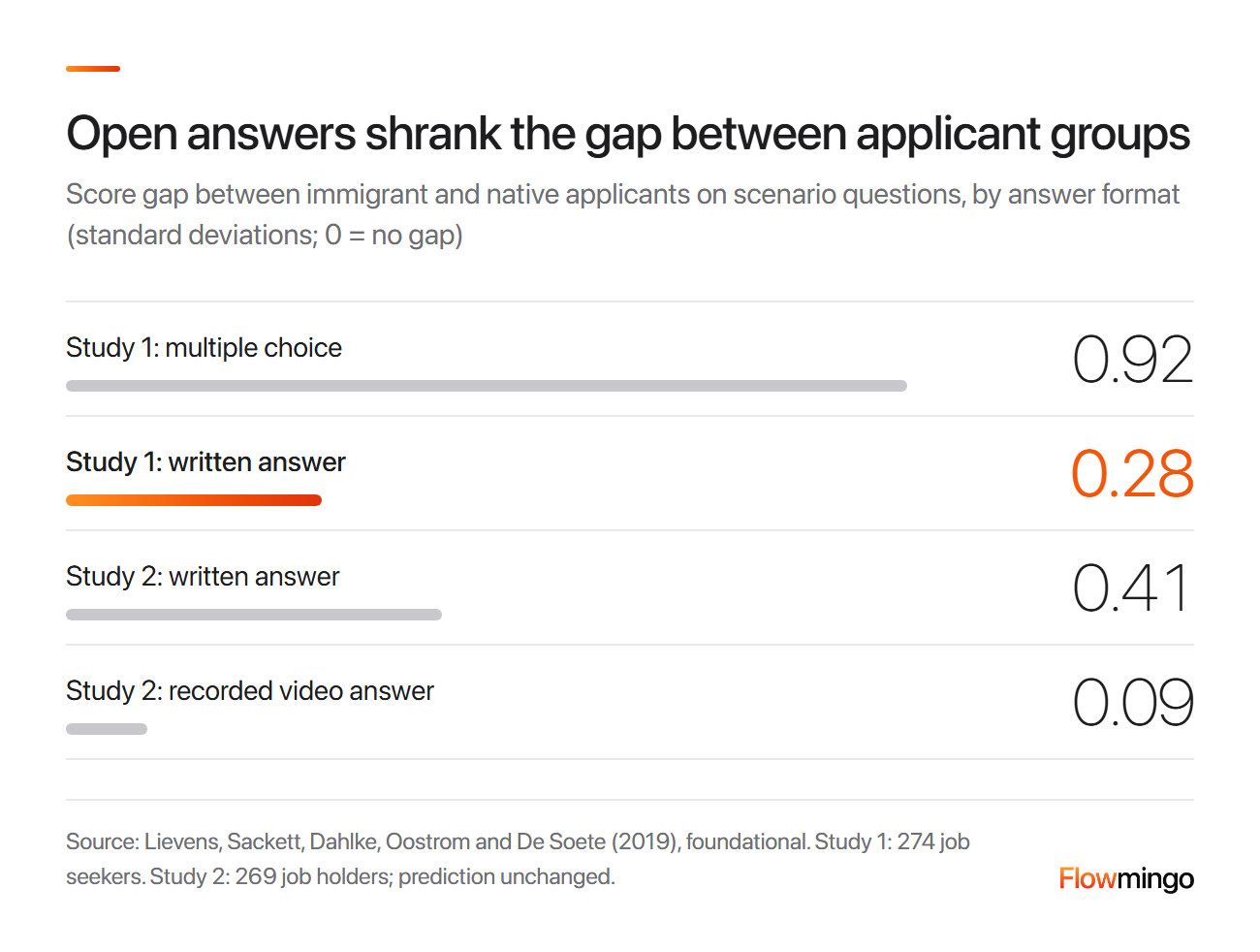
Group score gap by answer format: study 1 multiple choice 0.92, written answer 0.28. Study 2 written answer 0.41, recorded video answer 0.09, in standard deviations where 0 is no gap (foundational).
Score what applicants say, never tone or face. The EU AI Act bans AI that infers emotions at work, recruitment included (European Commission guidelines).
8.1 Which screening questions can't an applicant just paste into ChatGPT?
None fully, so tie questions to your own data, as 1, 3 and 9 do. Then ask question 12 about shortlisted written answers.
In foundational 2015 experiments, 516 interviewers watching videos often failed to spot exaggerated or invented answers, whatever their experience (Roulin, Bangerter and Levashina).
In Q3 2024, all 3 warnings tested (consequences, education, reasoning) cut reported AI use among 5,675 applicants (Robie and colleagues, 2026). A 2025 repeat found more AI use overall, but the consequences warning still cut it.
8.2 Should I send applicants the screening questions in advance?
Share the skills and the format, not the follow-ups. In Brosy, Bangerter and Ribeiro's foundational 2020 experiments, that cut generic pseudo-stories but not the share of real stories.
9. How many screening questions for job applicants can I add before good people drop off?
Keep the application to about 5 minutes: knockouts plus 1 short skill question, because long forms lose good people.
In foundational Appcast data reported by SHRM in 2016, completion fell by almost 50% when the whole application asked 50+ questions, against 25 or fewer. Cutting to 5 minutes lifted conversion by up to 365%.
Flowmingo data · 93,407 applications · 2,124 companies · 1 Jul 2025 to 30 Sep 2026
- 87.6% finished the AI interview after a screening form with 1 question, against 90.0% after a form with 7 or more.
Flowmingo data only sees applicants who submitted the screening form. People who opened the form and quit are not recorded, so this cannot show how many a long form loses. Longer forms also belong to different roles and companies. These are associations, not causes.
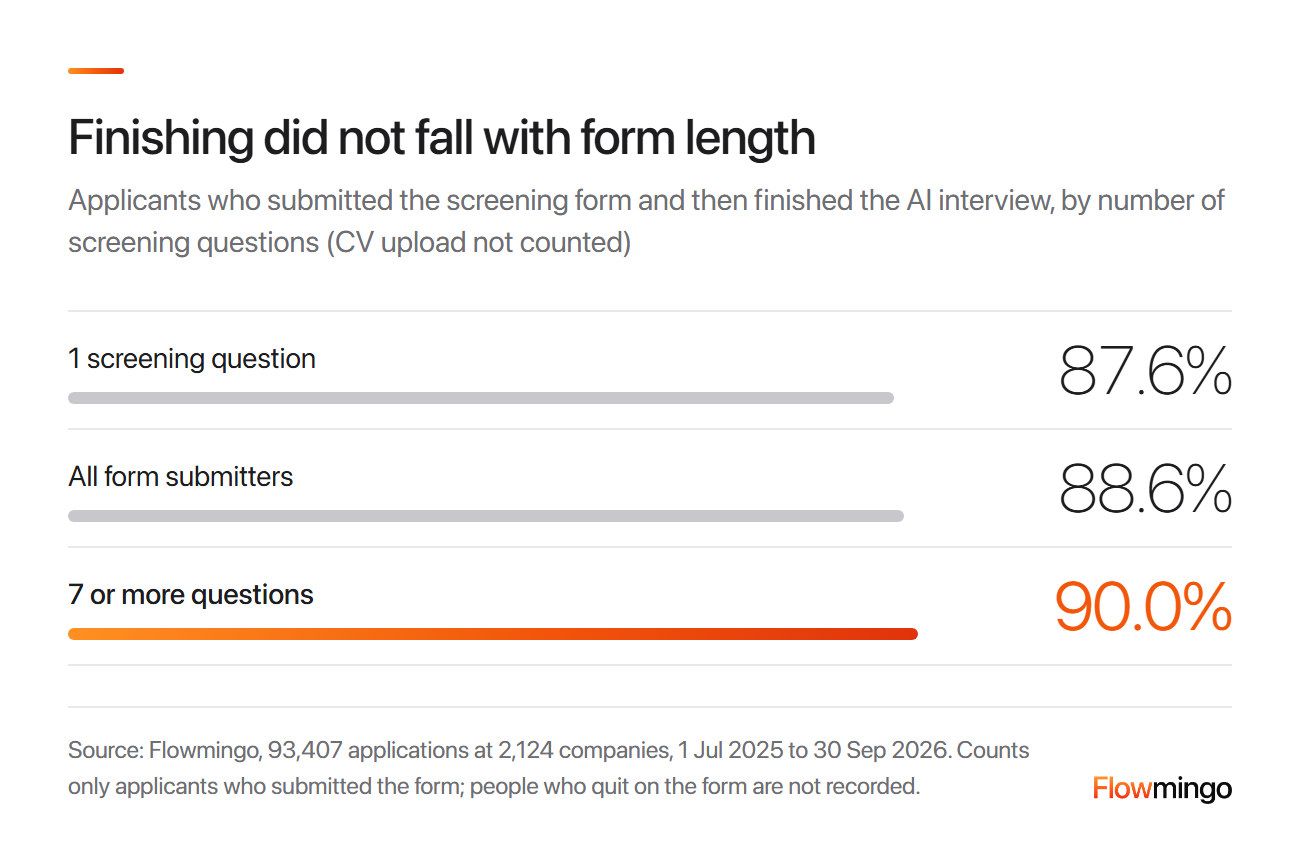
Finishing by form length: 1 screening question 87.6%, all form submitters 88.6%, 7 or more questions 90.0%. That is the share who went on to finish the AI interview (Flowmingo data).
So we suggest 3 steps (our recommendation, not a study):
- Application form, for everyone: knockouts plus 1 short ranking question, such as 17, in about 5 minutes.
- Skill screen, for those who pass: 3 to 5 questions, 1 per group the role needs, in 15 to 20 minutes. Our pre-screening guide fits 6 to 10 questions into the same 15 to 20 minutes and scores 2 to 4 of them. Stop at 4 scored answers unless the role needs all 5 groups. If your role needs all 5 groups, start from 3, 5, 10, 14 and 19.
- Interview, for your shortlist: the hiring manager probes the same skills for 30 to 45 minutes.
SEEK allows up to 8 screening questions per ad: spend 1 on a skill question. A free LinkedIn post allows 1 (LinkedIn Help), so use it on your deal-breaker.
10. With hundreds of screening answers to read, how do I spot strong ones and red flags?
A strong answer names 1 real situation, what the applicant did and how it ended. The red flag in every group is general talk after you asked for a specific time.
Plan 1 or 2 follow-ups per question for the part people skip, usually the result. In Brosy, Bangerter and Ribeiro's foundational 2020 experiment, 29 students named a result in 22% of answers before any follow-up, and 59% after.
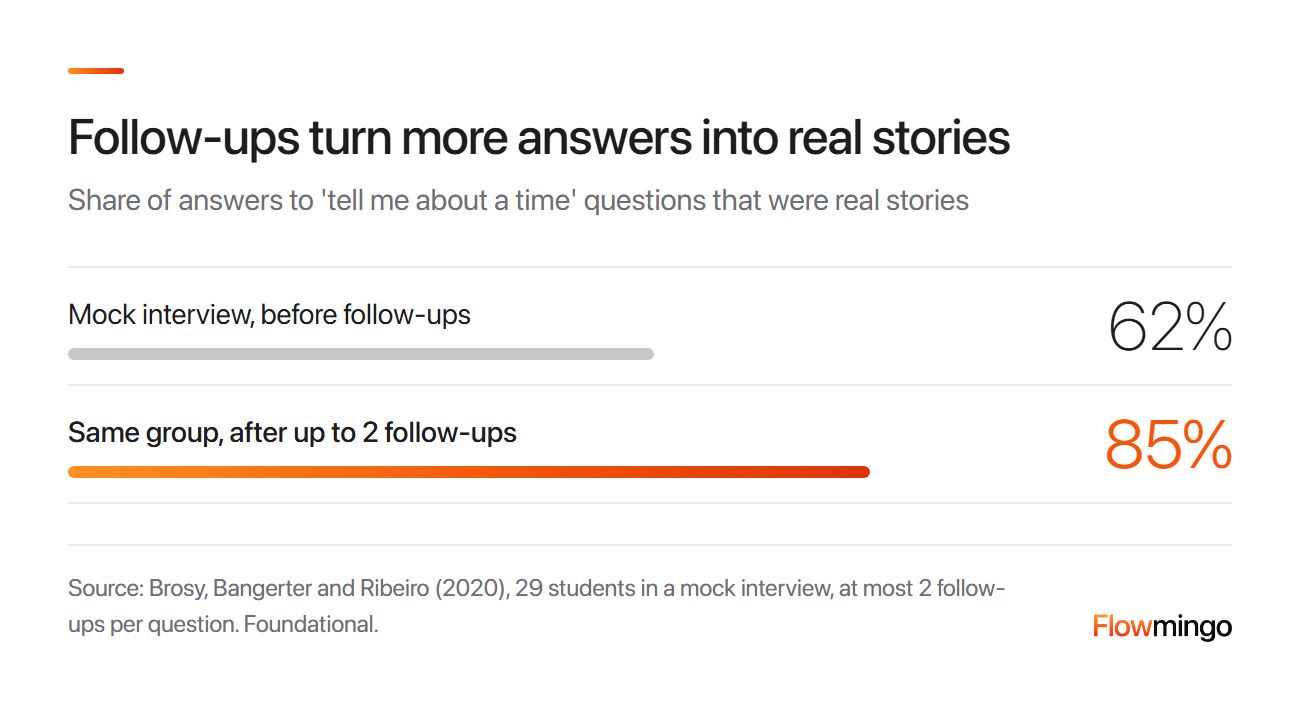
Real stories by follow-up: mock interview before follow-ups 62%, same group after up to 2 follow-ups 85% (foundational).
After follow-ups, real stories rose from 62% to 85%.
Follow-ups raised faking in 1 foundational study our pre-screening guide cites, but also raised real stories here. So make each event follow-up ask for a checkable date, number or name. Listen too for "he", "they" and "I would" with little "I did", a cue from Murphy's company research, not proof.
Write the bar for these screening questions for job applicants before you read answer 1, because a fluent first answer would set it. In Singapore, TAFEP asks you to keep assessment records for at least 1 year.
Start with 1 question per group, score each on an interview scorecard, and rewrite questions nobody answers well.
How Flowmingo helps
Flowmingo is a free AI hiring platform built around the AI Interviewer. When an answer does not address the question, the AI asks a follow-up on the same topic. Add "How did it end, and when?" as its own question. You get the recording, the transcript and a 0 to 10 rating per criterion, with reasons. Run step 2, written and spoken screening questions for job applicants side by side, in Flowmingo.
11. Sources
Every study, survey, law and forum post in this guide links to a source below; Flowmingo figures come from Flowmingo's own platform data.
- Adler, L. (2007). Hire with your head: Using performance-based hiring to build great teams (3rd ed.). John Wiley & Sons.
- Adler, L. (2015, March 17). How to hire highly engaged employees. World Economic Forum.
- Bangerter, A., Corvalan, P., & Cavin, C. (2014). Storytelling in the selection interview? How applicants respond to past behavior questions. Journal of Business and Psychology, 29(4), 593-604.
- Brosy, J., Bangerter, A., & Ribeiro, S. (2020). Encouraging the production of narrative responses to past-behaviour interview questions: Effects of probing and information. European Journal of Work and Organizational Psychology, 29(3), 330-343.
- European Commission (2025). Commission guidelines on prohibited artificial intelligence practices established by Regulation (EU) 2024/1689 (AI Act), C(2025) 5052 final.
- Galdin, A., & Silbert, J. (2025). Making talk cheap: Generative AI and labor market signaling (arXiv:2511.08785) [Working paper]. arXiv.
- Gartner (2025, July 31). Gartner survey shows just 26% of job applicants trust AI will fairly evaluate them [Press release]. Gartner newsroom.
- Greenhouse (2025, July 15). Fighting bias, bots and burnout: Global job market trends from the Greenhouse 2025 Workforce & Hiring Report. Greenhouse.
- Hickman, L., Liff, J., Willis, C., & Kim, E. (2025). Can interviewees fake out AI? Comparing the susceptibility and mechanisms of faking across self-reports, human interview ratings, and AI interview ratings. International Journal of Selection and Assessment, 33(2), e70014.
- Highhouse, S., Nye, C. D., & Zhang, D. C. (2019). Dark motives and elective use of brainteaser interview questions. Applied Psychology, 68(2), 311-340.
- Huffcutt, A. I., Howes, S. S., Murphy, D. D., & Murphy, S. A. (2024). Enhancing consistency of maximal responding in behavior description interviews: An exploration of priming and response length. Personnel Assessment and Decisions, 10(1), Article 1.
- Levashina, J., Morgeson, F. P., & Campion, M. A. (2012). Tell me some more: Exploring how verbal ability and item verifiability influence responses to biodata questions in a high-stakes selection context. Personnel Psychology, 65(2), 359-383.
- Liang, W., Yuksekgonul, M., Mao, Y., Wu, E., & Zou, J. (2023). GPT detectors are biased against non-native English writers. Patterns, 4(7), 100779.
- Lievens, F., Sackett, P. R., Dahlke, J. A., Oostrom, J. K., & De Soete, B. (2019). Constructed response formats and their effects on minority-majority differences and validity. Journal of Applied Psychology, 104(5), 715-726.
- LinkedIn (n.d., read 2026). Add screening questions to your job post. LinkedIn Help.
- LinkedIn Economic Graph (2025, March 3). Skills-based hiring: Increasing access to opportunity [Research note]. LinkedIn.
- Murphy, M. (2019, January 24). Hiring for attitude. American Management Association.
- r/managers (2026, June 18). Hired someone who interviewed better than anyone I've ever seen. Worst hire of my career. [Online forum post]. Reddit.
- r/recruitinghell (2024, October 24). Can someone tell me why companies are starting to add screening questions to applications? [Online forum post]. Reddit.
- Robie, C., Wingate, T. G., Baytalskaya, N., & Butera, H. (2026). Candidate generative AI use in pre-hire employment assessments: Self-reported incidence and the impact of warnings. International Journal of Selection and Assessment, 34(2), e70056.
- Roulin, N., Bangerter, A., & Levashina, J. (2015). Honest and deceptive impression management in the employment interview: Can it be detected and how does it impact evaluations?. Personnel Psychology, 68(2), 395-444.
- Sackett, P. R., Zhang, C., Berry, C. M., & Lievens, F. (2022). Revisiting meta-analytic estimates of validity in personnel selection: Addressing systematic overcorrection for restriction of range. Journal of Applied Psychology, 107(11), 2040-2068.
- Sackett, P. R., Zhang, C., Berry, C. M., & Lievens, F. (2023). Revisiting the design of selection systems in light of new findings regarding the validity of widely used predictors. Industrial and Organizational Psychology, 16(3), 283-300.
- SEEK (n.d., read 2026). The 5 types of screening questions that will help you find the best candidates faster. SEEK.
- Tripartite Alliance for Fair and Progressive Employment Practices (n.d., read 2026). Conducting job interviews (for employers). TAFEP.
- United States Code (current text). 42 USC 12112, Americans with Disabilities Act. Legal Information Institute, Cornell Law School.
- Wingate, T. G., Bourdage, J. S., & Steel, P. (2025). Evaluating interview criterion-related validity for distinct constructs: A meta-analysis. International Journal of Selection and Assessment, 33(1), e12494.
- Zielinski, D. (2016, March 8). Study: Most job seekers abandon online job applications. SHRM.