
Your employer branding is not the careers page you spent a month on. It is the reply an applicant got last week, or never got.
In Talent Board's foundational December 2024 report, 14% of candidates left a hiring process resentful. They would no longer do at least 1 of these: apply again, refer a friend, speak well of the employer or buy from it.
You did not choose this, because applications piled up and silence became normal. In Greenhouse's foundational 2024 survey of 3 countries, 61% of job seekers said an employer had ghosted them after an interview. No employer branding strategy survives that.
The cost stays out of sight. Among North American candidates who pulled out of a process in 2024, more blamed disrespected time than pay, 31% to 23%. About a third never share their experience publicly, so your review page can look fine while word of mouth turns against you.
The fix takes 3 moves. Audit what candidates actually meet, keep 4 promises at the moments they judge you, and track 4 numbers.
Key takeaways
- Where should a small business start with employer branding? With the job ad, your reply and the first interview, which every applicant meets.
- Does ignoring applicants really hurt our reputation? Yes. About 1 in 7 candidates leaves unwilling to apply again, refer anyone, speak well of the employer or buy from it, or several of these.
- Why do good candidates pull out? Wasted time. Among North American candidates who withdrew in 2024, 31% said their time was disrespected and 23% named pay.
- Should we reply to a bad Glassdoor review? Yes. Silent employers came off worst in 2 experiments, and with working job seekers a reply that says what you will fix did best.
- How do we know if our employer brand is working? Track offer acceptance, applicant quality, referral share and your review rating each quarter. Only 14% of UK employers measure it.
1. With small-business pay and no brand budget, where does employer branding start?
Start with what every applicant already meets: your job ad, your reply and your first interview. Fix those 3 before you spend anything on a careers page or social posts.
The reason is that ads do not buy a reputation. In a foundational 2003 study of 339 job seekers, people would accept lower pay to join a firm with a good reputation (Cable and Turban). Yet reputation advertising did not change how they saw the firm.
Our reading is that you earn a reputation in how you treat people, which costs a small team time, not money.
Still, a foundational 2012 meta-analysis of 232 studies found the job itself weighed most in the final choice (Uggerslev and colleagues). Good employer branding does not replace fair pay, but it wins the people for whom pay is close.
Here is a zero-budget employer branding strategy in 5 steps:
- Ask your 3 longest-serving staff why they stay, and write down 3 true reasons.
- Put the pay range and the hiring steps in all your job ads.
- Reply to every applicant, with the date they will hear by.
- Keep the first interview short, and let candidates take it in their own time.
- Count 4 numbers each quarter, the ones in section 10.
Step 3 takes about 1 hour a week and step 5 about 1 hour a quarter (our estimates).
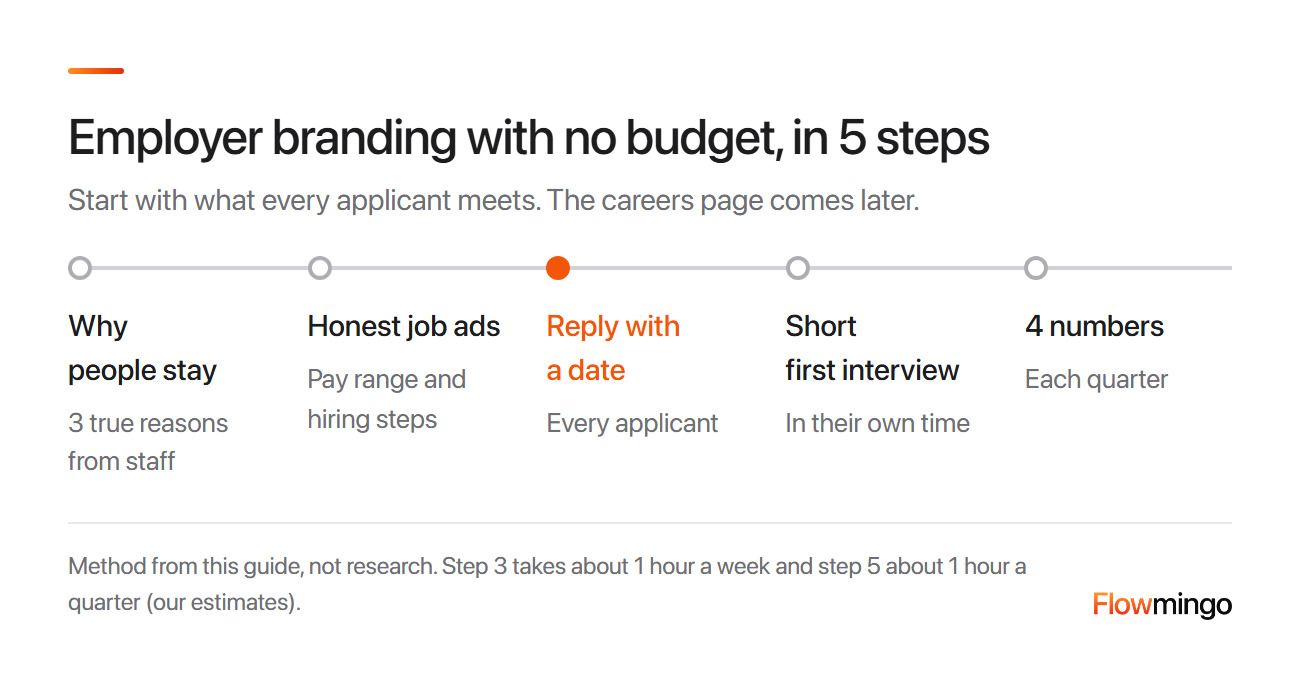
Zero-budget employer brand plan: why people stay, honest job ads, a reply with a date, a short first interview and 4 numbers each quarter.
How Flowmingo helps
With Flowmingo's AI Interviewer, you send every applicant 1 link to a structured, spoken first interview. They take it in their own time, evenings and weekends included. Your team gets the recording, transcript and a scored report, and every decision stays with you.
2. Is employer branding worth the effort if nobody outside our industry has heard of us?
Yes, and it may matter more for a company nobody has heard of, because candidates judge you on the little they see. Spend the effort on the hiring process first, because every applicant meets it.
Reputation shows up in numbers you can count. In 2 foundational 2003 field studies, firms with better reputations drew more applicants, with some evidence they could pick stronger ones (Turban and Cable).
In an early, unpublished estimate, a Glassdoor rating that just rounded up meant more applicants (Ma, Sheng and Xie). That was about 7% more Dice.com applications per posting in its first 7 days.
The effect was strongest for private, smaller, less established firms.
Treat that as a hint, not proof, because the authors withdrew this foundational 2023 working paper pending a data update.
Our rule of thumb, not research, depends on volume. Under 20 hires a year, skip campaigns and fix replies, interviews and rejections first. At 100 or more, add the careers page and employee stories.
For example, a 15-person clinic hiring 6 a year should put its hours into dated replies and a short first interview, not a careers video.
3. How do I run an employer brand audit for a small team without an agency?
Spend 1 hour on your hiring process as a candidate would, with the 6 checks below. Score each check red, amber or green before you change anything.
A review page alone will mislead you, because most bad experiences never reach it. In Talent Board's foundational December 2024 report, over half of candidates would share a negative experience with friends and family, under half in APAC.
Fewer would post publicly, and about a third said their experience was private. This means a clean Glassdoor page can hide a weak reputation, so the audit reads the places candidates actually meet you.
| Check | How to do it | Red flag | Minutes |
|---|---|---|---|
| Apply to your own job | Apply on a phone via your ad | Over 10 minutes, or no confirmation | 15 |
| Read your last 20 reviews | Glassdoor or Indeed, plus Google | Same complaint 3+ times, or no replies | 15 |
| Time your replies | First reply to your last 10 applicants | No reply within 2 working days, or no yes or no within 1 week | 10 |
| Read your job ad aloud | Mark every claim nobody can check | No pay range, or "like a family" | 5 |
| Ask 5 recent applicants | "Would you apply to us again, and why?" | Fewer than half say yes | 10 |
| Search your company name | Page 1 of Google, private window | A hiring complaint in the top 5 | 5 |
These thresholds are our suggestions, not research. They flag the worst gaps, while section 4's promises are the target. Repeat the checks each quarter, so the first audit is your baseline.
The survey question matters most, because rejected candidates are most of your audience. Include people you turned down, and make answering optional.
Each year about 25% to 30% of Talent Board respondents are extremely likely to refer, though nearly 90% did not get the job.
You do not need an agency for this baseline. In our view, an agency earns its fee when you must run the brand across countries or after a merger. That is the case one HR newcomer asked about on Reddit.
4. If our hiring process is what candidates actually meet, which employer branding fixes come first?
Fix the moments that cost candidates time: silence after applying, a first interview they must take time off for, and a decision that never comes. Those beat any careers-page change, because every applicant meets them.
Among North American candidates who withdrew in Talent Board's foundational December 2024 report, 31% picked "my time was disrespected". Only 23% said the salary did not meet their expectations, and 20% said the process took too long.
The 2025 CandE benchmark, now run by Survale, put the same reason at 32%. We use the foundational 2024 report because only it breaks out resentment and referrals by region.
Withdrawers are under 1% of those surveyed, so these are shares of a small group.
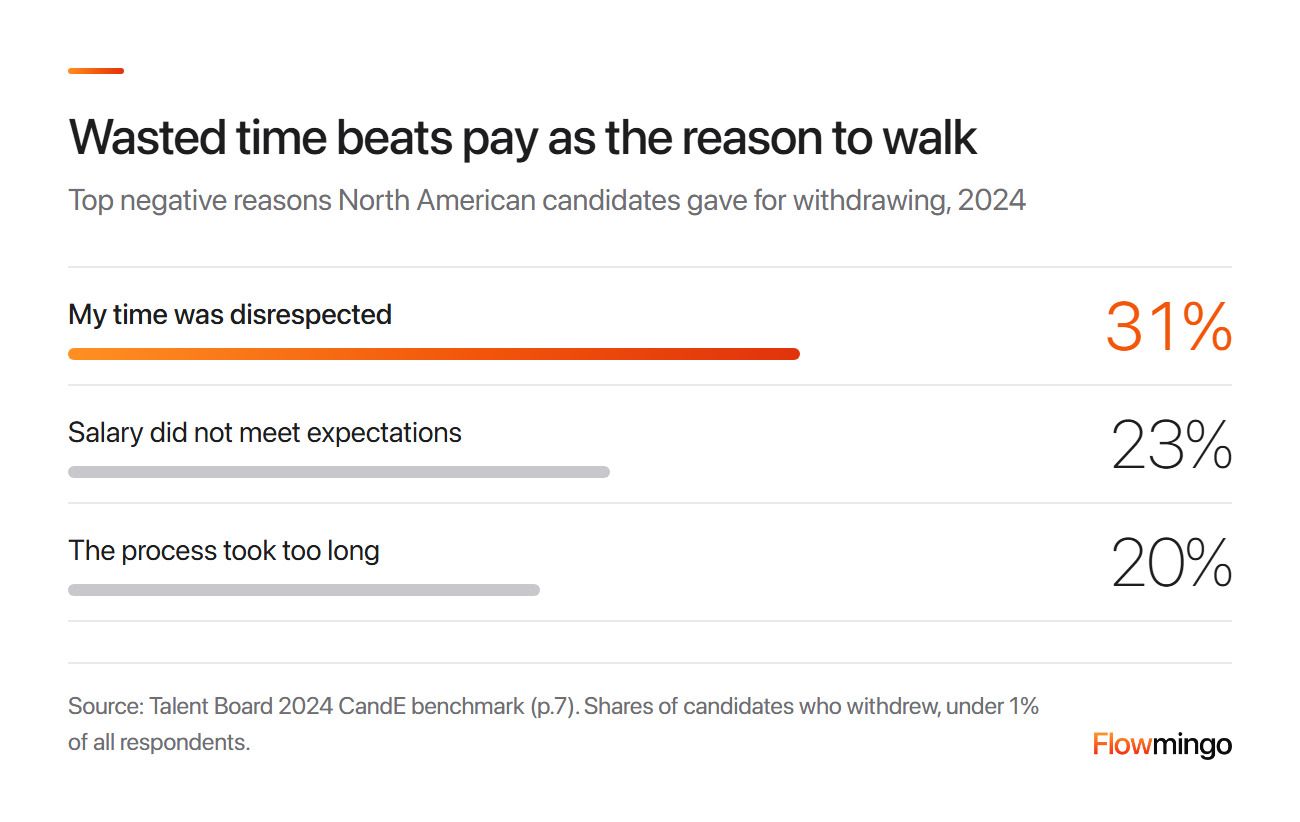
Why candidates withdrew: of North American candidates who pulled out in 2024, 31% said "my time was disrespected" and 23% named salary.
The stage decides what candidates notice. The same 2012 meta-analysis, foundational by now, found the recruiter's behaviour adds a lot to attraction in the first 2 stages. Later, the process weighs more.
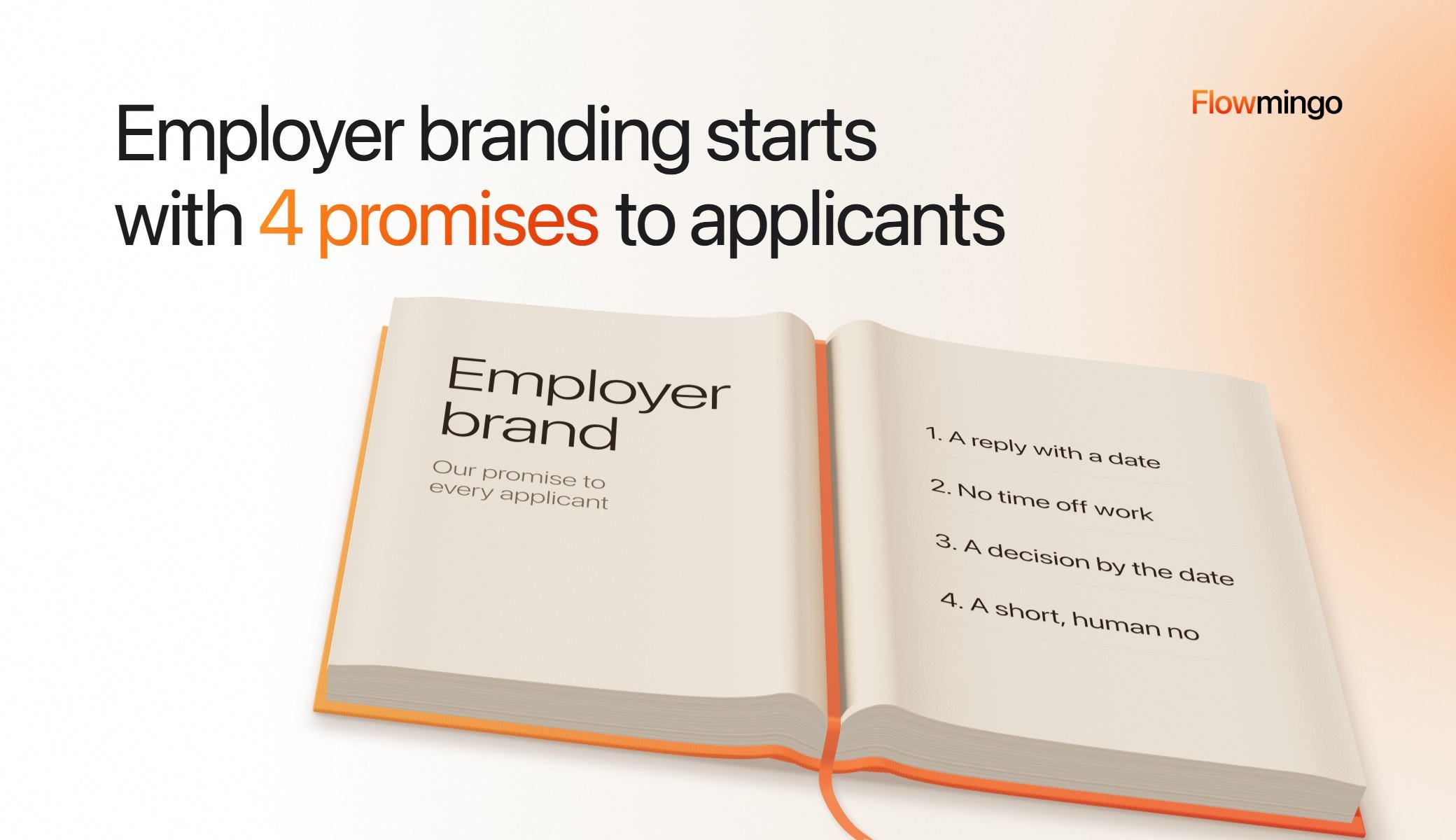
Turn that into 4 promises to every applicant, not only the strong ones.
| Moment | Promise | Our suggested standard |
|---|---|---|
| After applying | A reply with a date | Same day, with the date they will hear by |
| First interview | No time off work | Under 30 minutes, any time before a deadline |
| After any interview | A decision by the date | Next step within 3 working days, or a new date |
| Rejection | A short, human no | Within 1 week of your decision |
These standards are our suggestions. One recruiter now sends a 2-minute summary after every interview, which costs less than any campaign.
Flowmingo data · 4,866 ratings · 320 companies · 23 Jun to 10 Dec 2025
- 88.5% of candidates who rated the hiring company right after an AI interview gave it 4 or 5 out of 5.
- 78.1% to 100% was the range of 4-5 ratings across the 26 companies with 30+ ratings, so even the weakest company looked good.
The rating was optional, came only after the interview, and about 1 in 3 finishers answered, so it likely overstates satisfaction. It came before any decision, so it says nothing about rejected or ghosted candidates.
So an end-of-interview score alone cannot show your employer brand: it shows how candidates felt right then, not how rejected candidates feel later. Also ask rejected candidates the section 10 question.
4.1 Do candidates see our brand or the vendor's?
Any tool in your process is your brand to the candidate, so check 3 things before you send an invite. Look at whose name is on the link, which address the emails come from, and who the candidate contacts if something breaks.
If any answer is the vendor, candidates judge you through a company they have never heard of. For example, a broken link with no named contact reads as your silence, not the vendor's.
How Flowmingo helps
In a Flowmingo AI interview, candidates see the estimated time before they begin. The recording, transcript and report go to your team, and nobody is rejected automatically. On the Free plan, candidates see Flowmingo's brand beside yours. Your own brand on links comes with Starter, or you can sponsor a session to remove Flowmingo's brand and offers.
5. Does going silent on applicants hurt our reputation as an employer?
Yes, because the people you leave waiting tell others, stop applying and stop referring. A dated reply to every applicant is the cheapest employer branding fix you have.
Greenhouse's December 2024 report, foundational now, surveyed 2,500 workers in the US, UK and Germany. It found 61% of job seekers had been ghosted after an interview, up 9 points since April 2024. Greenhouse's 2025 US report put it at 63%, as our hiring process steps guide notes.
The cost lands on your reputation. Talent Board's foundational December 2024 report put candidate resentment at a global average of 14%, "higher than ever". In a smaller April 2026 poll by LiveCareer, 48% of 1,008 US workers would not reapply after being left unanswered.
That vendor poll was reported second-hand by Allwork.Space, so treat it as support only.
By region, EMEA sat at 17%, North America at 14%, APAC at 12% and Latin America at 11%. In North America it reached 25% in technology and 20% in finance and insurance.
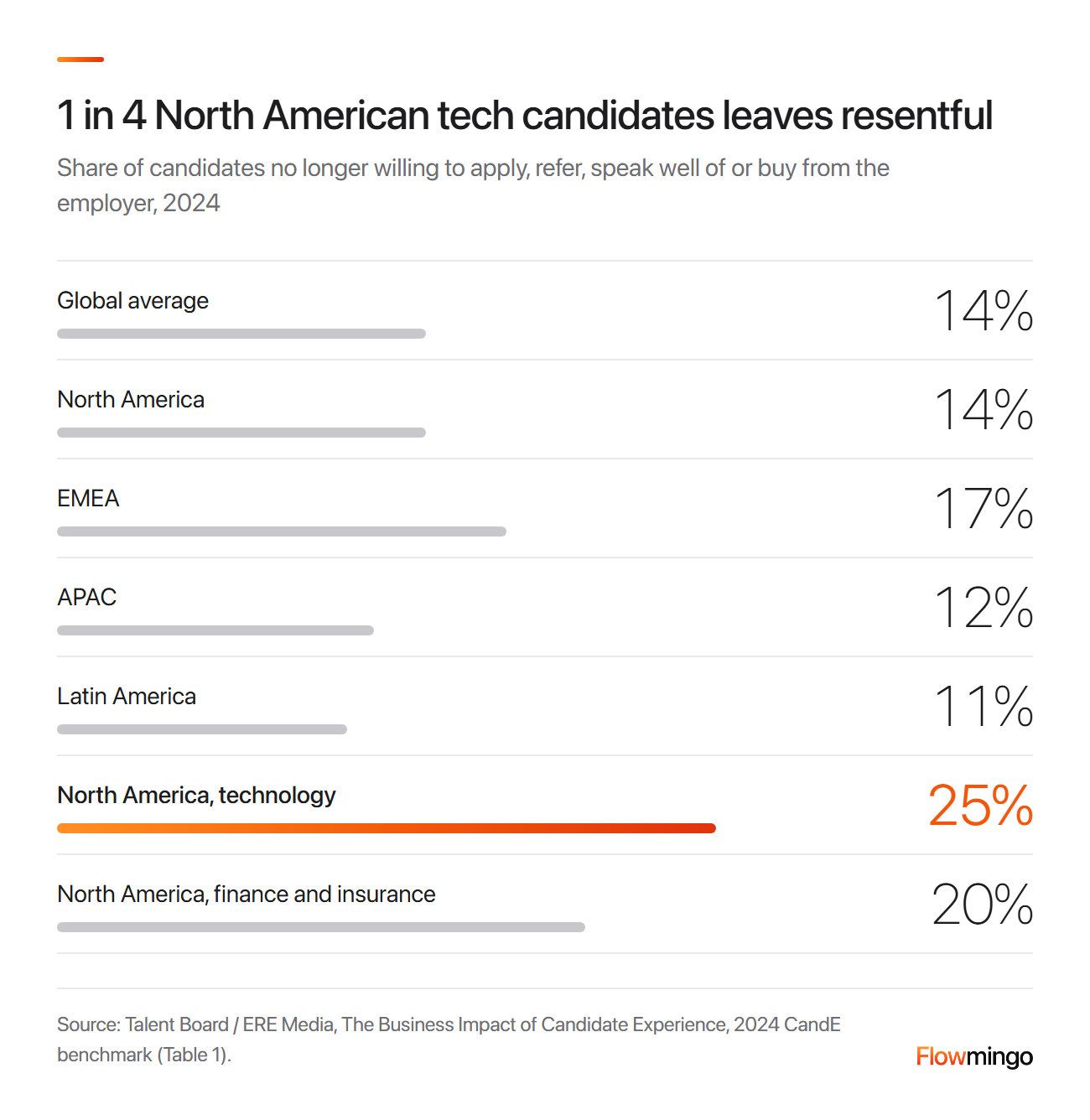
Candidate resentment by region: a 14% global average in 2024, from 11% in Latin America to 17% in EMEA, and 25% in North American technology.
The fix is 3 of the 4 promises, not a project. Give every applicant the date they will hear by, keep that date, and send a short, human no. Our candidate rejection email templates give the wording.
6. What employer brand claims do candidates not believe, and what can a job ad honestly say?
Say what is true and specific: the pay range, the hours, the hard parts and the steps of your hiring process. Cut every claim a candidate could not check, such as "we're like a family".
Candidates spot branding that tries too hard, as a recruiter who listed 17 claims candidates don't believe found.
Honesty works because it reads as honesty. A foundational 2011 meta-analysis of 52 studies found realistic job previews cut turnover mainly because the employer seemed honest (Earnest, Allen and Landis). The most effective previews may be ones given after hire, so this backs honesty in general, not a promise about ads.
This illustrative table, with made-up Singapore dollar figures, rewrites 3 doubted claims into checkable ones.
| Claim candidates doubt | Honest, checkable version |
|---|---|
| We're like a family | 9 of our 14 staff have been here 3+ years |
| Competitive salary | S$3,800 to S$4,400 a month, reviewed every April |
| Great work-life balance | 40 hours, Monday to Friday, 2 paid-overtime Saturdays a quarter |
An honest ad also has a legal floor. The EU Pay Transparency Directive, due by 7 June 2026, puts the starting pay or range in the ad or before the interview. Poland allows it up to the start date, and no employer of any size may ask past pay.
Some EU states may not have finished these rules yet, and this is not legal advice.
Sourcing adds 1 duty from GDPR Article 14, foundational EU law since 2016. Your first message to a sourced candidate must say who you are, where you got their details and their rights. It is also their first impression of you.
An honest ad attracts fewer, better-matched applicants. Our guide on how to write a job description shows how to list the must-haves.
7. How should we reply to a negative Glassdoor review about our hiring process?
Reply, and say what you will do about the problem. In 2 experiments, silence did more damage than any reply.
Yu, Goh, Soo and Yu sorted real Glassdoor replies into types, then tested them in 2 vignette experiments published in 2025. No reply meant the poorest reputation and the lowest interest in applying.
The best reply depended on the reader. Working job seekers rewarded replies that pledged improvements, while students preferred apologies and explanations (NTU Business). The scenarios were made up, so trust the direction more than the size.
The reply that backfires is the defensive one, such as a company that implied the candidate was wrong.
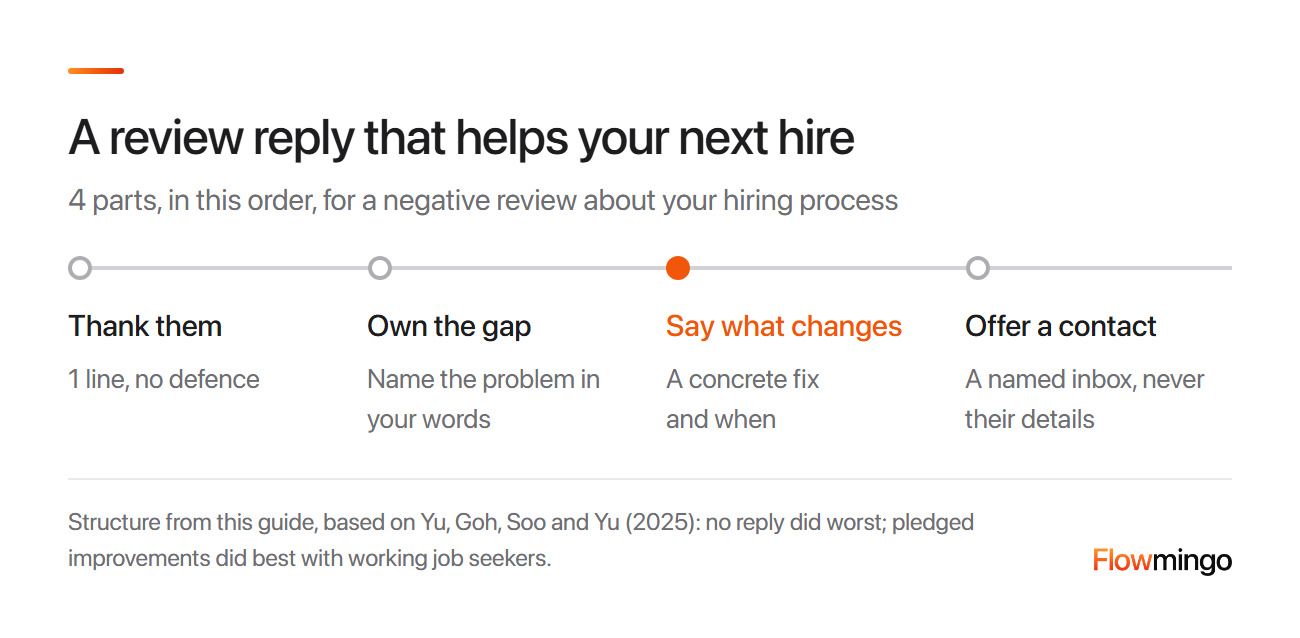
Review reply in 4 parts: thank them, own the gap, say what changes and when, then offer a named inbox.
Each part does 1 job:
- Thank them in 1 line, with no defence.
- Own the gap in your own words.
- Say what changes, and when it started.
- Offer a named inbox, never the reviewer's details.
Never name the reviewer or confirm they applied, because those details are personal data. Here is an illustrative reply about a slow, silent process:
Thank you for writing this. A 3-week wait with no news after an interview, as you describe, should not happen to anyone. Since September, every candidate gets a decision date at the interview and hears from us by then. To talk it through, write to [Name] at hiring@[yourcompany].com.
7.1 An angry ex-employee's review is costing us candidates. Can we get it removed?
Usually not, because review sites take down a post only when it breaks their own rules. Report it once under those rules, then answer it in public.
One agency owner's ex-employee rant ranked 3rd for the company name, and 2 strong candidates went quiet after a great first interview.
Never ask staff to bury the review with positive ones, because a sudden wave of praise reads as staged. Instead, reply with the same 4 parts, without naming the reviewer or confirming they worked for you.
Here is an illustrative reply to a rant about poor management:
Thank you for taking the time to write this. Feeling unsupported by a manager, as you describe, is not what we want for anyone here. Since August, every team lead holds a monthly 1-to-1 with each person, and we review exit feedback each quarter. To talk it through, write to [Name] at people@[yourcompany].com.
8. How do we raise our Glassdoor rating without faking or pressuring reviews?
Ask everyone at the same moments, never only the happy ones, and never pay or pressure anyone for a review. Then fix the thing the 1-star reviews repeat, and say in public that you fixed it.
The pressure often comes from the top. One HR lead's CEO wanted the average up from 3.8 to at least 4.0, faster than listening would allow.
Most employers do not even watch. In CIPD's 2026 survey of 1,014 UK HR professionals, 13% monitored feedback on Glassdoor and social media. Just 7% acted on that feedback.
The same report found 33% collect candidate-experience data, up from 27% in 2024. Data is growing faster than action, so acting on reviews already sets you apart.
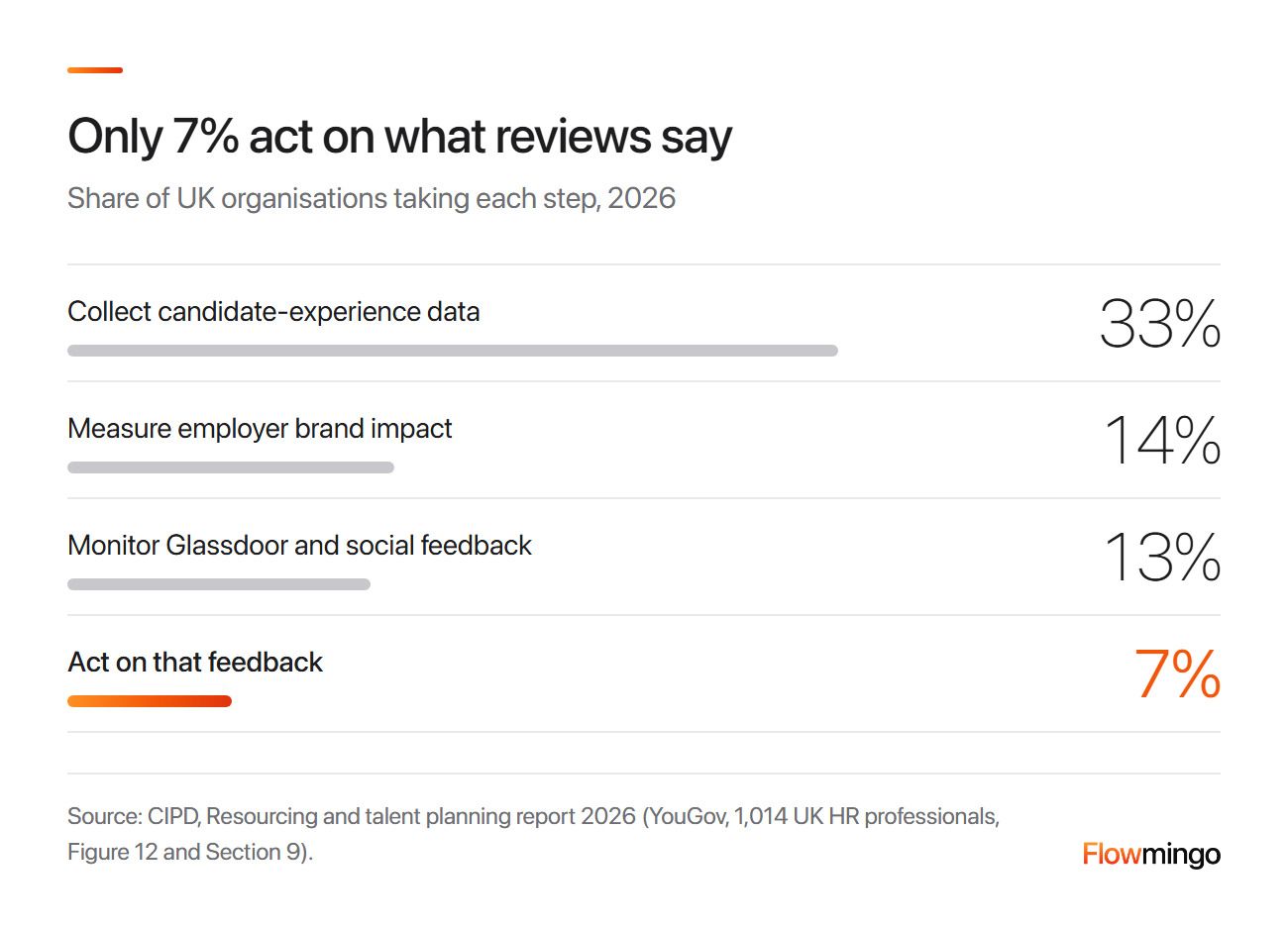
UK employer brand steps in 2026: 33% collect candidate-experience data, 14% measure impact, 13% monitor reviews and 7% act on them.
Use these 3 honest employer branding moves on review sites:
- Invite reviews at fixed moments, such as after 90 days and at exit, from everyone.
- Offer no incentives and write no drafts for staff, because that can break a review site's rules.
- Fix the most repeated complaint, then reply to old reviews saying what changed.
Awards help as a signal, as a small-firm director suggested on Reddit, but do not answer the 1-star complaint. Expect a quarter or longer to move an average (our estimate), because each review shifts it only a little. Even if 10 new reviews all gave 5 stars, 40 reviews at 3.6 would rise only to about 3.9.
9. Why are candidates turning down our offers, and is our employer brand the reason?
Maybe, but you cannot tell without asking. Log every decline in the person's own words, and count how many name your process or reputation rather than pay.
A manager spent weeks vetting candidates only to get silence or a last-minute no after the offer.
Gem's 2026 report, built on customer data from June 2021 to May 2025, put offer acceptance at 82% (Gem). It is vendor data, mostly from tech, so a rate well under 80% deserves a look at every decline.
The process plays a part. A foundational 2004 meta-analysis of 48,750 people found applicants who liked the selection process intended to accept offers and recommend the employer (Hausknecht and colleagues). This means intention, not proof that they accepted.
At the end, though, the job decides, as the 2012 stage review found. So check pay and hours before you blame your employer branding.
Give each decline 1 of 5 codes, as in this illustrative log: pay, role or hours, a faster offer, process, or reputation.
| Date | Role | Reason in their words | Code |
|---|---|---|---|
| 3 Feb | Shift lead | "Another company offered S$300 more a month" | Pay |
| 19 Feb | Bookkeeper | "Nobody told me the next step for 3 weeks" | Process |
| 2 Mar | Bookkeeper | "A friend said your reviews put her off" | Reputation |
Small numbers need care. With 10 offers a quarter, 1 decline moves your rate by 10 points. Read the reasons, not the rate, until you have about 30 offers.
10. How do I measure employer branding with offer acceptance, applicant quality and referral share?
Track 4 numbers each quarter against your own baseline: offer acceptance, applicant quality, referral share of hires and your review rating. Add a 1-question survey for rejected candidates, and skip likes and followers.
Few employers measure at all. In CIPD's 2026 report, only 14% of UK organisations measured the impact of their employer brand. Yet the term entered academic writing in a foundational 1996 paper by Ambler and Barrow, which treated the brand as something to measure.
Here is an illustrative scorecard for a business making 40 hires a year.
| Number | How to count it | Last quarter | This quarter |
|---|---|---|---|
| Offer acceptance | Offers accepted / offers made | 9 of 11 (82%) | 10 of 12 (83%) |
| Applicant quality | Share meeting every must-have | 18% | 26% |
| Referral share | Referred hires / all hires | 1 of 9 | 2 of 10 |
| Review rating | Average, and share answered | 3.6, 0% | 3.7, 100% |
| Would apply again | Yes answers from rejected candidates | Not asked | 7 of 12 |
Track applicant quality beside volume, because an honest ad should lower volume and raise quality. Wait for enough data before reading any row, such as 30 offers or 20 reviews.
Referral share shows whether people would vouch for you. Talent Board found willingness to refer was 78% at its 2024 award winners in North America, against 67% for all employers there. In EMEA it fell from 77% in 2023 to 58% in 2024 for all employers.
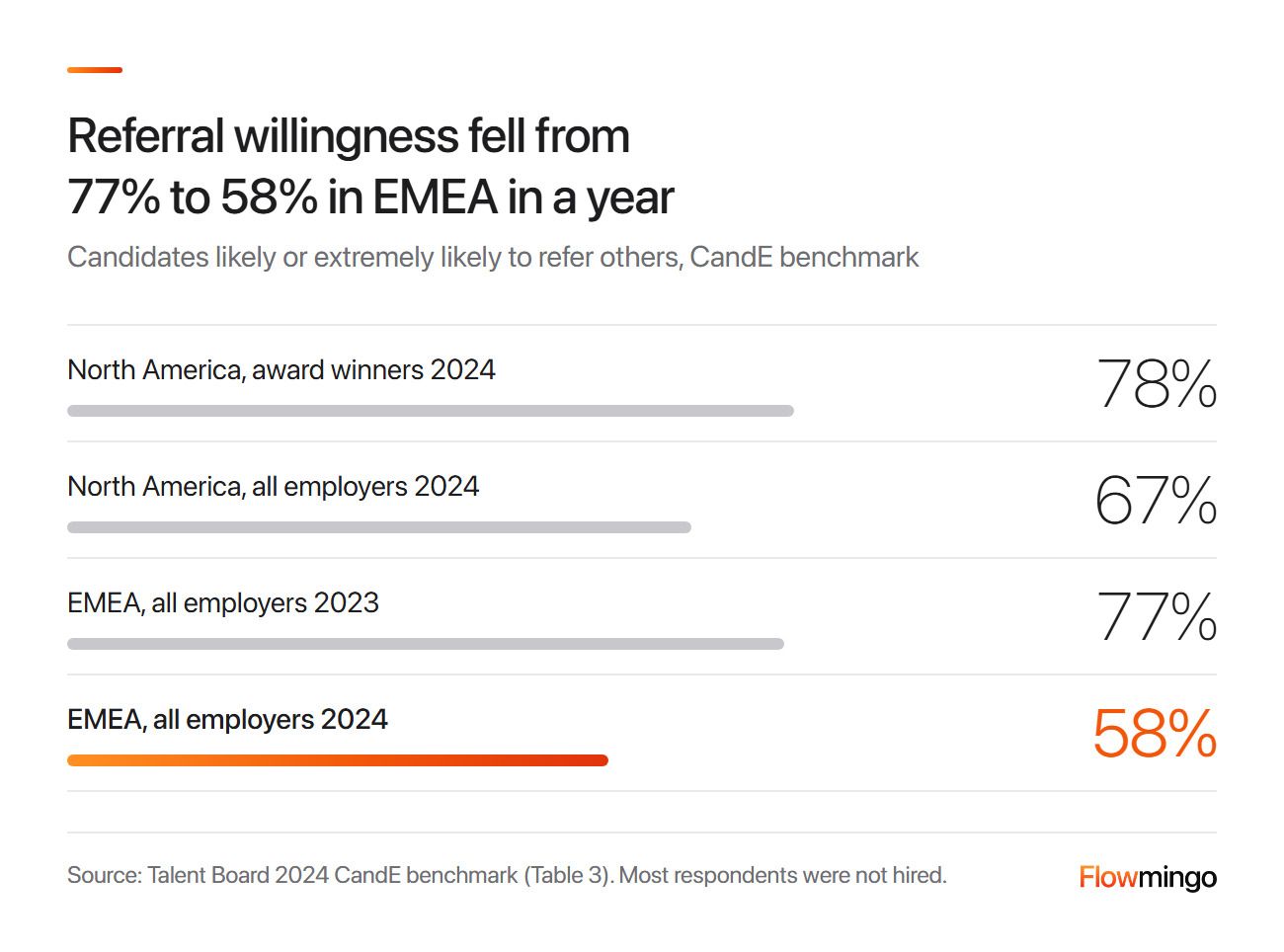
Willingness to refer: 78% at North American award winners against 67% for all employers in 2024, and 77% to 58% in EMEA.
Gem's 2026 report adds a reason to track it: referred candidates converted to hires at 11 times the rate of inbound applicants.
10.1 How do I get employees to refer people without a budget?
Ask for a specific person for a specific role, and tell referrers what happened within a week. Money alone may not fix it.
At 4 SaaS companies, bonuses of $2,000 to $10,000 went unused. A low referral share is a signal that staff would not yet recommend you, so fix the reasons first.
Tag the source of every hire on the application form, as our guide to recruiting metrics explains. Without it, every number above is guesswork.
How Flowmingo helps
Every Flowmingo AI interview returns a recording, a transcript and a report scored against your written criteria. That lets you count applicant quality the same way for every applicant. To give every applicant a first interview in their own time, try Flowmingo for your employer branding.
11. Sources
Every study, law and survey in this guide links to a source below; Flowmingo figures come from Flowmingo's own platform data.
- Allwork.Space (2026, July). 48% of workers say they wouldn't apply to a company again after being ghosted. Allwork.Space.
- Ambler, T., & Barrow, S. (1996). The employer brand. Journal of Brand Management, 4(3), 185-206.
- Cable, D. M., & Turban, D. B. (2003). The value of organizational reputation in the recruitment context: A brand-equity perspective. Journal of Applied Social Psychology, 33(11), 2244-2266.
- CIPD (2026). Resourcing and talent planning report 2026. Chartered Institute of Personnel and Development.
- Earnest, D. R., Allen, D. G., & Landis, R. S. (2011). Mechanisms linking realistic job previews with turnover: A meta-analytic path analysis. Personnel Psychology, 64(4), 865-897.
- European Parliament and Council (2016). Regulation (EU) 2016/679, General Data Protection Regulation, Article 14. gdpr-info.eu.
- Gem (2025, December 1). Key takeaways from the 2026 Recruiting Benchmarks Report. Gem.
- Greenhouse (2025). Greenhouse 2025 workforce and hiring report. Greenhouse.
- Greenhouse (2024). Ghosting, ghost jobs and bots: Greenhouse 2024 State of Job Hunting report. Greenhouse.
- Hausknecht, J. P., Day, D. V., & Thomas, S. C. (2004). Applicant reactions to selection procedures: An updated model and meta-analysis. Personnel Psychology, 57(3), 639-683.
- Littler (2025, December 17). Polish employers receive a 'gift': EU pay transparency obligations in recruitment. Littler.
- Ma, K., Sheng, S. Y., & Xie, H. (2023). Employer reputation and the labor market: Evidence from Glassdoor.com and Dice.com. arXiv:2305.02587v1, withdrawn.
- Nanyang Business School (2025). Managing online reviews: How employers can turn criticism into a talent advantage. NTU Singapore.
- Survale (2026, July 21). 2025 candidate experience (CandE) benchmark research: Key statistics. Survale.
- Talent Board & ERE Media (2024, December). The business impact of candidate experience: 2024 CandE benchmark research. ERE Media.
- Turban, D. B., & Cable, D. M. (2003). Firm reputation and applicant pool characteristics. Journal of Organizational Behavior, 24(6), 733-751.
- Uggerslev, K. L., Fassina, N. E., & Kraichy, D. (2012). Recruiting through the stages: A meta-analytic test of predictors of applicant attraction at different stages of the recruiting process. Personnel Psychology, 65(3), 597-660.
- Yu, K. Y. T., Goh, K. H., Soo, C. W. L., & Yu, S. (2025). Managing online employer reviews: An impression management perspective for talent recruitment. Journal of Applied Psychology, 110(11), 1538-1560.