
You have 1 role to fill, no job-board budget and a list of free job posting sites that predates Indeed's cap. In the US, UK and 10 other countries, Indeed now allows 3 free posts a month per company. So that list sends you to boards that charge, pause or bury your ad.
The lists are the problem, not you. Most free job posting sites for employers now carry an asterisk: LinkedIn pauses a free post after 14 days or 10 to 30 applications. ZipRecruiter, Workable and Recooty are trials of paid tools.
Get it wrong and you hear nothing, or you drown. Small businesses averaged 180 applicants per hire in 2024 and invited only 3% to interview (CareerPlug).
This guide on where to post jobs checks every free tier against the board's own page on 6 Oct 2026. Then it shows how to write the ad, tag each board and screen the pile in an afternoon.
Key takeaways
- Which job sites are still free for employers? Indeed (3 posts a month in the US, UK and 10 more countries), LinkedIn (1 at a time), Google via your careers page, Handshake Basic, PostJobFree and government boards.
- Is ZipRecruiter free? No, its own page offers a trial that becomes a paid plan. Workable and Recooty give 15 days, then charge from $299 and $79 a month, billed annually.
- Why does a free post go quiet? Free posts sink fast, and LinkedIn pauses one after 14 days or 10 to 30 applications. Show the pay: Indeed reports 3.8 times more applications when employers do.
- How do I know which board works? Give each board a tagged apply link and count hires. Across 60,000+ small businesses, job boards brought 61% of applicants but 42% of hires.
- How do I handle the flood? Set 2 or 3 Yes/No knock-outs before you post, score every CV the same way, then interview the top band. Small businesses interview about 3 in 100 (CareerPlug).
1. Which free job posting sites are actually still free for employers in 2026?
8 places are still free to post in 2026: Indeed, LinkedIn, Google's job results, Handshake, PostJobFree and 3 government boards. Each has a cap, so check the table below before you post.
Lists of free job posting sites for employers disagree, because free tiers change and few say when anyone checked. The table links each board's own page, read on 6 Oct 2026, so you can recheck it.
Read the table as 3 groups. Indeed and LinkedIn are free with a cap on posts and days, while Google and the government boards list no fee at all.
The third group is niche. For example, Handshake's Basic plan costs $0 and reaches students, and PostJobFree stays free by selling ads and recruiter subscriptions.
4 well-known names are not free. Craigslist charges $10 to $75 per job ad in the US and parts of Canada, and section 4 covers the 3 trials.
| Board | What free gets you | The catch | Own page |
|---|---|---|---|
| Indeed | 3 posts a month per company, 30 days each (12 countries incl. US, UK, Canada) | Sinks fast; agencies may need to sponsor | Help Centre |
| 1 active post, up to 14 days | Pauses at day 14 or 10 to 30 applications | Help page | |
| Google job results | Listing from code on your careers page | Remove it when filled | Search Central |
| Handshake | Basic plan at $0 | 10 messages a month | Pricing |
| PostJobFree | Free, renew every 30 days | Earns from recruiters and ads | FAQ |
| MyCareersFuture (Singapore) | Free, 30 days per post | 14 days before most pass applications | MOM |
| Find a job (UK) | Free | England, Scotland and Wales | GOV.UK |
| US state job banks | Free in every state | Registration varies by state | CareerOneStop |
| Craigslist | $10 to $75 per job ad | Varies by area | Fees page |
| ZipRecruiter | A trial | Then a paid plan | Post-a-job page |
| Workable | 15-day trial | Then from $299 a month, billed annually | Pricing |
| Recooty | 15-day trial | Then from $79 a month | Pricing |
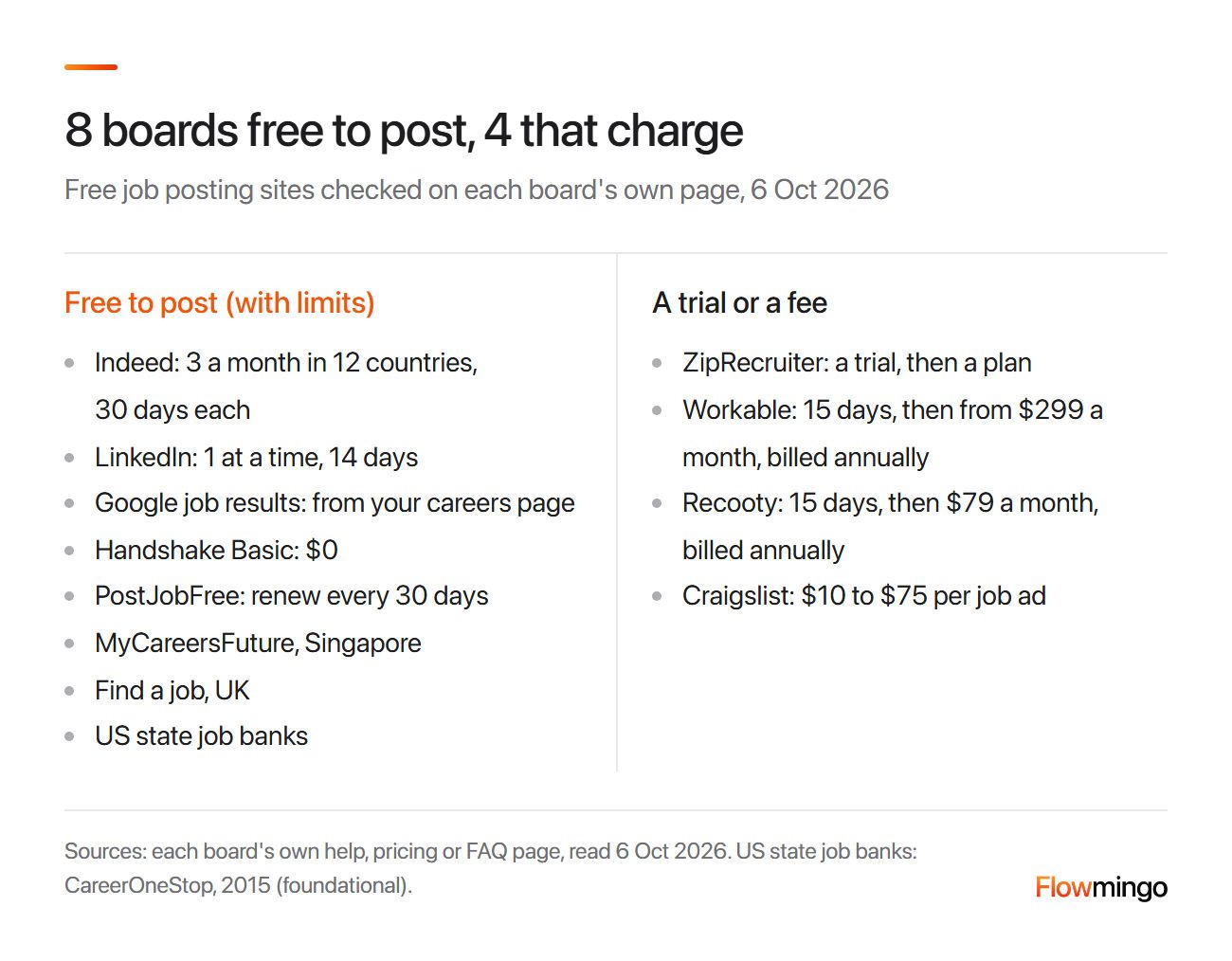
Free or trial: 8 boards are free to post with limits, including Indeed (3 a month) and LinkedIn (1 at a time). ZipRecruiter, Workable, Recooty and Craigslist charge or run trials.
The figure puts the 8 free boards on the left and the 4 that charge on the right. Sections 2 and 3 cover Indeed and LinkedIn, because their caps catch people out.
2. Is Indeed still free for employers, and how many jobs can I post free?
Yes, with a cap: up to 3 free jobs per calendar month per company, each visible for up to 30 days. After that, only a Sponsored Job keeps the role in search.
Indeed's own help centre sets the rule for 12 countries, including the US, Canada and the UK. The count resets on the 1st, and all locations under 1 parent company share it.
In practice, a 2-branch company still gets 3 free posts, not 6. In 22 other countries a free post lasts up to 120 days, and Singapore is on neither list, so check your country's page.
Free posts also sink. Indeed's free vs sponsored guide, updated 8 April 2026, says "15 jobs are added per second". You also can't reopen last month's closed job for free.
Agencies, read the small print. Indeed may require sponsorship for commission-only or hard-to-fill roles, and for jobs posted by recruitment firms and temp agencies.
Indeed says Sponsored Jobs get 60% more applicants and 3.1 times more impressions, its own claim with no published method. Our suggestion: spend the free slots on easy roles, because a hard role may need sponsoring anyway.
3. How many free LinkedIn job posts do I get, and why did mine pause?
You get 1 free LinkedIn job post active at a time. It pauses after 14 days, or sooner if it reaches LinkedIn's application limit, usually 10 to 30 applications.
LinkedIn Help allows "up to one free job post active at a time" and a limited number within 30 days. Unpromoted jobs close after 30 days, and the post must link to your company Page.
Your post paused for 1 of 2 reasons: it reached day 14, or it hit the application limit, which LinkedIn sets per role. Either way, to restart it you have to promote it, and promotion costs money.
This means the free post suits 1 urgent role, not a pipeline. Put the pay and 2 or 3 must-haves in the post, so the first 30 applicants are the right 30.
Plan the 14 days too, because the clock starts at once. For example, post a bookkeeper role on Monday, screen on Tuesday and Thursday, and book interviews in week 2.
Waiting a week to read applications wastes half the window, and good candidates take other offers meanwhile.
4. Which free job posting sites are really free trials that turn into a bill?
ZipRecruiter, Workable and Recooty advertise free posting, but each is a trial of a paid tool.
This matters because a trial ends on the vendor's schedule, not yours. If the role is still open on day 16, you pay or start again elsewhere.
Workable archives the job and takes it off job sites after 15 days unless you upgrade. Its pricing starts at $299 a month, billed annually.
Recooty's pricing shows a 15-day trial, then $79 a month, billed annually.
If the pricing page shows a trial length or asks for a card, you're looking at a trial.
4.1 Is ZipRecruiter free for employers?
No. ZipRecruiter's own post-a-job page offers new employers a trial that sends the job to "100+ job sites". After it, you "continue with your selected plan or cancel anytime".
The page gives no trial length, so set a calendar reminder on day 1 to cancel or decide.
4.2 Can I post 1 job to several free sites at once?
Mostly not. Every "post once, go everywhere" offer on page 1 of Google is a paid tool's trial, except PostJobFree, which earns from recruiters and ads (PostJobFree FAQ).
Otherwise, post by hand to 3 or 4 boards with 1 tagged link each, as section 9 explains.
5. Can I get my job onto Google for free from my own careers page?
Yes. Add JobPosting code to the job's page on your site, and Google can show it in its job results with no fee listed.
This route works because Google reads your page, not a board's. You add a short block of code, called JobPosting, to each job page.
For example, a bakery with a simple careers page can list each opening there, and each can appear when people search Google for local jobs.
Google Search Central requires 5 fields: datePosted, description, hiringOrganization, jobLocation and title. A fully remote job also needs jobLocationType and applicantLocationRequirements. The example below fills in a line cook role.
| Field | Required | Example value (replace every value) |
|---|---|---|
| title | Yes | Line Cook |
| description | Yes | Duties, must-haves, pay and how to apply |
| datePosted | Yes | 2026-10-09 |
| hiringOrganization | Yes | Your company name and website |
| jobLocation | Yes | Street, city, region, postcode, country |
| validThrough | Worth adding | 2026-11-08, your closing date |
| employmentType | Worth adding | FULL_TIME |
| baseSalary | Worth adding | USD 18 to 22 per HOUR |
| jobLocationType | Only if fully remote | TELECOMMUTE |
| applicantLocationRequirements | Only if fully remote | The country or state applicants must live in |
Google's title rule is strict: no job codes, addresses, dates, salaries or company names. For example, "Line Cook" passes, but "Line Cook #4471, $20/hr, Austin" fails 3 times.
Most lists also skip the removal rule. When you fill the role, set a past validThrough date, return a 404 or 410 page, or remove the code. Otherwise Google "may" take manual action.
Google recommends its Indexing API over sitemaps, so it crawls the page sooner. Test the page in its Rich Results Test before sharing the link.
How Flowmingo helps
No careers page or no developer: a Flowmingo job post with Boost goes out after an AI check. It reaches Google for Jobs, Jooble, Careerjet, Adzuna and the Flowmingo network. Reach varies by board and role, on a best-effort basis. LinkedIn is a manual step: you copy the post and mark it as posted. Job posts with free boosting are on the Free plan, at $0.
6. Which free job posting sites work for local hourly roles and graduate hires?
For local hourly roles, use your state job bank in the US and local or niche boards, and count Craigslist as paid. For interns and graduates, Handshake's Basic plan is free.
Local roles need local reach, because few people commute an hour for a shift. For example, a restaurant hiring a line cook should post where nearby people look: the state job bank, a local community board, the nearby college.
In the US, CareerOneStop said in a foundational 2015 post that employers "can post jobs free to their own state job bank". Registration varies, so check your state's site.
Niche boards earn their place among free job posting sites, because they reach people in the trade. In CareerPlug's 2025 report, applicants from these "custom sources" were 14 times as likely as job-board applicants to land the job. CareerPlug's custom sources are local, niche, industry or university boards an employer shares by hand.
6.1 How much does Craigslist charge to post a job?
Craigslist charges $10 to $75 per job ad in the US and parts of Canada, varying by area. Its posting fees page gives no city list, so check your city's page before you budget.
6.2 Is Handshake free for employers hiring students?
Yes. Handshake's Basic plan costs $0, lets you "Post jobs for free" and includes 10 messages a month (Handshake pricing).
Watch graduate ad wording, though. US rule 29 CFR 1625.4, in foundational 2007 text, names "young", "college student" and "recent college graduate" as terms that can break age law. Our advice: write "entry-level" instead.
7. Where can I post a job free in Singapore or the UK, and when must I?
In Singapore, post on MyCareersFuture, which MOM says "is free of charge". In Great Britain, use the government's Find a job service.
Each MyCareersFuture post lasts up to 30 days, and you can add up to 3 Yes/No screening questions you can't edit after publishing (MyCareersFuture FAQ).
Posting there is compulsory before most Employment Pass and S Pass applications. The ad must stay open at least 14 consecutive days, with no offer in that window (MOM).
Firms with fewer than 10 employees are exempt. So are roles paying a fixed S$22,500 a month or more, roles of 1 month or less and internal transfers.
The ad must show a salary range whose top is at most 2 times the bottom, for example S$4,500 to S$9,000. TAFEP also lists wording to drop, such as "Below 30 only" and "Preferably female".
That matters because Singapore's Workplace Fairness Act, expected by end-2027, will ban ads naming such traits as a requirement or advantage (TAFEP).
In the UK, Find a job is "one of the largest free job search sites in the UK", says the government. The Department for Work and Pensions runs it for England, Scotland and Wales.
8. My free job post gets no applicants. How do I write it so it gets seen?
Most free posts fail because nobody finds them, or nothing in them makes the right person apply. Share the link everywhere, show the pay, and keep the must-haves to 3.
The card below sorts posts on our platform by where they were visible.
Flowmingo data · 4,510 job posts · published 15 Jun to 31 Aug 2026 and still active on 6 Oct 2026 · applicants in the first 30 days
- 94.7% of 3,705 job posts left as a link only got 0 applicants through the post.
- 23.4% of 629 posts the recruiter sent out to job boards got 0 applicants, and the median post got 3.
- 18.2% of 176 posts shown on a company careers page got 0 applicants, with a median of 4.
The setting is read as it is today, and recruiters who share a post may also promote it harder, so this shows an association, not proof. "Applicants" means people who applied through the post's form.
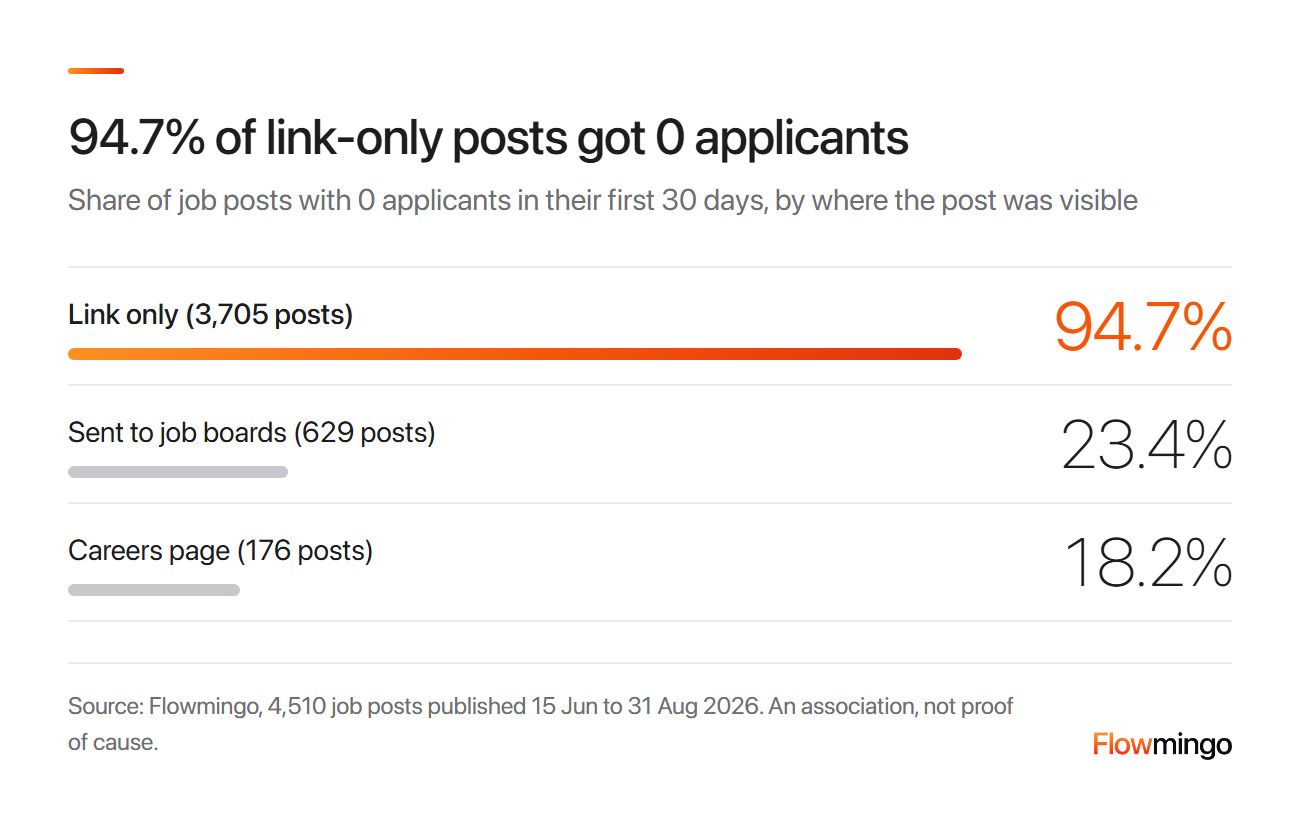
Zero-applicant posts: 94.7% of 3,705 link-only posts got 0 applicants in 30 days. It was 23.4% of 629 posts sent to job boards and 18.2% of 176 careers page posts.
The top bar is the trap: 19 in 20 link-only posts got nobody. About 1 in 4 sent to boards and 1 in 5 on careers pages got nobody. The samples differ, so don't rank 23.4% against 18.2%, just get the post in front of job seekers.
Then give the right person a reason to apply. Indeed's Hiring Lab found 59% of US postings showed pay in May 2025, and jobs with employer-provided pay got 3.8 times more applications (Indeed).
Showing pay doesn't seem to shrink hiring. An NBER working paper on US state pay-posting laws found disclosure rose 30 percentage points and wages 1.3% to 3.6%, with no effect on employment.
In the EU, the foundational 2023 Pay Transparency Directive requires that applicants get the pay or its range before the interview. National laws vary, and several countries missed the June 2026 deadline.
Wording matters less than pay. A foundational 2023 study of about 300,000 postings found gender-coded word swaps had "negligible practical effects" (MIT Sloan). So fix the title, pay and must-haves first, with this template from our job description guide:
| Line | What to write (template, not customer data) |
|---|---|
| Job title | Plain title, no codes, salary or company name: [Line Cook] |
| Pay | [min] to [max] per [hour or month]; in Singapore, max at most 2 times min |
| Location and hours | [Area, city], [days and shift times] |
| What you'll do | 5 to 7 responsibilities, 1 line each |
| Must-haves | 3 only: [licence], [skill], [availability] |
| Knock-out questions | 2 or 3 Yes/No questions, each with a job reason |
| How to apply | Your tagged apply link for this board |
| Closing date | [date], also your validThrough date |
Indeed's free posts stop after 30 days, and PostJobFree needs renewing every 30. Put both renewal dates in your calendar on the day you post. Most lists of free job posting sites never mention that a free post quietly expires.
9. How do I track which free job posting sites actually brought me the hire?
Give each board its own apply link with a tag, such as utm_source=indeed, and count hires per board, not clicks. Drop a board after 2 roles with no interview from it.
Volume misleads. In CareerPlug's 2025 report on 60,000+ small businesses, job boards brought 61% of applicants but 42% of hires.
Careers pages brought 13% of applicants and 26% of hires, and referrals 2% and 11%. That report's "job boards" mixes free and paid boards.
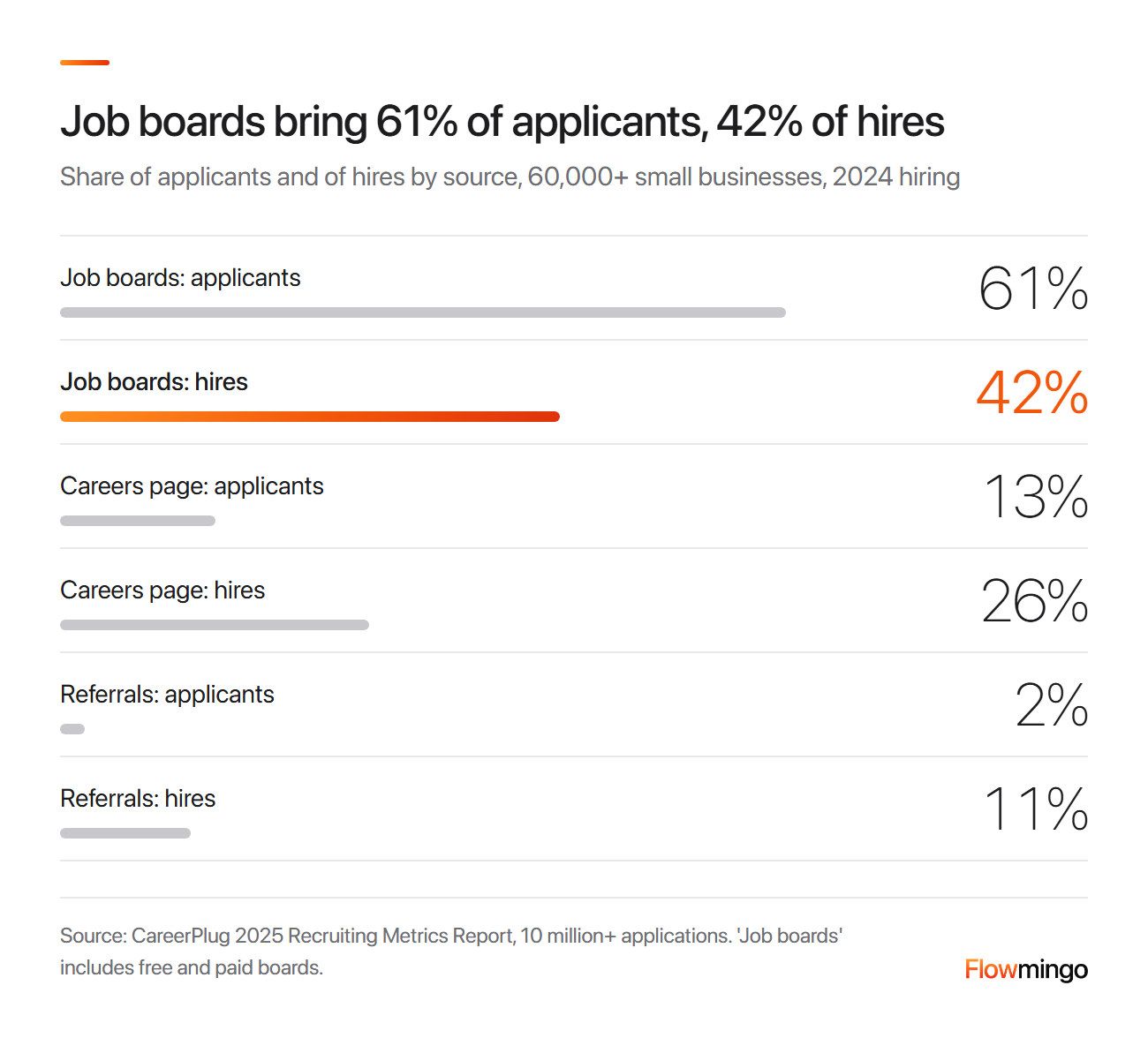
Volume vs hires: job boards brought 61% of applicants but 42% of hires. Careers pages brought 13% and 26%, referrals 2% and 11% (CareerPlug, 2024 hiring).
Where a board has its own apply form, add 1 required question: "Where did you see this job".
Then keep a sheet like this illustrative one, not customer data. The 2-role rule is our suggestion, not research.
| Board | Tag | Applicants | Passed knock-outs | Interviewed | Hired | Keep |
|---|---|---|---|---|---|---|
| Indeed | utm_source=indeed | 60 | 22 | 3 | 1 | Keep |
| utm_source=linkedin | 25 | 12 | 2 | 0 | Keep: 2 interviews | |
| State job bank | utm_source=statebank | 8 | 5 | 1 | 1 | Keep |
| PostJobFree | utm_source=postjobfree | 2 | 0 | 0 | 0 | Drop if role 2 brings 0 interviews |
Referrals cost nothing. In the foundational 2008 book Who, 77% of leaders the authors interviewed named referrals their best source (book summary).
Free boards save the fee, not the screening time, so count that time too. Our recruiting metrics guide shows how.
The card below shows how applicants reached job posts on our platform.
Flowmingo data · 885 job-post applications · 464 with a recorded source · 117 companies · 2 to 6 Oct 2026
- 30.4% of applicants with a recorded source came from Google, the top source.
- 20.7% of applicants with a recorded source came from LinkedIn.
- 15.3% came through a link in an email, and 14.2% from other websites.
- 12.9% came from job boards, and 3.0% from paid ads.
- 47.6% of all 885 applicants arrived with no source we could record.
About 4 days of data, so directional only. "Google" means a visit from google.com and may include Google's job listings.
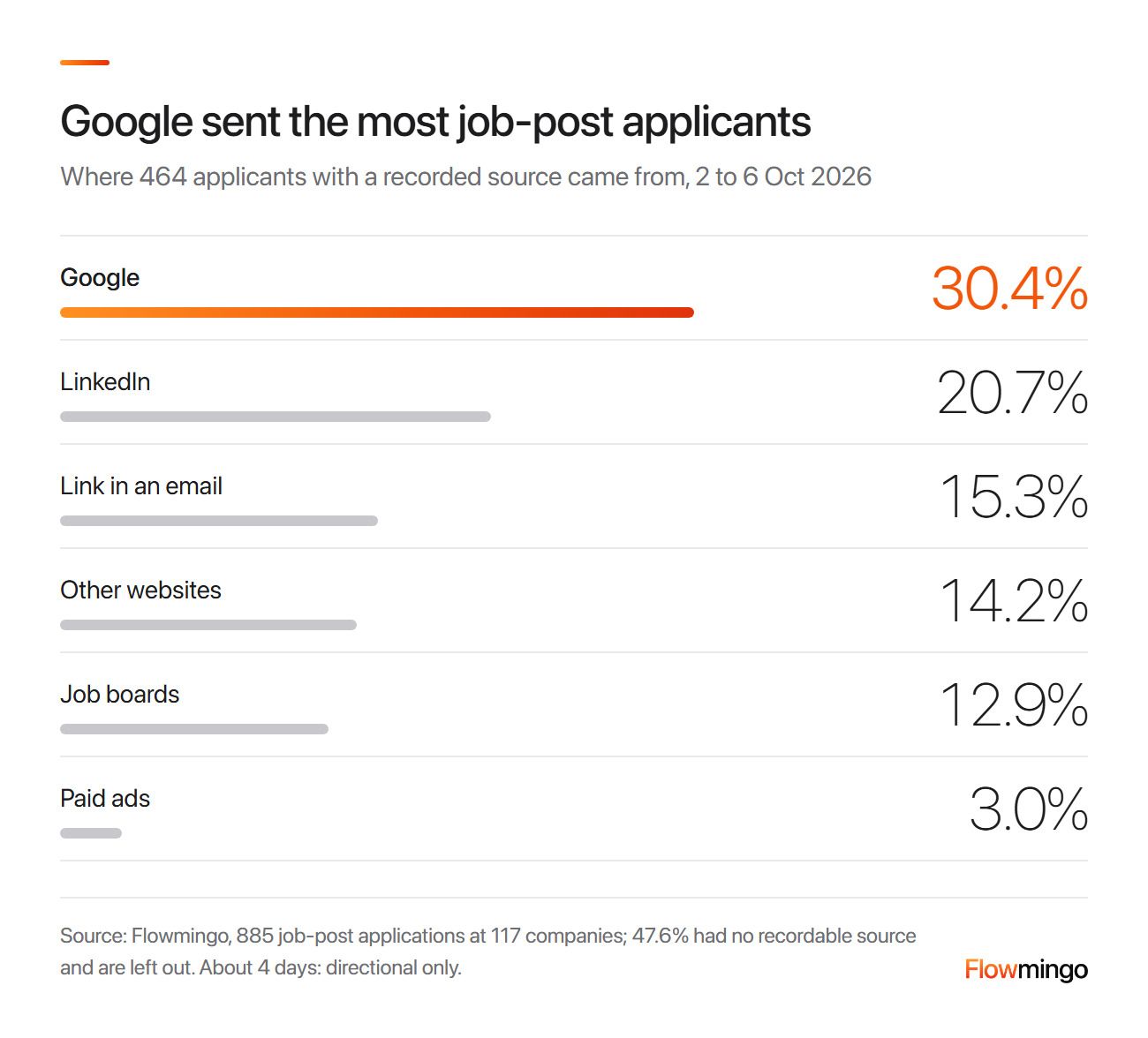
Applicant sources: of 464 applicants with a recorded source, 30.4% came from Google and 20.7% from LinkedIn. Email links brought 15.3%, other websites 14.2%, job boards 12.9% and paid ads 3.0%.
The shares are of the 464 applicants we could trace, about half of the 885. Google sitting on top is 1 more reason to try section 5, because Google can only list a job it can read.
10. My free post brought hundreds of applicants. How do I screen them fast?
Screen in 3 passes: Yes/No knock-outs set before you post, the same criteria for every CV, then a short interview for the top band.
In CareerPlug's 2025 report, small businesses averaged 180 applicants per hire, up from 93. That counts every source, not 1 free post, but it shows why arrival order fails.
Pass 1 puts Yes/No knock-outs in the apply form. Pick 2 or 3 from these 5, each with its job reason, and never the last row:
| Question (Yes/No) | Job reason |
|---|---|
| Can you work weekend shifts? | The rota needs it |
| Do you hold a valid food-hygiene certificate? | Where your licence or local law requires it |
| Can you start within 4 weeks? | The opening date |
| Can you travel to [site] daily? | The role is on site |
| Do you have the right to work in [country]? | You must be able to employ them legally; ask only where lawful |
| Do not ask: age or date of birth | US age rules scrutinise it closely (29 CFR 1625.4) and TAFEP bars age limits in ads, so leave it out |
Pass 2 scores every CV on the same 4 to 6 weighted criteria. Sort, don't auto-reject, because a formula can miss an unusual CV, as our candidate shortlisting guide shows.
Pass 3 sends 1 short interview to the top band, answered in the applicant's own time. Then read the top slice and the band below it by hand, framed by pre-screening interview questions.
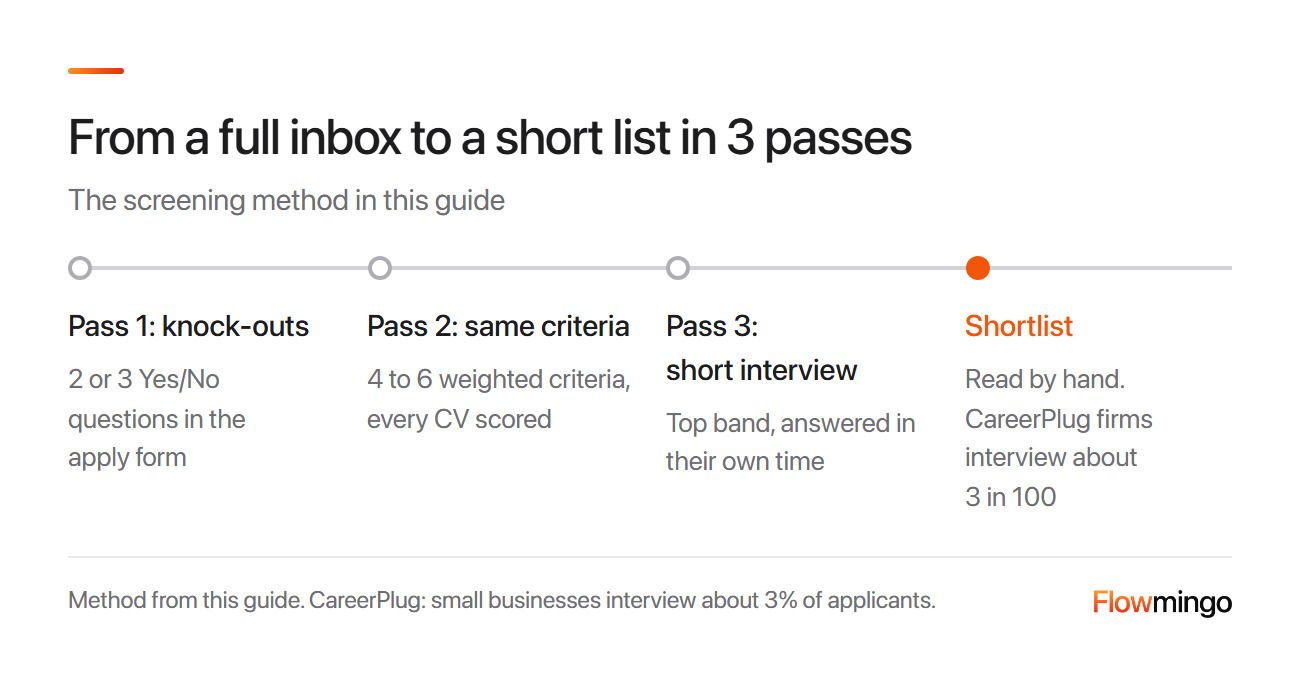
Flood to shortlist: 2 or 3 Yes/No knock-outs, then 4 to 6 weighted criteria for every CV. A short interview goes to the top band, and CareerPlug's small businesses interviewed about 3 in 100 applicants.
Read the figure left to right. Each pass costs less effort than the next, so only the top band reaches the interview. CareerPlug's small businesses interviewed about 3 in 100 applicants.
If AI screens for you, the foundational 2024 EU AI Act classes AI that filters applications as high-risk. Its hiring duties now start on 2 December 2027 (EUR-Lex, Regulation 2026/1744).
New York City's foundational Local Law 144, enforced since July 2023, requires a yearly independent check for bias and 10 business days' notice.
The card below shows how applicants to public job posts on our platform handled that interview, a colder group than people invited by hand.
Flowmingo data · 9,160 single-job applicants · 341 companies · applications 1 Jul to 21 Sep 2026
- 31.3% of applicants to a job post with an AI interview attached started that interview within 14 days.
- 24.1% of those applicants finished it within 14 days, which is 77.0% of the people who started.
- 8.5% of bulk applicants, who applied to several jobs at once, finished the interview (1,890 applicants at 97 companies).
Only posts where the recruiter attached an AI interview. It shows completion, not whether those who stopped were weaker candidates.
How Flowmingo helps
If a free post brought hundreds of CVs, upload them or send 1 link. CV Evaluation then scores each out of 10 against your criteria, writes out the evidence and filters nobody out. Put 1 AI interviewer link on your post or turn on auto-invites, and each applicant answers on camera in their own time. You get a score, a written evaluation, the recording and the transcript, and who moves forward is always your call. AI interviews and CV Evaluation are unlimited on the Free plan, which is a plan, not a trial. Free keeps your latest 300 videos for 30 days. Screen the pile from any of the free job posting sites above with Flowmingo.
11. Sources
Every board rule below was read on the board's own page on 6 October 2026. Flowmingo figures come from Flowmingo's own platform data.
- Arnold, D., Quach, S., & Taska, B. (2025). The impact of pay transparency in job postings on the labor market (NBER Working Paper No. 34480). National Bureau of Economic Research.
- CareerOneStop. (2015, August 6). Post open positions on your state's job bank (foundational). U.S. Department of Labor.
- CareerPlug. (2025). 2025 recruiting metrics report. CareerPlug.
- Castilla, E. J., & Rho, H. J. (2023). The gendering of job postings in the online recruitment process (foundational). Management Science, 69(11), 6912-6939.
- craigslist. (n.d.). Posting fees. Retrieved October 6, 2026.
- Department for Work and Pensions. (n.d.). Advertise your vacancies. GOV.UK. Retrieved October 6, 2026.
- European Parliament & Council of the European Union. (2023). Directive (EU) 2023/970 on pay transparency (foundational). Official Journal of the European Union.
- European Parliament & Council of the European Union. (2024). Regulation (EU) 2024/1689, the Artificial Intelligence Act (foundational). Official Journal of the European Union.
- Google. (n.d.). Job posting (JobPosting) structured data. Google Search Central. Retrieved October 6, 2026.
- Handshake. (n.d.). Pricing for employers. Retrieved October 6, 2026.
- Indeed. (n.d.). Free job post limit. Indeed Help Centre. Retrieved October 6, 2026.
- Indeed. (2025, July 2). Pay transparency across high-earning sectors [Press release]. Indeed.
- Indeed Employer Content Team. (2026, April 8). Free vs sponsored jobs on Indeed. Indeed UK.
- LinkedIn. (n.d.). Post a free job on LinkedIn. LinkedIn Help. Retrieved October 6, 2026.
- Ministry of Manpower. (n.d.). Do I have to pay a fee to advertise on the MyCareersFuture job portal. ask.gov.sg. Retrieved October 6, 2026.
- Ministry of Manpower. (n.d.). Employment Pass: Consider all candidates fairly. Retrieved October 6, 2026.
- MyCareersFuture. (n.d.). MyCareersFuture user FAQs [PDF]. Workforce Singapore. Retrieved October 6, 2026.
- European Union (2026). Regulation (EU) 2026/1744 amending Regulation (EU) 2024/1689 (Digital Omnibus on AI). Official Journal of the European Union.
- New York City Department of Consumer and Worker Protection. (n.d.). Automated employment decision tools. Retrieved October 6, 2026.
- PostJobFree. (n.d.). Frequently asked questions. Retrieved October 6, 2026.
- Recooty. (n.d.). Pricing. Retrieved October 6, 2026.
- Smart, G., & Street, R. (2008). Who: The A method for hiring (foundational). Ballantine Books.
- Welcome to the Jungle. (n.d.). Who: The A method for hiring, by Geoff Smart and Randy Street. Retrieved October 6, 2026.
- TAFEP. (n.d.). Writing job advertisements. Tripartite Alliance. Retrieved October 6, 2026.
- TAFEP. (2026). Fair recruitment practices for employers in Singapore: Preparing for the Workplace Fairness Act. Tripartite Alliance.
- U.S. Equal Employment Opportunity Commission. (2007). 29 CFR § 1625.4: Help wanted notices or advertisements (foundational). Legal Information Institute.
- Workable. (n.d.). Post a job for free for 15 days. Retrieved October 6, 2026.
- Workable. (n.d.). Pricing. Retrieved October 6, 2026.
- ZipRecruiter. (2026). Post jobs for free on ZipRecruiter [Archived web page]. Wayback Machine.