
Job analysis is the systematic study of a job to find its main tasks and the skills, knowledge and abilities needed to do them well. Its findings feed the job description, the job specification and the interview questions.
You need one when a hiring manager hands you a title and a wish list such as "organised, good with people". A short job analysis process turns that brief into 4 to 6 skills you can ask about and score. A structured interview needs exactly that.
Key takeaways
- What does a job analysis produce? A list of critical tasks, the skills each one needs and the link between them. OPM calls it the foundation for all selection decisions.
- How many steps does it take? OPM's checklist has 6, from collecting what describes the job to choosing the must-have factors.
- Why does it matter for interviews? It supplies the questions. In a foundational 2022 re-analysis, structured interviews predicted job performance better than any other method tested.
- Do you start from a blank page? No. O*NET, sponsored by the US Department of Labor, holds over 900 occupation profiles to start from.
1. What is job analysis in HR?
In HR, job analysis is the step that pins down what a job really involves before anyone writes the ad or the interview. OPM calls it "the foundation for all assessment and selection decisions".
It looks at 3 things. The tasks are what the person does each week, and the competencies are the knowledge, skills and abilities those tasks demand. The link shows which skill serves which task.
It is not a job description, which is 1 of its outputs. It is not job evaluation either, which Acas describes as measuring the value of different jobs. For example, job analysis lists what a dispatcher does, while job evaluation weighs whether that job is worth more than a driver's.
In the US, the term also carries legal weight. The foundational 1978 Uniform Guidelines on Employee Selection Procedures say any validity study "should be based upon a review of information about the job". For tests built from job content, they call for a job analysis of the important work behaviours.
2. What is an example of job analysis?
An example of job analysis is rating each task of a dispatch coordinator for importance, then keeping only the skills the critical tasks need. Here is that role worked through with illustrative numbers, from the brief to the final skill list.
Say you hire a dispatch coordinator for a plumbing and heating firm with 12 technicians. The manager's brief says "organised, good with people, strong in Excel". You spend 1 hour with 2 current coordinators and the manager, and list the tasks the job involves.
The 3 of them rate each task from 1 to 5 for importance, and a task rated 4 or 5 counts as critical. Planning the day's 40 jobs across 12 technicians rated 5, and so did re-routing technicians when a job overruns. Taking calls about late jobs and checking that parts are in the van both rated 4.
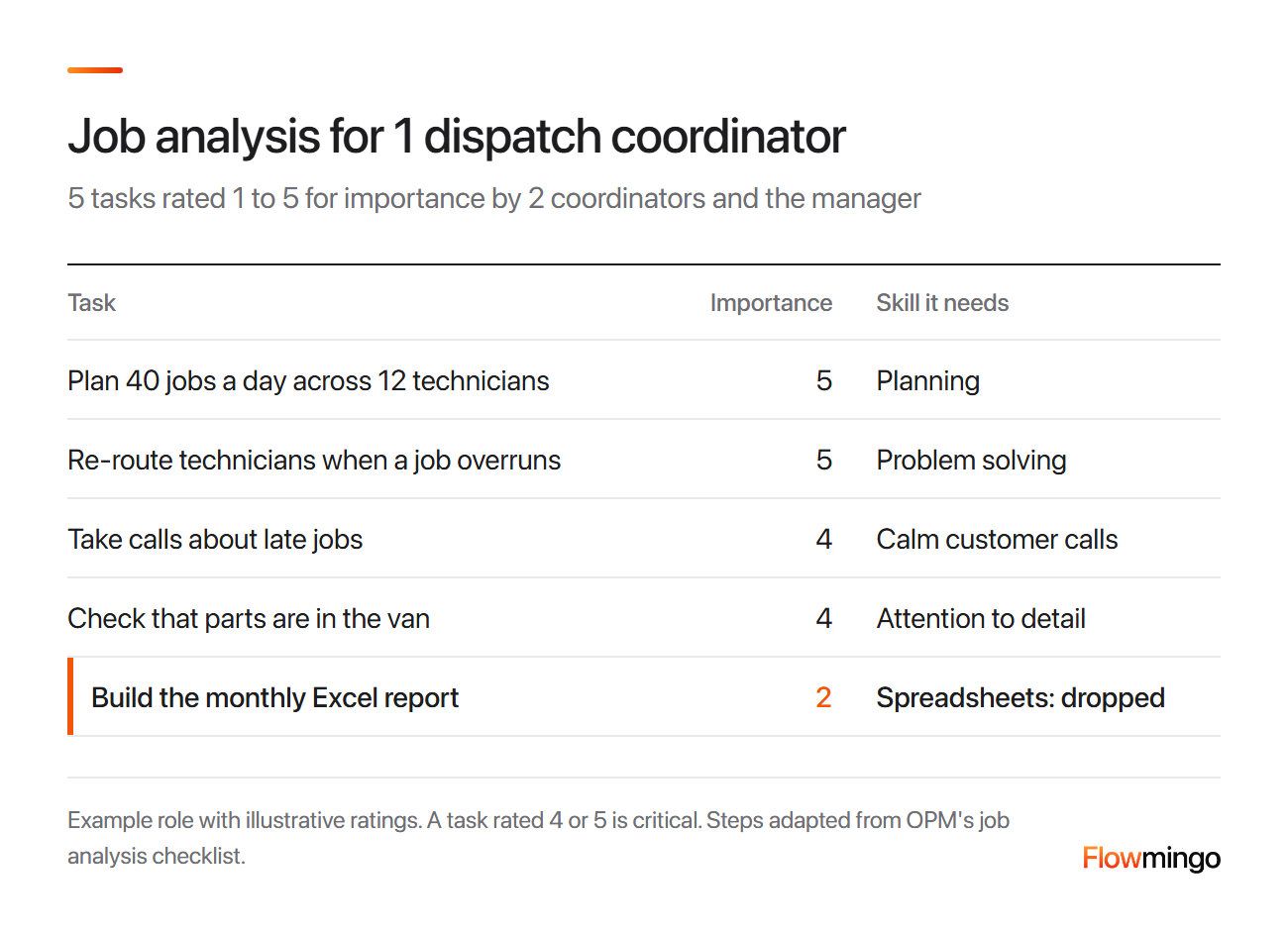
Job analysis for 1 dispatch coordinator: 4 tasks rated 4 or 5 and stay critical. The monthly Excel report rated 2, so the spreadsheet skill left the must-haves.
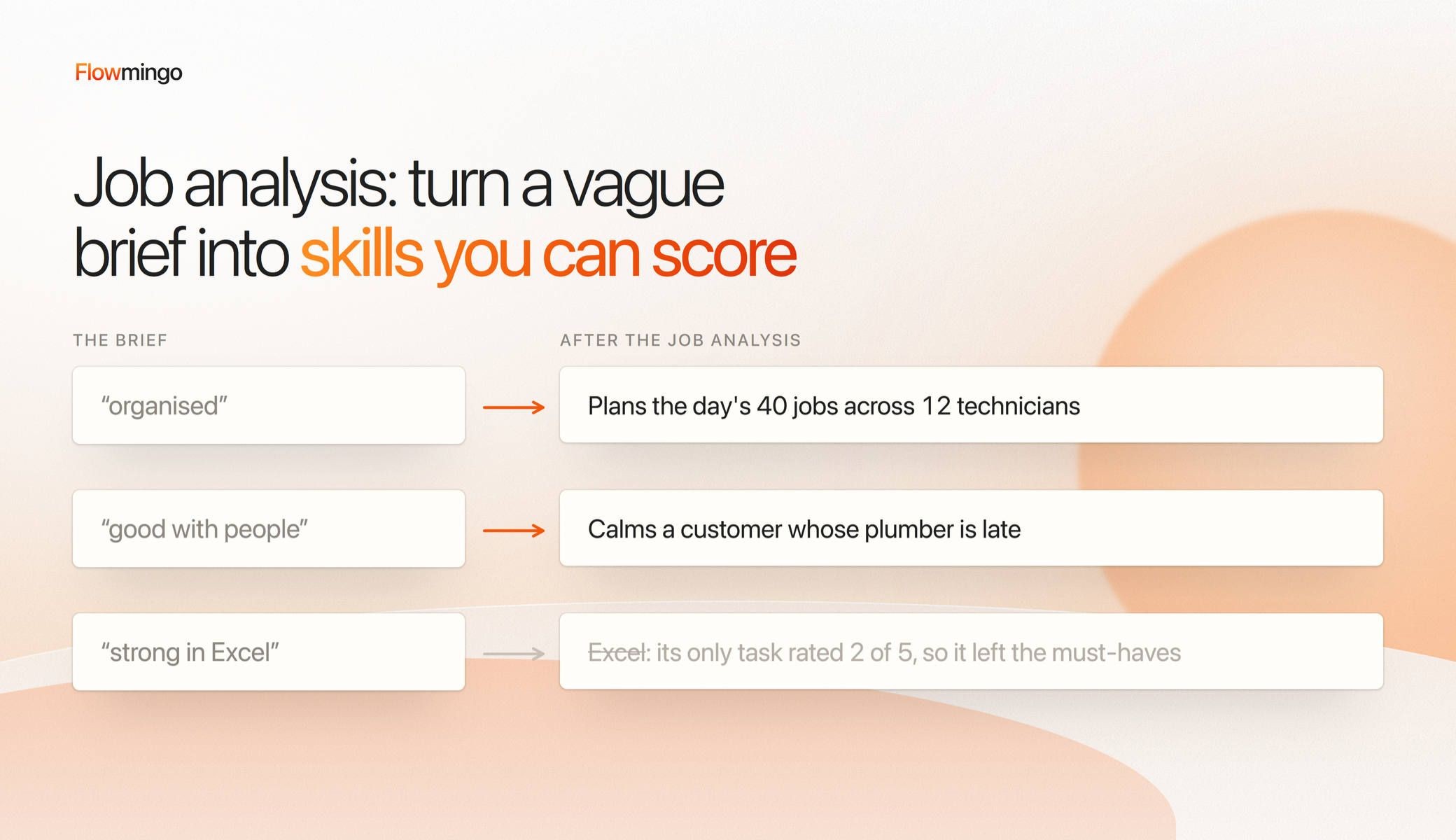
The result changed the brief. "Organised" became planning 40 jobs a day, and "good with people" became calming a customer whose plumber is late. "Strong in Excel" left the must-haves, because the only task that needs it rated 2 of 5.
That leaves 4 critical competencies, each linked to at least 1 task: planning, problem solving, calm customer calls and attention to detail. They become the job specification and 4 interview questions, 1 for each.
3. What are the steps of a job analysis for recruitment?
For recruitment, a job analysis takes 6 steps, adapted from OPM's 6-step checklist. Each step narrows the job to fewer, clearer facts, so the interview tests what matters.
- Collect what already describes the job. Read the current description, any performance standards and the matching O*NET profile. With over 900 occupation profiles in O*NET, you rarely start from a blank page.
- List the tasks with people who do the job. Write each task as a short statement that starts with a verb. People in the role remember the tasks a manager forgets.
- Rate each task's importance. OPM has subject matter experts rate every task, then keeps the critical ones. A shared scale stops the loudest voice from setting the list.
- Name the competencies needed on day 1. In OPM's example, a critical competency is rated at least "important" and "needed at entry". Skills a new hire can learn on the job belong in training, not in the job ad.
- Link each competency to a task. OPM drops any task with no competency and any competency with no task. This is the step that removed Excel from the dispatcher's brief.
- Choose the must-haves, then write the questions. OPM's last step decides which competencies, if any, become documented "selective factors" for the job. Most structured interviews assess 4 to 6 competencies, says OPM's interview guide, so write 1 open question for each.
3.1 Which job analysis mistakes weaken the interview?
The first mistake is asking only the manager. Managers describe the job they remember, while the people doing it describe the job as it runs today. Talk to at least 1 person in the role, the kind of subject matter expert OPM's checklist relies on.
The second mistake is listing traits instead of tasks. "Organised" cannot be scored, but "plans 40 jobs a day across 12 technicians" can. The third is skipping the link step, which is how a skill like Excel stays in the ad with no task behind it.
These mistakes matter because the interview inherits them. In Sackett and colleagues' foundational 2022 re-analysis, structured interviews ranked first on validity: .42, against .19 for unstructured ones (Journal of Applied Psychology). Our structured interview guide shows how to write and score those questions.
4. How do you turn a job analysis into an interview with Flowmingo?
You write the critical competencies into the job description as requirements, then interview every applicant against them. The importance ratings from steps 3 and 4 tell you which requirement should weigh most.
Before you start, have the job analysis table beside you, with 4 to 6 critical competencies and their ratings. Write each one as a task, for example "plans a full day of jobs across a team of technicians". A requirement written as a task gives a clearer score than a trait, as our guide to skills-based hiring explains.
How Flowmingo helps
Paste the job description with your critical competencies, and Flowmingo drafts 1 to 30 interview questions you review and edit. The AI interview adapts to each answer and follows up where it matters. It rates each requirement 0 to 10 and weights it by its importance. Sign up free to put your next job analysis to work on Flowmingo.
5. Sources
Every study, guideline and database in this glossary entry links to its source below.
- Acas. (2024, November 7). Preventing issues: Equal pay, employer responsibilities. Acas
- Equal Employment Opportunity Commission, Civil Service Commission, Department of Labor, & Department of Justice. (1978). Uniform guidelines on employee selection procedures, 29 C.F.R. § 1607.14. Cornell LII
- O*NET Resource Center. (n.d.). Overview. Retrieved 26 October 2026. O*NET
- Sackett, P. R., Zhang, C., Berry, C. M., & Lievens, F. (2022). Revisiting meta-analytic estimates of validity in personnel selection: Addressing systematic overcorrection for restriction of range. Journal of Applied Psychology, 107(11), 2040-2068. DOI
- U.S. Office of Personnel Management. (n.d.). Job analysis. Retrieved 26 October 2026. OPM
- U.S. Office of Personnel Management. (n.d.). Six steps to conducting a job analysis. Retrieved 26 October 2026. OPM
- U.S. Office of Personnel Management. (n.d.). Structured interviews: A practical guide. OPM