
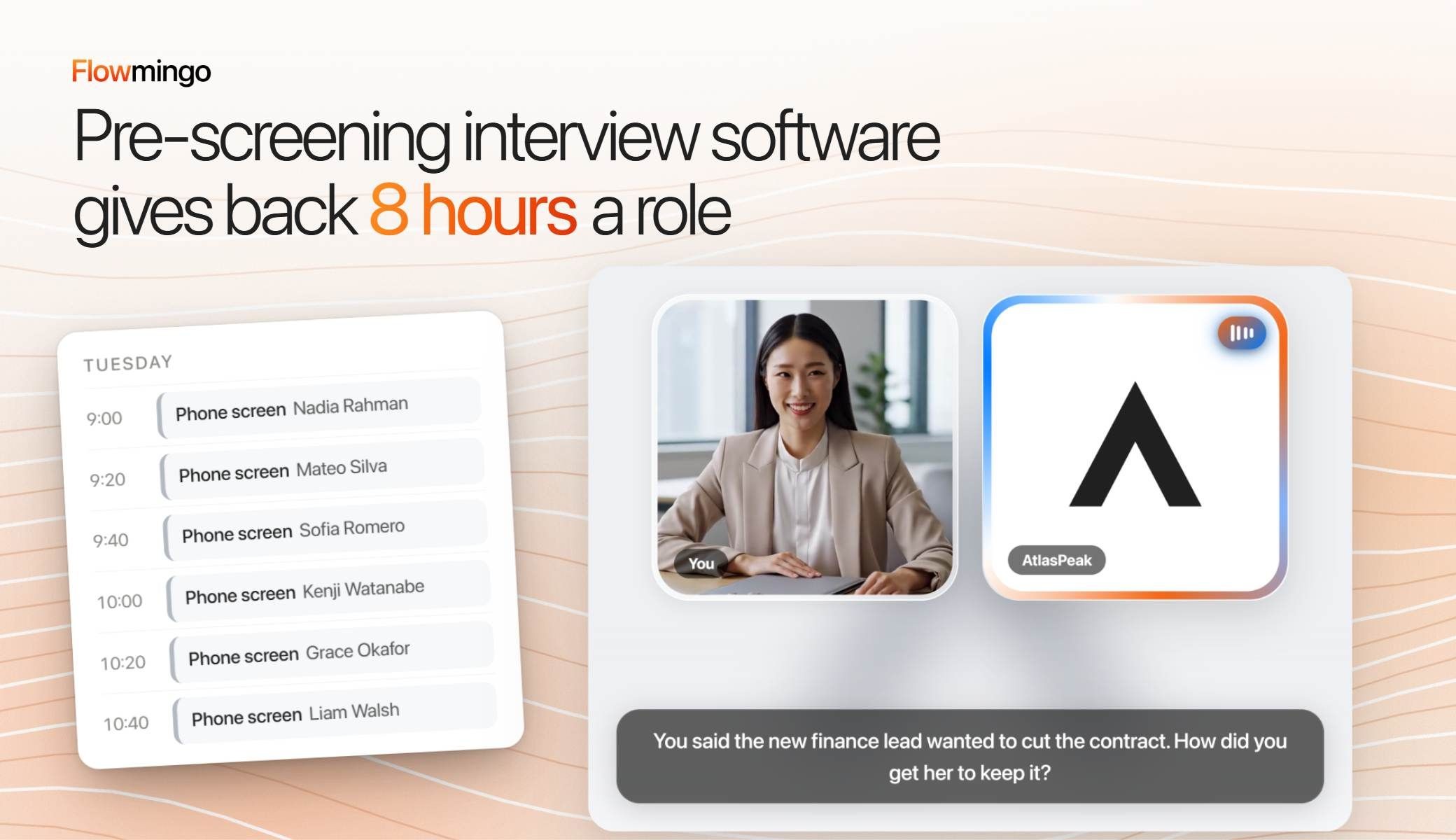
You have 25 phone screens to book for 1 role, and the first one is about 6 days away. Pre-screening interview software exists to replace phone screens like these, not the people who run them.
That wait is Ashby's foundational 2024 median from availability request to interview start. With booking and notes, our worksheet puts 1 role at about 10 hours of calls.
An earlier offer is more likely to be accepted (Becker and colleagues, foundational 2010). Yet in a 70,884-application field experiment, the paper's July 2026 version found slow review outweighed the time AI interviews saved.
The fix takes 3 moves. Hand over the repeatable half of the call, review results within 2 working days, and keep the live call for the shortlist.
Key takeaways
- How much does a phone screen really cost? About 25 minutes on our worksheet once booking and notes count, so 25 screens take about 10 hours per role, against about 2 hours to review them.
- Does replacing it lose good hires? Not in a field experiment where people made every decision: offers, job starts and 1-month employment all rose.
- Where does the speed gain get lost? In the review queue, says the study's July 2026 version. Our rule: review each finished interview within 2 working days.
- Will candidates refuse if the phone call goes? Few, once they start: in the field experiment, applicants refused to keep talking to the AI in about 1 in 20 AI interviews. Offer a call to anyone who asks.
- What do Illinois and New York City require? Illinois: explain the AI, get consent first and delete videos on request. New York City: if the tool substantially helps decide, the employer needs a bias audit within 1 year and 10 business days' notice.
1. What do phone screens really cost my team, and what can pre-screening interview software win back?
In our worksheet, 25 phone screens cost about 10.4 hours for 1 role once booking and notes count. Pre-screening interview software moves the first round to the candidate's own time, leaving about 2.1 hours of review.
In the field test, the recruiter's structured first screen ran 10 to 20 minutes (September 2026 version). Say each call needs another 10 minutes to book, rebook and write up.
The worksheet below is illustrative, not customer data.
| Step | Phone screen (25 candidates) | Automated first round (25 candidates) |
|---|---|---|
| Call or interview time | 25 x 15 min = 375 min | 0 min, in the candidate's own time |
| Booking, rebooking and notes (assumption: 10 min each) | 250 min | 0 min |
| Review (assumption: 5 min each) | Included above | 125 min |
| Total per role | 625 min, about 10.4 hours | 125 min, about 2.1 hours |
| A year at 20 requisitions | About 208 hours | About 42 hours |
Review is faster because you skim a transcript and jump to the answers that matter. That wins back 500 minutes, about 8 hours a role.
In SHRM's 2025 benchmarking, a dedicated recruiter handled a median 20 requisitions a year across all organisation sizes (6 at firms under 100 staff). That is about 208 hours a year on first calls, or about 5 working weeks.
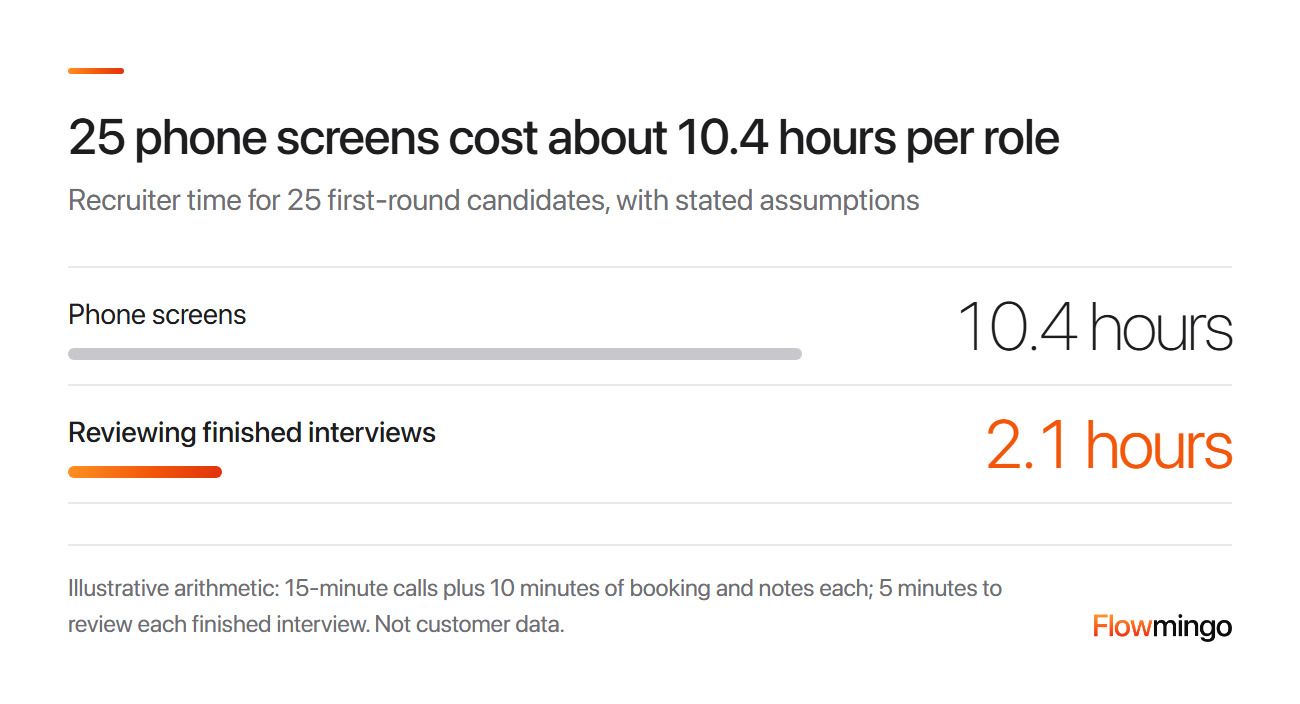
Recruiter hours per role: with 10 minutes of booking and notes per call, 25 phone screens take about 10.4 hours. Reviewing 25 finished interviews takes about 2.1 hours.
Swap in your own minutes and hourly cost. The paper's July 2026 version put an AI interview's vendor cost at $1.30 to $3.03, against $2.48 for a Philippine recruiter's call.
1.1 Is it worth paying for if we're a small team or agency?
Run the worksheet, not the demo. At 1 role a year, 10 hours of calls may not justify a new tool, but at 20 roles the 208 hours usually do. A per-candidate fee hits your busiest roles hardest.
How Flowmingo helps
Flowmingo's AI Interviewer is free and unlimited: a role with 40 applicants costs the same as one with 4,000. Upgrade to Flowmingo Pro (Starter, Growth or Scale) for longer interviews, video storage and your own branding. On Free, candidates see Flowmingo's brand next to yours and may see optional offers, unless you sponsor the session for $0.49.
2. Why do my best applicants take other offers while I am still booking phone screens?
Because booking takes about a week, and a faster first round makes an earlier offer possible. Earlier offers win more acceptances without lowering quality.
In Ashby's foundational October 2024 report, about 50% of candidates gave their availability within 24 hours. Yet interviews started a median of about 6 days after the request: calendar time, not candidate time.
In a foundational 2010 study of 3,012 candidates, Becker and colleagues found earlier offers won more acceptances, with no drop in performance or turnover.
In a foundational 2018 Robert Half survey of 9,000 jobseekers, 67% had taken a second-choice offer because their first choice took too long.
Pre-screening interview software removes the booking step, because the invite is the interview. For example, someone who applies on Monday night can finish the first round on Tuesday.
The table shows a trap. In the paper's July 2026 version, recruiters already called within hours, so AI interviews saved little: 0.32 days to interview, against 0.51. But interview to offer took 7.24 days against 2.62, so application to start took 24 days against 20.
These medians cover only remote-mode hires; the 4-day median gap is significant at the 5% level. The authors' September 2026 version leaves this timing analysis out, so read it as 1 firm's warning, not a measured rule.
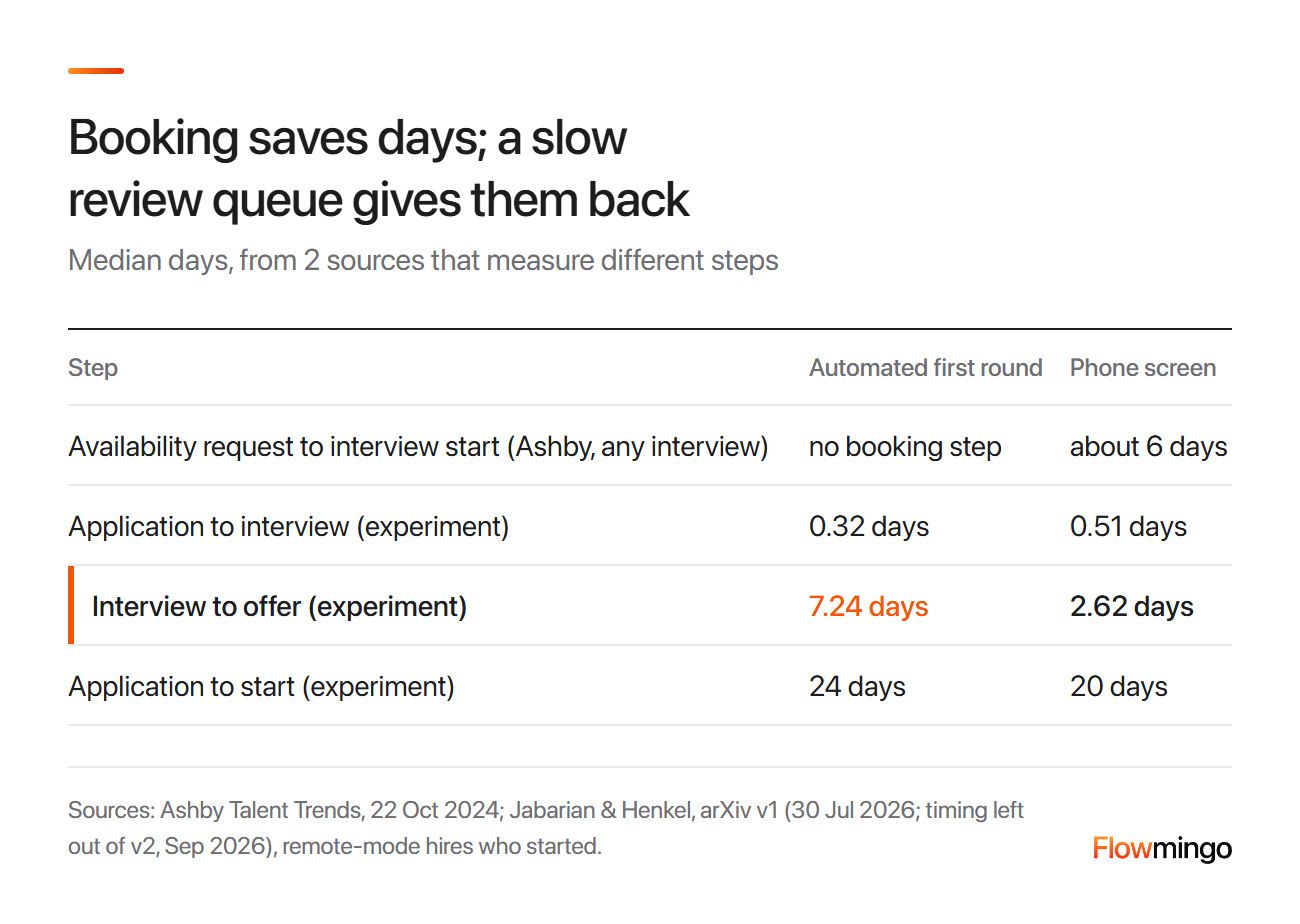
Where the days go: Ashby puts about 6 days from availability request to interview start. In the experiment, interview to offer took 7.24 days with the automated round, against 2.62.
The authors traced the delay to slower review of AI interviews.
3. How do I stop phone-screen no-shows and phone tag without chasing every candidate?
Stop booking the first call at all. A link the candidate opens whenever they like has no slot to miss, so you only chase people who have not started.
A slot booked days ahead is easy to forget, and every reschedule adds days. Waiting hurts after the offer too.
In a 2026 study of 157,154 accepted offers at 1 telecom company, 4.1% of hires never turned up on day 1 (Speer and colleagues). Longer offer-to-start gaps raised the risk. A second survey, of 434 US adults, tied weaker contact before the start to more no-shows.
A self-paced first round has no appointment, so evenings and weekends work. For example, a day-shift warehouse worker can answer at 9 pm without asking for time off.
Flowmingo data · 12,590 applicants who finished an AI interview · 444 companies · invites sent 1 Jul to 9 Oct 2026
- 23.1 hours was the median time from the invite to a finished interview, with no call to book.
- 51.8% of these finishers were done within 24 hours of the invite, and 74.8% within 48 hours.
- 98.2% of these finishers were done within 7 days of the invite.
Finishers within 14 days of an invite sent straight away. The clock starts at send, not open, so this shows how fast finishers moved, not how many finish. Other guides count other invites or dates, so shares differ.
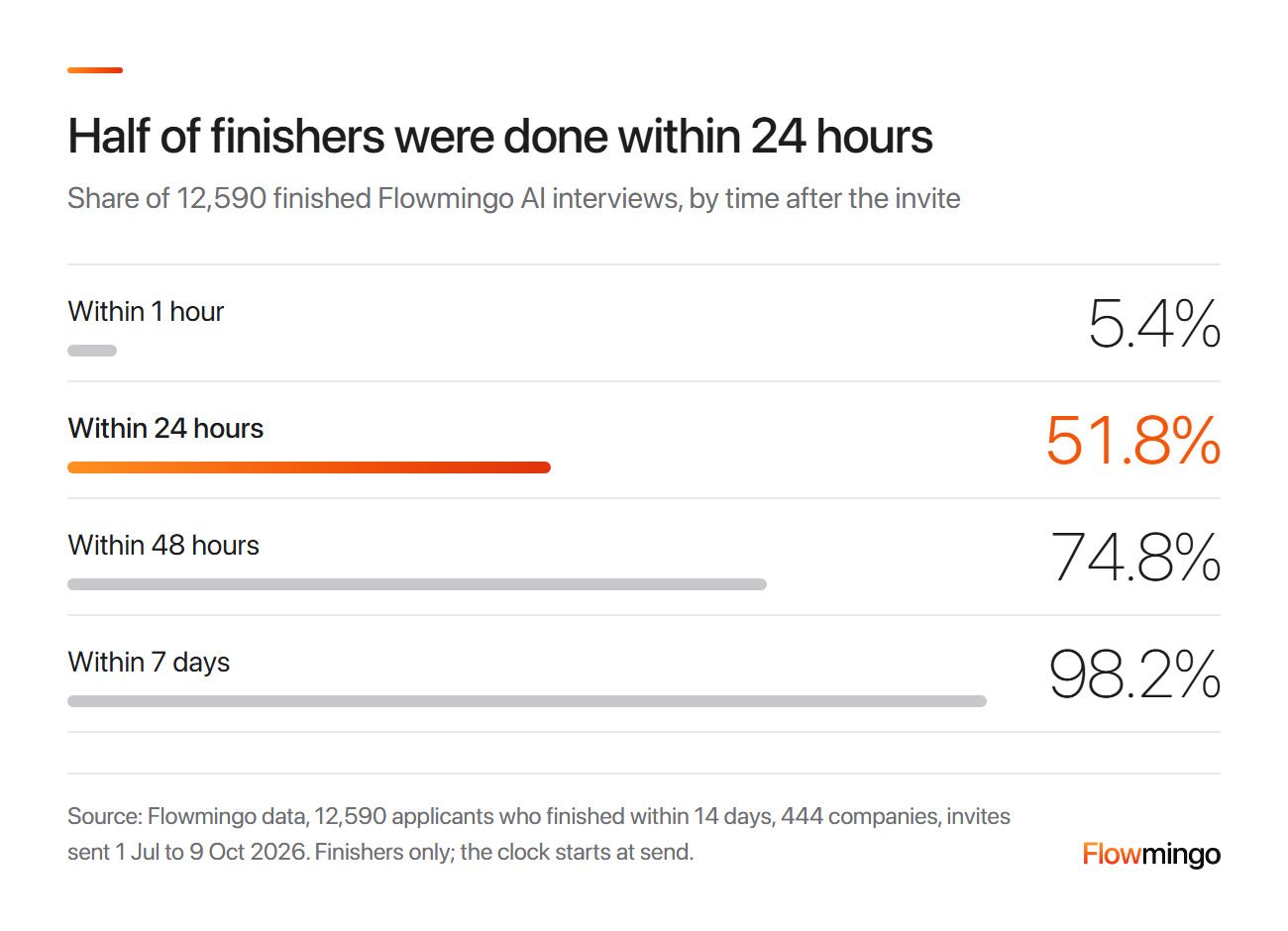
Finish times after the invite: of 12,590 finishers, 5.4% were done within 1 hour and 51.8% within 24 hours. 74.8% finished within 48 hours and 98.2% within 7 days.
Send the link within 1 working day of the application. Set a deadline about 7 days out, with the date, time and time zone written out. Nearly all finishers in the card were done inside a week.
Then send a reminder on day 2 and a last nudge 2 days before the deadline. If your tool already sends reminders, add only what it lacks, so nobody gets the same message twice.
4. Why does each recruiter's phone screen give a different verdict on the same applicant?
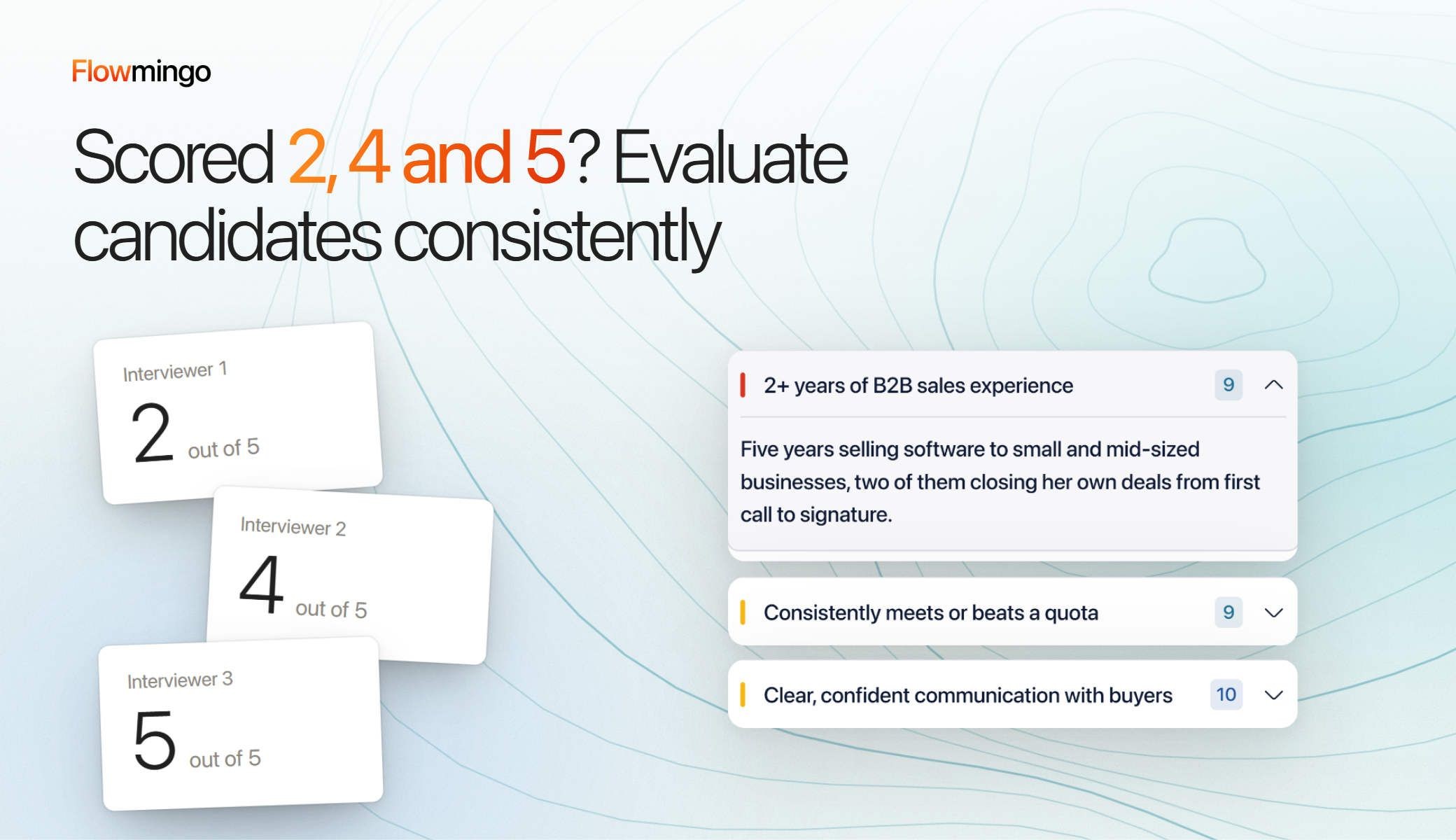
Because each screener asks different questions and weighs the answers by feel, so the verdict depends on who picked up the phone. The fix is the same questions, criteria and scale for every applicant.
Say you have 2 recruiters screening the same applicant. The first asks about shifts and hears confidence, and the second asks about a conflict and hears hesitation. The hiring manager gets 2 verdicts that cannot be compared.
In a foundational 2022 re-analysis, Sackett and colleagues found structured interviews predicted job performance more than twice as well as unstructured ones. Years of experience barely predicted it. The gain comes from the same questions and the same scoring for everyone, which any format can do.
The foundational 2021 book Noise puts it in plain odds (SBAM summary). If all you know is that 1 candidate interviewed better, the chance they really are better is about 56% to 61%. Its fix is a rating scale agreed in advance, with separate ratings before anyone compares notes.
So give every applicant the same pre-screening interview questions, scored on the same interview scorecard.
How Flowmingo helps
Paste the job, and the AI drafts 1 to 30 questions and weighted criteria, which you edit. Every applicant for the role gets the same set, and each report rates every criterion 0 to 10 with written reasons.
The overall score rates the answers' transcript against your criteria, plus the CV if sent. Face and appearance are not scored, and grammar and fluency are separate ratings outside the overall score. Nobody is rejected automatically.
5. Which parts of my phone screen should pre-screening interview software replace, and which stay human?
Let pre-screening interview software take the repeatable half of the call: must-have facts and the same 3 to 5 job questions for everyone. Keep selling the role, the candidate's questions and every decision human.
A 15-minute call does 4 jobs at once, which makes it hard to replace. The table splits them, and our automated first round interviews guide shows how to check each score.
| Job of the call | Goes to software | Stays human |
|---|---|---|
| Must-have facts: availability, pay, location, right to work where lawful to ask | Yes, asked the same way to everyone | Exceptions |
| Can they explain their experience | Yes, the same questions plus follow-ups | Reading the evidence |
| Selling the role and answering their questions | No | Yes, in the shortlist call |
| The decision | No | Always |
For example, a support role needs weekend shifts and calm with angry customers. Software asks every applicant about both; you read the answers, decide and spend the live call selling the role.
Jabarian and Henkel randomly assigned 67,056 of 70,884 applications at 1 recruitment firm to an AI voice interviewer, a recruiter or a free choice.
People made every hiring decision. With the AI, 9.73% of applicants got a job offer against 8.70%, or 12% more. Job starts and 1-month employment each rose about 18%.
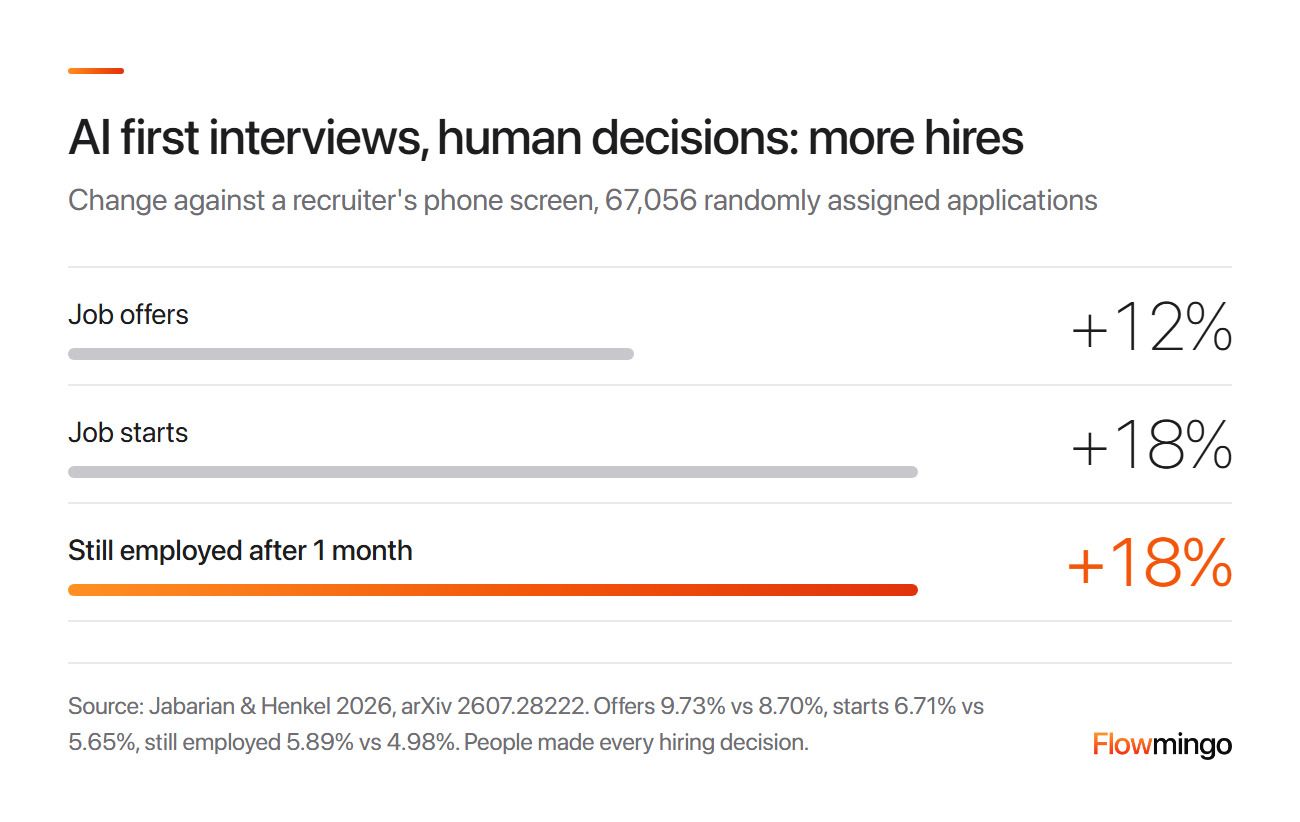
Field experiment results: with people deciding, AI first interviews brought 12% more offers, and 18% more starts and applicants still employed after 1 month.
That makes it a sound phone screen alternative for volume roles. The evidence is 1 working paper, not yet peer reviewed, from 1 firm hiring entry-level customer service in the Philippines. Its AI was a voice agent on a live phone call.
Keep the final round of a senior hire human, because that talk is as much selling as judging.
6. One-way video, AI interview with follow-ups or chat: which first round fits my role?
Use chat for fact checks at high volume, one-way video when first answers say enough, and an AI interview when you need follow-ups. Whatever you pick, keep a route that does not need video.
Sapia.ai Labs, a chat-interview vendor, presented a foundational April 2024 study of its own data (IT Brief). Of 1,309,490 chat completers, 60.3% finished within 24 hours, against 33.4% of 453,808 video completers.
About 79% of men and women asked to chat completed it, against 78% of men and 74% of women asked to do video. That gap for women is why pre-screening software needs a no-video route beside it: a call.
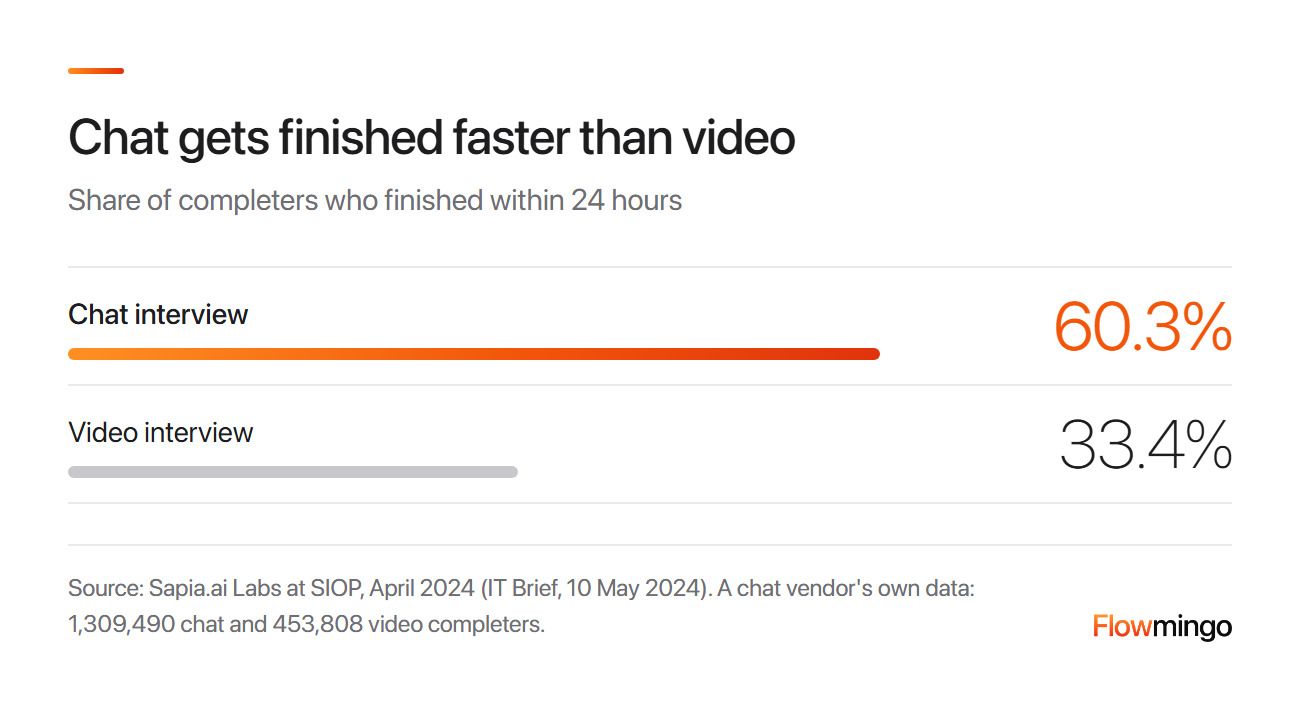
Chat vs video finish speed: in a chat vendor's data, 60.3% of chat interview completers finished within 24 hours, against 33.4% of video interview completers.
In a foundational 2023 study of 299 people, Kleinlogel and colleagues found people disliked asynchronous formats. Yet observers rated performance as similar across formats, and interviewees appeared less stressed.
Follow-ups are the reason to pick an AI interview, because first answers are often vague. For example, a candidate says they "improved retention", and the follow-up asks what changed. Our guide to automated interview tools goes deeper.
6.1 Can candidates game it with ChatGPT, and does a phone screen catch it better?
Some will try on any format, including the phone. In a 2Q25 Gartner survey of 3,000 candidates, 6% admitted interview fraud, such as posing as someone else or using a stand-in (Gartner).
Reading answers off a second screen is harder to count, and a phone call does not stop it. The fix is review flags plus a live human step before any offer.
How Flowmingo helps
Flowmingo's AI interview asks a follow-up when an answer misses the question. It flags tab switches, a second window, screenshot shortcuts, an extra monitor and missing or extra faces for your review, never as an automatic penalty.
7. Will good candidates drop out if a recorded or AI interview replaces my phone call?
A few will, and you can keep that number low. Most candidates accept an AI interview, and their bigger complaint is the silence afterwards.
In Greenhouse's 2026 survey of 1,200 US job seekers, 38% had walked away from a process because it had an AI interview. Of those who finished one, 51% never heard back.
That second number is the bigger warning: it is about silence, not the format. Trust starts low too: in a separate 1Q25 Gartner survey of 2,918 candidates, only 26% trusted AI to evaluate them fairly.
In the field test, 78% chose the AI interviewer when offered a choice. In 5% of AI interviews, the applicant refused to keep talking to it.
The survey is what job seekers recall about any process with an AI step. The field figure is what people did inside an AI interview at 1 firm, most assigned to it without a choice.
So once candidates start, refusals can be closer to 1 in 20 than 4 in 10. Our advice: offer a human route in the invite, and reply to everyone who finishes. Our completion-rate data shows where candidates drop off.
8. How do I switch to pre-screening interview software without losing the human touch?
Put a named person on every touchpoint of the step: the invite, the review and the reply. Say AI is used and how, offer a human route, and review within 2 working days.
Greenhouse's chief people officer, Sharawn Tipton, gave the same advice in Fortune. Show that a person reviews AI assessments, and offer a human interviewer option.
The illustrative invite below does that, so edit every bracket.
Subject: [Role]: your first interview, open until [Mon 30 Nov, 18:00 SGT]
Hi [first name], thanks for applying for [role]. The first step is a [15]-minute interview you take online, whenever suits you, until [Mon 30 Nov, 18:00 Singapore time (SGT)]. Start here: [interview link]
An AI asks the questions and may ask a follow-up. I review every answer and make the decision, and you can do a practice run first.
If you would rather talk to a person, or need more time, captions or typed answers, just reply and I will set it up. You will hear from me within 3 working days of finishing.
[Recruiter name], [job title], [company]
For Illinois-based roles, explain what the AI checks and ask for consent before the link. For New York City roles, post the Local Law 144 notice on your careers page at least 10 business days before the first invite.
Section 3's reminder on day 2 and last nudge on day 5 both use the template below. On day 5, start the subject with "Last few days".
Subject: Reminder: your [role] interview, open until [Mon 30 Nov, 18:00 SGT]
Hi [first name], your [15]-minute interview is open until [Mon 30 Nov, 18:00 Singapore time (SGT)]: [interview link]. An AI asks the questions, and I review every answer and decide.
Reply if you want a call instead, more time, captions or typed answers. You will hear from me within 3 working days of finishing.
[Recruiter name], [job title], [company]
Then set our review rule, because of section 2's warning: review every finished interview within 2 working days, so each candidate hears within 3.
In the figure, a named person invites within 1 working day, decides within 2, and spends the live call selling the role.
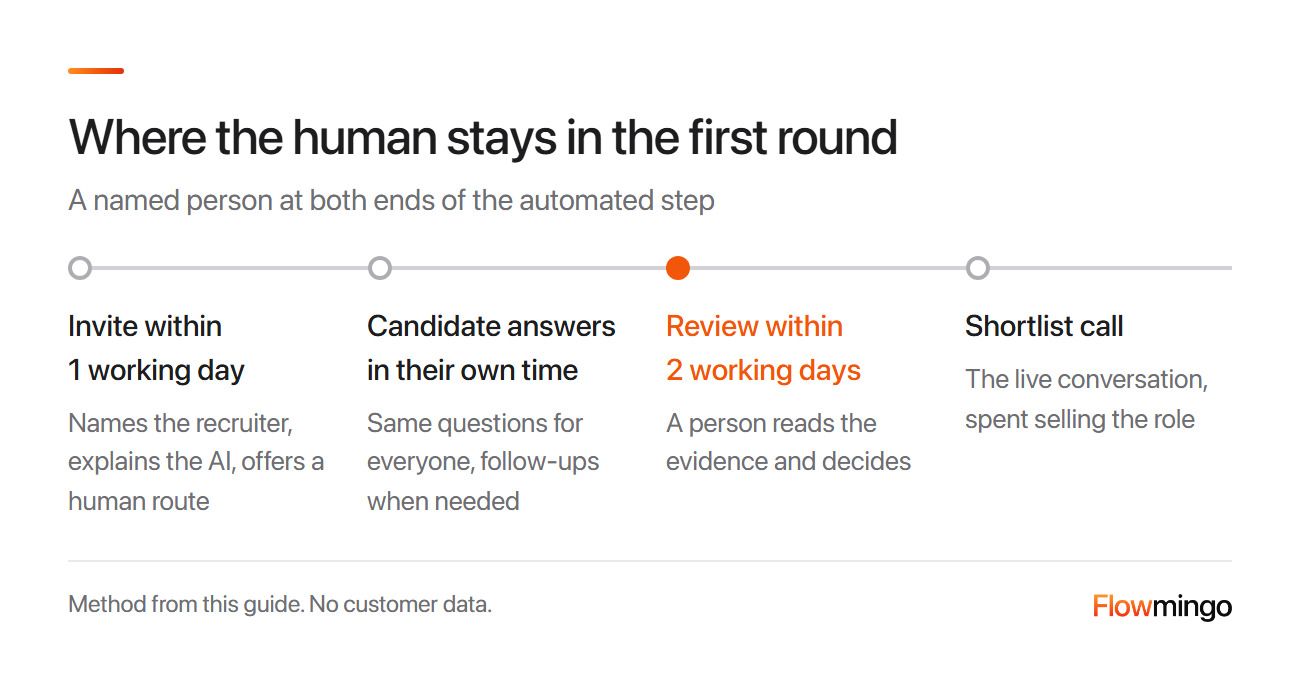
Where the human stays: invite within 1 working day, then candidates answer in their own time. Review within 2 working days, and spend the live call on the shortlist.
How Flowmingo helps
Candidates get a practice run and an introduction to what happens, in any of the 60+ languages you allow per role. Your team checks any score against the recording and transcript, and can override it.
9. Before I switch on AI scoring, what do Illinois, New York City and the ADA require?
In Illinois, tell candidates AI will analyse the video, explain it, get consent and delete on request. In New York City, a tool that substantially helps decide needs the employer's bias audit and notice; US-wide, the ADA needs an accommodation route.
This is general information, not legal advice.
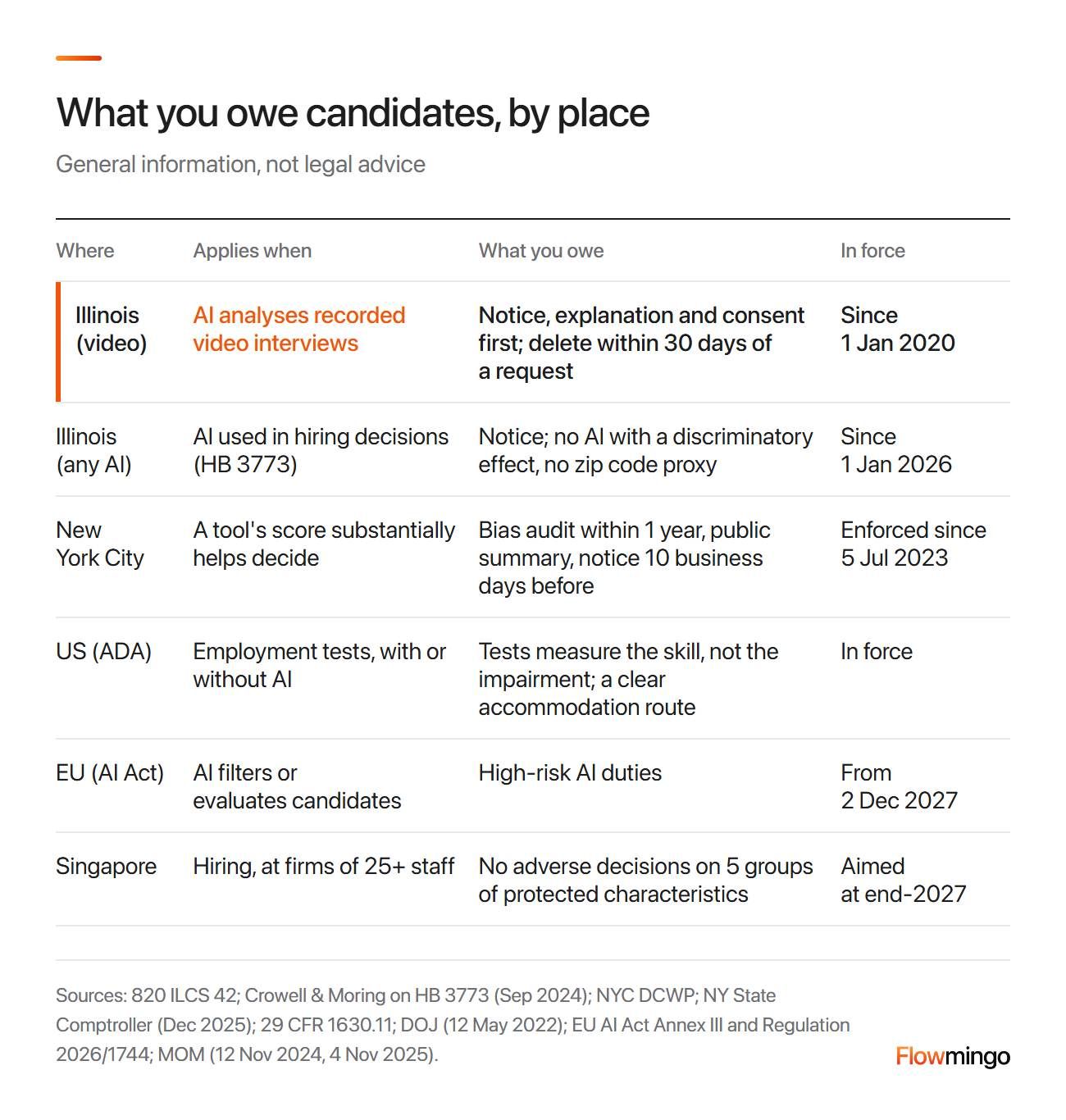
Legal duties by place: Illinois needs consent and deletion within 30 days of a request. A New York City tool that substantially helps decide needs the employer's bias audit and 10 business days' notice.
9.1 Illinois: the AI Video Interview Act
Illinois's AI Video Interview Act, a foundational law since 1 Jan 2020, applies when AI analyses recorded video interviews for Illinois-based roles (820 ILCS 42). Before the interview, give notice, explain how the AI works and get consent.
Put consent in the invite, because it cannot be added after the interview. For example, treat a remote role open to Chicago applicants as Illinois-based, to be safe.
Share videos only with people needed to evaluate the applicant, and delete them within 30 days of a request. If AI analysis alone picks who gets an in-person interview, you also report applicants' race and ethnicity to the state yearly, by 31 December. Since 1 Jan 2026, HB 3773 also requires notice of AI in hiring and bans AI that discriminates, including by zip code.
9.2 New York City: Local Law 144
New York City's Local Law 144, a foundational 2021 law enforced since 5 Jul 2023, covers tools that substantially assist or replace hiring decisions (DCWP). The city's rule defines that as a score used alone, weighted above the other criteria, or used to overrule people. The employer needs a bias audit within 1 year before use, a public summary and notice 10 business days before.
If a score shapes who leaves your shortlist, plan as if the law applies. The duty is yours, not the vendor's, so book an independent bias audit before go-live.
Enforcement has been light. The State Comptroller's December 2025 audit found only 2 complaints in 2 years (Comptroller). The city found 1 issue at 32 companies, where the auditors found at least 17.
9.3 The ADA: an accommodation route
Under 29 CFR 1630.11, an employment test must measure the skill it targets, not an applicant's impaired sensory, manual or speaking skills. The Justice Department's foundational 2022 guidance says employers may need to explain the tool, how it assesses applicants and how to ask for accommodation (ADA.gov).
The EEOC removed its foundational 2022 note on AI and the ADA in early 2025, but the law did not change (Cooley). So offer more time, captions, typed answers or a live call, and say so in the invite.
9.4 Hiring outside the US
The EU AI Act treats AI that filters or evaluates candidates as high-risk (Annex III), with duties from 2 Dec 2027 under Regulation 2026/1744. Singapore's Workplace Fairness Act, aimed at end-2027, will ban adverse hiring decisions on 5 groups of protected characteristics at firms of 25+ staff (MOM).
10. How do I pilot pre-screening interview software on 1 role before rolling it out?
Pick 1 role you hire often, with 30+ applicants a side, and pilot the new first round against phone screens for 4 weeks. Decide on days to first screen, hours, review lag, acceptance and 30-day retention.
A demo shows the tool, not your queue. So copy the field test's measures at small scale: offers, starts, 30-day retention and the review lag its July 2026 version flagged.
In SHRM's 2025 benchmarking, only 20% of organisations measured quality of hire, so checking 30-day retention already puts you ahead. The plan below is illustrative, not customer data.
| Week | What you do | What you measure |
|---|---|---|
| 1 | Write criteria, questions and the invite with the hiring manager | Setup time |
| 2 to 3 | Split applicants, odd arrivals to phone screens and even to the new step; link within 1 working day, reminders on day 2 and day 5, review within 2 working days | Days to first screen, review lag, human-route requests |
| 4, then 30 days after start | Shortlist calls and offers, then check who stayed | Hours, acceptance and 30-day retention, each side |
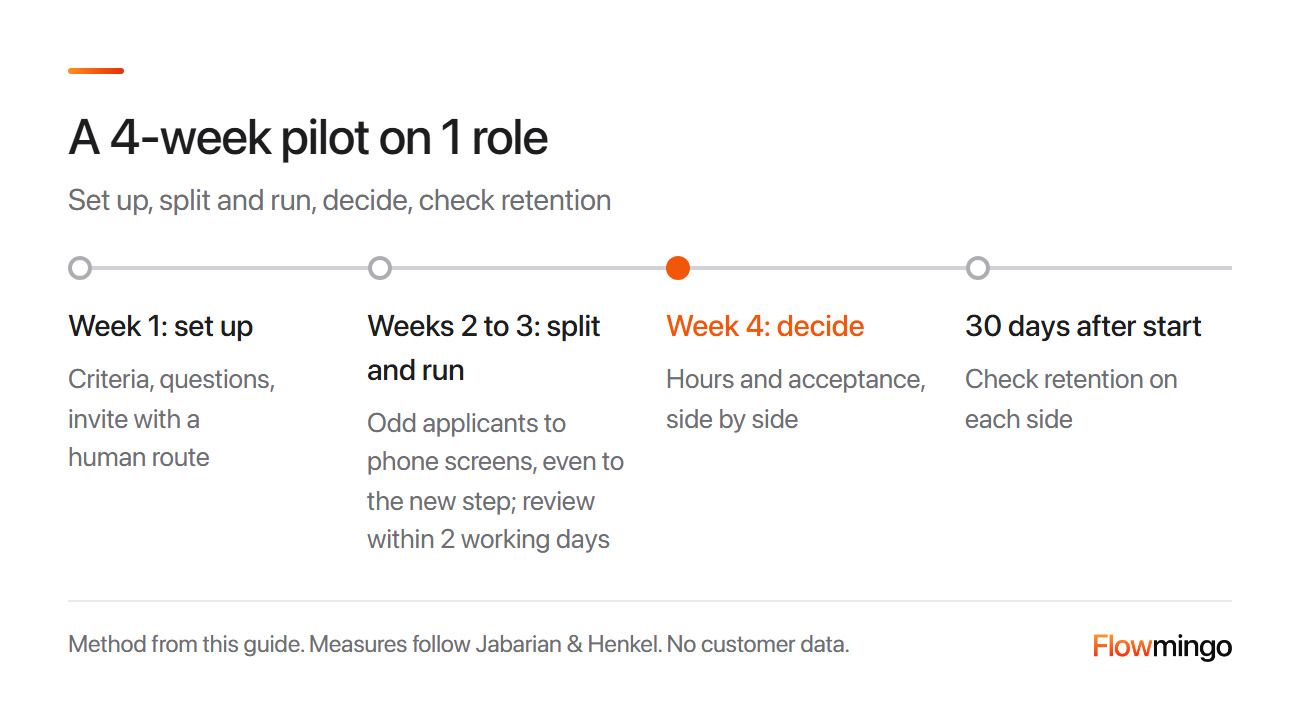
4-week pilot on 1 role: set up in week 1, then split applicants and run both sides in weeks 2 to 3. Decide on hours and acceptance in week 4, then check 30-day retention.
The split keeps it fair, because both sides face the same weeks and applicants. Keep the new step if days and hours fall while acceptance and retention hold. Our automated first round interviews guide tests for 2 weeks; this adds phone screens.
Set stop rules first: stop if review lag passes 2 working days in week 2. Stop too if more than about 1 in 20 ask for a call and you cannot book them within 2 working days.
The UK ICO's foundational November 2024 audit made almost 300 recommendations to AI recruitment vendors (ICO). Ask vendors what the tool infers, how long it keeps recordings, what bias testing they can show and whether a person can override every score.
How Flowmingo helps
To pilot on 1 role, paste the job, edit the drafted questions and criteria, and paste the link into your ATS email. Finished interviews land on a board you sort by score, with recordings, transcripts and rated reasons. Run the pilot on Flowmingo, free pre-screening interview software with no charge per candidate.
11. Sources
Every study, law and survey in this guide links to a source below; Flowmingo figures come from Flowmingo's own platform data.
- Ashby (2024, October 22). Talent trends report: Recruiting coordination. Ashby.
- Becker, W. J., Connolly, T., & Slaughter, J. E. (2010). The effect of job offer timing on offer acceptance, performance, and turnover. Personnel Psychology, 63(1), 223-241.
- Burleigh, E. (2026, May 4). Nearly 4 in 10 job candidates have bailed on a hiring round because it required an AI interview. Fortune.
- Cooley (2025, February 21). Gone but not forgotten: Federal laws still apply despite AI guidance disappearance act. Cooley LLP.
- Crowell & Moring (2024, September 23). Artificial intelligence in employment update: Illinois requires notice and prohibits discriminatory impact in use of AI. Crowell & Moring LLP.
- European Parliament and Council (2026). Regulation (EU) 2026/1744, the Digital Omnibus on AI. Official Journal of the European Union.
- European Union (2024). Artificial Intelligence Act, Annex III: High-risk AI systems. AI Act Explorer.
- Gartner (2025, July 31). Gartner survey shows just 26% of job applicants trust AI will fairly evaluate them. Gartner newsroom.
- Greenhouse (2026, May 1). 63% of job seekers have faced an AI interview. Most haven't had a good one yet. Greenhouse 2026 Candidate AI Interview Report.
- Hoover, S. (2021, April 16). Noisy job interviews. Small Business Association of Michigan.
- Illinois General Assembly (2020). Artificial Intelligence Video Interview Act, 820 ILCS 42. Illinois Compiled Statutes.
- Information Commissioner's Office (2024, November 6). ICO intervention into AI recruitment tools leads to better data protection for job seekers. ICO.
- IT Brief UK (2024, May 10). Video-first interviews disadvantage women, study finds. IT Brief.
- Jabarian, B., & Henkel, L. (2026, January 26). Voice AI in firms: A natural field experiment on automated job interviews (arXiv:2607.28222v1, posted 30 July 2026). Its timing analysis (section 7.1) and cost benchmarks (Appendix I) are not in v2.
- Jabarian, B., & Henkel, L. (2026). Voice AI in firms: A natural field experiment on automated job interviews (arXiv:2607.28222v2, 11 September 2026). Working paper.
- Kleinlogel, E. P., Schmid Mast, M., Jayagopi, D. B., Shubham, K., & Butera, A. (2023). "The interviewer is a machine!" Investigating the effects of conventional and technology-mediated interview methods on interviewee reactions and behavior. International Journal of Selection and Assessment, 31(3), 403-419.
- Ministry of Manpower, Singapore (2024, November 12). Fact sheet on Workplace Fairness Bill first reading. MOM.
- Ministry of Manpower, Singapore (2025, November 4). Workplace Fairness (Dispute Resolution) Bill press release. MOM.
- NYC Department of Consumer and Worker Protection (2023). Notice of Adoption of Final Rule: Use of Automated Employment Decision Tools, 6 RCNY §5-300 and §5-304(b). DCWP.
- NYC Department of Consumer and Worker Protection (n.d., read 2026). Automated employment decision tools (AEDT). City of New York.
- Office of the New York State Comptroller (2025, December 2). Enforcement of Local Law 144: Automated employment decision tools. Report 2024-N-6.
- Robert Half UK (2018, May 10). Two thirds of candidates have turned down a dream job after businesses leave them dangling. Robert Half.
- Sackett, P. R., Zhang, C., Berry, C. M., & Lievens, F. (2022). Revisiting meta-analytic estimates of validity in personnel selection: Addressing systematic overcorrection for restriction of range. Journal of Applied Psychology, 107(11), 2040-2068.
- SHRM (2025). 2025 recruiting executives benchmarking: Insights to maximize recruitment. SHRM.
- Speer, A. B., Hardy, J. H., Gibson, C., Frost, C., & Hong, Q. (2026). Now you see them, now you don't: Understanding new hire ghosting and its antecedents. Human Resource Management Journal.
- U.S. Code of Federal Regulations (current text). 29 CFR 1630.11, administration of tests. Legal Information Institute.
- U.S. Department of Justice (2022, May 12). Algorithms, artificial intelligence, and disability discrimination in hiring. ADA.gov.