
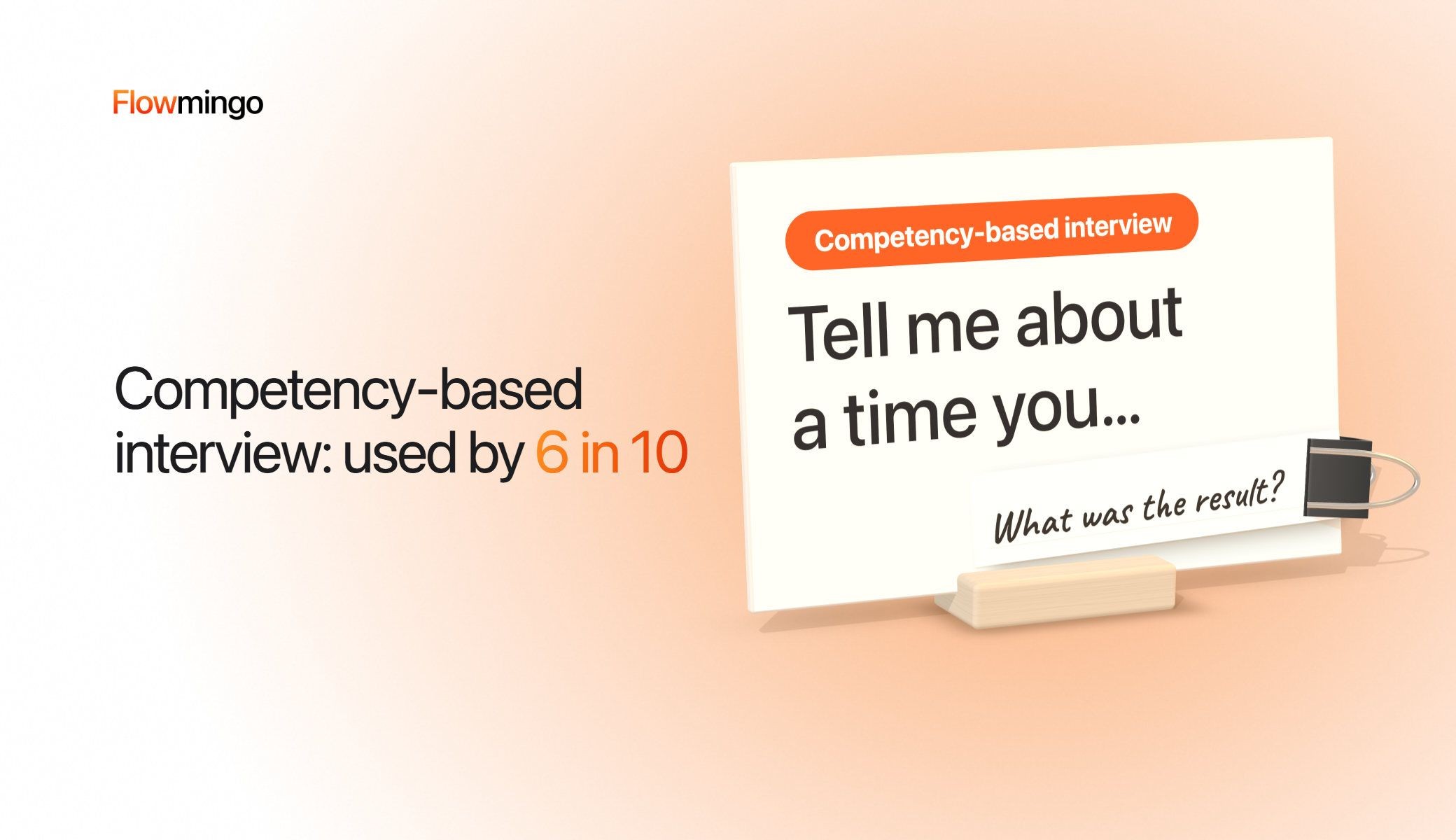
A competency-based interview is a structured interview that asks every candidate about real past situations, 1 question for each skill the job needs. Each answer is scored against the same written scale.
You meet the term when a hiring manager or a client asks you to "use competency-based interviews" for a role. It is the most common interview type in the UK: in CIPD's 2026 survey of 1,014 HR professionals, 60% of organisations that hired used it. So your competency-based questions need a plan, a follow-up and a score.
Key takeaways
- What does a competency-based interview test? 4 to 6 skills from the job, each with 1 question about a real past event and a written 1-to-5 scale.
- How common is it? It is the most common interview type in the UK: 60% of organisations that hired used it in CIPD's 2026 survey.
- Is it the same as a behavioral interview? Almost. Behavioral questions are the method, and the competency list is the plan they serve.
- Why plan follow-ups? In a foundational 2020 experiment, students named a result in 22% of answers before a follow-up and 59% after.
1. What is a competency-based interview?
A competency-based interview tests a short list of competencies by asking for a real example of each one. A competency is a skill or behavior the job needs, for example winning new clients or calming an angry customer.
It includes 3 parts, all written before the first call. There is the competency list, 1 past-behavior question per competency, and a scale that says what a weak, fair and strong answer sounds like. The STAR method checks that an answer is complete: situation, task, action and result.
It is not really different from a behavioral interview, and the University of Washington's HR team uses the 2 terms interchangeably. Behavioral names the question style, while competency-based names the skills plan behind it. A strengths-based interview is a separate type: it asks what a person enjoys and does well, and 42% of the same CIPD sample used one.
The term spread through HR after psychologist David McClelland's foundational 1973 paper, Testing for competence rather than for "intelligence". Its title sums up the shift: judge people on what they can do, not on an intelligence score.
2. What does a competency-based interview look like on a real role?
In practice, it is 1 question plan and 1 score sheet that every interviewer uses the same way. Here is 1 example with illustrative numbers.
Say your agency hires a recruitment consultant for its permanent desk, and 2 finalists reach the competency round. You test 5 competencies, inside the 4 to 6 range that OPM suggests. Each one gets 1 question, scored 1 to 5, for a total out of 25.
The 5 questions ask about real events. Business development asks for the last client they won cold, and candidate assessment asks for a hire they advised against. Resilience asks about a month they missed target, client communication about a shortlist a client rejected, and planning about their busiest week last quarter.
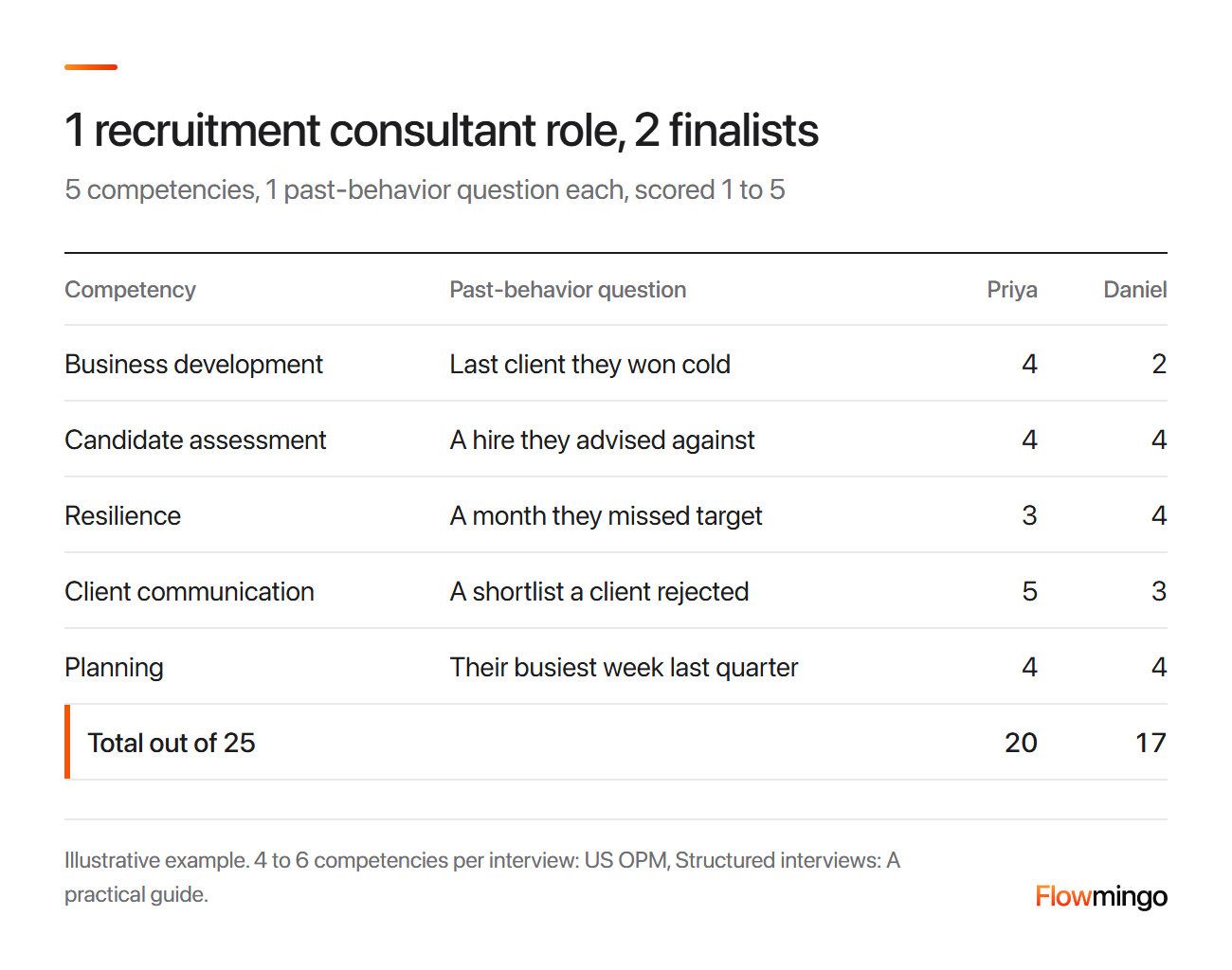
Competency-based interview scoring example: 5 competencies scored 1 to 5 for 2 recruitment consultant finalists, Priya 20 of 25 and Daniel 17 of 25.
Priya scored 4 on business development, 4 on candidate assessment, 3 on resilience, 5 on client communication and 4 on planning. Daniel scored 2, 4, 4, 3 and 4. His 2 came from a cold-call story with no named client and no result, even after the follow-up.
The agency offered Priya the role. The total decided it, and the written scores let the hiring manager explain the gap to Daniel in 1 line.
3. How do you write and score competency-based interview questions?
Pick the competencies from the job first, then write 1 question, 1 or 2 follow-ups and a scale for each. Every candidate then hears the same questions in the same order.
- Choose 4 to 6 competencies from the job description. More than 6 leaves too little time to probe each one, and OPM's guide says most structured interviews assess 4 to 6.
- Ask what people did, not what they would do. In Taylor and Small's foundational 2002 meta-analysis, past-behavior questions predicted job performance better than "what would you do" questions. The gap was clearest when both used anchored rating scales.
- Write what a 1, a 3 and a 5 answer sound like before the first interview. A written scale stops each interviewer from inventing their own bar halfway through the call.
- Plan 1 or 2 follow-ups that ask for the result. In Brosy, Bangerter and Ribeiro's foundational 2020 experiment, 29 students named a result in 22% of answers before any follow-up, and 59% after.
- Score each answer alone, before the debrief. Then add up the scores, so the loudest voice in the room cannot move them. Our interview scorecard template gives you a sheet to copy.
3.1 Which mistakes weaken a competency-based interview?
The most common mistake is an opinion question under a competency label. "What are your greatest strengths" asks for a view of yourself, not an event, so the scale has nothing to measure.
The second is accepting "we" as an answer. OPM's guide tells interviewers to ask for clarification when a candidate says "we", because the score must rate what this person did.
The plan is what makes the method work. Structured interviews predicted job performance at .42, against .19 for unstructured ones, in Sackett and colleagues' foundational 2022 re-analysis. Our structured interview guide covers the rest of the set-up.
4. How do you run a competency-based interview with Flowmingo?
You turn your competency list into interview questions once, and every candidate answers them in their own time. You read each scored answer and decide who moves on.
Before you start, have 2 things ready: the job description and the 4 to 6 competencies from step 1. Name each competency as a behavior you can hear in an answer. A recruiter can score "has won a client from a cold call" from a story, but nobody can score "go-getter".
Keep the follow-up rule from step 4 in every question, because an answer without a result gives the scale nothing to rate.
How Flowmingo helps
Paste your job description and the AI interviewer drafts between 1 and 30 questions from it, which you edit into 1 per competency. It runs a structured interview that follows up where it matters, then rates each requirement 0 to 10 and weights it by importance. Every hiring decision stays with your team. Sign up free to run your next competency-based interview on Flowmingo.
5. Sources
Every study, survey and guide in this glossary entry links to its source below.
- Brosy, J., Bangerter, A., & Ribeiro, S. (2020). Encouraging the production of narrative responses to past-behaviour interview questions: Effects of probing and information. European Journal of Work and Organizational Psychology, 29(3), 330-343. DOI
- CIPD. (2026). Resourcing and talent planning report 2026. Chartered Institute of Personnel and Development. CIPD
- McClelland, D. C. (1973). Testing for competence rather than for "intelligence". American Psychologist, 28(1), 1-14. DOI
- Sackett, P. R., Zhang, C., Berry, C. M., & Lievens, F. (2022). Revisiting meta-analytic estimates of validity in personnel selection: Addressing systematic overcorrection for restriction of range. Journal of Applied Psychology, 107(11), 2040-2068. DOI
- Taylor, P. J., & Small, B. (2002). Asking applicants what they would do versus what they did do: A meta-analytic comparison of situational and past behaviour employment interview questions. Journal of Occupational and Organizational Psychology, 75(3), 277-294. DOI
- University of Washington Human Resources. (2026, October 5). Behavioral/Competency-based interviewing. Retrieved 26 October 2026. UW HR
- U.S. Office of Personnel Management. (n.d.). Structured interviews: A practical guide. OPM