
Your role is live, and 300 applications are waiting for you or for an AI candidate screening platform to read them. By the time anyone reaches CV 240, your best applicant may have stopped waiting.
The pile has grown faster than any hiring team. Greenhouse, which makes hiring software, saw applications per job on its North American platform more than double from 2022 to 2025, while recruiters per organisation fell 55.6% (Greenhouse).
That is more than twice the applicants per job for fewer than half the recruiters. The cost is the people you never meet, because 77% of US candidates expect a reply within 2 weeks of applying.
Flowmingo, the company publishing this guide, makes a free AI hiring platform. Its own records show where invited candidates drop out: most of the ones you lose never start the screen at all (section 4).
So judge any platform first on what happens between your invite and the first question, and only then on how well it scores the people who answer.
Key takeaways
- Where does an early hiring funnel leak? At the first reply, before the screen starts, and in a shifting CV filter. About 3 in 10 North American candidates hear nothing for 1 to 2 months or more.
- What's the best candidate screening software for a flood of applicants? Software that passes 3 tests: a same-day next step for everyone, 1 scored rubric for CV and interview, and a person who decides.
- Why do invited candidates never finish the screen? Mostly they never start it: 95.1% of non-finishers never began, and 83.8% of those who began finished, so fix the invite, not the interview length.
- Can an AI screening platform reject people on its own? It should not: a person should sign off every no. Only 21% of US recruiters are very confident their AI is not rejecting qualified people.
- What must I tell candidates about AI screening? That you use AI, what it scores, that a person reviews before any decision, and how to ask for human review. In Greenhouse's 2026 survey, 44% of US job seekers wanted that disclosure upfront.
1. Where is my early funnel leaking, and which leaks can an AI candidate screening platform fix?
Your early funnel leaks in 3 places: a slow first reply, invites that never become finished screens, and a CV filter that shifts. An AI candidate screening platform narrows all 3 by screening everyone the same day on 1 set of criteria, but your invite decides who starts.
Leak 1 is the first reply. The 2025 Candidate Experience (CandE) benchmark, which Survale runs, gathered 66,000+ candidate surveys, and in them 31% of North American candidates had not heard back 1 to 2+ months after applying (Survale).
Leak 2 is the gap between your invite and a finished screen. Of the candidates invited to a Flowmingo AI interview who did not finish, 95.1% never began, which means this leak sits before the first question rather than inside the screen (section 4).
Leak 3 is the filter itself, which can fail in 2 ways. People who screen alone each apply a private bar. The research on this measured interviews rather than CV reads, and interviewers working alone agreed much less than a panel did (section 5).
A rigid filter fails the other way, at the cost of the qualified people it screens out. Hidden Workers, a 2021 study by Harvard Business School and Accenture, now more than 5 years old, asked employers about that cost (HBS and Accenture).
In it, 88% of employers agreed that qualified high-skills candidates get vetted out for missing the exact criteria in the job description.
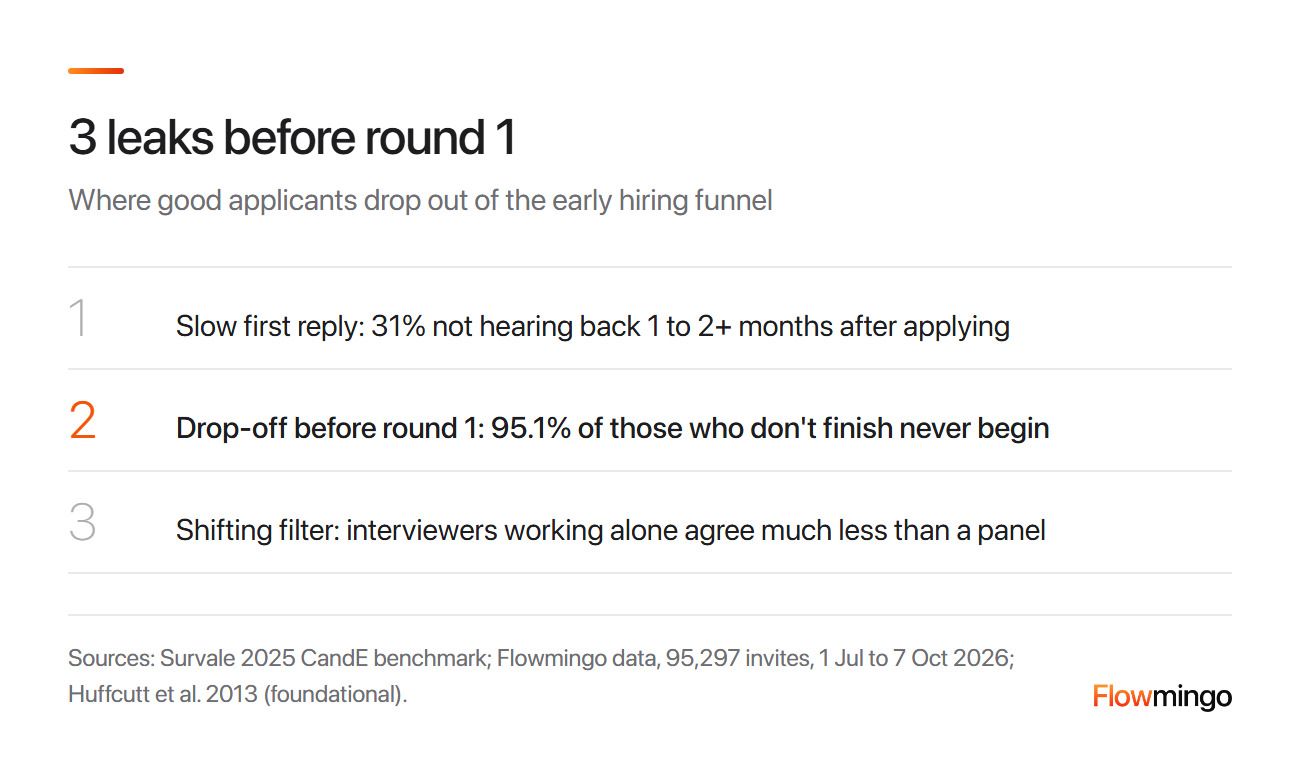
Leak map: Leak 1 is a slow first reply, with 31% not hearing back 1 to 2+ months. Leak 2 is drop-off before round 1, where 95.1% of those who don't finish never begin, and Leak 3 a shifting filter.
Some leaks sit outside the screen, and no platform will fix them for you: a job ad that attracts the wrong people, a shortlist left unread for 2 weeks, or an offer below market.
2. What's the best candidate screening software for handling a flood of applicants?
The best candidate screening software for a flood of applicants screens everyone the same day and scores them on your criteria, with reasons. It then moves the strongest into a first interview, so judge vendors on those 3 jobs.
Volume breaks a manual screen first, and much of the volume is noise. In Greenhouse's November 2025 survey, 34% of US recruiters spent up to half their week filtering spam and junk applications.
A keyword filter alone fails under that load, because applicants now game it. The same survey found that 41% of US job seekers admit using prompt injections, text planted in a CV to steer the software that reads it.
On the other side, 22% of US hiring managers say they have caught prompt injections hidden in CVs. A scored answer to a job question is much harder to fake than a keyword.
So test any candidate screening platform on the 3 jobs that matter when the pile is this large:
- Same day. Every applicant gets a next step within hours, with no call to book.
- Same criteria. The CV and the first interview share 1 scored rubric with reasons, so applicant 900 meets the same bar as applicant 1.
- Carry-through. The ranked list lands on 1 board you can sort, and a person decides.
A tool that passes all 3 still needs checking on bias and on who signs off a rejection, and the vendor questions in section 9 cover them.
3. Good applicants take other offers while waiting: how fast must our first reply be?
Send the first screen within 24 hours of the application and close it 7 days later. Give everyone a yes or no within 2 weeks of applying, and turn down clear screen-outs within 3 to 5 days.
The employers candidates rate highest already move at that pace. Talent Board, which founded the CandE benchmark, calls them CandE Winners, and in its December 2024 research they moved people on or closed them out within 3 to 5 days (ERE).
Candidates set a similar limit. In a Greenhouse report from April 2024, now more than 2 years old, 77% of US candidates expected a response within 2 weeks of applying (Greenhouse).
Silence costs you, because 50% of US candidates have ghosted an employer, most often after poor communication or long delays on the employer's side (Greenhouse 2025).
Speed does not cost quality either. In a 2010 study of 3,012 candidates, now more than 15 years old, earlier offers won more acceptances, with no drop in performance or retention (Becker and colleagues).
That study measured offer timing, not screening speed, so it shows that faster offers cost no quality, not that faster screens win hires. A platform makes same-day contact possible because the first screen goes out with the application, with no calendar back-and-forth.
Flowmingo data · 19,191 candidates who finished an AI interview within 14 days · 556 companies · invites 1 Jul to 7 Oct 2026
- 26.3 hours was the median time from invite to a candidate finishing the Flowmingo AI interview.
- 45.1% of finishers completed the Flowmingo AI interview within 24 hours of the invite.
- 83.6% of finishers completed the Flowmingo AI interview within 72 hours of the invite.
Time until the candidate finished, not until a recruiter saw a score. Finishers after 14 days are not counted. Other guides count other invites or dates, so shares differ.
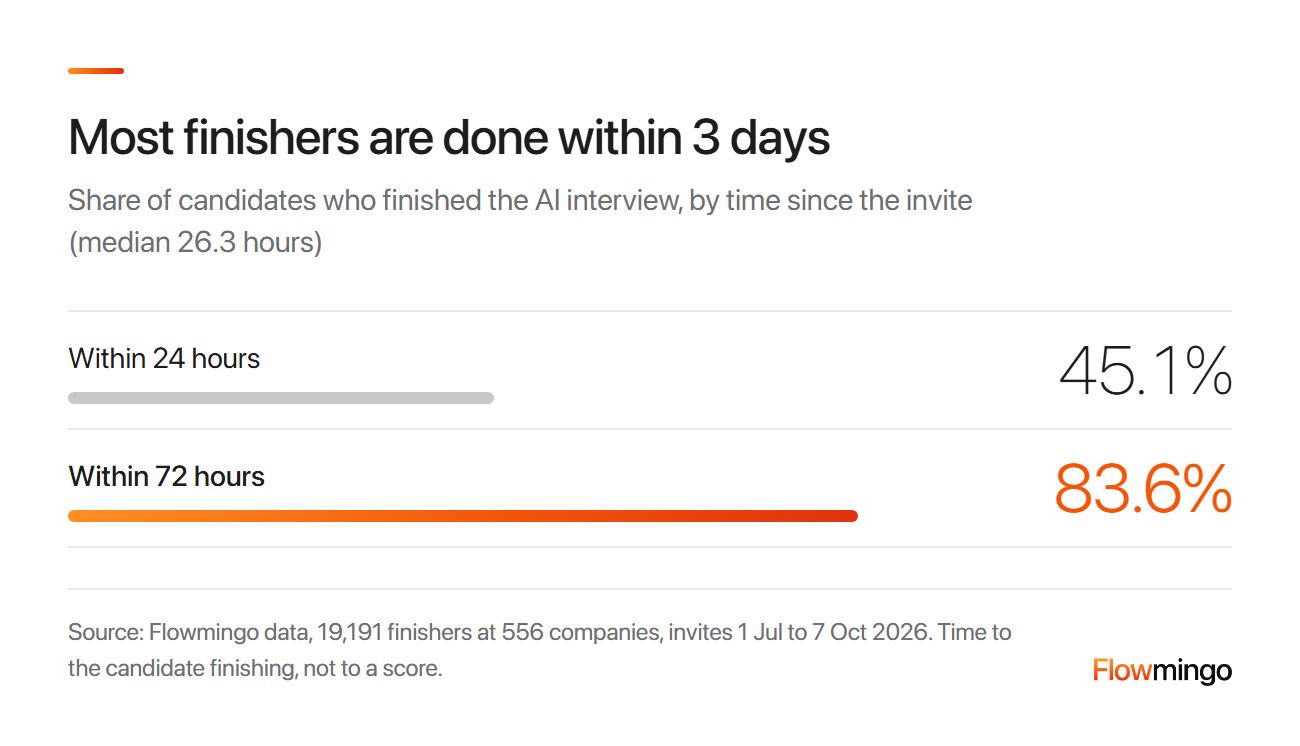
Time to finish: of 19,191 finishers, 45.1% did so within 24 hours and 83.6% within 72 hours, with a median of 26.3 hours.
So most finishers are done within 3 days, which leaves room for your 7-day deadline and for a decision inside 2 weeks.
4. Candidates never finish the screening step: how do I stop losing them before round 1?
Most candidates you lose never start the screen, so fix the invite before you shorten the screen. Send it with the application, say what it is and how long it takes, and set a 7-day deadline with the date written out.
Flowmingo data · 95,297 candidates invited to an AI interview · 944 companies · invites 1 Jul to 7 Oct 2026, each followed for 14 days
- 75.7% of the 95,297 invited candidates had not started the Flowmingo AI interview within 14 days.
- 3.9% of invited candidates started the Flowmingo AI interview but did not finish it within 14 days.
- 20.1% of invited candidates finished the Flowmingo AI interview within 14 days of the invite.
- 83.8% of candidates who started the Flowmingo AI interview went on to finish it within 14 days.
- 0.5% of the never-started invites had a recorded email bounce or send failure.
Email invites only. "Never started" includes people who saw the invite and chose not to begin.
Our recruitment funnel guide counted an earlier window, 52,078 invites that recruiters sent themselves from 15 Jun to 13 Sep 2026, and 36.3% of them began. Other guides count other invites or dates, so shares differ, but each puts the biggest leak at the invite.
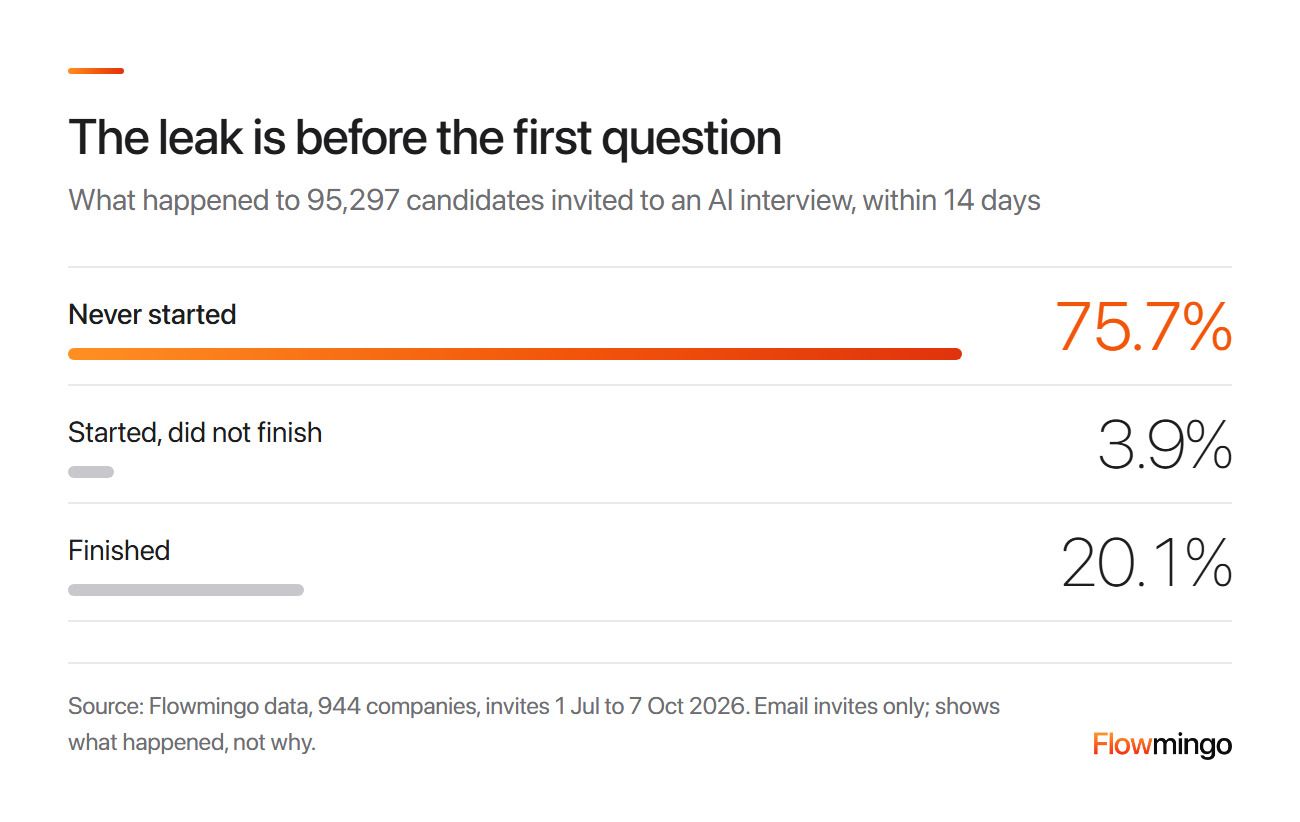
Invite outcomes: of 95,297 invited candidates, 75.7% never started, 3.9% started but did not finish and 20.1% finished within 14 days.
The data card makes the 2 easy explanations, bad delivery and a long interview, unlikely. Only 0.5% of the never-started invites had a recorded bounce or send failure, so bounces explain almost none of the loss.
Quitting partway is not the problem either, because only 3.9% of invitees started and then stopped, against 75.7% who never began. That is why 95.1% of those who did not finish never began, and why a shorter interview would win back little.
Once people begin, they mostly finish: 83.8% of starters completed the interview within 14 days. That is a different measure from the 83.6% in section 3, which counts the finishers who were done within 72 hours.
What stops people sits before the first question, because each extra link, account or form costs you. In Greenhouse's 2025 report, 46% of US candidates abandoned applications that made them re-type CV details.
Who leaves is not random, and that shapes your shortlist. In a 2000 study, now more than 25 years old, of 3,550 police applicants facing several hiring hurdles, those who withdrew differed from those who stayed in most areas measured (Ryan and colleagues).
Women's and African Americans' views of the process also differed from the majority's, which the authors note makes diversifying harder. The fixes below come from practice rather than a study, and our invitation email templates show them in full:
- Send 1 link with the application, or right after it.
- Say the format, the minutes and the deadline in the invite.
- Ask for nothing to install, and send 2 reminders: 1 on day 2 and a last nudge on day 5.
- Tell people what happens next, and when.
4.1 Will strong candidates walk away if an AI runs the first screen instead of a person?
Some will, if you hide it. In Greenhouse's 2026 survey, 38% of US job seekers had walked away from a hiring process over an AI interview.
Surprise is part of the reason, because 70% said they were never clearly told upfront that AI would evaluate them. Trust starts low as well: in a Gartner survey, only 26% of candidates trusted AI to judge them fairly (Gartner).
So name the AI step in the invite, say what it scores and offer a person instead, using the notice in section 8. Our completion-rate guide goes further and splits finishing by device.
5. When 2 of us shortlist different people from the same CVs, how do we make it consistent?
Agree 4 to 6 weighted criteria before the first CV, then score every applicant against them with a reason per criterion. A platform applies the same rubric to applicant 1 and applicant 900, in any order.
You and a colleague disagree because each of you carries a private bar. In a 2013 review of 125 reliability estimates, more than 10 years old, interviewers meeting the same candidate separately agreed at 0.44 on a 0 to 1 scale, where 1 means they always agree.
Interviewers on a panel, by contrast, agreed at 0.74 (Huffcutt and colleagues). The review measured interviews rather than CV reads, but the same private-bar problem applies to a pile of CVs.
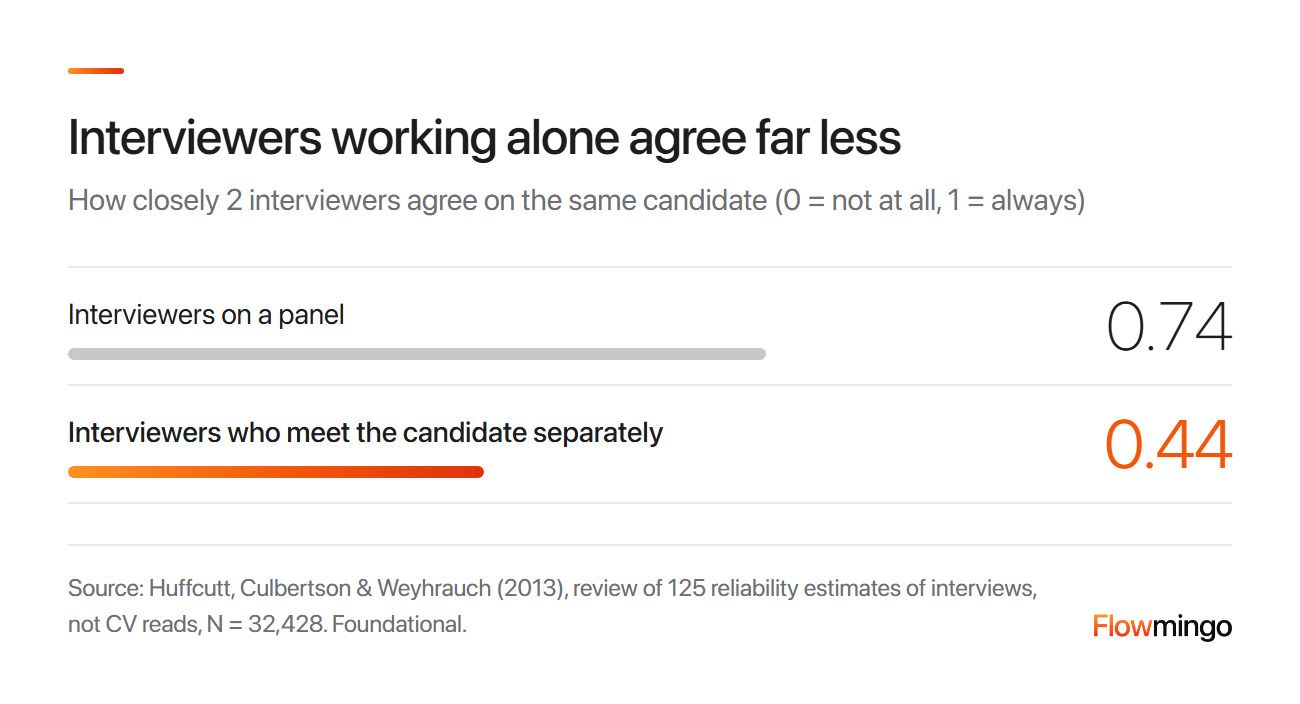
Interviewer agreement: a panel agrees at 0.74. Interviewers who meet the same candidate separately agree at only 0.44 (a 2013 review of interviews, not CV reads, more than 10 years old).
The order in which you read applicants matters too. In a 2025 study of high-stakes admission and hiring panels, a strong previous candidate pulled the next one's vote down: back-to-back votes were negatively correlated by up to 40% (Radbruch and Schiprowski).
Weighted scores with reasons fix both problems, the private bar and the order effect, because each applicant is measured against the same criteria rather than against whoever came before.
They also give a home to the applicants who fit only part of the brief, since a 60% match lands in a ranked list instead of a maybe pile. As 1 recruiter put it on r/recruiting, "The 60% matches are what eat the day."
Our CV screening and candidate shortlisting guides cover writing the criteria. Here is what a hiring manager should then receive for a Customer Support Lead, as an illustration rather than customer data:
| Criterion (weight) | CV /10 | Interview /10 | Reason |
|---|---|---|---|
| Support queue (Must Have) | 8 | 7 | Ran a 12-person queue, no time frame for the backlog cut |
| Coaching (Very Important) | 5 | 8 | Gave a specific 1:1 plan and result |
| Help-desk tool (Important) | 7 | 6 | Vague on reporting |
How Flowmingo helps
CV Evaluation scores each CV out of 10 against criteria weighted from Good to Have up to Must Have, with the reasons written out.
CV screening uses the same criteria as the interview, so the CV score and the interview score compare directly. CV Evaluation is unlimited on every plan, including the Free plan.
5.1 Every CV now looks AI-written: can a screen still tell who can actually do the job?
Yes, at the next step, because a live answer is far harder to polish than a CV line. A hiring manager on r/managers put it plainly: "Every resume is written by AI and looks exactly the same."
In other words, a polished CV now tells you about the applicant's AI tools. A Support Lead CV says "Led a high-performing support team," and so do a dozen others.
So ask 1 job question: describe a week your queue doubled, what you changed and what happened to response times. A strong answer names the queue size, the change and the result, while a weak one repeats the CV line.
Scored on the queue criterion, the strong answer and the weak one land far apart, even though the 2 CVs looked alike.
6. Our CVs, tests and video screens sit in 3 tools: should screening be 1 flow?
Yes: score the CV and the first interview on 1 set of criteria, and read them in 1 place. Every extra tool adds a link the candidate can drop at and a report you rebuild by hand.
The first interview belongs in that flow because, run with structure, it carries the strongest signal. In a 2022 re-analysis, now more than 3 years old, structured interviews ranked first among selection methods.
Their validity, the correlation between a method's scores and job performance, was 0.42. Job knowledge tests came next at 0.40, then empirically keyed biodata, scored questions about an applicant's background, at 0.38.
Work samples scored 0.33 and cognitive ability tests 0.31. People with set questions ran the interviews in that re-analysis, not an AI, so treat the estimates as the case for structure rather than as proof for any tool.
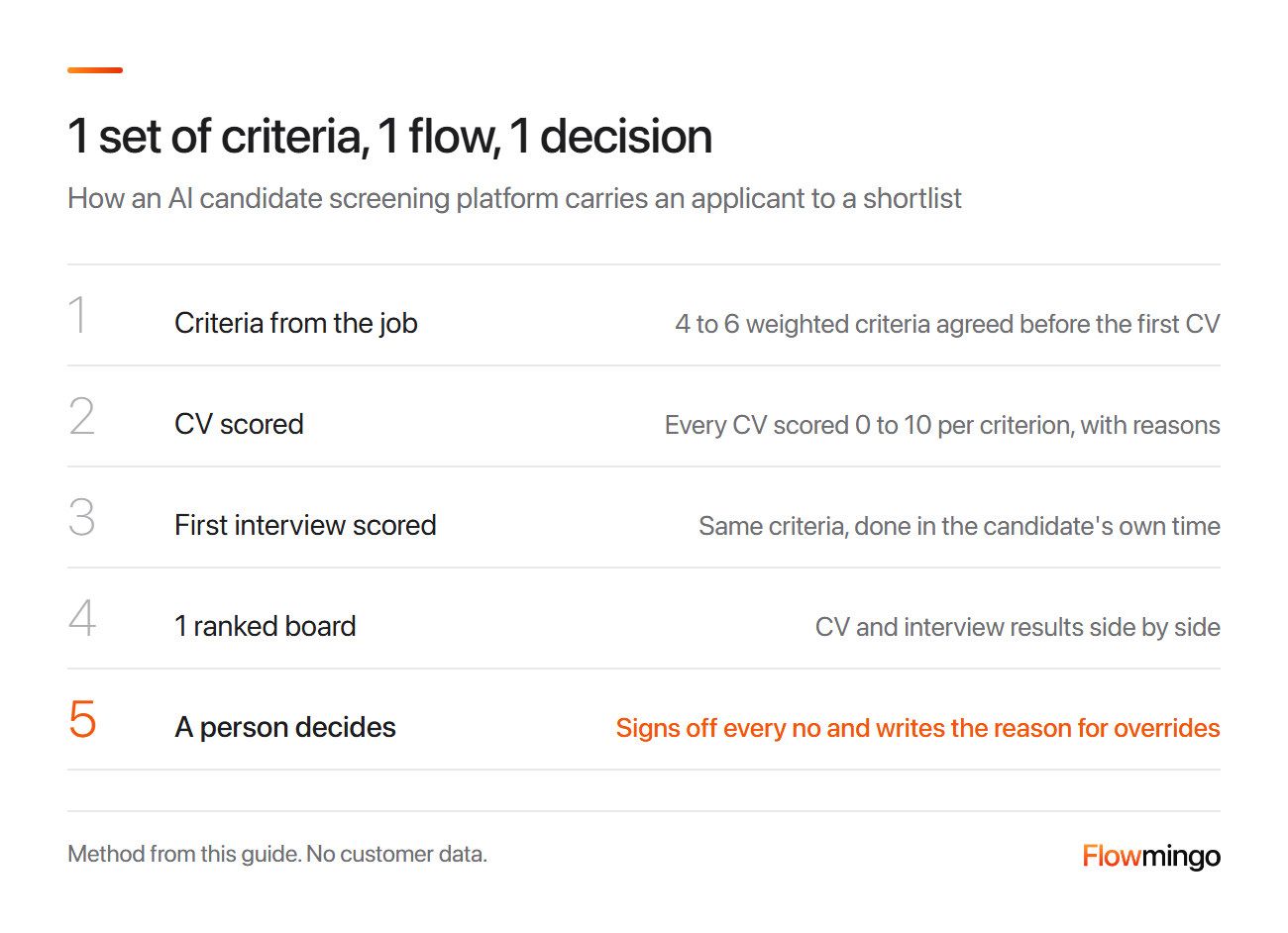
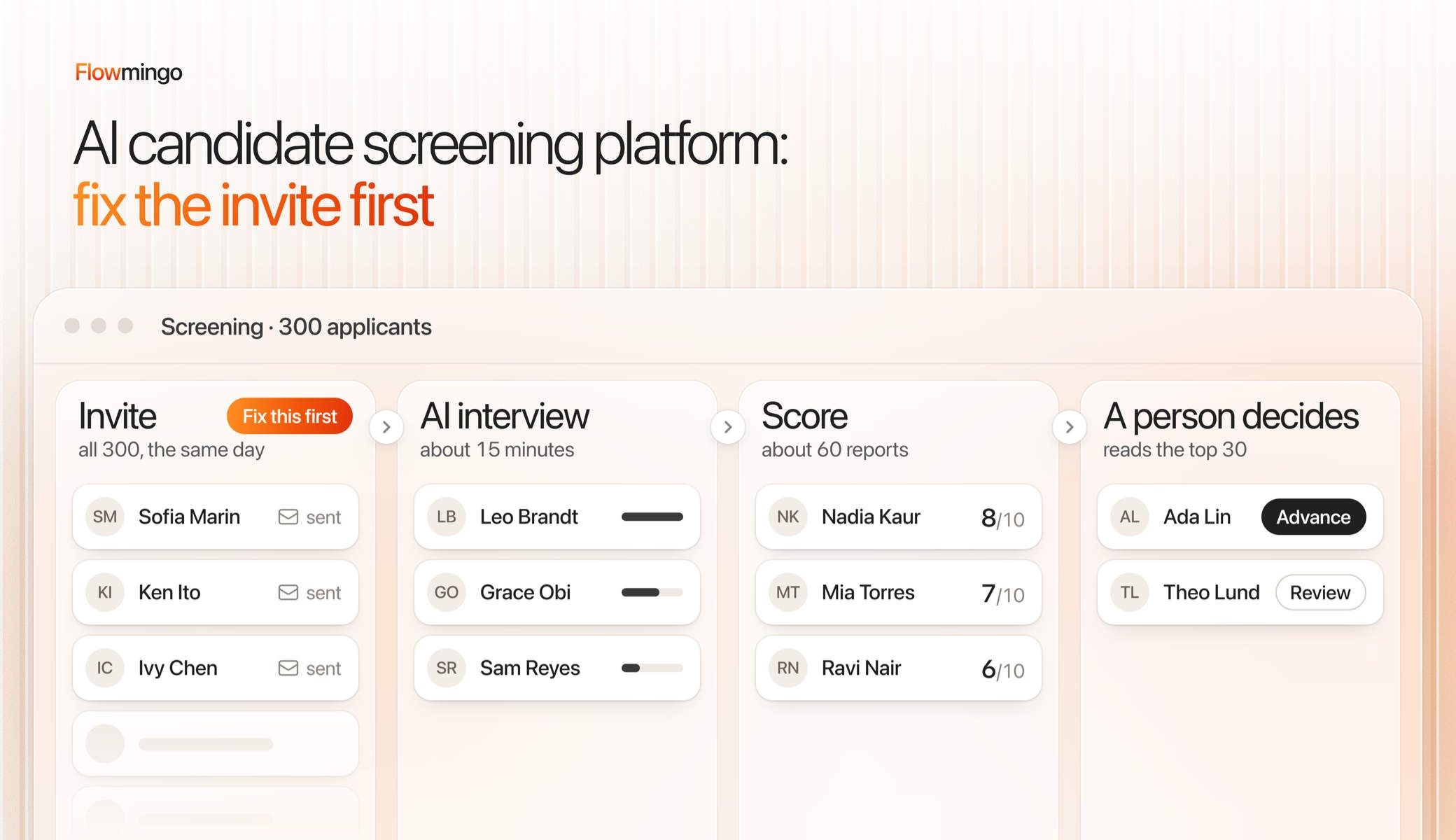
One-flow screening: criteria from the job, CV scored, first interview scored on the same criteria, 1 ranked board, then a person decides.
In practice, you set weighted criteria from the job, and the platform scores every CV out of 10 against them, with reasons. It then scores the first interview on the same criteria and puts both results on 1 ranked board, where a person decides.
6.1 Do I still need my ATS?
Keep your applicant tracking system (ATS) if it is your system of record, and make sure the score and a report link land on each candidate's record there. An ATS connector does that, so nobody types scores across by hand.
A team with no ATS may manage with a built-in tracker instead.
How Flowmingo helps
Paste the job, and the AI drafts the interview questions and weighted criteria. Every finished assessment lands on 1 board you can sort by score. The AI Interviewer returns a recording, a transcript and a scored report.
Flowmingo connects to 20+ ATSs on every plan and writes the AI interview score and a report link back in most of them (Workday receives a file). It sends the AI interview at the stage you pick.
A REST API, webhooks and MCP (the Model Context Protocol) are free.
7. Can an AI candidate screening platform reject applicants alone, or must a person approve each no?
Let the AI candidate screening platform score and rank everyone, but have a person sign off every no. Candidates ask for exactly that, and European law turns on it.
Recruiters themselves doubt their filters. In Greenhouse's November 2025 survey, only 21% of US recruiters felt very confident that their systems were not rejecting qualified candidates.
Candidates want the same check. Among the 1,200 US job seekers in Greenhouse's 2026 survey, 46% wanted the option of a human interview and 44% upfront disclosure of AI use.
Further down their list, 39% wanted to know what the AI measures, 38% a human review before any decision and 29% evidence the tool was audited for bias. Each could pick several, which means the shares add up to more than 100%.
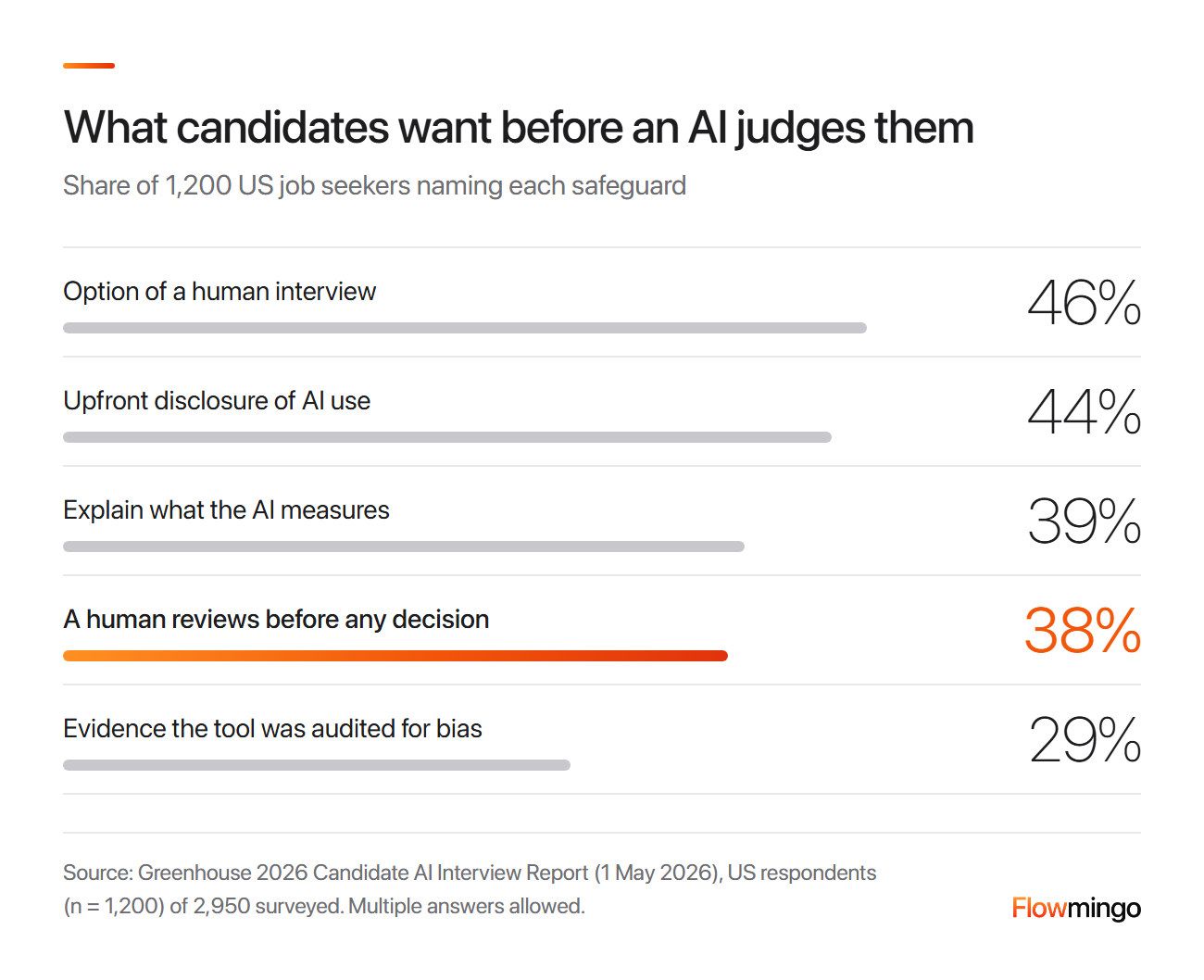
Candidate safeguards: what 1,200 US job seekers asked for in Greenhouse's 2026 survey, with a human review before any decision highlighted.
The legal hinge is Article 22 of the GDPR, the EU's data protection law, which dates from 2016. It gives people the right not to face a significant decision based solely on automated processing (GDPR Art. 22).
The simplest way to stay clear of it is for a person to make every advance and every no. Let the platform score and rank, then have a person read every report before a rejection, and also the band just under the cut-off, where a rubric is most likely to miss an unusual profile.
Treat integrity flags, such as a tab switch during an AI interview, as prompts to review rather than penalties, and give every override a written reason.
Who signs off matters too. From 2 Dec 2027, the EU AI Act, the bloc's law on artificial intelligence, asks for someone with the competence, training and authority to overrule the score (Article 26).
How Flowmingo helps
Flowmingo rejects nobody automatically: it returns a score with its reasons, and every decision stays with your team.
In an AI interview, integrity signals such as tab switches are for review only, never an automatic penalty. Flowmingo does not score face or appearance. The FAQ explains how scoring works.
8. Is it legal to use an AI candidate screening platform, and what must I tell candidates?
Yes, in most places, if you tell candidates, keep a human review point and can explain the result. This is general information, not legal advice.
Read the rules for the places where you hire. The sample invite at the end of this section carries the notice most of them ask for.
In New York City, Local Law 144 has applied for more than 3 years, since 5 Jul 2023 (NYC DCWP). It covers tools that substantially assist or replace the decision.
For those tools, the employer or agency, not the vendor, owes a yearly independent bias audit and a published summary of it. It must also notify candidates at least 10 business days before it uses the tool.
In the EU, the AI Act counts AI that filters job applications as high-risk (Annex III). From 2 Dec 2027, a deadline moved back from 2 Aug 2026, employers must assign trained human oversight, keep logs for at least 6 months and tell candidates (Cooley).
The GDPR's Article 22 is in force now: candidates facing a solely automated significant decision can get human intervention, give their view and contest it.
In the UK, the Data (Use and Access) Act 2025 made automated decisions easier to use, but the safeguards remain. The ICO, the UK's data protection regulator, still says: tell candidates, explain how to challenge and offer human review.
In the US, a federal court in May 2025 preliminarily let applicants aged 40 and over proceed as a nationwide group against Workday, the HR software vendor, in Mobley v. Workday, an age-discrimination case over its AI screening (Holland & Knight).
The case shows that a screening vendor itself can face AI-bias claims before any finding of discrimination.
Colorado's SB26-189, signed on 14 May 2026, applies from 1 Jan 2027. It adds notice, a plain-language explanation within 30 days of a rejection and human review on request, where commercially reasonable.
Singapore expects its Workplace Fairness Act by end-2027 for firms with 25+ staff. Its Tripartite Alliance for Fair and Progressive Employment Practices (TAFEP) already asks for the same job-related criteria for everyone and records kept at least 1 year.
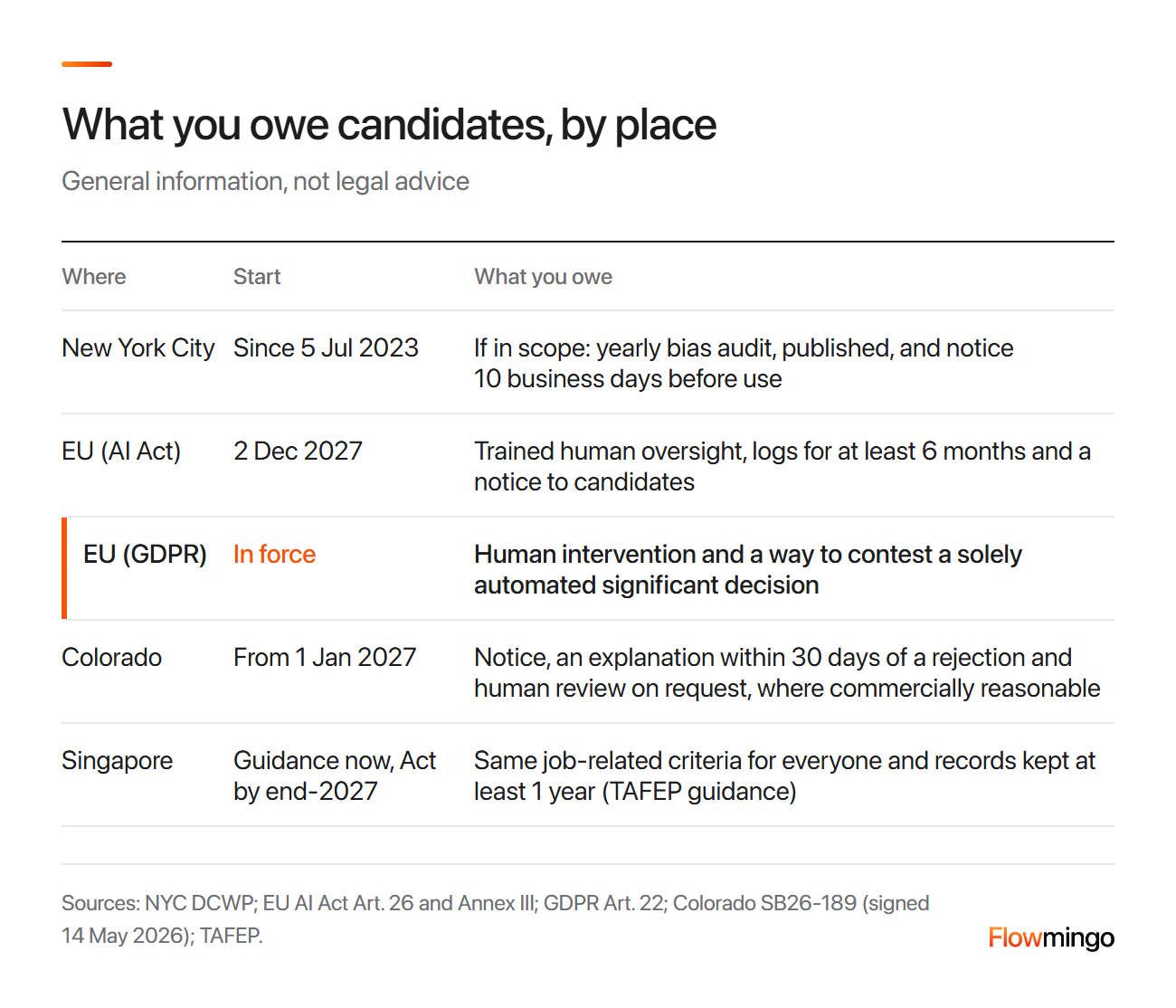
Legal duties by place: NYC since 2023, the EU from 2 Dec 2027 and GDPR in force. Colorado from 1 Jan 2027 (signed 14 May 2026), Singapore by end-2027.
Send this invite from a named person, because nearly every rule above starts with telling candidates:
Subject: Next step for [Role] at [Company]: a [15]-minute AI interview
Hi [First name], the first step is an AI interview in your browser, about [15] minutes, with nothing to install.
What it scores: your answers against the job criteria, not your face or appearance.
Who decides: a person on our team reviews every result before any decision.
Finish by: [Fri 4 Dec], 7 days from today: [interview link]
Prefer a person: reply to ask for a human interview or review instead.
You hear back by: [date, within 2 weeks of applying].
[Your name], [title], [Company]
Keep the line about face and appearance only if it is true of the tool you use.
9. What should I ask an AI candidate screening platform vendor before I sign?
Ask what the AI scores and why, where a person signs off, how candidates hear about it and how the vendor tested for bias. Then pilot it on your hardest role and compare its shortlist with your hiring manager's.
Ask for evidence on bias rather than a promise, because even audited vendors had gaps. The ICO's audits of AI recruitment tool providers, published in November 2024, found filters that could exclude people with protected characteristics (ICO).
The auditors also found tools that inferred gender and ethnicity from an application or just a name, often without a lawful basis or the candidate's knowledge.
Ranking CVs by their similarity to a job description can carry race bias too. In a test of 3 such retrieval models, CV rankings favoured White-associated names in 85.1% of the race comparisons (Wilson and Caliskan).
| Ask | A good answer |
|---|---|
| What exactly does the AI score? | Your criteria, the same for CV and interview, with reasons |
| Can it reject anyone on its own? | No, a person signs off |
| Do you infer protected traits or allow filters on them? | No, with bias test results you can read |
| What share of invitees start and finish? | Real numbers with a scope |
Judge the answers, not the demo. A weak reply to the reject question is "only if you switch on auto-reject," because then, in a busy week, someone will. A weak reply on start and finish gives 1 rate with no dates or count.
9.1 Which numbers prove the platform fixed our leaks?
Count 5 numbers before go-live and again after 4 weeks, because without a baseline you cannot show a change. Each one tracks 1 of the 3 leaks from section 1, as the last column shows.
Most UK employers lack a baseline even for time to hire. The CIPD, the UK's professional body for HR, found in its 2026 survey that fewer than 1 in 3 UK employers tracked it.
| Metric | How to count it | Leak |
|---|---|---|
| Hours to first reply | Median, per role | 1 |
| Invite-to-start rate | Started within 14 days, divided by invited | 2 |
| Start-to-finish rate | Finished, divided by started | 2 |
| Shortlist overlap | Hiring manager's blind picks in the top band | 3 |
| Days to decision | Application to a yes or no | 1 |
Then pilot 1 role with 100+ applicants for 4 weeks, so 2 cycles of the 2-week decision window from section 3 finish. Have your hiring manager shortlist blind from the CVs, compare with the platform's top band and read every disagreement.
10. Few roles, 200+ applicants each: is an AI candidate screening platform worth paying for?
Usually yes, because 1 missed hire or a lost weekend costs more than a low monthly fee. Free plans now cover real screening, so do the arithmetic on 1 role first.
Few UK employers screen with AI yet. In CIPD's 2026 report, only 16% of UK organisations used AI to screen candidates, and 32% of the organisations using AI reported a shorter time to hire.
Here is 1 role with 300 applicants, before and after a screening platform, with every assumption labelled.
| Step | Manual | With a screening platform |
|---|---|---|
| Read CVs | 300 x 2 minutes = 10 hours (assumption) | Top 30 with reasons, 30 x 2 minutes = 1 hour (assumption) |
| First screens | 30 phone screens x 20 minutes = 10 hours (assumption) | Invite all 300, about 60 reports, read the top 30 x 5 minutes = 2.5 hours (assumption) |
| Recruiter hours | About 20 | About 3.5 |
That is about 16.5 hours back on 1 role, by our arithmetic. The 60 reports come from the 20.1% finish rate in the section 4 data card, a Flowmingo rate across all invites, so use your own.
The saving does not come from cutting the close reads, because both columns still read 30 people closely. Skipping 270 CVs saves 9 hours, and replacing the phone screens saves the other 7.5.
The pain is real for small teams. A business owner on r/smallbusiness lost a whole Sunday to 200+ CVs and said an agency fee of $10k+ "would wipe out" the onboarding budget.
A free plan costs you nothing to test. If you hire for 3+ roles a year with 100+ applicants each, try one on your next role.
How Flowmingo helps
Flowmingo is a free AI hiring platform. CV Evaluation and AI interviews are unlimited on every plan, including the Free plan, with no charge per candidate.
Free keeps the latest 300 videos for 30 days and gives 3 report downloads in total. Free sessions also carry Flowmingo's brand next to yours and may show candidates optional offers.
For more video and unlimited downloads, Flowmingo Pro, the paid tier, comes as 3 plans, Starter, Growth and Scale, from $49 a month or $42 a month billed annually.
Candidates take the interview free, and buying optional practice never changes their score. See pricing, and run your next role on the free AI candidate screening platform from Flowmingo.
11. Sources
Every study, law and quote in this guide links to a source below. Flowmingo figures come from Flowmingo's own platform records.
- Becker, W. J., Connolly, T., & Slaughter, J. E. (2010). The effect of job offer timing on offer acceptance, performance, and turnover. Personnel Psychology, 63(1), 223-241.
- CIPD (2026). Resourcing and talent planning report 2026. CIPD.
- Colorado General Assembly (2026). SB26-189. Colorado General Assembly.
- Cooley (2026). Digital AI Omnibus delays key deadlines, introduces new rules. Cooley.
- European Union (2024). Artificial Intelligence Act, Article 26: Obligations of deployers of high-risk AI systems. artificialintelligenceact.eu.
- European Union (2024). Artificial Intelligence Act, Annex III: High-risk AI systems. artificialintelligenceact.eu.
- European Union (2016). General Data Protection Regulation, Article 22. gdpr-info.eu.
- Fuller, J. B., Raman, M., Sage-Gavin, E., & Hines, K. (2021). Hidden workers: Untapped talent. Harvard Business School and Accenture.
- Gartner (2025, July 31). Gartner survey shows just 26% of job applicants trust AI will fairly evaluate them. Gartner newsroom.
- Greenhouse (2024). Greenhouse candidate experience report 2024. Greenhouse.
- Greenhouse (2025). 2025 workforce and hiring report. Greenhouse.
- Greenhouse (2025, November 19). An AI trust crisis [Press release on the 2025 AI in Hiring Report]. Greenhouse newsroom.
- Greenhouse (2026). The Hire Standard: Greenhouse benchmark report, March 2026, North America. Greenhouse.
- Greenhouse (2026, May 1). 63% of job seekers have faced an AI interview. Most haven't had a good one yet. Greenhouse 2026 Candidate AI Interview Report.
- Grossman, K. (2025, January 23). 12 key takeaways from the 2024 candidate experience benchmark research. ERE.
- HR Dive (2026, May 13). Recruiters see job applications triple to more than 300 per role. HR Dive.
- Holland & Knight (2025, May 27). Federal court allows collective action lawsuit over alleged AI hiring bias. Holland & Knight.
- Huffcutt, A. I., Culbertson, S. S., & Weyhrauch, W. S. (2013). Employment interview reliability: New meta-analytic estimates by structure and format. International Journal of Selection and Assessment, 21(3), 264-276.
- Information Commissioner's Office (2024). AI tools in recruitment: Audit outcomes report. ICO.
- Information Commissioner's Office (2026, March 31). News post on automated decisions in hiring and the safeguards they need. ICO.
- Ministry of Manpower (2024, November 12). Introduction of Workplace Fairness Legislation to preserve and entrench fair and harmonious workplace norms [Fact sheet on the Workplace Fairness Bill first reading]. Ministry of Manpower, Singapore.
- NYC Department of Consumer and Worker Protection (n.d.). Automated employment decision tools (AEDT). City of New York.
- Radbruch, J., & Schiprowski, A. (2025). Interview sequences and the formation of subjective assessments. Review of Economic Studies, 92(2), 1226-1256.
- Ryan, A. M., Sacco, J. M., McFarland, L. A., & Kriska, S. D. (2000). Applicant self-selection: Correlates of withdrawal from a multiple hurdle process. Journal of Applied Psychology, 85(2), 163-179.
- Sackett, P. R., Zhang, C., Berry, C. M., & Lievens, F. (2022). Revisiting meta-analytic estimates of validity in personnel selection. Journal of Applied Psychology, 107(11), 2040-2068, as reported by SIOP.
- Survale (2026, July 21). 2025 candidate experience (CandE) benchmark research: Key statistics. Survale (the CandE program, founded by Talent Board in 2011, is now part of Survale).
- Tripartite Alliance for Fair and Progressive Employment Practices (2026). Workplace Fairness Act: Fair recruitment practices for employers in Singapore. TAFEP.
- Wilson, K., & Caliskan, A. (2024). Gender, race, and intersectional bias in resume screening via language model retrieval. Proceedings of the AAAI/ACM Conference on AI, Ethics, and Society, 7(1), 1578-1590.
- Reddit threads quoted: r/recruiting, r/managers and r/smallbusiness.