
Your calendar was full before the first of 60 applications for 1 role came in. Learning how to conduct an interview as a manager fell to you, because nobody on staff recruits full time.
In SHRM's 2025 benchmarking survey of 2,371 members, only 55% of organisations had dedicated in-house recruiters. In the rest, interviews fall to agencies, busy HR staff or managers like you.
Say you give all 60 a 45-minute call: that is 45 hours, more than a working week. A free-flowing chat also predicts job performance about half as well as a structured interview.
The fix comes down to 3 moves. Decide what good looks like before the CVs, and send everyone the same recorded first round. Then meet only the shortlist, score each interview alone and close on a date.
Key takeaways
- What are the steps to conduct an interview? 6: criteria first, a recorded first round, an agenda, the same questions with follow-ups, a dated close and a score.
- Is a structured interview really better than a conversation? Yes. Set questions and a scoring guide predict job performance about twice as well as a free chat.
- How do I interview 60 applicants without 45 hours of calls? Send all 60 the same recorded first round, then meet the top 5: about 5 hours. In Flowmingo data, 6 in 10 AI interviews started outside office hours, though most candidates were in India and Nigeria.
- Which questions can't I ask in a job interview? In the US, avoid family, religion, national origin and age, protected from 40, which the EEOC may treat as evidence of discrimination. The ADA bars health questions before a conditional offer, and many states bar asking current pay.
- What should I say at the end of an interview? The next step and a date within 7 days, then keep it.
1. How to conduct an interview as a manager when you have never run one?
Run 6 steps: prepare, first round, open, ask and probe, close and score. None needs a recruiting team.
The steps matter because a free chat is a weak way to judge people. In Sackett and colleagues' foundational 2022 re-analysis, structured interviews ranked first, at 0.42 against 0.19 for unstructured ones.
That number shows how closely interview scores track later job performance, from 0 for no link to 1 for a perfect match. So the structured version is about twice as strong.
For example, open a support lead role on Monday and write the criteria that day. Send the recorded round on Tuesday with 7 days to finish. From the next Wednesday, read the reports and meet your top 5.
Each live slot is 45 minutes, plus 15 alone to check your scores, so the 5 take about 5 hours.
| Step | What you do | Time | Done when |
|---|---|---|---|
| 1. Prepare | 4 to 6 criteria, must-have or teachable, 1 question each, before CVs | About 1 hour (our estimate) | Strong and weak answers written |
| 2. First round | The same recorded interview for all who pass the hard facts | 0 calendar slots | A ranked list and 3 to 6 names |
| 3. Open | You, the job, the agenda, your notes | 3 minutes | They know the plan |
| 4. Ask and probe | About 6 main questions, 2 follow-ups each | 30 minutes | An example under every criterion |
| 5. Close | Their questions, the next step, a date | 12 minutes | They know when they will hear |
| 6. Score | Each criterion 1 to 5 right after its questions, then check every score against your notes, alone | 15 minutes, straight after | A score and a reason on every row |
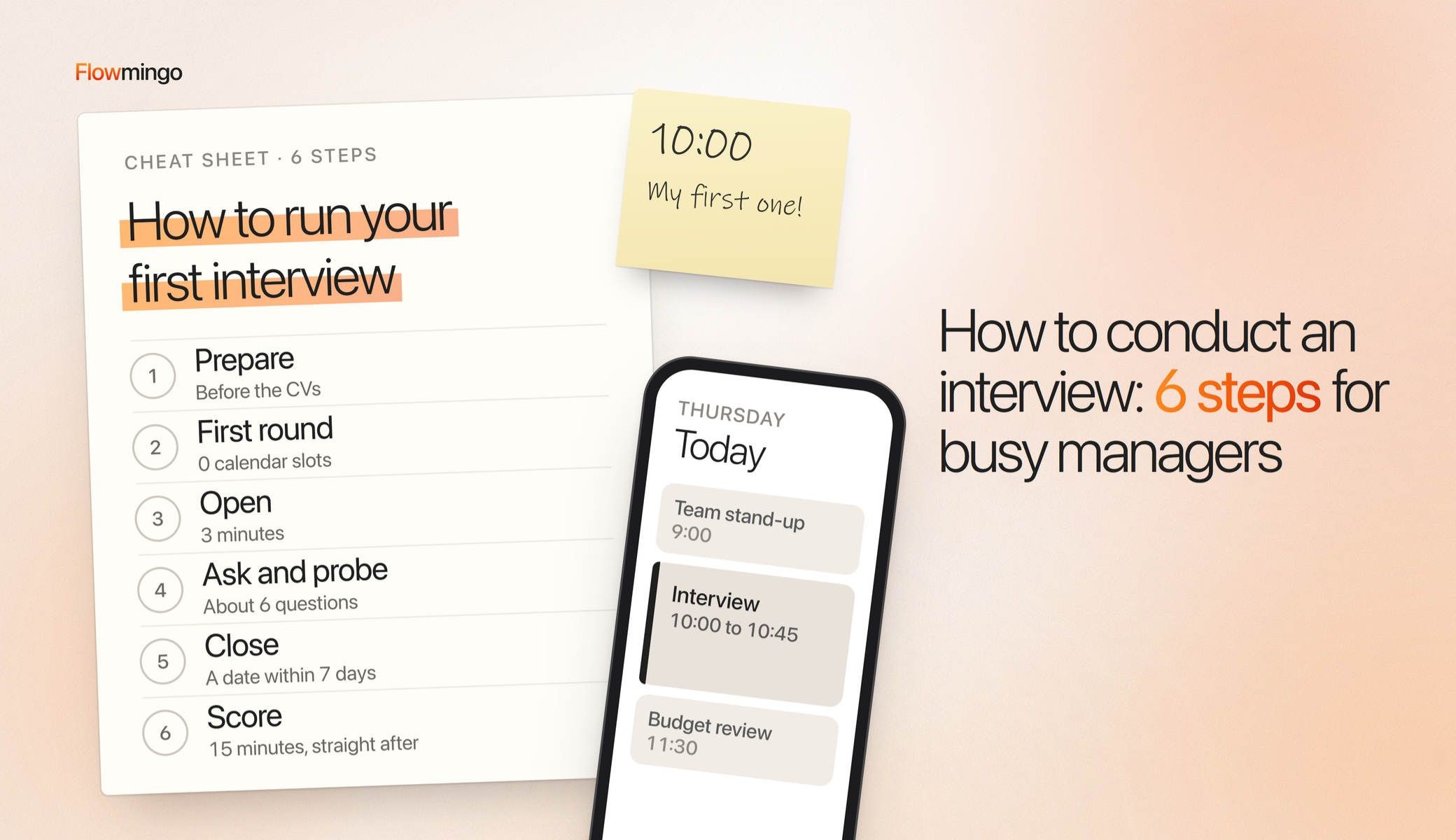
The figure picks out step 2, the biggest time saver.
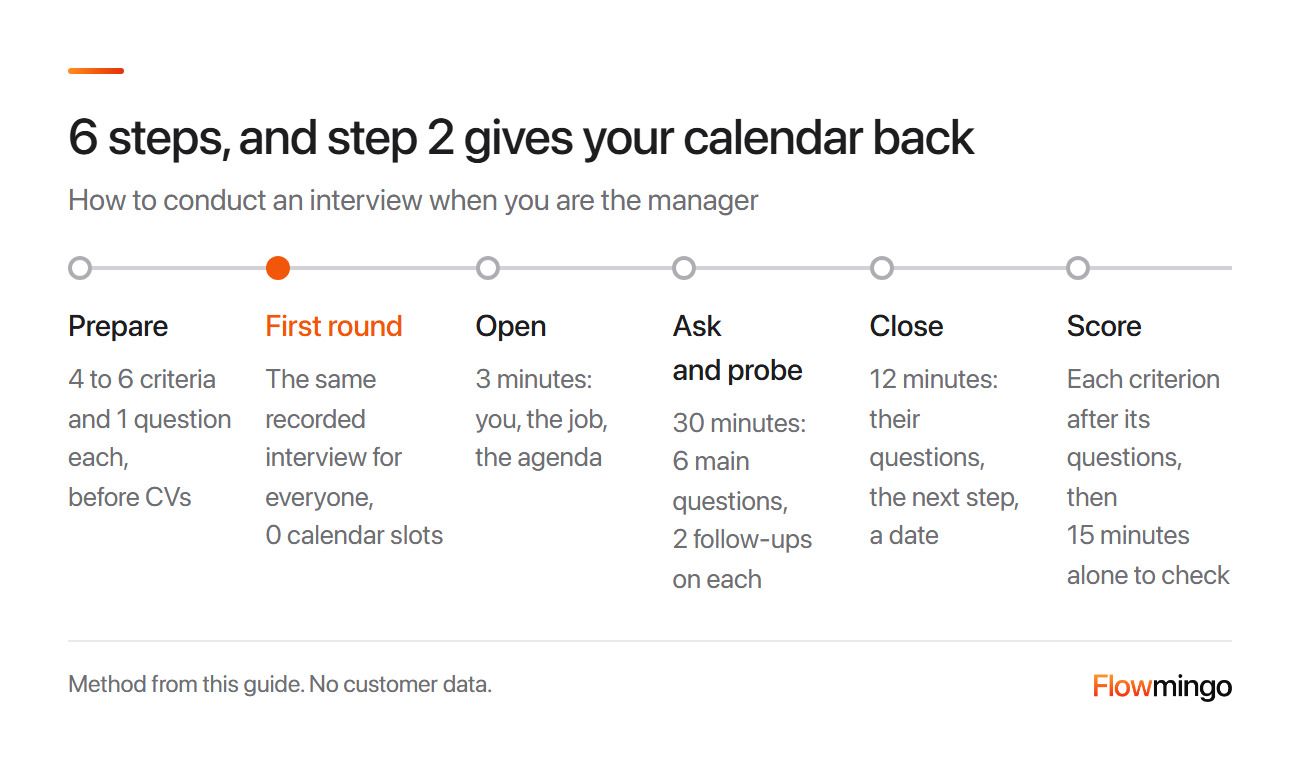
The 6-step interview: prepare, first round, open, ask and probe, close and score, with step 2 keeping all but the shortlist off your calendar.
In a r/managers thread from a first-time manager, the top reply recommends an agenda. Another asks the same 5 questions in a short phone screen.
For the full method behind steps 4 and 6, see our structured interview guide.
2. What should I decide about the role before I read a single CV?
Pick 4 to 6 things the person must be able to do, mark each must-have or teachable, and write 1 question for each. Do it before the first CV, so the pile cannot rewrite your criteria.
The order matters because CVs and first impressions quietly reset the bar. In 3 foundational studies from 2013, Dana, Dawes and Peterson had people predict students' grades, some after an interview.
People felt just as sure of their impressions when the interviewee answered at random. The unstructured interview made their predictions worse, not better.
For example, a support lead must calm an angry customer on day 1, but can learn your ticket tool in a week. Hard facts, such as working 2 Saturdays a month, go in the application as pass-or-fail questions, because they need no interview to check.
For each criterion, write what a strong and a weak answer sound like, as in this illustrative example. Those lines become your scoring anchors.
| Criterion | Type | Question | Strong (5) | Weak (1) |
|---|---|---|---|---|
| Calms an escalated customer | Must have | "Tell me about the last time a customer escalated to you." | The issue, their own steps, the outcome | "We", or what should happen |
| Coaches junior agents | Must have | "Tell me about someone you helped get better." | A named person, the method, a measured change | "I'm a people person" |
| Spots patterns in tickets | Teachable | "Tell me about a problem you found across tickets." | The pattern, how they found it, the fix | No example |
| Writes clear replies | Teachable | Rewrite 1 real reply in the first round | Short, correct, kind | Long or vague |
The first r/managers reply asks the same things: the role, the key skills, and whether it is new. Every later step borrows from this sheet.
3. How to conduct an interview round without losing a week of your calendar?
Do not give everyone a live slot. Send all who pass the hard facts the same recorded first round, then meet the top 3 to 6.
That turns 45 hours of calls into about 5. Recordings take time too, so read each scored report and watch only the deciding answers.
In a 2025 mock-interview experiment with 229 people, Germanier and colleagues found similar answers and performance live and on camera, and both predicted work-sample results.
Give candidates about 7 days to finish, as our interview invitation email templates advise, because many use hours you are not offering.
Flowmingo data · 48,512 completed AI interviews · 931 companies · finished 24 Jun to 5 Oct 2026
- 6 in 10 completed AI interviews started outside weekday 9:00 to 17:00 in the candidate's own time zone.
Device time zones, mostly in India and Nigeria, so this is not a global average. It shows choice, not that a daytime slot was impossible.
The chart's accent bar is the weekday evening, the biggest block outside office hours and almost a third of starts.
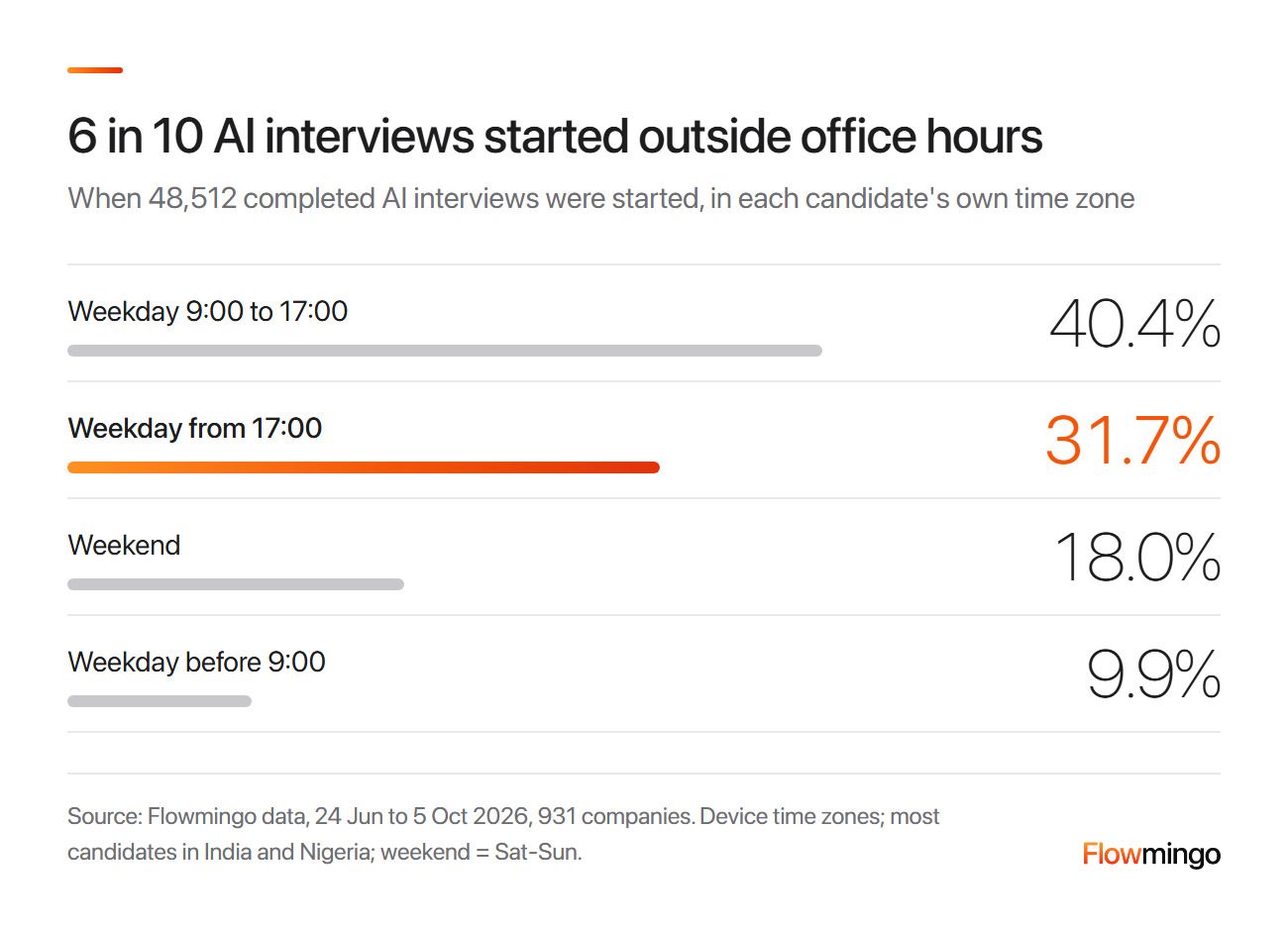
When candidates interview: 40.4% of AI interviews started on a weekday from 9:00 to 17:00 and 31.7% on a weekday from 17:00. 18.0% started at the weekend and 9.9% on a weekday before 9:00.
3.1 What should I tell candidates about a recorded first round?
Say what scores the answers, AI or a person, and that a person reviews every report before anyone is turned down. Then make sure someone does.
Many candidates distrust a machine judge. Only 26% of 2,918 candidates in Gartner's 2025 survey trusted AI to evaluate them fairly. In 2 foundational 2023 studies, Oostrom and colleagues found algorithm scoring felt less fair to candidates.
So name the reviewer:
You'll answer about 6 questions on camera, plus a short follow-up when needed, in your own time, by [date 7 days out, time, time zone]. AI scores each answer against this role's criteria. [Name], the hiring manager, reviews every report before anyone is turned down. [Illinois or New York City: add the notice and consent the law requires.]
Local law adds duties when AI scores the video. For Illinois-based jobs, give notice, explain how the AI works, get consent, limit sharing and delete videos within 30 days on request (foundational 2019 summary). Since 1 January 2026, Illinois HB 3773 also requires notice of AI in hiring decisions and bars AI with a discriminatory effect (Public Act 103-0804).
New York City's Local Law 144 covers an automated tool whose score you use alone, weight above other factors or use to overrule people. It needs an independent audit for bias within the past year, a public summary and 10 business days' notice.
The EU AI Act lists AI that evaluates candidates as high-risk. This is general information, not legal advice.
How Flowmingo helps
Flowmingo's AI Interviewer runs step 2. Paste the job description, and AI drafts questions and scoring criteria for you to edit. When an answer is thin, the AI asks a follow-up. You get the recording, the transcript and a report scoring each criterion 0 to 10, and you decide who gets a live slot.
4. How to conduct an interview on Zoom, Teams or in person: what do you say first?
Spend the first 3 minutes on you, the job, the plan for the time and your notes. Then ask your first question and let the candidate do most of the talking.
The opening matters because judgments form fast. In a foundational 2016 study by Frieder and colleagues, 166 interviewers at a university career centre reported when they decided on 691 applicants.
Interviewers said 4.9% of decisions came in the first minute, about 30% within 5 minutes and 17.7% after 15 minutes. More than 1 in 5 decisions (22.5%) came only after the interview ended, when the verdict rests on memory. So score each criterion right after its questions, as our interview scorecard template advises, and hold your overall verdict until the end.
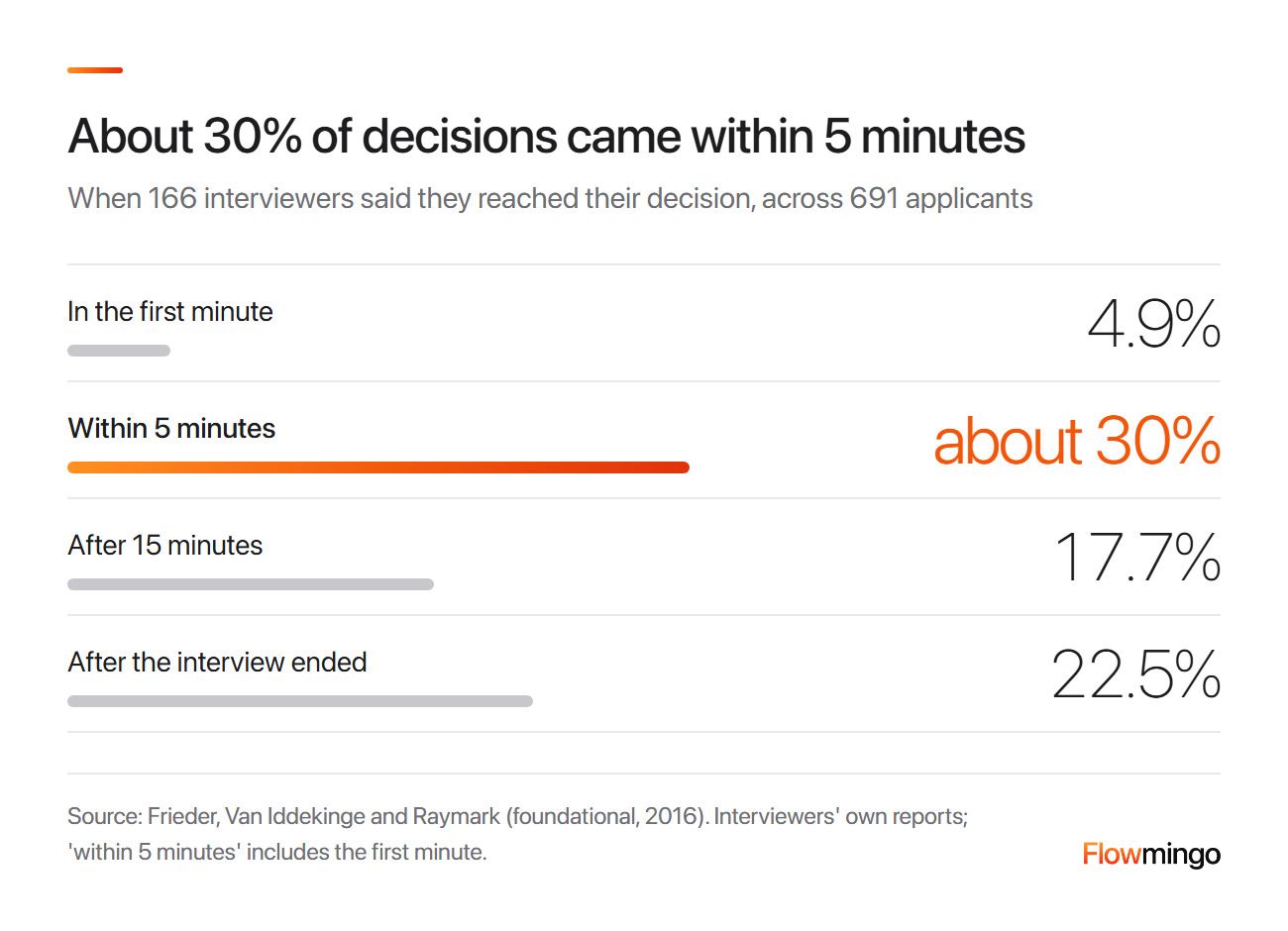
When interviewers decide: 4.9% of decisions in the first minute, about 30% within 5 minutes, 17.7% after 15 minutes and 22.5% after the interview ended.
Asking everyone the same questions tended to make interviewers decide more slowly, so structure holds off the snap judgement. This script sets the agenda:
- "Hi [first name], I'm [name], I run [team], and this role reports to me."
- "The job in 1 line: [what the person will own in the first 90 days]."
- "We have 45 minutes. I'll ask about 6 questions about things you've done, then you get time for yours."
- "I'll take notes, and I want specific examples, so take your time."
- "What made you apply for this role?"
Line 5 keeps the warm-up on the job, away from small talk that drifts toward topics the law protects.
On Zoom or Teams, send the link with a backup phone number, then check photo ID against the recorded round. In a separate 2025 Gartner survey, 6% of 3,000 candidates admitted interview fraud. In person, say who greets the candidate and where.
5. Should I ask every candidate the same questions, or just have a conversation?
Ask every candidate the same main questions in the same order, and score them on the same scale. The follow-ups can differ with each answer, but the main questions stay fixed.
Sackett and colleagues' foundational 2022 re-analysis rechecked decades of hiring research and lowered most estimates. In commonly reported figures, the structured interview came first at 0.42. A job knowledge test followed at 0.40 and a work sample test at 0.33.
A cognitive ability test scored 0.31, and the unstructured interview came last of these 5, at 0.19, where 0 means no link to job performance.
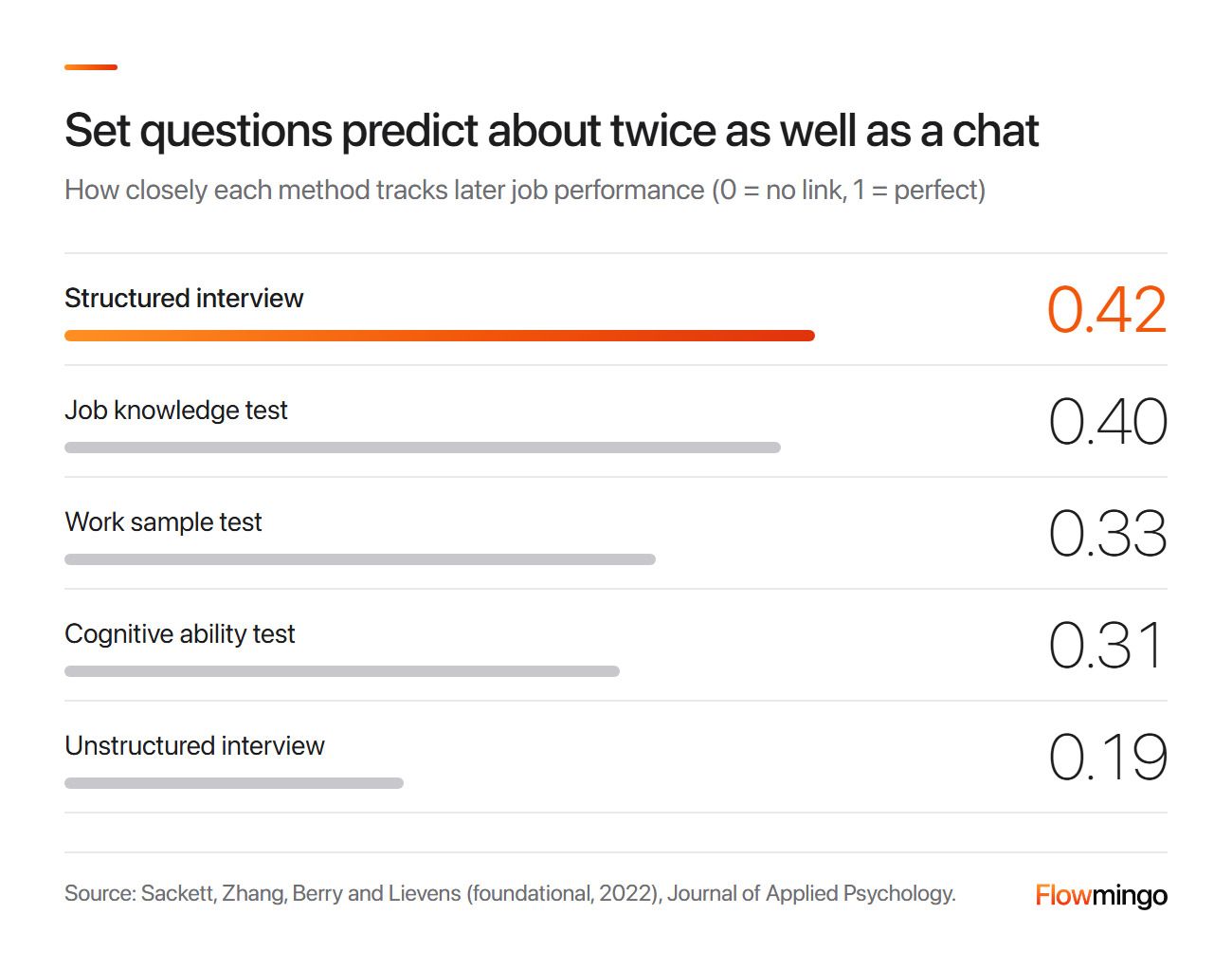
Structured vs unstructured interview: in a foundational 2022 re-analysis, the structured interview scored 0.42 and the unstructured one 0.19.
Structure helps because it limits each interviewer's room for taste. The US Office of Personnel Management says it raises interviewers' agreement by limiting their discretion.
Singapore's TAFEP gives the same advice: an objective, consistent list of questions tied to the selection criteria.
For example, every candidate for the support lead role hears "Tell me about the last time a customer escalated to you". Write about 6 questions like it, and our structured interview guide has 12 more.
A panel is optional, though TAFEP recommends diverse panels where feasible. 1 colleague who scores separately checks your own view.
6. How do I ask follow-up questions that get past rehearsed or AI-polished answers?
Plan 2 follow-ups for every main question, chosen from the ladder below. A rehearsed answer runs out after the first probe, while a real one gets more specific.
Polished answers are cheap now. In an r/managers post with 291 comments, a hiring manager wrote that every CV now looks AI-written and the same.
A foundational 2014 review by Levashina and colleagues treats probing as part of how structure works, not a break from it.
Pick 2 rungs per main question in advance, and keep the rest for vague answers. The "we" rung comes from OPM's interview training deck, which tells interviewers to ask what the candidate did themselves.
| After the main answer | Probe | What it checks |
|---|---|---|
| Situation | "When did this happen?" | It really happened |
| Task | "What was your part, exactly?" | Their role, not the team's |
| Action | "What did you do first?" | The behaviour |
| "We" | "You said we. What did you do yourself?" | Ownership |
| Result | "How did you know it worked?" | The outcome |
| Reflection | "What would you do differently?" | What they learned |
For example, a candidate says, "We cut refund times in half." You ask, "You said we. What did you do yourself?", then "How did you know it worked?"
A real story gains names, numbers and dates as you climb, while a rehearsed one repeats the headline. Avoid leading questions, which hand over the answer, and double questions, which let the candidate answer the easier half.
With 30 minutes for 6 main questions, each gets about 5 minutes, enough for the main answer and 2 probes.
7. What questions am I not allowed to ask in a job interview?
In the US, do not ask about race, colour, religion, sex or pregnancy, national origin, age, disability or genetic information. Ask only whether the person can meet the job's real requirements, the same way for everyone.
This is general information, not legal advice. Under the laws the EEOC enforces, it is illegal to discriminate against applicants on those grounds, and age covers people 40 or older.
Questions about marriage and children may violate Title VII. Even when you ask everyone, the EEOC may treat them as evidence of intent to discriminate. It calls questions about religious affiliation generally non-job-related, including religious holidays.
Small talk is where managers slip. In the r/managers thread, 1 manager opens by asking about hobbies, the weekend and Netflix.
The table below swaps each risky question for a job question you ask everyone. If someone says no because of religion or a disability, talk about an adjustment before you decide.
| Don't ask | Ask instead, to everyone | The rule |
|---|---|---|
| "Are you married? Do you have kids?" | "This role works 2 Saturdays a month. Can you work that schedule?" | EEOC: may violate Title VII |
| "Will you need religious holidays off?" | The same schedule question | EEOC: generally non-job-related |
| "Any health conditions? How many sick days last year?" | "This job means lifting 20 kg boxes every day. Can you do that?" | ADA: none before a conditional offer |
| "How old are you?" or "Where are you from originally?" | Nothing: ask about job experience | EEOC: age 40 or older, national origin |
| "What do you earn now?" | "The range is [X to Y]. Does that work for you?" | California Labor Code 432.3 |
For a disability, the ADA requires a reasonable accommodation in hiring unless it causes undue hardship (EEOC guidance).
7.1 Can I ask a candidate about their salary or their health?
Ask about expected pay and the job's physical demands, never pay history or medical conditions. Before a conditional offer, the ADA bars disability-related questions (EEOC guidance).
California's Labor Code 432.3 bars asking for pay history but allows asking about expectations. Of HR Dive's 22 state-wide and 24 local salary history bans, some cover only state agencies. Michigan's and Wisconsin's laws on that list instead stop cities from banning the question, so check your state.
8. How should I take notes so every candidate is judged the same way?
Write down what the candidate said under each question, in their words and numbers. Leave out judgements about personality or looks, and read the notes back before you score.
Memory fades fast across a day of interviews. In a foundational 2002 study of videotaped interviews, Middendorf and Macan found that taking notes improved recall but not, on its own, judgement.
Interviewers who reviewed their notes judged more accurately, and the authors add that notes may matter for legal reasons.
Compare 2 notes on the same escalation answer, an illustration rather than customer data. Only 1 helps you score.
| Good note | Bad note |
|---|---|
| Refund 3 weeks late. Called the customer the same day. Got finance to approve in 2 days. Customer renewed. | Confident, nice smile, good energy. Seems a culture fit. |
For example, "Got finance to approve in 2 days" supports a 5 on the escalation anchor, while "good energy" supports nothing. Use 1 sheet per candidate, with the same questions in the same order.
Keep the notes. Under federal law, covered US employers must keep hiring records for 1 year from the record or the decision, whichever is later (29 CFR 1602.14). After a discrimination charge, keep them until it ends.
Singapore's TAFEP asks for at least 1 year too. A recorded first round's transcript is your note for that round, so take your own notes live.
9. How do I score a candidate straight after the interview, before memory fades?
Score each criterion 1 to 5 right after its questions, then check each score against your notes within 15 minutes, before you talk to anyone. Average the scores, and treat a 2 or lower on any must-have as a no.
Scoring parts beats scoring a feeling. In the foundational 2021 book Noise, Kahneman, Sibony and Sunstein describe Google's structured interviews (review of Noise). Interviewers score each part on a set scale with sample answers, rather than deciding whether they like the candidate.
Your section 2 lines describe a 5 and a 1. The scale below fills the points between, so 2 interviewers mean the same thing by a 3.
| Score | What the answer shows |
|---|---|
| 5 | Specific example, own actions, result with a number |
| 4 | Specific example, own actions, result without a number |
| 3 | Real example, actions partly "we", vague result |
| 2 | Thin example, mostly "we", no result |
| 1 | No example, or only what they would do |
This illustrative example, not customer data, scores 3 candidates on the section 2 criteria. Beside each real score, write the reason from your notes.
| Criterion | A | B | C |
|---|---|---|---|
| Escalations (must have) | 4 | 5 | 3 |
| Coaching (must have) | 4 | 2 | 4 |
| Ticket patterns | 3 | 4 | 4 |
| Clear replies (first-round task) | 5 | 4 | 3 |
| Average | 4.0 | 3.75 | 3.5 |
| Decision | Work task | No: a must-have at 2 | Work task |
B's average beats C's, yet B fails a must-have, because a teachable skill cannot cover for it. With 2 interviewers, score alone, then talk through gaps of more than 1 point.
Most roles then need 2 live interviews and 1 scored work task, as our hiring process steps guide sets out. For the support lead: your interview, a 30-minute ticket-reply task, then a final for the best 2.
10. How do I end an interview and tell the candidate what happens next?
Leave about 8 minutes for their questions, then give the next step and a date. Never offer the job in the room, because you have not compared candidates yet, and keep the date even for a no.
Silence is the norm, so a kept date stands out. Greenhouse's December 2024 report surveyed 2,500 workers in the US, UK and Germany. Of those job seekers, 61% said an employer ghosted them after an interview.
Hiring runs both ways, so give their questions real time:
- "What would you like to ask me?"
- "Next step: I finish interviews on [day], then the strongest few do a 30-minute work task."
- "I'll email you by [a day and date within 7 days] either way."
On that date, send a follow-up with 1 line that shows you listened:
Subject: Your interview for [Role]: next step
Hi [First name],
Thank you for talking with me on [day]. Your example about [specific thing they said] stayed with me.
As promised, the next step is [step], on [date].
[Your name]
For a no, keep the opening and give 1 job-related reason:
Subject: Your interview for [Role]: our decision
Hi [First name],
Thank you for talking with me on [day]. Your example about [specific thing they said] stayed with me.
We needed more depth in [criterion] than your examples showed, so we won't take your application further. Every candidate answered the same questions, scored on the same criteria.
[Your name]
After the recorded round, turn people down within 7 days. Say what you assessed, that everyone got the same process and that it gave them a fair chance. Our candidate rejection email templates have a ready version (1.2).
In a 2025 online experiment, Falls and colleagues tested those 2 points on 380 people rejected after an automatically scored recorded interview. Combined, they made the process feel fairer than a bare "did not score high enough", indirectly raising interest in the employer.
How Flowmingo helps
Run step 2 on Flowmingo, a free AI hiring platform led by its AI Interviewer. Each finisher gives you a transcript and a score with its reasons, which you can override. Your calendar holds only the shortlist, and that is how to conduct an interview round with a day job.
11. Sources
Every study, law and survey in this guide links to a source below, and Flowmingo figures come from Flowmingo's own platform data.
- California Legislature (n.d., read 2026). Labor Code section 432.3. California Legislative Information.
- Dana, J., Dawes, R., & Peterson, N. (2013). Belief in the unstructured interview: The persistence of an illusion. Judgment and Decision Making, 8(5), 512-520.
- Falls, B., Willis, C., & Liff, J. (2025). The impact of explanations on applicant reactions to automated asynchronous video interviews. International Journal of Selection and Assessment, 33(2).
- Frieder, R. E., Van Iddekinge, C. H., & Raymark, P. H. (2016). How quickly do interviewers reach decisions? An examination of interviewers' decision-making time across applicants. Journal of Occupational and Organizational Psychology, 89(2).
- Gartner (2025, July 31). Gartner survey shows just 26% of job applicants trust AI will fairly evaluate them. Gartner newsroom.
- Germanier, E., Bangerter, A., Orji, K., Renier, L. A., Schmid Mast, M., He, M., & Garner, P. N. (2025). Responses to past-behavior questions in face-to-face and asynchronous video interviews: Storytelling, interview performance and criterion validity. Human Performance, 38(5), 284-298.
- Greenhouse (2024, December 10). Greenhouse 2024 State of Job Hunting report. Greenhouse.
- HR Dive (n.d., read 2026). Salary history bans: A running list of states and localities that have outlawed pay history questions. HR Dive.
- Illinois General Assembly (2024). Public Act 103-0804 (HB 3773). Illinois General Assembly.
- Jedreski, M., Bosley, J. S., & Halm, K. C. (2019, November 12). IL regulates employers' use of AI video interviews. Davis Wright Tremaine.
- Kahneman, D., Sibony, O., & Sunstein, C. R. (2021). Noise: A flaw in human judgment. Little, Brown Spark. Passage read in Aldous, D., review of Noise.
- Legal Information Institute (n.d., read 2026). 29 CFR 1602.14, Preservation of records made or kept. Cornell Law School.
- Levashina, J., Hartwell, C. J., Morgeson, F. P., & Campion, M. A. (2014). The structured employment interview: Narrative and quantitative review of the research literature. Personnel Psychology, 67(1), 241-293.
- Middendorf, C. H., & Macan, T. H. (2002). Note-taking in the employment interview: Effects on recall and judgments. Journal of Applied Psychology, 87(2), 293-303.
- NYC Department of Consumer and Worker Protection (n.d., read 2026). Automated employment decision tools (AEDT). City of New York.
- Oostrom, J. K., Holtrop, D., Koutsoumpis, A., van Breda, W., Ghassemi, S., & de Vries, R. E. (2023). Applicant reactions to algorithm- versus recruiter-based evaluations of an asynchronous video interview and a personality inventory. Journal of Occupational and Organizational Psychology, 97(1).
- r/managers (2025, October 9). How do you usually conduct your hiring interviews? [Online forum post]. Reddit.
- r/managers (2026). Every resume is written by AI [Online forum post]. Reddit.
- Regulation (EU) 2024/1689 (2024). Artificial Intelligence Act, Annex III: High-risk AI systems. Official Journal of the European Union.
- Sackett, P. R., Zhang, C., Berry, C. M., & Lievens, F. (2022). Revisiting meta-analytic estimates of validity in personnel selection: Addressing systematic overcorrection for restriction of range. Journal of Applied Psychology, 107(11), 2040-2068.
- SHRM (2025). 2025 recruiting executives benchmarking: Insights to maximize recruitment. SHRM data brief.
- Tripartite Alliance for Fair and Progressive Employment Practices (2026, May 18). Fair recruitment practices for employers in Singapore: Preparing for the Workplace Fairness Act. TAFEP.
- U.S. Equal Employment Opportunity Commission (2002, October 17). Enforcement guidance: Reasonable accommodation and undue hardship under the Americans with Disabilities Act. EEOC.
- U.S. Equal Employment Opportunity Commission (n.d.). Enforcement guidance: Preemployment disability-related questions and medical examinations. EEOC.
- U.S. Equal Employment Opportunity Commission (n.d.). Pre-employment inquiries and marital status or number of children. EEOC.
- U.S. Equal Employment Opportunity Commission (n.d.). Pre-employment inquiries and religious affiliation or beliefs. EEOC.
- U.S. Equal Employment Opportunity Commission (n.d.). Prohibited employment policies/practices. EEOC.
- U.S. Office of Personnel Management (n.d.). How to conduct a successful interview [Slide deck]. OPM.
- U.S. Office of Personnel Management (n.d.). Structured interviews. OPM.