
Candidate scoring means giving each applicant a number per job criterion, on 1 shared scale with written examples of a low, middle and high score. Weighted by what matters most in the role, those numbers settle the shortlist and offer instead of an overall impression.
You need it the moment a hiring manager asks why 1 finalist beat another. Scoring candidates this way gives you an answer on paper, criterion by criterion, with the evidence beside each number.
An overall impression, the usual alternative, is a weak signal. If all you know is that 1 candidate interviewed better than another, the chance they really are the better hire is only about 56% to 61%, not far above a coin toss.
That estimate comes from Noise, a book on flaws in human judgment published in 2021, more than 5 years ago. The weakness of an overall impression is why scoring works criterion by criterion: a number with its evidence is easier to check than a feeling.
Key takeaways
- What does candidate scoring give you? A rating per criterion for every candidate, for example 0 to 10 on 4 criteria, with 1 line of evidence behind each number.
- Is scoring the same as ranking? No. Scoring rates each person against the criteria, and ranking orders the pool by those scores afterwards.
- Do 2 interviewers give the same score? Often not. In a 2013 review of interview studies, interviewers who saw a candidate separately agreed far less than 2 people on the same panel.
- Can software score candidates for you? It can propose scores, but keep a person on the decision. The UK regulator contacted 37 employers it thought used automated tools in 2025, and found 16 likely using automated decision-making on candidates.
1. What is candidate scoring in recruitment?
Candidate scoring is the step where each interviewer or reviewer rates the evidence against fixed criteria, on the same scale for every candidate. It turns notes into numbers you can compare and explain.
A scoring set-up has 4 parts. It starts with 3 to 5 criteria from the job, and 1 scale, such as 0 to 10, for all of them.
The 3rd part is written anchors, short descriptions of what a low, a middle and a high score look like, so a 7 means the same to every rater. Our guide to behaviorally anchored rating scales shows how to write them.
The 4th part is a weight for each criterion, which sets how much it counts in the total. Once scoring starts, each score carries a note on its evidence, so someone else can check it.
Scoring sits between 2 neighbouring terms that people confuse with it. Candidate assessment is the set of methods that produce the evidence, for example tests and interviews. Ranking orders the pool once every score is in.
The practice comes from structured interviewing. Google's re:Work guide lists standardised scoring rubrics as 1 of its 4 parts, beside vetted, job-relevant questions, notes on each answer and interviewer training.
Noise describes the same approach at Google. Interviewers there do not decide whether they like a candidate overall, but collect evidence on each criterion and grade it on a scale set in advance.
2. What does a candidate scoring example look like?
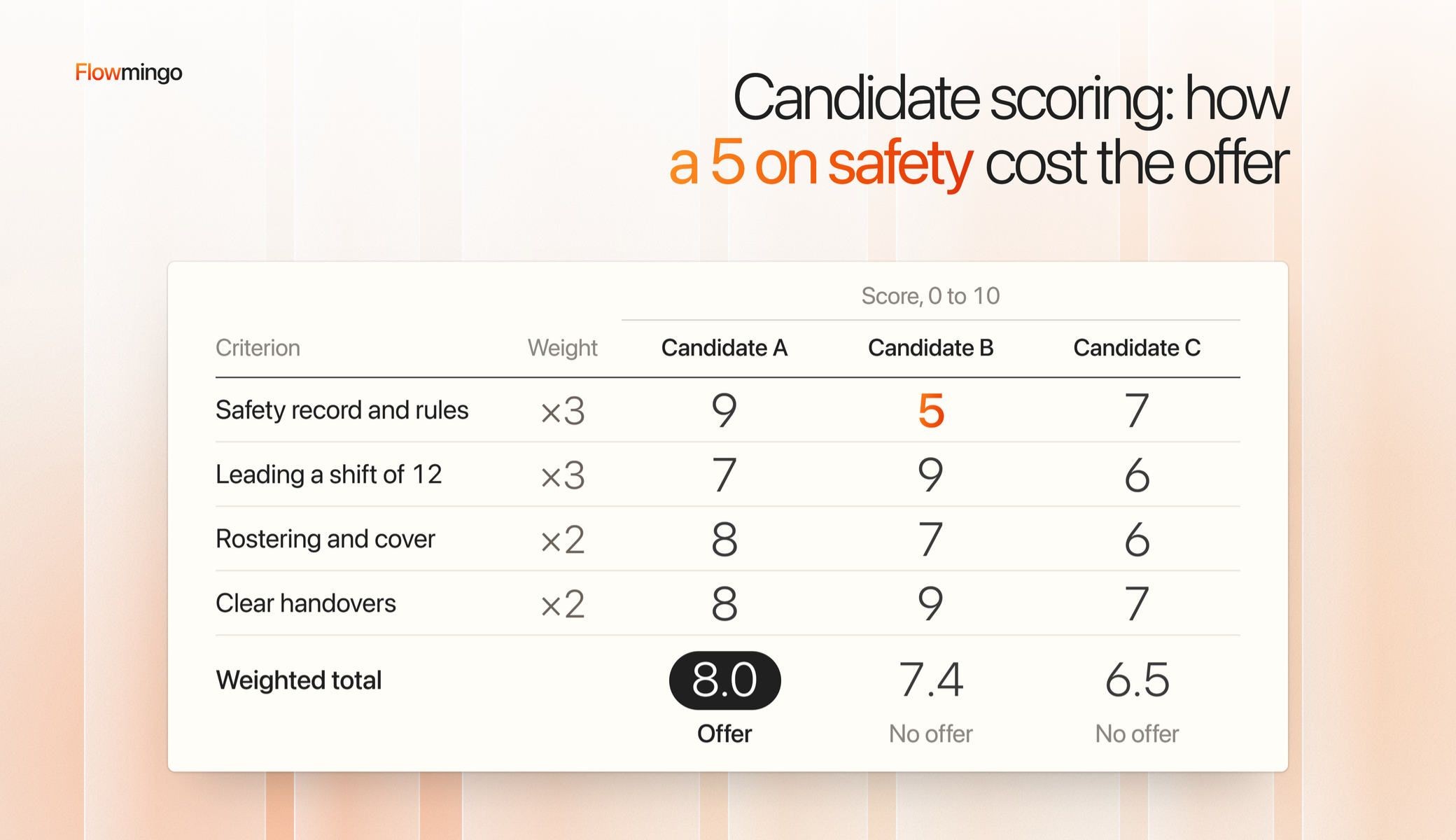
A candidate scoring example is easiest to follow on 1 filled-in sheet. This one is for a warehouse shift supervisor, with example numbers: you set 4 criteria and their weights before the interviews, and 2 interviewers on 1 panel each score every finalist on their own, from 0 to 10.
Of the 4 criteria, "safety record and rules" and "leading a shift of 12" carry a weight of 3 each. The other 2, "rostering and cover" and "clear handovers", carry 2 each.
Each number on the sheet is the score the 2 interviewers agreed on after comparing their own scores. To get the weighted score, multiply each by its weight, add up the 4 results and divide by 10, the total of the weights.
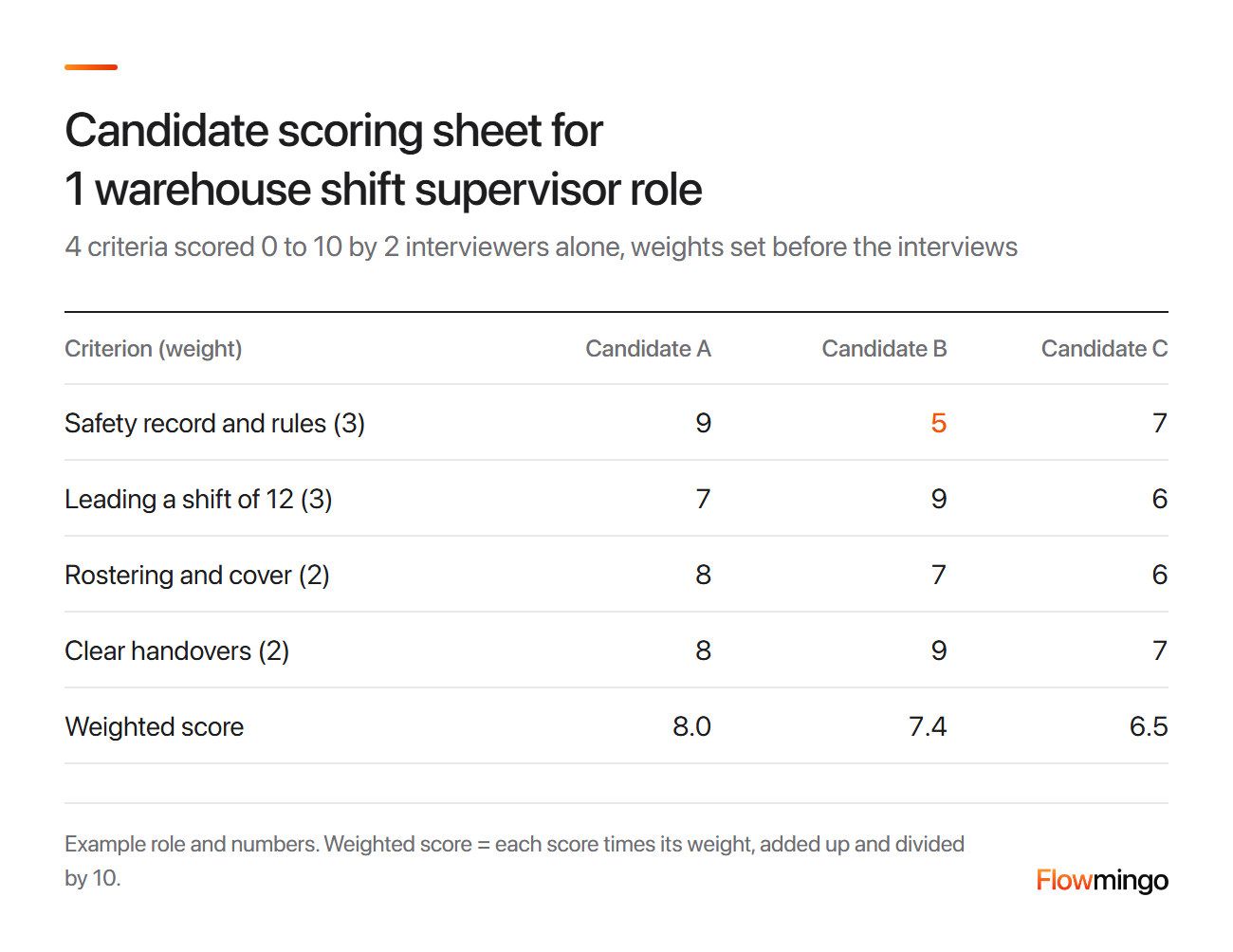
Candidate scoring sheet for 1 warehouse shift supervisor role: Candidate A leads at 8.0, ahead of Candidate B at 7.4 and Candidate C at 6.5.
At first, both interviewers leaned towards Candidate B, the most confident speaker. B scored 9 on leading a shift, 9 on handovers and 7 on rostering, but only 5 on safety, 1 of the 2 criteria weighted 3.
Candidate A scored lower on leading a shift, at 7, but 9 on safety and 8 on both rostering and handovers, for 8.0 overall. Candidate C scored 7 on safety, 6 on leading, 6 on rostering and 7 on handovers, for 6.5.
The gap between A and B comes down to the 2 criteria weighted 3. A's 4-point lead on safety counts 3 times, which makes it worth 12 points, twice the 6 that B gains from a 2-point lead on leading a shift.
Rostering and handovers cancel out, because A leads by 1 on rostering and B by 1 on handovers, both weighted 2. That leaves A 6 points ahead, or 0.6 once you divide by 10, the difference between 8.0 and 7.4.
The decision followed the scores, not the first impression. A got the offer, and the panel could name the exact reason B did not.
3. How do you score candidates fairly, step by step?
Fix the criteria, scale and weights before you meet anyone, then have each interviewer score on their own, and compare. That order matters, because a sheet written after the interviews can bend to fit the favourite.
- Pick 3 to 5 criteria from the job, and keep yes-or-no facts out of the score. The right to work, for example, is a gate rather than points, so a high score elsewhere cannot hide a missing one.
- Use 1 scale, and write anchors for its low, middle and high points. Without anchors, each rater brings a private idea of what a 7 means.
- Set the weights before the first interview. A weight chosen afterwards can quietly reward whoever the panel already liked.
- Score on your own, 1 criterion at a time, right after the answer, with 1 line of evidence. A note such as "ran a 12-person night shift for 2 years" lets someone else check the number.
- Compare the scores, then discuss only the big gaps. A 3-point split on 1 criterion means the anchor is unclear, or 1 rater saw something the other missed.
Expect gaps in step 5, and leave more time for it when your interviewers hold separate interviews instead of sitting on 1 panel. A 2013 meta-analysis by Huffcutt and colleagues, which pooled earlier studies, measured how closely interviewers agree in each set-up.
Interviewers who met the same candidate in separate interviews agreed at 0.44 on average, on a scale from 0 to 1, where 1 is full agreement. Interviewers on the same panel agreed at 0.74. Those figures are more than 13 years old, so treat them as a sense of scale.
Our interview scorecard template gives you a sheet to start from, and the structured interview guide covers the questions behind it.
3.1 When does software scoring need a person?
Software scoring needs a person whenever a score could end an application. Treat the score as evidence for that person to review, and keep their name on each decision.
In the UK, the data protection regulator, the Information Commissioner's Office (ICO), contacted 37 employers in 2025 that it had identified as likely users of automated recruitment tools.
It concluded that 16 of them were likely using automated decision-making on candidates. The ICO picked those 37 because of that likely use, so the 16 is not a share of all employers.
The UK rules on such decisions changed on 5 February 2026, when the Data (Use and Access) Act 2025's changes to them took effect. Before then, the rules banned them except in set cases.
Now the law generally allows them, provided the employer puts safeguards in place and lets a candidate challenge the decision. The named person on each decision answers that challenge.
4. How do you run candidate scoring with Flowmingo?
In Flowmingo, you set the criteria, which it calls requirements, and their weights, then each candidate takes an AI interview in their own time. Every answer comes back scored with a reason, and you check the evidence and make the call.
Before you start, write each requirement as something an answer can show, because a score is only as clear as the requirement behind it.
Then read the reason under each score before you compare finalists, as in step 5. That keeps the discussion on the evidence, not on who sounded most sure, the trap B's confidence set in the example.
How Flowmingo helps
After each AI interview, you get the recording, the transcript and a scored report. Flowmingo's scoring rates each requirement 0 to 10, weights it by its importance, and explains why each answer got its score.
The overall score is the weighted average, and a 6.2 is not a 62% chance of success or a hiring recommendation. Every hiring decision stays with your team.
Sign up free to try candidate scoring that explains every number on Flowmingo.
5. Sources
Every study, guide and regulator page cited above links to its source below.
- Google. (2026). A guide to structured interviewing for better hiring practices. re:Work. Google re:Work
- Huffcutt, A. I., Culbertson, S. S., & Weyhrauch, W. S. (2013). Employment interview reliability: New meta-analytic estimates by structure and format. International Journal of Selection and Assessment, 21(3), 264-276. Wiley
- Information Commissioner's Office. (n.d.). Introduction: what is ADM and why are we focusing on it in recruitment? Retrieved 26 October 2026. ICO
- Kahneman, D., Sibony, O., & Sunstein, C. R. (2021). Noise: A flaw in human judgment, ch. 24, as quoted by NPR Planet Money (2021, March 23). Little, Brown Spark. NPR