
You have 1 remote role open and a hunch that a few applicants are not who they say they are. That hunch has a name: candidate fraud. In a Gartner survey of 3,000 candidates, 6% admitted to interview fraud: posing as someone else, or having someone pose as them.
Nothing in your process was built for fake candidates. Gartner predicts that 1 in 4 candidate profiles will be fake by 2028, and people spot deepfakes just over half the time. A nervous or badly connected honest candidate can look just as off.
Hiring fraud can be costly. Checkr, a background-check vendor, surveyed 3,000 American managers, and 23% estimate their company lost more than $50,000 to hiring or identity fraud in a year. Reject someone over an accent, name or nationality and you risk a discrimination claim, which in the UK has no upper limit (Home Office).
This guide to candidate fraud fixes it in 3 moves. Check facts you can verify instead of faces, and give every finalist the same ID step with an alternative. Then write down what you saw before you say a word.
Key takeaways
- How common is candidate fraud? Nobody has counted it. Gartner's 1 in 4 is a 2028 forecast, and 6% of 3,000 candidates admitted interview fraud.
- Can my interviewers spot a deepfake by eye? No. People spotted deepfakes 55.54% of the time across 56 studies, so check documents and facts.
- Which candidate fraud signals count as evidence? Facts you can cross-check, such as 1 phone number on several applicants. A hunch is right only 54% of the time.
- What do I say when I think someone is reading AI answers? Say what you notice, ask for a real example, and leave the verdict until after the call.
- Is checking ID or matching faces legal? A person checking ID on live video is the lowest-risk route, in our reading. Face-match software usually needs explicit consent in the UK and EU.
1. How common is candidate fraud, and should I plan around Gartner's 1 in 4 fake profiles?
Treat Gartner's 1 in 4 fake profiles as a forecast, not a count of fake candidates. The measured figure is 6% of 3,000 candidates who admitted interview fraud.
4 numbers circulate, each with a different base. Only the 6% comes from candidates themselves, and in our reading it is a floor, because people admit only what they choose to. The 25% is Gartner's forecast for 2028, about profiles, not people (Gartner).
The other 2 are vendor surveys of managers. Checkr, a background-check vendor, found that 35% of 3,000 American managers say someone other than the applicant joined a virtual interview. Greenhouse, an ATS vendor, found that 65% of US hiring managers say they caught applicants using AI deceptively.
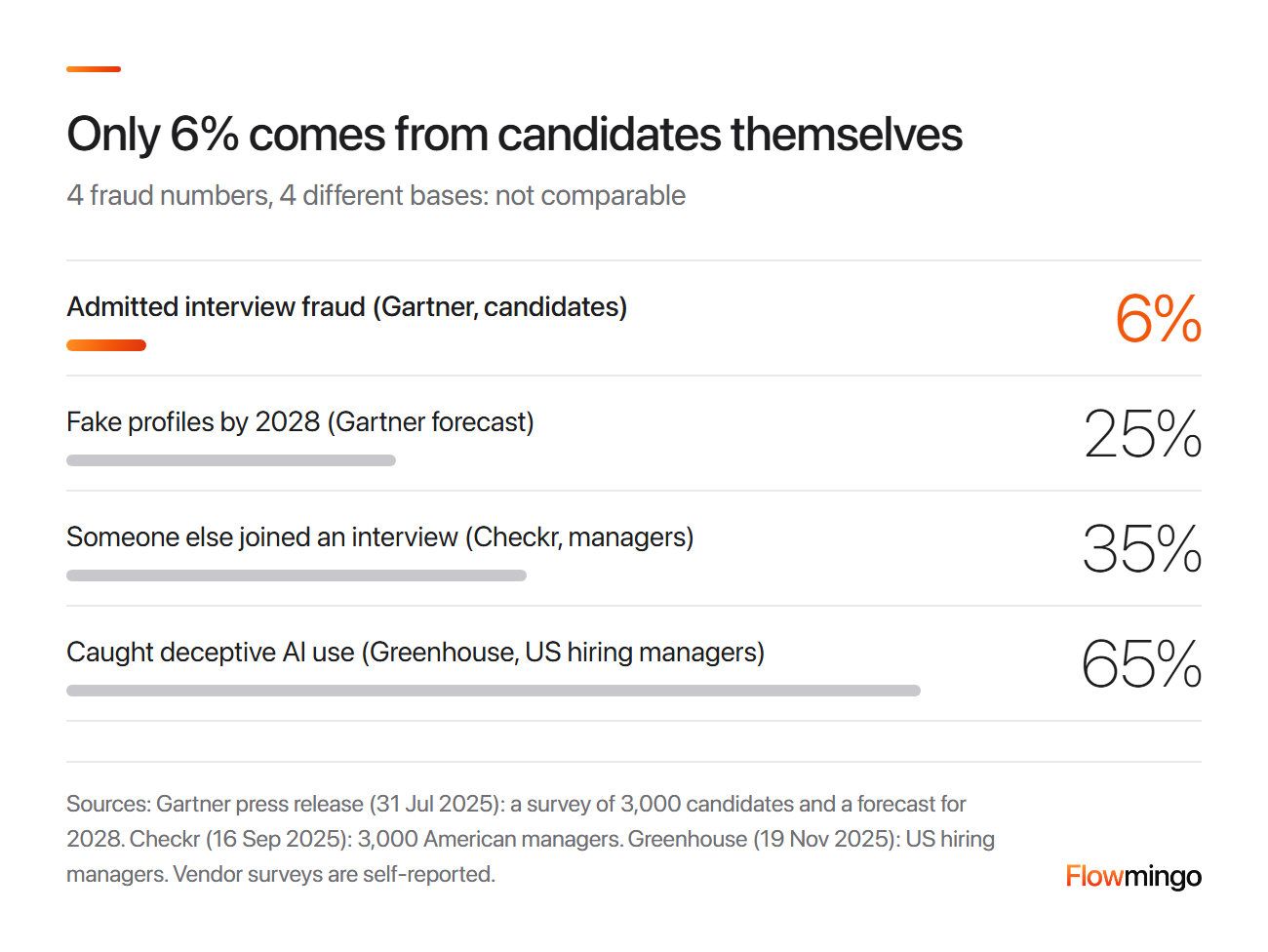
Candidate fraud numbers: 6% of 3,000 candidates admitted interview fraud. The 25%, 35% and 65% are a forecast and manager reports from vendor surveys, so none is comparable.
In 1 thread, a manager interviewed about 30 people and judged about 25% were likely not who the CV said. That is 7 or 8 people, about 0.3% of 2,500 CVs by our arithmetic, not "a quarter".
Run cheap checks on everyone and costly ones on finalists, our rule of thumb. Gartner advises layered checks, validated at system level rather than by watching individuals.
2. How do I check for candidate fraud on a small team without buying a detection tool?
Check facts you can cross-check for free, for every finalist: contact details, background answers, 1 live identity step and the delivery address. None needs software.
2.1 Which 7 checks do I run?
Check facts, not faces, because the same cheap checks for everyone also protect honest candidates.
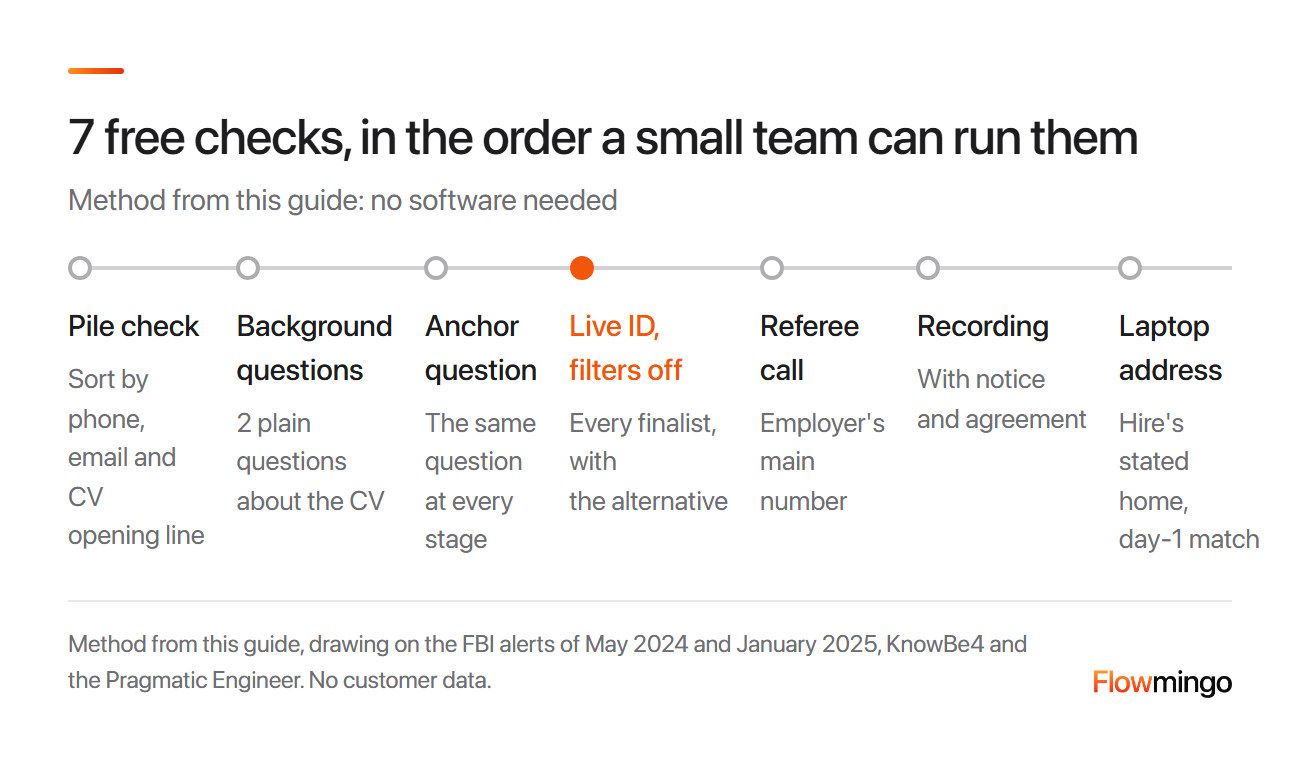
7 free checks for fake candidates: pile check, background questions, anchor question, live ID, referee call, recording and laptop address.
| Check | What to do | What it shows | Cost |
|---|---|---|---|
| 1. Pile check | Sort applicants by phone, email and CV opening line; look up VoIP numbers | Shared contact details or near-identical CVs (FBI, Jan 2025) | Free or low |
| 2. Background questions | Ask 2 plain questions about the CV's city, school or past role | Whether the story holds up (FBI, May 2024, foundational) | Free |
| 3. Anchor question | Ask 1 identical question at every stage, such as the hardest problem they solved | Whether a different person turns up later | Free |
| 4. Live ID, filters off | Ask every finalist to turn off filters and show a photo ID on live video, or offer the alternative: the same ID shown in person, on a day they choose | The document matches the person on screen | Free |
| 5. Referee call | With the finalist's yes, call the employer's main number and ask for the referee; a current employer only after a conditional offer | The referee exists and confirms the dates | Free |
| 6. Recording | Record the call with notice and agreement | A second reviewer can compare | Free or low |
| 7. Laptop address | Ship only to the hire's stated home and re-verify if it changes; compare the hire with the same ID on day 1 | A changed address after the offer, or one that is not the hire's home, is a flagged moment (FBI, May 2024; KnowBe4, both foundational) | Free |
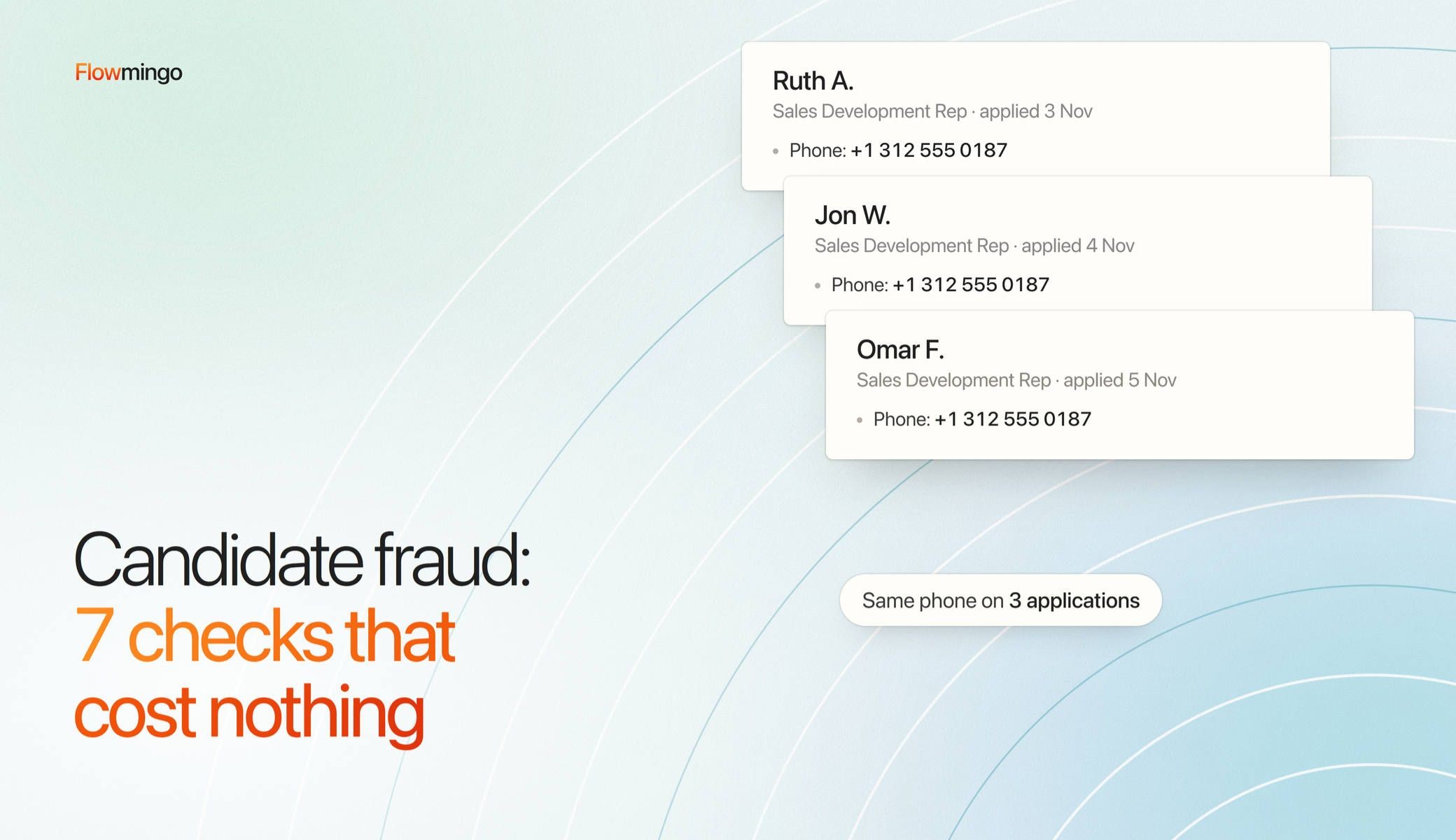
The pile check is the strongest. The FBI says North Korean IT workers reused phone numbers and emails across different applicants' resumes, and tells employers to cross-check their HR system.
Say 400 apply for 1 remote role. Sort the export by phone number, and 3 CVs sharing 1 number show up in seconds. A reused number is a fact, while a VoIP number alone is weak, because honest people use internet numbers too.
A small security startup got 500 applications for a backend engineer job and faced 2 fake candidates (Pragmatic Engineer, Mar 2025). The first got through several interviews that were not recorded. The second declined to put a hand in front of the face, so the interviewer ended the call.
Filters improve, so treat a refusal as a prompt, never proof.
Our rule: with about 10 hires a year, run all 7 checks on every finalist. With 10,000 applications, run check 1 on everyone and checks 2 to 7 on finalists.
3. Which candidate fraud signals are strong, and which are just nerves, accents or a bad connection?
Act on facts you can check, such as repeated contact details or a document that does not match. Treat pauses, accents and odd video as reasons to look again, never as proof.
A signal of candidate fraud is strong when you can check it against an outside fact and an honest candidate has no innocent explanation. That is our rating, not a study.
| Candidate fraud signal | Strength | Why | What to do |
|---|---|---|---|
| Same phone or email on several applicants, or near-identical CVs | Strong | A fact in your own system (FBI, Jan 2025) | Compare every other detail |
| A background check or ID shows the details belong to someone else | Strong | A fact (FBI, 2022, foundational) | Verify identity first |
| Plain questions about the claimed city or past role fail, or the laptop address changes | Strong if repeated | FBI, May 2024 (foundational) | Ask again; verify the address |
| Declines to turn off a filter or show a hand | Weak | 1 startup's case; a privacy or disability reason is possible | Offer the alternative, then close without a verdict |
| Long pauses, eyes moving, formal wording or lip-sync lag | Weak | Notes, captions and a bad line look the same; a 1.2-second delay lowers ratings (foundational) | Ask for a real example and offer a reconnect |
| Accent, grammar or fluency | Not a signal | Identical statements rated 7.5 vs 6.84 for truthfulness (foundational) | Check facts, never fluency |
Your gut is weak evidence. A foundational 2006 review by Bond and DePaulo covered 206 documents and 24,483 judges. Most were lab studies of people with no special training, and they judged lies and truths correctly 54% of the time.
Accent is not a signal. Listeners rated identical scripted statements 7.5 for truthfulness from native speakers, 6.95 from mild accents and 6.84 from heavy accents (Lev-Ari and Keysar, foundational 2010). The researchers say listeners mistake the effort of understanding for doubt about the truth.
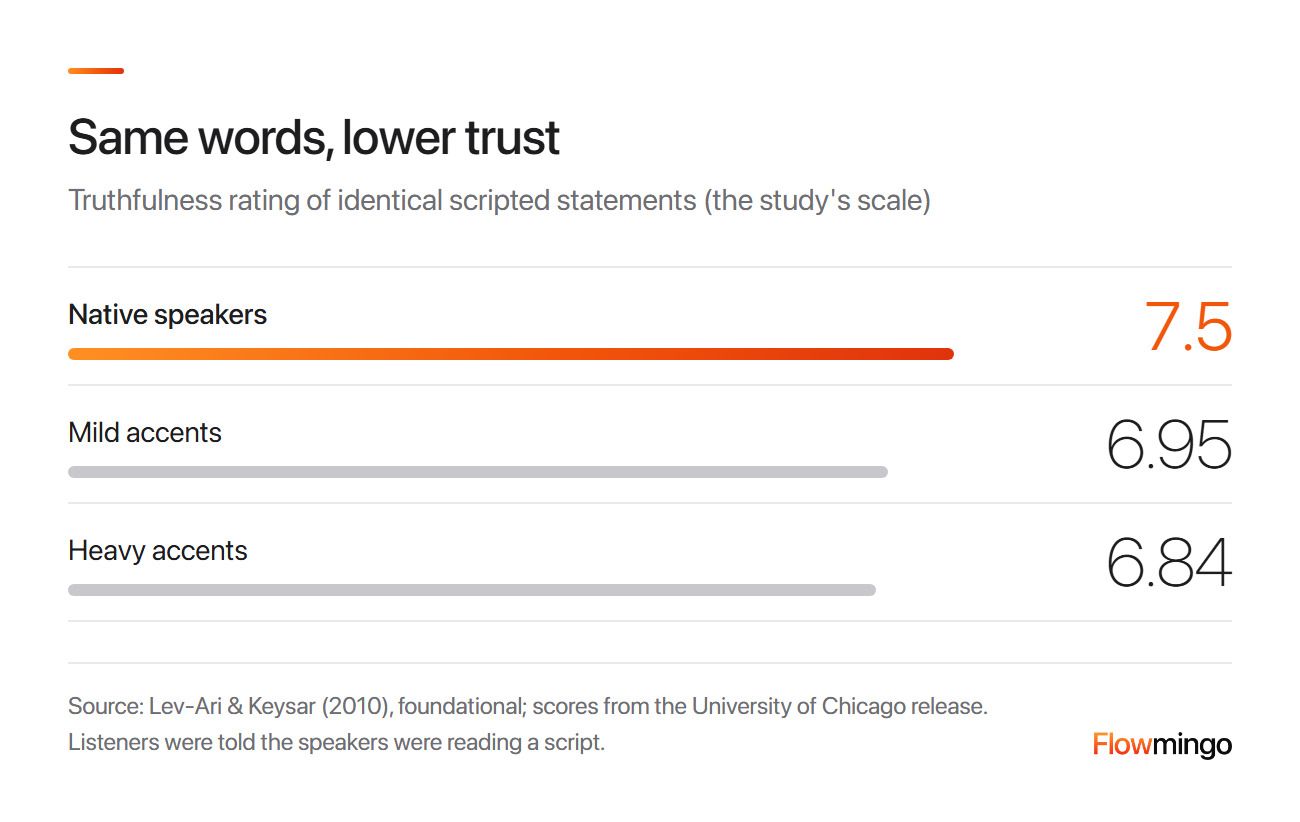
Accent and credibility: listeners rated identical scripted statements 7.5 for truthfulness from native speakers, 6.95 from mild accents and 6.84 from heavy accents. The study is Lev-Ari and Keysar's, foundational 2010.
Never guess by ethnicity, age, accent or surname, because it is also a discrimination risk. The UK Home Office guide tells employers not to assume right to work from them.
Honest candidates trip the weak signals too.
4. How do I tell resume fraud from a polished AI-written CV without rejecting honest applicants?
Do not reject a CV because it sounds like AI. Check what it claims against facts you can verify, then ask every applicant who clears the cut the same follow-up.
Polishing wording is not resume fraud. Inventing an employer, a degree or a result is.
In a Gartner survey of 3,290 candidates, 39% used AI when applying. Of those, 54% used it for CV text, 50% for cover letters, 36% for writing samples and 29% for answers to assessment questions.
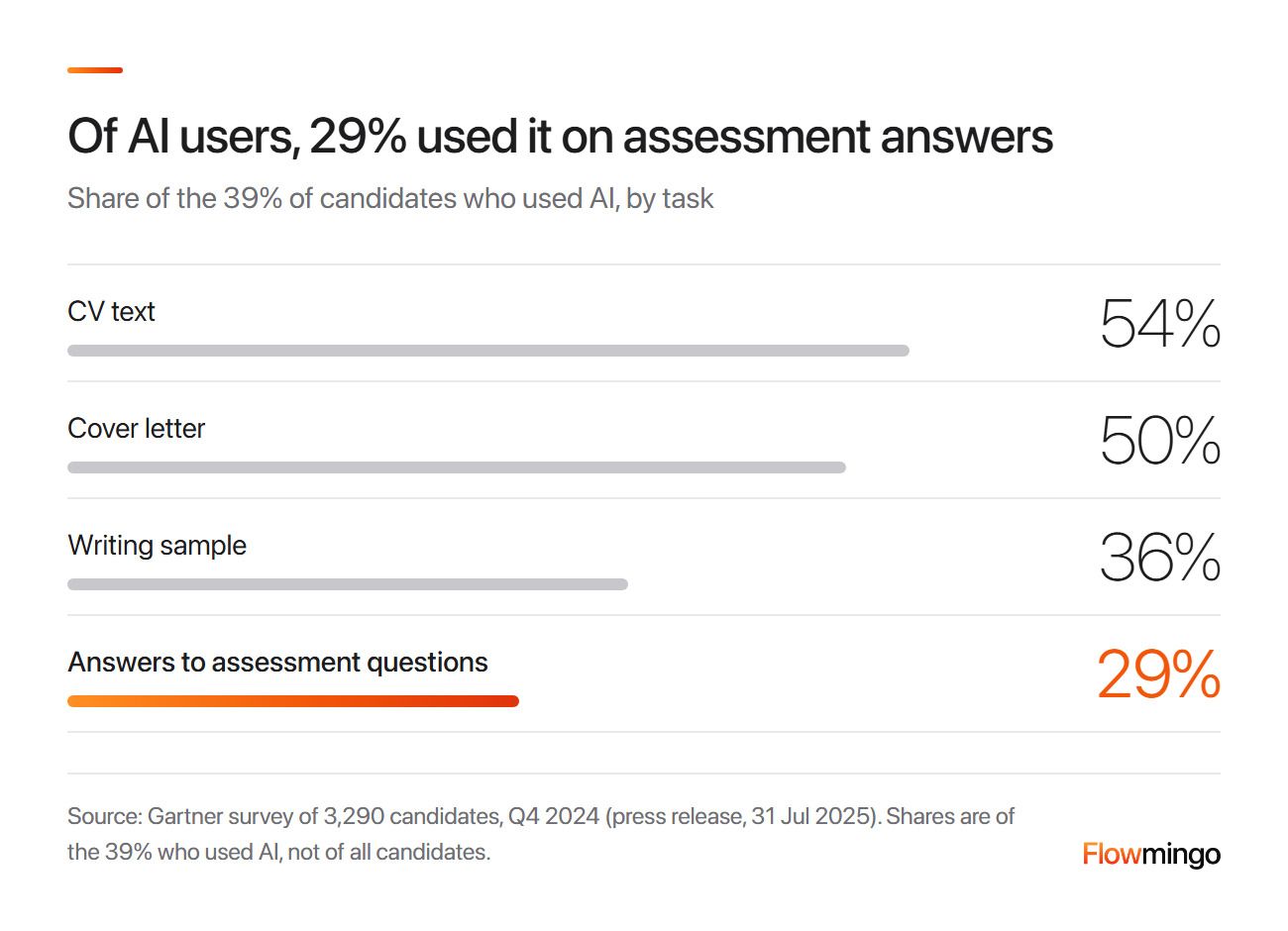
AI use by task: of the 39% of candidates who used AI, 54% used it for CV text and 50% for cover letters. Of the same users, 36% used it for writing samples and 29% for answers to assessment questions.
A detector score is not evidence. In a foundational 2023 study by Liang and colleagues, 7 AI-text detectors falsely labelled 61.3% of non-native writers' essays as AI-generated on average. These were exam essays, not CVs.
Test the claims instead. Ask which system a CV's "billing migration" moved from and what broke. Then, with the finalist's yes, call the employer's main number, as our reference check questions guide shows.
A short work sample for everyone who clears the cut also makes an invented CV fall apart. In 2 foundational reviews (2019, 2022), job knowledge tests and work samples tracked job performance roughly 6 times as strongly as prior experience.
5. How do I confirm the person on camera is the one who applied, without deepfake software?
Confirm identity with a document shown live and facts you verify yourself, not by studying the face. In 56 studies, people spotted deepfakes just over half the time.
A review of 56 papers and 86,155 participants found 55.54% accuracy at spotting deepfakes. The authors call that not significantly above chance, because the plausible range (48.87% to 62.10%) includes 50%. Feedback training and AI support lifted it to 65.14%, and participants were lay people, not recruiters (Diel and colleagues, December 2024).
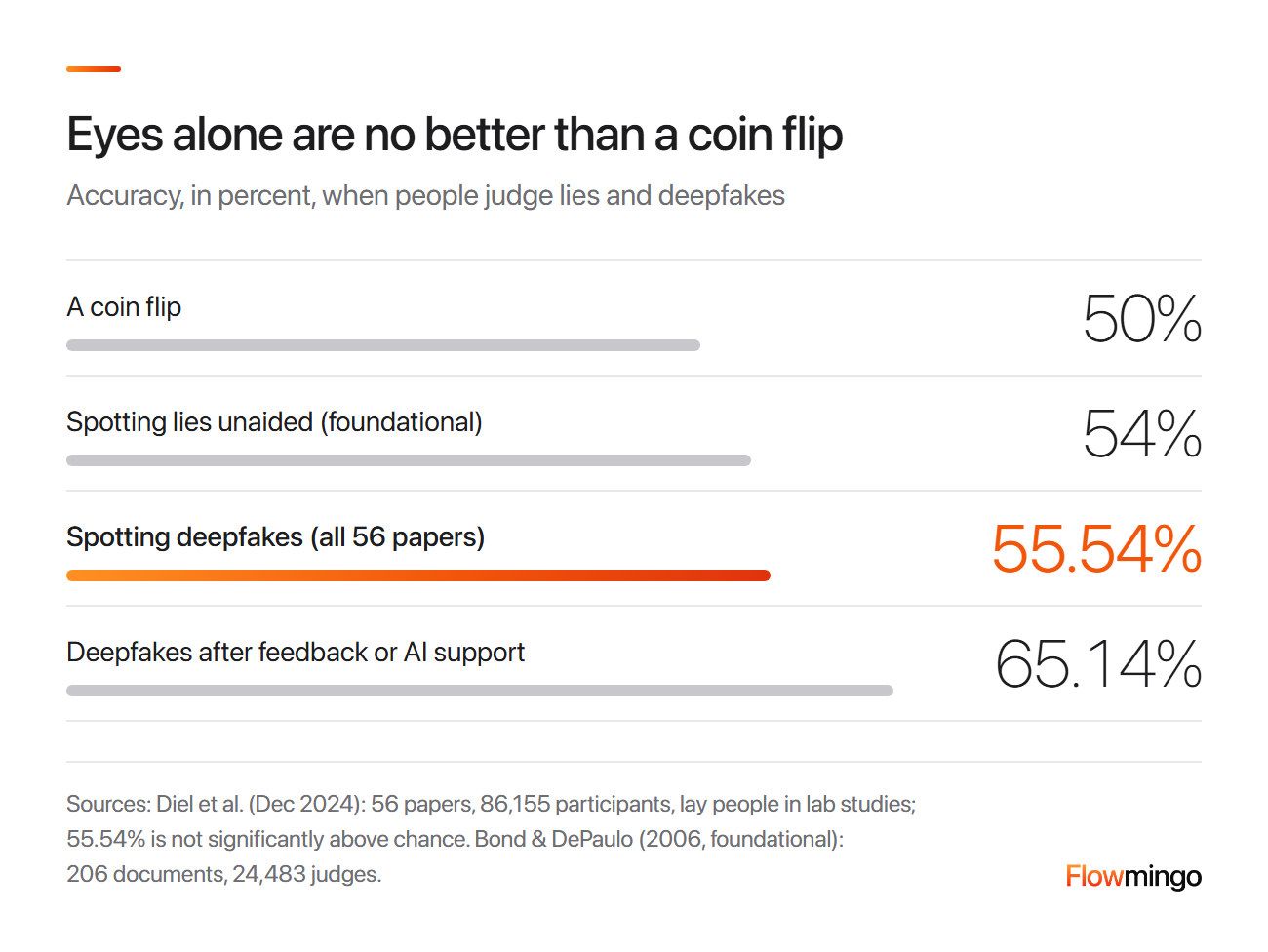
Deepfake accuracy by eye: people spot deepfakes 55.54% of the time in 56 papers, against 50% for a coin flip and 54% for spotting lies. Feedback training or AI support lifts it to 65.14%.
Stand-ins are real: the FBI's May 2024 alert (foundational) says US-based facilitators attended virtual interviews for North Korean IT workers. So use candidate fraud checks 3 to 7 from section 2, because none depends on how the video looks:
- Ask the same anchor question at each stage.
- Check a photo ID on live video, with an alternative.
- Verify facts yourself, such as a reference on a number you found, with the finalist's yes.
- Record the interview, with notice and agreement, for a second reviewer.
- Compare the new hire on camera with the same ID on day 1.
Re-run check 1 between offer and day 1, because 1 manager found a duplicate application with a different CV a week before the start date.
6. How do I know a remote hire is not part of a North Korean fake-worker scheme?
You cannot tell from the interview, because these schemes can pass interviews and background checks with stolen identities. Check where the person and the laptop are, and watch device activity early.
In June 2025 the US Department of Justice searched 29 known or suspected laptop farms in 16 states. An indictment alleges compromised identities won remote jobs at more than 100 US companies, with at least $3 million in losses.
A US helper hosts the company laptop at home, so the hire looks US-based and the paperwork matches a real person (IRS, July 2025).
KnowBe4's own case (foundational, July 2024) shows why. Its operative passed 4 video interviews on separate occasions, with background and pre-hiring checks clear, using a stolen but valid US identity. Only laptop monitoring caught it, at 9:55 PM EST on 15 July 2024.
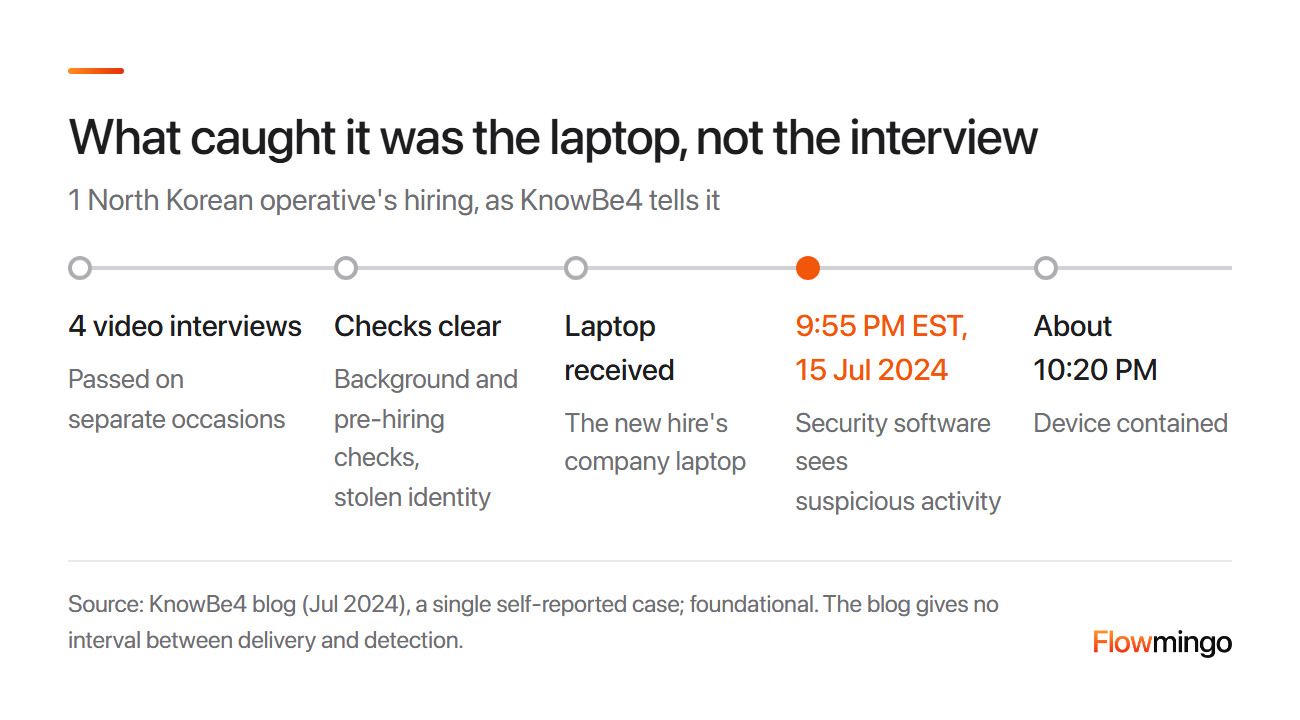
KnowBe4 timeline (foundational): its operative passed 4 video interviews and background checks. Software flagged the laptop at 9:55 PM EST on 15 Jul 2024, and the team contained it about 10:20 PM.
With no security budget, our practice is the pile check and the live ID step. Hold the laptop until the address matches the hire's stated home, such as the home address on the contract. Check where the hire logs in from in week 1.
7. What do I say, word for word, when I suspect AI interview cheating mid-call?
Say what you notice, ask for a real example in the candidate's own words, and offer a restart for any technical trouble.
Do not accuse anyone mid-call, because the signals are weak. In a 245-person online experiment, AI-fed answers outscored unaided ones on content (Canagasuriam and Lukacik, published in print in 2025). A smooth answer proves nothing, and neither does a halting one.
Use the same lines for every candidate. The wording is ours, not a study's, built on the Home Office's "sensitive and proportionate" approach.
- Check depth: "Tell me about a real example from your last role, in your own words."
- Add lived detail: "What was the hardest decision, who disagreed, and what would you change?"
- Name the rule: "We ask everyone to keep other screens closed and answer without reading. Short notes on paper are fine."
- Fix tech first: "The line is breaking up. Let's reconnect, or switch to a phone call, and I'll repeat the question."
- Verify identity: "We ask every finalist to turn off filters and show a photo ID on video. If you would rather not, we can check it in person on a day that suits you."
- Close without a verdict: "Thanks, I have what I need for this round. You'll hear from us by [date]."
Before you speak to anyone, note what you saw and heard, with times, not your conclusion. Write "10:42 looked left before each answer", not "reading a script". In the UK a candidate can ask for interview notes (ICO), so write each note as if they will read it.
End the call early only for an identity concern: the candidate declines the ID step and the alternative. For AI interview cheating, keep going and decide afterwards.
8. What does the law allow when I check ID or run a face match on candidates?
In our reading, a person checking an ID on a live video call is the lowest-risk route. A face-match tool brings biometric consent rules, and this is general information, not legal advice.
The reason, in our reading of GDPR Recital 51, is that a photo is biometric data only when software processes it to identify someone. Software that compares a scanned licence with a photo of the person is special category biometric data processing (ICO). The ICO (foundational, February 2024) says explicit consent is likely the best condition and that you must offer an alternative, or "people do not have a real choice".
| Where | Rule | What it means for a candidate fraud check |
|---|---|---|
| UK right to work | Home Office guide, 1 Oct 2026 | Hold the original and check it with the holder present, in person or on live video; a video view, screenshot or scan alone gives no statutory excuse; face matching only via a registered provider; civil penalty up to £60,000 per illegal worker, and £45,000 for a first breach under the 2024 code of practice |
| UK and EU data protection | ICO and EDPB (both foundational) | Software face matching is biometric data: usually explicit consent plus a non-biometric alternative; consent is hard to rely on in hiring |
| EU AI Act | Article 5(1)(f), Annex III (Regulation 2026/1744) | No emotion reading in recruitment since 2 Feb 2025; 1-to-1 face verification is outside Article 5(1)(h) but GDPR applies; high-risk rules for screening AI apply from 2 Dec 2027 |
| Illinois | BIPA, 740 ILCS 14 | Written notice and signed release before collecting a face-geometry scan or voiceprint; $1,000 (negligent) or $5,000 (intentional or reckless) per violation, 1 recovery per person and method since 2 Aug 2024; HireVue agreed a $3.75 million settlement, with preliminary approval only, and denies wrongdoing |
| US federal | USCIS remote I-9 | E-Verify employers in good standing may examine documents on live video after receiving copies; offer it consistently |
| Singapore | Workplace Fairness Act (target end-2027); MOM fact sheet, 12 Nov 2024 | Hiring decisions covered; nationality and language are protected; firms under 25 employees are exempt at first |
| California and Colorado | ADS regulations (1 Oct 2025); SB 26-189 (1 Jan 2027) | Automated-decision records kept 4 years (California) and 3 (Colorado); Colorado excludes identity verification |
The EU guidelines do not name stress, nervousness or deception, so ask any vendor selling a lie score for its legal position. The rules add up to this checklist, our reading:
- Say what you check in the job post and the invitation.
- Run the same step for everyone.
- Offer a non-biometric alternative.
- Keep a person in every reject decision.
- Keep notes and scores for the local retention period.
- Never use accent, surname or nationality as a signal.
- Ask counsel before any face scan.
9. Do I need in-person interviews to stop candidate fraud, or can I redesign the interview?
Not for every role: ask the same structured questions, add a live follow-up, and keep an ID or in-person step for finalists where it fits. In-person has costs for honest candidates too.
The FBI recommends doing as much hiring and onboarding in person as possible. Gartner advises layered checks, including in-person interviews, and found 62% of candidates say they are more likely to apply for roles that require them.
Against it, a disabled remote candidate said in a manager thread that a forced in-person interview would mean disclosing a disability or opting out. On-site is not immune either: another thread reports 2 on-site cases of cheating. The Reddit reports and the Gartner 62% are self-reported, and none measures candidates actually lost.
| Option | Cost to you | Catches | Misses | Cost to honest candidates |
|---|---|---|---|---|
| Same questions and 1 live follow-up | Free | A stand-in who cannot go deep | A coached real person | Low |
| Short work sample or knowledge test | Low | Invented skills | A stand-in who sits the test | Their time |
| Live ID check on video | Free | A stand-in at the final stage | A stolen identity with a matching face | Low, with an alternative |
| In-person final step | Travel and time | Deepfakes and stand-ins | On-site cheating (2 cases reported) | High for remote-only or disabled candidates |
That table is our assessment of the FBI and Gartner advice, not a study. Redesign in 3 moves, starting with the same structured questions for everyone. Add a short work sample before the final, then an ID step and a day-1 check for finalists.
Write 1 follow-up in advance that needs lived detail, such as "When did a release last break, who did you call and what did you change?"
Every check also costs honest candidates time: the card below shows how long an AI interview alone takes. Publish this notice in the job post and with the invitation, because Gartner advises saying what AI use is acceptable and that fraud checks exist.
AI help is fine for polishing your CV, and short notes on paper are fine during the interview. Reading full sentences from a screen, or having someone else answer, is not allowed. We confirm every finalist's identity on video with filters off, with an alternative on request: reply to this email. We may record the interview, and we will ask you first.
Flowmingo data · 43,759 AI interviews · 850 companies · finished 5 Jul to 3 Oct 2026
- 99.99% of the finished AI interviews (43,756) have a stored candidate recording.
- 26.5 minutes is the median time a finished AI interview took from start to finish.
A stored recording does not show who the person is. The Free plan keeps the latest 300 videos for 30 days. The 26.5 minutes is wall-clock time, pauses included.
How Flowmingo helps
In the AI Interviewer, applicants answer a structured interview out loud on camera, in their own time. When an answer is thin or drifts off topic, the AI asks a follow-up, so someone reading notes has to go deeper. It flags tab switches, second windows, screenshot shortcuts, extra monitors, and faces missing or multiplied. Flags never change the score, so review them beside your own ID step.
10. What if candidate fraud shows up after the offer, and what does each wrong call cost?
Pause access, write down the facts and, in the US, report suspected state-linked candidate fraud to the FBI. Then weigh both errors: yearly fraud losses that 23% of managers put above $50,000 and 10% above $100,000, and uncapped UK discrimination claims.
- Do not confront the person in chat or before the team.
- Save the evidence and pause access and shipping while you check.
- Verify identity on live video, with the same alternative you offer everyone.
- Tell HR, IT and legal, and seek independent advice.
- In the US, report a suspected state-linked scheme at ic3.gov and review the device's network activity.
- A person decides: check local employment law before any termination, and write down the reason the same day.
A biased call has its own price. UK discrimination compensation has no upper limit (Home Office). Singapore's tribunals will hear claims up to S$250,000 from the Act's start (firms under 25 employees are exempt at first).
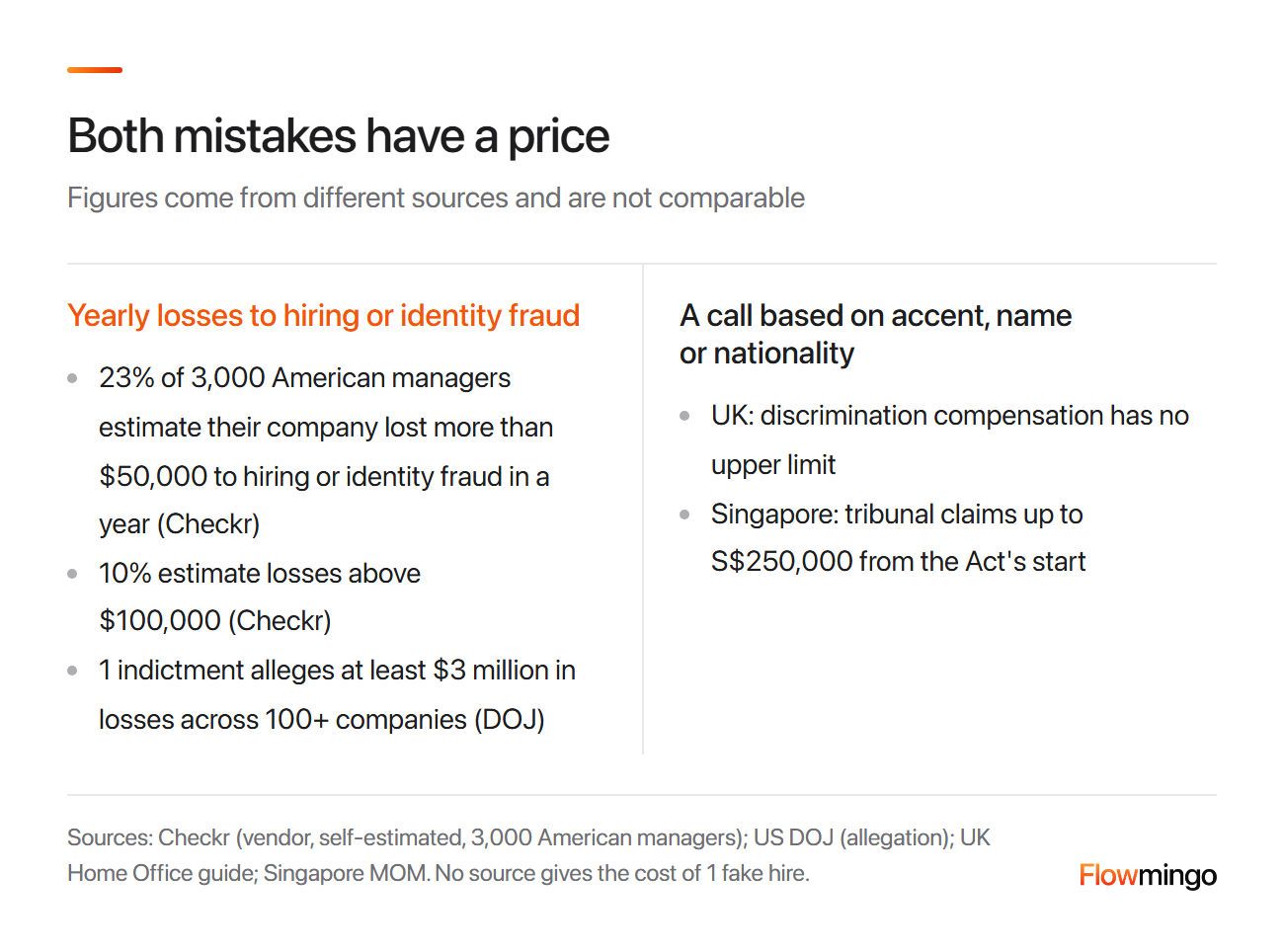
Both mistakes have a price: 23% of surveyed managers estimate losses above $50,000 to hiring or identity fraud in a year. A biased call risks uncapped UK discrimination compensation and Singapore claims up to S$250,000.
No source gives the cost of 1 fake hire, and none prices the lost hires from wrongly rejecting honest candidates. In practice, scale checks to access: all 7 checks for hires with system access or hardware, and checks 1, 3 and 4 for the rest. This is general information, not legal advice.
How Flowmingo helps
Flowmingo is a free AI hiring platform, led by its AI Interviewer, and its recording gives a second reviewer something to compare. Try Flowmingo next to your own candidate fraud checks.
11. Sources
Every study, law and quote in this guide links to a source below; Flowmingo figures come from Flowmingo's own platform data.
- Ask a Manager (2025, August 13). I hired someone who wasn't who he said he was. Ask a Manager.
- Bond, C. F., Jr., & DePaulo, B. M. (2006). Accuracy of deception judgments. Personality and Social Psychology Review, 10(3), 214-234.
- California Civil Rights Department (2025, June 30). Civil Rights Council secures approval for regulations to protect against employment discrimination related to artificial intelligence. California Civil Rights Department.
- Canagasuriam, D., & Lukacik, E. (2025). ChatGPT, can you take my job interview? Examining artificial intelligence cheating in the asynchronous video interview. International Journal of Selection and Assessment, 33(1), e12491.
- Checkr (2025, September 16). The hiring hoax: What 3,000 managers revealed about AI and identity fraud in 2025. Checkr.
- Diel, A., Lalgi, T., Schröter, I. C., MacDorman, K. F., Teufel, M., & Bäuerle, A. (2024). Human performance in detecting deepfakes: A systematic review and meta-analysis of 56 papers. Computers in Human Behavior Reports, 16, 100538.
- European Commission (2025, July 29). Guidelines on prohibited artificial intelligence practices established by Regulation (EU) 2024/1689 (AI Act). C(2025) 5052 final.
- European Data Protection Board (2020). Guidelines 05/2020 on consent under Regulation 2016/679. EDPB.
- European Parliament and Council (2016). Regulation (EU) 2016/679, the General Data Protection Regulation, Recital 51. Official Journal of the European Union.
- European Parliament and Council (2026, July 24). Regulation (EU) 2026/1744 amending Regulation (EU) 2024/1689, the Digital Omnibus on AI. Official Journal of the European Union.
- Federal Bureau of Investigation, Internet Crime Complaint Center (2022, June 28). Deepfakes and stolen PII utilized to apply for remote work positions. Alert I-062822-PSA.
- Federal Bureau of Investigation, Internet Crime Complaint Center (2024, May 16). Democratic People's Republic of Korea leverages U.S.-based individuals to defraud U.S. businesses and generate revenue. Alert I-051624-PSA.
- Federal Bureau of Investigation, Internet Crime Complaint Center (2025, January 23). North Korean IT workers conducting data extortion. Alert I-012325-PSA.
- Gartner (2025, July 31). Gartner survey shows just 26% of job applicants trust AI will fairly evaluate them. Gartner newsroom.
- Greenhouse (2025, November 19). An AI trust crisis: 70% of hiring managers trust AI to make faster and better hiring decisions. Greenhouse newsroom.
- Illinois General Assembly (n.d.). Biometric Information Privacy Act, 740 ILCS 14/15 and 14/20. Illinois Compiled Statutes.
- Information Commissioner's Office (2024, February 23). Biometric recognition. ICO.
- Information Commissioner's Office (2024, February 23). How do we process biometric data lawfully?. ICO.
- Information Commissioner's Office (n.d.). Keeping recruitment records. ICO.
- Internal Revenue Service (2025, July 24). Arizona woman sentenced for $17M information technology worker fraud scheme that generated revenue for North Korea. IRS news release.
- KnowBe4 (2024, July 23). How a North Korean fake IT worker tried to infiltrate us. KnowBe4 blog.
- Lev-Ari, S., & Keysar, B. (2010). Why don't we believe non-native speakers? The influence of accent on credibility. Journal of Experimental Social Psychology, 46(6), 1093-1096. Scores from the University of Chicago release, via ScienceDaily.
- Liang, W., Yuksekgonul, M., Mao, Y., Wu, E., & Zou, J. (2023). GPT detectors are biased against non-native English writers. Patterns, 4(7), 100779.
- Littler (2026, May 15). Colorado amends its artificial intelligence law, substantially reducing its scope. Littler.
- Ministry of Manpower, Singapore (2024, November 12). Fact sheet on the Workplace Fairness Bill (first reading). MOM.
- Ministry of Manpower, Singapore (2025, November 4). Workplace Fairness (Dispute Resolution) Bill press release. MOM.
- Orosz, G. (2025, March 11). AI fakers exposed in tech dev recruitment: postmortem. The Pragmatic Engineer.
- r/ExperiencedDevs (2025). Anyone else dealing with likely "fraudulent" candidates when hiring for remote roles? [Online forum post]. Reddit.
- r/managers (2025). No more remote interviews [Online forum post]. Reddit.
- r/managers (2026). Cheating in On-Site Interviews? [Online forum post]. Reddit.
- Sackett, P. R., Zhang, C., Berry, C. M., & Lievens, F. (2022). Revisiting meta-analytic estimates of validity in personnel selection: Addressing systematic overcorrection for restriction of range. Journal of Applied Psychology, 107(11), 2040-2068.
- Schoenenberg, K., Raake, A., & Koeppe, J. (2014). Why are you so slow? Misattribution of transmission delay to attributes of the conversation partner at the far-end. International Journal of Human-Computer Studies, 72(5), 477-487. Summary in The Conversation.
- Simpluris (2026). Deyerler, et al. v. HireVue, Inc. class action settlement website. Settlement administrator.
- UK Home Office (2024, February 13). Code of practice on preventing illegal working: Right to work scheme for employers. GOV.UK.
- UK Home Office (2026, October 1). Right to work checks: An employer's guide. GOV.UK.
- US Citizenship and Immigration Services (n.d.). Remote examination of documents (optional alternative procedure to physical document examination). USCIS.
- US Department of Justice (2025, June 30). Justice Department announces coordinated, nationwide actions to combat North Korean remote information technology workers' illicit revenue generation schemes. DOJ press release.
- Van Iddekinge, C. H., Arnold, J. D., Frieder, R. E., & Roth, P. L. (2019). A meta-analysis of the criterion-related validity of prehire work experience. Personnel Psychology, 72(4), 571-598.