
A screening interview is a short first-round interview, by phone, video or recorded answers, that checks an applicant against a role's must-haves. Only the people who pass it meet the hiring manager.
You meet the term when a hiring manager asks you to "phone screen them first" before giving up an hour of their week. The initial screening interview is where you decide who gets that hour.
In Gem's 2026 benchmark, 6% of inbound applicants reached a first interview round, such as a recruiter screen, between June 2024 and May 2025. Only 16% of those inbound candidates reached the onsite round.
Key takeaways
- What does a screening interview decide? Who meets the hiring manager. In Gem's 2026 benchmark, only 16% of inbound candidates in an early round, screens included, reached the onsite round between June 2024 and May 2025.
- Is a phone screen the same thing? Yes, it is the same first-round check held by phone. HR screening is the same step when someone in HR runs it.
- Should every call use the same questions? Yes. Structured interviews, with the same questions and scoring for all, predicted job performance more than twice as well as unstructured ones.
- When should you make up your mind? At the end of the call. In a study of 166 interviewers, only 4.9% of decisions came in the first minute.
1. What is a screening interview in recruitment?
It is the first check of a candidate in their own words, held after the CV screen and before any round with the hiring manager. It confirms the facts a CV cannot show, for example pay, timing and real interest.
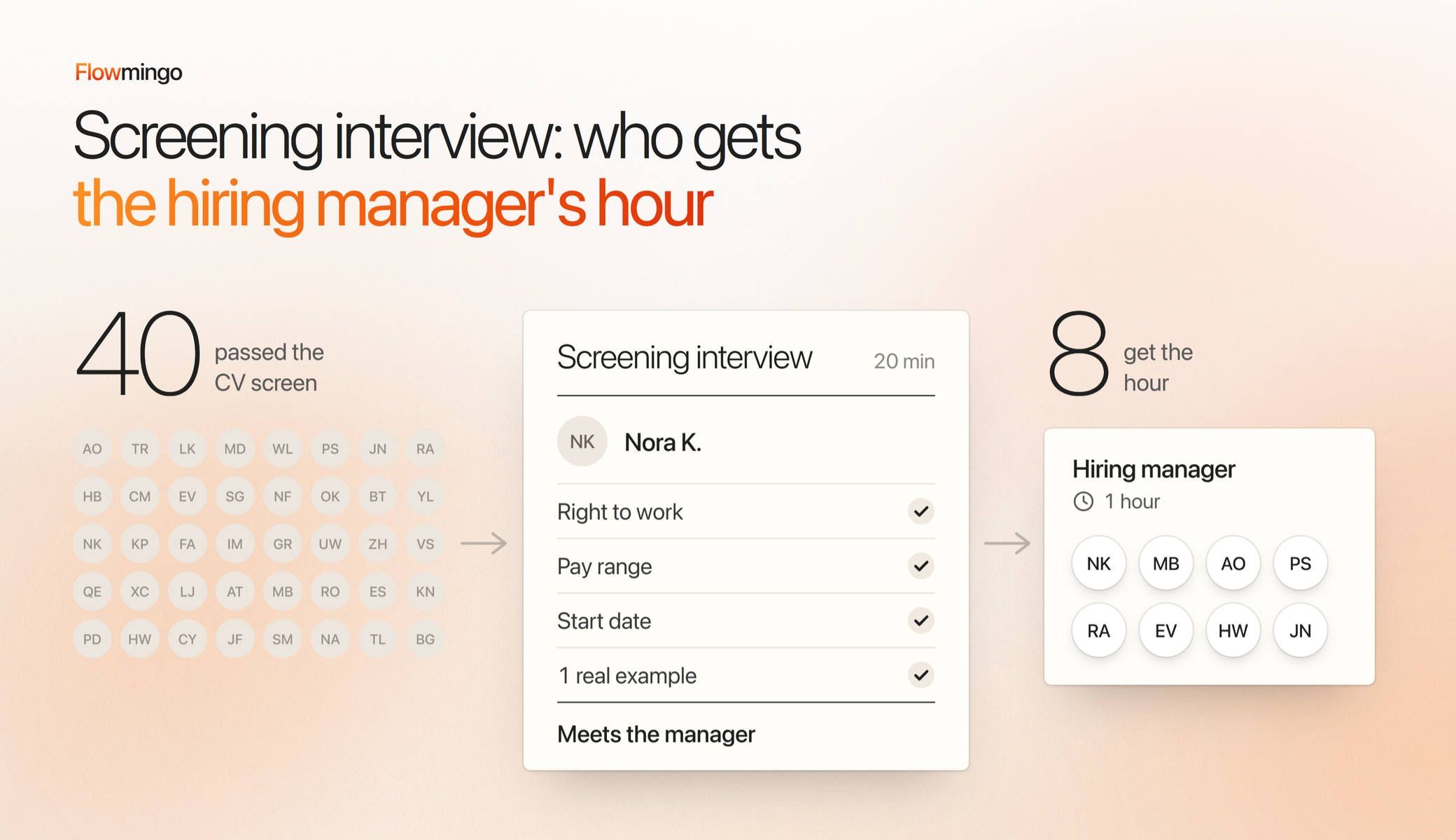
It usually covers 3 things. Knockout facts come first: the right to work, the pay range and the start date. Then 1 or 2 questions test the role's top must-have, and the candidate gets time to ask about the job.
Northwestern University's phone screening guide for managers lists the same core. It asks for a standard format, work authorization, salary expectations, a start date and 1 to 2 competency questions.
It is not the full interview, which tests depth over 1 or more longer rounds. It is also narrower than pre-employment screening, the wider set of checks that can include background and reference checks.
In recruitment, screening means removing the clear no's before selection begins. In a foundational 2008 study of 276 firms, Ordanini and Silvestri found cost drove the outsourcing of job adverts and pre-screening. Strategy mattered more for interviews and the final choice.
2. What does a screening interview look like in practice?
In practice, it is a run of short, identical calls, and each one ends in a pass or a stop. Here is 1 role worked through, with example numbers.
Say you hire an inside sales representative, and 40 people pass the CV screen. You book 40 calls of 20 minutes each. Every call asks the same 5 questions, with the knockouts first, and you score each call at the end.
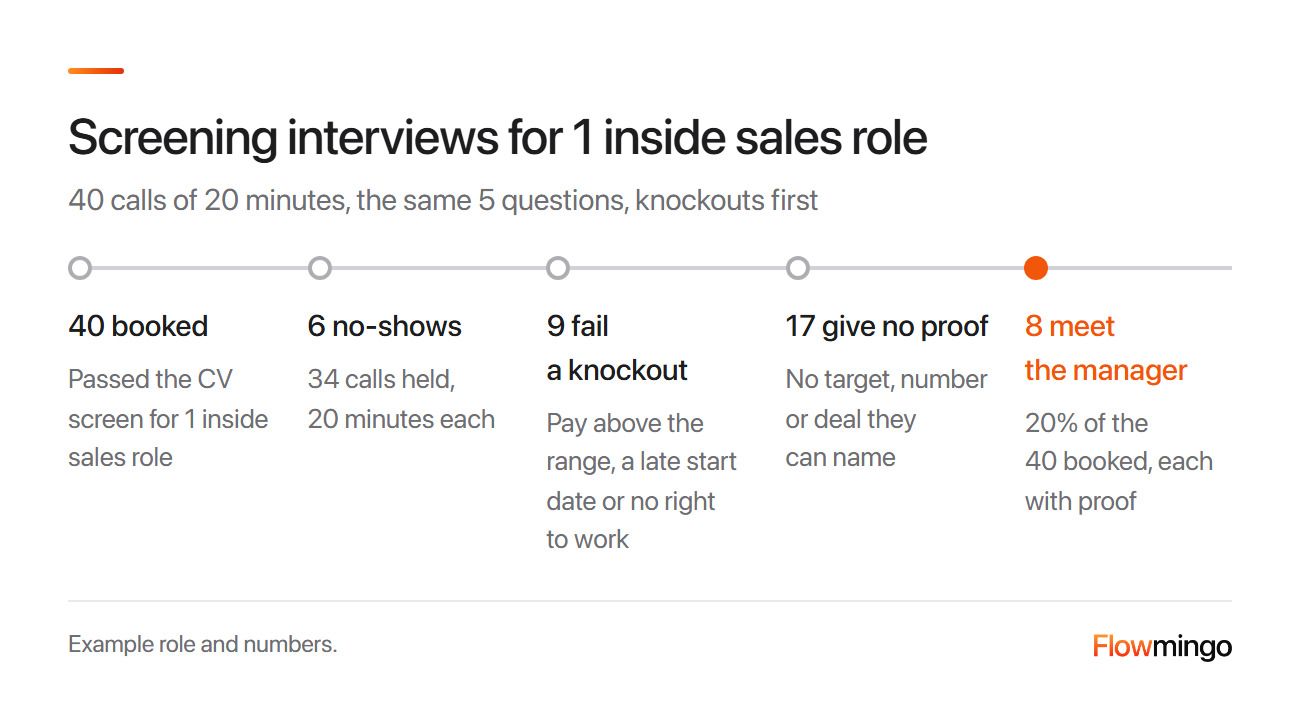
Screening interviews for 1 inside sales role: 40 booked, 6 no-shows, 9 fail a knockout, 17 give no proof and 8 meet the manager.
Of the 40, 6 are no-shows, so 34 calls are held. Then 9 people fail a knockout: pay above the range, a late start date or no right to work.
Another 17 give no proof of the core skill, because they cannot name a target, number or deal. That leaves 8 people, 20% of the 40 booked. The hiring manager meets 8 people instead of 40, and each one has already shown proof.
When a role draws hundreds of applicants, our guide to high volume recruiting plans the same funnel backwards from your start date.
3. How do you run a screening interview, step by step?
Agree the criteria with the hiring manager, then run the same short call, in the same order, for every candidate. That keeps each call fair, because every candidate meets the same bar, and it lets you explain every stop.
- Agree 3 to 5 must-haves with the hiring manager before the first call. If the bar moves halfway, your first 20 candidates were judged for a different job.
- Write the same 5 to 7 questions for everyone. Structured interviews predicted job performance at 0.42, more than twice the 0.19 of unstructured ones, in Sackett and colleagues' foundational 2022 re-analysis.
- Ask the knockout questions first. Pay range, start date and right to work are facts, so a miss ends the call before either side loses more time.
- Ask for 1 real example per must-have, and note it in their words. A named target, number or deal is evidence you can show the manager later.
- Score at the end of each call, then tell every candidate the result. In the 2025 CandE benchmark, candidates given job-fit feedback within 1 to 2 weeks were 75% more likely to be extremely willing to refer. In the same research, 32% of withdrawing candidates said interviews and appointments disrespected their time.
Our list of pre-screening interview questions gives you a bank to pick your 5 to 7 from.
3.1 Which mistakes make a screening interview unfair?
The most common mistake is deciding in the first few minutes. In a field study of 166 interviewers, only 4.9% of decisions came in the first minute, and about 30% within 5 minutes.
Another 22.5% came only after the interview had ended, a foundational 2016 result. The same study found that asking everyone the same questions made interviewers take longer to decide.
The second mistake is turning the screen into a full interview. Foundational Talent Board data from 2023, reported by SHRM, found 2 steps drew the most complaints of wasted time. They were recorded video interviews and hiring-manager phone screens.
So keep the screen to the facts and 1 skill, and leave depth to the later rounds.
4. Screening interview vs interview: what is the difference?
The screen checks whether a candidate meets the minimum. The interviews that follow run longer and go deeper, because they test how well the person would do the job.
A recruiter or someone in HR usually runs the screen, which is why people also call it HR screening. The later rounds belong to the hiring manager and the team, with a closer look at skills, judgement and fit.
A useful test is what each round can end. A screen can end a candidacy on a fact, such as a pay gap or a start date. A later interview should end one only on evidence about the work itself.
5. How do you run a screening interview with Flowmingo?
You write the questions once, share 1 link, and each candidate answers in their own time. You then read the answers and decide who meets the manager.
The market is moving this way. In LinkedIn's Talent 2026 research, 66% of recruiters said they plan to increase their use of AI for pre-screening interviews in 2026. The 5 steps above still apply, because a recorded screen is only as fair as its questions.
Recorded video interviews were 1 of the 2 steps with the most wasted-time complaints in the Talent Board data above. So keep a recorded screen as short as the call, with the same 5 questions and nothing added.
Our guide on how AI interviews replace phone screens covers the switch from booked calls in more depth.
How Flowmingo helps
Flowmingo's CV evaluation scores every résumé against the must-haves you set, then Flowmingo's AI Interviewer drafts between 1 and 30 questions from your job description. Review them, share a single link, and each candidate takes a structured interview that asks a follow-up when an answer is thin or off topic. You get the recording, the transcript and a scored report, and every hiring decision stays with your team. Sign up free and run your next screening interview on Flowmingo.
6. Sources
Every study, benchmark and guideline in this glossary entry links to its source below.
- Frieder, R. E., Van Iddekinge, C. H., & Raymark, P. H. (2016). How quickly do interviewers reach decisions? An examination of interviewers' decision-making time across applicants. Journal of Occupational and Organizational Psychology, 89(2), 223-248. Wiley
- Gem. (2025). 2026 recruiting benchmarks: Year-over-year insights and industry trends. Gem
- LinkedIn. (2026, January 7). LinkedIn Research: Talent 2026. LinkedIn Pressroom
- Maurer, R. (2024, April 9). Candidate experience: Talent Board research. SHRM
- Northwestern University Human Resources. (n.d.). Phone screening questions. Retrieved 26 October 2026. Northwestern HR
- Ordanini, A., & Silvestri, G. (2008). Recruitment and selection services: Efficiency and competitive reasons in the outsourcing of HR practices. The International Journal of Human Resource Management, 19(2), 372-391. Taylor & Francis
- Sackett, P. R., Zhang, C., Berry, C. M., & Lievens, F. (2022). Revisiting meta-analytic estimates of validity in personnel selection: Addressing systematic overcorrection for restriction of range. Journal of Applied Psychology, 107(11), 2040-2068. APA
- Survale & Talent Board. (2026, July 21). 2025 candidate experience (CandE) benchmark research: Key statistics. Survale