
You interviewed 12 people for 1 role and hired 1. Now 3 of the other 11 want candidate interview feedback, and each asks the same thing: why not me.
Saying nothing feels safer, and most rejected candidates get exactly that: in 2025, more than half got no feedback after a screen or interview (CandE). And nobody taught you how to give interview feedback to a stranger who lost.
Silence costs you too. Candidates' willingness to refer rose 69% in the same benchmark when employers gave specific feedback, by their own answers. And 1 careless note, like "looking for a retirement job", can end up in a lawsuit.
The fix takes 3 moves: answer in tiers, rest every sentence on evidence, and give 1 reason in your reply, follow-up and notes.
Key takeaways
- Do we have to give candidate interview feedback at all? No, not in the UK or under US federal rules we read. But keep notes at least 1 year, and make every line match them.
- Is a short, honest reason better than saying nothing? Usually: with specific feedback, willingness to refer others rose 69% in 2025, by candidates' own answers.
- How do I answer 40 candidates without 40 personal notes? 3 tiers: a status note, 1 of 4 pre-approved reasons, and a specific note for finalists, about 3 hours instead of 13 on our planning estimate.
- What should never appear in interview feedback? Any of 8 lines: age, family plans, health, accent, looks, "culture fit", an unproven suspicion or a comparison with the hire.
- Can a rejected candidate see what our interviewers wrote? In the UK and EU, yes, within 1 month, so your feedback must match your notes.
1. Do we have to give candidate interview feedback, or is saying nothing safer?
You don't have to: UK guidance and the US federal rules we read set no such duty. But silence is not automatically safer, so give 1 true, job-related reason from your notes.
Acas agrees that "Employers do not have to explain their reasons", but lets applicants ask you to reconsider if you broke your own interview rules.
US EEOC guidance sets no duty either, but 2 rules come close. Colorado's AI law asks for a plain-language description of a covered tool's role (section 7). Background checks need their own notices, as our rejection email templates explain.
In the EU's foundational 2012 Meister ruling, a total refusal to give information can be 1 factor in a discrimination case. The real risk is a reason that differs from your notes, because it looks like a cover story.
A reason also sets you apart: in the 2025 CandE Benchmark of 66,000+ surveys, most candidates rejected after a screen or interview got no feedback. Its December 2024 edition, which our rejection email templates cite, found 22% of North American finalists got feedback.
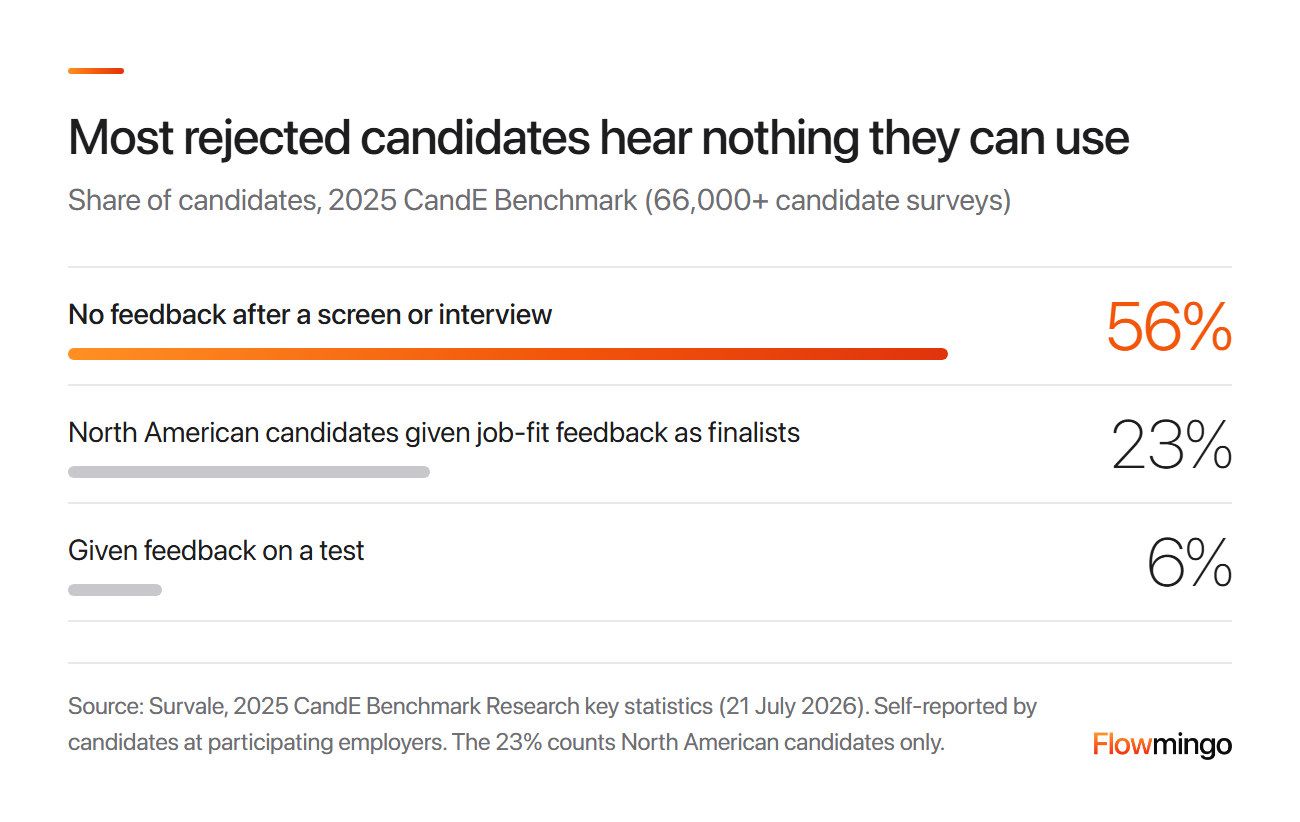
Candidate feedback in 2025: 56% got none after a screen or interview, and 6% got test feedback. Among North American candidates, 23% got job-fit feedback as finalists (CandE).
Explaining how you decided also makes a no feel fairer, in a foundational 2009 review of 26 samples and 3,481 applicants (Truxillo and colleagues).
Say your notes read "SQL depth 3/10, could not say when to add an index". Your reply says "The role needs SQL depth, and on the indexing follow-ups your answers stayed at the definition".
2. How do I give candidate interview feedback to 40 people without writing 40 notes?
Split the round into 3 tiers and write by hand only for the finalists. For 40 interviews and 1 hire, that is about 168 minutes of writing instead of 780, on our planning estimate.
| Tier | Who | What they get | Minutes each | Round of 40 |
|---|---|---|---|---|
| 0 | Applied, never interviewed | A status message, no reason | 0 | Outside the 40 |
| 1 | Out after a first interview (36) | 1 of 4 pre-approved reasons and 1 evidence line | 3 | 108 |
| 2 | Rejected finalists (3) | A call first, then a specific 2 to 4 sentence note the same day | 20 | 60 |
| Total | 39 rejected | 168 minutes |
They sit on top of the 4 tiers in our rejection email templates. Tier 0 here is their tier 1, tier 1 covers their tiers 2 and 3, and tier 2 is their finalist call.
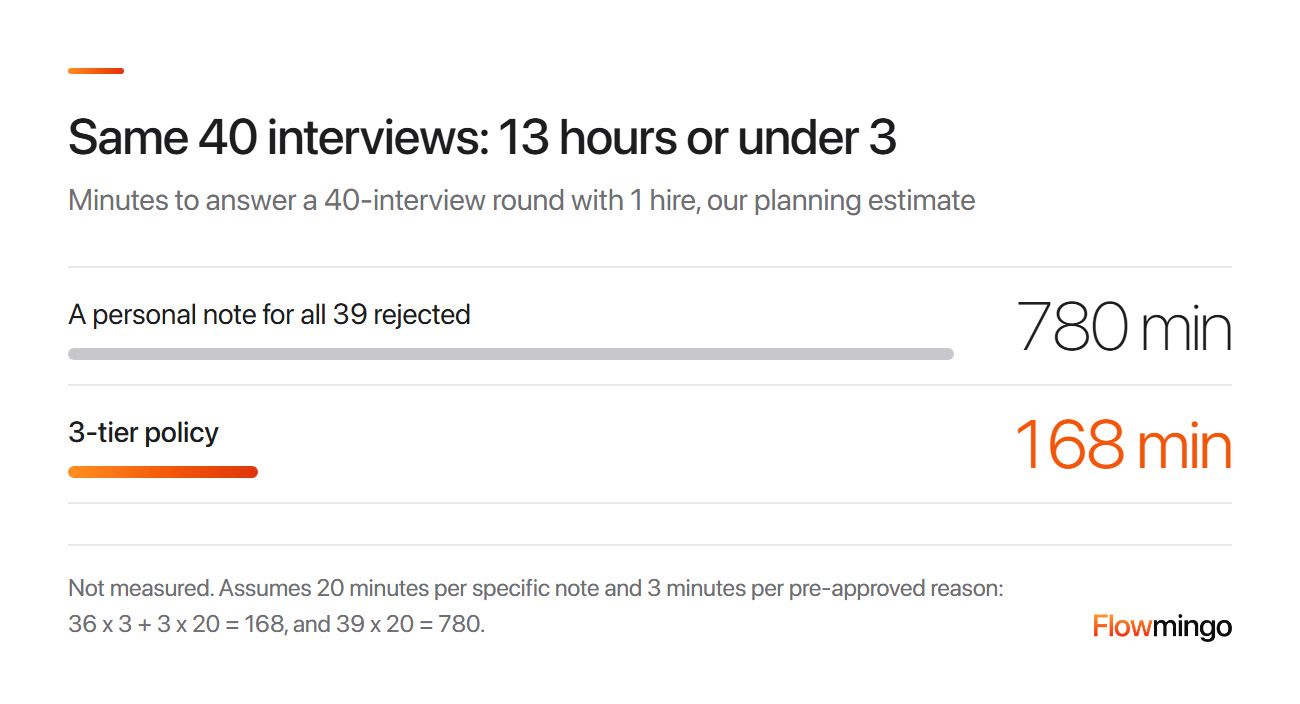
Feedback time for 40 interviews: 39 personal notes take about 780 minutes (13 hours), a 3-tier policy about 168 (2.8 hours), on our planning estimate.
Offering feedback on request saves more. Jacob Kaplan-Moss tells candidates early that they can email to ask, then replies after the round closes (foundational 2023 post). He says the wait cut angry replies "substantially".
Still, answer a feedback request within 2 weeks. The rejection itself still goes out within a week of your decision, as our rejection email templates advise. In the 2025 CandE benchmark, candidates given job-fit feedback within 1 to 2 weeks were 75% more likely to be extremely willing to refer.
Tier 0 has a public precedent: DWP Digital, a UK Civil Service employer, tells people not invited to interview that volume makes feedback unlikely.
Flowmingo data · 1,954 hiring projects · 725 companies · AI interviews completed 13 Aug to 10 Nov 2026
- 3 finished AI interviews was the median per hiring project.
- 77.4% of AI interview finishes sat in the 11.8% of projects with 25 or more finished AI interviews.
This counts candidates who finished an AI interview in a hiring project, not applicants or hires, and a candidate in 2 projects counts in each. It says nothing about whether they got feedback.
So across Flowmingo, most candidates who finish an AI interview sit in rounds of 25 or more. That means tier 1 saves the most hours there.
3. How do I turn my interviewers' notes into candidate interview feedback I can send?
Keep the score and the evidence, and drop the opinion about the person. Every sentence you send should rest on 1 job-related line in the notes: what they said or did, against what the job needs.
The rewrite takes 4 steps:
- Name the criterion from the scorecard.
- Quote the evidence: the answer, the task step or the moment in the recording.
- State the gap against the bar for the job, never against other candidates.
- Add 1 thing to build, and thank them for their time.
Step 3 matters because comparison feels unfair. In a foundational 2023 test-feedback study of 181 simulated applicants, scores given against a standard felt fairer than scores compared with others (Feeney and colleagues).
In Reinebold v. Bruce, a foundational 2021 appeals case, 1 committee note on a 56-year-old applicant read "Looking for a retirement job". He lost to a 31-year-old and cited the note as evidence of age bias, but the employer won, helped by job-related notes such as "Doesn't have a well thought philosophy".
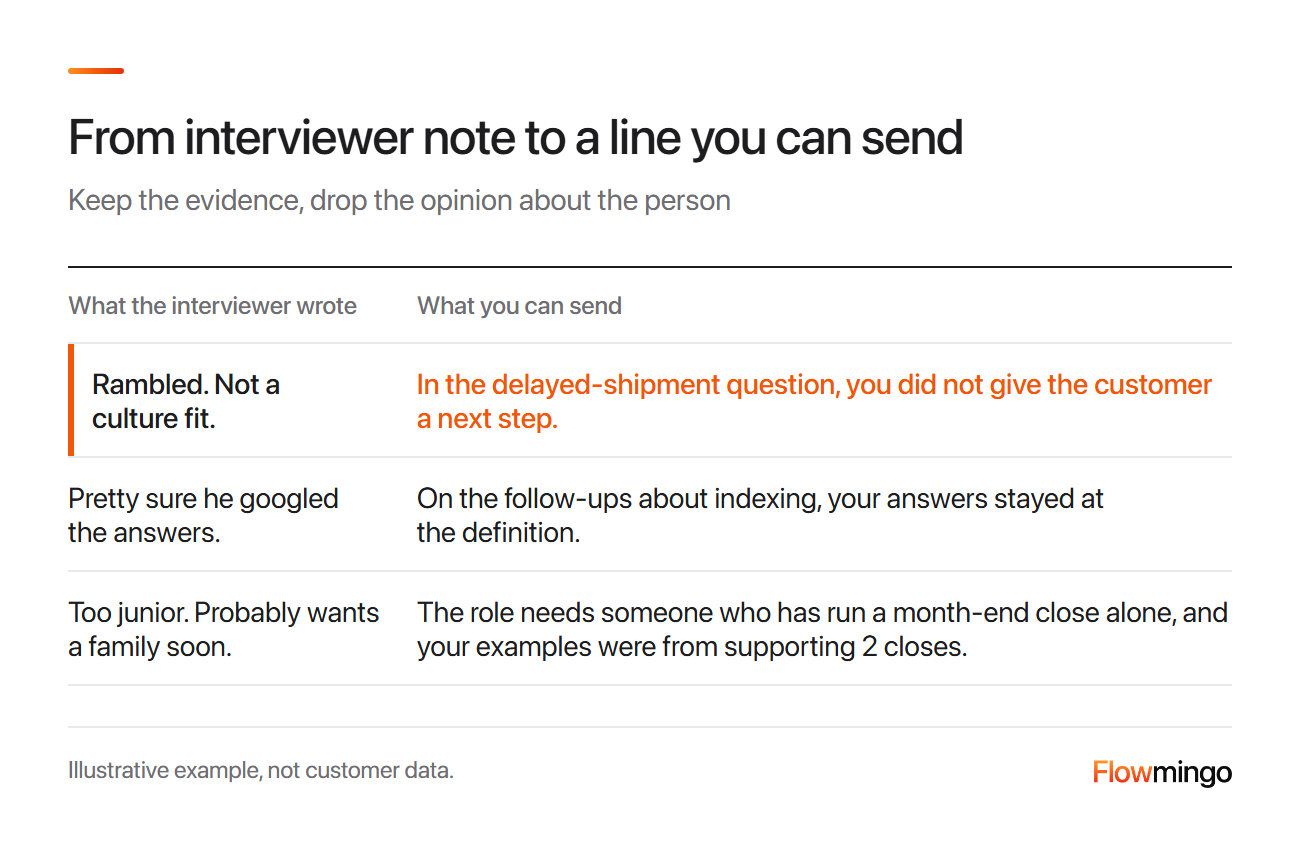
Raw notes rewritten: 3 interviewer notes turned into feedback a candidate can read, each resting on what they said, not who they are.
| What the interviewer wrote | The evidence line | What you can send |
|---|---|---|
| Rambled. Not a culture fit. | "Explains a plan to a customer": 4/10, no next step given | In the delayed-shipment question, you did not give the customer a next step. |
| Pretty sure he googled the answers. | "SQL depth": 3/10, could not say when to add an index | On the follow-ups about indexing, your answers stayed at the definition. |
| Too junior. Probably wants a family soon. | "Has run a month-end close alone": 3/10, supported 2 closes | The role needs someone who has run a month-end close alone, and your examples were from supporting 2 closes. |
This is illustrative, not customer data. If notes are too thin, fix them upstream with a candidate interview feedback tool and a shared interview scorecard.
How Flowmingo helps
Flowmingo's AI Interviewer scores each criterion you set from 0 to 10, with a 3 to 5 sentence justification. Highlighted quotes are exact transcript phrases you can copy into your evidence line. Check the recording first, as how we score advises.
4. What should I never write in candidate interview feedback, and why?
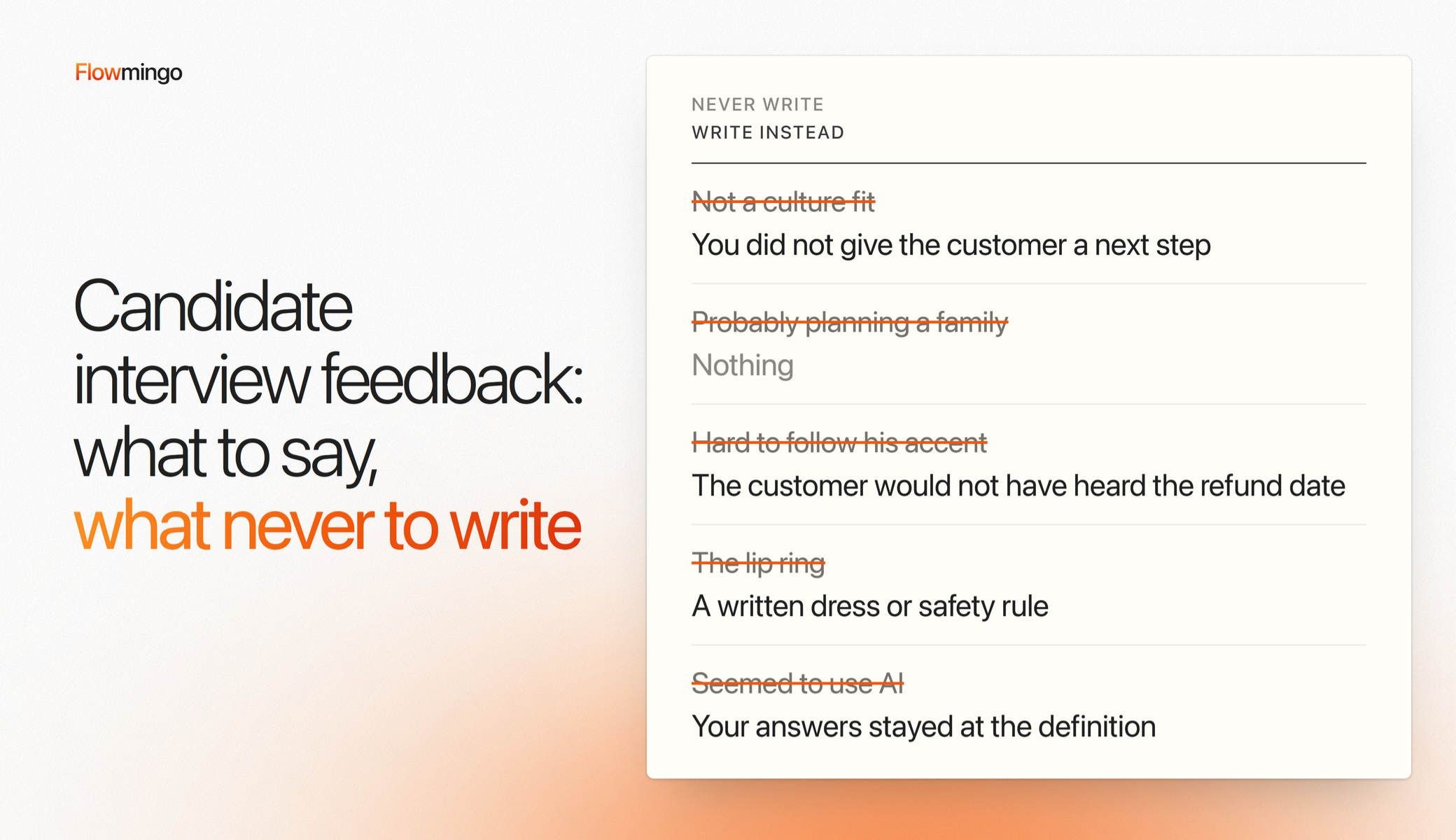
Never write about age, family plans, health, accent, looks or "culture fit", and never an unproven suspicion. Each can become evidence that a protected trait, not the job, decided the outcome.
Here are 8 tempting lines, with the risk and the fix. They are our examples and general information, not legal advice.
| Never write | Why it is risky | Write instead |
|---|---|---|
| Not a culture fit | Can hide stereotypes | The behaviour the job needs |
| Probably planning a family | Can be evidence of sex bias | Nothing |
| Not much energy, or overqualified | Can read as age, protected from 40 (ADEA) | The skill gap you saw |
| Hard to follow his accent | Lawful only if it materially interferes with spoken English the job needs (EEOC, foundational 2016) | The misunderstanding: "the customer would not have heard the refund date" |
| Seemed anxious about health | Can read as disability bias, and no medical questions before an offer (ADA) | Nothing |
| The lip ring | Not job evidence | A written dress or safety rule |
| I think you used AI | An unproven suspicion invites an argument | What you observed (section 7) |
| The other candidate was stronger | Comparison feels less fair than a standard | Their result against the bar |
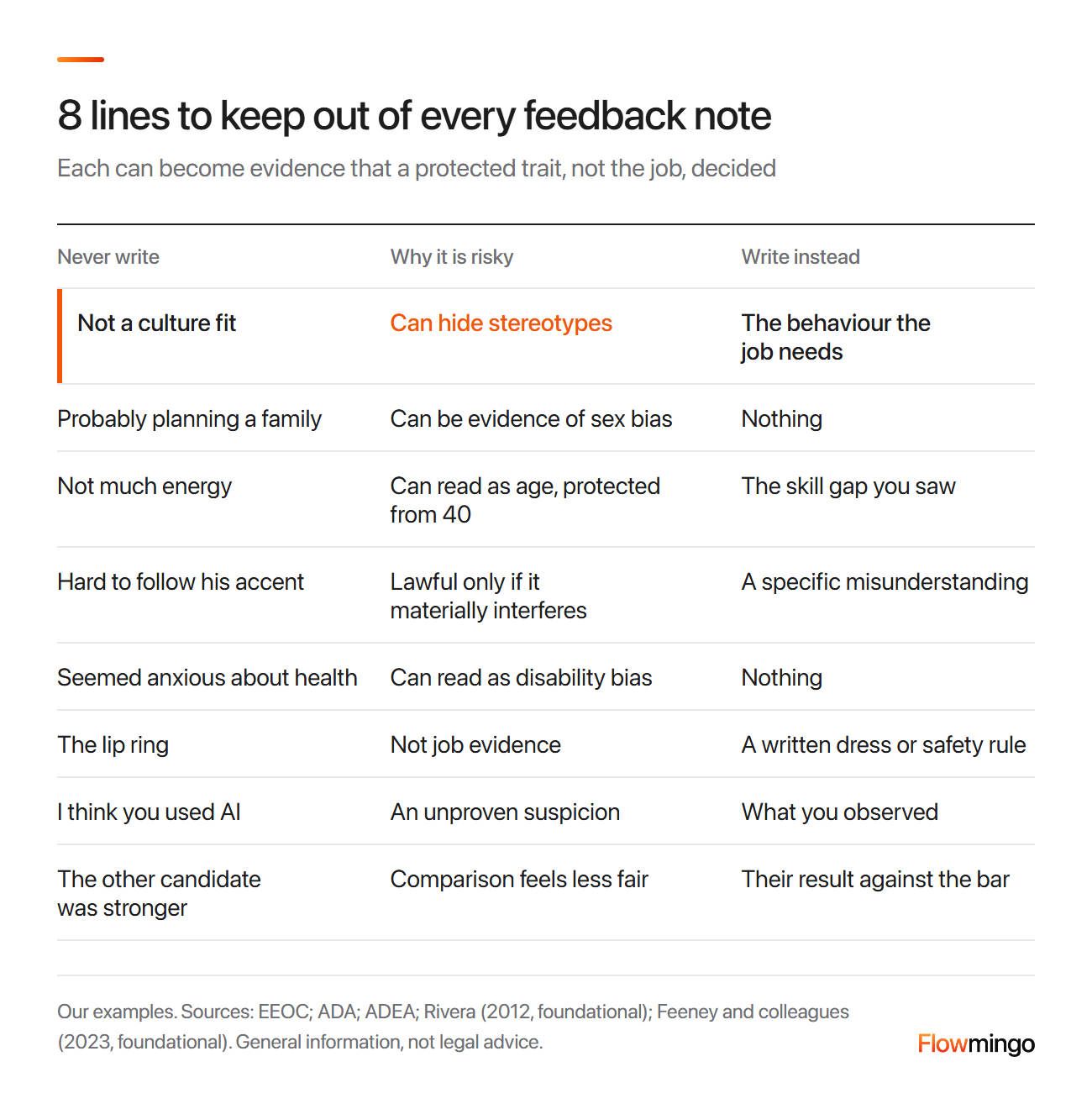
Lines never to write: culture fit, family plans, energy, accent, health, a lip ring, suspicion and comparison, each with its risk and fix.
Start with culture fit, because it sounds neutral but points at nothing the job needs. In a foundational 2012 study of elite firms, shared culture often outweighed productivity (Rivera).
It is not illegal, but the EEOC says hiring decisions may not rest on "stereotypes and assumptions" about protected traits. So name the behaviour the job needs, as our guide to interview bias explains.
On family, the EEOC says questions about children, even asked of men too, "may be seen as evidence of intent to discriminate against, for example, women with children".
For a rejection on or after 1 October 2026, most UK claims under the Equality Act have 6 months minus 1 day (Acas). Earlier ones had 3 months minus 1 day, timely early conciliation pauses the clock, and a tribunal can allow longer (section 123).
Singapore's TAFEP expects the Workplace Fairness Act, covering job offers and interview invitations, by the end of 2027.
5. Can you give me candidate interview feedback examples for each kind of candidate I turned down?
Yes: find the situation and its evidence line, then fill the brackets.
These interview feedback examples are sorted by situation, because it decides what is fair to say. All are illustrative.
5.1 Solid, but missing 1 must-have
For a capable candidate who lacked a major part of the job (r/recruiting).
Evidence line: Must Have "Owned a budget of [size]" scored low, noted "[tracked spend, did not set it]".
Thank you for the [budget case] you walked us through on [day]. You showed strong [criterion], especially [example]. The role needs someone who has owned a budget of [size], and your examples were about tracking spend. Owning even a small budget end to end would close that gap.
5.2 Good, but not ready yet
For someone strong but early, like a new graduate (r/recruiting). Name the experience the level needs, never age, and invite a new application only if you mean it.
Evidence line: "[led X end to end]" scored low, with a strength on [criterion].
Thank you for the [project] you talked us through on [day]. Your answers on [criterion] were clear and specific, for example [answer]. This role needs someone who has already [led X end to end], and your examples came from supporting roles. Build that, and we'd be glad to see you apply again.
5.3 Screened out after a first interview
This is the tier 1 reply from section 2: 1 reason and 1 evidence line, no coaching, because 3 minutes buys a reason.
Evidence line: 1 scorecard note for the reason you pick.
Thank you for the [20]-minute interview on [day]. The role needs [Must Have], and we did not hear an example of it. [Evidence, e.g. In the question about X, you described the team's result but not your own part.]
Agree 4 pre-approved reasons with HR first:
- The role needs [Must Have], and we did not hear an example of it.
- Your answers on [criterion] covered the basics, but the role needs [depth].
- The role needs [hard requirement, e.g. weekend shifts], and your availability does not match.
- Your [skill] task result was below the bar we set: [bar].
6. How do I tell a strong finalist they lost to just 1 other person?
Measure them against the bar for the job, not against the person you hired. Name the 1 requirement where their evidence fell short, and 1 thing you saw them do well.
A standard feels fairer than a comparison (section 3), so the template below counts requirements met.
You need not describe the winner either, because their details are their own data (GDPR Article 15). In Meister, the EU court said a rejected applicant has no right even to learn whether you hired someone else.
Watch the wording: 1 silver medallist, told the hire had deeper experience, called it ageist.
So name the skill evidence, for example "your renewal examples were from accounts under $50k, and this role owns accounts above $500k". Our rejection email templates suggest naming what the hired person brought, and their example counts years. Name the skill instead, for example "ran the month-end close alone", never the person or their years, because years can read as age.
Promise a follow-up only with a date you will keep. In the foundational 2023 CandE brief, only 45% of participating companies said they set and keep a follow-up date with finalists.
Evidence line: every requirement met but 1, with its note.
Thank you for the [3] rounds and your [case study]. You met [5] of the [6] requirements we set, and [strength] stood out, for example [answer]. The gap was [requirement]: [what you saw], and [1 step] would close it. [Role] is likely to open around [month]. I'll email you by [date] either way. If you'd like that, reply yes and I'll keep your details until then, up to [12] months.
7. What do I tell a candidate who failed the skills test, or seemed to use AI?
Give the result against the bar and 1 specific gap from the task. If you suspect AI or outside help, leave the suspicion out and describe what you saw.
ERE's December 2024 report found willingness to refer rose from 13 to 42, on a -100 to 100 scale, among candidates who got it. That is their own answers, not proof of cause.
For suspected AI, describe the effect, because a suspicion invites an argument. The top answer in a foundational 2017 Workplace Stack Exchange thread names "surface knowledge of many topics" and "a deep understanding of none".
If AI scored the round, say a person reviewed it, if one did. In 2 foundational 2023 studies, telling candidates an algorithm had judged their video interview made them accept its feedback less (Oostrom and colleagues).
Colorado's SB26-189 requires a plain-language description of a covered tool's role within 30 days of a rejection it materially influenced. Most of its provisions take effect on 1 January 2027 (Goodwin). For a Colorado candidate, add 1 plain sentence on what the tool scored.
Evidence line, failed test: the score below the bar, and the step that failed.
Thank you for the [2] hours on the [skill] task. Your result was below the bar we set: [bar, e.g. a working query for 3 of 4 questions]. The step that held it back was [specific], which this role does daily. Practising that step on real data would close the gap. [If AI scored it: A person on our team checked your recording before we decided.]
Evidence line, suspected AI: what you observed, never the suspicion.
Thank you for the [30] minutes on [day]. Your first answers covered [topic] clearly, but on the follow-ups about [specific] they stayed at [the definition]. This role needs that depth from day 1, and working through [topic] on a real case would build it. [If AI scored it: A person on our team checked your recording before we decided.]
8. How do I give feedback to an internal candidate who didn't get the job?
Tell them yourself before the announcement, then send the same evidence in writing. Most employers in the 2023 CandE benchmark already give internal finalists more feedback than outsiders, and you will work with them the next morning.
In the foundational 2023 CandE brief, 65% of participating North American employers said hiring managers give feedback to internal finalists they turn down. For external ones it was 17%.
Acas adds that an internal applicant can raise the decision informally and might be able to reach a tribunal.
On r/managers, a manager planned to tell a 10-year colleague the team wanted energetic thinkers, and commenters called it insulting.
Our 5 steps, from practice rather than a study:
- Tell them yourself, before the announcement.
- Give the decision in 1 sentence, and thank them for putting themselves forward.
- Name the 1 or 2 criteria where the evidence fell short, with the example.
- Say what they did well, from the same notes.
- Agree 1 development step with a date, and put it in writing that day.
Use the scorecard's words, because a UK or EU employee can ask to see their notes. Our guide to evaluating candidates consistently shows how to write them.
9. What positive feedback should I give the candidate we're hiring?
Tell the hire exactly which answers won the role, criterion by criterion, when you make the offer. Then name 1 area you'll support first, so the same evidence sets up their first 90 days.
Most example lists skip this, because their positive feedback is interviewers writing to each other. Yet the foundational 2023 CandE brief says top-rated employers give feedback more often to rejected candidates and "new hires" alike.
Use Stone and Heen's 3 kinds of feedback in order (foundational 2014 book): appreciation, then evaluation ("you're hired because of X and Y"), then coaching on 1 area.
Hold it to the same standard as a rejection: specific, quoted and job-related. Swap "you'll fit right in" for the answer itself, for example "your renewal plan named the owner, the date and the risk".
That tells the hire what you value, which praise for personality never does. The gap you name then becomes the first item in their onboarding plan, our suggestion rather than a study finding. Their manager starts with evidence instead of a blank page.
Evidence line: the 2 strongest criteria in the report, and 1 gap.
We're glad to offer you the role, and thank you for your [renewal plan] in the final round. You're getting it because of [criterion 1]: [their answer]. [Criterion 2] stood out too: [evidence]. In your first 90 days we'll support you most on [gap], starting with [first step].
10. The candidate asked again after my first reply. What do I say now?
Restate the same evidence once, briefly, and close the thread without reopening the decision.
"Refuse to argue", Kaplan-Moss says, unless you made a genuine mistake. Add no new reason or tip, because anything new reads as the inconsistency section 1 warned about.
Thanks for following up. The decision is final, and the reason is the one I shared: [same evidence line]. I can't add more, but [name] at [email] handles formal concerns.
10.1 They asked to see our interview notes and scores. Must we send them?
In the UK and EU, yes: a request to see what you wrote is a data request with a 1-month deadline. In the US, no federal rule we read gives that right, but covered employers (15 or more staff) must keep the records.
The ICO sets that clock, and its draft recruitment guidance says candidates can request interview notes, including your opinion of them.
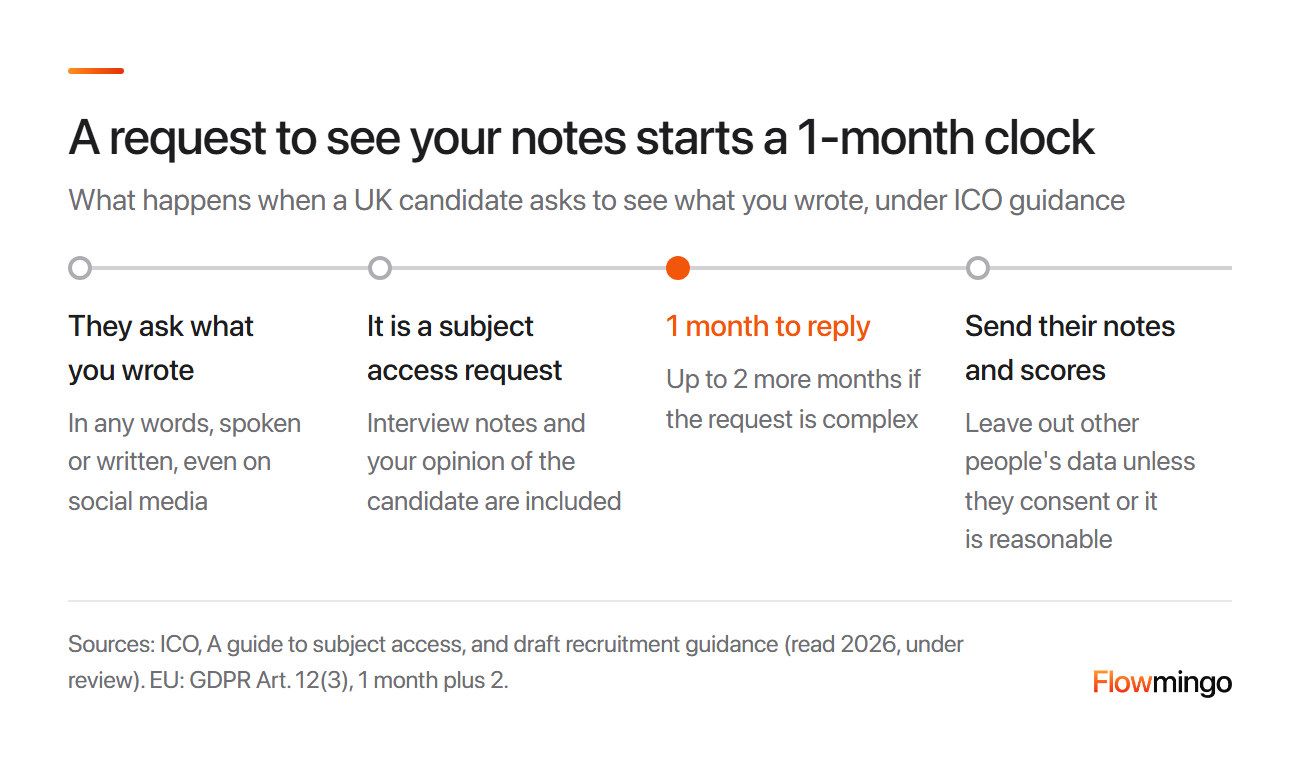
Subject access request timeline: in the UK a request in any words starts a 1-month clock, extendable by 2 months, and covers interview notes (ICO).
You can leave out what would reveal another person, such as the hire, unless they consent or disclosure is reasonable. Don't delete early either, because the ICO says it makes a fair process harder to prove (recruitment records).
In the EU, GDPR Article 15 gives a right to a copy, and Article 12 sets 1 month, extendable by 2. In the foundational 2017 Nowak case, a court treated an examiner's comments as the candidate's data, so by analogy expect scorecards to count.
| Where | Can they see your notes | Deadline | Records to keep |
|---|---|---|---|
| UK | Yes, including your opinion of them (ICO draft guidance) | 1 month, up to 2 more | 12 months, as the EHRC advises; longer only for a clear business reason (ICO) |
| EU | Yes, a copy of their personal data (GDPR Article 15) | 1 month, up to 2 more | No fixed period in the rules we read |
| US (federal) | No federal access right we found | None set | At least 1 year at 15 or more staff (29 CFR 1602.14), all candidates once a charge is filed |
| Singapore | No, for opinions kept only to judge suitability (PDPA) | None for those opinions | At least 1 year (TAFEP advice) |
So the 3 who asked why not me get 1 true reason each: interview feedback for candidates you can repeat and defend.
How Flowmingo helps
Flowmingo's AI Interviewer is free and unlimited on every plan today. Results, scores and transcripts stay on every plan, but Free keeps the latest 300 videos for 30 days, so quote the transcript in your notes. In the interview settings, you can stop candidates seeing their own report. Run your next round there, and the evidence behind each line of candidate interview feedback you write is already in the report on Flowmingo.
11. Sources
Every study, law and guidance page cited above is listed below. Reddit threads are linked in the text as examples of real situations, not as evidence.
- Acas (2025, November 7). If you applied for a job and did not get it. Acas.
- Acas (2026, updated 1 October). Employment tribunal time limits. Acas.
- Colorado General Assembly (2026). SB26-189: Automated decision-making technology. Colorado General Assembly.
- Court of Justice of the European Union (2012, April 19). Galina Meister v Speech Design Carrier Systems GmbH, Case C-415/10. EUR-Lex.
- Court of Justice of the European Union (2017, December 20). Judgment in Case C-434/16, Peter Nowak v Data Protection Commissioner. Press release No 140/17.
- DWP Digital (n.d., read 11 November 2026). Applying for jobs at DWP Digital. Department for Work and Pensions.
- Equality and Human Rights Commission (n.d.). What equality law means for you as an employer: When you recruit someone to work for you. EHRC.
- ERE (2024, December 11). The return on candidate assessment feedback is clear. ERE.
- Feeney, J. R., McCarthy, J. M., Daljeet, K. N., & Goffin, R. D. (2023). Simulated job applicant test-taker reactions to rejection: Comparing absolute and social-comparative feedback. Current Psychology, 43(4), 3714-3726.
- Goodwin (2026). Colorado enacts law repealing and replacing landmark Colorado AI Act. Goodwin.
- Grossman, K. (2026, July 21). 2025 candidate experience (CandE) benchmark research: Fact sheet and key statistics. Survale.
- Information Commissioner's Office (n.d., read 2026). A guide to subject access. ICO.
- Information Commissioner's Office (n.d., read 2026). Keeping recruitment records. ICO.
- Information Commissioner's Office (n.d., read 2026). Shortlisting, testing, and interviewing candidates [Draft guidance, under review]. ICO.
- Kaplan-Moss, J. (2023, August 25). Should you give candidates feedback on their interview performance. jacobian.org.
- Legal Information Institute (read 2026). 29 CFR 1602.14, preservation of records made or kept. Cornell Law School.
- Oostrom, J. K., Holtrop, D., Koutsoumpis, A., van Breda, W., Ghassemi, S., & de Vries, R. E. (2023). Applicant reactions to algorithm- versus recruiter-based evaluations of an asynchronous video interview and a personality inventory. Journal of Occupational and Organizational Psychology, 97(1), 160-189.
- Personal Data Protection Act 2012, Fifth Schedule (Singapore). Personal Data Protection Act. Singapore Statutes Online.
- Regulation (EU) 2016/679, General Data Protection Regulation. Article 12 and Article 15. gdpr-info.eu.
- Reinebold v. Bruce, No. 21-1092 (7th Cir. 2021, November 18). Opinion. Justia.
- Rivera, L. A. (2012). Hiring as cultural matching: The case of elite professional service firms. American Sociological Review, 77(6), 999-1022.
- Stone, D., & Heen, S. (2014, April 28). The three most important kinds of feedback you can give and receive. Excerpt from Thanks for the Feedback (Viking), The Globe and Mail.
- TAFEP (2026, May 18). Fair recruitment practices for employers in Singapore: Preparing for the Workplace Fairness Act. Tripartite Alliance for Fair and Progressive Employment Practices.
- Talent Board & ERE Media (2024). The 2023 North American CandE Benchmark Research overview. Executive brief.
- The Workplace Stack Exchange (2017, December 19). Providing post-interview feedback to a candidate who I suspect was googling answers. Stack Exchange.
- Truxillo, D. M., Bodner, T. E., Bertolino, M., Bauer, T. N., & Yonce, C. A. (2009). Effects of explanations on applicant reactions: A meta-analytic review. International Journal of Selection and Assessment, 17(4), 346-361.
- UK Parliament (2010, as amended 2026). Equality Act 2010, section 39 and section 123. legislation.gov.uk.
- U.S. Equal Employment Opportunity Commission (n.d., read 2026). Age discrimination. EEOC.
- U.S. Equal Employment Opportunity Commission (2016, November 18). EEOC enforcement guidance on national origin discrimination. EEOC.
- U.S. Equal Employment Opportunity Commission (n.d., read 2026). Pre-employment inquiries and marital status or number of children. EEOC.
- U.S. Equal Employment Opportunity Commission (n.d., read 2026). Pre-employment inquiries and medical questions and examinations. EEOC.
- U.S. Equal Employment Opportunity Commission (n.d., read 2026). Prohibited employment policies/practices. EEOC.