
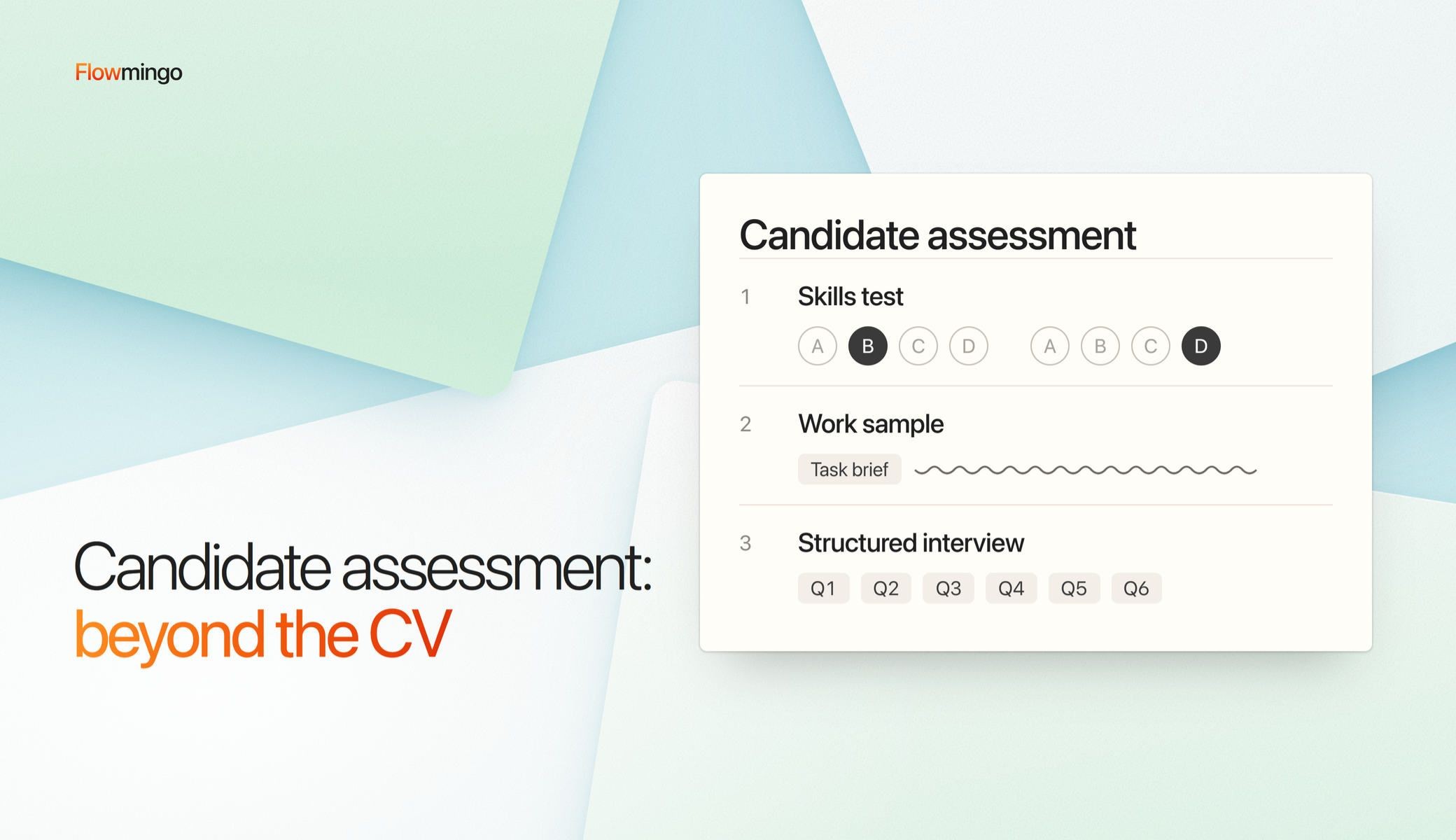
A candidate assessment is the set of methods used to judge every applicant on the same job criteria: skills tests, structured interviews or work samples. It shows what a person can do, not only what a CV claims.
You reach for one when CVs stop telling people apart, for example when 30 applicants list the same tools. Candidate assessment tools give you a test, a task or a fixed set of questions to compare them on. Yet in CIPD's 2026 survey of 1,014 UK HR professionals, only 7% said their organisation collects data on whether its assessment methods predict performance.
Key takeaways
- What counts as a candidate assessment? Any method that judges every applicant on the same criteria: a skills test, a structured interview, a work sample or a role-play.
- Which method predicts job performance best? Structured interviews ranked first in a foundational 2022 re-analysis, ahead of job knowledge tests, work samples and cognitive ability tests.
- How should you combine the results? With a rule fixed in advance. A formula predicted performance more than 50% better than expert judgment across a foundational 2013 review of many studies.
- Do most employers check that their assessments work? No. Only 7% of UK HR professionals in CIPD's 2026 survey said their organisation collects that data.
1. What is a candidate assessment in recruitment?
It is the part of hiring where you test the must-haves directly instead of reading about them. It runs after the CV screen and before the final decision, in 1 stage or several.
It usually mixes 3 kinds of method. Tests check knowledge or skill, such as a 20-question SQL quiz, and work samples or role-plays ask for a slice of the real job. Structured interviews ask everyone the same questions, scored the same way.
It is not candidate scoring, which is the rating each person gets on the criteria once the assessment is done. It is not the CV screen either, because a CV shows claims, while an assessment produces new evidence.
The term is common in public-sector hiring. In the US, a foundational 2020 order, Executive Order 13932, called for more skills- and competency-based assessments in federal hiring. The GSA Office of Evaluation Sciences describes how the Department of the Interior then moved from self-rated questionnaires to scored assessments and expert reviews.
2. What does a candidate assessment look like for 1 role?
For 1 role, it is a short plan that ties each must-have to 1 method. Here is an example for a junior data analyst, with example numbers.
Say 12 people pass your CV screen. The role has 3 must-haves: SQL and spreadsheets, cleaning messy data, and explaining findings to people who are not analysts. You give each must-have its own method, so the whole assessment asks for 2 hours of each candidate's time.
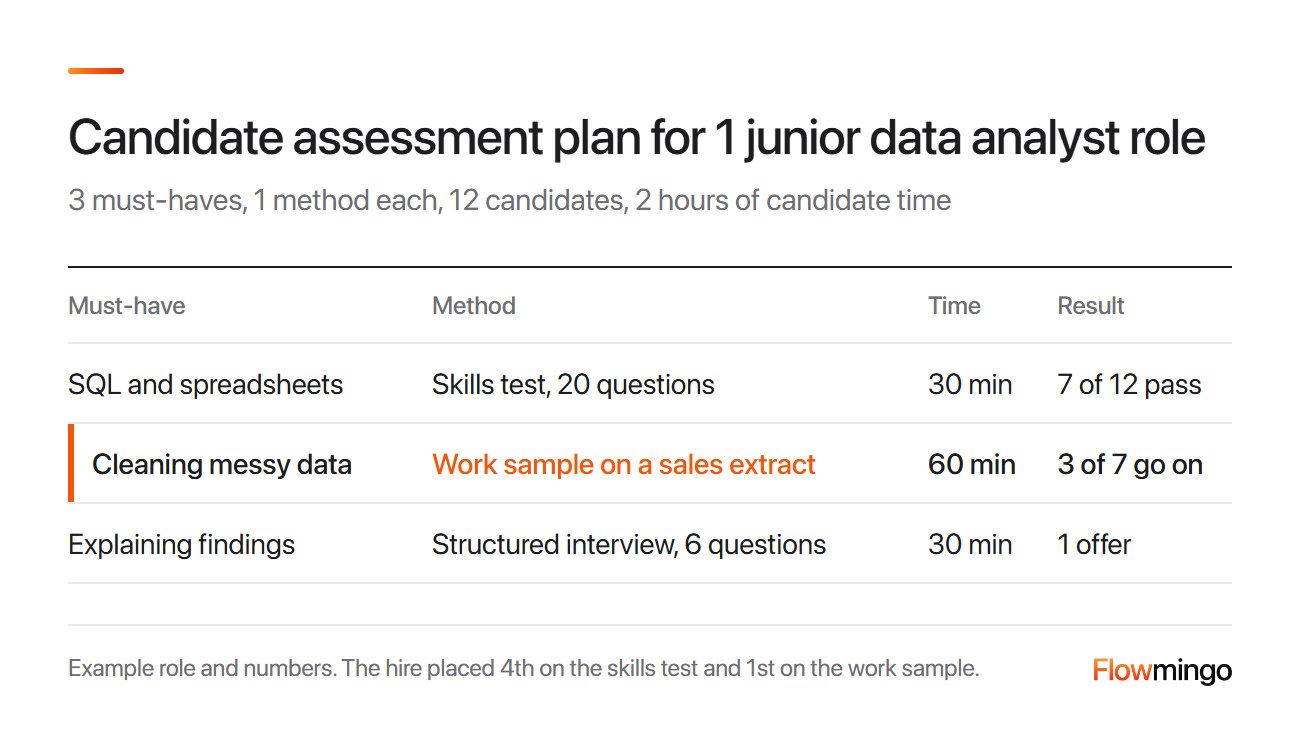
Candidate assessment plan for 1 junior data analyst role: 3 methods, 1 per must-have, take 12 candidates to 1 offer.
The 30-minute skills test has 20 questions, and 7 of 12 pass. Those 7 get a 60-minute work sample: clean a messy sales extract and write 3 findings. Then 3 of 7 go on to a 30-minute structured interview of 6 questions, and 1 offer goes out.
The decision came from the work sample, because it showed the real job. The hire placed 4th on the skills test but 1st on the work sample. The hiring manager could point to the 3 findings they wrote, while a test alone would have ranked them behind 3 others.
3. How do you build a candidate assessment, step by step?
Start from the job, not from a list of tests. Pick 1 method per must-have and fix how the results combine in advance, because a set plan treats every candidate the same way.
- Write 3 to 5 must-haves from the job. A method that measures nothing on the list adds candidate time, not evidence.
- Match 1 method to each must-have, using methods that predict performance. In a foundational 2022 re-analysis by Sackett and colleagues, structured interviews predicted job performance at 0.42. Job knowledge tests followed at 0.40, work samples at 0.33 and cognitive ability tests at 0.31.
- Keep the total time short and say it upfront. State the minutes in the invite so people can plan, and ask for only what the must-haves need.
- Write the rule that combines the results before anyone takes part. Otherwise the last or loudest impression wins, as the next section shows.
- Send every candidate their result, then check the method worked. Only 6% of candidates in the 2025 CandE benchmark received feedback on assessment or test results. Later, compare the results with first-year performance, the check CIPD found so rare.
Our guide to skills-based hiring shows what to test once you drop a degree requirement.
3.1 Which mistakes weaken a candidate assessment?
The first mistake is ending with an unstructured chat and letting it override the evidence. In a foundational 2013 study by Dana, Dawes and Peterson, grade predictions made after an unstructured interview correlated .31 with actual grades.
Predictions made with no interview at all correlated .61. The study predicted grades, not job performance, but the chat made the forecast worse, not better.
The second mistake is combining results by gut feel. In Kuncel and colleagues' foundational 2013 meta-analysis, a formula applied the same way to everyone predicted job performance at 0.44, against 0.28 for holistic judgment. That held even when the people judging were experts who knew the job.
4. How do you run a candidate assessment with Flowmingo?
You add the methods to 1 role, and each result lands on the same candidate profile. You then compare the evidence against your rule from step 4 and make the call.
Before you set it up, write down the must-haves from step 1 and the combining rule from step 4. The tool only runs the plan, so a vague must-have still gives a vague result. For example, a task like "clean a 5,000-row extract" tells you something, while "good with data" does not.
Our post on the most accurate AI candidate assessment tools looks at the wider market.
How Flowmingo helps
Add Flowmingo's tests, multiple-choice in a locked-down runtime, next to an AI interview, a role-play or a technical test for the same role. Every assessment a candidate completes lands on 1 profile, in 1 board you run your hiring from, and every hiring decision stays with your team. Sign up free to run your next candidate assessment on Flowmingo.
5. Sources
Every study, survey and guideline in this glossary entry links to its source below.
- CIPD. (2026). Resourcing and talent planning report 2026. Chartered Institute of Personnel and Development. CIPD
- Dana, J., Dawes, R., & Peterson, N. (2013). Belief in the unstructured interview: The persistence of an illusion. Judgment and Decision Making, 8(5), 512-520. SJDM
- Kuncel, N. R., Klieger, D. M., Connelly, B. S., & Ones, D. S. (2013). Mechanical versus clinical data combination in selection and admissions decisions: A meta-analysis. Journal of Applied Psychology, 98(6), 1060-1072. APA
- Office of Evaluation Sciences. (n.d.). Describing candidate assessments and hiring outcomes at DOI. U.S. General Services Administration. Retrieved 26 October 2026. OES
- Sackett, P. R., Zhang, C., Berry, C. M., & Lievens, F. (2022). Revisiting meta-analytic estimates of validity in personnel selection: Addressing systematic overcorrection for restriction of range. Journal of Applied Psychology. APA
- Survale & Talent Board. (2026, July 21). 2025 candidate experience (CandE) benchmark research: Key statistics. Survale