
A structured interview asks every candidate the same job-based questions in the same order. The interviewer rates each answer against the same written scale. An unstructured interview is a conversation that goes wherever the interviewer takes it, judged on overall impression.
The difference changes how well the interview predicts who will do the job well. Structured interview questions, a rating scale and notes are the parts that do the work.
This guide covers the research, the 6 parts of a structured interview and 6 steps to run one. It ends with example questions by criterion.
Key takeaways
- Structured interviews predict job performance better than free-form ones in every major review.
- The rating scale with written anchors does most of the work, not the question list.
- Ask the same questions in the same order, and rate each answer on its own.
- Each interviewer scores alone, before the panel talks.
- The format works live, on video or asynchronously.
1. What the research says about the structured interview
Selection research has compared interview formats for decades, and structured interviews come out ahead every time. In the newest re-analysis, structure more than doubles the correlation with job performance, from 0.19 to 0.42.
The chart below shows the 2 best-known estimates. The numbers are correlations with job performance, where 0 means no relationship and 1 means a perfect one.
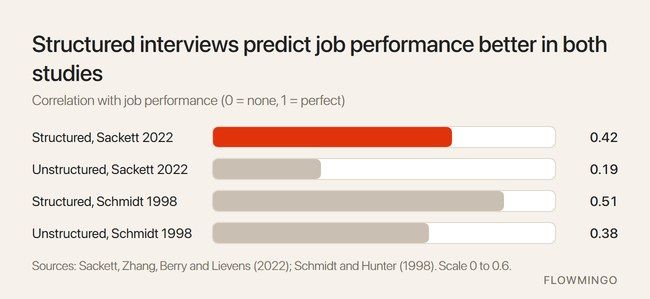
Correlation with job performance, from 2 major reviews of selection research.
The foundational re-analysis by Sackett, Zhang, Berry and Lievens (2022) corrected earlier estimates that they found inflated, which lowered most predictors. The structured interview came out with the highest validity of the selection procedures they re-examined, at 0.42 against 0.19 for an unstructured one.
The older foundational estimate, from Schmidt and Hunter (1998) in Psychological Bulletin, put the 2 formats at 0.51 and 0.38. The ranking is the same in both, and the gap grew in the newer work.
1.1 Why a structured interview is also fairer to check
Structure also makes interviews easier to audit. When every candidate answers the same questions against the same scale, a team can compare them, explain a decision and review the process later.
The US Office of Personnel Management publishes a guide to structured interviews for federal hiring on the same basis. Its guide walks through job analysis, question writing and rating scales.
2. The 6 parts of a structured interview
Structure is not a single switch. Campion, Palmer and Campion (1997, Personnel Psychology) listed 15 components, and the 6 that carry the most weight are shown below.
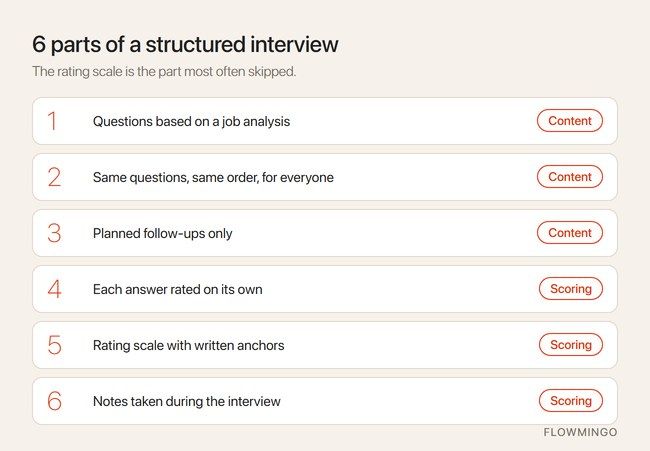
3 parts shape what you ask, and 3 shape how you rate the answers.
A structured interview with 4 of these parts is far more structured than one with none. Questions are the easy part to standardise.
The interview rating scale is the part that turns a list of questions into a structured interview. Without it, the same questions still get judged by overall impression.
3. How to run a structured interview in 6 steps
The 6 steps below take a role from job description to decision. Building a set takes 1 to 2 hours per role, and you can reuse it for every opening in that role family.
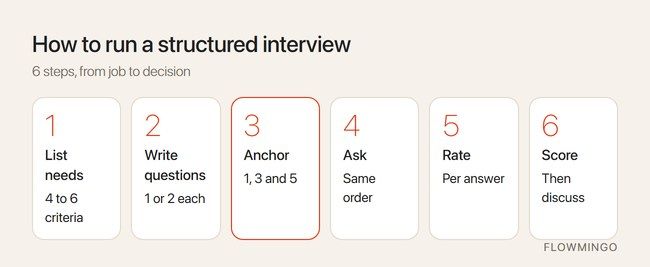
Write the anchors before the first interview, not after it.
3.1 List what the job needs
From the job description and the hiring manager, list 4 to 6 things a person must be able to do in the role. Write them as behaviours: "handles an escalated complaint without a manager", not "good with people".
3.2 Write structured interview questions for each criterion
Write 1 or 2 questions per criterion, using 2 question types that are well supported by research. Past-behaviour questions start with "Tell me about a time…", and situational questions start with "What would you do if…".
Behavioural interview questions work well for experienced candidates. Situational questions suit graduates and career changers, who may have no direct experience to describe.
3.3 Write the anchors before the first structured interview
For each question, describe what a 1, a 3 and a 5 answer contains. This is the step that turns questions into a structured interview.
An interview scorecard holds the questions, anchors and weights on 1 page. It also gives each interviewer a place to record evidence.
3.4 Ask every candidate the same questions
Use the same wording in the same order for every candidate. Plan the follow-ups, such as "What was the result?", and use them for everyone.
If a candidate asks you to repeat a question, repeat it word for word. Rephrasing it on the spot gives that candidate a different question from everyone else.
3.5 Rate each answer straight after it is given
Rate question by question, with a note of the evidence. Overall impressions formed at the end are where halo effects creep in, when 1 strong answer colours the rest.
3.6 Score before you discuss
Each interviewer submits ratings independently, and then the panel meets. Discussing first lets the most senior or most confident person set everyone's score.
4. Structured interview questions by criterion
The table below gives 1 past-behaviour question and 1 situational question for 6 common criteria. Adapt the wording to the role, then write anchors for each.
| Criterion | Past-behaviour question | Situational question |
|---|---|---|
| Problem solving | Tell me about a problem at work that had no obvious answer. What did you do? | A key supplier misses a delivery the day before launch. What do you do in the first hour? |
| Prioritisation | Describe a week where you had more work than time. How did you decide what to drop? | Your manager and a client both need something by 5 pm and you can only finish 1. What do you do? |
| Collaboration | Tell me about a time you disagreed with a colleague on how to do something. | A teammate keeps missing deadlines that affect your work. How do you handle it? |
| Customer handling | Describe the most difficult customer you have dealt with and how it ended. | A customer demands a refund the policy does not allow. What do you say? |
| Learning | Tell me about something you had to learn quickly for a job. How did you learn it? | You start next week on a tool you have never used. How do you get up to speed? |
| Ownership | Tell me about a mistake you made at work. What happened next? | You notice an error in a report that has already gone to the client. What do you do? |
For more on which question types predict performance, see hiring interview questions that predict job performance.
5. Common objections to the structured interview
Teams moving from free-form interviews tend to raise the same 4 objections. Each has a practical answer.
- "It feels robotic." Open with 2 minutes of introduction and explain the format: "I ask everyone the same questions so it is fair."
- "I can tell in 5 minutes." A first impression is what an unstructured interview measures. The research above shows how weakly it predicts performance.
- "Our roles are too different." Only the criteria and questions change from role to role, so build 1 set per role family and reuse it.
- "It takes too long to prepare." A set takes 1 to 2 hours per role, while interviewing the wrong candidates takes longer.
Hiring managers are often the harder audience. Show them 2 rated answers side by side, 1 strong and 1 weak. The value of a structured interview becomes clear in a few minutes.
Candidates also tend to accept the format once you explain it. What they notice most is whether the process felt fair and whether they heard back.
6. Structured interview formats: live, video and asynchronous
The structure sits in the questions and the scoring, not in the channel. A structured interview works in person, on a video call or asynchronously.
In an asynchronous format, each candidate answers the same questions in their own time. Flowmingo's own data covers 49,323 asynchronous structured interview sessions from June to September 2026.
In that data, 85.0% of candidates who began finished, and the median structured interview took 25.7 minutes (full data). That keeps the wording identical by design and removes the scheduling step, which matters most when a role has hundreds of applicants.
Whichever channel you choose, keep the same anchors and the same scorecard across every structured interview for the role. Mixing channels is fine, while mixing scales is not.
A semi-structured interview sits between the 2 formats. It uses core questions but lets the interviewer add or skip questions, and its predictive value depends on how much structure it keeps.
7. How Flowmingo runs a structured interview
Flowmingo's AI Interviewer is a structured first-round interview that each applicant does in their own time. Paste the job description, and AI drafts the questions and the criteria you will score on.
You edit both and mark the questions that must always be asked. Every applicant gets the same questions, spoken, with follow-ups when an answer is thin or off-topic.
Every interview comes back rated against your criteria, 0 to 10 per criterion with a written justification, next to the recording and transcript. You still decide who moves forward, and it is free for unlimited applicants.
8. Conclusion
A structured interview asks job-based questions, the same for every candidate. Interviewers rate each answer against written anchors and submit scores before any discussion.
The research gives it the highest validity of the common selection methods.
Start with 4 to 6 criteria, write the anchors first and keep the evidence for every rating. To give every applicant the same first-round questions and a scored report, try Flowmingo and run your next structured interview free.