
A job requisition is an internal request to fill a role, written by the hiring manager and approved by HR and finance before recruiting starts. It records the role, the reason, the budget and the start date.
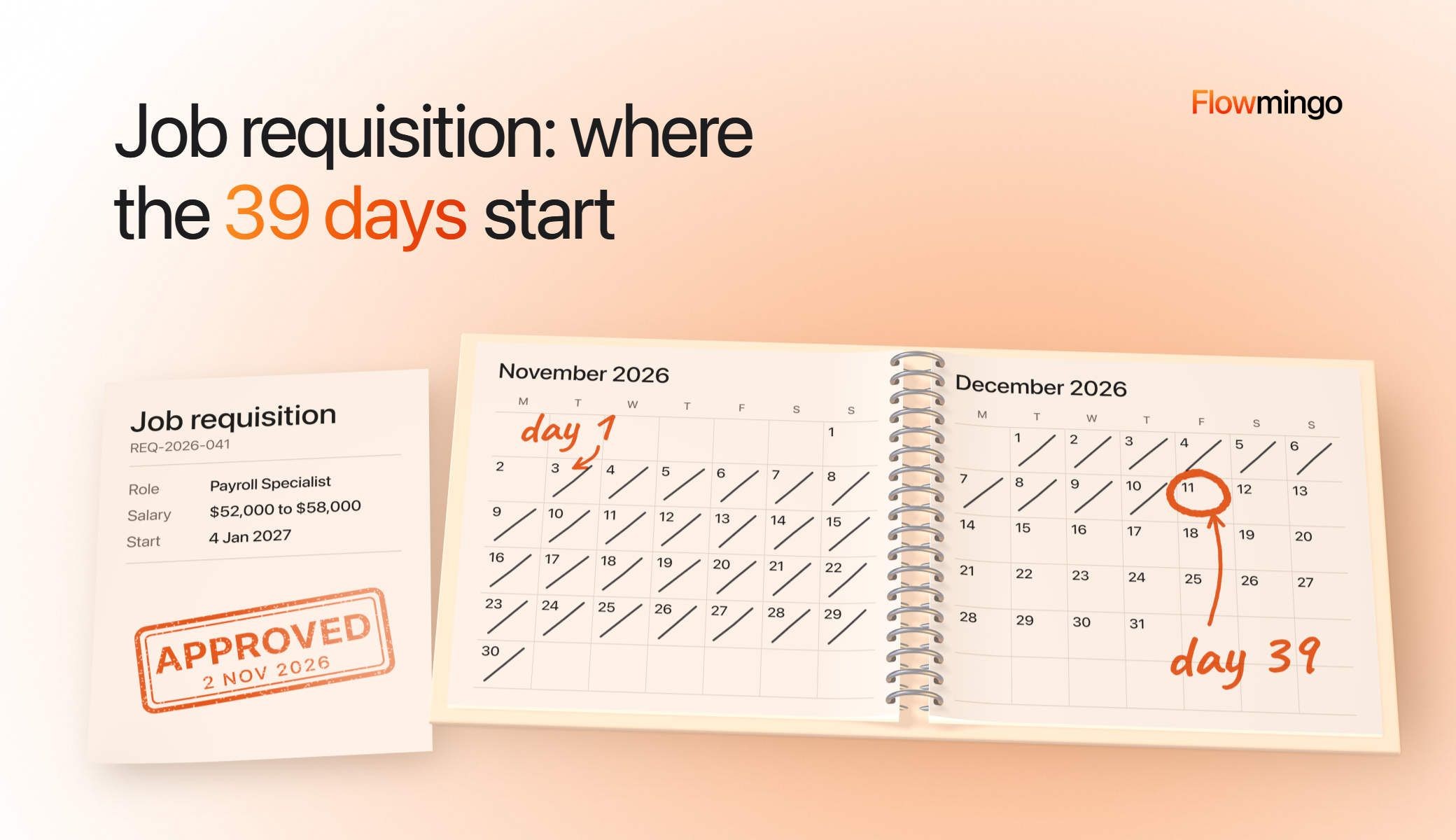
You meet it when a hiring manager says they need to "raise a req", or a client wants sourcing to start before sign-off. Until finance approves the job requisition form, there is no budget to recruit against. The time-to-fill clock also starts on the day it opens, in SHRM's foundational 2012 definition.
Key takeaways
- Who writes a job requisition? The hiring manager writes it, then HR and finance approve it. OPM gives US federal managers 1 day for this step.
- When does the time-to-fill clock start? On the day the requisition opens. SHRM's 2026 median is 39 calendar days for nonexecutive roles.
- Is a job requisition a job posting? No. The requisition stays internal, and 1 job posting can carry several requisitions.
- What gets a requisition approved quickly? A named reason, a salary range inside the budget and a start date the team can hold.
1. What is a job requisition in recruiting?
A job requisition is the approval to hire, kept on paper or in an applicant tracking system. Once the approvers sign it, the role becomes an open "req" with its own number, and recruiting can start.
It holds 3 kinds of detail: role facts, a business case and money. The role facts are the title, level, team, manager, location and contract type.
The business case is the reason: a backfill for someone who left, or new headcount. The money is the salary range and the start date.
It is not a job posting, which is the public ad candidates read. It is not a job description either, which lists the duties and the skills. Section 4 shows how the 3 documents fit together.
In US federal hiring, the same request has its own form: the SF-52, a "Request for Personnel Action". OPM's hiring process tool says the manager creates it and gets it approved, and it allows 1 day for that step.
2. What is a job requisition example?
A job requisition example is easiest to read as a filled-in form. Here is 1 request worked through with illustrative numbers, from the manager's draft to the open req.
Say you recruit for a retailer whose payroll team now pays 420 staff, up from 300 a year ago. The payroll manager raises a job request for a second payroll specialist. She gives new headcount as the reason and asks for a permanent role.
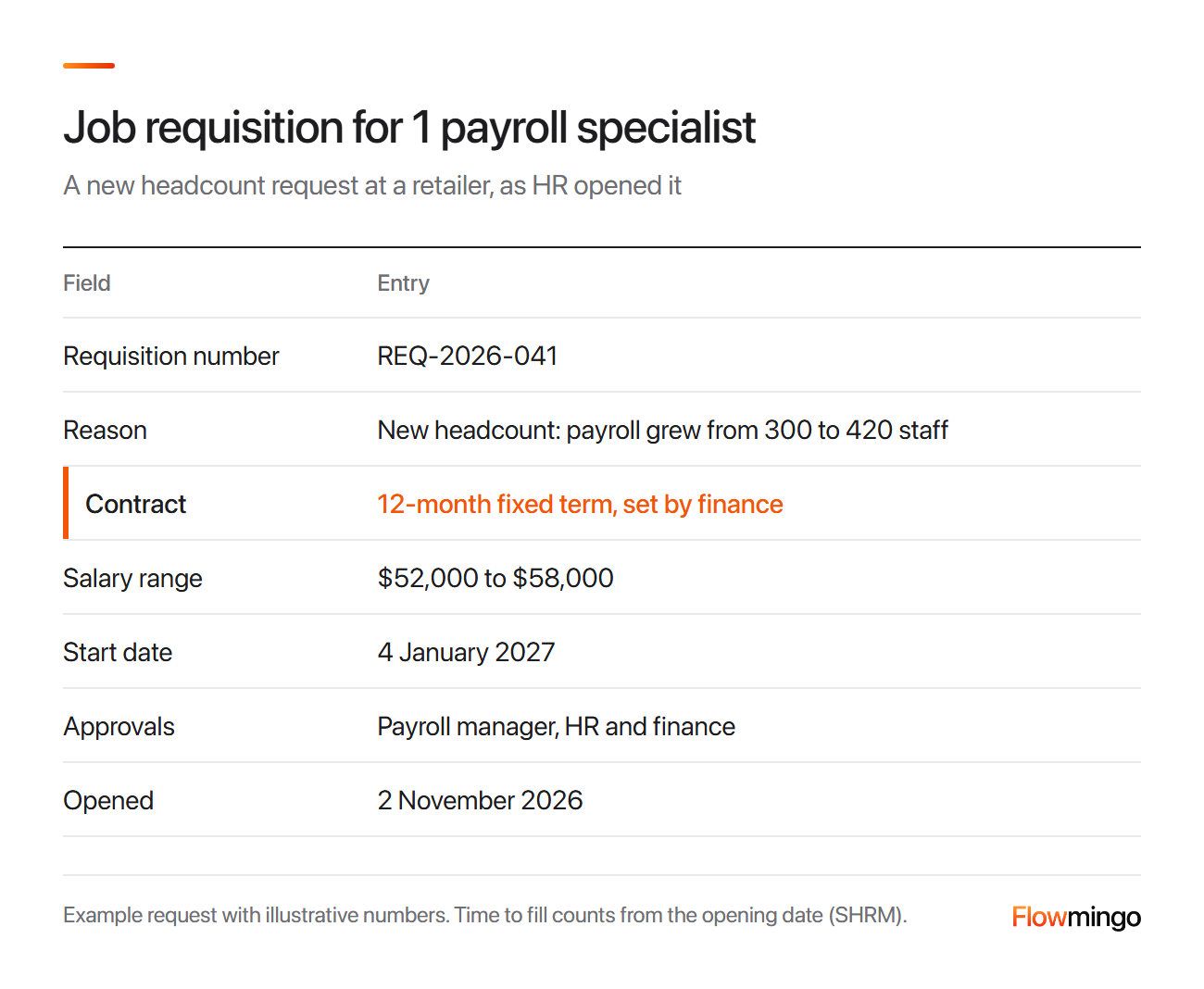
Job requisition for 1 payroll specialist: REQ-2026-041, new headcount as payroll grew from 300 to 420 staff, and a 12-month fixed term. It pays $52,000 to $58,000, starts 4 January 2027 and opened 2 November 2026.
HR checked the title and level against the pay structure and passed it on. Finance approved the budget but changed the contract to a 12-month fixed term, because the growth came from stores still in their first year. HR then opened it as REQ-2026-041 on 2 November 2026.
That 1 change shaped everything after it. The posting, the screening questions and the offer all say fixed term and $52,000 to $58,000, so no finalist learns it at offer stage. If the role fills at SHRM's 2026 median of 39 calendar days, the offer is accepted around 11 December, 24 days before the start.
3. How do you create a job requisition and get it approved?
Write the request so an approver can say yes without a meeting, then route it in a fixed order. The job requisition process below works on a paper form or inside an applicant tracking system.
- Name the gap and the reason. Say whether it is a backfill or new headcount, and which work is not getting done. Approvers fund a reason, not a title.
- Fill in the role facts. Give the title, level, team, manager, location, contract type and start date. The posting and the offer copy these fields, so an error travels.
- Set a salary range inside the budget. Check it against the pay band first. Finance then approves a number the posting can show.
- Attach the job description, or flag that it needs one. In OPM's process, the very next step is a review of the position description. A clear description lets the recruiter write the posting the same day.
- Route it in a set order. Send it to HR, then finance, with a date for each sign-off. OPM's 1 day for the federal version is a useful bar for your own.
- Open it, number it and close it. The requisition number goes on every candidate record and on the offer. Close the req when the candidate accepts the offer, or cancel it if the business drops the role, so your reports stay true.
3.1 Which job requisition mistakes slow hiring down?
The costliest mistake is sourcing before finance signs the requisition. If finance later cuts the role or changes the contract, your finalists hear it at offer stage, and some will walk away.
The second mistake is a vague reason, such as "the team is busy". Approvers send it back for numbers, and the team carries the gap for longer. A reason with a number, like the payroll growth in section 2, gets a faster yes.
The third mistake is a req that never closes. It keeps showing as open, so time-to-fill and open-role reports drift away from the truth. Our hiring process guide shows where the requisition sits among the other steps.
4. Is a job requisition the same as a job posting or a job description?
No. The requisition approves the hire, the job description defines the work, and the posting advertises it, usually in that order.
A job requisition is internal and holds the budget. Workable's help centre calls it the request a hiring manager uses to ask formally to hire, which HR or leadership then reviews. It also notes that 1 job can link to several requisitions, while each requisition belongs to 1 job.
This means 1 posting can fill 3 warehouse seats: 1 ad, 3 approved reqs and 3 numbers. The job description sits between the 2, and our guide on how to write a job description covers it. If the role has no current description, a job analysis comes first: it breaks the role into tasks and the skills each one needs.
5. How do you hire against an approved job requisition with Flowmingo?
Once the req is open, you move from approval to candidates. Flowmingo starts from the job description for the approved role and runs the first round of screening for you.
Before you start, keep the approved requisition beside you, with its contract type, salary range and start date. Put those 3 facts in the posting and in 1 early interview question, so nobody reaches the offer surprised. For example, in the payroll role that question checks that the fixed term and the stated range work for the candidate.
How Flowmingo helps
Paste the job description for your approved requisition, and Flowmingo drafts 1 to 30 interview questions you review and edit, then you share 1 link. Every completed interview lands on 1 candidate profile, in 1 board you run your hiring from, with stages you define. Sign up free to hire against your next job requisition on Flowmingo.
6. Sources
Every guideline, benchmark and help page in this glossary entry links to its source below.
- Ross, J., & Werner, K. (2012, January 18). Staffing metrics: "Time to fill" can kill prospects of landing top talent. SHRM. SHRM
- SHRM. (2026). Recruiting benchmarking. Retrieved 26 October 2026. SHRM
- U.S. Office of Personnel Management. (n.d.). Request for personnel action to fill the job. Hiring Process Analysis Tool. Retrieved 26 October 2026. OPM
- Workable. (n.d.). What is the difference between a job and a requisition? Workable Help. Retrieved 26 October 2026. Workable