
You run an ATS, a scheduler, a video tool and a note-taker. Now a vendor wants to sell you an AI hiring platform instead. Only 33% of HR professionals at small and midsized firms rate their hiring tech stack good or excellent (HR.com).
Every all in one hiring platform says it fits your size, and every point tool says it plugs into your ATS. You can still lose candidates between the tools.
The wrong choice costs you a 12-month contract and scores you cannot explain. On the day a candidate asks why, the answers sit with 4 vendors.
This guide gives you 3 moves: map 6 parts to your roles, keep 1 record per candidate, and test 12 questions before you sign.
Key takeaways
- Should we buy 1 AI hiring platform or keep a stack of tools? Buy 1 if a small team hires volume roles. Keep the stack if your ATS also runs HR and payroll.
- Which hiring stage should we give to AI first? The first-round interview. In a preprint field test on 70,884 entry-level applications, AI-interviewed applicants were 12% more likely to get an offer than recruiter-interviewed ones.
- Can the AI reject candidates on its own? It should not. A recruiter makes every advance and reject, and under GDPR people may refuse a purely automated decision, with exceptions.
- Who has to keep the records of each AI decision? You do, and so does the vendor. From 2 December 2027, an EU employer keeps the logs under its control for at least 6 months.
- What should we check before we sign? 6 things: export, logs, override, the ATS link, bias and law, and how the price grows.
1. Should we buy 1 AI hiring platform or keep adding point tools to our ATS?
Buy 1 AI hiring platform when a small team hires mostly volume or entry to mid-level roles. Keep your stack when your ATS runs HR and payroll and only 1 stage is missing.
The question matters because the joins between tools hurt. In an HR.com survey of 225 HR professionals, only 43% rated their TA tech stack good or excellent. Large firms said 55%.
The real cost sits in the handoffs and the logs. From December 2027, in the EU, you keep each high-risk tool's logs under your control (AI Act Article 26).
New York City has a foundational 2023 rule on automated hiring tools (NYC DCWP). There, the employer must make sure each tool that substantially assists or replaces a hiring decision had a bias audit in the past year.
That bias audit is not the vendor's legal duty, so 3 scoring tools can mean 3 audits to arrange, by our reading. With 1 platform, you ask just 1 vendor for logs and audit data.
Flowmingo data · 3,042 hiring projects at 1,230 companies that produced at least 1 assessment result, created July to September 2026
- 46.8% of these projects used 2 or more assessment types on their applicants.
- 44.6% of these projects used the same pair: a CV score and an AI interview.
- About 1 in 100 of these projects used 3 or more types.
CV scoring sits in projects only since April 2026, and the new-project setup asks about it, so this shows setup today, not a trend.
Our hiring process steps guide found 27.3% for this pair in 1,020 projects created 20 Jul to 28 Aug 2026. That guide counted an AI interview once an invite was sent; this count takes completed interviews, including those done through a shared link.
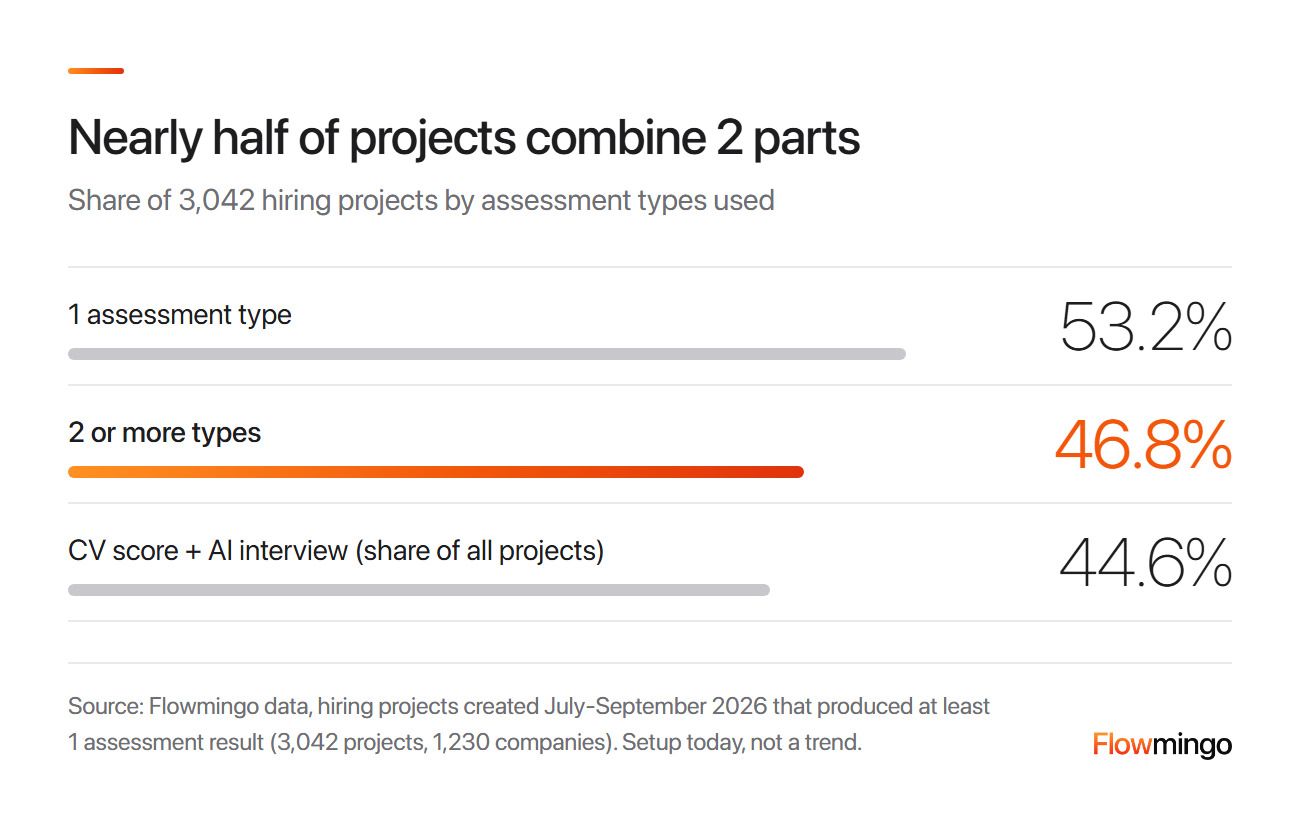
Parts used together: 53.2% of 3,042 hiring projects used 1 assessment type and 46.8% used 2 or more. 44.6% of all 3,042 used a CV score + AI interview.
On Flowmingo, where both parts sit in 1 project, almost every project that combines 2 parts uses this pair.
2. Which parts of an AI hiring platform does my team need for the roles we hire?
Map 6 parts against what you already own: job post, CV screening, AI interview, tests, the ATS pipeline and integrations. Then buy only what your roles need, because volume roles lean on the CV score and interview.
Say you hire 30 warehouse pickers a quarter. You need a fast, fair first round more than a polished final interview.
| Part | Gives you | Who decides | Legal flag |
|---|---|---|---|
| Job post | Applicants and their source | Recruiter | EU high-risk if AI targets ads |
| CV screening | A score per criterion, with reasons | Recruiter sorts, never cuts | EU high-risk, NYC audit |
| AI interview | Recording, transcript, score | Recruiter | EU high-risk, NYC audit |
| Tests | A skills result | Hiring manager | EU high-risk and NYC audit if AI scores it |
| ATS pipeline | Stages, notes, the decision | Recruiter and manager | The record you keep |
| Integrations | 1 candidate ID across tools | Ops or IT | Where logs break |
The EU flags come from the AI Act, which lists AI used "to place targeted job advertisements, to analyse and filter job applications, and to evaluate candidates" as high-risk (AI Act Annex III). Reading the AI interview as evaluating candidates is our view.
For the 30 pickers, a job post brings in applicants, the CV score sorts them, and the AI interview asks every picker the same questions. The ATS keeps the decision with your recruiter.
You can skip tests for this role, because a test adds time for every picker, and the CV score and interview already carry round 1. Add one back only where a skill must be proven.
How Flowmingo helps
Flowmingo mixes 6 assessment types per role (Flowmingo). The AI Interviewer runs a structured interview that adapts to each answer and scores it against your criteria once the candidate finishes. You get each candidate's recording and transcript.
The AI interview suits volume, entry to mid-level roles, not the final round of a senior hire (FAQ).
Every assessment lands on 1 profile, with your stages, team notes and ratings, and the ATS comes with the free plan (Full ATS).
2.1 We hire 40 to 120 people a year. How do we avoid a platform that is overbuilt for us?
Count your hires before features, because the 2 mid-sized teams below bought far more than they used.
A recruiter at a 120-person company makes 35 to 40 hires a year. The team signed for 12 months with the top-rated ATS on G2 in its category, then found it "wildly overbuilt for us" (Reddit).
A solo TA manager on Reddit pays about USD 50,000 a year for iCIMS for about 70 hires, which they call "way overkill for us".
Our rule of thumb: pay only for stages you will use in the first 90 days.
Flowmingo data · 3,271 hiring projects created July to September 2026, 1,355 companies; candidates counted to 23 October 2026
- 10 applicants came into the median hiring project, and the middle half had 2 to 39.
An applicant is anyone in the project tracker, not a qualified or hired candidate.
On Flowmingo the median role is small, so ask each vendor to price your own applicants per role, not a headline volume.
3. Which hiring stage should we give to AI first: CV screening, the first interview or tests?
Hand the first-round interview to AI first, with the same structured questions and rubric for every candidate. The CV score still runs before it, but only to sort the pile, never to cut it.
Picture an owner on Reddit with 200+ applications in 48 hours and no HR. An AI interview gives every one of them the same first round.
In a foundational 2022 re-analysis by Sackett and colleagues, structured interviews scored 0.42 for predicting job performance. Job knowledge tests scored 0.40, work sample tests 0.33 and cognitive ability tests 0.31.
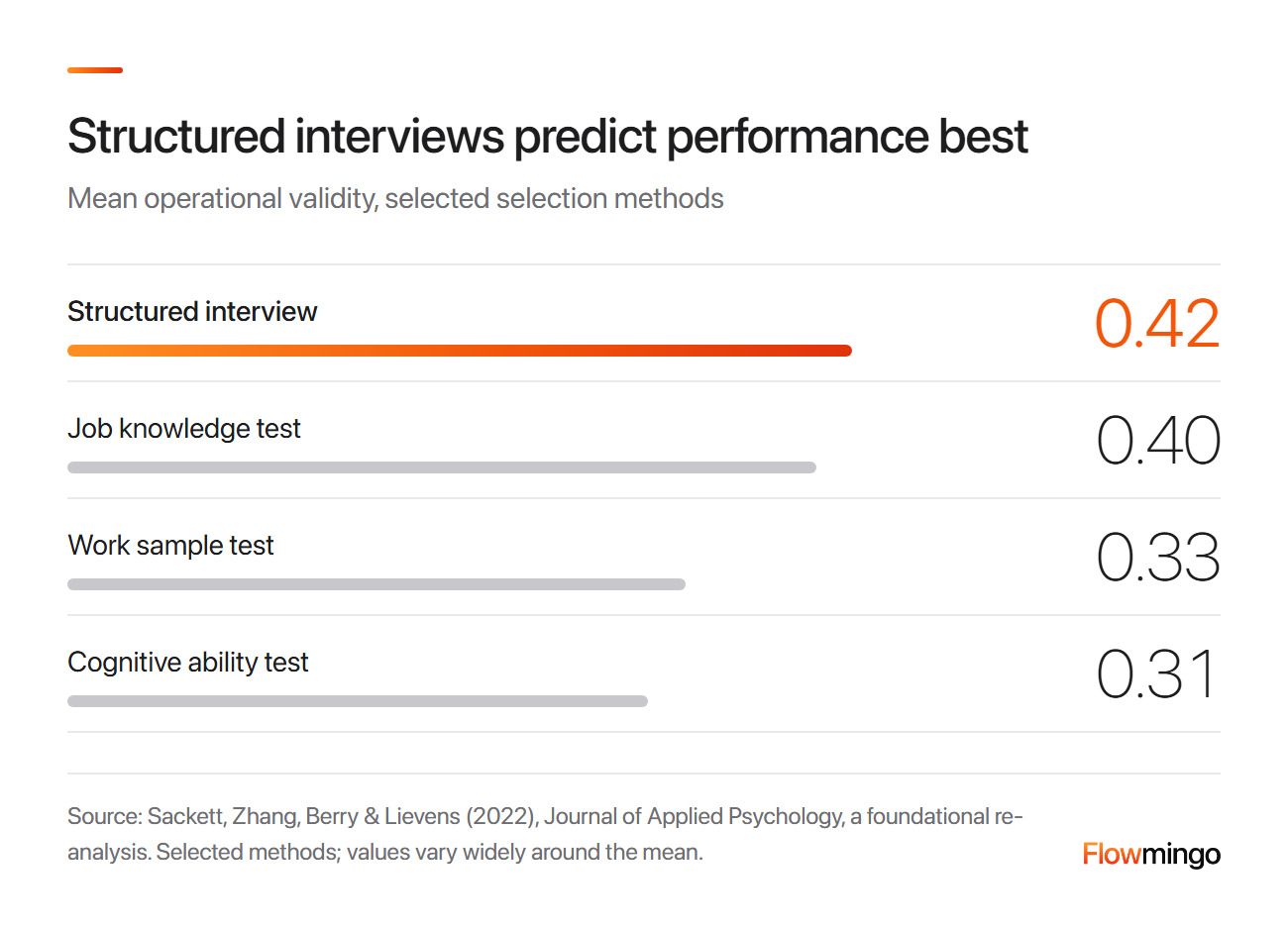
What predicts performance: structured interview 0.42, job knowledge test 0.40, work sample test 0.33 and cognitive ability test 0.31, in a foundational 2022 re-analysis.
On that scale, 0 means no link and 1 a perfect one.
In a 2026 preprint, Jabarian and Henkel report a field experiment on 70,884 applications for entry-level customer service jobs in the Philippines. Of these, 67,056 were randomly assigned. AI-interviewed applicants were 12% more likely to get an offer than recruiter-interviewed ones.
That was 9.73% against 8.70%, a relative gain, not yet peer reviewed. Recruiters made every decision.
Use the CV score to sort, not cut, because text models can carry name bias. In a foundational October 2024 audit of 3 CV-matching models, White-associated names won 85.1% of the race comparisons (Wilson and Caliskan).
Our rule of thumb puts tests last, because they take candidates the longest, so they suit the few who pass a structured interview. Where a project runs an AI interview, most also score CVs in the same project.
Flowmingo data · 1,605 hiring projects from 654 companies with a completed AI interview, July to September 2026
- 86.4% of these hiring projects also scored applicants' CVs in the same project.
Both parts ran in the same project, not always for the same candidate.
4. Will an AI hiring platform work with the ATS we already have, or must we replace it?
Most AI hiring tools can sit beside your ATS, so you rarely have to replace it. Ask exactly how results get back into it, and which plan each method needs.
A Bullhorn user on Reddit wants screening AI "that integrates", and a staffing owner wants software that works with Gusto.
The catch sits in the plan, not the brochure. In the SelectSoftwareReviews buyer guide, reviews of several tools flag integrations that need technical work. At least 1 vendor keeps API access for its top custom plan.
Say you run an agency and add an AI recruitment platform with no way to write back. Your recruiters then copy each score by hand, and every copy is a chance to get 1 wrong.
Results move in 4 ways, each with its own question:
| Option | What moves | Ask the vendor |
|---|---|---|
| Native sync | Candidates and results both ways | Which ATS, fields and plan |
| API | Anything your developer builds | Which plan, which rate limits |
| Webhooks | Events as they happen | Which events, and if signed |
| Link in your ATS email | Candidates out, results stay | How results get back |
Native sync needs no developer, but only for the ATSs a vendor names. 1 recruiting systems lead calls MCP and API automations "extremely important" (Reddit).
Our rule of thumb: if your ATS runs onboarding and payroll, keep it and add parts by API. If it only holds CVs, a platform may replace it.
How Flowmingo helps
Paste the assessment link into the email your ATS already sends, or invite through the API (Full ATS). Recruitee and Zoho Recruit users can send AI interviews from the candidate's record and get the score back on it (ATS guides).
The API, an MCP server and signed webhooks for invitation, assessment and evaluation events are free on every plan. There is no native one-click sync with Greenhouse, Lever or Workday today (FAQ).
5. How should candidate data move from job post to interview to offer without anyone retyping it?
Give each candidate 1 record that every stage writes to, from application to decision. Where a tool cannot write back to that record, someone retypes it, and your audit trail breaks there.
1 poster on Reddit says many teams still track candidates in Excel and WhatsApp after buying an ATS.
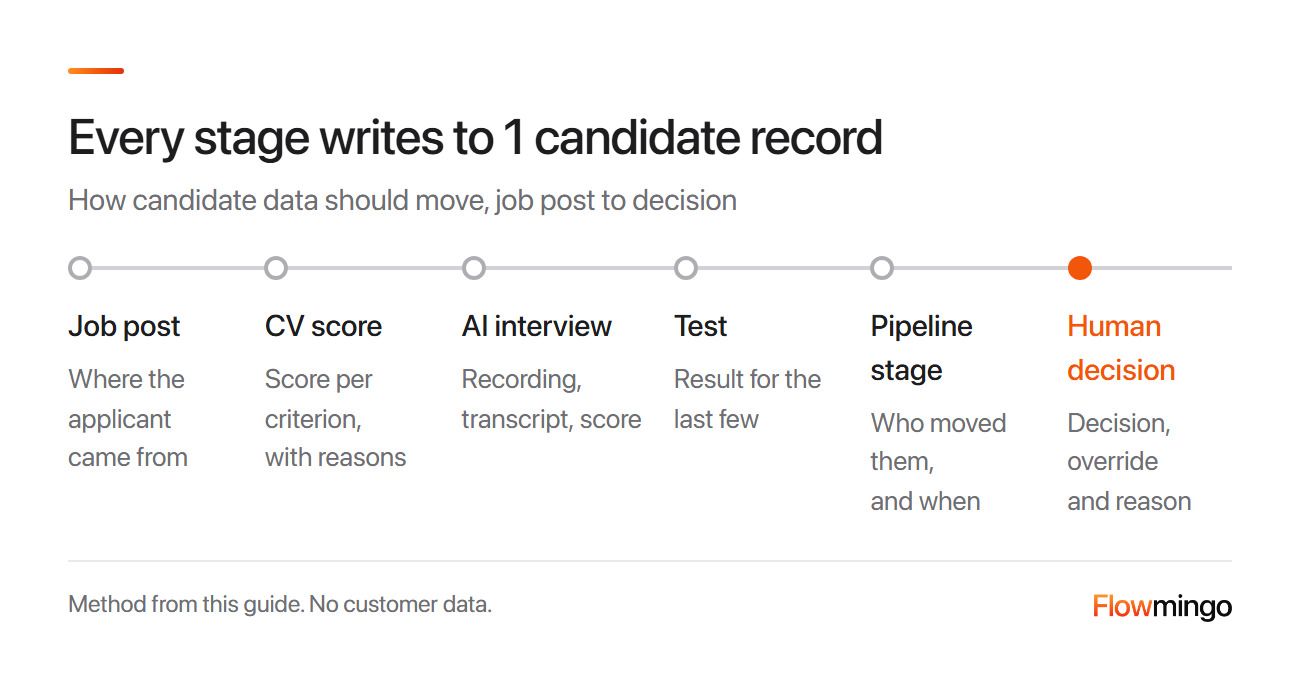
1 candidate record: job post, CV score, AI interview, test, pipeline stage and human decision, each written to the same candidate.
The job post records the source, and the CV score adds a score per criterion, with reasons. The AI interview adds the recording, transcript and score, and the test adds a result.
The pipeline stage records who moved them, and when, and the human decision closes it with any override and its reason. That record matters because of 3 risks.
- Fairness. Under a foundational 1978 rule, a pass rate under 4/5 (80%) of the top group's generally counts as evidence of adverse impact (29 CFR 1607.4). As of 2 November 2026 the rule is still in the eCFR. On 9 June 2026 the Justice Department's Office of Legal Counsel called the guidelines behind it an unconstitutional reading of Title VII. The EEOC's agenda lists rescinding them in November 2026. Keep the 4/5 check as your own monitor, which is easiest to run per stage on 1 record, as our interview bias guide explains.
- Explanation. By our reading, from 2 December 2027 an affected EU candidate can obtain "clear and meaningful explanations" of the AI's role (AI Act Article 86). That works only if every score traces back to 1 person.
- Identity. In Gartner's survey, 6% of 3,000 candidates admitted interview fraud in Q2 2025. That is easier to catch on 1 record, because the CV, recording and test sit side by side, so a mismatch between them shows.
6. Does the AI make the hiring decision, or can my recruiters override every score?
A recruiter should make every advance and reject, with the AI's score and reasons in front of them. The AI should never reject anyone on its own.
Under GDPR Article 22, a foundational 2016 law, people may refuse a decision "based solely on automated processing", with exceptions. They can still ask for a person.
Oversight also has to be real. From 2 December 2027, EU employers must give it to people with "the necessary competence, training and authority" (AI Act Article 26). A recruiter who cannot see why the AI scored someone cannot overrule it.
Greenhouse's November 2025 survey of 4,136 people shows why.
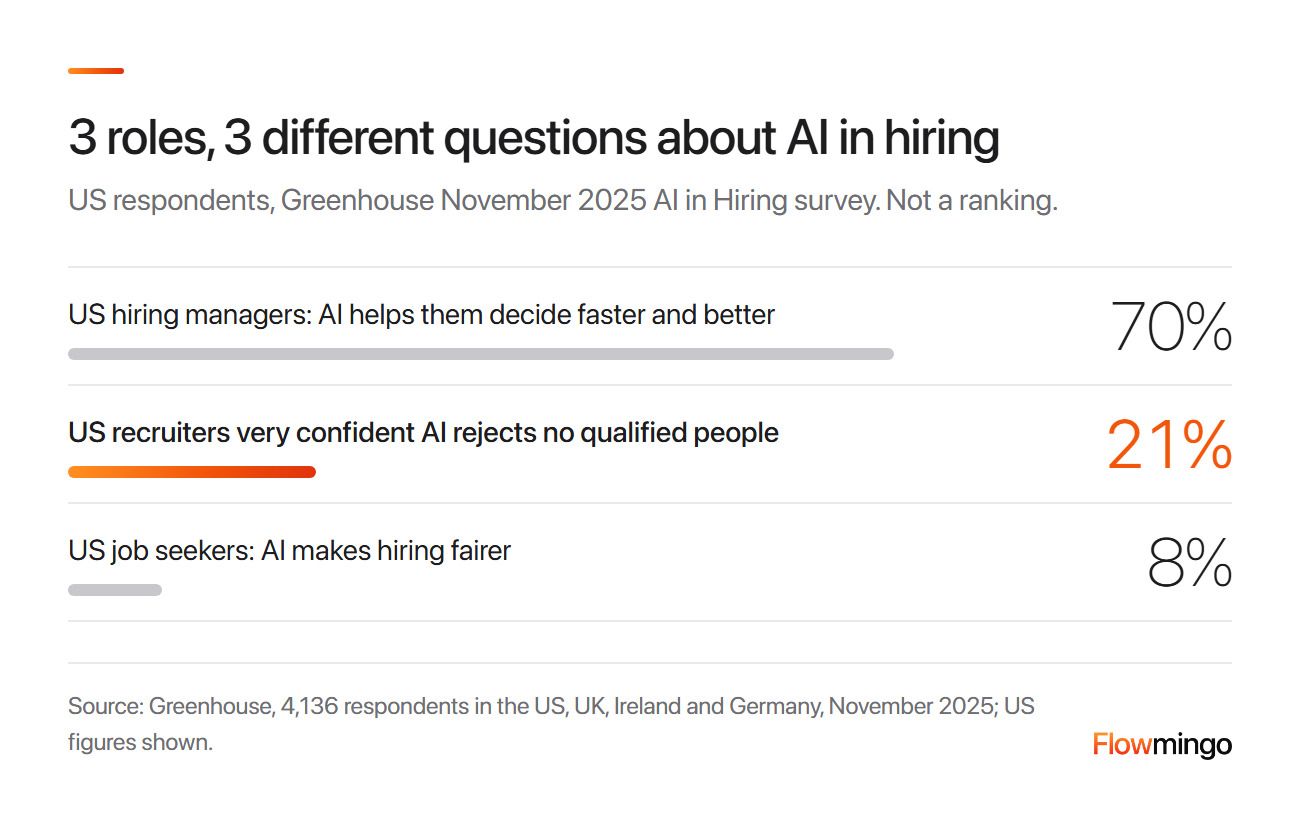
3 roles, 3 questions: 70% of US hiring managers say AI helps them decide faster and better. Only 21% of US recruiters are very confident it rejects no qualified people, and 8% of US job seekers call it fairer.
Greenhouse asked each group a different question, so read the 3 bars side by side, not as a ranking.
The recruiter bar matters most here, because recruiters must defend each score. So make the override visible.
In Mobley against Workday, a US court in May 2025 preliminarily certified a nationwide age claim for applicants over 40 (HR Dive). These are allegations, not findings.
So run 3 checks in the demo: read why 1 candidate scored that way, overrule the AI, and ask where that change lives.
7. What audit trail should each screening decision leave, and who has to keep it?
Each decision should leave who decided, when, on which scores and criteria, and any override with its reason. In the EU, from 2 December 2027, the employer keeps the logs under its own control for at least 6 months, whatever the vendor keeps.
When a rejected candidate asks why, you show the rule, what the AI said and who decided, as in this illustration.
| Field | Example | Why you need it |
|---|---|---|
| Criteria and weights | Agreed with the manager | Rule set before the CVs |
| AI output | CV score 6.8 out of 10, with reasons | What the AI said |
| Human decision | Advanced to interview | A person decided |
| Who and when | Recruiter, date and time | A named person oversaw it |
| Override and reason | Moved up: strong portfolio | Human can overrule |
| Retention date | Kept at least 6 months (EU, from Dec 2027) | The deployer's log duty |
The vendor owns half the job, because high-risk AI must "technically allow for the automatic recording of events (logs)" (AI Act Article 12). The vendor also keeps the logs under its control for at least 6 months (AI Act Article 19). So ask to see the log for 1 real decision.
You own the other half, keeping the logs under your control (AI Act Article 26). Once those duties apply, fines for breaking them reach EUR 15,000,000 or 3% of worldwide turnover, whichever is higher (AI Act Article 99). SMEs face the lower amount.
In a foundational November 2024 review, the UK ICO found tools that let recruiters filter out candidates by protected characteristics. It made almost 300 recommendations to AI recruitment providers.
Singapore's Workplace Fairness Act, passed on 8 January 2025, will ask firms for a grievance process once in force (MOM). That is slated for the end of 2027 (TAFEP).
A grievance needs the record of how the decision was made. So with a stack, ask each tool for its log, and with a platform, ask for 1 export.
8. Is our AI hiring platform high-risk under the EU AI Act, or due a NYC bias audit?
In the EU, yes: AI that targets job ads, filters applications or evaluates candidates is high-risk, with duties from 2 December 2027. In New York City, the employer needs a yearly bias audit of any tool that substantially assists or replaces the decision, plus candidate notice.
This is general information, not legal advice. The EU date is law, because the AI Omnibus, Regulation (EU) 2026/1744, came into force on 27 July 2026 (National Law Review).
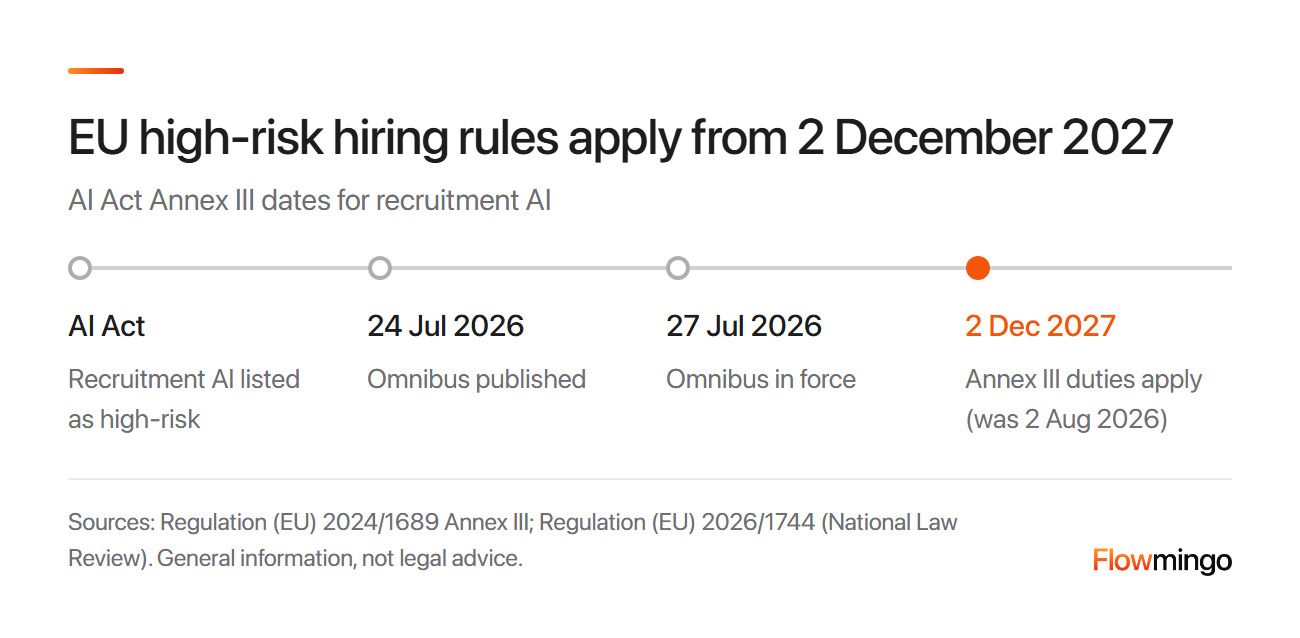
EU timeline: the AI Act lists recruitment AI as high-risk, and the EU published the Omnibus on 24 Jul 2026. In force on 27 Jul 2026, it moved Annex III duties to 2 Dec 2027, from 2 Aug 2026.
A 24-month contract you sign this year will still run when the hiring duties start, so write them into it.
Since 5 July 2023, a foundational rule has asked employers to get a yearly bias audit of each covered tool and post a summary. Candidates get notice 10 business days before use (NYC DCWP).
Do not lean on thin enforcement, because the duty stays with you. The New York State Comptroller found the city spotted 1 issue across 32 companies, where auditors found at least 17 cases of potential non-compliance. Penalties run USD 500 to 1,500 a day.
Illinois HB 3773 has asked for notice of AI use since 1 January 2026. It also bans a discriminatory effect and zip codes as a proxy.
9. If we leave an AI hiring platform, can we export every candidate, score and recording?
Only if the contract and your plan say so. Before you upload thousands of CVs, get in writing what comes out, in which file, and when videos go.
The cost shows up late. Say you uploaded 8,000 CVs and scored 1,200 interviews, an illustrative case.
If only the CVs come out, you cannot explain any of the 1,200 decisions during the EU's minimum 6-month log period.
Under GDPR Article 20, a foundational 2016 law, people can get the data they provided "in a structured, commonly used and machine-readable format".
That covers what the candidate gave you, such as a CV, but not the scores the system made. So name scores, transcripts and recordings in the contract.
Ask 5 questions before the first upload:
- Who owns the candidate data, in writing.
- Which file formats you get, and on which plan.
- Whether scores and transcripts come out as well as CVs.
- How long videos stay on your plan.
- What gets deleted after you leave, and when.
The export is also your audit trail when you switch vendors, because the EU log duty can outlive the contract.
How Flowmingo helps
Recordings, transcripts and reports belong to your company, not to Flowmingo (FAQ). Results, scores and transcripts are kept on the free plan, and the latest 300 videos are kept for 30 days. Free also includes 3 PDF or DOCX reports in total.
For unlimited report and video downloads, upgrade to Flowmingo Pro (Starter, Growth or Scale). CSV export starts on Growth (Pricing).
10. What should we ask in the demo before we sign a 12-month AI hiring platform contract?
Ask 12 questions across 6 areas, from export to price. Then pilot it on 1 live role for 2 weeks before you sign.
1 recruiter on Reddit notes that "every vendor says they're perfect for your size". Questions 9 and 10 below follow the UK ICO's buyer questions.
| Area | Ask about | A good answer |
|---|---|---|
| Export | 1. Who owns candidate data | We do, in writing |
| Export | 2. Scores, transcripts, recordings out, deletion after we leave | Formats, how long videos stay, a deletion date |
| Audit trail | 3. The log for 1 real decision, and how long it stays | Shown live, at least 6 months |
| Override | 4. Why 1 candidate got their score | Reasons per criterion set before the CVs |
| Override | 5. A recruiter changing an AI score | Shown live |
| Override | 6. Where the override reason sits | On the candidate record |
| Override | 7. Any automatic rejection | None, or only rules we set |
| Integrations | 8. How results reach our ATS | Named method and plan |
| Bias and law | 9. How the vendor checks for and reduces bias | Documents we can read, with dates |
| Bias and law | 10. DPIA and who owns which duty | In writing |
| Bias and law | 11. How candidates get notice of AI use | Wording and timing, 10 business days for NYC |
| Pricing | 12. What grows the price, and add-ons | A quote for our volume |
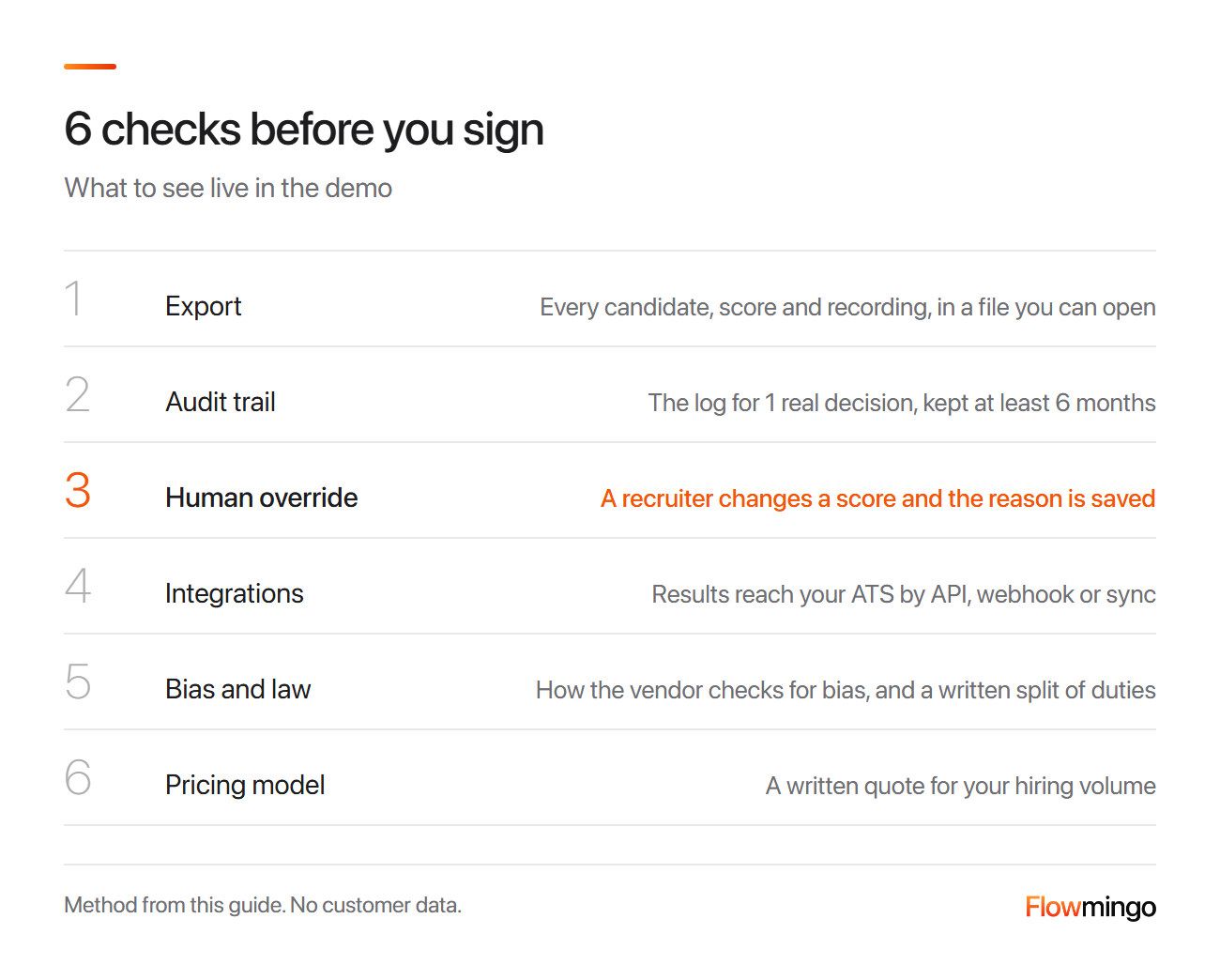
6 checks before you sign: export, audit trail, human override, integrations, bias and law, and the pricing model, each with a test to see live.
The figure groups the 12 questions into 6 checks to see live in the demo. Watch the human override most, because it shows whether a recruiter can really overrule the AI and leave a reason.
Price your real volume, because add-ons change the total. In the SelectSoftwareReviews reviews, several AI hiring software vendors share prices only after a demo. At least 1 sells video interviews and assessments as add-ons.
Test odd answers too, such as a reply in the wrong language. In a foundational January 2024 book, a reporter answered an English test in German and was rated "competent" (Schellmann, via Publishers Weekly).
In the pilot, compare time to first shortlist with your last similar role, so you judge the tool on your own numbers. Our AI interview tool for recruiters guide lists 7 tests for that trial.
How Flowmingo helps
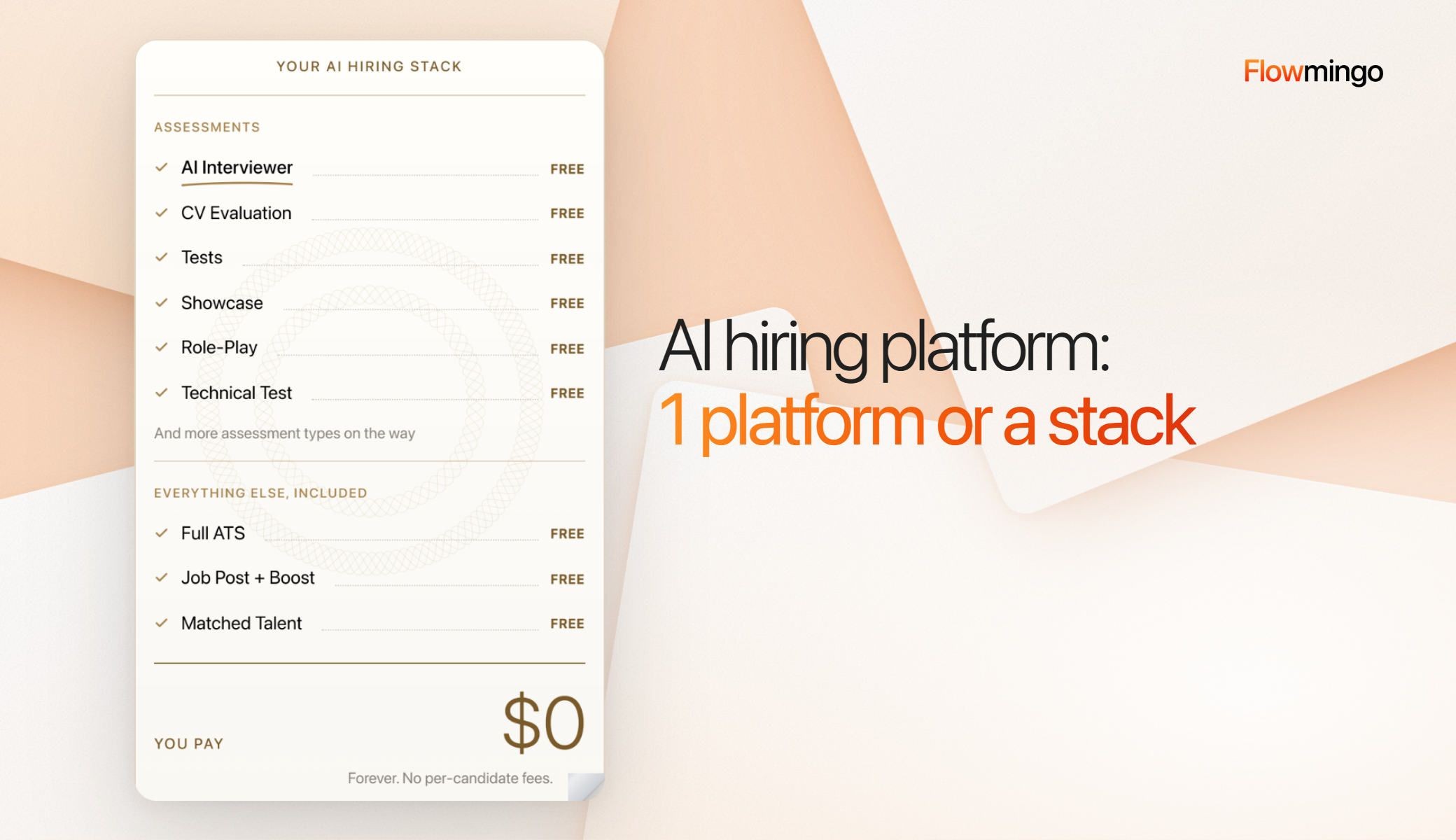
Flowmingo is a free AI hiring platform, led by the AI Interviewer. The free plan includes unlimited AI interviews, CV evaluation, tests and the full ATS, with unlimited team members (Pricing).
Free sessions carry our brand next to yours, and candidates may see optional offers from Flowmingo. For longer video storage, downloads and branded share links, upgrade to Flowmingo Pro (Starter, Growth or Scale), from $42 a month billed annually.
Flowmingo returns each score with its reasons, and nobody is rejected automatically. Your team can check any score against the recording and transcript and override it (FAQ).
Try 1 live role on Flowmingo before you sign any AI hiring platform contract.
11. Sources
Every law, study and survey in this guide links to a source below. Flowmingo figures come from our own platform data.
- Crowell & Moring (2024). Artificial intelligence in employment update: Illinois requires notice and prohibits discriminatory impact in use of AI. Crowell & Moring LLP.
- European Parliament and Council (2016). Regulation (EU) 2016/679, General Data Protection Regulation, Article 20. gdpr-info.eu.
- European Parliament and Council (2016). Regulation (EU) 2016/679, General Data Protection Regulation, Article 22. gdpr-info.eu.
- European Parliament and Council (2024). Regulation (EU) 2024/1689, the Artificial Intelligence Act, Annex III. artificialintelligenceact.eu.
- European Parliament and Council (2024). AI Act Article 12: Record-keeping. artificialintelligenceact.eu.
- European Parliament and Council (2024). AI Act Article 19: Automatically generated logs. artificialintelligenceact.eu.
- European Parliament and Council (2024). AI Act Article 26: Obligations of deployers of high-risk AI systems. artificialintelligenceact.eu.
- European Parliament and Council (2024). AI Act Article 86: Right to explanation of individual decision-making. artificialintelligenceact.eu.
- European Parliament and Council (2024). AI Act Article 99: Penalties. artificialintelligenceact.eu.
- Gartner (2025). Gartner survey shows just 26% of job applicants trust AI will fairly evaluate them. Gartner newsroom, via the Wayback Machine.
- Greenhouse (2025). An AI trust crisis. Greenhouse newsroom.
- HR.com (2025). The future of recruitment technologies 2025-26. HR.com research report.
- HR Dive (2025). Workday AI bias lawsuit can proceed as collective action. HR Dive.
- Information Commissioner's Office (2024). Thinking of using AI to assist recruitment? Our key data protection considerations. ICO.
- Jabarian, B., & Henkel, L. (2026). Voice AI in firms: A natural field experiment on automated job interviews. arXiv working paper.
- Equal Employment Opportunity Commission (2026). Rescission of Uniform Guidelines on Employee Selection Procedures, RIN 3046-AB43. Unified Agenda, via the Wayback Machine.
- Ministry of Manpower, Singapore (2025). Passing of Workplace Fairness Bill marks next step in building fair and harmonious workplaces. MOM.
- National Law Review (2026). EU Digital Omnibus on AI enters into force. National Law Review.
- NYC Department of Consumer and Worker Protection (2023). Automated employment decision tools (AEDT). City of New York.
- Office of Legal Counsel, US Department of Justice (2026, June 9). Constitutionality of disparate-impact liability under Title VII. DOJ.
- Office of the New York State Comptroller (2025). Enforcement of Local Law 144: Automated employment decision tools (Report 2024-N-6). Office of the NY State Comptroller, via the Wayback Machine.
- Publishers Weekly (2024). Review of The Algorithm by Hilke Schellmann. Publishers Weekly.
- Reddit r/recruiting and r/smallbusiness (2025-2026). Threads 1w91bp8, 1rdnl5p, 1ol29y8, 1jtpu3z, 1whbsie, 1xcn553 and 1tasw8t. Reddit.
- Sackett, P. R., Zhang, C., Berry, C. M., & Lievens, F. (2022). Revisiting meta-analytic estimates of validity in personnel selection: Addressing systematic overcorrection for restriction of range. Journal of Applied Psychology.
- SelectSoftwareReviews (2026). 20 best AI recruiting software for 2026: Expert reviews + pricing. SelectSoftwareReviews.
- Tripartite Alliance for Fair and Progressive Employment Practices (n.d., read 2026). Workplace Fairness Legislation. TAFEP.
- U.S. Code of Federal Regulations (current text). 29 CFR 1607.4, information on impact. Legal Information Institute.
- Wilson, K., & Caliskan, A. (2024). Gender, race, and intersectional bias in resume screening via language model retrieval. Proceedings of the AAAI/ACM Conference on AI, Ethics, and Society.