CV screening is the first check of each applicant's CV against a job's must-have requirements. It decides who moves on to an interview.
You meet it the moment a role goes live. Applications per job rose from about 115 in 2022 to 244 in 2025, in Greenhouse's North American benchmark. So resume screening now takes the biggest share of your hiring week.
Key takeaways
- What does CV screening decide? Who gets an interview. In 2025, 7.6% of applicants passed the first stage, about 19 of 244.
- Is resume screening the same thing? Yes. "Resume" is the US word and "CV" the UK and Asian one.
- What should a CV screen look for? Proof of the job's must-have skills, not years. In a review of 81 samples, past work experience told almost nothing about later performance.
- Can AI screen CVs? It can score them, but test it: 22 AI models picked the first CV shown 63.5% of the time.
1. What is CV screening in recruitment?
CV screening is the step where someone reads each CV against the job's criteria and sorts applicants into yes, no and maybe. It sits after the application and before any interview.
It includes 2 kinds of check. Knockout checks are pass or fail facts, such as the right to work or a required licence. Evidence checks ask whether the CV shows the person has done this kind of work, with results.
It is not resume parsing, which only copies a CV into fields of an applicant tracking system. It is not an interview either, because a CV shows what a person claims, not how they think. That is why the screen should cut only on what the CV can prove.
2. What does CV screening look like on a real role?
On a real role, the screen is a funnel. Knockout checks remove the clear no's, an evidence check ranks the rest, and the top slice goes to interview.
Here is 1 role worked through. The 244 CVs and the 7.6% first-stage rate are 2025 averages from Greenhouse, which does not define its stages. The split in between is an example.
Say you hire a customer support lead and 244 CVs arrive in a week. For example, your must-haves are the right to work in Singapore, written English and 2 years of chat or phone support. Your evidence criteria are a team or queue they ran and a result they can name.
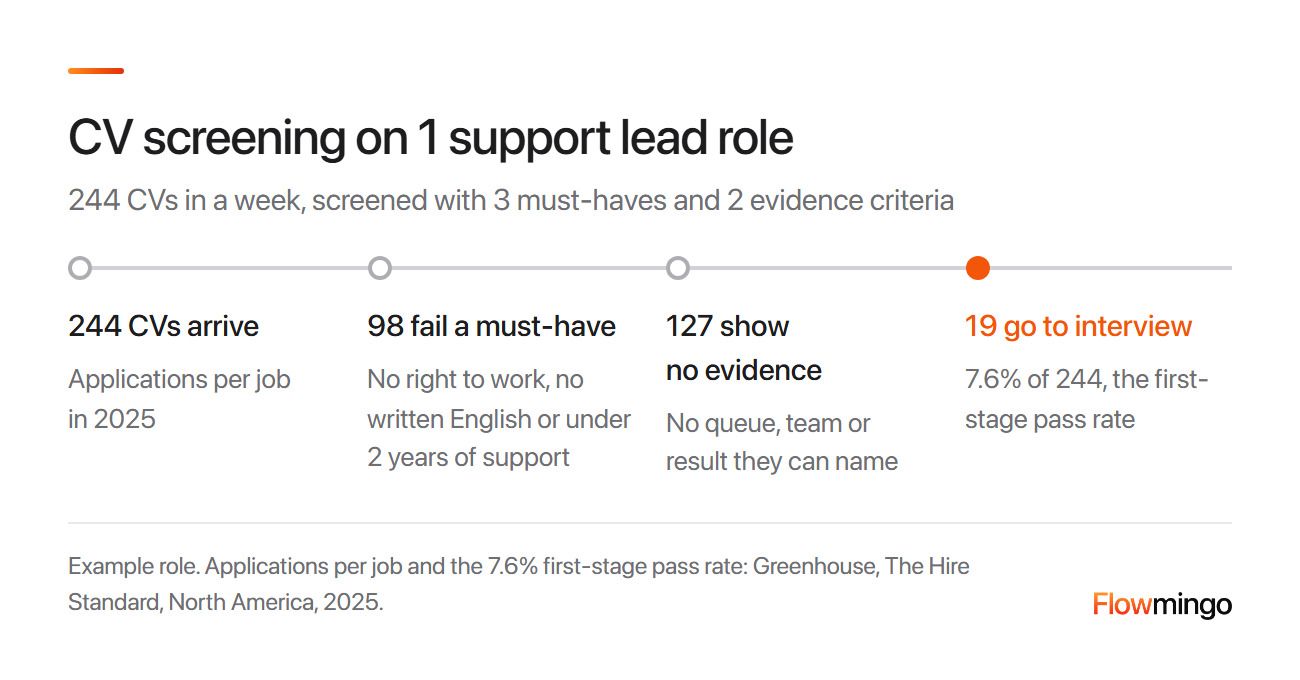
CV screening on 1 support lead role: 244 CVs arrive, 98 fail a must-have, 127 show no evidence and 19 go to interview.
The 98 who miss a knockout leave first, which takes minutes because each check is a fact. The 146 left are read for evidence, and 127 never mention a queue, a team or a result. That leaves 19 people, the 7.6% the Greenhouse benchmark reports, and they get an interview.
3. How do you screen CVs fairly, step by step?
Write the criteria before you open the first CV, then apply the same checks, in the same order, to every applicant. That keeps the screen fast and lets you explain every no.
- Write 3 to 5 must-haves and 2 to 3 evidence criteria from the job. Singapore's TAFEP guidance tells employers to list selection criteria and apply them consistently to all candidates.
- Run the knockout checks first. They are facts, so they are quick and hard to argue with.
- Look for proof of the skill, not years. A foundational 2019 review of 81 samples by Van Iddekinge and colleagues found prior experience tracked job performance at only 0.06. On that scale, 0 means no link at all.
- Score each CV on the same criteria with the same rule. Then rank, and invite the top slice your interview hours can hold.
- Write 1 line on why each person moved on or stopped. This means you can answer a candidate or a hiring manager later.
3.1 Which mistakes make CV screening unfair?
The costliest mistake is letting names and order change the result. A foundational 2022 study by Kline, Rose and Walters sent more than 83,000 test applications to 108 large US employers. Distinctively Black names cut the chance of a call by 2.1 percentage points.
Order matters for software too. In a 2026 test of 22 AI models on equally strong pairs, the first CV shown won 63.5% of the time (Rozado, PeerJ Computer Science). So shuffle the order, or check that your tool scores each CV alone.
Our guide to candidate shortlisting shows how to set the cut line once the scores are in.
4. How do you run CV screening with Flowmingo?
You set the criteria once, and every CV is scored against them with the reason written next to each score. You read the evidence and decide who moves on.
Before you start, have 2 things ready: the job description and the 3 to 5 must-haves from step 1. The criteria matter more than the tool, because every score is only as good as the requirement it measures. For example, "2 years of chat support" gives a clear score, while "great communicator" gives a guess.
Keep the 1-line reason for each person, as in step 5, so the hiring manager sees why.
How Flowmingo helps
Paste your job description, check the must-haves, and Flowmingo scores every CV against them, rating each requirement 0 to 10 and weighting it by importance. You get a ranked shortlist with the reasoning attached, and the decision stays with your team. Sign up free to run your next CV screening on Flowmingo.
5. Sources
Every study, benchmark and guideline in this glossary entry links to its source below.
- Greenhouse. (2026, March). The Hire Standard: Greenhouse benchmark report, North America. Greenhouse
- Kline, P., Rose, E., & Walters, C. (2022). Systemic discrimination among large U.S. employers. Quarterly Journal of Economics, 137(4), 1963-2036. NBER w29053
- Rozado, D. (2026). Gender and positional biases in LLM-based hiring decisions: Evidence from comparative CV/resume evaluations. PeerJ Computer Science, 12, e3628. PeerJ
- Tripartite Alliance for Fair and Progressive Employment Practices. (n.d.). Conducting job interviews. Retrieved 26 October 2026. TAFEP
- Van Iddekinge, C. H., Arnold, J. D., Frieder, R. E., & Roth, P. L. (2019). A meta-analysis of the criterion-related validity of prehire work experience. Personnel Psychology, 72(4), 571-598. UNF Digital Commons