
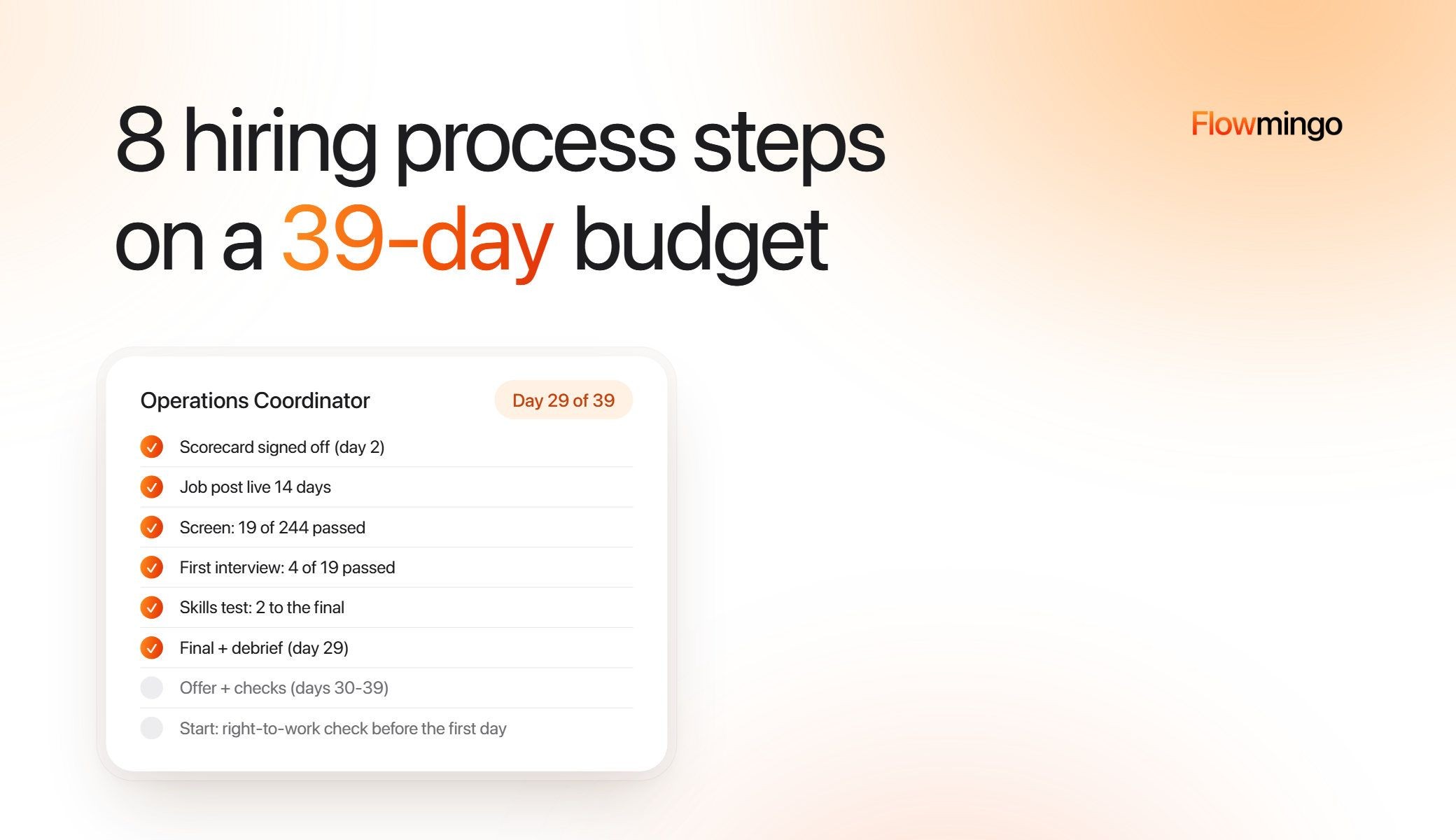
The seat has been empty for 6 weeks, 200+ people applied, and your hiring process steps change with every role. Last round, your finalist took another offer while you were booking the final.
It isn't only you. Applications per job reached 244 in 2025, while recruiters per organisation fell from 10.43 to 4.62 (Greenhouse). Old recruitment process steps were built for a smaller pile, and 93% of US hiring managers say hiring now takes longer (Robert Half).
Only 48% of candidates accepted their latest job offer in late 2025 (Gartner). Every quiet week gives your finalist time to say yes somewhere else.
This guide fixes it. Run 8 steps in a fixed order, each with a day limit inside a 39-day budget. Then write each step's pass rule and candidate message before the role opens.
Key takeaways
- What are the hiring process steps, in order? 8 steps, each with 1 pass rule: scorecard, job post, screen, first interview, skills test, final, offer and checks, start.
- How long should the whole process take? About 39 days, the SHRM median time-to-fill. In our budget, the job ad takes 14 days and offer and checks 10.
- How fast should applicants hear back? Within 1 week, never later than 2 weeks, because 63% of US candidates say an employer ghosted them after an interview (Greenhouse, 2025).
- How many interviews are enough? 2 interviews plus 1 skills test after the screen. At Google, 4 interviews predicted the final hire decision with 86% confidence (foundational, 2015).
- How fast should the offer go out? Within 1 week of the final interview, because only 48% of candidates accepted their latest offer in late 2025.
1. With 200+ applicants and a team of 2, what are the hiring process steps, in order?
Run 8 hiring process steps in this order: scorecard, job post, first screen, first interview, skills test, final interview, offer and checks, start. Write each step's pass rule before the first application arrives.
The cheapest filter goes first, so each step spends time only on people who passed the last one. Pass rules come first, because every interviewer checks the same things. In a foundational 2014 review by Levashina and colleagues, 12 meta-analyses all rated structured interviews higher.
Take an Operations Coordinator at a 40-person logistics firm (illustrative). Its step 3 rule might be "can work the 07:00 shift and has run a rota for 10+ staff". The table gives every step its rule:
| Step | What you do | Pass rule |
|---|---|---|
| 1. Scorecard | 4 to 6 weighted criteria, 2 or 3 knockouts | Signed off before the ad |
| 2. Job post | Pay range, privacy notice | Live on your boards |
| 3. First screen | Knockouts, then CV score | Above the line |
| 4. First interview | Same questions, rated | At the bar |
| 5. Skills test | 30 to 45 minute work sample | Can do the core task |
| 6. Final interview | 2 interviewers, debrief, references | Chosen |
| 7. Offer and checks | Conditional offer, background check | Accepted, cleared |
| 8. Start | Right to work, records filed | Before day 1 |
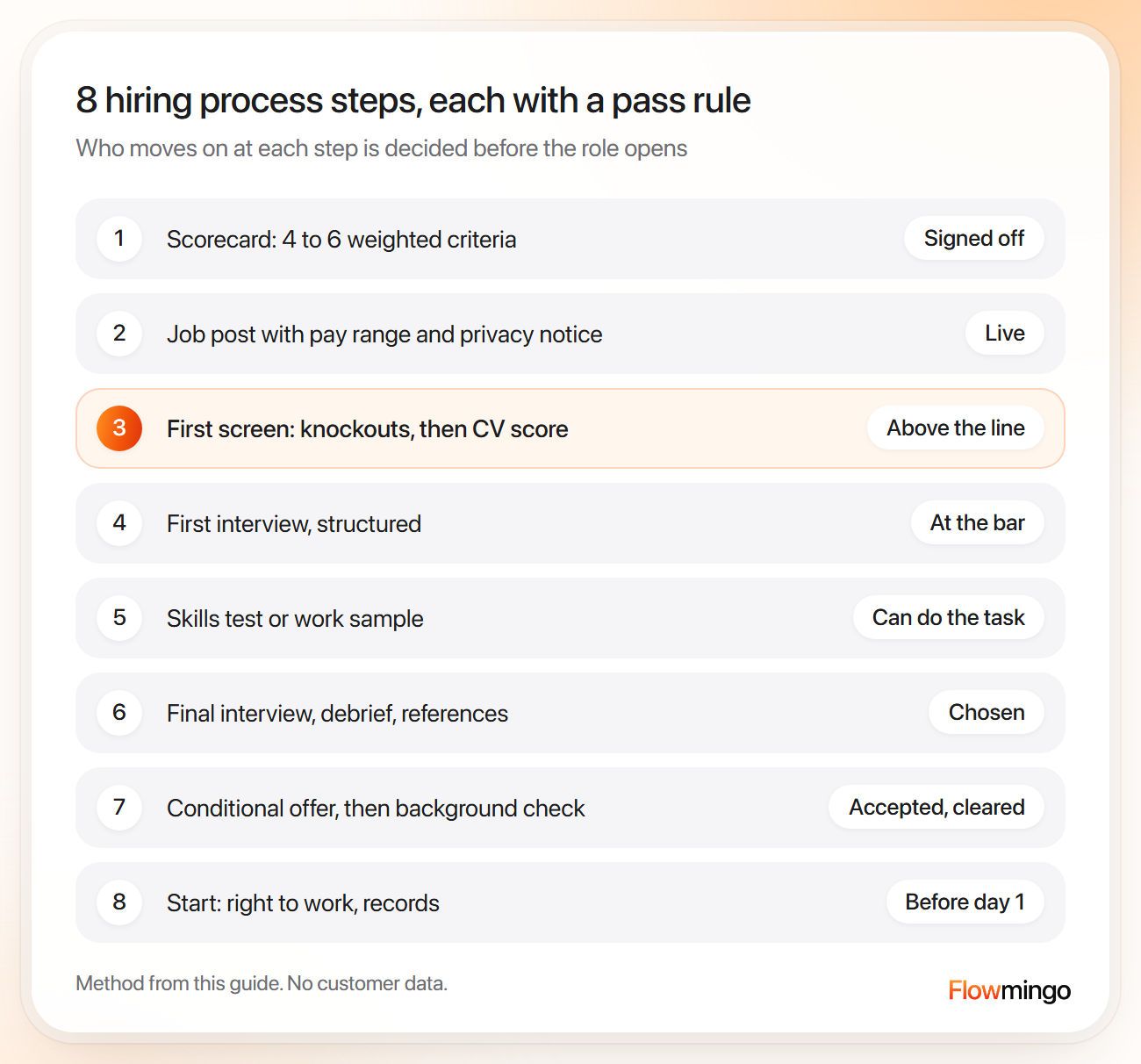
8 hiring process steps: scorecard signed off, job post live, first screen above the line, first interview at the bar. Then a skills test, the final interview, offer and checks, and the start before day 1.
Other guides count 5 or 7 stages of the hiring process, mapped here onto the 8 steps:
| Model | Their stages | Our steps |
|---|---|---|
| 5 stages | Plan, attract, screen, select, hire | 1 / 2 / 3 / 4-6 / 7-8 |
| 7 stages | Needs, job description, sourcing, screening, interviewing, offer, onboarding | 1 / 1-2 / 2 / 3 / 4-6 / 7 / 8 |
The 8 steps split "select" into 3, because each removes people for a different reason.
1.1 I'm making my first hire with no HR: which steps can I skip?
Merge steps, but don't skip them. Run the first interview and skills test in 1 sitting, and hold 1 final interview with 2 people.
Never skip the scorecard, the skills check, the right-to-work check or the records. One r/smallbusiness owner learned it the hard way: "I do need to test people on basic skills".
Flowmingo data · 6,968 hiring projects · 3,185 companies · 197,746 applicants · projects created 1 Jan to 28 Aug 2026
- 5 applicants was the median number of applicants in a Flowmingo hiring project.
- 63.8% of hiring projects had fewer than 10 applicants in total.
Many small projects are trials or single-role tests, and "applicants" counts everyone in a project. So the median understates a live, busy role.
With 10 applicants, the screen, interview and test take hours, but the ad and checks take days.
2. How long should each of the hiring process steps take when leadership wants the seat filled?
Budget about 39 days, the median time-to-fill for non-executive roles in SHRM's 2026 benchmarking. Give each step a day limit, and screen while the job ad is open.
SHRM surveyed 4,600+ organisations but doesn't define when the clock starts, so we end it at "offer accepted, checks cleared".
Across its 6,000+ customer companies, Greenhouse counts 59.67 days to fill in 2025, up 37% from 43.64 in 2022. Its North America report puts it at 56.7 days, so treat 39 days as a tight budget.
This hiring process timeline is an illustrative budget, not a benchmark:
| Step | Days | Calendar |
|---|---|---|
| Scorecard | 2 | Days 1-2 |
| Job ad open, screening daily | 14 | Days 3-16 |
| Close out screens and first interviews | 3 | Days 17-19 |
| Skills test | 4 | Days 20-23 |
| Final interview and decision | 6 | Days 24-29 |
| Offer and checks | 10 | Days 30-39 |
The ad window plus offer and checks take 24 of the 39 days.
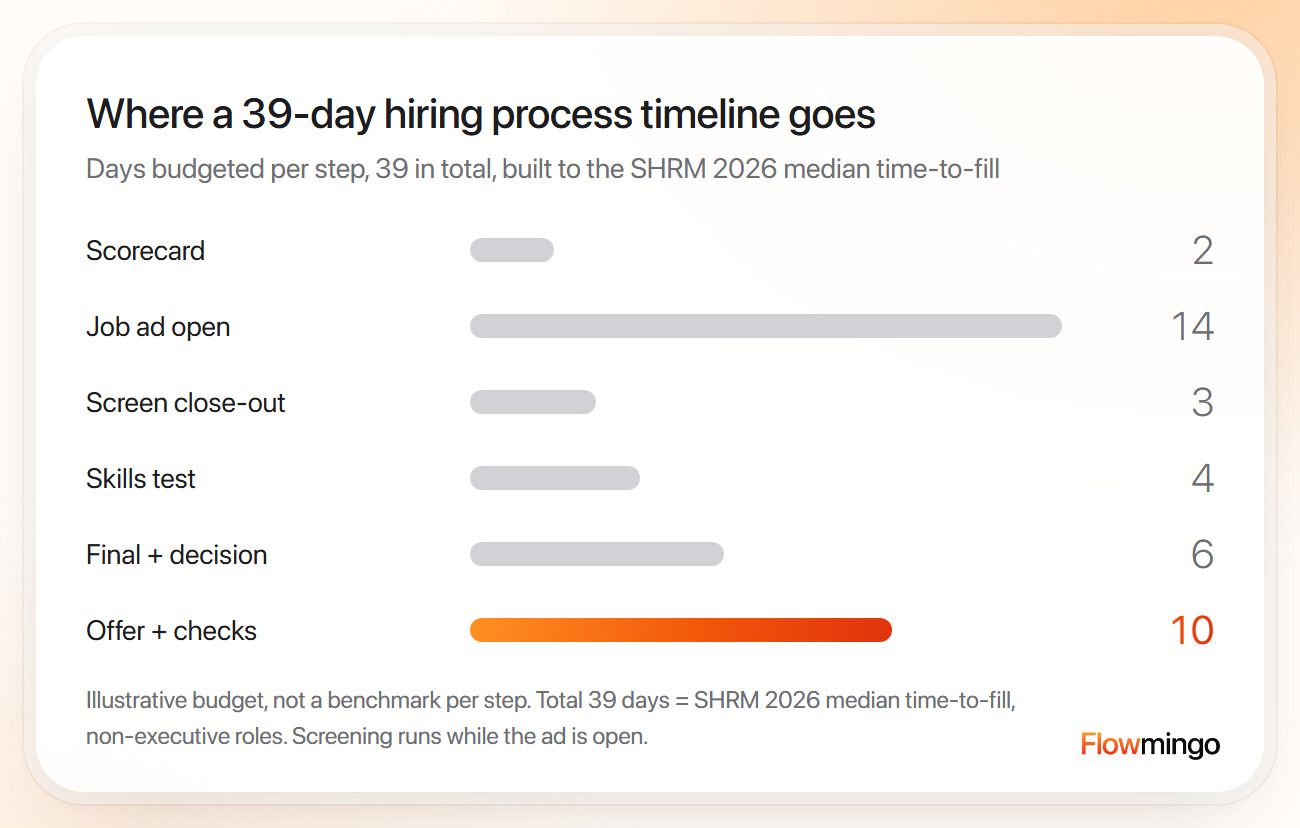
Hiring process timeline: of 39 days, the job ad is open 14 and offer and checks take 10. The final interview and decision take 6, the skills test 4, screen close-out 3 and the scorecard 2.
The ad runs 14 days because that collects a real pool. Singapore's Fair Consideration Framework also requires 14 consecutive days on MyCareersFuture for Employment Pass and S Pass roles, unless the job is exempt.
2.1 Where do the days go, and what can we cut without a bad hire?
Cut the waiting, and keep every check. Robert Half names the parts that now take longer: reading applications (51%), reference and background checks (47%), and scheduling and conducting interviews (43%).
AI-written applications made it worse: in November 2025, 67% of US hiring managers said they slowed hiring, and 38% added interviews (Robert Half).
Adding rounds is slow: booking 19 live first interviews across 2 calendars can take most of a week (illustrative).
Knockouts and a CV score cut the reading (51%). An own-time interview cuts the scheduling and calls (43%), so close-out stays at 3 days. Early checks cut the wait on references (47%).
A day-16 passer still gets 7 days, so start skills tests for early passers on day 20 while the last interviews come in.
3. We get 200+ applicants per role: which step removes most of them without reading every CV?
The first screen removes most of them, using rules instead of reading: 2 or 3 knockouts, then a weighted CV score. Everyone who passes gets a structured first interview they take in their own time.
At 20 minutes a call, phone-screening 244 applicants takes about 81 hours. That call length is our assumption, not a study.
In Greenhouse's North American data, only 7.6% of applicants passed the first stage. Greenhouse doesn't define its stages, so treat about 19 of 244 as our rough arithmetic on averages.
For the Operations Coordinator, knockouts come first: the 07:00 shift, a required licence, the right to work where it's lawful to ask. Our pre-screening interview questions guide covers them.
Then read a weighted CV score on 4 to 6 criteria in score order, as in our candidate shortlisting guide.
The first interview moves earlier in 2026 because AI-written CVs look alike. A short structured interview shows more, and costs review time, not calendar time.
The screening leg can then run in hours to days. The figure's 3 medians come from 3 separate groups, so read them side by side, not as 1 journey.
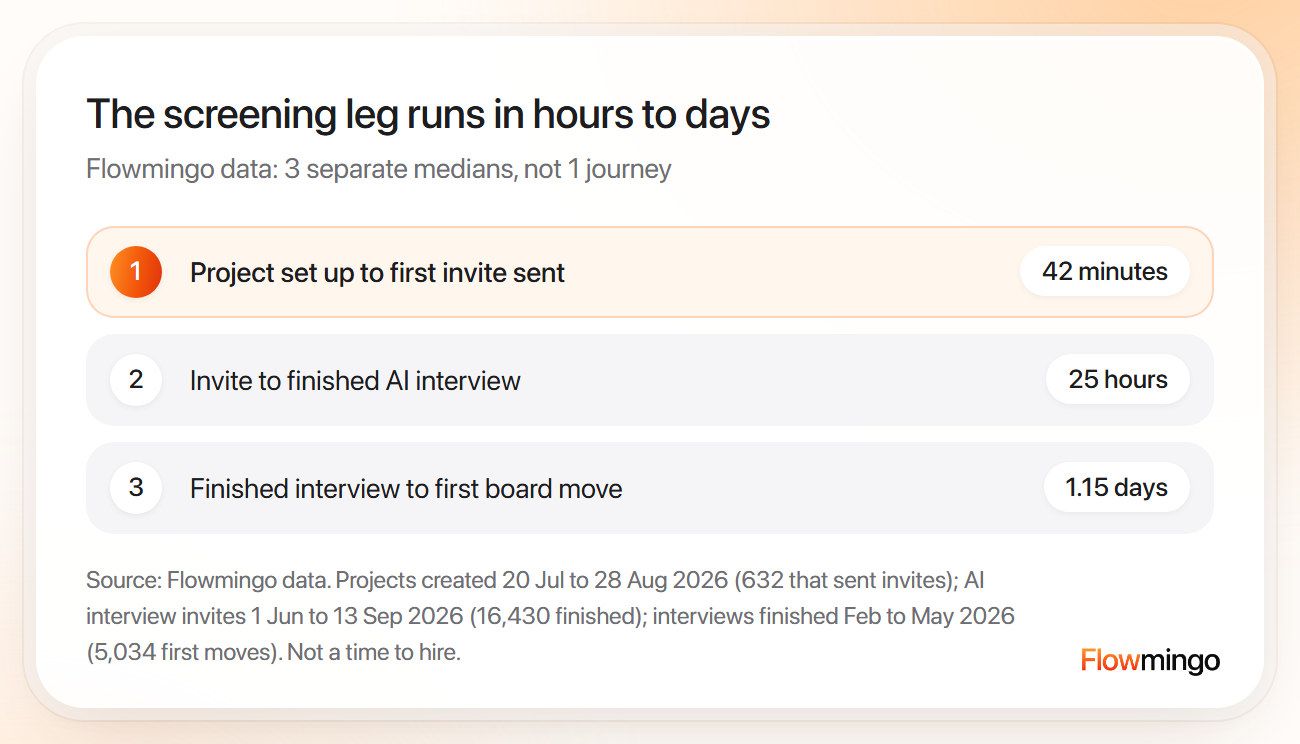
Screening leg medians: the first invite sent 42 minutes after the project was set up, and the AI interview finished 25 hours after the invite. The first board move came 1.15 days after the finished interview.
Flowmingo data · 632 hiring projects that sent invites · 327 companies · 25,494 candidates invited · projects created 20 Jul to 28 Aug 2026
- 42 minutes was the median time from creating a hiring project to its first sent invite.
75% of the 2,543 projects created in that window sent no invite within 30 days, many being trials. Project creation is not when the role opened.
How Flowmingo helps
CV Evaluation turns a job description into criteria you weight 4, 3, 2 or 1. It scores every CV 0 to 10 per criterion with written evidence, and filters nobody out automatically. Then send 1 AI interview link to everyone above your line, with nothing to book.
4. Finalists keep ghosting us: where do candidates drop out, and how fast must we reply?
They drop out where you go quiet: after applying, between rounds and while an offer waits. Give every applicant a yes or no within 1 week, and never go 2 weeks without a message.
In Greenhouse's 2025 report, 63% of US candidates said an employer ghosted them after an interview, and 50% had ghosted an employer themselves.
Candidates in that report walked away after poor communication or long delays (24%), a poor interview (23%) and hearing the salary (22%). So post the pay range and message at every step.
Talent Board says a yes or no should take 1 to 2 weeks at most (ERE). Yet in 2024, 24% of North American candidates were still waiting 2+ months (Talent Board).
Name AI or a recording in the invite, because only 31% of candidates in a Gartner survey heard about an AI interview in advance (Gartner).
The first 3 messages are ready to paste:
Applied, same day: "Hi [first name], thanks for applying for Operations Coordinator. You'll hear yes or no from us by [date]. [Your name], [Company]"
Invited, the day they pass: "Hi [first name], next is a recorded AI interview of about [n] minutes, taken in your own time. Please finish it by [date]. [Your name], [Company]"
Screened out, within 1 week: "Hi [first name], thanks for applying for Operations Coordinator. We need [the knockout, e.g. 07:00 starts], so we won't move forward. [Your name], [Company]"
The rest follow the interview:
| Step | Message | Send by |
|---|---|---|
| After the interview | The next step | 3 working days |
| After a test or interview | A short no | Within 7 days |
| Offer | A call, then the written offer | 1 week after the final |
| Runner-up | "Hi [first name], you're still in the running for [role]. We'll give you an answer by [date]. [Your name], [Company]" | Same day as the offer |
Our candidate rejection email templates cover every other no. Recorded steps need deadlines too, as the card and our AI interview completion rates show.
Flowmingo data · 74,549 AI interview invites · 887 companies · 16,430 finished at 426 companies · invites sent 1 Jun to 13 Sep 2026
- 22.0% of AI interview invites led to a finished interview within 14 days.
- 25 hours was the median time from invite to finished interview, among finishers.
- 9 in 10 finishers completed the AI interview within 4 days of the invite.
This counts invites, not unique people, and only the invited route; applicants from a public link are not included.
Read 22.0% against invites, not people. Counting only invites recruiters sent themselves (Matched Talent excluded), 1 per person, 30.9% finished within 14 days (52,078 invites, 15 Jun to 13 Sep 2026). Send the invite the day someone passes, and give about 7 days with the date written out.
Remind on day 2 if your tool does not already.
5. Which step catches people who interview well but cannot do the work?
A short skills test right after the first interview catches them. A friendly candidate can win a loose chat, but a scored task shows whether they can do the work.
Skipping it is expensive. 30% of US hiring managers admit a hiring mistake in the past 2 years, most often from not properly assessing technical skills (54%) (Robert Half).
In a foundational 2022 re-analysis by Sackett and colleagues, structured interviews ranked highest of the methods compared. Job knowledge tests came close behind, and work samples still beat cognitive ability tests.
The test goes after the first interview because it costs the candidate time. Ask for 30 to 45 minutes only when about 4 people remain, not 244. That length is our rule, not a study.
For example, the Operations Coordinator work sample asks for next week's rota for 12 staff in 30 minutes. It is scored on 3 criteria with an interview scorecard. A candidate who interviewed smoothly leaves 2 shifts uncovered, the gap the interview missed.
Yet only 2.2% of 1,020 Flowmingo projects in the figure below paired a test with an interview or CV score. Some teams test elsewhere, but many may skip the step behind Robert Half's most common hiring mistake.
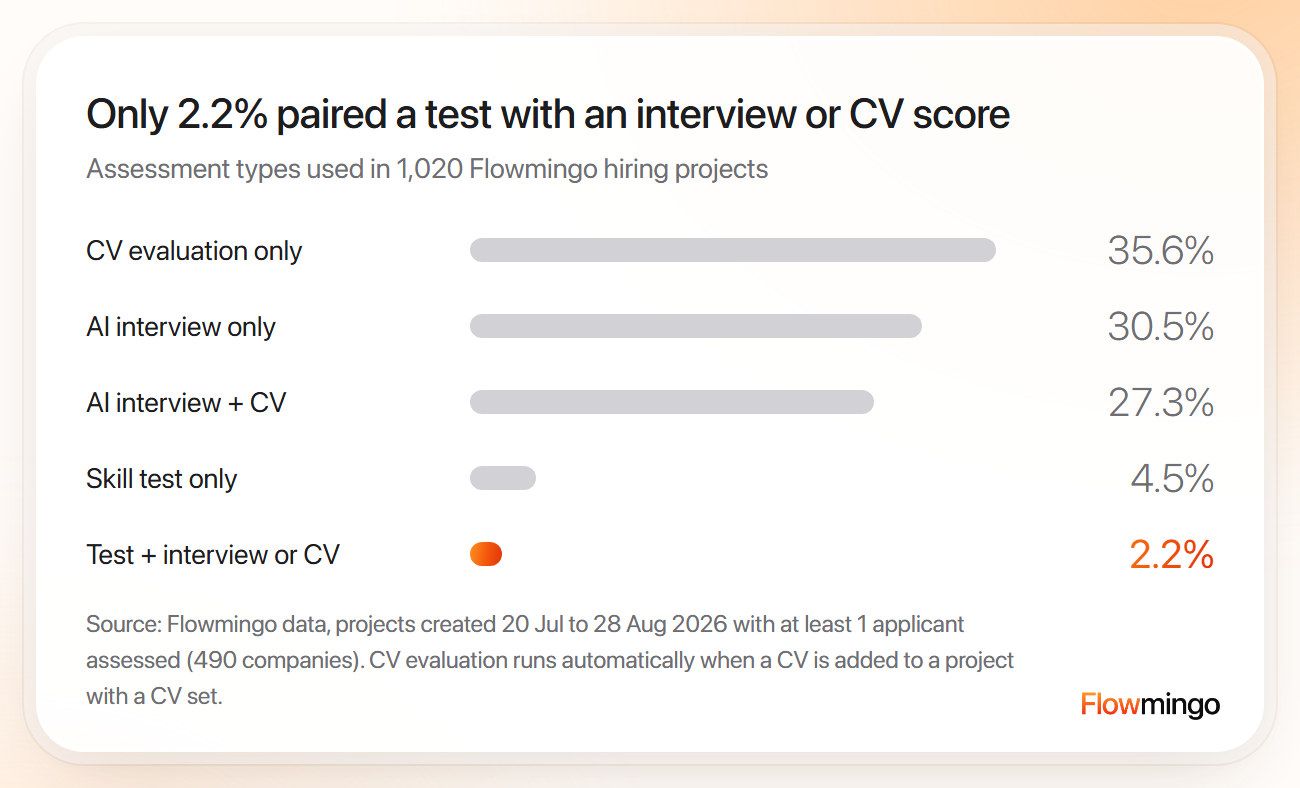
Assessment mix: of 1,020 active projects, 35.6% used CV evaluation only, 30.5% the AI interview only and 27.3% both. Only 4.5% used a skill test alone, and 2.2% paired a test with either.
Flowmingo data · 1,020 hiring projects that assessed at least 1 real applicant · 490 companies · 42,365 candidates · projects created 20 Jul to 28 Aug 2026
- 35.6% of these projects used CV evaluation and no other assessment.
- 30.5% of these projects used the AI interview and no other assessment.
- 2.2% of these projects paired a test (a skill test or showcase) with the AI interview or CV evaluation.
CV evaluation runs automatically when a CV is added to a project with a CV set, so the CV share partly reflects CVs being attached.
How Flowmingo helps
Tests are multiple choice, drawing on 270+ skills plus your own, with AI-written questions you can edit. You set how much the test counts toward each candidate's fit score.
6. How many interview rounds do our hiring process steps need, and how many candidates per round?
3 rounds after the screen are enough: first interview, skills test and final, each with its own job. Of 244, about 19 pass the screen and about 4 clear the first interview for the skills test (Greenhouse averages).
We then send the best 2 to the final, our rule rather than a benchmark, and about 1 gets the offer (Gem). Google's people-analytics team found that 4 interviews predicted its final hire decision with 86% confidence (Workforce). In that foundational 2015 report from 1 company, rounds past 4 added little but cost weeks.
Our 2 interviews plus a scored work sample give 3 separate reads of each finalist. Rounds creep because each new worry gets its own interview.
The figure shows how the pile shrinks, reading Greenhouse's first and second stages as your screen and first interview. Gem lands close: 8% pass initial screening and 0.5% of applicants get an offer.
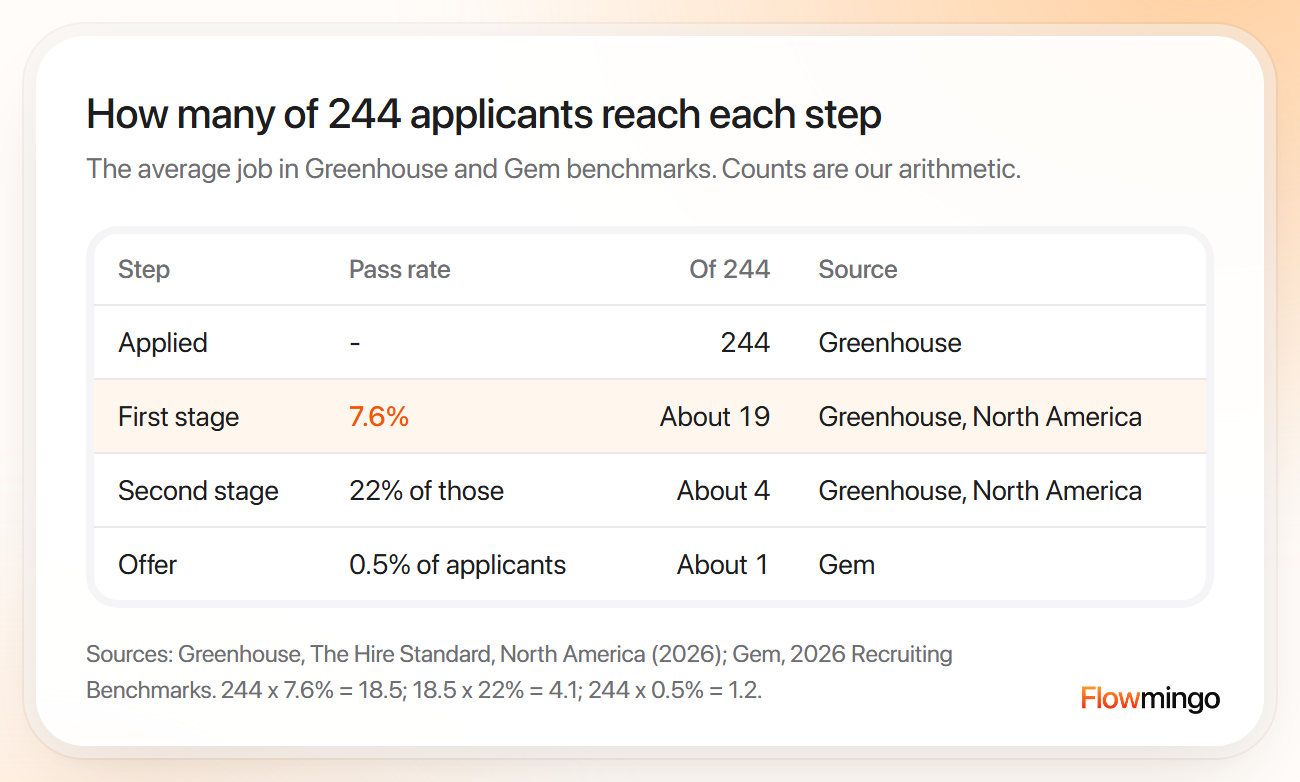
Pass-through per step: of 244 applicants who applied, about 19 pass the first stage (7.6%) and about 4 the second (22% of those, Greenhouse). About 1 gets an offer (0.5% of applicants), per Greenhouse, North America, and Gem.
Count interviewer hours too. Greenhouse's North American jobs averaged 22.7 interviews and 12.3 interview hours per hire. Here, 2 finalists with 2 interviewers for 1 hour cost 4 hours, and 19 live first interviews would cost 38.
So step 4 moves off the calendar: the 19 first interviews become recorded ones, finished while the ad is open. Your 38 interviewer hours become review time, and only the final needs a booked room.
7. We have 2 finalists: after the final interview, how fast should we decide and offer?
Collect every interviewer's scores before anyone talks, decide within 1 working day, and send the offer within 1 week of the final interview. Faster offers won more acceptances, with no drop in later performance.
That comes from a foundational 2010 field study of 3,012 candidates at 1 large organisation by Becker, Connolly and Slaughter.
Speed matters more now because fewer candidates say yes. As the figure shows, 48% accepted their most recent offer in 4Q25, down from 54% in 4Q24 and 85% in 4Q23 (Gartner).
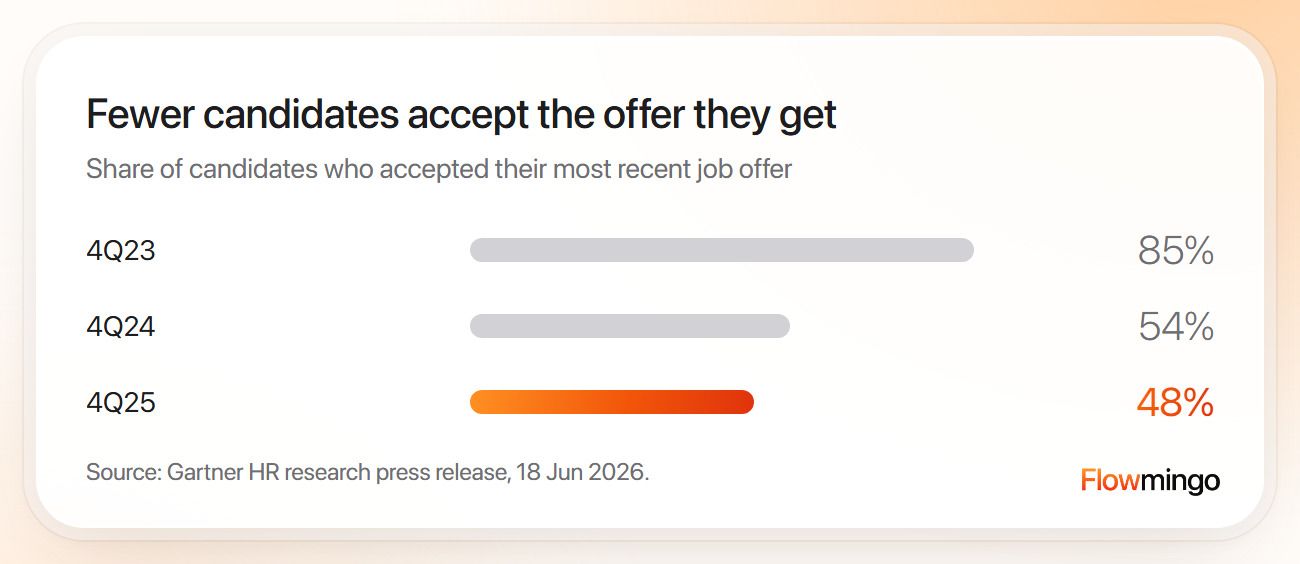
Offer acceptance: 85% of candidates accepted their most recent offer in 4Q23, 54% in 4Q24 and 48% in 4Q25 (Gartner).
Gartner counts candidates, and a candidate holding 2 offers must decline 1, so it is not your rate. For your own offers, Gem puts acceptance at 82%.
Run the debrief like this:
- Each interviewer scores every criterion alone, before any discussion.
- Meet within 1 working day, and read the weighted totals first.
- Break a tie on the must-have criterion, then the skills-test score.
- The hiring manager decides, writes 1 line on why and calls the finalist that day.
Keep the runner-up warm until the finalist signs, because nearly 1 in 5 offers is declined (Gem). The hiring process steps after the interview are debrief, decide, offer, then checks.
Pooled across teams, candidates moved after a recorded interview were moved a median 1.15 days later, as the card below shows. Without the largest company, that median is 1.45 days. No board move does not mean no reply, because many teams decide by email or in another system.
Flowmingo data · 14,750 AI interviews finished in hiring projects · 624 companies · 5,034 first moves at 227 companies · interviews finished 1 Feb to 31 May 2026
- 34.1% of candidates who finished an AI interview moved to another stage within 21 days.
- 1.15 days was the median time from a finished interview to the first stage move.
A stage move is a recruiter dragging a candidate on the Flowmingo board, not a hiring decision. 66% had no move within 21 days.
8. Should reference and background checks come before or after the offer, without stalling the hire?
Check references for your last 2 or 3 finalists, with consent, around the debrief. Make the offer conditional on a background check started the day you pick, so checks fit the 10-day budget.
The University of Washington takes references before the offer and makes the offer conditional on a background check. That order saves time because references run alongside the debrief.
Ask referees about the scorecard's criteria, not whether they'd rehire. Call a current employer only after a conditional offer and the finalist's clear yes. In the UK, Acas lists suitable references as an example offer condition.
In the UK, a prescribed right-to-work check before employment starts gives you a statutory excuse. Without one, employing someone with no right to work carries a maximum civil penalty of £45,000 per worker, £60,000 for a repeat breach (Home Office).
In Singapore, MOM says employers should not make a job offer during the 14-day advertising period for Employment Pass and S Pass roles (MOM).
For example, you pick the Operations Coordinator finalist on day 29 and call references that day and the next. The conditional offer goes out on day 30, and the checks finish by day 39.
9. We hire across the US, UK, EU and Singapore: which laws touch our hiring process steps?
Each step carries its own legal duty, from the privacy notice at application to the right-to-work check before day 1. This is general information, not legal advice.
At application, GDPR Article 13 requires telling applicants who you are, why you process their data and how long you keep it.
US federal guidelines compare selection rates by race, sex or ethnic group. A rate below 80% of the highest group's generally counts as adverse impact (29 CFR 1607.4). Agencies judge the whole process, but per-step checks help.
For example, if 30% of 1 group pass your screen and 20% of another, 20 ÷ 30 = 67%, so review that knockout (illustrative).
Singapore's Workplace Fairness Act is slated for the end of 2027 (TAFEP; MOM). It bars adverse hiring decisions based on protected characteristics, at first only at firms with 25+ employees (Mayer Brown).
9.1 Can we use AI at the screening step without breaking EU, NYC or Illinois rules?
Yes, if you meet each rule. Tell candidates (Illinois, NYC), and for NYC commission an independent audit for bias within the year before use and publish its summary. Keep a person on every decision as good practice.
Illinois has required notice of AI in hiring since 1 Jan 2026 (Crowell & Moring). New York City's foundational Local Law 144 has been enforced since 5 Jul 2023, with notice 10 business days before use.
The EU AI Act lists AI that filters applications as high-risk, and its duties for those systems apply from 2 Dec 2027 (Regulation 2026/1744).
The UK ICO audited AI recruitment tools, found some guessing gender and ethnicity from names, and made 296 recommendations.
10. How do we make our hiring process steps repeatable, so every manager stops improvising?
Write the process once as a 1-page role template: 8 steps, pass rules, day limits and messages. Change only the criteria for each role, and track 4 numbers so drift shows early.
Managers improvise because nobody writes the process down, so requirements move mid-search. One poster on r/humanresources saw a manager reject a candidate for missing people-management experience, then admit it was "a nice to have, not required".
The template holds 6 fields, shown for the Operations Coordinator (illustrative):
- Criteria and weights: rota planning for 10+ staff (Must Have, 4), supplier follow-up (3), reporting (2).
- Knockouts: 07:00 starts and the right to work.
- Questions: 1 per criterion, with a 1-line anchor for each score.
- Skills task: next week's rota for 12 staff in 30 minutes.
- Days and messages: the 39-day budget and the message plan above.
- Records: every application, score and rejection in 1 place, kept at least 1 year in the US (29 CFR 1602.14).
Every gate has a yes and a no path. A declined offer goes to the runner-up, and failed checks mean withdrawing the offer where the law allows. If the runner-up declines too, re-read the saved pool, then reopen at the first screen.
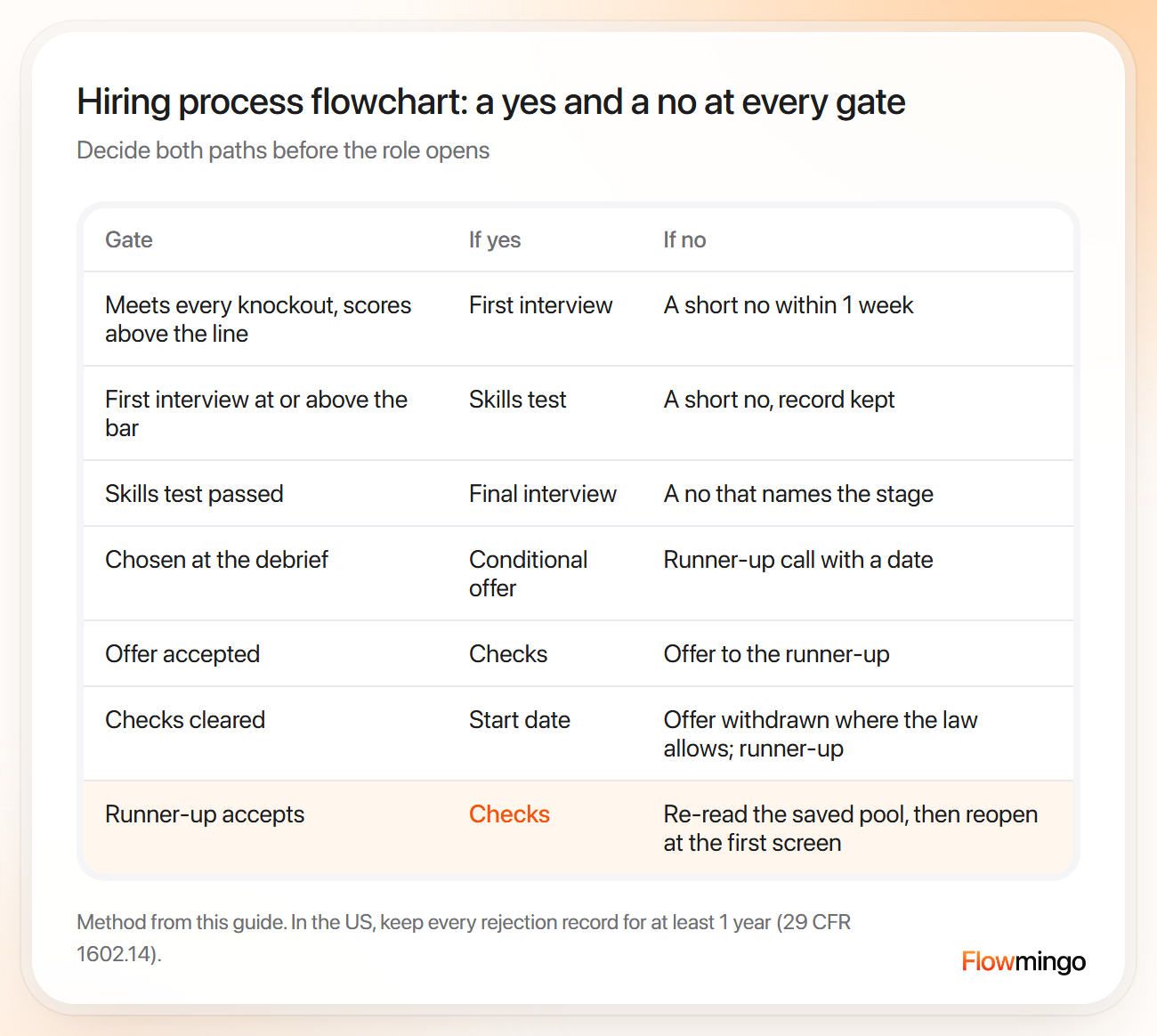
Hiring process flowchart: every gate has a yes and a no path. A declined offer goes to the runner-up, and if the runner-up declines, you re-read the saved pool, then reopen at the first screen.
10.1 Which numbers show our hiring process works?
Track 4 numbers against this guide's benchmarks. Leadership asks about time-to-fill, but pass-through per step shows which step to fix.
| Number | Benchmark |
|---|---|
| Time-to-fill | 39 days, SHRM 2026 median |
| Days to first reply | 1 week, 2 at most |
| Pass-through per step | 7.6% at the first stage, 22% of those at the second (Greenhouse) |
| Offer acceptance | 82% of offers accepted (Gem, 2026) |
How Flowmingo helps
Flowmingo is a free AI interviewer for recruiters. It covers steps 3 to 6: the CV score, an own-time first interview, a multiple-choice skills test and a fit score for the debrief. The offer, checks and start stay in your own tools. Write your hiring process steps once, then run the screen, first interview and skills test for every role in Flowmingo.
11. Sources
Every study, law and survey here links to a source below. Flowmingo figures come from its own platform data.
- Acas (n.d., read 2026). References. Acas.
- Becker, W. J., Connolly, T., & Slaughter, J. E. (2010). The effect of job offer timing on offer acceptance, performance, and turnover. Personnel Psychology, 63(1), 223-241.
- Crowell & Moring (2024). Artificial intelligence in employment update: Illinois requires notice and prohibits discriminatory impact in use of AI. Crowell & Moring LLP.
- European Parliament and Council (2016). Regulation (EU) 2016/679, General Data Protection Regulation, Article 13. Official Journal of the European Union.
- European Parliament and Council (2026). Regulation (EU) 2026/1744 amending Regulation (EU) 2024/1689, the Digital Omnibus on AI. Official Journal of the European Union.
- Gartner (2026, June 18). Gartner HR research finds 48% of candidates accepted job offers in 4Q25. Gartner newsroom.
- Gem (2025, December 1). Key takeaways from the 2026 Recruiting Benchmarks report. Gem.
- Greenhouse (2025). Greenhouse 2025 workforce and hiring report. Greenhouse.
- Greenhouse (2026, March). The Hire Standard: Hiring benchmarks 2026. Greenhouse.
- Greenhouse (2026, March). The Hire Standard: Greenhouse benchmark report, North America. Greenhouse.
- Grossman, K. (2025, January 23). 12 key takeaways from the 2024 Candidate Experience Benchmark Research. ERE.
- Home Office (2024, February 13). Code of practice on preventing illegal working: Right to work scheme for employers. GOV.UK.
- Information Commissioner's Office (2024, November 6). ICO intervention into AI recruitment tools leads to better data protection for job seekers. ICO.
- Levashina, J., Hartwell, C. J., Morgeson, F. P., & Campion, M. A. (2014). The structured employment interview: Narrative and quantitative review of the research literature. Personnel Psychology, 67(1), 241-293.
- Mayer Brown (2025, July 2). Fair play at work: Unpacking Singapore's Workplace Fairness Act. Mayer Brown.
- Ministry of Manpower, Singapore (n.d., read 2026). Fair Consideration Framework. MOM.
- Ministry of Manpower, Singapore (2025, November 4). Workplace Fairness (Dispute Resolution) Bill press release. MOM.
- NYC Department of Consumer and Worker Protection (n.d., read 2026). Automated employment decision tools (AEDT). City of New York.
- r/humanresources (2026). Oh the hiring process [AZ] [Online forum post]. Reddit.
- r/smallbusiness (2026). Turns out I do need to test people on basic skills in the hiring process [Online forum post]. Reddit.
- Rafter, M. (2015, March 22). Laszlo Bock: Just Google him. Workforce.
- Robert Half (2025, June 18). Hiring headaches: 93% of managers say the process takes longer than 2 years ago. Robert Half press room.
- Robert Half (2026, March 10). Robert Half survey: 67% of HR leaders report AI-generated applications are slowing hiring. Robert Half press room.
- Sackett, P. R., Zhang, C., Berry, C. M., & Lievens, F. (2022). Revisiting meta-analytic estimates of validity in personnel selection: Addressing systematic overcorrection for restriction of range. Journal of Applied Psychology, 107(11), 2040-2068.
- Society for Human Resource Management (2026). 2026 recruiting executives benchmarking. SHRM.
- Society for Industrial and Organizational Psychology (n.d., read 2026). Is cognitive ability the best predictor of job performance? New research says it's time to think again. The Industrial-Organizational Psychologist.
- Talent Board (2024, December). What sets CandE award winners apart: 2024 CandE benchmark research. ERE Media.
- Tripartite Alliance for Fair and Progressive Employment Practices (n.d., read 2026). Workplace fairness. TAFEP.
- University of Washington (2026, July 24). Staff hiring process overview. UW Human Resources.
- U.S. Code of Federal Regulations (current text). 29 CFR 1602.14, preservation of records made or kept. Legal Information Institute.
- U.S. Code of Federal Regulations (current text). 29 CFR 1607.4, information on impact. Legal Information Institute.