
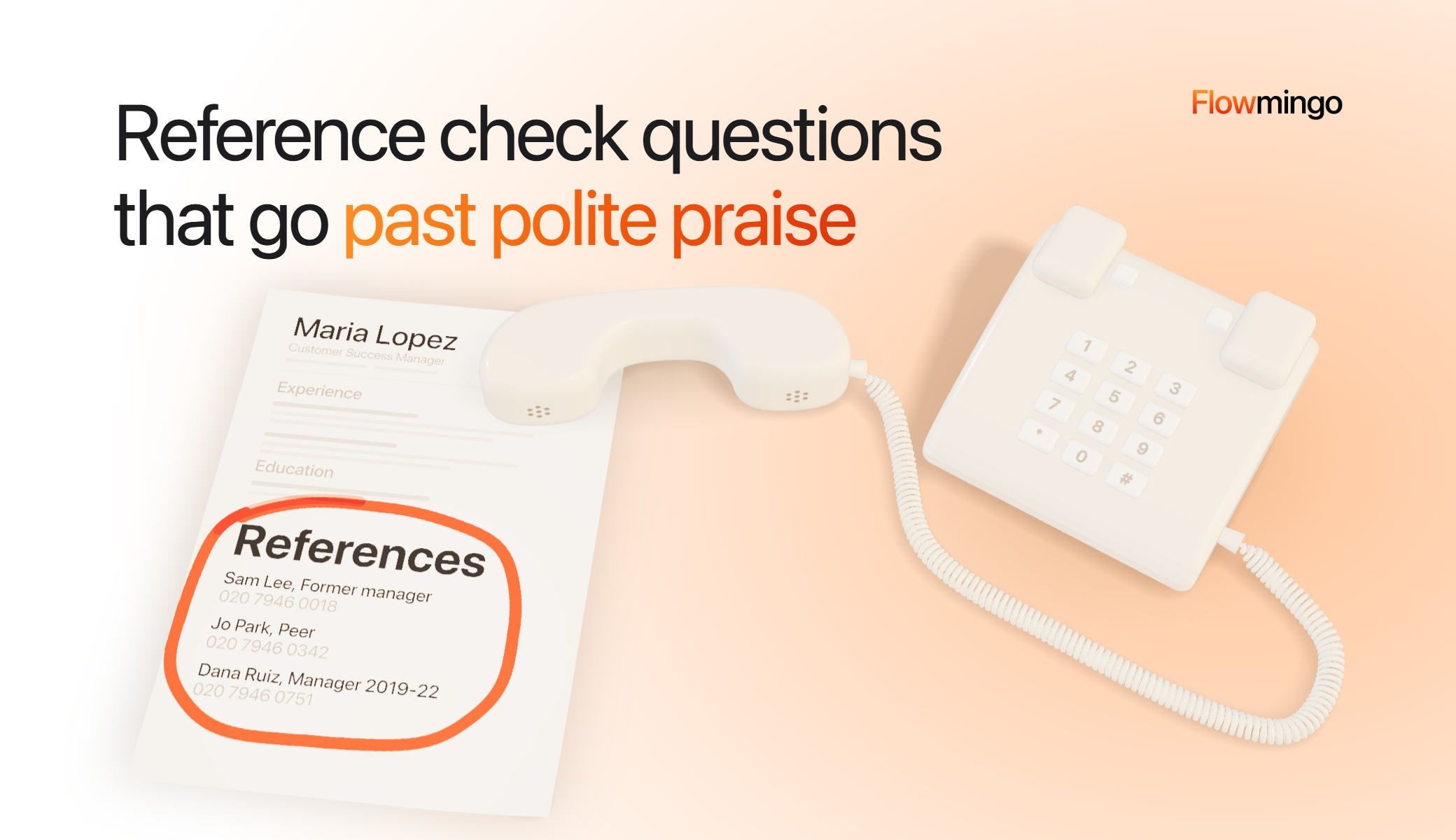
Your finalist aced the interview, you've drafted the offer, and 3 phone numbers sit in your inbox. The reference check questions you ask in the next hour decide whether those calls change anything.
Too many calls end in polite praise or a flat "we only confirm dates", because the candidate picked the referees and many HR teams say nothing else.
Across your last 3 finalists, that is 9 calls, 3 hours of your week, re-confirming strengths you already saw. Meanwhile the weak spot goes unchecked.
About 4 in 10 finalists in our AI interview numbers had a job criterion the interview rated weak or never tested. An employment reference check should go after that gap, in 3 moves.
Aim 2 or 3 questions to ask references at the gaps your interview left. Have every referee rate the same 3 job behaviours from 1 to 10. Check the referee is real before you believe a word.
Key takeaways
- Which reference check questions are worth asking? Ones aimed at what your interview left open. In 1 study of entry-level jobs, a 10 to 15 minute call rating 3 named qualities predicted supervisor ratings.
- How much should a reference count against the interview? Less than a structured interview, since the headline figure rests on 10 studies from before 1984.
- When should I call, and how many referees do I need? At the end: 3 referees for each of your last 2 or 3 finalists, about 20 minutes each.
- What must I never ask a referee? Anything you can't ask the candidate, such as health, age or religion. In the US, age is protected from 40, and in California past pay is off-limits too.
- How do I know the referee is real? Call the company's main number yourself. About 1 in 5 employees at large UK firms say they or someone they know used a fake-reference service.
1. Which reference check questions predict whether my finalist will do the job, not just polite praise?
Aim 2 or 3 questions at the gaps your interview left, and ask for a 1 to 10 rating on 3 named behaviours.
Generic "strengths and weaknesses" questions mostly return polite praise, because the candidate chose these referees. Structure helps: in 1 foundational 2004 study, scripted ratings still predicted later performance (Taylor and colleagues).
Untrained recruiters ran a 10 to 15 minute script for 223 applicants to entry-level customer-contact jobs, and referees rated 3 qualities, such as customer focus.
Ask about behaviour, because a colleague's view of someone's traits predicts performance better than a self-description (Oh, Wang and Mount, foundational 2011).
For example, say she claimed renewals on 40 accounts, and her old manager says about 25 were hers (illustrative, not customer data).
An overall 1 to 10 rating is a core question in the foundational hiring book Who. Rating 3 named behaviours this way, then our follow-up "What would have made it a 10?", makes answers comparable, as in our pre-screening interview questions.
Here is a reference check template. Open with: "Thanks for your time. I'm [name], hiring a [role]. [Candidate] agreed we could call. It takes about 20 minutes, and I'll use your answers only for this hiring decision."
Pick the 3 behaviours from the job's must-haves, such as dependability or handling unhappy customers.
- Verify: How do you know [candidate], and for how long?
- Verify: What was their title and main job then?
- Probe the gaps: What was [candidate]'s own part in [area, e.g. renewals]? How much of it was theirs?
- Probe the gaps: We didn't see [criterion]. Can you give me 1 time they [situation]?
- Rate: From 1 to 10, how do you rate them on [behaviour 1]? What would have made it a 10?
- Rate: The same for [behaviour 2], then [behaviour 3].
- Rate: Among people you've managed in that role, where do they rank?
- Pressure: What were their biggest areas for improvement back then?
- Close: Would you hire them again into the same kind of role?
- Close: Who else should I speak to?
The figure maps the script to 5 steps. Probe the gaps with questions 3 and 4, the accented step, because only your interview can find them.
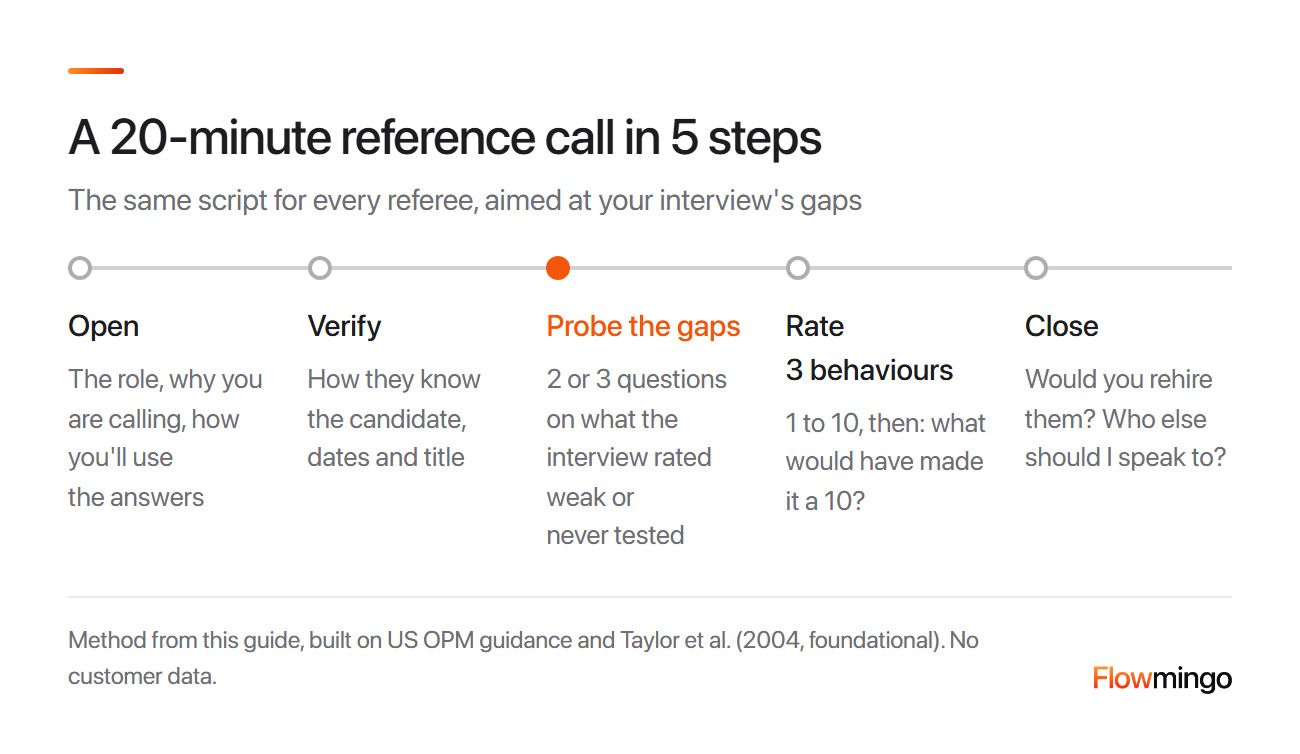
Reference call structure: open on the role and how you'll use the answers, then verify. Probe the gaps, rate 3 behaviours from 1 to 10, then close.
How Flowmingo helps
Flowmingo has no reference-check feature, but the AI Interviewer report helps you decide what to ask. It scores each criterion 0 to 10 with a written justification, and lists 2 to 5 gaps. Replay the answer or read its transcript so you know which part of their past role to ask about. Our tip, not a feature: turn the 2 lowest-scored criteria, or the gaps the report lists, into questions 3 and 4, in your own words.
2. Are reference checks worth my time? How much weight should one carry against the interview?
Yes, as a check rather than the verdict. A reference is a modest predictor built on old evidence, so your structured interview should outweigh it.
The best-known summary of hiring methods was updated in a foundational 2016 working paper (Schmidt, Oh and Shaffer). On a scale where 0 means no link and 1 a perfect one, it gives references .26, well behind a structured interview.
That rests on only 10 studies from before 1984, and the authors warn it "may not at present be fully accurate".
A foundational 2022 re-analysis found older estimates for top methods inflated, and ranked structured interviews first (Sackett and colleagues). Our structured interview guide explains that method.
A reference does 1 thing well: a multi-referee check predicted who the employer later let go, not who quit (Hedricks and colleagues, foundational 2013). In an Accountemps survey, managers said they drop up to 34% of candidates after reference checks (HR Dive, foundational 2019).
So spend the call on the gaps, because that is where a reference can still change your mind. In our numbers, about 4 in 10 finalists had at least 1 criterion to check.
For the 56% with none, use the call to verify claims and rate the 3 behaviours.
Flowmingo data · 1,458 finalist places · 486 jobs · 246 companies · AI interviews 22 Jul to 28 Sep 2026
- 44% of AI interview finalists had at least 1 job criterion rated below 5 out of 10 or never tested.
- 32% of finalists had at least 1 criterion that the AI interview rated below 5 out of 10.
- About 17% of finalists had at least 1 criterion the interview gathered no evidence on.
- 56% of finalists had no criterion rated below 5 or left untested.
Finalists are the top 3 AI interview scores per job, not people hired, and the share ran 39% to 44% across 2 cut-offs. These are AI ratings, not job performance, and untested means no evidence, not a missing skill.
The chart shows those 3 shares: 44%, 32% and about 17%.
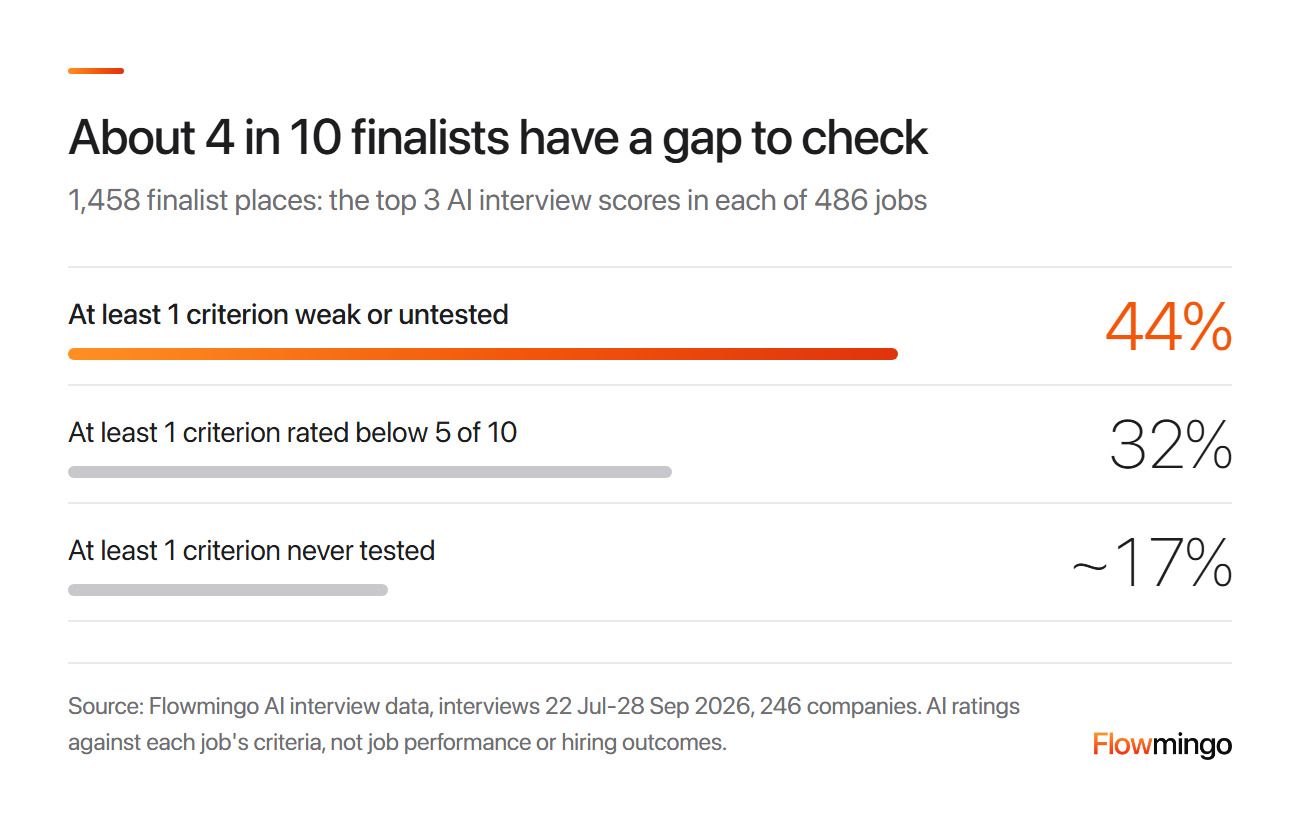
Finalist gaps: 44% of 1,458 finalist places had a criterion rated below 5 of 10 or never tested, 22 Jul to 28 Sep 2026.
Let the interview pick the finalist, and let references confirm, flag a risk or break a tie. Set the weights on your interview scorecard before you call.
3. Should I check references before or after the offer, and how many, from whom?
Check at the end, for your last 2 or 3 finalists, and in the UK as a condition of the offer. Call 3 referees each, about 20 minutes a call, including at least 1 former direct manager.
Timing matters because the call only pays off once few candidates are left. The US Office of Personnel Management puts reference checks "near the end of the selection process".
In the UK, Acas advises asking "when making a job offer", and lists "suitable references" as an example offer condition. If you check before any offer, tell the finalist, because a slow check can lose them to a faster offer.
A foundational 2005 report by the US Merit Systems Protection Board also recommends 3 referees. When their stories disagree, add a 4th referee rather than picking a favourite.
The former direct manager matters because they saw the work and can rate it, while a peer mostly sees collaboration.
For example, 2 finalists with 3 referees each means 6 calls of 20 minutes, about 2 hours, against 9 calls if you check all 3.
3.1 The referee won't call back: is that a red flag?
Not on its own. A slow reply is normal, because referees are busy, and big employers often route the call to HR.
So make yes easy: 1 email with 2 time slots, then 1 follow-up call. For example: "Hi Sam, Maria named you as her manager. Could you spare 20 minutes on Tuesday or Wednesday morning?"
After 2 working days, ask the candidate to nudge the referee or name another former manager. Silence from every referee is the signal, not 1 slow reply. This is our advice, not a research finding.
4. Do I need the candidate's consent to call references, including their current employer?
Ask anyway: tell every finalist you will check references, and get permission before you contact a current employer. No country's rules stop you asking first.
In the UK, Acas says to hold a conditional offer and the applicant's permission before you approach a current employer. The ICO adds that you must tell candidates if you intend to vet them.
In the US, obtaining a consumer report from a reporting company triggers FCRA duties: standalone notice and written permission (15 USC 1681b). For investigative consumer reports, disclose within 3 days of first requesting the report. Explain the right to request its nature and scope (15 USC 1681d).
In Singapore, the PDPC guidelines let you take a reference from a former employer without consent, for an evaluative purpose. Ask anyway, because the candidate knows whom to call.
In the EU, GDPR Article 14 generally requires information about personal data obtained from other people, including its source. Its deadlines and exceptions depend on the circumstances, so off-list sources make it particularly important to check what notice is required.
At the final stages of your hiring process, call former employers first, and the current manager only after a conditional offer and a clear yes. Ask in 1 line: "We call 3 references before a final decision. Tell us who we can call, and anyone to avoid until you accept an offer."
5. Is a backdoor reference check on my finalist OK, and is it legal?
A backdoor call to someone the candidate didn't list is legal in many places, but unfair unless you say you do it. Tell finalists up front, weigh 1 off-list voice lightly, and never use it to out a job search.
1 recruiter on Reddit says backdoor calls were the norm for senior roles at their startup, and saw an offer pulled after 1.
Off-list checks are hard to measure because they happen privately between people. A foundational note by Moon says their "veiled and covert nature" hides the extent.
It also misleads, because an off-list voice has no script, no known relationship and maybe an old grudge. Never let it outvote the 3 scripted calls.
In Singapore, the Workplace Fairness Act, slated to take effect at end-2027, will bar rejecting someone over a protected trait a referee mentions.
The safe version is 2 lines in the invite, for finalists only. Copy this: "We may also speak with people you worked with beyond your list, never your current employer. We will ask you about anything that concerns us before we decide."
6. Which reference check questions am I legally allowed to ask, and which invite a discrimination claim?
Ask only about the job: performance, behaviour, duties, dates and whether they'd rehire. Anything you can't ask the candidate, such as health, age, family or religion, you can't ask the referee either.
The US Equal Employment Opportunity Commission's foundational 1995 ADA guidance bars asking a former employer any disability-related question you couldn't ask the applicant (EEOC guidance).
The question itself can become evidence, because the EEOC says questions revealing race, sex, religion or age "may be used as evidence" of intent to discriminate. In the US, age protection starts at 40.
In California, Labor Code 432.3 bars seeking salary history, personally or through an agent, so a referee call counts. Keep pay off every script, so 1 template works in every state.
In Great Britain, section 60 of the Equality Act 2010 bars health questions before a job offer. EHRC guidance says that includes questions to a past employer (Stammeringlaw). So leave sickness absence until after the offer.
Use this table as the last check on your reference check questions before you dial.
| Ask about | Don't ask about |
|---|---|
| Performance and 1 specific example | Health, disability, sick days |
| Duties, title and dates | Race, colour, national origin, religion |
| Would you rehire them | Age, or clues like graduation year |
| How they handled feedback | Marriage, pregnancy, children, caregiving |
| Reason they left | Past pay or benefits |
If a referee volunteers something protected, such as "she was out a lot with her kids", stop them politely and don't write it down.
7. The old employer only confirms dates: which reference check questions still get a useful answer?
Treat "dates only" as neutral, confirm the facts, then ask a former direct manager for their own view. A referee may still answer the rehire question, and in California the law protects that answer.
A referee may limit an answer because of employer policy or concern about disputes. Ask which job-related facts they can confirm, and record the limits of the answer rather than treating silence as a negative reference.
California's Civil Code 47(c) protects performance facts "based upon credible evidence, made without malice", and the rehire answer.
In an Accountemps survey of over 2,800 senior managers (foundational), 38% most wanted strengths and weaknesses, and 22% past duties. Titles and dates got 19%, and preferred work culture 12%.
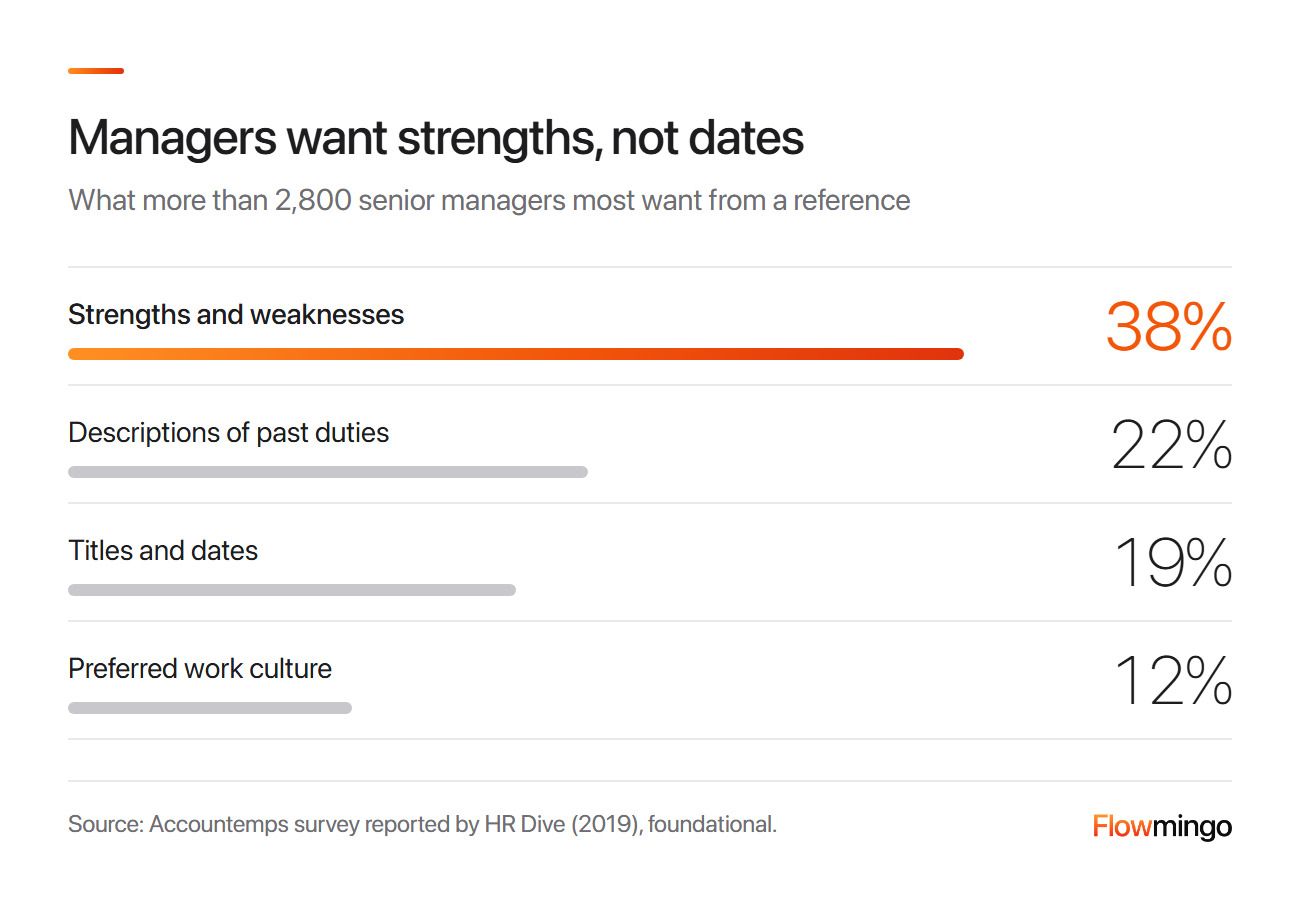
Managers' wish list: 38% most want strengths and weaknesses, 22% past duties, 19% titles and dates, 12% work culture (Accountemps, foundational 2019 survey).
So a dates-only answer covers the 19% and misses the rest. Confirm dates and title, then ask "Is she eligible for rehire?" Then ask the candidate for the former manager's direct contact, or a peer or client.
7.1 Can I legally give an honest bad reference for a former employee?
It depends on jurisdiction and circumstances. A UK reference must be "accurate and fair" (Acas).
Ask for first-hand, job-related facts and the examples behind them. Keep accurate notes and explain their use. Legal protections vary by jurisdiction, so promise neither immunity nor complete confidentiality.
Keep the ask narrow, for example: "I'm only asking what you saw her do on renewals."
Never give a false negative reference to punish an equal-opportunity complaint: the EEOC treats that as retaliation.
8. How do I spot a fake or AI-written reference before I make the offer?
Verify the referee before you trust the reference, because a written letter alone no longer proves a real person wrote it.
Cifas surveyed 2,000 employees at UK firms with 1,000+ staff. Almost a fifth (19%) said they or someone they know used a fake "reference house".
In a single-blind trial, 7 faculty reviewers correctly identified only 40% of human-written and 63% of AI-written letters (Simister and colleagues).
So 6 in 10 real letters were taken for AI.
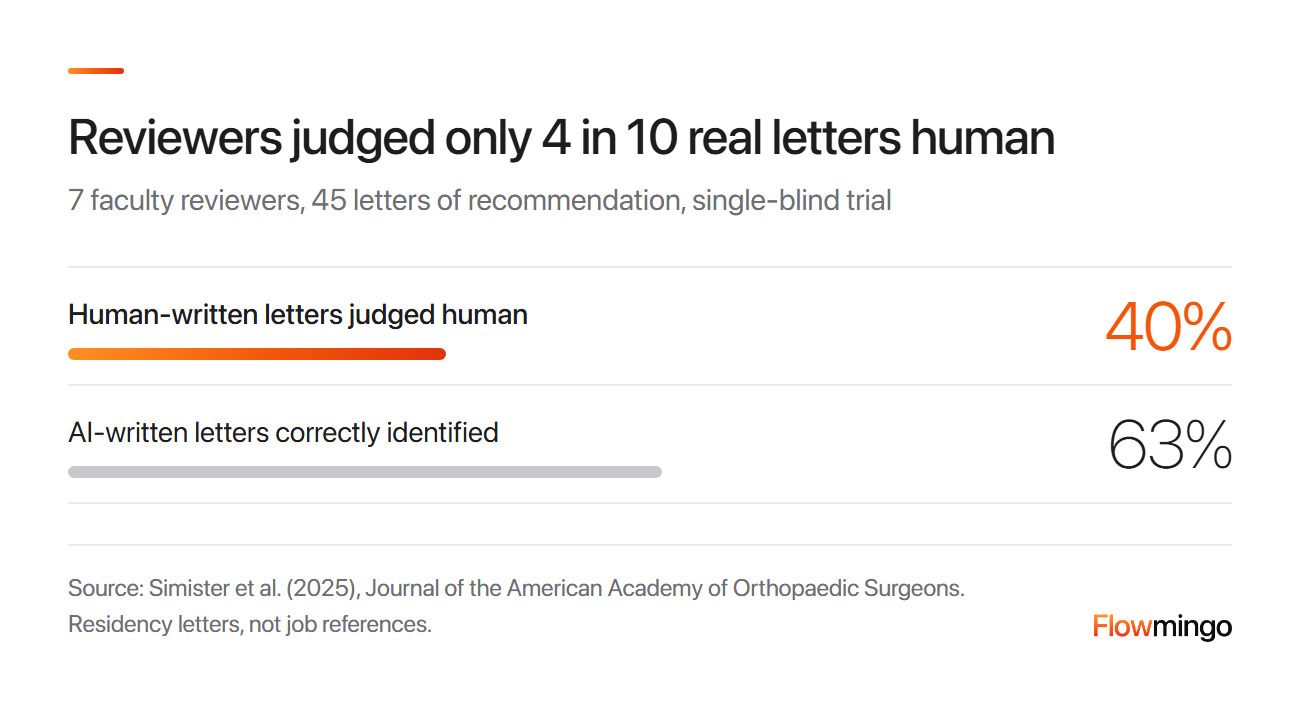
AI letter test: reviewers judged only 40% of human-written letters human and spotted 63% of AI-written ones, in a single-blind trial of 45 letters.
Those were residency letters, not job references, but the lesson carries. AI drafts can invent detail and add gender stereotypes (Wan and colleagues, foundational 2023).
Before any reference check questions, run these checks:
- Call the employer's main number and ask for the referee by name.
- Check their role on the company site or a public profile.
- Talk live: a letter is a lead, not proof.
- If a step fails, ask for another former manager.
8.1 Should I switch to an online form or an AI reference tool?
Use forms for speed, and keep a live call for your final pick. A multi-referee web form improved response time and rate in a foundational 2013 study (Hedricks and colleagues).
Say you have 2 finalists: send a web form to their 6 referees, then book a 20-minute live call with your final pick's former manager. A form is easier to fake and harder to probe, because nobody hears the voice, checks the number or follows up a vague answer.
If software makes the decision on its own, the UK ICO says to tell candidates and offer a human review. In the EU, an AI tool that evaluates candidates is high-risk, and its heavy duties start on 2 December 2027 (Regulation (EU) 2026/1744).
9. One finalist's references glow, the other's are lukewarm: should a vague reference change my decision?
Not on tone alone. A lukewarm reference should change your decision only when it confirms a gap you already saw, or when 2 referees raise the same concern.
Glowing praise can say more about the referee. In a foundational 1998 study, upbeat writers wrote more favourable reference letters (Judge and Higgins), so a glowing tone can be habit.
Lukewarm can be a warning, since Smart and Street call "the absence of enthusiasm" a "terrible sign". But a careful referee sounds the same, so probe before you conclude.
The decoder below pairs 5 common answers with a follow-up. For example, "She was fine" with no example calls for 1 specific time, and a pause before rehire calls for "Would you hire them again yourself?".
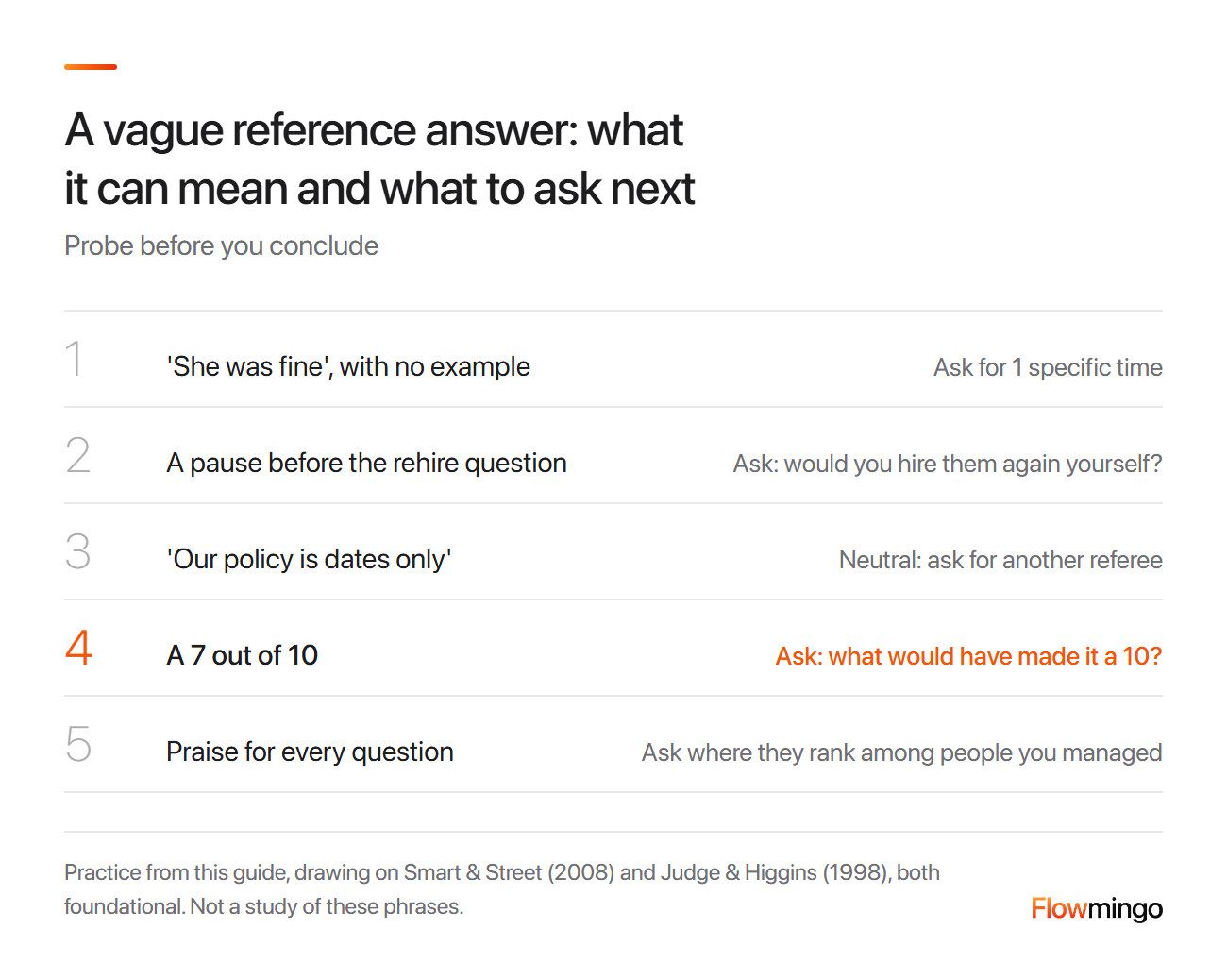
Answer decoder: 5 common reference answers, from faint praise to a 7 out of 10, each with a follow-up question.
A dates-only policy is neutral, so ask for another referee. A 7 out of 10 earns "What would have made it a 10?", and constant praise earns a ranking question.
Then score both finalists the same way (illustrative, not customer data):
| Question | Referee 1 (former manager) | Referee 2 (peer) | Referee 3 (earlier manager) | Average |
|---|---|---|---|---|
| Dependability, 1 to 10 | 8 | 9 | 7 | 8.0 |
| Handling unhappy customers, 1 to 10 | 7 | 8 | 5 | 6.7 |
| Working with sales, 1 to 10 | 8 | 7 | 8 | 7.7 |
Referee 3's 5 on unhappy customers sits 2+ points below the others, so call again or add a 4th referee.
How Flowmingo helps
Flowmingo's ATS has team notes and ratings on each candidate. Our tip, not a feature: type each referee's 3 ratings there by hand, beside the interview score.
Even strong candidates usually have 1 weaker criterion, so a lukewarm rating on 1 behaviour is expected, and only matters when it hits a must-have.
Flowmingo data · 1,458 finalist places at 246 companies · 11,773 strong scorers at 502 companies · AI interviews 22 Jul to 28 Sep 2026
- 3.5 points out of 10 was the median gap between a finalist's best and worst criterion.
- 28.0% of the 11,773 candidates who scored 7 or more overall still had a criterion below 5.
AI interview ratings against each job's own criteria, not job performance. A gap means less evidence for 1 criterion, not that the candidate can't do it.
Say finalist A glows but scored lower on the must-have, while B is lukewarm on 1 behaviour the interview also flagged. Decide on the must-have first, then use B's references to plan B's first 90 days.
10. Hiring in the UK, EU or Singapore: which reference check questions and data rules apply?
Job-related questions still raise different data duties: EU Article 14 generally requires transparency for references, with exceptions. Singapore has an evaluative-purpose consent exception, not a blanket data-protection exemption.
This matters because a team hiring across borders can't reuse 1 consent line. Say your Singapore team is hiring in Berlin, and the finalist last worked in Munich.
Where GDPR Article 14 applies, provide the information within a reasonable period, at most 1 month after obtaining the data. First communication or disclosure can bring an earlier deadline. Exceptions include information the candidate already has.
Singapore's consent exception does not replace applicable EU requirements.
Read the table row by row. The US leans on notice and state law, the UK on a conditional offer, the EU on notice, and Singapore on its evaluative exception.
| Where | Before you call | Can the candidate see it | Don't ask or act on |
|---|---|---|---|
| US | Tell the finalist; FCRA notice and permission for consumer reports | Applicable law; FCRA report-copy rights for covered reports | What you can't ask the candidate |
| UK | Conditional offer; permission for a current employer | Not if given in confidence | Health before the offer |
| EU | Explain the planned checks; provide Article 14 information where required | Generally, access to their personal data under Article 15, subject to applicable restrictions and others' rights | What you can't lawfully ask the candidate |
| Singapore | Evaluative-purpose consent exception | Not opinions kept only to evaluate them | Protected traits, expected from end-2027 |
Access need not mean an unredacted reference. The EDPB's Article 15 guidance explains how to protect others' rights without a blanket refusal.
Singapore's rule on opinions is in the PDPC guidelines, para 6.10.
10.1 Can the candidate or the hiring manager see what the referee said?
Restrict notes to decision-makers. US direct-call access depends on applicable law and policy.
For consumer reports, FCRA also requires a report copy and rights summary before adverse action, then the adverse-action notice. Never promise secrecy.
The hiring manager needs the notes because unseen evidence cannot inform the decision. A candidate may later request them.
So write notes as job facts and ratings, not quotes: "Referee 2, former manager: 6 of 10 on unhappy customers."
In the UK, mark your request "in confidence", because the ICO exempts only confidential references from access requests, in guidance now under review. This is general information, not legal advice.
How Flowmingo helps
Send every applicant an AI interview scored on your criteria, then take its gaps into the call. Try Flowmingo before your next round of reference check questions.
11. Sources
Every study, law and survey in this guide links to a source below. Flowmingo figures come from Flowmingo's own AI interview records.
Acas (n.d., read 2026). References. Acas.
Acas (n.d., read 2026). What employers can say in a reference. Acas.
California Legislature (current text). Civil Code section 47. California Legislative Information.
California Legislature (current text). Labor Code section 432.3. California Public Law.
Cifas (2025, October 8). Workplace fraud trends 2025. Cifas press release.
Cooper, M. D. (2001). Job reference immunity statutes: Prevalent but irrelevant. Cornell Journal of Law and Public Policy, 11(1).
European Parliament and Council (2016). General Data Protection Regulation, Article 14. Official Journal of the European Union.
European Parliament and Council (2026). Regulation (EU) 2026/1744, the Digital Omnibus on AI. Official Journal of the European Union.
Hedricks, C. A., Robie, C., & Oswald, F. L. (2013). Web-based multisource reference checking: An investigation of psychometric integrity and applied benefits. International Journal of Selection and Assessment, 21(1), 99-110.
HR Dive (2019, March 14). Managers rule out a third of candidates after reference checks. HR Dive.
Information Commissioner's Office (2026, March 31). News release on automated decisions in hiring and the safeguards they need. ICO.
Information Commissioner's Office (n.d., read 2026). Recruitment and selection: Verifying candidates. ICO.
Judge, T. A., & Higgins, C. A. (1998). Affective disposition and the letter of reference. Organizational Behavior and Human Decision Processes, 75(3), 207-221.
Moon, M. Y. (2018). Undisclosed off-list reference checks: Violating the human to manage the resource. ephemera: theory and politics in organization, 18(2).
Oh, I.-S., Wang, G., & Mount, M. K. (2011). Validity of observer ratings of the five-factor model of personality traits: A meta-analysis. Journal of Applied Psychology, 96(4), 762-773.
Personal Data Protection Commission Singapore (2024, May 23). Advisory guidelines on the PDPA for selected topics, revised. PDPC.
Sackett, P. R., Zhang, C., Berry, C. M., & Lievens, F. (2022). Revisiting meta-analytic estimates of validity in personnel selection: Addressing systematic overcorrection for restriction of range. Journal of Applied Psychology, 107(11), 2040-2068.
Schmidt, F. L., Oh, I.-S., & Shaffer, J. A. (2016). The validity and utility of selection methods in personnel psychology: 100 years of research findings. Working paper.
Simister, S. K., Huish, E. G., Tsai, E. Y., Le, H. V., Halim, A., Tuason, D., Meehan, J. P., Leshikar, H. B., Saiz, A. M., & Lum, Z. C. (2025). Can artificial intelligence deceive residency committees? A randomized multicenter analysis of letters of recommendation. Journal of the American Academy of Orthopaedic Surgeons, 33(6), e348-e355.
Smart, G., & Street, R. (2008). Who: The A method for hiring. Ballantine Books, summary by Welcome to the Jungle.
Stammeringlaw (n.d., read 2026). Pre-employment enquiries, citing EHRC guidance on section 60 of the Equality Act 2010. Stammeringlaw.
Taylor, P. J., Pajo, K., Cheung, G. W., & Stringfield, P. (2004). Dimensionality and validity of a structured telephone reference check procedure. Personnel Psychology, 57(3), 745-772.
Tripartite Alliance for Fair and Progressive Employment Practices (n.d., read 2026). Workplace fairness. TAFEP.
United States Code (current text). 15 USC 1681b, permissible purposes of consumer reports. Legal Information Institute.
United States Code (current text). 15 USC 1681d, disclosure of investigative consumer reports. Legal Information Institute.
UK Parliament (2010). Equality Act 2010, section 60: Enquiries about disability and health. legislation.gov.uk.
U.S. Equal Employment Opportunity Commission (1995). Enforcement guidance: Preemployment disability-related questions and medical examinations. EEOC.
U.S. Equal Employment Opportunity Commission (n.d., read 2026). Prohibited employment policies/practices. EEOC.
U.S. Equal Employment Opportunity Commission (n.d., read 2026). Questions and answers: Enforcement guidance on retaliation and related issues. EEOC.
U.S. Merit Systems Protection Board (2005). Reference checking in federal hiring: Making the call. MSPB.
U.S. Office of Personnel Management (n.d., read 2026). Reference checking. OPM.
Wan, Y., Pu, G., Sun, J., Garimella, A., Chang, K.-W., & Peng, N. (2023). "Kelly is a warm person, Joseph is a role model": Gender biases in LLM-generated reference letters. Findings of the Association for Computational Linguistics: EMNLP 2023, 3730-3748.
European Data Protection Board (2023, foundational). Guidelines 01/2022 on data subject rights: Right of access, final version. EDPB.