

You have until Friday, so you paste last year's posting and add 3 requirements. At many firms, how to write a job description means exactly that. In a foundational 2021 Harvard Business School and Accenture report, 72% of employers reused or lightly edited an old posting for a middle-skills role.
The template is not your fault. A job description template gives you the parts but not which 4 to 6 criteria a CV must show. In the same survey, 47% of leaders said half or fewer of their middle-skills hires met every posted requirement.
Every line you add becomes a rule later, because CV screening, interview questions and the scorecard all come from this 1 document. In that report, 94% of employers using screening software said it at least sometimes screens out qualified middle-skills candidates who miss the exact criteria. That is a belief, not a measured rate.
This guide fixes it in 3 moves. Write outcomes first, split must-haves from nice-to-haves, then check wording, pay and law before you post.
Key takeaways
- What do I write first? The 3 to 5 results the person must deliver in their first year.
- How many requirements should I list? Score 4 to 6 criteria a CV can show. In 1,647 Flowmingo projects, 18% to 19% of applicants scored 7 or more out of 10 with 2-3 must-haves or with 8 or more.
- Should I ask for a degree and 5 years of experience? Only if you can name the task each line stands for. 67% of production-supervisor postings asked for a degree that 16% of workers had.
- Do I have to post the pay range? In many US states, yes, and the EU rule is arriving country by country. 44% of candidates said they skipped jobs with no salary.
- How do I turn it into screening questions and a scorecard? Give every requirement 1 score and 1 question: hard facts go in the application, the rest become weighted criteria.
1. How to write a job description for a new role when I'm unsure what it owns?
Start from what the job must deliver, not a list of tasks. Write 1 sentence on why the job exists and 3 to 5 first-year outcomes, then derive the duties and requirements from them.
A new role has no holder to interview. Ask your hiring manager, 1 or 2 close colleagues and 1 peer at another firm (our practice).
Outcomes tell you which requirements matter, because they say what good looks like. The foundational 2008 book Who (Smart and Street) builds its scorecard on 1 mission line and 3 to 8 ranked outcomes, as quoted in notes. We say 3 to 5 so each outcome can carry a number.
Say you're hiring a Customer Success Manager for 40 accounts (illustrative):
- Mission: keep 40 mid-size accounts renewing and growing.
- Outcome 1: renew 36 of 40 accounts (90%).
- Outcome 2: onboard each new customer within 30 days.
- Outcome 3: all 40 accounts have an owner and a renewal date in the CRM.
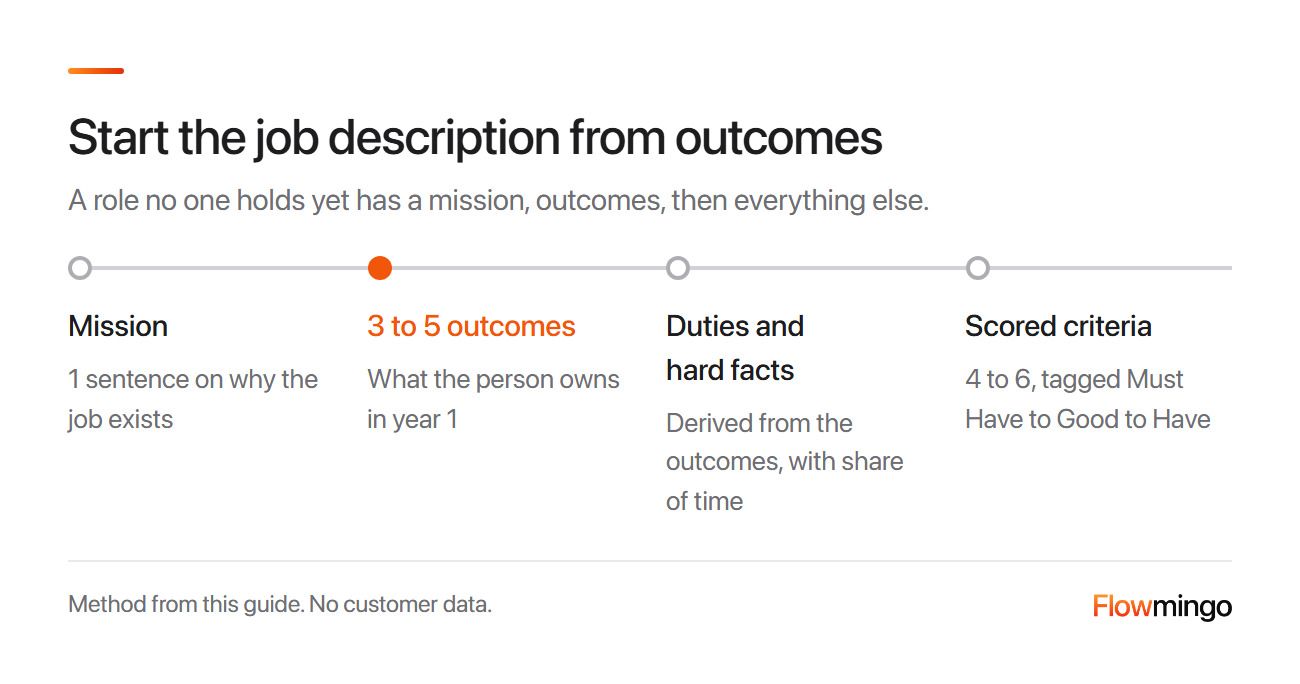
Job description from outcomes: a mission, then 3 to 5 outcomes, then duties with share of time, then 4 to 6 scored criteria.
1.1 Can I use ChatGPT to write the first draft, and what do I fix before I post it?
Yes for structure and wording, but not for substance. We found no study of AI-written job descriptions, so this is practice.
Delete any duty you did not write, cut clichés such as "fast-paced" and rewrite the pay and legal lines yourself. Read it aloud once, because 1 manager's posting still held the chatbot's offer to make changes.
2. My hiring manager keeps changing the requirements after we start. How do I stop it?
Agree the criteria in writing before the role opens, and treat every later change as a new version with a reason. If one comes after scoring, rescore the whole pile.
In 3 foundational 2005 experiments, people choosing a police chief redefined the job to fit the candidate they favoured (Uhlmann and Cohen). Committing to the criteria first removed the discrimination.
Run this 20-minute intake before anyone drafts:
- What must be true in 12 months for this hire to succeed?
- Which 1 to 3 things can they not be bad at? These are the must-haves.
- What can they learn in 90 days? These are the nice-to-haves.
- What would make you reject a strong CV? These are the hard facts, each job related.
- Who signs off, and when does the list freeze? Sign-off is step 1 of our hiring process steps, and every later change gets a version, a reason and a name.
Say 60 CVs are scored when your manager adds SQL as a must-have (illustrative). Save version 2, rescore all 60 and show the manager who moved, because a score only means something against its own criteria.
3. How to write a job description with must-haves clear enough to score every CV against?
Write 4 to 6 criteria a CV can show, with 1 to 3 Must Have (our practice). Ask 2 or 3 hard facts in the application instead, and write what a strong and a weak CV would show.
Tag each criterion Must Have, Very Important, Important or Good to Have, weighted 4, 3, 2 and 1 (our scale). So a Must Have counts 4 times a Good to Have.
The authors of the same foundational 2021 survey recommend a short must-have list. In our reading, that is because screening software enforces your exact words.
Write each criterion as scope plus proof, not a trait. Here is the same role, rewritten (illustrative):
| Line as often written | A strong CV shows | A weak CV shows | Tier and weight |
|---|---|---|---|
| Strong account management skills | Renewed a B2B account book and names its size and a result | Managed accounts, no size or result | Must Have, 4 |
| Customer onboarding experience | Ran onboarding for N customers and says what changed | Onboarding as a duty, no change | Very Important, 3 |
| Proficient in CRM | Names the CRM and what they tracked | CRM experience, no tool named | Important, 2 |
| SaaS background a plus | Names the SaaS product they worked with | SaaS, no product named | Good to Have, 1 |
Flowmingo data · 117,176 CV-screened applicants · 1,718 hiring projects · 827 companies · CV scores 10 Jul to 4 Oct 2026, older scoring method excluded · projects with 10+ scored applicants and criteria not edited after the first applicant was scored
- 18.0% to 19.2% of applicants scored 7 or more out of 10 in projects with 2 or more must-haves: 18.0% with 2-3, 19.2% with 4-5, 18.9% with 6-7 and 18.1% with 8 or more.
- 4 of 9 criteria were must-haves in the median project, and the middle half had 3 to 6.
- 12.3% scored 7 or more in the 71 projects with 0-1 must-haves, where 64% of applicants arrived another way. Among open job-post applicants it was 14.9% (38 projects), in line with the other groups' 13.1% to 17.2%.
AI CV scores out of 10 against each job's own criteria, not candidate quality or hiring outcomes; 7 or more is the top band. A Must Have is a weight, never a filter, so this does not show that stricter requirements screen out more people. AI drafts the criteria and recruiters may edit them, so 4 of 9 is the platform default plus any edits. Applicant source moves the share, and scores do not compare across jobs.
A possible reason is that the score is a weighted average, so more must-haves shift weight and filter nobody out. We did not test this, so read it as association, not cause.
A tool that filters on your words works differently, as the 94% in the intro suggests. There, every extra line acts as a rule, so keep the list short. Our typical project lists 9 criteria, more than the 4 to 6 advised here.
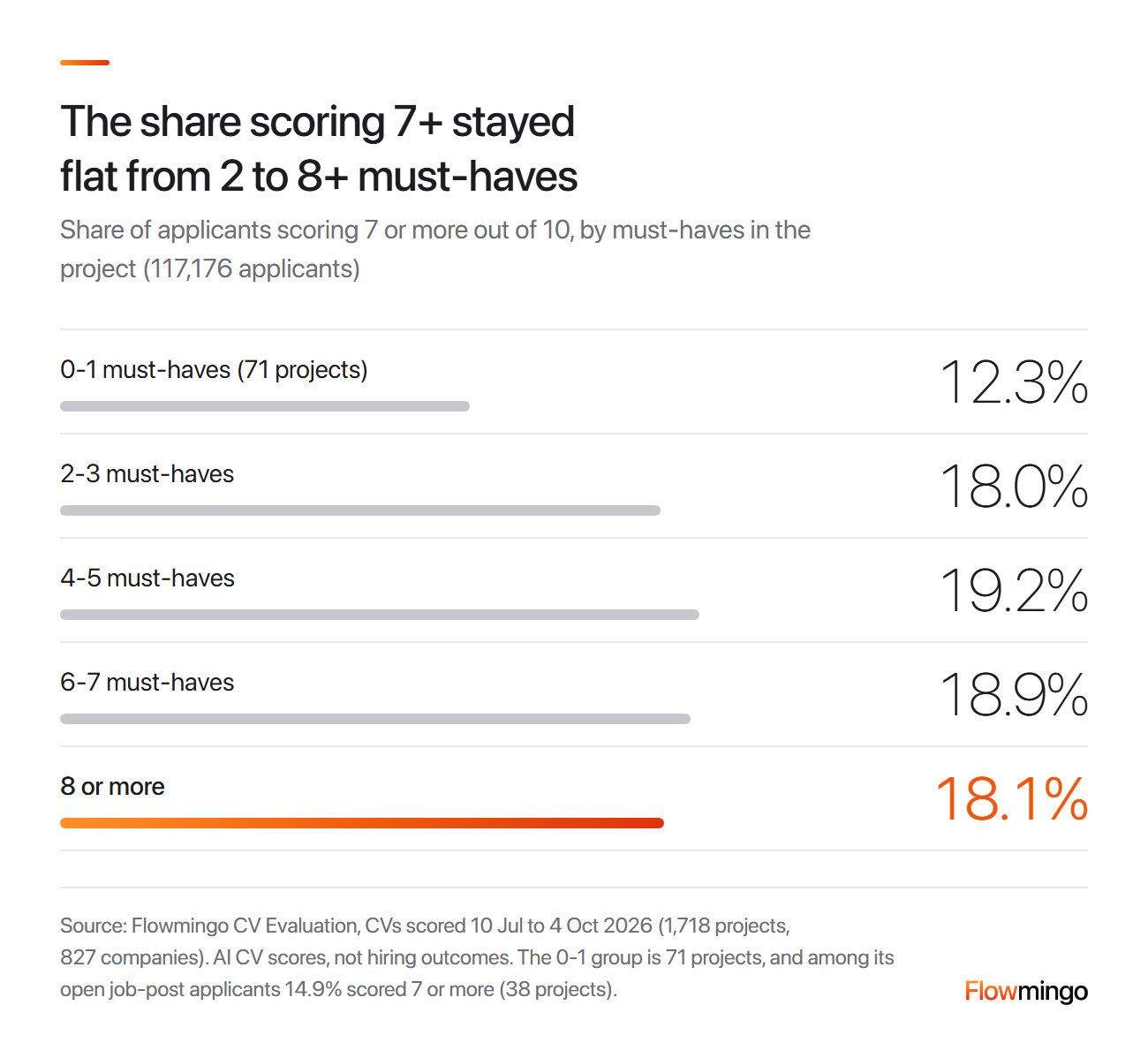
Must-haves and CV scores: 18.0% to 19.2% of applicants scored 7 or more out of 10 with 2-3 to 8 or more must-haves. The 0-1 group scored 12.3% overall but 14.9% among job-post applicants, in line with the rest.
How Flowmingo helps
CV Evaluation turns a pasted job description, or just a job title, into criteria you edit and rate by importance. It scores every CV from 0 to 10 on each criterion, with written evidence. A criterion with no evidence counts as 3, and nobody is filtered out automatically.
4. Are the degree and 5 years of experience in my job description shrinking my pool?
Yes, often, and years of experience predicts little. Keep a degree or years line only when you can name the task it stands for, and write that task instead.
Fuller and Raman's foundational 2017 study found 67% of US production-supervisor postings in 2015 asked for a degree, yet 16% of employed supervisors had one.
A foundational 2019 review pooling 81 samples found prior experience tracked job performance at 0.06 (44 studies), where 0 means no link.
Dropping the line is not enough. The Burning Glass Institute followed 11,300 roles at large US firms in a foundational 2024 study. It found that 45% of the firms that dropped a degree requirement did so in name only.
Where the line was dropped, hires without a degree rose 3.5 points, but only 3.6% of roles dropped it. The net change was 0.14 points, fewer than 1 in 700 hires. This means a new ad alone changes little, so score for the evidence you want next to each line.
In the US, Title VII says a requirement that screens out a protected group must be job related and consistent with business necessity. Federal agencies are moving away from disparate-impact enforcement, but the statute and private lawsuits remain.
In Great Britain, our reading of section 19 of the Equality Act is that a degree or years line could be indirect discrimination. That holds if it puts a protected group at a particular disadvantage and the employer cannot show a proportionate means of achieving a legitimate aim. This is our reading, not a court ruling or legal advice.
Audit each line (illustrative):
| Line | What it really tests | Write instead |
|---|---|---|
| Bachelor's degree | Can analyse data and write a plan | Has written an account plan: a past plan shows it |
| 5+ years of experience | Has done the core task at scale | Has run 20+ accounts, with scope and a result |
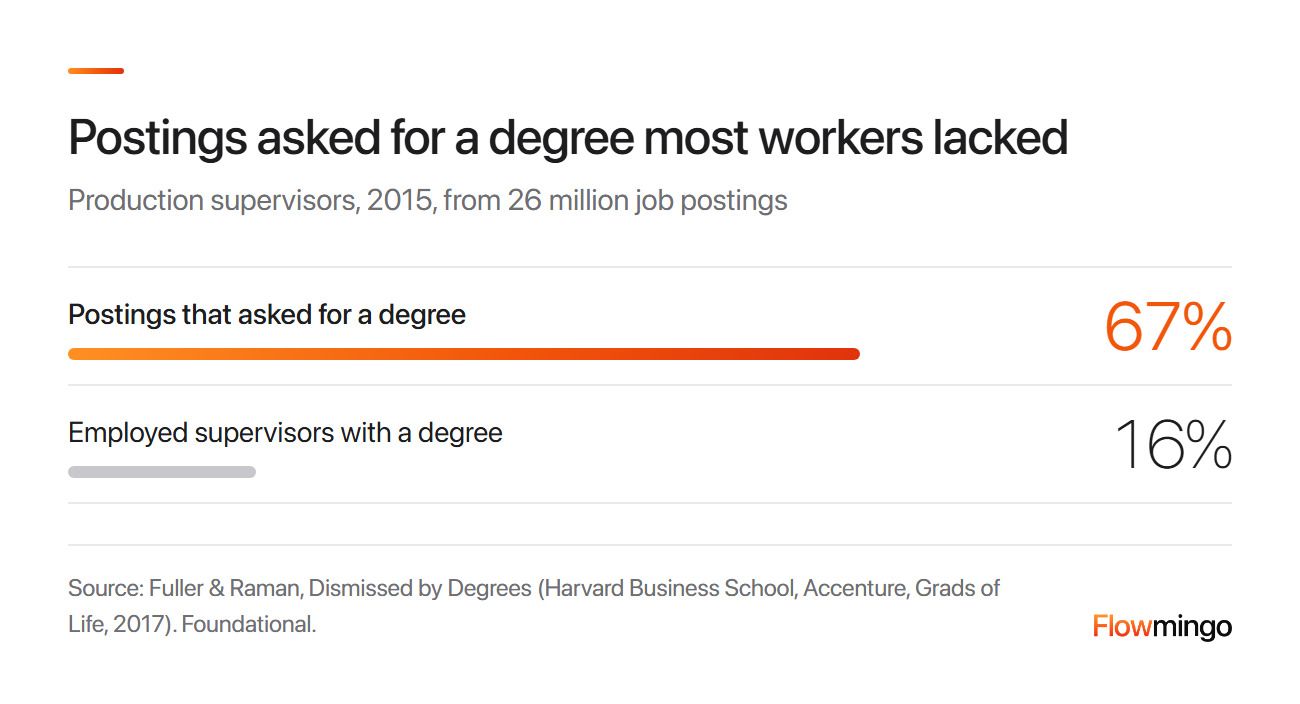
Degree requirements: 67% of production-supervisor postings in 2015 asked for a degree. 16% of employed supervisors had one (foundational 2017 study of 26 million postings).
5. How do I list essential functions for the ADA without creating a not-my-job excuse?
List the essential functions as results, each with a share of time. Write the description before you advertise or interview, because in the US it then counts as evidence.
This section is US-specific, and the ADA covers employers with 15 or more employees. Section 12111(8) says a written description prepared before advertising or interviewing "shall be considered evidence of the essential functions of the job" (ADA text). It is evidence, not proof.
Move any task nobody would miss, such as booking team travel, to a marginal-tasks line. We suggest 4 to 6 functions, as the ADA sets no count.
For the same Customer Success Manager, the 4 functions share 100% of the time:
- Own renewals for the 40-account book, including the work needed to close each one: 50%.
- Onboard each new customer within 30 days: 25%.
- Keep the CRM and renewal forecast current: 15%.
- Resolve escalations before they reach a renewal: 10%.
To remove the not-my-job excuse, state the outcomes the role owns, as the first line above does. Add an other-duties line only if your counsel agrees.
Ask "Can you do [function], with or without adjustments?", never about health, because the ADA bars medical questions before an offer. This is general information, not legal advice.
6. Should the job description on file and the job ad I publish be the same document?
No, keep 2 documents: a file for the people who hire and a shorter ad for applicants, as 1 recruiter thread describes it.
The file holds the job's outcomes, functions and requirements, and the ad is a pitch cut from it.
Here is a job description example you can copy, built from sections 1, 3 and 5 (illustrative):
Job description: Customer Success Manager
Mission: Keep 40 mid-size accounts renewing and growing.
Year-1 outcomes: Renew 36 of 40 accounts (90%). Onboard each new customer within 30 days. Give all 40 accounts an owner and a renewal date in the CRM.
Essential functions: Own renewals for the 40-account book, including the work needed to close each one (50%). Onboard each new customer within 30 days (25%). Keep the CRM and renewal forecast current (15%). Resolve escalations before they reach a renewal (10%).
Marginal tasks: Book your own team travel.
Scored criteria (strong CV; a weak CV shows the opposite): Must Have (4): renewed a B2B account book, with its size and a result. Very Important (3): ran onboarding, with what changed. Important (2): names the CRM and what they tracked. Good to Have (1): names a SaaS product.
Hard facts, asked in the application: Core hours 9 to 6. Right to work here, where lawful to ask.
Pay: Grade [grade]. Range to post: [lowest to highest pay you would offer on hire].
Adjustments: Can you do each function, with or without adjustments?
Version log: v1, [date], approved by [hiring manager]. Each later change: version, reason, name.
In the ad, screen 1 holds the 3 results, 5 or 6 requirement lines at most, the pay range and what happens next.
The ad opens with a promise, "You will own renewals for 40 customers", and shows a typical week in 3 lines, not all 4 functions. The requirements part, sometimes called the job specification, is the scored criteria list.
6.1 How long should a job description be, and what do I cut so the must-haves aren't buried?
Keep the file to 1 to 2 pages and the ad to about 2 screens, because a long ad buries the must-haves and pay. No source gives a word target, so these numbers are our suggestion.
Cut ambiguous verbs such as "assists" and "handles", because they hide who owns the result. In the ad, also cut other employees' names, future duties, clichés and "other duties as assigned".
7. How to write a job description with a pay range when the law now requires one?
Post an honest range of the pay you would offer on hire, lowest to highest, never open-ended. In a covered US state or an EU country, check the rule first, because scope, dates and thresholds differ.
In a foundational May 2023 survey of nearly 3,500 candidates, 44% said they skipped a job in the previous 12 months. The reason was no salary in the posting (Gartner).
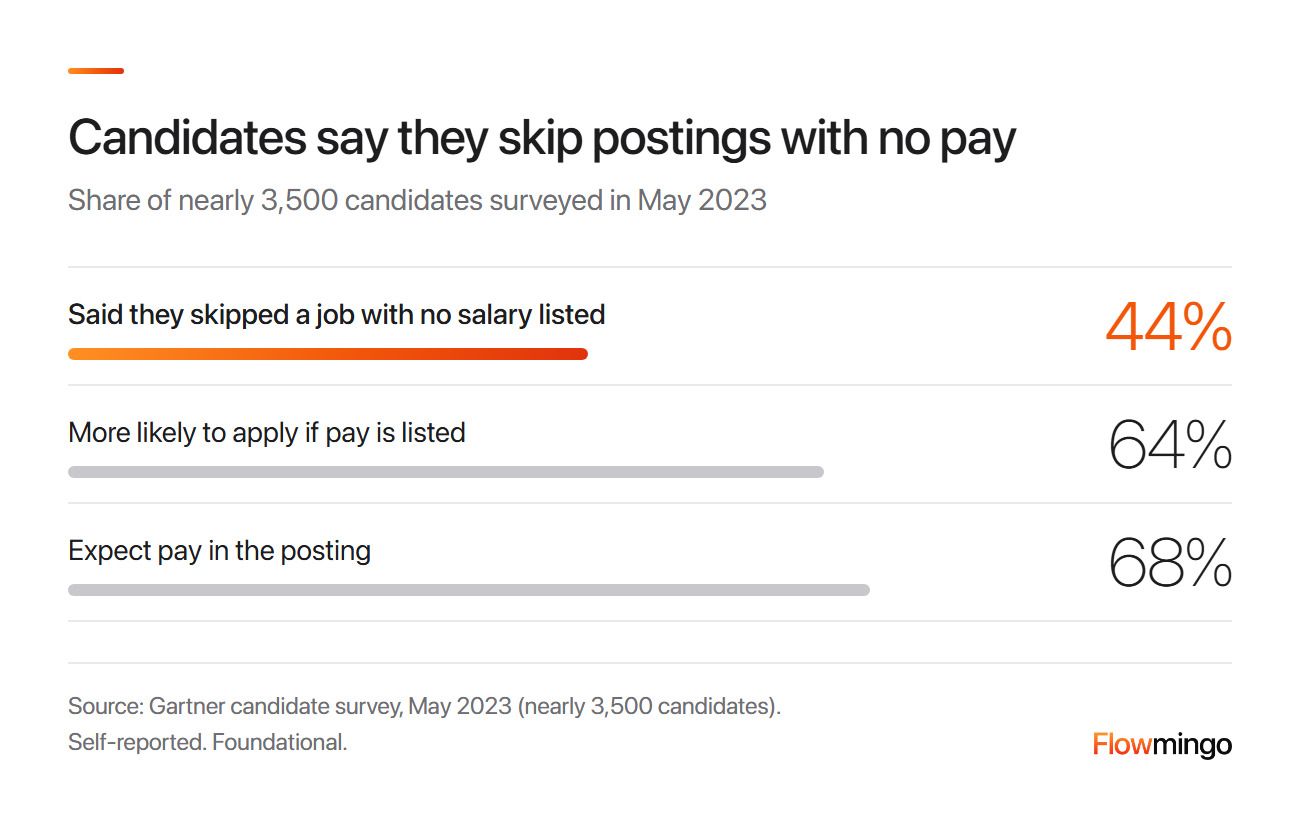
Pay in the posting: 44% of candidates said they skipped a job with no salary listed. 64% are more likely to apply if pay is listed, and 68% expect it (Gartner, foundational 2023 survey, self-reported).
The table lists dated rules as of 4 October 2026, and the list changes monthly:
| Where | Rule and start | What it means for your range |
|---|---|---|
| Colorado | Pay in postings since 2021, amended 2024 | Lowest to highest pay you may pay; no "up to"; fines of $500 to $10,000 per violation |
| California | SB 642 from 1 Jan 2026; 15 or more employees (Labor Code 432.3) | A good-faith estimate of the pay you expect to offer on hire |
| EU | Directive 2023/970, Article 5; deadline 7 Jun 2026 | Pay or range before pay is negotiated, such as in the vacancy notice; no pay-history questions |
| Other US states | The list keeps growing: Virginia from 1 Jul 2026, Maine from 29 Jul 2026, Connecticut from 1 Oct 2026 | Check the state where the person will work, remote roles included; employee thresholds run from 1 to 50+ (Jackson Lewis) |
| Singapore | MOM, Employment Pass jobs | 14 consecutive days on MyCareersFuture; maximum at most 2 times the minimum |
A directive binds employers only through national law. By 23 September 2026, only 5 of 27 member states had fully passed it (Lockton). Poland (24 Dec 2025) and Estonia (13 Jul 2026) had partly passed it, mostly the pre-employment rules.
In 1 HR thread, 2 colleagues disagreed: 122k to 128k, the pay on hire, or 101k to 152k, the whole grade. The grade is 8.5 times as wide (51k against 6k), so it tells a candidate almost nothing.
So in Colorado, post the whole grade only if you would truly pay it. In California, post 122k to 128k.
This is general information, not legal advice.
8. Which words in my job description screen people out, and is 'young team' a legal risk?
Words about age, sex or language, such as 'young', 'waitress' or 'native speaker', screen people out. Describe the work and the proof of it instead.
The US, Singapore and the UK all name 'young': 29 CFR 1625.4, TAFEP ("Young/Youthful working environment") and the EHRC guidance ("young and dynamic"). The EHRC page is foundational and under review, and also lists titles such as waitress or postman.
In a foundational 2011 study, ads for male-dominated fields used more masculine-coded words, for example "leader" and "dominant" (Gaucher and colleagues). In experiments with Canadian students, such wording made women feel they belonged less, but not that they lacked the skills.
The swaps below turn people words into work words (illustrative):
| Instead of | Write |
|---|---|
| Young, dynamic team | A team of 8 that ships every 2 weeks |
| Native Mandarin speaker | Speaks Mandarin with customers on calls: a short call shows it |
| Waitress, salesgirl, postman | Server, salesperson, postal worker |
| Dominant, competitive rockstar | Owns a renewal target and reports it weekly |
These words can break the law in the UK and the US, and in Singapore they breach the Tripartite Guidelines. A breach of the Fair Consideration Framework there can cost an employer work pass privileges for 12 months or more (MOM).
In the UK, the EHRC can act on an advert even when no applicant was harmed. This is general information, not legal advice.
9. How to write a job description I can turn into screening questions and a scorecard?
Give every requirement 1 score and 1 question: hard facts become application questions, and the rest become weighted criteria. The same list drives CV scoring, interview questions and the scorecard, so that you judge every candidate on 1 sheet.
In a foundational 2022 re-analysis, structured interviews predicted job performance at 0.42 against 0.19 for unstructured ones, where 0 means no link (Sackett and colleagues). In our reading they work best when the questions come from a written list of what the job requires, and results vary widely between settings.
The table adds an interview question and an anchor to each scored line of section 3, down to your interview scorecard (same role):
| Job description line | Interview question | A strong answer shows |
|---|---|---|
| Must Have (4): renewals | Tell me about a renewal that was at risk. What did you do? | A named account, an action and a result |
| Very Important (3): onboarding | Walk me through your last onboarding plan. | Steps, dates, what the customer did differently |
| Important (2): CRM | What did you track in your CRM? | A named field and a decision it drove |
| Good to Have (1): SaaS | Which SaaS product did you support? | A named product and a customer outcome |
Every scored criterion has 1 CV signal, 1 question and 1 anchor, and hard facts fail only if the job truly cannot flex. A weak answer is the opposite of each strong one: no named account, step, field or product, and no result.
Where software scores CVs against these criteria, some laws, such as California's and Colorado's, add notice, explanation or records, as our candidate shortlisting guide shows.
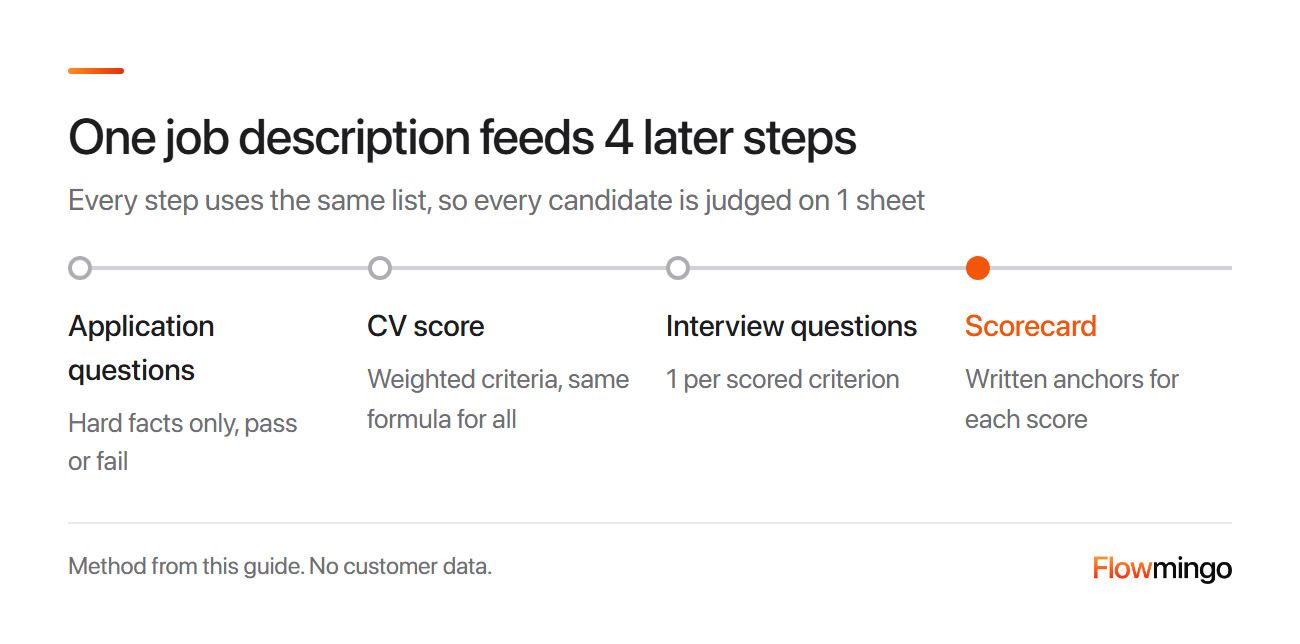
Job description to scorecard: hard facts become application questions and weighted criteria drive the CV score. Each scored criterion gets 1 interview question and a scorecard line with written anchors.
10. My last job post drew many applicants and few right ones. What do I change?
Read the pile for the pattern: wrong applicants point to the title or requirements, and missing ones point to what screened them out. Change that 1 line, then measure the next batch.
A hiring manager at a large firm put a bold "no sponsorship" line in a posting, yet about 1 in 10 applicants met the residency rule. Text does not screen, because the application does, so move every hard fact into the form.
Read your pile with the figure below, then run a 10-minute check (our practice). Tick each requirement against your last 3 hires, and treat any that none of them met as a nice-to-have.
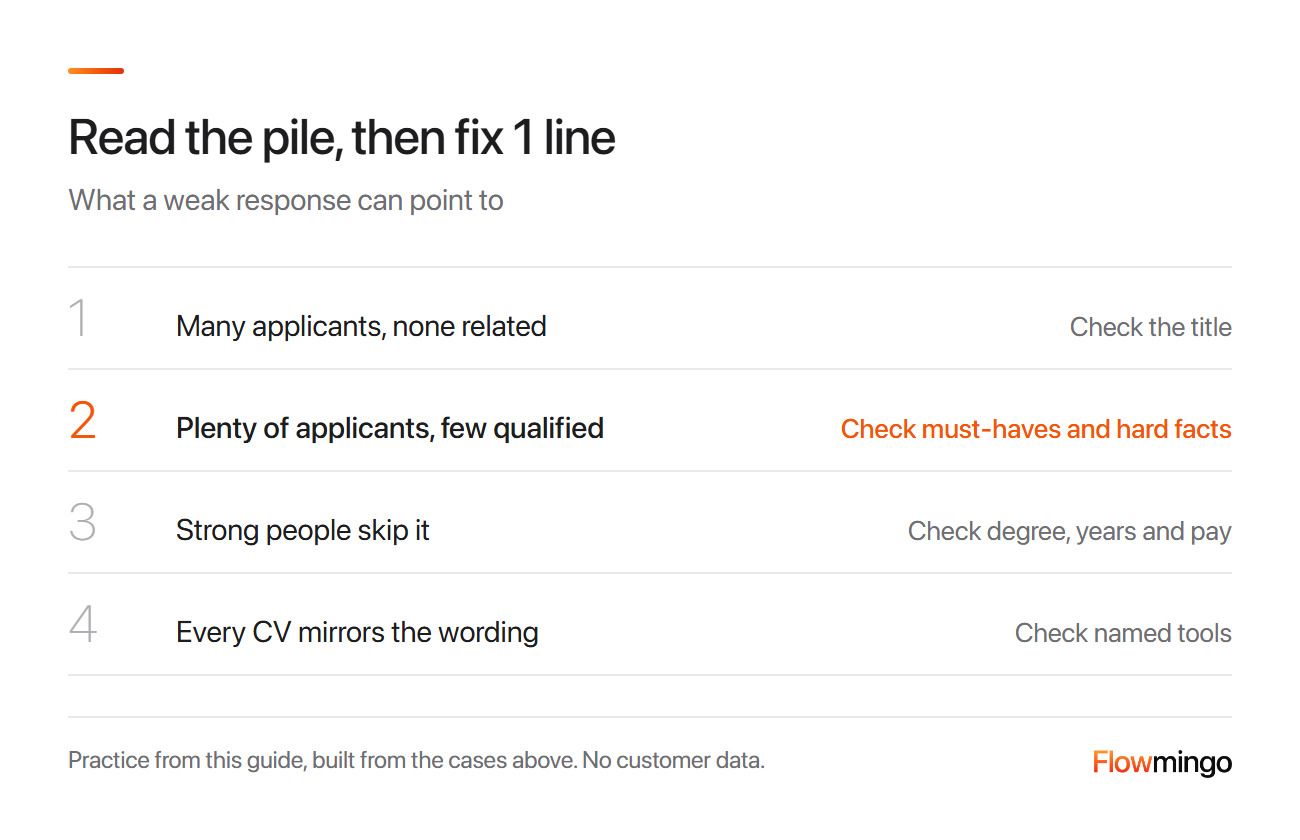
Posting symptoms: many unrelated applicants point to the title, and few qualified ones to the must-haves and hard facts. Skipped postings point to degree, years and pay, and mirrored CVs to named tools.
Flowmingo data · 117,176 CV-screened applicants · 1,718 hiring projects · 827 companies · CV scores 10 Jul to 4 Oct 2026 · projects with 10+ scored applicants and criteria not edited after the first applicant was scored
- 11.5% of scored applicants scored 7 or more out of 10 in the median project (a median of project shares; pooled it is 18.3%, a narrower cohort than the 19.0% of CVs in our candidate shortlisting guide), and 20.7% of projects had nobody at 7 or more.
- 16.0% of open job-post applicants scored 7 or more, against 21.3% of applicants who arrived another way.
AI CV scores against each job's own criteria, not hiring outcomes. A project's numbers depend on its criteria and its applicants, so do not read 11.5% as a pass rate or a benchmark.
A thin top is common, so it does not prove your post failed, and how applicants arrive moves the share.
10.1 Every CV repeats my job description word for word: how do I stop AI-tailored CVs gaming it?
Do not name internal-only tools anywhere in the posting, and ask for evidence a CV cannot copy from it. Numbers, scope and dates are harder to echo than a tool name.
1 manager got 3,000 applicants in 1 week, and 75% of the CVs claimed experience with the internal products the posting named. So polish proves little: after the CV cut, give everyone the same work sample or structured questions (section 9).
How Flowmingo helps
In the AI Interviewer you paste the job description, and AI drafts the interview questions and criteria for you to edit. Once you know how to write a job description every hiring step can use, try Flowmingo to score every applicant against it.
11. Sources
Every study, law and survey in this guide links to a source below; Flowmingo figures come from Flowmingo's own platform data.
- Burning Glass Institute & Harvard Business School Managing the Future of Work (2024). Skills-based hiring: The long road from pronouncements to practice. Burning Glass Institute.
- Colorado Division of Labor Standards and Statistics (2024). INFO #9A: Transparency in pay and job opportunities, the Colorado Equal Pay for Equal Work Act, Part 2. Colorado Department of Labor and Employment.
- California Legislature (2025). Labor Code section 432.3, as amended by SB 642. California Legislative Information.
- DLA Piper (2026). Virginia pay transparency law goes into effect July 1, 2026. DLA Piper GENIE.
- Equality and Human Rights Commission (2024). Guidance on discriminatory adverts. EHRC.
- European Parliament and Council (2023). Directive (EU) 2023/970 on pay transparency. Official Journal of the European Union.
- Fisher Phillips (2026). Maine sets new pay transparency requirements. Fisher Phillips.
- Foley & Lardner (2026). Connecticut expands pay transparency requirements starting October 1, 2026. National Law Review.
- Fuller, J., & Raman, M. (2017). Dismissed by degrees: How degree inflation is undermining U.S. competitiveness and hurting America's middle class. Harvard Business School, Accenture and Grads of Life.
- Fuller, J., Raman, M., Sage-Gavin, E., & Hines, K. (2021). Hidden workers: Untapped talent. Harvard Business School Project on Managing the Future of Work and Accenture. Survey fielded January and February 2020.
- Gartner (2023). Gartner HR survey finds within 12-month period, half of candidates have accepted a job offer - and then backed out before starting. Gartner newsroom.
- Gaucher, D., Friesen, J., & Kay, A. C. (2011). Evidence that gendered wording in job advertisements exists and sustains gender inequality. Journal of Personality and Social Psychology, 101(1), 109-128.
- Jackson Lewis (2026). Navigating 2026 pay transparency laws and employer obligations. Jackson Lewis.
- Lockton (2026). EU pay transparency directive implementation status. Lockton Global Employee Benefits.
- Ministry of Manpower, Singapore (2025). Fair Consideration Framework. MOM.
- Ministry of Manpower, Singapore (2026). Employment Pass: Consider all candidates fairly. MOM.
- Office of Legal Counsel, US Department of Justice (2026). Constitutionality of disparate-impact liability under Title VII. DOJ.
- Polsinelli (2026). California refines pay transparency requirements for employers. National Law Review.
- Sackett, P. R., Zhang, C., Berry, C. M., & Lievens, F. (2022). Revisiting meta-analytic estimates of validity in personnel selection: Addressing systematic overcorrection for restriction of range. Journal of Applied Psychology, 107(11), 2040-2068.
- Smart, G., & Street, R. (2008). Who: The A method for hiring. Ballantine Books. Quoted in Eliason, N. (n.d., read 2026). Who by Geoff Smart: notes.
- Tripartite Alliance for Fair and Progressive Employment Practices (n.d., read 2026). Writing job advertisements. TAFEP.
- Uhlmann, E. L., & Cohen, G. L. (2005). Constructed criteria: Redefining merit to justify discrimination. Psychological Science, 16(6), 474-480.
- UK Parliament (2010). Equality Act 2010, section 19. legislation.gov.uk.
- United States Code (current text). 42 USC 2000e-2, Title VII of the Civil Rights Act, unlawful employment practices. Legal Information Institute.
- United States Code (current text). 42 USC 12111, Americans with Disabilities Act, Title I. Legal Information Institute.
- US Code of Federal Regulations (current text). 29 CFR 1625.4, Help wanted notices or advertisements. Legal Information Institute.
- Van Iddekinge, C. H., Arnold, J. D., Frieder, R. E., & Roth, P. L. (2019). A meta-analysis of the criterion-related validity of prehire work experience. Personnel Psychology, 72(4), 571-598.