

You have 10 seasonal jobs to fill, but seasonal hiring succeeds only when those people can cover the shifts you need. An accepted offer cannot run Saturday's checkout.
Your retail hiring plan might look healthy while the actual roster still has gaps. Applicants can meet the experience requirements and need different hours from yours.
Then supervisors spend peak trading time chasing availability, teaching basic tasks and rearranging shifts. The cost shows up in the operation before it reaches a recruitment report.
This guide works through an illustrative store needing 240 extra productive hours each week. Calculate coverage first, recruit against the actual shifts, then check that each starter can work safely before the rush.
Key takeaways
- How many people should I hire? Start with uncovered hours by shift. In the worked example, 240 extra hours divided by 24 productive hours per starter gives 10 people.
- When should recruitment start? Work backward from independent shift readiness, including selection, notice, training and contingency. A fixed 4-week rule cannot fit every role.
- What belongs in the job advert? State pay, location, contract dates, the real shift pattern and the route for discussing adjustments. Applicants should see the deal before interviewing.
- How should I screen applicants quickly? Confirm the practical requirements, then use the same job-related questions and written scoring standards for everyone.
- How do I know the plan worked? Track trained shift coverage and the first week's actual attendance. Keep 1 shared view of gaps, decisions and the person responsible.
1. How many people does our seasonal hiring plan actually need?
Calculate the productive hours missing from each shift, then divide by the hours a trained starter can realistically cover. Check the individual shifts before approving a headcount.
Start with your demand forecast and the service standard you intend to protect. For a store, that might mean checkout cover, replenishment and collection orders during the busiest trading blocks.
Use last season's comparable weeks as a starting point, then adjust for changes you can explain. A longer opening day, a new collection service or a closed nearby branch can change the workload.
Separate forecast demand from available staff hours because they describe different things. Remove known leave, training and supervisor duties from the hours you assume existing staff can deliver.
1.1 Turn the weekly gap into a shift plan
Consider this illustrative calculation, which is planning arithmetic rather than a hiring benchmark. The store needs 720 productive hours weekly and can obtain 480 from its existing team.
That leaves a 240-hour gap. If each trained seasonal starter contributes 24 productive hours weekly, the simple calculation gives 10 starters.
The seasonal staffing figure shows required hours, existing cover and the remaining gap. It does not count induction time as productive shop-floor cover.
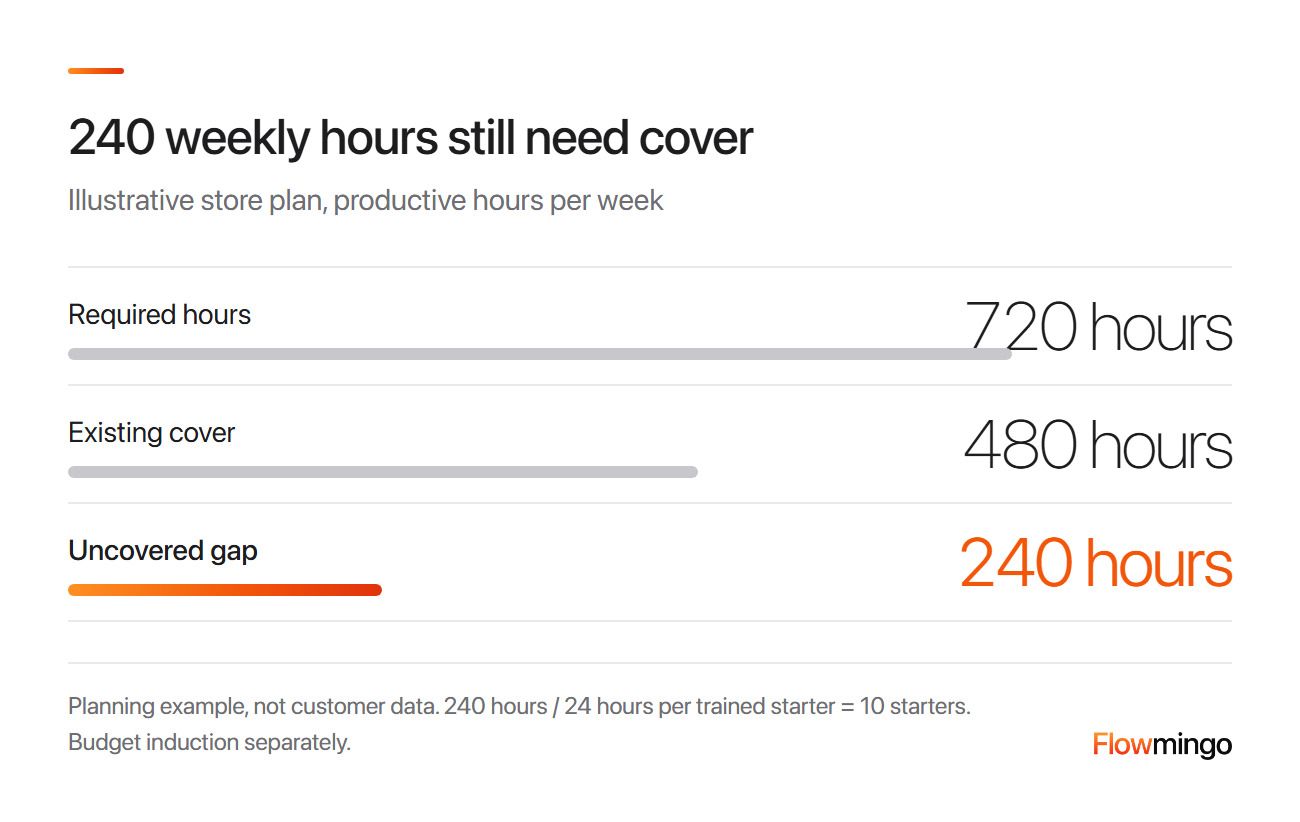
Weekly coverage gap: 720 required hours minus 480 existing hours leaves 240 hours, equivalent to 10 trained starters contributing 24 productive hours each.
Now test the calculation against the roster. If every new starter can work weekdays but the uncovered hours fall on weekends, the headcount is wrong for the job.
Build a row for each location, role and shift block. Record required hours, confirmed existing cover, new cover and the unresolved gap, with a named manager responsible.
For example, split the same store's weekly totals into 2 groups before scheduling individual shifts. These are productive hours across each group, not daily hours per person.
| Shift group | Required hours | Existing cover | New cover needed |
|---|---|---|---|
| Monday to Thursday | 400 | 288 | 112 |
| Friday to Sunday | 320 | 192 | 128 |
| Weekly total | 720 | 480 | 240 |
If 4 starters only work Monday to Thursday, their combined 96 hours leave 16 hours uncovered in that group. The remaining 6 starters provide 144 hours.
Those 144 hours must cover the remaining 16 weekday hours and 128 Friday-to-Sunday hours. Confirm compatible availability, skills, breaks and lawful individual schedules before treating the plan as workable.
This reveals what a headcount total hides: the remaining vacancies need substantial Friday-to-Sunday availability. Use that requirement in the advert and check the same pattern during selection.
Budget paid induction separately from these productive hours. For example, 10 starters receiving 4 hours of induction require 40 learner-hours, plus the trainer's time and any further supervised practice.
The 4-hour figure is an arithmetic example, not a sufficient training standard. The tasks, hazards and each person's experience determine the actual training needed.
Recalculate the plan when demand or availability changes. Keep the assumptions beside the figures so another manager can challenge them without rebuilding your spreadsheet.
2. When should seasonal hiring start if peak demand has a fixed date?
Work backward from independent shift readiness, then book the people needed for selection and training. Use your own process times rather than treating an early-start rule as a promise.
In this illustrative plan, peak demand begins on 16 November. Approve shifts and budget on 5 October, then open recruitment and contact interested returners on 12 October.
Complete the main selection round by 26 October, allowing time afterward for agreed checks, notice and joining arrangements. Begin induction on 9 November and verify readiness before 16 November.
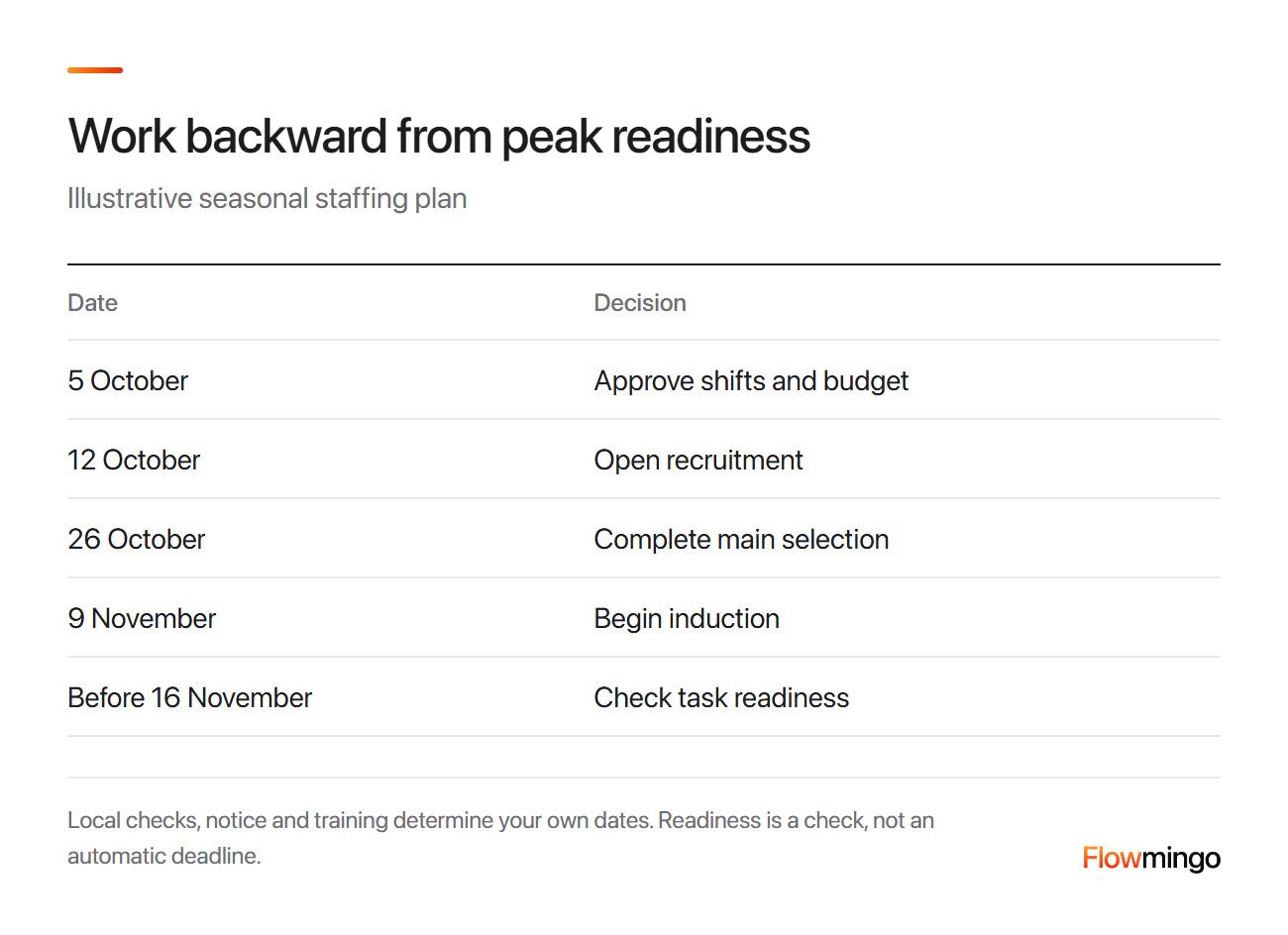
Peak-readiness timeline: approve shifts on 5 October, recruit on 12 October and complete main selection by 26 October. Induction starts 9 November, before peak demand on 16 November.
These dates assume the role and local checks fit that schedule. Start earlier when your records show longer notice, scarce skills or slower clearance.
The Acas induction guidance recommends planning before the worker starts, including shift patterns and adjustments. For seasonal hiring, that means reserving supervisor time before you promise start dates.
For example, budget 15 minutes for each of 18 interviews and 5 minutes to record each assessment. That creates 360 minutes, or 6 hours, of selection work.
If the interviewer can provide 3 hours daily, reserve 2 days rather than hoping the interviews fit around customer service. These are example capacity assumptions, not recommended interview limits.
2.1 Protect a fallback date
In the example, the store manager owns a checkpoint on 26 October. Recruitment must show confirmed availability against all 240 additional productive hours, alongside outstanding joining conditions.
Suppose accepted candidates can cover only 192 hours. The 48-hour gap triggers an approved local recruitment push that day, with the manager checking progress again on 30 October.
If that review still shows uncovered shifts, the operations lead chooses funded agency cover or a smaller service plan. The agency route must leave sufficient time for the required induction.
Write those dates, owners and options into the plan before applications arrive. Never solve the gap with extra offers for unfunded shifts or by skipping safety preparation.
3. What should our advert say so applicants can commit to the shifts?
Describe the work, pay, dates and actual hours clearly before asking people to interview. Include the difficult parts of the role alongside the reasons someone might want it.
The US Office of Personnel Management's realistic job preview guidance recommends consistent information about attractive and challenging aspects. It treats the preview as a candidate self-evaluation tool, rather than a substitute for selection.
Apply that principle to seasonal hiring by showing the deal early. Someone who cannot work the advertised pattern should discover that before spending time on an assessment.
Avoid phrases such as full flexibility when you actually need particular evening and weekend blocks. They hide the scheduling problem instead of helping applicants judge whether the role fits.
A useful advert names the workplace, contract start and end dates, pay basis, expected hours and any variable elements. Explain training arrangements and provide a contact route for recruitment adjustments.
For example, a manager might write the following opening after confirming the details locally. The placeholders require real values before publication, rather than assumptions about pay or promised work.
Example advert opening
Seasonal store assistant at [location], from [start date] to [end date]. Pay is [amount and currency] per hour, with [applicable shift premium].
The role covers [specific days and time blocks], with [agreed minimum hours or an accurate explanation of variable hours]. You will help customers, replenish stock and handle collection orders.
Training takes place on [dates and times], with [pay arrangements]. The work includes [accurate task demands], and [named role] supports new starters.
To discuss the role or recruitment adjustments, contact [contact details]. Any opportunity to continue after the contract depends on an available role and a separate decision.
Show the advert to a supervisor who actually runs those shifts. Ask them to identify anything that could surprise a new starter on the first day.
Do not make broad promises about future permanent employment to improve response rates. Explain the process and likely decision date if conversion is genuinely possible, while keeping the current contract clear.
Use the same practical information in messages, interviews and offers. Contradictions about a weekend requirement or training date can undo the clarity you created at the top of the process.
4. Which seasonal hiring channels should we use when time is short?
Choose channels by the trained cover they supply for your actual shifts, not application volume alone. Start with suitable local sources and interested returners, then compare results at the same checkpoint.
Share a consistent public advert through employee referrals and relevant job boards. Apply the same essential requirements to everyone, because a referral or previous contract does not establish current availability.
The following first-week review continues the illustrative store example. It looks back at a completed recruitment round, rather than predicting performance or setting industry benchmarks.
| Channel | Applications | Starters | Ready hours |
|---|---|---|---|
| Local job board | 40 | 6 | 96 from 4 people |
| Returners and referrals | 20 | 4 | 96 from 4 people |
| Total | 60 | 10 | 192 from 8 people |
Across both sources, 30 applicants met the availability requirements and 18 met the selection standard. There were 12 cumulative acceptances, including 2 replacement offers after confirmed withdrawals, and 10 actual starts.
Only issue replacement offers for funded vacancies. An acceptance that later falls through is not another person available for the roster.
Ready hours means productive hours available next week from workers with task clearance by day 7. Each of the 8 ready workers can contribute 24 hours, with 96 hours from each channel.
Check the schedule underneath that total before shifting recruitment spend. Suppose the board supplies 40 Friday-to-Sunday hours, while returners and referrals supply 72, leaving 16 of those 128 required hours uncovered.
That finding supports targeting the remaining shift pattern, not declaring the referral channel universally better. Record costs and repeat the comparison across later intakes before making a broader budget decision.
An agency may help with the remaining gap, but brief the assignment before people arrive. US OSHA guidance recommends hazard-information exchange and agreed responsibilities between host employers and staffing agencies.
Specify who supplies induction, equipment, supervision and the reporting contact, while checking local requirements. Agency recruitment does not itself prove that someone is ready for your worksite.
Keep those distinct stages in your recruitment process. A seasonal hiring report should make the unresolved shift obvious enough for the manager to act that day.
5. How can we screen seasonal applicants quickly and fairly?
Confirm the practical requirements first, then assess the skills the work actually needs using consistent questions and scoring. Remove redundant steps instead of lowering the standard for the busiest season.
Write the essential requirements before reading applications. Separate requirements needed at the start from skills a supervisor can reasonably teach during the planned induction.
For example, familiarity with your exact till system may be teachable. Understanding instructions, handling a customer problem and knowing when to request help may need evidence before the offer.
Ask applicants about their availability for the stated shifts without asking for private explanations about family responsibilities. Offer a clear route to discuss reasonable adjustments under the applicable local requirements.
The US Office of Personnel Management's structured interview guidance recommends predetermined questions and common rating standards. Use that structure to compare job evidence rather than confidence or conversational similarity.
Ask a scenario that resembles the work: a customer is waiting, an order is missing and another colleague needs help. Invite the applicant to explain their sequence and when they would involve a supervisor.
Before interviews, describe an acceptable answer and an unsafe or incomplete answer. Have interviewers record the evidence supporting their rating before discussing the candidate together.
For that customer-service scenario, use the following example anchors after checking they match your store's procedures. They illustrate a rating method, not a validated test.
| Rating | Evidence in the answer |
|---|---|
| 1: Below the requirement | Ignores the waiting customer or invents an answer about the missing order |
| 3: Meets the requirement | Acknowledges the customer, checks the order and asks the appropriate colleague for help |
| 5: Strong evidence | Meets rating 3, explains priorities and confirms the handover so the customer knows the next step |
Use intermediate ratings only when the written evidence sits between anchors. Record the answer rather than rewarding an applicant for sounding confident.
An applicant without retail experience can still explain a relevant situation from other work or responsibilities. Avoid treating familiar employer names as evidence of the skill you are trying to measure.
Keep any practical assessment proportionate and accessible. Explain what it assesses, and check the applicable rules before using productive trial work or asking applicants to spend substantial unpaid time.
The structured interview guide provides a fuller method for building shared questions and standards. Adapt the method to the seasonal role rather than copying unrelated interview questions.
How Flowmingo helps
Flowmingo's AI Interviewer lets applicants complete a spoken interview in their own time. Recruiters receive a recording, transcript and report scored against their criteria.
Review the evidence and keep the hiring decision with your team. An interview score does not confirm shift availability, work eligibility or readiness for a particular task.
Tell candidates the next step and who to contact if they cannot complete the assessment. Fast seasonal hiring should make the process easier to understand, not harder to question.
6. What must be ready before seasonal employees work independently?
Confirm the employment arrangements and check the actual tasks, equipment and escalation route before assigning independent work. Record remaining support needs instead of treating attendance at induction as clearance.
Acas's induction plan covers practical arrangements, training and continuing reviews tailored to the worker. Apply it through a short handover that names the task, evidence, reviewer and next action.
For the example store, a task record might look like this. The supervisor must adapt the checks to the role and site procedures.
| Task check | Observed evidence | Supervisor's next action |
|---|---|---|
| Locate a collection order | Starter finds the correct order and follows the identity-check procedure | Record readiness for that task |
| Resolve a missing order | Starter cannot find the escalation contact | Show the route, then observe another attempt |
| Report a safety concern | Starter identifies how to stop and report an unsafe task | Confirm the reporting route and record the check |
Readiness belongs to the task you observed. Passing the collection-order check does not clear someone to operate unfamiliar equipment.
In the example's 4-hour learner induction, suppose 1 hour requires individual supervisor observation. For 10 starters, that needs 10 supervisor-hours within the 40 learner-hours, plus any other trainer duties.
If available supervisors can provide only 6 observation-hours before the planned check, the deficit is 4 hours. Book qualified cover or stagger readiness assessments rather than marking everyone complete.
Those durations illustrate capacity arithmetic, not a sufficient training standard. Actual tasks, hazards, experience and necessary repeat observations determine the time required.
In this example, the manager secures 2 of those 4 additional hours during the first week. That leaves 8 completed observations and 2 still outstanding at day 7.
The broader handover has 3 checkpoints: the manager confirms role and shifts before arrival, and the supervisor verifies training and task readiness before independent work. After the first week, the manager reviews attendance and support.
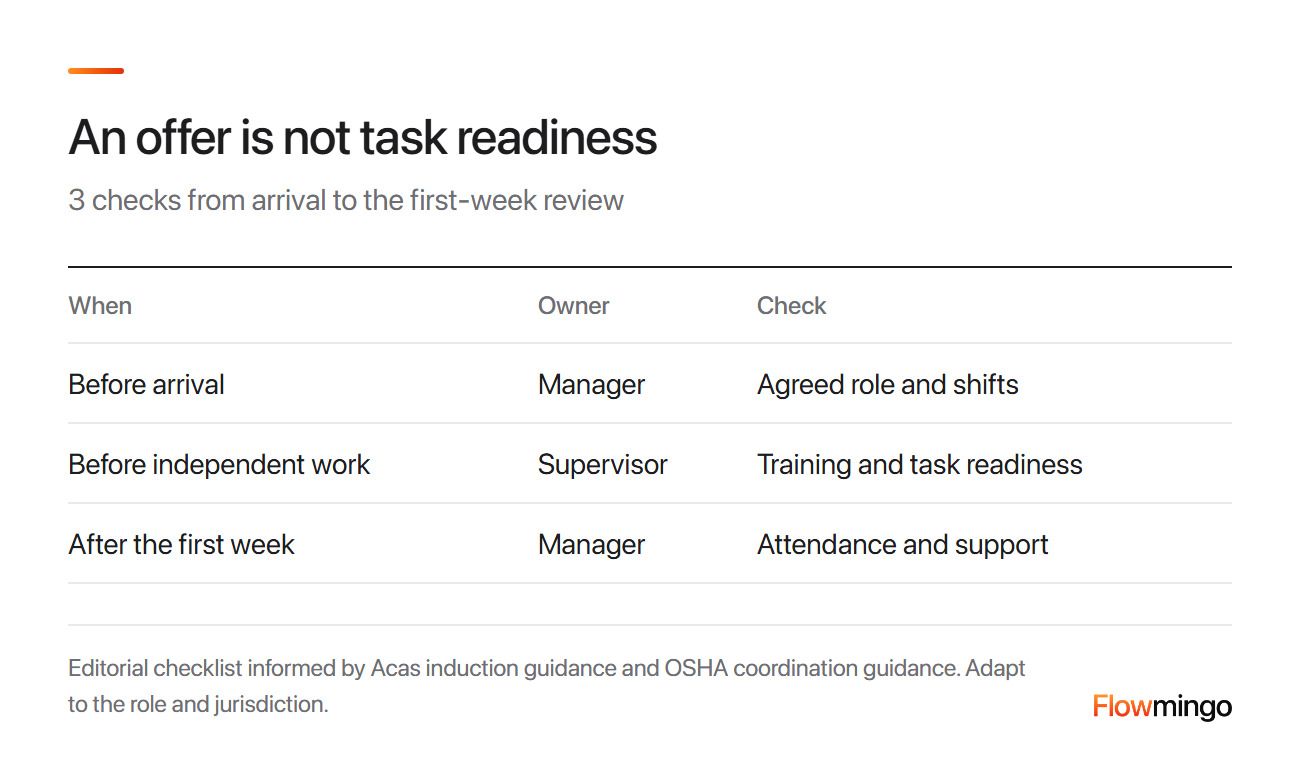
Starter-readiness checklist: confirm role and shifts before arrival, verify training and task readiness before independent work, then review attendance and support after the first week.
In Singapore, the Ministry of Manpower explains that temporary or contract status does not itself remove Employment Act protections. Check coverage and each entitlement instead of assuming seasonal means fewer rights.
For example, record the agreed pay and hours beside the operational handover without treating them as a substitute for required employment documents. Escalate discrepancies before the person starts.
7. How do we keep the team through the busiest weeks?
Make the roster and support match the working arrangement you offered, then investigate gaps weekly. Separate people still employed, people ready for tasks and hours they can actually cover.
Foundational Kesavan and colleagues' 2022 study tested a scheduling package at 28 Gap stores in San Francisco and Chicago. The randomized experiment compared treatment stores with stores maintaining existing practices over 9 months.
The package included consistent shift structures, recurring weekly schedules, adequate hours for a core group, targeted staffing additions and an app for exchanging shifts. The analysis estimated 5.1% higher productivity, with 3.3% higher sales and 1.8% fewer labor hours.
Those estimates concern the combined intervention at a US apparel retailer, not seasonal employees specifically. They do not establish that announcing schedules earlier alone produces the same result.
The managerial implication is to consider schedule consistency and worker control alongside total staffing hours. Test a locally suitable change and measure it, rather than inserting the research percentages into your forecast.
For the example store's day-7 review, all 10 starters remain employed, but only 8 have task clearance. Calling that 80% retention would misdiagnose a training issue as staff turnover.
Those 8 supply 192 productive hours against the 240-hour requirement, leaving 48 uncovered hours. The shortfall comprises 32 Monday-to-Thursday hours and 16 Friday-to-Sunday hours.
The manager should first arrange the missing assessments for the 2 starters who still need support. Then check whether their availability and the existing roster can fill those specific gaps.
If both starters become ready and can supply the planned hours, the extra capacity may resolve the shortage. It does not automatically fix a particular shift, so confirm the final allocation.
Keep a change log with the affected shift, reason, person contacted and confirmed replacement. For example, when a delivery moves, distinguish the additional workload from someone changing their availability.
Review recurring patterns with the team and publish schedules with reliable notice, following local rules. A weekly decision should have an owner and follow-up date, so the same gap does not become another emergency advert.
8. What should we record now to make the next season easier?
Close the season by comparing the plan with actual coverage and turning the largest gaps into assigned changes. Keep the assumptions, observed result and next decision together, so the review survives a manager handover.
For example, the first-week review already showed 10 starters but only 192 ready productive hours. The next-season record should preserve that distinction instead of saying the team filled every vacancy on time.
Here is a completed closeout record using that illustrative finding. It records operational changes, not employee performance judgments.
| Recorded finding | Next-season decision | Owner and checkpoint |
|---|---|---|
| 10 starters, 8 ready by day 7 | Book task assessments before promising independent cover | Store manager, before opening recruitment |
| Initial budget of 6 observation-hours against 10 needed | Reserve the missing 4 supervisor-hours and review repeat-assessment needs | Operations lead, before confirming starts |
| 16 Friday-to-Sunday hours uncovered | State that shift pattern in remaining vacancies and review availability explicitly | Recruiter, before publishing the advert |
Update these entries when later evidence changes the conclusion. If training finishes on time but demand exceeds the forecast, the next action belongs in workforce planning rather than selection.
At contract end, explain next steps and complete the required employment and pay processes under local rules. Ask about future vacancies through your normal recruitment and privacy procedures without promising another contract.
Separate operational lessons from personal records, and keep each only as long as your applicable policy permits. The useful reusable asset is the staffing assumption and its outcome, not an indefinite collection of candidate details.
Your seasonal hiring plan is ready when demand, shift availability and training capacity agree. Keep the completed review with next season's budget so the improvements have an owner before the rush returns.
How Flowmingo helps
Explore Flowmingo for seasonal hiring.
9. Sources
The guidance below supports the sourced statements. The store calculations and timeline are illustrative planning examples.
- Acas. (2026, June 30). Planning an induction programme.
- Ministry of Manpower, Singapore. (n.d.). Does the Employment Act cover temporary and contract employees?. Accessed 29 September 2026.
- Occupational Safety and Health Administration. (n.d.). Communication and coordination for host employers, contractors, and staffing agencies. Accessed 29 September 2026.
- US Office of Personnel Management. (n.d.). Realistic job previews. Accessed 29 September 2026.
- US Office of Personnel Management. (n.d.). Structured interviews. Accessed 29 September 2026.
- Kesavan, S., Lambert, S. J., Williams, J. C., & Pendem, P. (2022). Doing well by doing good: Improving retail store performance with responsible scheduling practices at the Gap, Inc.. Management Science, 68(11), 7818-7836. Foundational research.
- Christie, T. (2022, June 1). Study finds worker-friendly scheduling boosts bottom line. University of Oregon. Foundational research account.
Planning note: all store headcounts, hours, dates and recruitment-stage counts are illustrative arithmetic. They are not customer results, national benchmarks or promises about recruitment performance.