
You run 40 interviews a week, and Metaview pricing looks easy at $60 a user a month for notes. Then the bill adds seats, profiles, reviews and credits.
The Metaview notetaker is now 1 of 8 products, most priced on their own, and AI Screening has no public price. Metaview's help center and its Terms also give 2 cancel deadlines: 24 hours and 30 days.
Sign on the headline and those gaps cost you. Decide 2 weeks before renewal that you need fewer seats. 1 document lets you cut them, while the other renews every seat for another year.
Avoid that cost in 3 moves. Price every agent you will use, get the notice period and credit price in writing, then test the free plan. We sell a rival product, so every number links to its source.
Key takeaways
- What does Metaview pricing come to for 1 recruiter? $60 a month for Notetaker Pro, or $360 with uncapped Sourcing Max, at list price.
- Is Metaview free? Yes, with caps: 25 calls per user a month, 60 per company, and 14 days of history.
- How much notice do I need to cancel? The help center says 24 hours for card plans and the Terms say 30 days, so get 1 in writing, in your order form if you sign one.
- What does an AI-screened candidate cost on Metaview? 50 credits from a shared balance, at no published dollar price.
- What do companies actually pay for Metaview? Vendr shows a median contract of $25,500 a year, in a range of $5,865 to $61,860.
1. What will Metaview pricing cost my team per month, agent by agent?
Metaview pricing starts at $60 per user a month for Notetaker Pro, and Sourcing costs $100 or $300 per user a month. Application Review starts at $150 a month, while Screening, Reports and the full platform carry no list price.
Its pricing page prices each agent on its own and tells you to pay for what you use. That means a cheap first seat, but a harder bill to forecast.
| Agent | Free plan | Paid list price | Billed by |
|---|---|---|---|
| Notetaker | 25 calls per user a month | Pro, $60 per user a month | Seat |
| Sourcing | First 100 profiles, once | Pro $100 or Max $300 per user a month | Seat and profiles |
| Application Review | 50 applications a month | From $150 a month | Reviews (pricing page) or credits (help center) |
| Screening (AI interviews) | Unstated allowance | Not published | Shared credits |
| Reports | None listed | Flat add-on, not published | Flat fee |
| Full platform | None | Custom pricing | Contract |
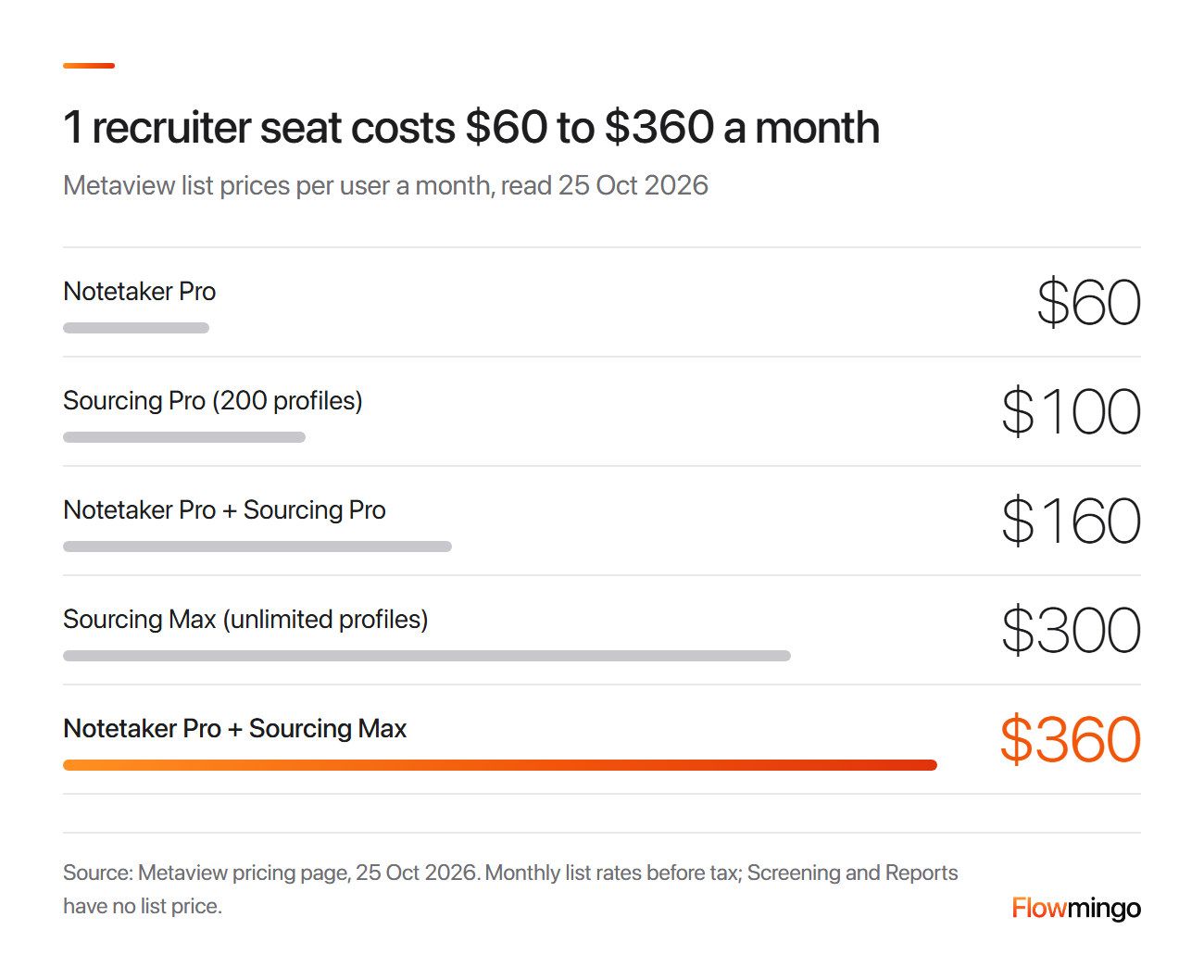
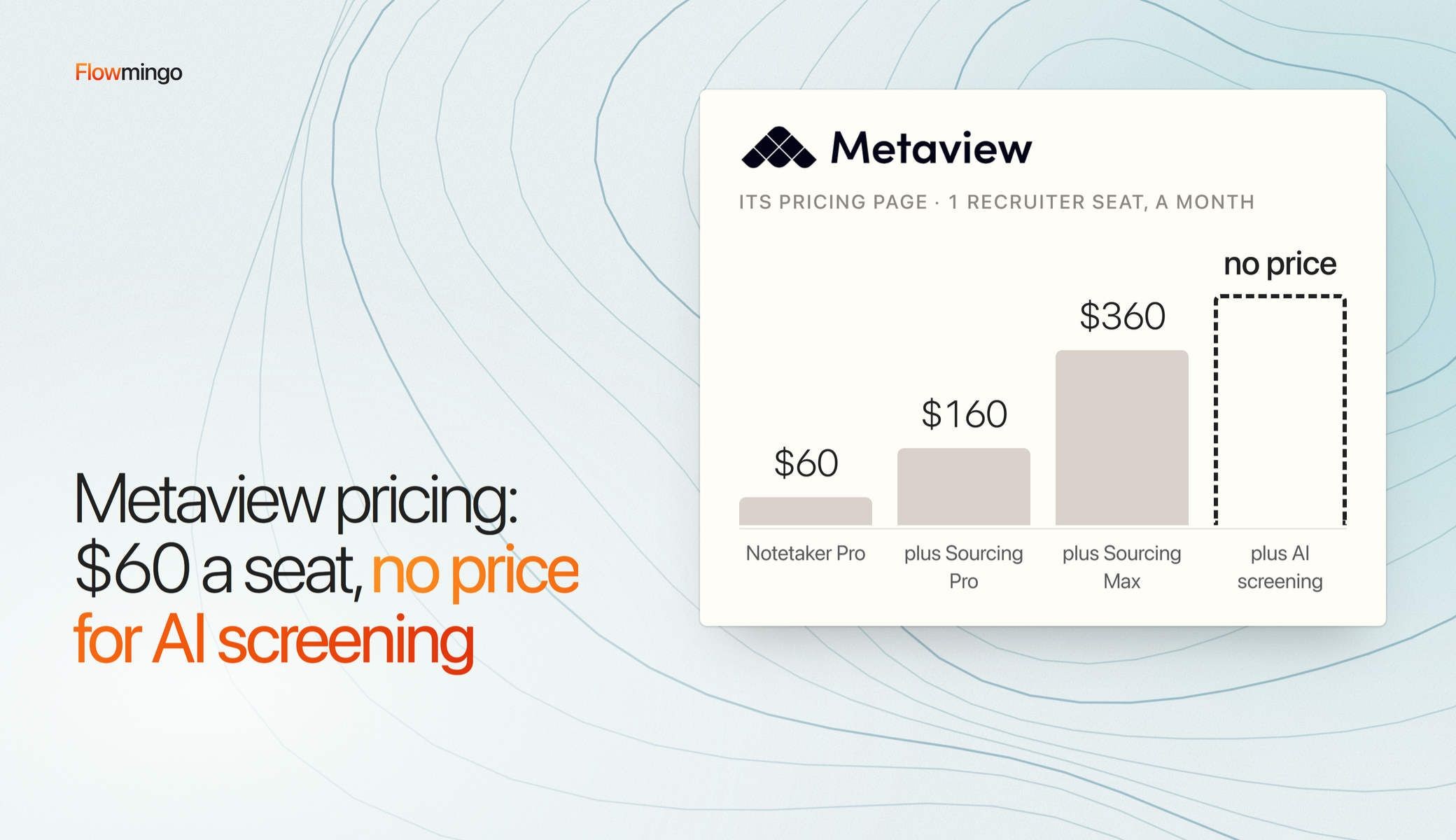
Cost of 1 recruiter seat a month: Notetaker Pro $60, Sourcing Pro (200 profiles) $100, both $160 and Sourcing Max $300. Notetaker Pro with Sourcing Max costs $360.
Notes alone are the cheapest seat, while notes plus uncapped sourcing cost 6 times as much.
At list price, 5 Notetaker Pro seats cost $300 a month. 2 recruiters add Sourcing Pro for $200, and 1,000 application reviews add $300.
The bill reaches $800 a month, or $9,600 a year, before any screening credits. Signed contracts run higher: Vendr, a software buying marketplace, shows a median Metaview contract of $25,500 a year.
Its range runs from $5,865 to $61,860, with no deal count shown. Treat the median as a guide for larger teams, not a quote.
1.1 How does Application Review pricing change at 10,000 applications a month?
It barely gets cheaper with volume, as the pricing page slider shows.
| Reviews a month | Monthly price | Per 1,000 reviews |
|---|---|---|
| 500 | $150 | $300 |
| 1,000 | $300 | $300 |
| 5,000 | $1,450 | $290 |
| 10,000 | $2,800 | $280 |
| 50,000 | $13,000 | $260 |
| 100,000 | $25,000 | $250 |
A 200-fold jump in volume cuts the unit price by only 17%, by our arithmetic. An agency reviewing 10,000 applications a month pays $33,600 a year for 1 agent, though Pro includes unlimited users.
At that volume, price the agent by the year and ask sales whether a platform contract beats the slider.
2. Is Metaview free, and how far will the free plan carry a team of 3 recruiters?
Yes, with caps: the free notetaker gives each user 25 calls a month, up to 60 across your company. It hides calls older than 14 days, and free sourcing covers your first 100 profiles, once.
Every plan you can buy without a sales call has a "Start for free" button, and none of the free plans has an end date.
The help center says the free plan's call credits reset on the 1st and do not roll over. Free Application Review covers 50 applications a month.
That company cap is the one a team hits first. Say 3 recruiters share the free plan: together they get 60 calls a month, not 75, or about 3 a working day.
The 14-day window matters more, because a screening note you cannot open is no use in a debrief 3 weeks later. Metaview also says it can change the free plan at any time without notice.
So treat the free plan as a test drive, not a home for a team. It is enough to run your 3 hardest calls inside the 14-day window. If you need full history for a debrief, add 1 Notetaker Pro seat for 1 month.
3. Is Metaview pricing monthly or annual, and how much notice do I need to cancel?
Metaview pricing comes monthly or yearly, and plans bought by card can go month to month. The notice period is unclear: the help center asks for 24 hours before renewal, while the Terms ask for 30 days in writing.
An admin can reassign a seat once per calendar month, but 2 people cannot share 1 seat.
The help center applies a change at the next renewal if your request arrives "at least 24 hours before your renewal date".
That page excludes enterprise, team and custom plans, so the 24-hour cutoff can only help seats bought by card. The Terms' 30-day clause covers subscriptions you pick on your account, not only order forms. So a card buyer faces both rules, and Metaview does not say which it enforces.
Metaview's Terms of Service were last updated on 07/06/2023, so they are foundational: more than 24 months old. They renew a subscription automatically unless either side gives written notice 30 days before it ends.
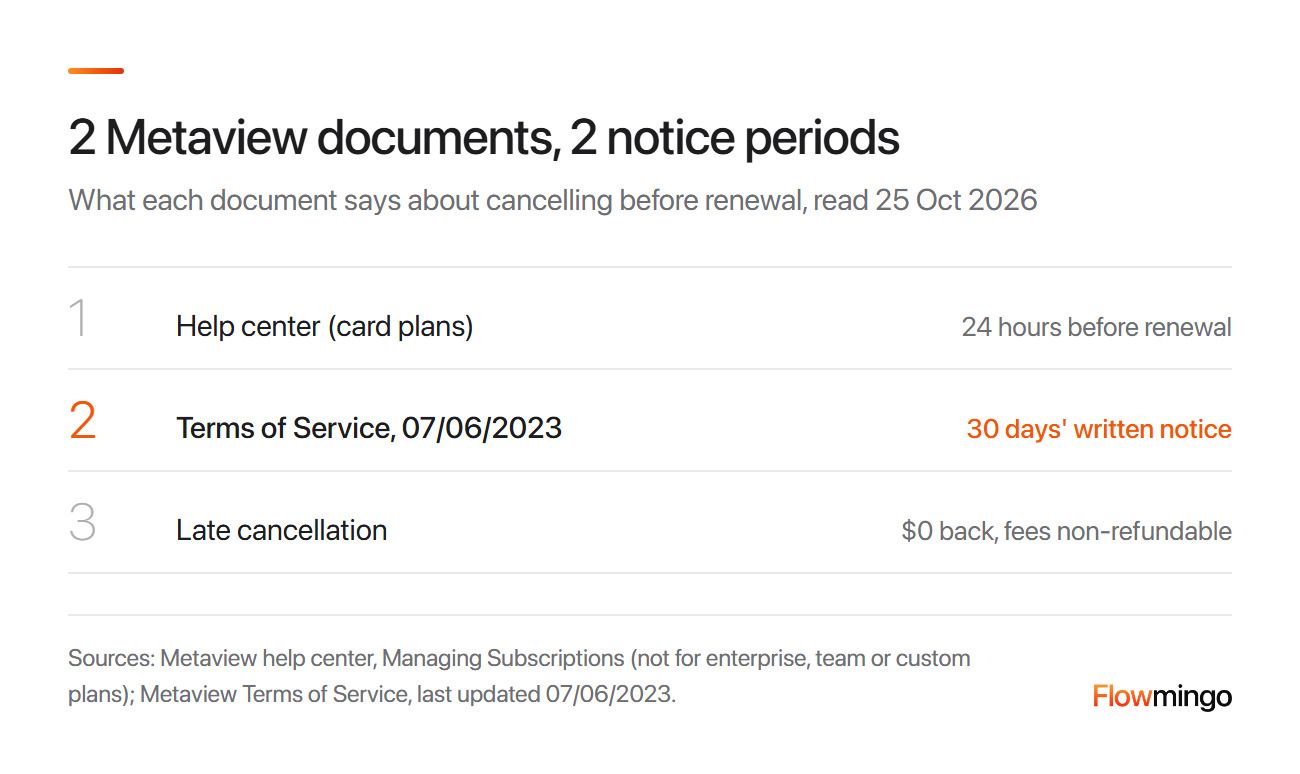
Notice to cancel: the help center asks for 24 hours before renewal on card plans. The Terms of Service dated 07/06/2023 ask for 30 days' written notice, and a late cancellation gets $0 back.
Both documents rule out refunds: the Terms call all fees non-refundable.
Say you pay yearly for 5 Notetaker Pro seats, $3,600 at list, and decide 2 weeks out that 3 are enough.
Under the 24-hour rule, you renew 3 seats for $2,160. Under the 30-day rule, you may owe $3,600 again, so get 1 notice period in writing, in your order form if you sign one.
4. Is Metaview an ATS, or will we still need our own applicant tracking system?
No, Metaview is not an applicant tracking system, so you keep your own. It sits beside your ATS, and its help center lists 43 ATS and CRM integrations.
Metaview is an AI recruiting platform that began as an interview notetaker. Siadhal Magos and Shahriar Tajbakhsh founded it in 2018, after building teams at Uber and Palantir.
Its about page says more than 7,000 teams use it. On 30 September 2026 it announced a $60M Series C led by Insight Partners, taking total funding to $110M (Reworked).
Metaview has grown past notes, into sourcing, outreach, application review, screening, reports, job posts and fillmore, an outbound recruiting agent inside Slack. Each agent you switch on can add to the bill.
Metaview reads jobs, candidates and interview stages from your ATS, then writes notes back to it.
Your candidate records, offers and pipeline stay in the ATS, so budget for 2 lines. Say you run 5 recruiters on Greenhouse. Under Metaview pricing, their Notetaker Pro seats add $300 a month at list price, on top of your Greenhouse licence.
4.1 Is Metaview owned by Meta?
No, the 2 companies are unrelated, though Google often suggests "is metaview owned by meta".
Metaview's licence agreement names Metaview Technologies Inc., a US company with a Wilmington, Delaware address. Its Terms of Service name Metaview Global Limited, registered in the UK. Its site footer reads Metaview Labs Inc., and none is part of Meta Platforms.
5. Does the Metaview notetaker record video on Teams and fill scorecards in Greenhouse or Workday?
Yes. The Metaview notetaker records video, audio and a transcript on Zoom, Google Meet, Microsoft Teams and Webex, and it fills scorecards in Greenhouse and Workday.
The help center says a video call gives a recording, audio and the full transcript, while a phone call gives audio and a transcript only. A workspace can also switch to audio only.
Metaview's channel data, published 7 September 2026, shows where its conversations happen.
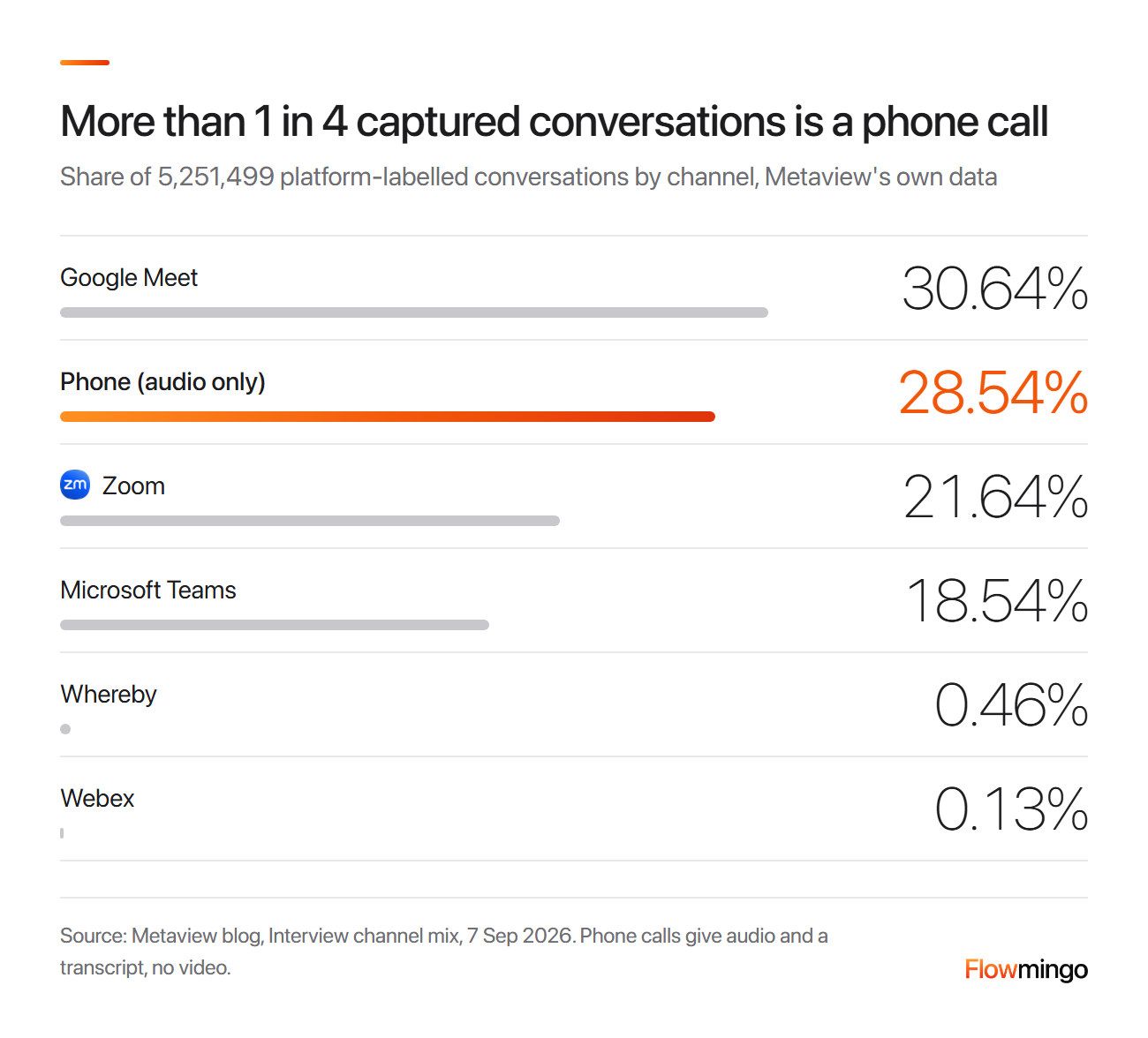
Where Metaview captures conversations: Google Meet 30.64%, phone 28.54%, Zoom 21.64% and Microsoft Teams 18.54%. Whereby had 0.46% and Webex 0.13% of 5,251,499 labelled conversations.
More than 1 in 4 captured conversations was a phone call, with no video. Video platforms made up 71.42%, so check the notes on both kinds of call.
Plan each integration's setup before you buy seats:
- Microsoft Teams: the notetaker joins as a guest up to 2 minutes early, and the host must admit it within 5 minutes. It leaves after 5 minutes of silence, and nobody can hide the bot.
- Greenhouse: the connection needs a Greenhouse Site Admin and can take up to 48 hours. A browser extension then fills the factual parts of a scorecard and leaves judgement fields blank.
- Workday: setup needs a Workday administrator, a dedicated Integration System User and 26 permission rows. The extension fills objective answers, never the Overall Rating.
- Desktop app: it records calls and in-person conversations without a bot.
No line of Metaview pricing shows the Workday IT work, so book the administrator early, because seats bill whether or not the integration is live.
If you are weighing a notetaker against a better ATS scorecard, our interview feedback tool guide compares the 2.
6. Does Metaview run AI interviews, and what does Metaview pricing charge per screened candidate?
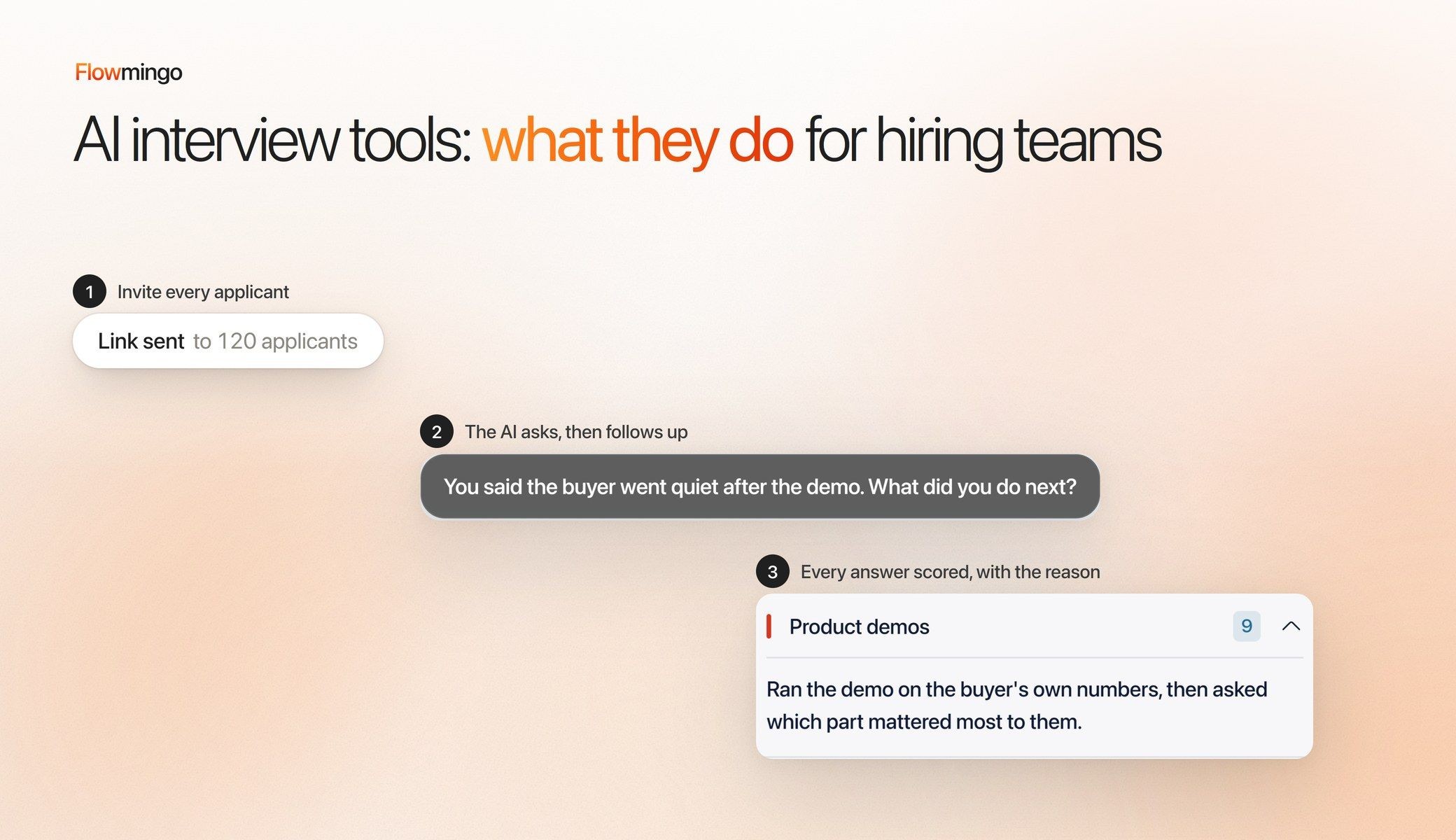
Yes, its Screening agent runs a 2-way voice interview and rates each answer against your rubric. Metaview publishes no price for it, and each evaluated interview uses 50 credits from a shared balance.
BrightHire's comparison page lists Metaview with an AI interviewer as of September 2026. Candidates take the screen in their browser whenever it suits them, and the AI follows up when an answer is vague.
Each finished interview gets a rating of Great, Good, Okay, Poor or Inconclusive, from the transcript alone. Screening runs in 18 interview languages, per Metaview's Screening FAQs.
Metaview's credits rate table charges 50 credits per evaluated interview.
For "high-volume or unlimited screening", the help center sends you to sales, and no page gives a dollar price per credit. Older workspaces may still hold a separate Screening balance at 1 credit per interview, now marked deprecated.
Say you screen 200 applicants a month: that uses 10,000 credits, at a price you must ask for. The slider in section 1.1 prices reviews in dollars. Metaview does not say how a slider review converts to credits, so that table cannot price a screen.
Before a big role opens, get 2 answers in writing: a credit's dollar price and whether Inconclusive or unfinished interviews use any. The help center says monthly plan credits expire at the end of each billing cycle, while credit packs you buy do not. Our AI interview cost per candidate guide shows how to set a credit quote beside per-interview plans.
How Flowmingo helps
Screening is where the 2 overlap most, and Flowmingo's CV evaluation matches Application Review. Metaview's notetaker writes up interviews your people run, and its Screening agent runs first-round interviews at a credit price you must ask for. Flowmingo, a free AI hiring platform, runs the first-round AI interview at a published price and takes no notes on live calls. Each applicant answers in their own time, in 60+ languages, and you get the recording, the transcript and a scored evaluation. The Free plan puts no limit on how many AI interviews you run, so 200 first-round interviews cost $0. Each can run up to 20 minutes, and Free keeps your latest 300 videos for 30 days, while scores and transcripts stay. Free sessions show our brand beside yours and may show candidates optional offers, and sponsoring all 200 at $0.49 each removes both for $98. A team could run both: Flowmingo for the first round, Metaview for the human rounds after it.
7. Is Metaview safe for candidate data, and is there a bias audit for our NYC roles?
Metaview lists an independent security certification, stores data on AWS in the UK and lets you set retention. Its public bias audit covers Application Review, where every group tested had an impact ratio above 0.80, but not Screening or the notetaker.
Metaview's privacy overview says it encrypts data at rest and in transit, runs external penetration tests and "does not use customer data for AI model training". The Terms still let it use aggregated or de-identified data "for machine learning and training", so ask which rule your contract follows.
Consent sits with you. Metaview's data processing agreement makes your company the controller, and its guidance is to tell candidates in advance and offer an opt-out.
Its bias auditor Warden AI publishes a monthly NYC Local Law 144 report on Application Review, the latest dated 1 November 2026.
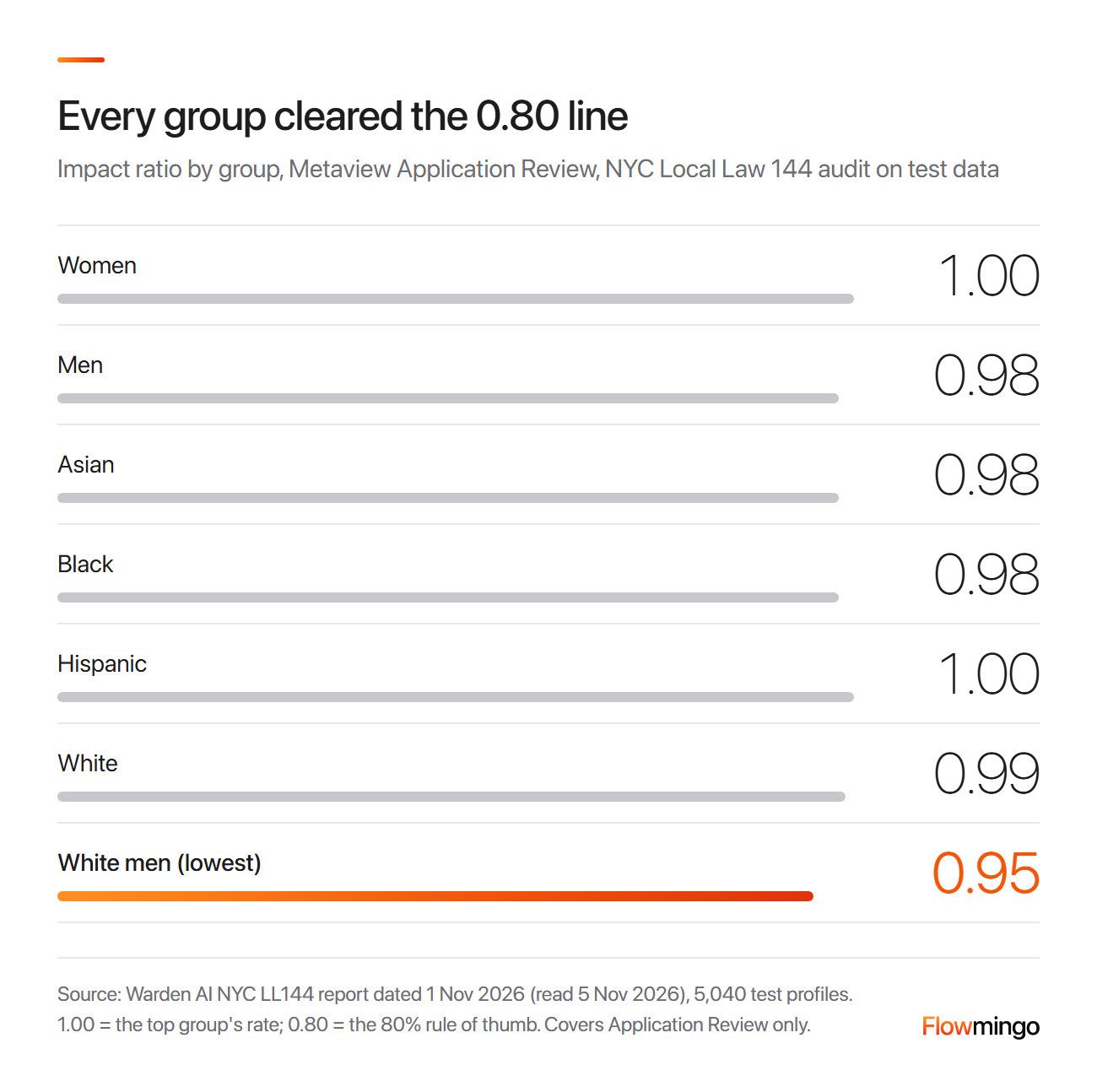
Application Review bias audit: impact ratios were women 1.00, men 0.98, Asian 0.98, Black 0.98, Hispanic 1.00 and White 0.99. White men were lowest at 0.95, in Warden's NYC audit of 5,040 test profiles.
For Application Review, every group tested cleared 0.80, the line below which the foundational 1978 Uniform Guidelines see evidence of adverse impact. Multiracial, Native American and Pacific Islander profiles had a sample of 0, so the audit says nothing about them.
That line is no safe harbour. On 9 June 2026 the Justice Department's Office of Legal Counsel called the guidelines an unconstitutional reading of Title VII. The EEOC's agenda lists rescinding them in November 2026, as our AI in recruitment guide explains.
Warden built its own matched profiles "due to a lack of access to historical data", so it tests the tool, not your hiring.
They come from real resume data, research and census statistics, identical except for demographic signals. The report also says it "should not be interpreted as a formal certification or compliance determination".
Coverage is the bigger gap. Warden's pages for Screening and the notetaker return "not found", and the data processing agreement has no annex for Screening.
Metaview's EU AI Act notice calls the notetaker non-high-risk because it does not evaluate candidates. The Act's Annex III lists AI that evaluates candidates as high-risk, and Screening rates candidates.
Those high-risk duties apply from 2 December 2027 (Regulation (EU) 2026/1744). For New York City or EU roles, ask in writing whether Screening has a bias audit and a DPA annex before the first interview.
8. What do Metaview reviews say, and which complaints should we test before buying?
Reviewers rate Metaview 4.8 out of 5 on G2, as a rival vendor reports it. The common complaints are inaccuracy, mixed-up languages, ATS links, bugs and summaries that still need editing.
G2 blocked our requests, so we could not count its reviews. Pin reports 132 G2 reviews at 4.8 in September 2026.
Pin also found 130 reviews at 4.9 in a snapshot from 4 June 2025, so only 2 arrived in the 15 months between. If Pin is right, the stars mostly reflect the product up to mid-2025.
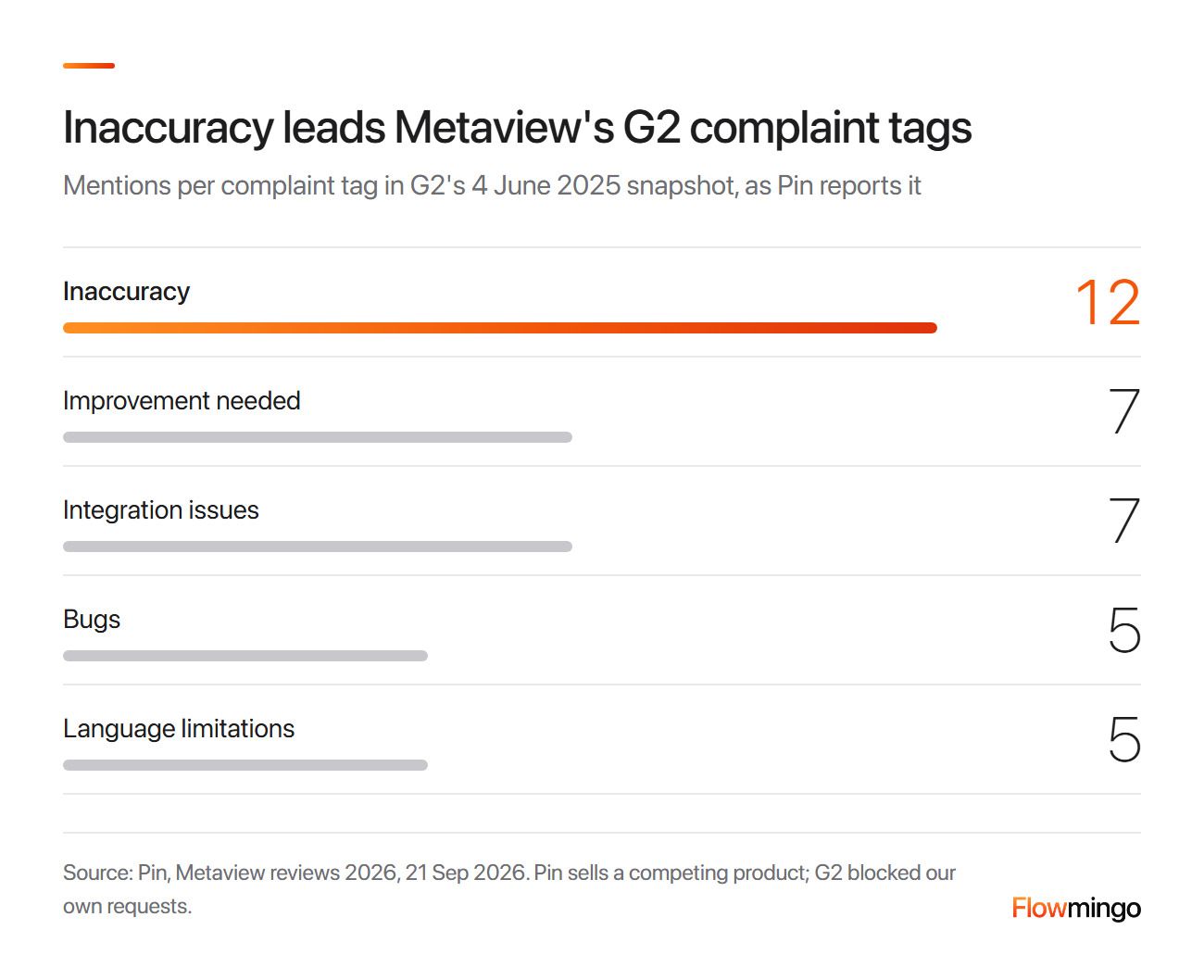
G2 complaint tags for Metaview: inaccuracy 12 mentions, improvement needed 7, integration issues 7, bugs 5 and language limitations 5. From G2's 4 June 2025 snapshot, as Pin reports it.
The inaccuracy examples are specific: 1 reviewer got German interviews back as English notes, and another said a Pinpoint ATS link stopped the bot joining.
Metaview's pricing page quotes a director of TA operations saving "53 hours per month", a chosen testimonial, not a measurement.
"metaview reddit" gets about 40 searches a month, but buyer threads are rare. The most useful we found is a September 2025 r/recruiting thread, where a buyer compared BrightHire, Metaview and Otter and found vendor sites "all vague about AI".
So test the complaints, not the praise. Run your 3 hardest calls on the free plan: a non-English interview, a technical screen and a phone call.
Metaview's phone FAQ says phone calls need a trial or a paid subscription, though its phone guide talks of calls counting against a free plan. If that blocks the phone test, use the 1 Pro seat from section 2.
Then check the notes against the recording. That takes minutes, because Metaview links every note to its moment in the transcript.
9. Which Metaview alternatives fit if we only need interview notes or first-round interviews?
Pick by the job: BrightHire, Ashby's notetaker, Screenloop, Fireflies, Otter or tl;dv replace the notes, and an AI interview tool replaces the first-round screen. Most recruiting-specific Metaview alternatives publish no price.
We read each vendor's own pricing page on 25 October 2026, and BrightHire's again on 5 November: BrightHire, Ashby, Fireflies, Otter, tl;dv and Screenloop.
| Tool | Job it does | Main catch |
|---|---|---|
| BrightHire | Notes, AI screening and application review | Owned by Zoom, demo first |
| Ashby AI Notetaker | Notes inside Ashby | Needs Ashby as your ATS |
| Fireflies | Meeting notes | Not built for recruiting |
| Otter | Meeting notes | Not built for recruiting |
| tl;dv | Meeting notes | Not built for recruiting |
| Screenloop | Interview intelligence and ATS | Demo first |
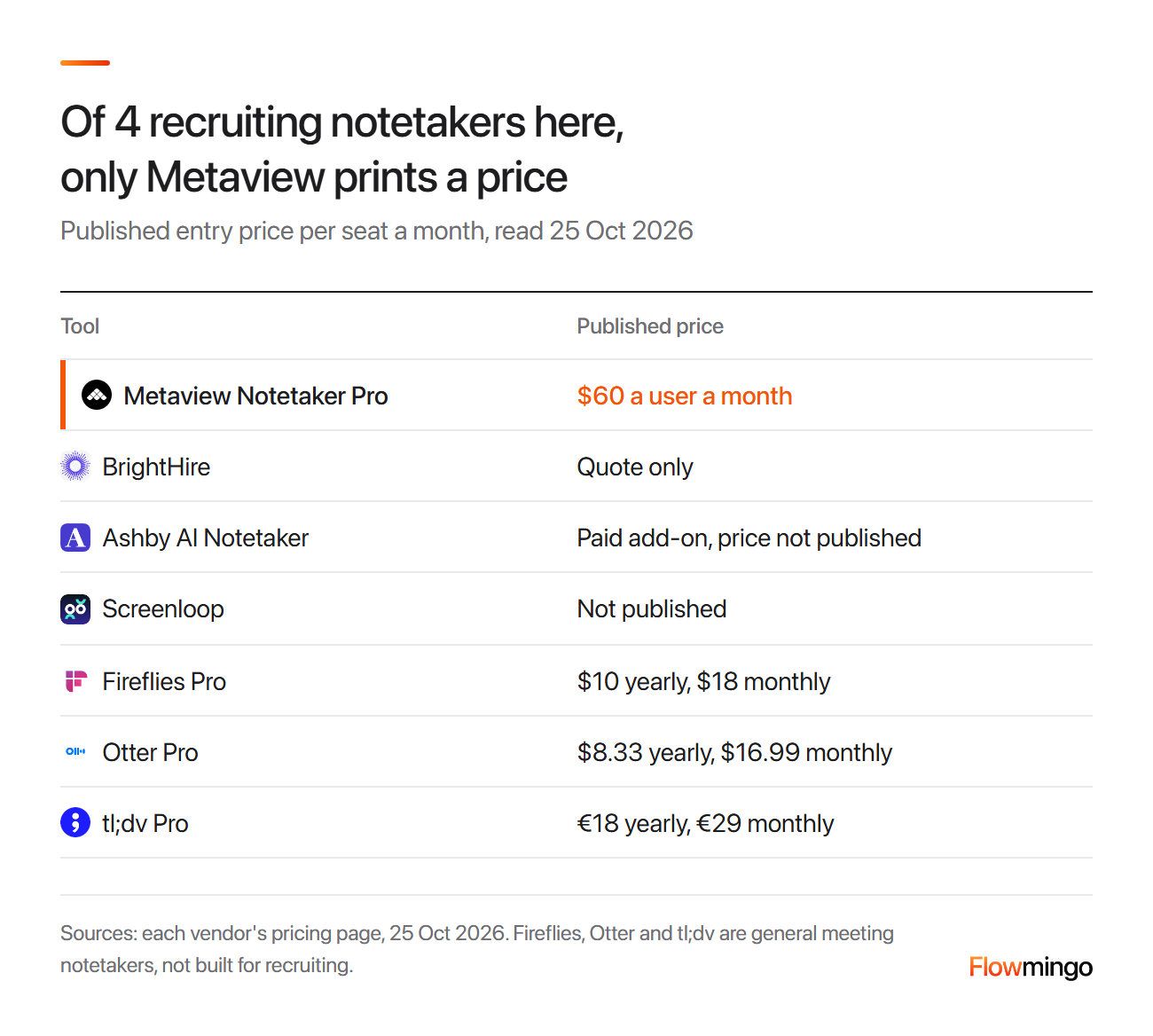
Notetaker prices: Metaview $60 a user a month, while BrightHire, Ashby and Screenloop publish none. Fireflies Pro costs $10 billed yearly or $18 monthly, Otter Pro $8.33 yearly or $16.99 monthly, and tl;dv Pro €18 yearly or €29 monthly.
General notetakers list Pro seats from $8.33 a month billed yearly to $18 billed monthly, in US dollars, under a third of Metaview's price. The gap buys recruiting depth, for example scorecard autofill in Greenhouse and Workday.
For the first round, Metaview Screening bills in credits with no dollar price, and BrightHire Screen sits behind a demo. So ask each for a price per finished interview at your volume.
If the first-round screen is the job, our AI interview tool for recruiters guide runs 7 tests on a real role.
9.1 Metaview vs BrightHire: which costs less?
On signed contracts BrightHire comes in lower: Vendr shows a median of $25,500 a year for Metaview and $18,350 for BrightHire, about $7,150 less.
Zoom announced its purchase of BrightHire in November 2025 and closed it in December 2025. BrightHire's pricing page names BrightHire Screen, an AI interviewer, and promises no extra fees for training or implementation.
Use BrightHire's median to push a Metaview quote down, then choose on fit. A Zoom-only team may prefer BrightHire, while a team that wants 1 seat this week, or sourcing too, will find Metaview easier to buy.
Test both on the same 5 recorded interviews, and time how long interviewers spend fixing the notes.
10. Is Metaview pricing worth it for a team running 40 interviews a week?
Yes, if your team loses time to notes on live interviews, because a Notetaker Pro seat pays back after about 70 minutes saved a month. If the first-round screen is your bottleneck, a notetaker documents those hours rather than removing them.
Metaview's notes cover 57 transcription languages, and you can buy 1 seat by card at list price, so a 1-month test is cheap.
US HR specialists, recruiters included, earned a median $36.51 an hour in May 2025 (BLS).
Benefits were 29.8% of private employers' compensation costs in June 2025 (BLS employer costs), so a loaded hour costs about $52. At that rate, 70 minutes saved a month covers 1 seat.
By our arithmetic, 40 interviews a week is about 173 a month. Across 5 interviewers, that is 5 seats, or $300 a month, which pays back at about 6 hours saved a month.
That is about 2 minutes per interview. Yet 40 phone screens of 20 minutes a week add up to more than 13 hours of calls.
A notetaker writes those calls up, but your team still holds every call. To cut that, move the first round to an AI interview that applicants take alone, and keep a notetaker for the human rounds. Metaview's Screening agent is 1 option, at its unpublished credit price.
Before you sign or renew, do 3 things:
- List every meter you will use (seats, profiles, reviews, credits), and price those with a list price before talking to sales.
- Get these in writing, in your order form if you sign one: the notice period and a credit's dollar price. Ask too whether unfinished interviews use credits and whether your data can train models.
- Test your 3 hardest calls on the free plan (phone calls may need 1 Pro seat), and check each note against the recording.
In New York City or the EU, ask whether Screening has a bias audit and a DPA annex too.
How Flowmingo helps
If the first round is where your hours go, Flowmingo takes it off your calendar, at a published price. Those 40 first-round calls a week become 40 AI interviews applicants take in their own time: free, or $19.60 a week sponsored at $0.49 each. It also covers CV evaluation, tests and a full applicant tracking system, with unlimited team members. The catch is on the pricing page: free sessions show our brand beside yours and may show candidates optional offers. Free also keeps only your latest 300 videos, for 30 days. Sponsoring an AI interview, at $0.39 to $0.49 depending on plan, removes the brand and the offers, and paid plans start at $499.80 a year. So before you renew, set your first round beside your Metaview pricing on Flowmingo.
11. Sources
Every price, rule and study in this guide links to a source below. Search volumes are Google Keyword Planner 12-month averages, worldwide, English, pulled on 25 October 2026.
- Ashby. (2026). Pricing. Retrieved October 25, 2026.
- BrightHire. (2026). BrightHire vs Metaview. Retrieved October 25, 2026.
- BrightHire. (2026). Pricing. Retrieved November 5, 2026.
- European Parliament and Council. (2024). Regulation (EU) 2024/1689, the Artificial Intelligence Act, Annex III. Artificial Intelligence Act Explorer.
- European Parliament and Council. (2026). Regulation (EU) 2026/1744 amending Regulation (EU) 2024/1689, the Digital Omnibus on AI. Official Journal of the European Union.
- Fireflies.ai. (2026). Pricing. Retrieved October 25, 2026.
- Kline, C. (2026, September 21). Metaview reviews 2026: What recruiters complain about. Pin.
- Magos, S. (2026, September 7). Interview channel mix. Metaview.
- Metaview. (2023). Terms of service. Last updated 07/06/2023. Retrieved October 25, 2026.
- Metaview. (2026). About Metaview. Retrieved October 25, 2026.
- Metaview. (2026). Data processing agreement. Retrieved October 25, 2026.
- Metaview. (2026). End user licence agreement. Retrieved October 25, 2026.
- Metaview. (2026). fillmore. Retrieved November 5, 2026.
- Metaview. (2026). Pricing. Retrieved November 5, 2026.
- Metaview Help Center. (2026). Credits. Retrieved November 5, 2026.
- Metaview Help Center. (2026). Greenhouse integration. Retrieved October 25, 2026.
- Metaview Help Center. (2026). Integrations overview: ATS and CRM integrations. Retrieved November 5, 2026.
- Metaview Help Center. (2026). Languages. Retrieved October 25, 2026.
- Metaview Help Center. (2026). Managing subscriptions. Retrieved October 25, 2026.
- Metaview Help Center. (2026). Microsoft Teams. Retrieved October 25, 2026.
- Metaview Help Center. (2026). Notifications. Retrieved October 25, 2026.
- Metaview Help Center. (2026). Phone calls. Retrieved November 9, 2026.
- Metaview Help Center. (2026). Phone FAQs. Retrieved November 9, 2026.
- Metaview Help Center. (2026). Privacy and security overview. Retrieved October 25, 2026.
- Metaview Help Center. (2026). Screening credits. Retrieved November 5, 2026.
- Metaview Help Center. (2026). Screening FAQs. Retrieved October 25, 2026.
- Metaview Help Center. (2026). Screening overview. Retrieved October 25, 2026.
- Metaview Help Center. (2026). Transcript and recording. Retrieved October 25, 2026.
- Metaview Help Center. (2026). Workday integration. Retrieved October 25, 2026.
- Office of Legal Counsel, US Department of Justice. (2026, June 9). Constitutionality of disparate-impact liability under Title VII. DOJ.
- Otter.ai. (2026). Pricing. Retrieved October 25, 2026.
- r/recruiting. (2025, September 22). Experience of Brighthire / Metaview / Otter.ai. Reddit.
- Reworked. (2026, September 30). Metaview raises $60M Series C to lead the shift to agentic recruiting. Reworked.
- Screenloop. (2026). Pricing. Retrieved October 25, 2026.
- tl;dv. (2026). Pricing. Retrieved October 25, 2026.
- Uniform Guidelines on Employee Selection Procedures. (1978). 29 C.F.R. § 1607.4. Cornell Legal Information Institute.
- U.S. Bureau of Labor Statistics. (2025, September 12). Employer costs for employee compensation, June 2025. BLS.
- U.S. Bureau of Labor Statistics. (2026). Human resources specialists. Occupational Outlook Handbook.
- Vendr. (2026). BrightHire pricing. Retrieved October 25, 2026.
- Vendr. (2026). Metaview pricing. Retrieved November 5, 2026.
- Warden AI. (2026, November 1). Metaview Application Review: NYC Local Law 144 bias audit. Warden AI.
- Zoom. (2025, November 13). Zoom acquires BrightHire. Zoom blog.