
Resume parsing is software that copies the text of a CV into named fields, such as name, employer, job title and dates. The fields make a CV searchable in an applicant tracking system, but parsing judges nothing.
You meet CV parsing every time a CV reaches your applicant tracking system, from a job board, an email or a careers page. Each file becomes a profile you can search and filter. Any field the parser gets wrong travels with that profile into your screen.
Key takeaways
- What does resume parsing do? It copies a CV into fields such as name, employer, job title and dates. It ranks and rejects no one.
- How often do parsers get fields wrong? In a 2025 preprint on real CVs, a widely used commercial parser got 83.5% of fields right, so about 1 in 6 came out wrong.
- Which fields break most? Long text. Job and education descriptions came out right 54% of the time, against 92.1% for dates.
- When does parsing turn into screening? When a tool filters CVs by terms. California has counted that as an automated-decision system since 1 October 2025.
1. What is resume parsing in recruitment?
Resume parsing is the step where software reads a CV file and stores its parts as data. It runs before anyone screens, so you can search hundreds of profiles instead of opening hundreds of files.
It fills 3 kinds of field. Contact fields hold the name, email and phone. History fields hold employers, job titles, schools and dates, and long-text fields hold the duties written under each job.
It is not CV screening: parsing copies a CV into fields, and screening decides who moves on. A resume parser is the tool, and parsing is the job it does. This means a parser can store a weak CV perfectly and a strong one badly.
The term comes from ATS software. Bullhorn's glossary notes that most applicant tracking systems include a parser. It also treats CV parsing and resume parsing as the same process.
2. What does resume parsing look like on 1 real CV?
On 1 real CV, most fields come through clean and a few do not. The ones that break are usually long text and anything outside the main column.
Here is 1 CV worked through, with the numbers set to match a 2025 preprint on real CVs.
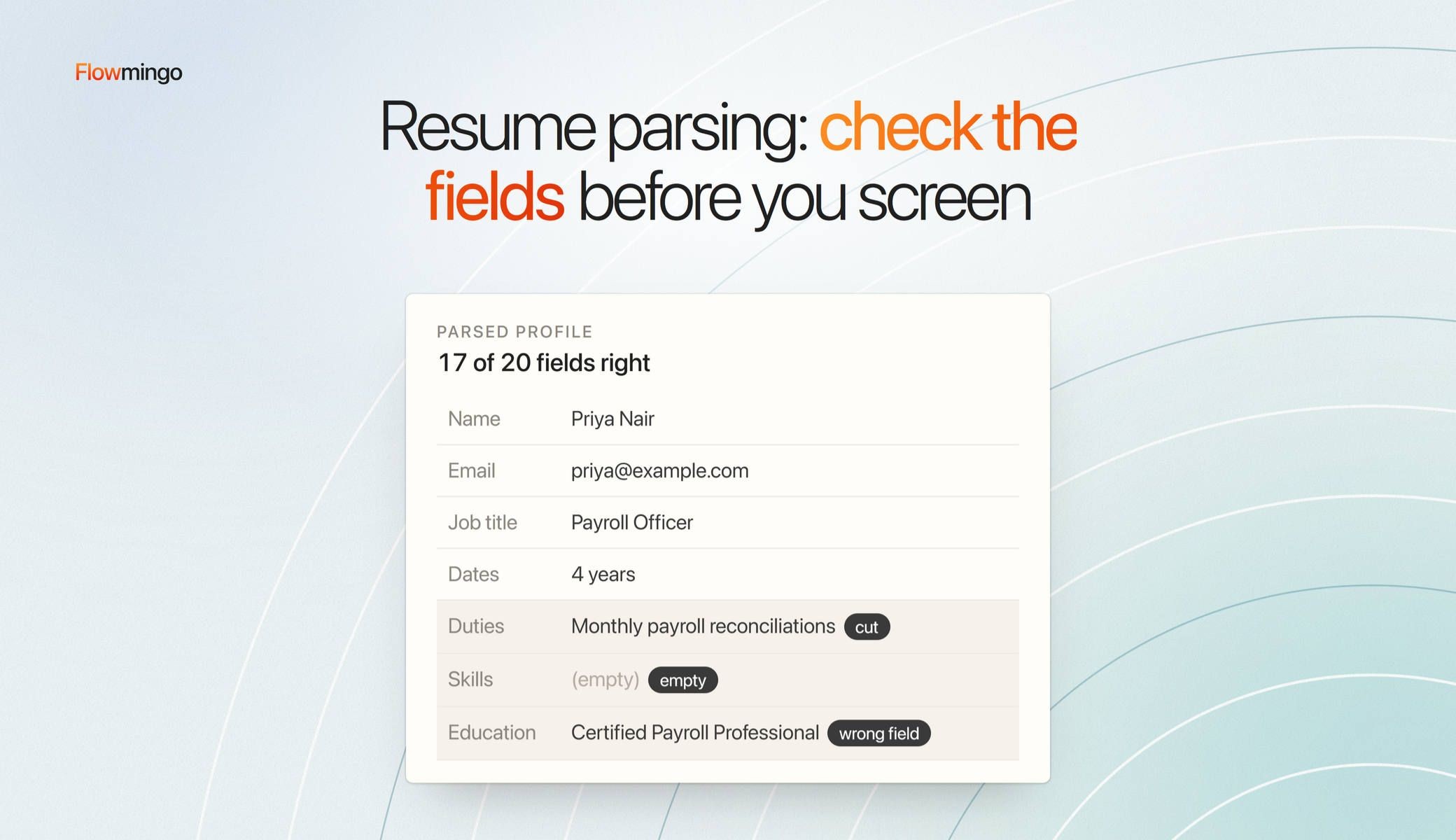
Say you recruit a payroll officer for a client, and Priya Nair applies with a 2-column CV. For example, your ATS profile has 20 fields, and the parser fills 17 of them right. That is close to the 83.5% that Zhu and colleagues measured on real CVs from a large HR system.
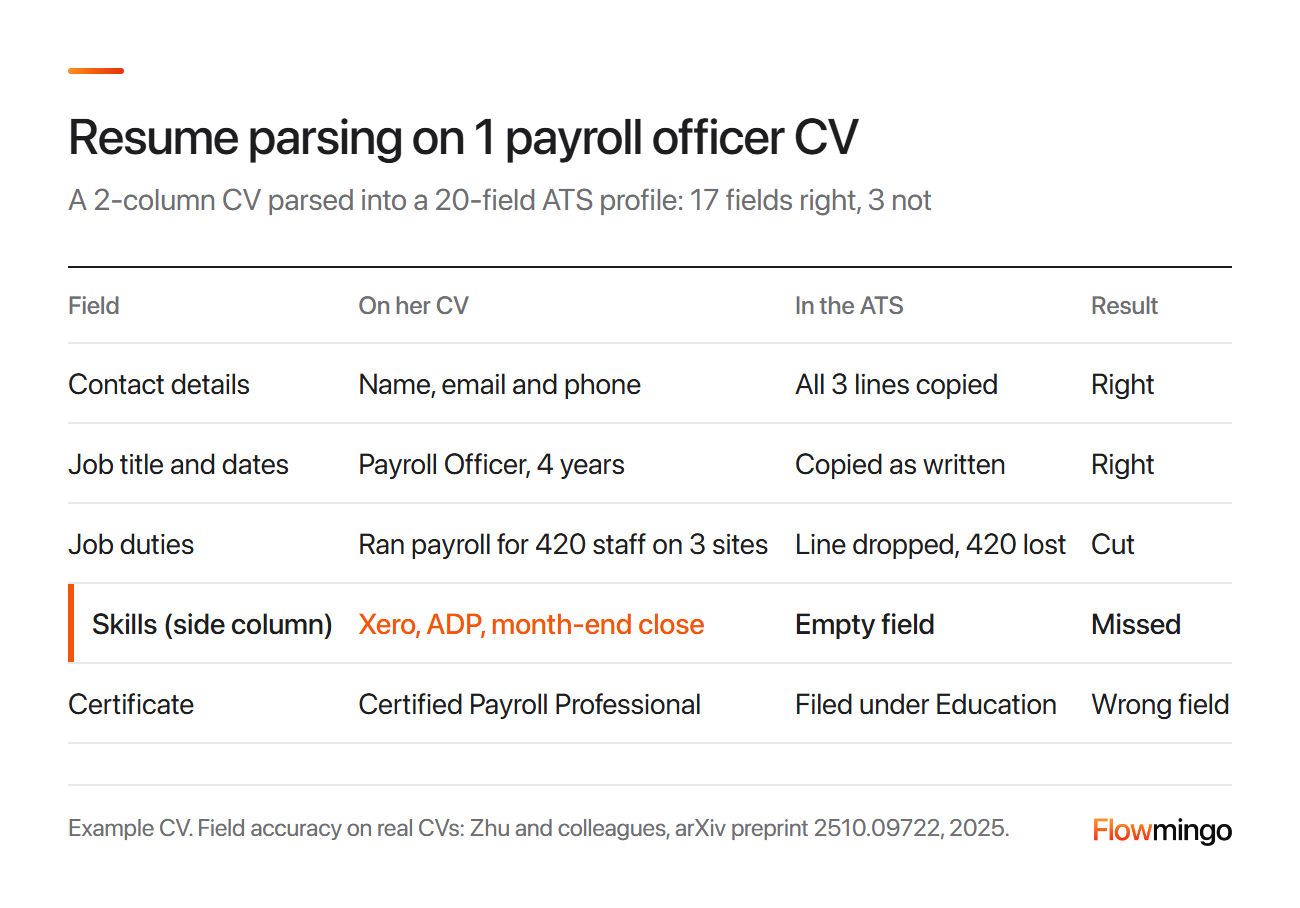
Resume parsing on 1 payroll officer CV: 17 of 20 fields come through right. The parser cuts the job duties, misses the side-column skills and puts a certificate under Education.
The parser copied all 3 lines of her contact details right: name, email and phone. It copied her job title and dates, Payroll Officer for 4 years, as written. It kept only the first line of her duties and dropped the next, "ran payroll for 420 staff on 3 sites", so the 420 was lost.
It missed the side column with Xero, ADP and month-end close, leaving an empty skills field. It filed her Certified Payroll Professional certificate under Education, the wrong field. Now picture a knockout filter for ADP on the skills field.
Priya would have dropped out with the exact skill the client asked for. You open the original file instead, see ADP in the side column, and she goes on to the screen.
3. How do you check CV parsing before you screen?
Test the parser on your own CVs, then never let a parsed field reject anyone on its own. Those 2 habits stop a wrong field from becoming a wrong no.
- Parse 10 recent CVs and compare every field with the file. The error rate that matters is the one your candidates' formats produce, not a vendor's average.
- Check long text and side columns first. In the 2025 preprint, long descriptions came out right 54% of the time, against 92.1% for dates.
- Never knock out on a parsed field alone. An empty skills field can mean a missed column, not a missing skill.
- Keep the original file on every profile. Open it before any no, the way Priya's file saved her application.
- Let applicants correct their own fields. When a careers page fills the form from the CV, the person who wrote it can fix a wrong field before it reaches you.
- Write down which parsed fields feed a filter. Once a tool screens CVs for terms, California's rules count it as an automated-decision system, with records kept at least 4 years.
3.1 Why does resume parsing fail on some CVs?
Most failures come from layout, not content. Scanned or photographed CVs need optical character recognition first, and Bullhorn notes that accuracy usually drops on them. Tables, text boxes and 2-column designs can also scramble the reading order.
The opposite problem is text a person can't see. A parser copies white-on-white text as faithfully as the rest, and an AI screener reading those fields may obey it. In a test study, hidden instructions fooled AI screeners over 80% of the time for some tricks (Mu and colleagues).
So treat a strange field as a reason to open the file, because the file is the record and the profile is a copy. Our piece on why resume screening fails at scale covers what goes wrong after the fields are in.
4. How do you move from resume parsing to screening with Flowmingo?
Parsing gets the CV into your system, and the screen still needs written criteria. Set them once, score every CV against the same list, and keep the reason next to each score.
Before you start, list 3 to 5 must-haves and check that a CV can show each one. A must-have that lives in the job duties is the one a parser is most likely to cut, as Priya's 420 staff showed. So read those against the original file, not the profile.
Keep the parsed profile for search and contact details, where parsers do well. Judge fit on the full CV text, where the evidence sits.
How Flowmingo helps
Flowmingo works alongside your current ATS and runs the first round of screening for you. Flowmingo's CV evaluation scores every résumé against the must-haves you set and hands back a ranked shortlist with the reasoning attached. Sign up free to screen what your resume parsing stored on Flowmingo.
5. Sources
Every study, regulation summary and vendor page cited in this glossary entry links to its source below.
- Bullhorn. (n.d.). What is resume parsing? Retrieved 26 October 2026. Bullhorn
- Kourinian, A., Zadikany, R., & Merritt, R. N. (2025, September 2). California adopts new employment AI regulations effective October 1, 2025. Mayer Brown. Mayer Brown
- Mu, H., Liu, J., Wan, K., Xing, R., Chen, X., Baldwin, T., & Che, W. (2025). AI security beyond core domains: Resume screening as a case study of adversarial vulnerabilities in specialized LLM applications. arXiv preprint. arXiv 2512.20164
- Zhu, F., Yu, J., Chen, Z., Zhou, Y., Ji, J., Yang, Z., Zhang, Y., Hu, H., & Liu, Z. (2025). Layout-aware parsing meets efficient LLMs: A unified, scalable framework for resume information extraction and evaluation. arXiv preprint. arXiv 2510.09722