
A behaviorally anchored rating scale is a numbered rating scale in which the scores are tied to short descriptions of real behavior. Raters pick the description that matches what they saw, not a vague word like "good".
You meet the term on a performance review form, or in a debrief where 2 interviewers scored the same answer 2 and 4. In hiring, BARS turns "a good answer" into a written description every interviewer can check against what the candidate said.
Key takeaways
- What is a BARS? A numbered rating scale, such as 1 to 5, where the numbers carry written examples of behavior.
- Where does it come from? A 1963 paper by the psychologists Smith and Kendall on building "unambiguous anchors" for rating scales.
- Is it only for performance appraisal? No. Most guides cover yearly reviews, but the same scale scores 1 interview answer at a time.
- Do anchors help in interviews? Across 19 interview studies, raters using anchored scales agreed a little more and predicted performance better.
1. What is a behaviorally anchored rating scale?
A behaviorally anchored rating scale, or BARS, scores 1 skill on a numbered scale with written behaviors as anchors. The rater matches what they saw to the closest description.
It includes 3 parts: the skill being rated, a numbered scale such as 1 to 5, and the anchors. Each anchor is a short, observable action, for example "logged the hazard the same shift", not a trait like "safety-minded".
It is not a graphic rating scale, which labels each point with a word such as "poor" or "excellent". There, each rater decides what the word means.
Most top pages describe BARS for performance appraisal, where a manager rates a year of work. In hiring, you rate 1 answer to 1 question, which is easier to anchor because the evidence is short.
The method comes from Smith and Kendall's foundational 1963 paper, Retranslation of expectations, on unambiguous anchors for rating scales. Its title names the step at its core. In AIHR's guide, a second group of experts retranslates by sorting each example behavior back into the skill it best fits.
2. What does a behaviorally anchored rating scale look like in an interview?
In an interview, it is 1 question with 5 written answers beside the numbers 1 to 5. Here is 1 example with illustrative numbers.
Say you hire a warehouse shift supervisor, and safety ownership is a must-have. Your question is "Tell me about the last safety problem you found on a shift." The finalist says she moved a pallet that blocked a fire exit, then carried on without logging it.
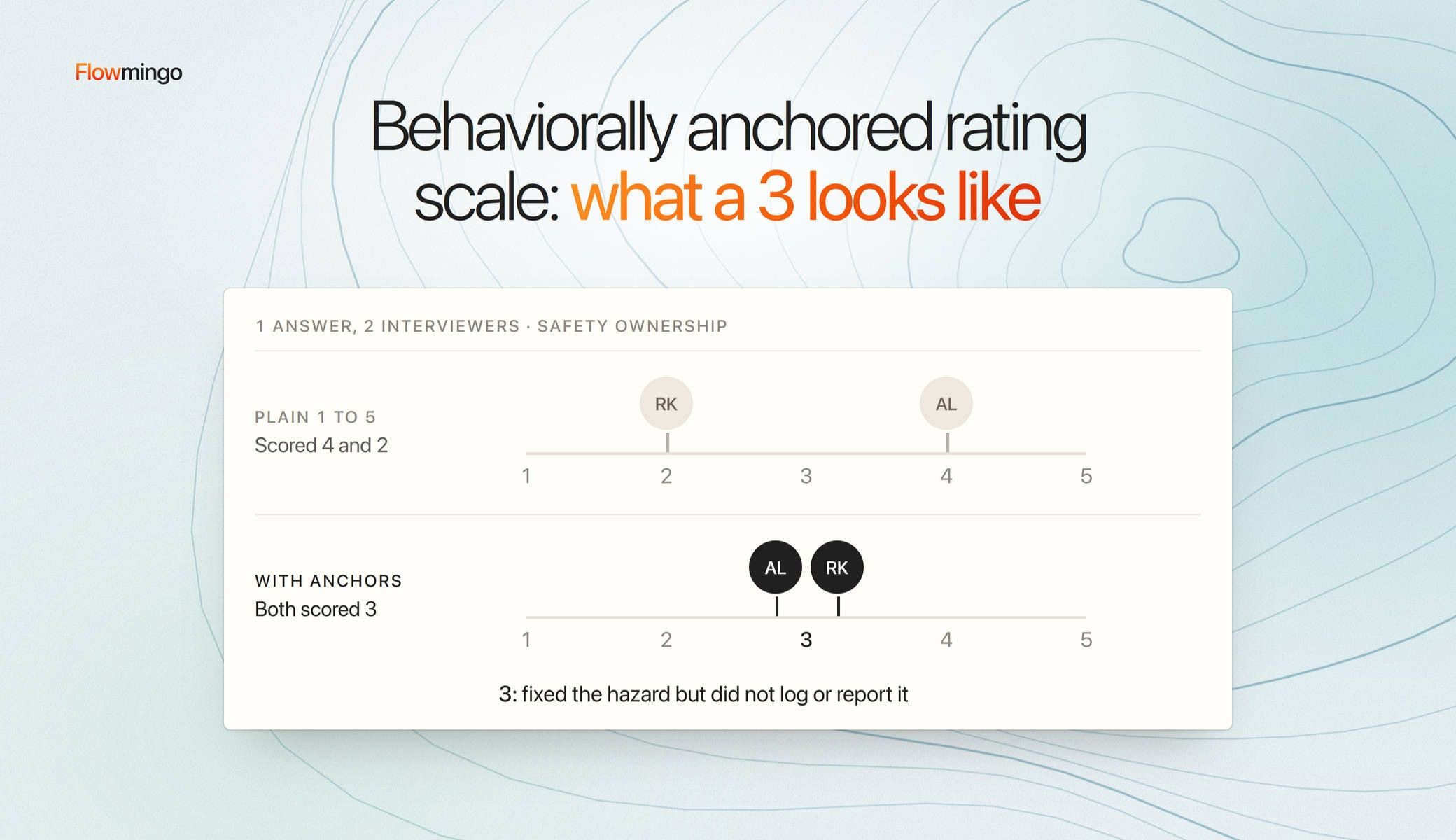
Your 2 interviewers first scored that answer on a plain 1-to-5 scale. One gave 4 because she acted fast, and the other gave 2 because nobody heard about it. Then you wrote the anchors below, from 5 down to 1.
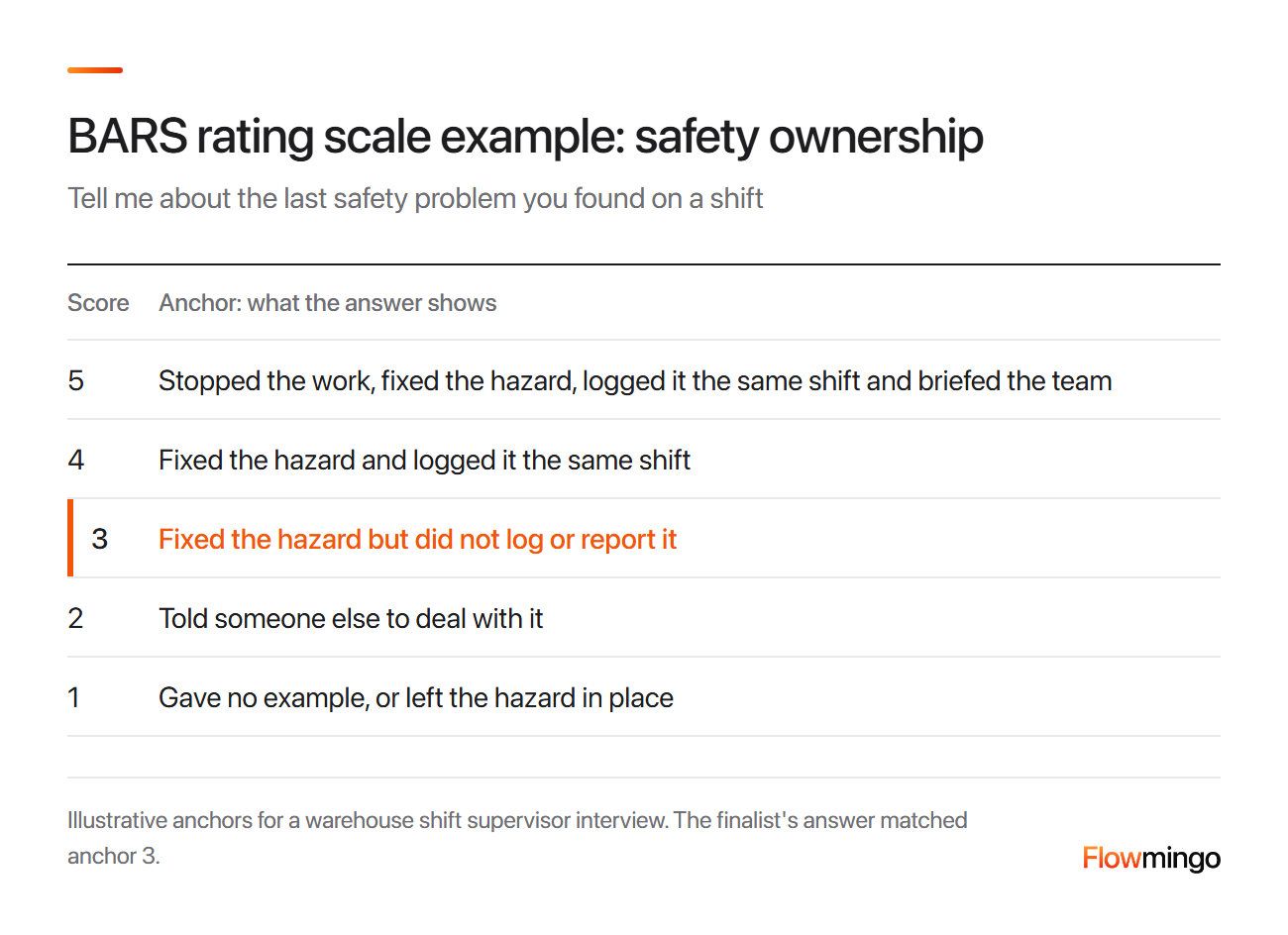
BARS rating scale example: 5 anchors for safety ownership in a warehouse shift supervisor interview, with the finalist's answer matching anchor 3.
A 5 stopped the work, fixed the hazard, logged it the same shift and briefed the team. A 4 fixed the hazard and logged it the same shift.
A 3 fixed the hazard but did not log or report it. A 2 told someone else to deal with it, and a 1 gave no example or left the hazard in place.
Against those anchors, both interviewers scored the answer 3. The hiring manager had set 4 as the bar for safety, so the finalist did not move on, and the reason fit in 1 line.
3. How do you build a behaviorally anchored rating scale for interviews?
Start from real behavior, write an anchor for every point, then check that a second person reads the anchors the same way. 1 scale covers 1 skill, so build 1 for each competency you interview for.
- Pick 1 skill and 1 past-behavior question. A scale that rates 2 skills at once forces raters to average in their heads.
- Collect real examples of strong and weak behavior. Ask people who do or manage the job for the strongest and weakest examples they have seen. Real events are easier to recognise in an answer.
- Write an anchor at every point of a 5-point scale. A foundational 2006 study in Levashina and colleagues' 2014 review found fully anchored scales held up better against disability bias than end-only anchors.
- Test the anchors on a colleague. Shuffle them, ask the colleague to put them back in order, and rewrite any anchor they misplace.
- Score each answer alone, then compare. This way each score shows 1 person's reading of the anchors, and the debrief starts from real differences.
The evidence for the effort is strong but not clean. Taylor and Small's foundational review of 19 past-behavior interview studies found a link to job performance of .35 with anchored scales, against .26 without.
Interviewers also agreed slightly more, with interrater reliability of .77 against .73, as Levashina and colleagues' review reports. The studies differed in other ways too, so treat the gap as a strong hint, not a controlled test.
Our interview scorecard template anchors 1, 3 and 5 for 5 skills on 1 page. Add anchors for 2 and 4 to cover every point.
3.1 What are the disadvantages of behaviorally anchored rating scales?
The main cost is time, because every skill needs its own anchors and a test. For a role with 5 interview skills, that means 25 written anchors before the first call.
An answer can also fall between 2 anchors, or show a behavior none of them describe. Score the closest anchor and write 1 line on what differed, then sharpen the anchor after the round. Google's re:Work guide uses 4 levels instead, poor, borderline, solid and outstanding, which works too when each has a written behavior.
Anchors also leave room for judgment. OPM describes structured scoring as limiting each interviewer's discretion, which raises their agreement on the overall evaluation. Our structured interview guide covers the rest of that set-up.
4. How do you use a behaviorally anchored rating scale with Flowmingo?
You write the anchors, and Flowmingo scores each answer with the reason next to the score. You check that reason against your anchors and make the call.
Before you start, have 2 things ready: the job description and the anchors for each skill you interview for. In the first round, read 3 or 4 scored answers against your anchors, because that check shows whether the 2 readings agree. If they differ, the anchor or the requirement needs a sharper sentence.
How Flowmingo helps
Paste your job description and the AI drafts between 1 and 30 interview questions from it, which you edit to match your skills. Flowmingo's scoring rates each requirement 0 to 10, weights it by importance and explains why, while every hiring decision stays with your team. Sign up free and check each scored answer against your behaviorally anchored rating scale on Flowmingo.
5. Sources
Every study, guide and review in this glossary entry links to its source below.
- Google re:Work Editorial Team. (2026). A guide to structured interviewing for better hiring practices. Google re:Work. re:Work
- Levashina, J., Hartwell, C. J., Morgeson, F. P., & Campion, M. A. (2014). The structured employment interview: Narrative and quantitative review of the research literature. Personnel Psychology, 67(1), 241-293. DOI
- McCoy, J. W. (n.d.). Behaviorally anchored rating scale: Examples + guide. AIHR. Retrieved 27 October 2026. AIHR
- Smith, P. C., & Kendall, L. M. (1963). Retranslation of expectations: An approach to the construction of unambiguous anchors for rating scales. Journal of Applied Psychology, 47(2), 149-155. DOI
- Taylor, P. J., & Small, B. (2002). Asking applicants what they would do versus what they did do: A meta-analytic comparison of situational and past behaviour employment interview questions. Journal of Occupational and Organizational Psychology. DOI
- U.S. Office of Personnel Management. (n.d.). Structured interviews. OPM