
Ask your recruiters where last week's hours went, and each will give you a confident guess. To reduce recruiter workload, you need the real split, because Peter Drucker's foundational book on executive time warns that memory is a poor record.
In 2025, each recruiter on Greenhouse's platform handled 746 applications, up from 146 in 2022. Applications per recruiter grew about 5 times over in 3 years. That matters for recruiter burnout: Gallup counts an unmanageable workload among its 5 main causes.
The cost shows up as admin you can count. "The average time spent on manual tasks per vacancy is 17.7 hours," IrishJobs found in a 2025 survey of 475 recruiters in Ireland. At 4 hires a month, the job site's own sum is 850 hours a year per recruiter.
This week, have each recruiter log every 15 minutes of work under 8 task codes. On Friday, sort each task into automate, batch, delegate or drop, and take the before and after to leadership.
Key takeaways
- Is burnout on a 20-req team a people problem? No. Gallup lists an unmanageable workload among the 5 main causes, and people with enough time are 70% less likely to report high burnout.
- Can we promise recruiters 20 hours a week back? No source we opened supports it. The best evidence says about a day: 8 hours in an HBR study, a full workday in LinkedIn's survey.
- Where do recruiter hours go first? Scheduling. TA leaders estimate it takes nearly 2 in 5 of their teams' hours, the biggest burden GoodTime measured.
- What should we automate first? The repeatable first-round screen. In a field trial of 67,056 applications, AI-led first interviews brought 12% more offers, with people deciding.
- How many open reqs is too many? No single number fits. SHRM's median is 20 a year per recruiter, so weight reqs by type before you set a cap.
1. Our recruiters carry 20+ reqs each and are burning out: how do I reduce recruiter workload?
Treat it as a workload problem first, because the evidence points there. Then measure 1 week of hours and cut with 4 moves: automate, batch, delegate and drop.
The World Health Organization's foundational 2019 definition calls burnout "chronic workplace stress that has not been successfully managed". Its 3 signs are exhaustion, distance from the job and a falling sense of doing it well.
In a foundational 2018 study of nearly 7,500 full-time employees, Gallup named an unmanageable workload among its 5 main causes. People who often or always had enough time for their work were 70% less likely to report high burnout.
Employ, which sells applicant tracking and AI recruiting software, surveyed more than 1,200 US recruiters and HR managers for its 2025 Recruiter Nation Report. It asked those whose job got more stressful why.
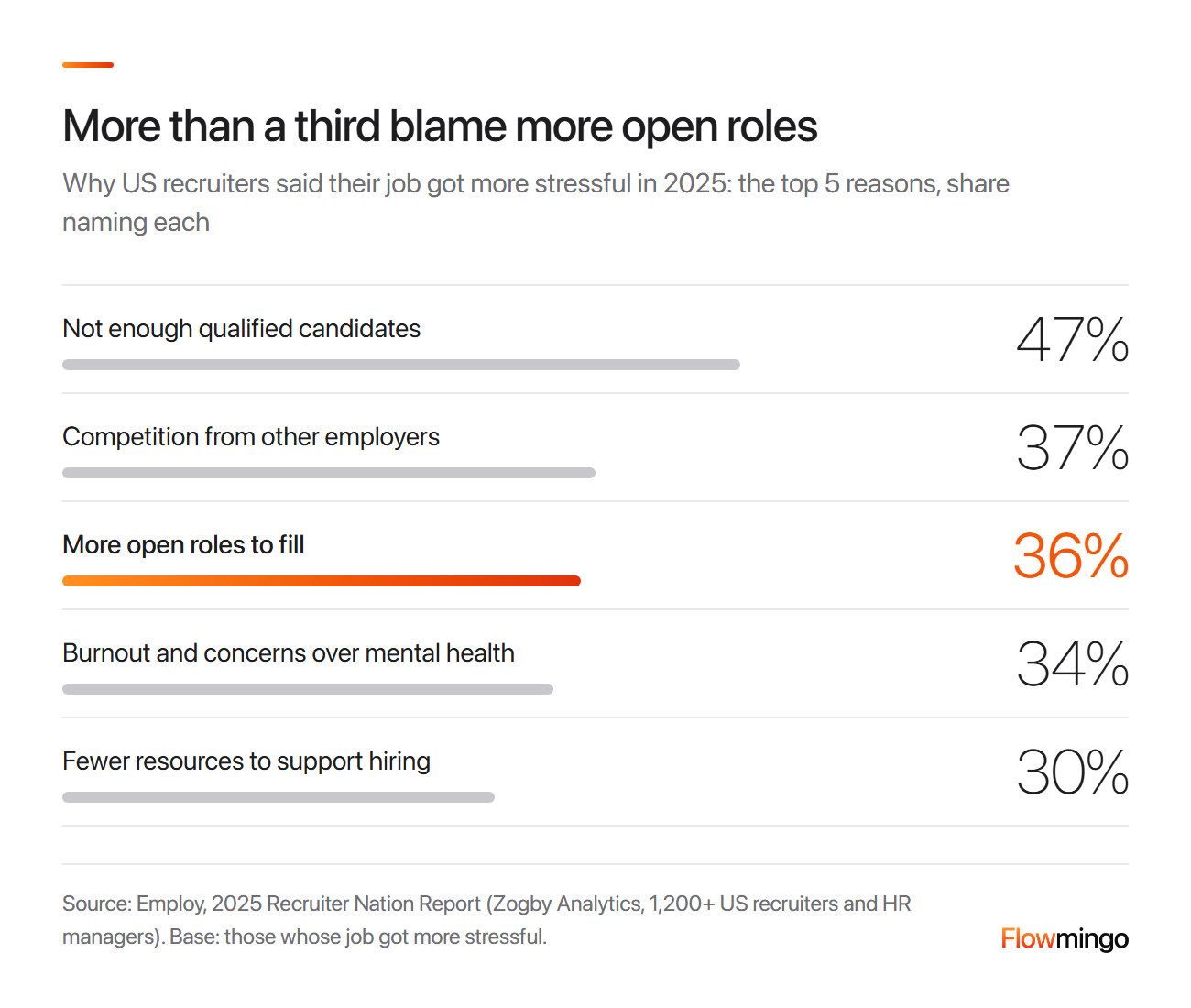
Why the job got more stressful, top 5 reasons: too few qualified candidates, competition, more open roles, burnout and fewer resources (Employ, 2025).
Not enough qualified candidates led at 47%, and competition from other employers followed at 37%. Burnout and concerns over mental health came 4th at 34%, up from 24% in 2024. More open roles to fill, at 36%, and fewer resources to support hiring, at 30%, are the workload itself: more reqs and less help.
Say 1 of your recruiters carries 22 open roles. Gem's 2026 benchmarks, built on its customers' data, put the average at 13.4 open roles at a time. That load runs about 64% above it by our arithmetic, a capacity signal, not a performance one.
2. We can't add headcount, so where do my recruiters' hours actually go each week?
Scheduling comes first, then screening and admin, but surveys only give averages. TA leaders estimate scheduling alone takes 38% of their teams' time.
GoodTime surveyed 504 senior US TA leaders at companies with 1,000+ staff in November 2025. GoodTime sells scheduling software, and leaders estimated for their teams, so read it as a signal rather than a stopwatch.
The volume is real: Greenhouse counts 650.5 interviews scheduled per recruiter a year. Each needs a slot, a confirmation and often a reschedule.
In the IrishJobs survey, the 17.7 hours of manual work per vacancy included scheduling, post-interview notes and data entry. The same recruiters spent 3.6 hours per vacancy filtering out irrelevant applications, at about 4 roles a month each.
The only "20 hours" figure we found is old and narrow. In a foundational 2017 Harris Poll for CareerBuilder, 231 HR managers said they lose an average 14 hours a week to automatable tasks. More than a quarter said 20 hours or more.
This means the hours exist, but no survey gives your team's split: for example, a team booking by email differs from 1 on booking links. Log your own week before you buy a tool.
3. Before buying any tool, how do I run a 1-week time audit to reduce recruiter workload?
Have every recruiter log 1 normal week in 15-minute blocks, coded by task, then total the codes on Friday. It takes minutes a day and replaces guesses with your own numbers.
Drucker's foundational book, The Effective Executive, tells managers to start with their time, not their tasks. Record it, cut what is unproductive, then consolidate what is left into larger blocks.
In foundational 2013 research in Harvard Business Review, Julian Birkinshaw and Jordan Cohen interviewed 45 knowledge workers in 39 companies. On average, they spent 41% of their time on discretionary work that others could handle competently.
Log each block like Mon 09:15-09:45 SCH, with these 8 codes:
| Code | Task | Friday question |
|---|---|---|
| SCH | Scheduling and rescheduling | Could a link or a coordinator do it |
| SCR | First-round screens | Is it the same 5 questions each time |
| CV | Reading CVs and applications | Would written must-haves sort most of it |
| HM | Hiring-manager meetings and chasing | Does it have an owner and a deadline |
| COM | Candidate email and status updates | Is it a template you rewrite |
| ADM | ATS updates, notes and reports | Who reads it |
| SRC | Sourcing and outreach | Is it getting squeezed |
| OFF | Offers and closing | Keep it with the recruiter |
Pick a normal week, not a hiring spike, and log as you go rather than at night. Count evening and weekend work, because it is the part of the load people forget.
On Friday, total each code and put every task through the 4 tests in the figure. Birkinshaw and Cohen sort into quick kills, work to off-load and work to redesign.
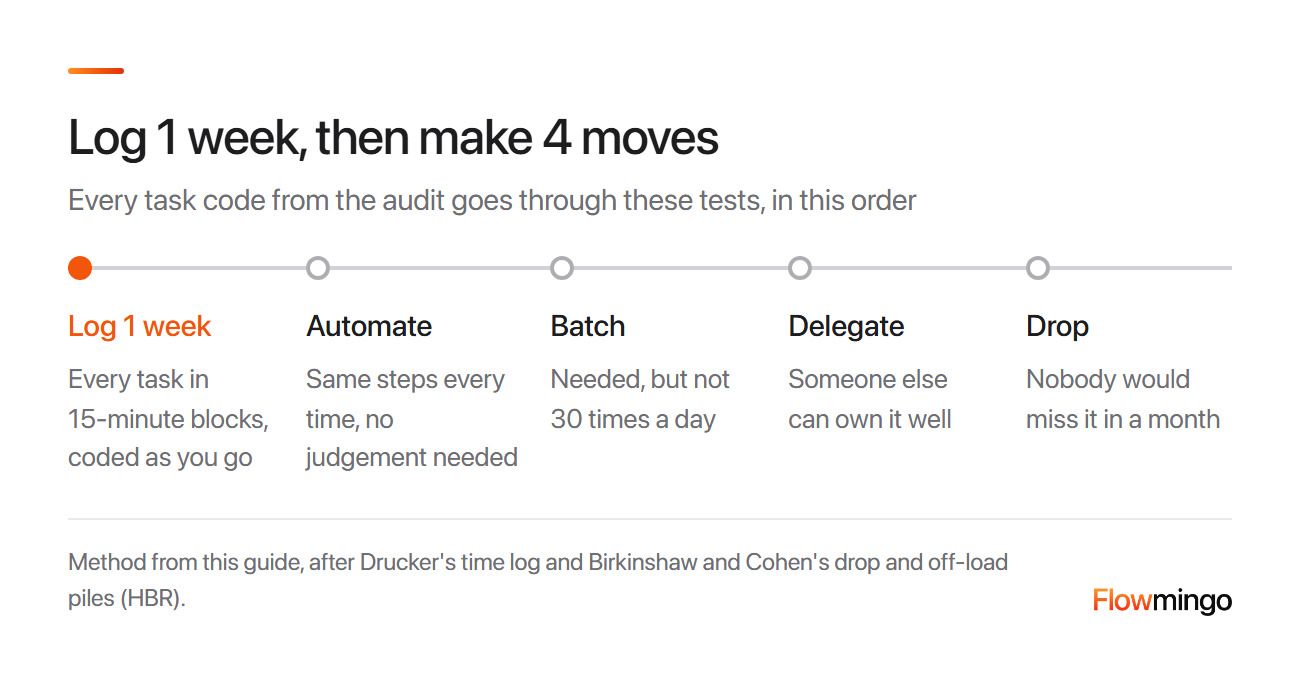
4 moves after the audit: log 1 week in coded blocks, then automate, batch, delegate or drop each task.
The flow starts with the coded log. Automate takes the same steps every time, with no judgement needed. Batch takes work that is needed, but not 30 times a day.
Delegate is for work someone else can own well, and drop is for work nobody would miss in a month.
4. Which recruiter tasks should we automate first to reduce recruiter workload without losing quality?
Automate the steps that run the same way every time: first-round screens, invites, reminders and status emails. Keep a person on every hiring decision, and the bar stays where it was.
The strongest evidence is a field trial at 1 recruiting firm in the Philippines. Jabarian and Henkel randomly assigned 67,056 of 70,884 entry-level applications to an AI voice interviewer, a human recruiter or a free choice.
AI-interviewed applicants were 12% more likely to get an offer, 9.73% against 8.70%, and 18% more likely to start the job. Recruiters made every hiring decision, and a full human-led interview took 10 to 20 minutes.
AI helps most where work repeats. When 5,172 customer-support agents got an AI assistant, issues resolved per hour rose 15% (Brynjolfsson, Li and Raymond). That was support work, so read it as a pattern.
On Flowmingo, most finished AI interviews come from a few big projects:
Flowmingo data · 37,054 finished AI interviews · 1,955 hiring projects · 724 companies · 14 Aug to 11 Nov 2026
- 3 finished AI interviews came from the median hiring project over those 90 days.
- 14.5% of hiring projects finished 20 or more AI interviews in the window.
- 80.6% of all finished AI interviews came from those projects with 20 or more.
- 27.9 minutes was the median length of a finished AI interview, from start to end.
Counts only projects that finished at least 1 AI interview, and only interviews finished in those 90 days, not over the life of a role. Length is wall-clock time, including the AI interviewer's own turns and pauses.
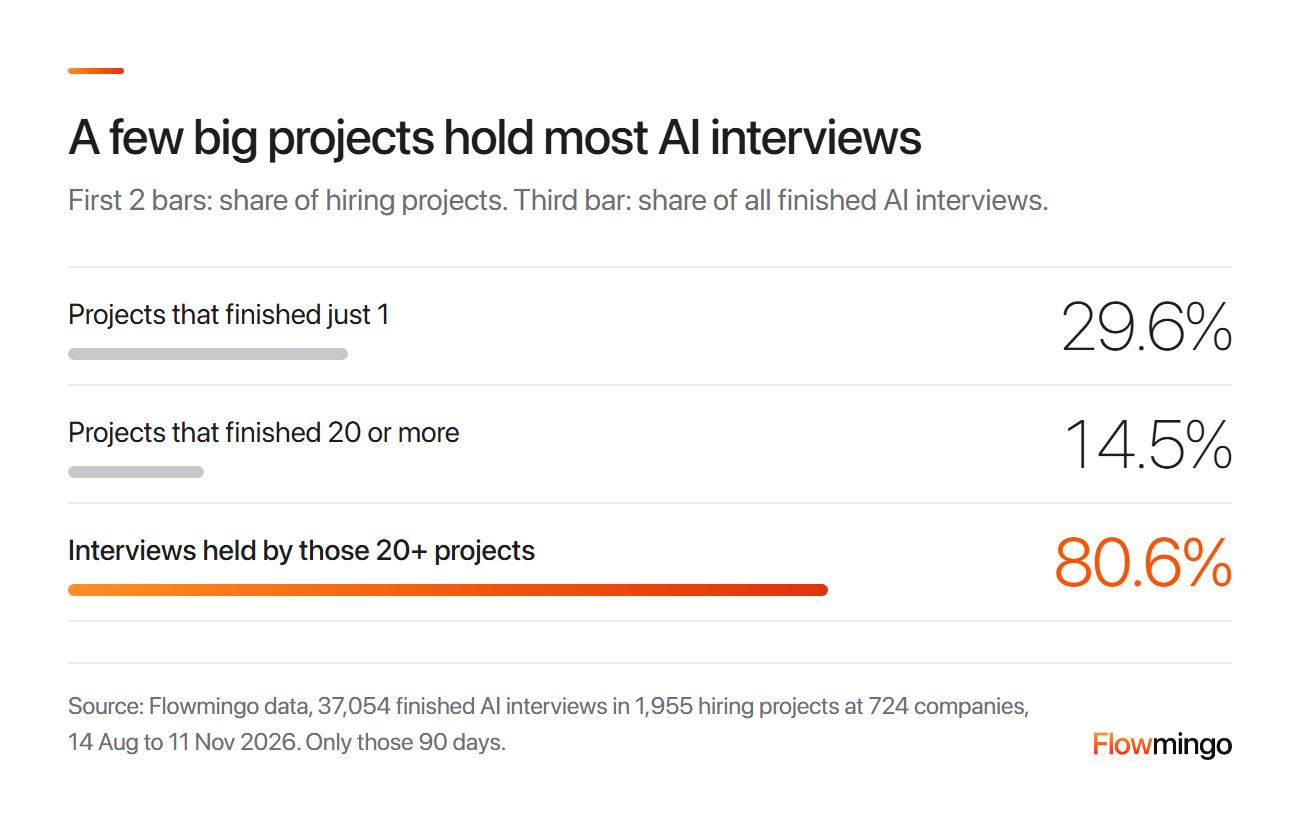
AI interviews by project size: 29.6% of projects finished just 1, and the 14.5% that finished 20 or more held 80.6% of all finished interviews.
The bars show 29.6% of projects finishing just 1 interview, often a trial. This means the saving matters most on your high-volume roles, not on a senior search with 4 applicants.
For 1 big role, take the median project with 20 or more: 41 finished interviews in 90 days. As 20-minute live calls, the top of the trial's range, plus 10 minutes each to book and write up, that is 20.5 recruiter hours.
Reading 41 reports at 5 minutes each takes about 3.4 hours, by our arithmetic on those assumptions. The card's 27.9 minutes is the candidate's time, not yours: it counts the AI's turns and pauses, and paid plans allow longer interviews. Our recruiting automation guide maps the wider tool set, and automated first-round interviews covers the setup.
How Flowmingo helps
Flowmingo is a free AI hiring platform, and its AI Interviewer takes the repeatable first round off your calendar. You send 1 link, and each applicant answers on camera in their own time. The AI asks a follow-up when an answer is thin or off topic. You get the recording, the transcript and a report scored against your criteria, and who moves forward is always your call. An interview runs up to 20 minutes on Free, 30 on Starter and 60 on Growth.
5. Hundreds of applicants per role: how do we reduce recruiter screening workload without missing good people?
Rank every applicant against written must-haves instead of reading in arrival order, and ask the hard facts in the form. Then keep a person on every cut.
Ranking is how you reduce recruiter workload at the screening stage. In the IrishJobs survey, 73% of recruiters said screening many irrelevant applications slows hiring.
The safe order is facts, then scores, then a human read. Pass/fail facts, such as right to work or shift hours, go in the form as screening questions for job applicants. Applicants answer them, so they cost no reading time.
Everyone left gets the same scored first round, and recruiters read the ranked list from the top. Our high-volume recruiting guide covers the funnel, and candidate shortlisting covers how many names to keep.
Flowmingo users already hand the first invite to a rule:
Flowmingo data · 94,409 AI interview invites · 742 companies · created 14 Aug to 11 Nov 2026
- 72.1% of these invites went out automatically, through a job-post rule a recruiter set, when someone applied.
- 66.3% is that same share once the single largest company is left out.
Counts only invites sent by a recruiter or by a job-post rule a recruiter set. It counts invites sent, not interviews taken.
About 2 in 3 or more needed no recruiter click, though a rule never replaces the human check on who drops out.
In 1 Reddit thread on hiring without burning out, 4 replies gave the same guard: rank with the tool, reject with a person.
Re-read a sample of the "no" pile every week, for example 1 in 10. If a strong applicant turns up there twice, fix the rule, not the reviewer.
How Flowmingo helps
On a Flowmingo job post, a rule can invite every applicant who passes pre-screening or reaches a CV score you choose. You pick the timing, from immediately to 7 days after they apply. CV Evaluation scores every CV against your criteria, unlimited on every plan, including Free. Flowmingo rejects nobody automatically, so a person makes every cut.
6. Scheduling and follow-ups eat our week: what should recruiters batch instead of doing all day?
Batch the work that is needed but arrives in pieces: email, scheduling, status updates and debriefs. Give each 1 or 2 fixed blocks a day, and protect the rest for calls and sourcing.
In foundational 2001 experiments, Rubinstein, Meyer and Evans found each switch between tasks costs time, more for complex tasks. In the lab, each switch cost only tenths of a second.
The bigger cost is stress. In a foundational 2008 study by Mark, Gudith and Klocke, 48 people played an HR manager answering email under interruptions.
They finished faster with no loss of quality, but reported more stress, frustration and time pressure after only 20 minutes. This means batching may not show up as saved hours, because its payoff is fewer restarts and less strain.
Microsoft's 2025 Work Trend Index found the most-interrupted fifth of users get a ping about every 2 minutes in core hours.
Here is a batched day to copy, with times as our suggestion:
- 9:00 to 9:30: email and status updates, block 1.
- 9:30 to 12:00: screens, calls and hiring-manager intake.
- 13:00 to 13:30: all scheduling and rescheduling for the day.
- 13:30 to 15:30: sourcing with notifications off.
- 16:00 to 16:30: email and status updates, block 2.
Invites already go out in batches:
Flowmingo data · 26,382 AI interview invites recruiters sent themselves · 6,481 sends · 392 companies · 14 Aug to 11 Nov 2026
- 66.1% of these invites went out in sends of 10 or more candidates at once.
Leaves out job-post rules and other automatic invites. A send is 1 invite action for 1 AI interview.
Yet most sends in the same data were for 1 person. Those 1-at-a-time clicks are most of the actions and the smallest part of the volume, so batch them first. To invite 50 or more at once, use our interview invitation email templates.
How Flowmingo helps
An AI interview has nothing to book: each applicant starts when it suits them, on a laptop or a phone. Flowmingo sends up to 2 reminders, about 2 and 4 days after the invitation, unless the candidate has already taken the interview. Later rounds go in your own calendar.
7. Hiring managers slow everything down: what can they own to reduce recruiter workload?
Give hiring managers 3 things to own in writing: the intake sign-off, feedback within 1 working day and weekly interview slots. Recruiters then stop chasing, and roles move.
In the IrishJobs survey, recruiters named an unclear split of roles between recruiters and departments (21%), poor stakeholder availability (20%) and gathering hiring-manager feedback (19%).
Scheduling shows the same gap. In GoodTime's survey, 31% of TA leaders named hiring manager availability as a scheduling bottleneck. Scheduling delays and a limited interviewer pool came top, at 35% each.
Here is a 1-page agreement to copy, with deadlines as our suggestion:
| Who | Owns | Deadline |
|---|---|---|
| Hiring manager | Signs off the must-haves at intake | Before the job goes live |
| Hiring manager | Scores each interview on the scorecard | Within 1 working day |
| Hiring manager | Holds 2 interview slots a week | Every week the role is open |
| Recruiter | Sends a ranked shortlist with evidence | Within 5 working days of going live |
The written intake matters most, because a changing spec restarts the search. For example, a must-have added in week 3 becomes a new intake, not a quiet extra screen. A same-day scorecard is easier to trust, and our interview scorecard template gives managers 1 to fill in.
7.1 Should I hire a recruiting coordinator or sourcer before another recruiter to cut workload?
Let the audit decide. If scheduling and candidate email fill most of the logged week, a coordinator buys back more recruiter hours than a new recruiter.
Ashby's foundational data to mid-2024 found each coordinator worked with about 4 recruiters. Coordinators per organisation fell from about 4 in early 2022 to 2 by the end of 2023.
If sourcing keeps shrinking on hard-to-fill roles, a sourcer protects the work that produces hires. In a Reddit thread on recruiter load, the top reply put it plainly. Without sourcing, a recruiter can carry 20 to 30 reqs; with sourcing, 10 to 15.
8. Which 20% of recruiter work drives 80% of our hires, and what can we drop?
The 80/20 rule is a prompt to look, not a measured law. Find the few tasks that produce most hires, protect them, and drop what nobody would miss.
The idea is the Pareto principle, which quality pioneer Joseph Juran named in foundational work from the early 1950s. The Juran Institute calls the few causes behind most of an effect the "vital few".
In Greenhouse's 2026 benchmark report, on 2025 data, recruiters sourced nearly 10% of hires from only 3% of applications. Job boards brought nearly 75% of applications but less than half of hires.
This means sourcing may be your vital few, and the audit shows whether it is squeezed. Protect it first, then look for quick kills you can stop now with no harm.
Birkinshaw and Cohen tested this with 15 executives. Dropping and off-loading low-value work cut their desk work by an average of 6 hours a week and meetings by 2.
Good candidates to drop, if you want to reduce recruiter workload this month:
- A weekly status report built by hand, when a shared pipeline view would do.
- Status meetings that repeat what the ATS shows.
- Re-reading CVs a written scorecard has scored.
Stop each 1 for 2 weeks, and keep it dropped if nobody asks for it.
9. How many open reqs per recruiter is too many for our mix of roles?
There is no single safe number, because a req's weight depends on the role and on what else the recruiter does. Benchmarks put it at about 13 open at once on average (Gem), or a median of 20 a year (SHRM).
In SHRM's 2025 benchmarking, dedicated recruiters carried a median of 20 requisitions a year. That was 6 at organisations under 100 staff, 22 at medium firms, 50 at large firms and 60 at the largest.
SHRM adds that the higher loads "may signal a risk of recruiter burnout". Gem counts 13.4 open roles at a time instead, so never compare a yearly count with an at-once count.
Your mix matters more than the average, so a blunt cap fits few teams. 22 high-volume hourly roles with automated first rounds are not 22 senior searches.
Weight each open req before you set a cap:
| Req type | Weight | Why |
|---|---|---|
| Senior, technical or executive search | 2 | Sourcing-heavy, long intake |
| Standard professional role | 1 | The baseline |
| High-volume role with automated first round | 0.5 | Screening hours moved off the recruiter |
For example, 6 senior searches, 10 standard roles and 6 high-volume roles make 22 open reqs. Weighted, that is 12 + 10 + 3 = 25 units, so set the cap in units and rebalance above it.
10. How do I show leadership that we need to reduce recruiter workload, not push harder?
Bring 1 page: the audit's hours by code, the 4 moves, the hours each gives back and where they will go. A measured plan is easier to approve than a request for more effort.
In Employ's survey, recruiters whose job got less stressful credited AI recruiting tools most, at 42%. Other reasons included being able to meet candidate expectations (36%), more recruiters or resources (33%) and stable open roles (30%).
Set honest expectations, because leaders will measure you on the promise. LinkedIn's Future of Recruiting 2025 found TA pros using generative AI saved about a fifth of their work week, a full workday.
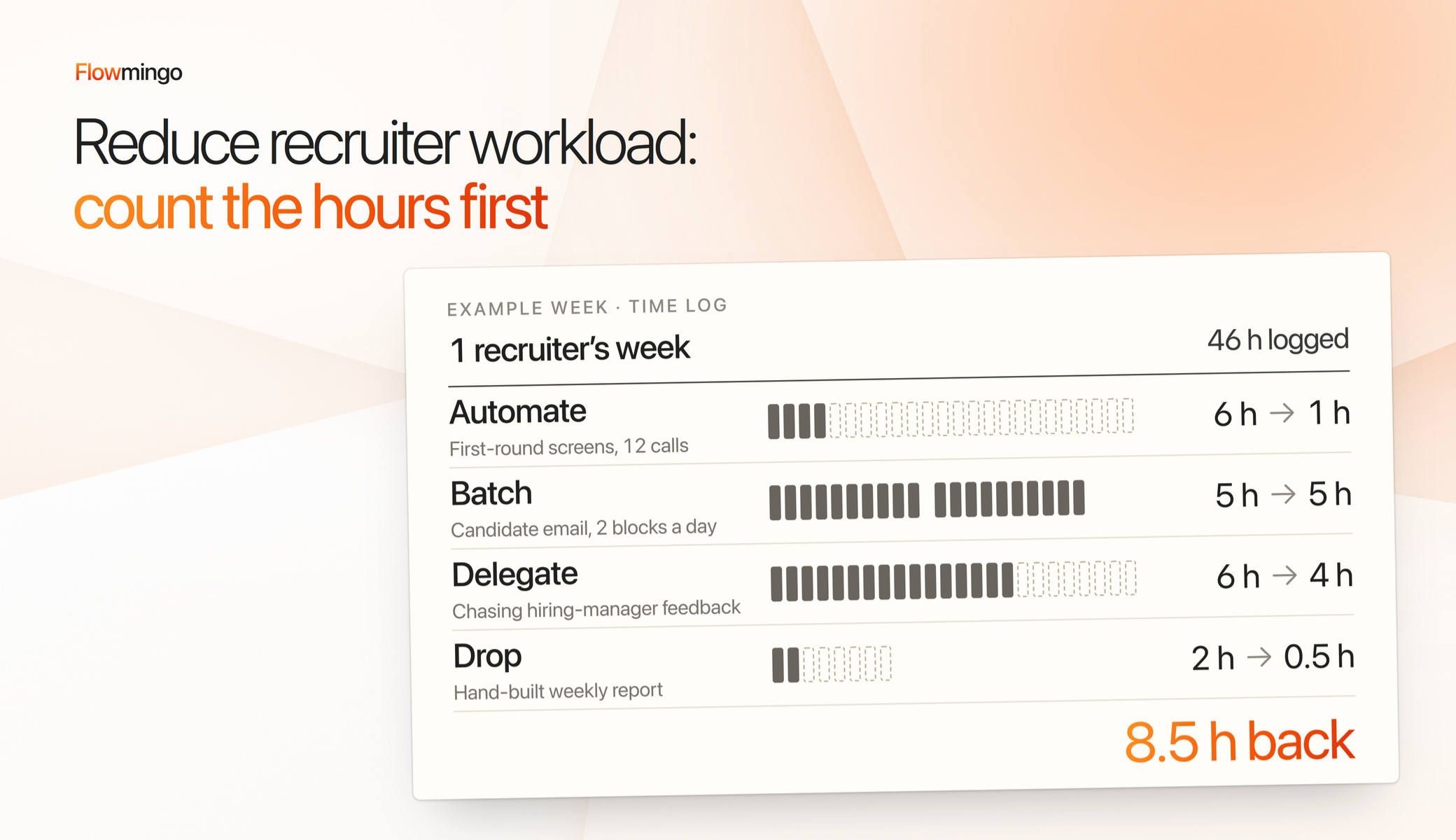
That is about 8 hours on a 40-hour week, near the 8 hours Birkinshaw and Cohen measured. The worked example shows the same scale on 1 illustrative recruiter with 46 logged hours:
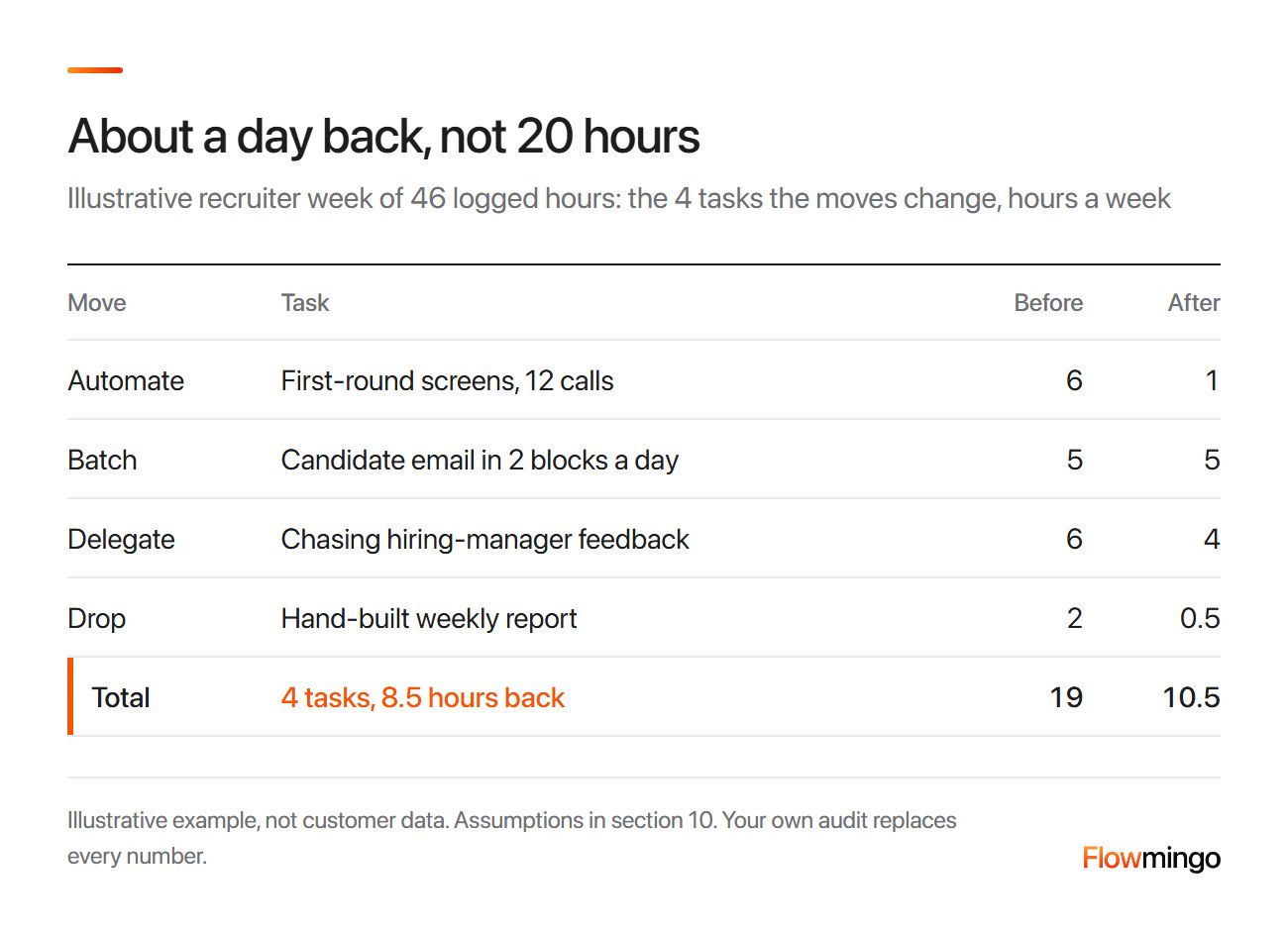
Hours back, worked example: 4 moves take 19 logged hours on 4 tasks down to 10.5, so 8.5 hours a week come back.
Automate turns 12 first-round calls, 6 hours, into 12 reports at 5 minutes each, about 1 hour. Batch moves candidate email into 2 blocks a day, so it stays at 5 hours but stops breaking up the day.
Delegate cuts chasing hiring-manager feedback from 6 hours to 4 once the deadline is in writing. Drop swaps a hand-built weekly report, 2 hours, for a shared view at 0.5, and 20 hours would mean deleting nearly half the week.
In law, the UK's Health and Safety Executive says employers must assess the risk of stress at work and act on it. With 5 or more workers, it must be written down.
Singapore's foundational 2023 Tripartite Advisory on Mental Health and Well-being at Workplaces is guidance employers can adopt, not law. It names workload as a cause of work stress.
10.1 After the changes, how do I tell whether recruiter burnout is actually falling?
Re-run the 1-week log 6 weeks later and compare. Then add 3 monthly pulse questions that follow WHO's 3 signs of burnout.
Track 4 numbers monthly: hours per code, weighted reqs per recruiter, after-hours time and the share of the week on sourcing. If after-hours time falls and sourcing grows, the hours went where you meant them to.
Score each question 1 to 5: how drained recruiters feel by Friday, how much they still care about their roles, and how effective they feel. Our recruiting metrics guide covers the hiring numbers to report beside them.
How Flowmingo helps
Flowmingo connects to 20+ ATSs on every plan, so results land in the system your team already uses. When a candidate reaches the stage you pick, Flowmingo sends the AI interview. In most ATSs it then writes the score out of 100 and a report link back, while Workday gets a file. It is a stage-triggered connection, not a full sync. Try Flowmingo free as your first move to reduce recruiter workload.
11. Sources
Every study, survey and rule in this guide links to a source below; Flowmingo figures come from Flowmingo's own platform data.
- Ashby (2024). Recruiting coordination. Ashby Talent Trends Report.
- Birkinshaw, J., & Cohen, J. (2013). Make time for the work that matters. Harvard Business Review.
- Brynjolfsson, E., Li, D., & Raymond, L. (2025). Generative AI at work. The Quarterly Journal of Economics, 140(2), 889-942.
- CareerBuilder, via HR Dive (2017). CareerBuilder: Over half of HR managers predict AI will be part of their future. HR Dive.
- Drucker, P. F. (1967). The effective executive. Harper & Row.
- Employ (2025). 2025 Recruiter Nation Report. Employ Inc.
- Gallup (2018). Employee burnout, part 1: The 5 main causes. Gallup Workplace.
- Gem (2025). Key takeaways from the 2026 Recruiting Benchmarks report. Gem.
- GoodTime (2026). Hiring insights 2026: Lessons from 2025. GoodTime.
- Greenhouse (2026). The Hire Standard: Greenhouse benchmark report, North America. Greenhouse.
- Health and Safety Executive (n.d., read 2026). Stress risk assessment. HSE.
- IrishJobs (2025). What's slowing down your hiring? New survey reveals the top blockers and breakthroughs. The Stepstone Group.
- Jabarian, B., & Henkel, L. (2026). Voice AI in firms: A natural field experiment on automated job interviews. arXiv working paper.
- Juran Institute (n.d., read 2026). A guide to the Pareto principle (80/20 rule) and Pareto analysis. Juran.
- LinkedIn (2025). The future of recruiting 2025. LinkedIn Talent Solutions.
- Mark, G., Gudith, D., & Klocke, U. (2008). The cost of interrupted work: More speed and stress. Proceedings of CHI 2008, 107-110.
- Microsoft (2025). Breaking down the infinite workday. Work Trend Index special report.
- Ministry of Manpower, NTUC and SNEF (2023). Tripartite advisory on mental health and well-being at workplaces, 2nd edition. TAFEP.
- Reddit, r/recruiting (2026). Recruiter requisition load. Reddit.
- Reddit, r/RecruitmentAgencies (2026). How are you handling high volume hiring without burning out your recruiters. Reddit.
- Rubinstein, J. S., Meyer, D. E., & Evans, J. E. (2001). Executive control of cognitive processes in task switching. Journal of Experimental Psychology: Human Perception and Performance, 27(4), 763-797.
- SHRM (2025). 2025 recruiting executives benchmarking. SHRM.
- World Health Organization (2019). Burn-out an "occupational phenomenon": International Classification of Diseases. WHO.