
You have 150 applicants for 1 role and 1 recruiter, and must decide: should you interview every applicant or let a CV filter pick 30.
Greenhouse's North American data shows the squeeze: from 2022 to 2025, applications per job doubled while recruiters per organisation halved.
Phone-screening all 150 for 30 minutes each takes 75 hours. So the usual fix is a CV cut to 30, which is where career changers, thin CVs and second-language writers drop out. In our projects, a top-fifth CV cut left out about 6 in 10 strong interview scorers, against 8 in 10 for a random cut.
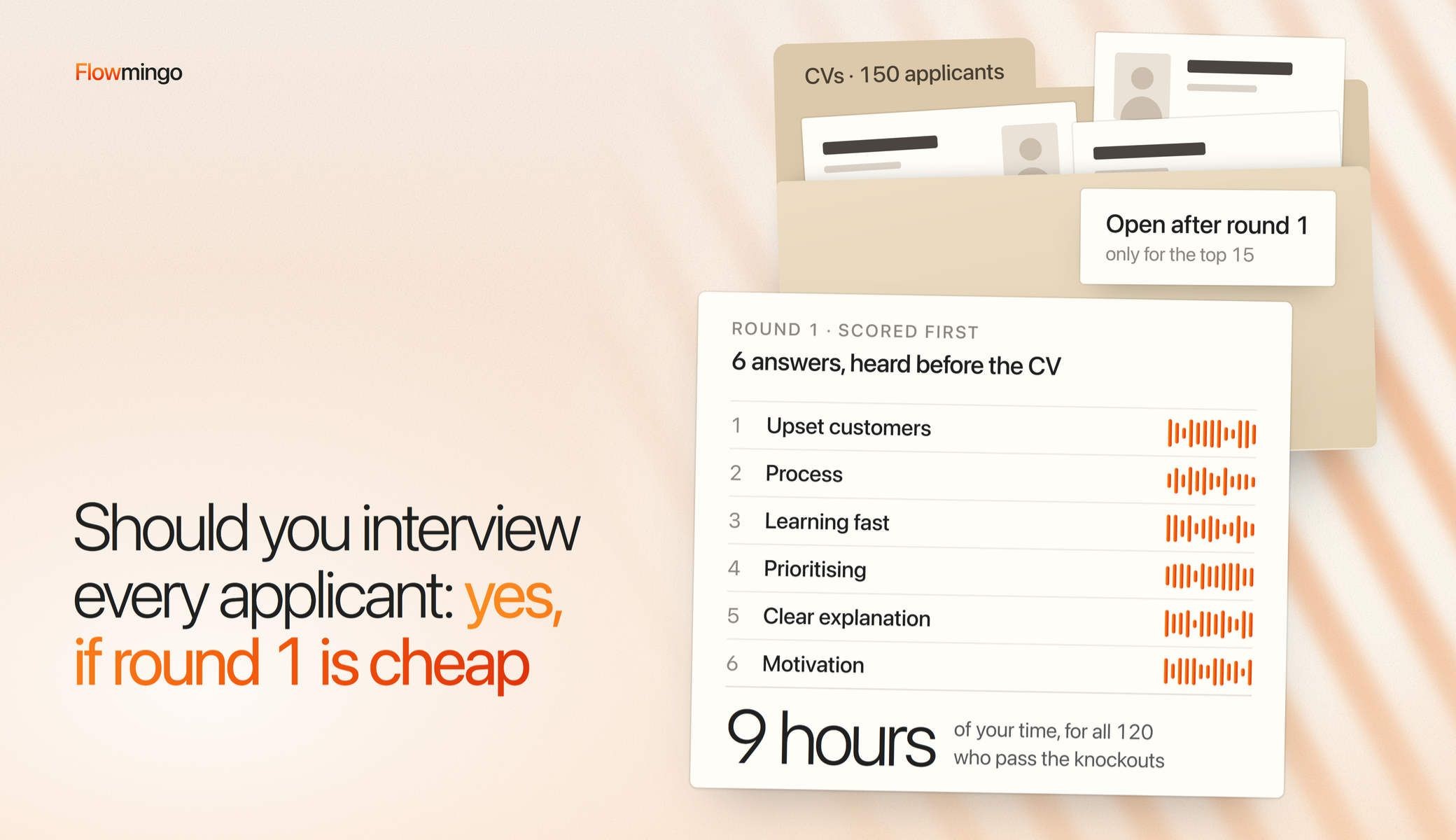
Hearing all 120 who pass 5 knockouts takes about 9 hours. Ask them the same 6 questions in their own time, then score the answers before any CV.
Key takeaways
- Should you interview every applicant for a role with 150 applicants? For most trainable roles, yes, in a short first round they take in their own time. Not for a senior role with about 6 strong applicants.
- Does the CV filter really throw away good people? Often. Among candidates who did both stages, a top-fifth CV shortlist would have left out about 6 in 10 scoring 8+ out of 10 in our AI interview. A random fifth would leave out 8 in 10.
- What predicts job performance better than years of experience? A structured interview, with the same scored questions for everyone, predicts about 6 times better.
- How many hours does it take to interview every applicant? About 75 hours of phone screens for 150, or about 9 for a scored first round after knockouts.
- Do I legally have to interview every applicant? Not by default in the UK or the US. UK Disability Confident employers offer an interview to disabled applicants who meet the minimum criteria. Singapore's TAFEP advises keeping records for at least 1 year.
1. Should you interview every applicant when 1 recruiter has 150 of them?
Yes, for a short first round that everyone who passes your knockouts takes in their own time. No, for a senior role with a handful of strong applicants, because live interviews for all of them already cover the field.
Most applicants never get past the first step: only 7.6% passed what Greenhouse's North American report calls stage 1 in 2025, about 19 in 244.
LHH, the page ranking first for this question, says in a foundational 2024 guide that interviewing every applicant is "neither feasible nor effective". That is right for 75 hours of 30-minute calls, but wrong for a short, scored first round answered in the applicant's own time.
A stricter CV cut is no substitute, because it hears fewer people without picking better ones. At 1 Fortune 500 firm that rejected 95% of applicants at CV review, 90% of interviews still ended without a hire (Li, Raymond and Bergman).
There, the firm randomly assigned applicants to screeners who differed in strictness. Strict screeners did not pick a stronger group, and if anything lenient ones did slightly better.
In the figure's example, 150 applicants meet 5 knockouts, and the 120 who pass get the same 6 questions in their own time. You rank the answers, open the CV only for the top band and take 3 to 5 to live interviews.
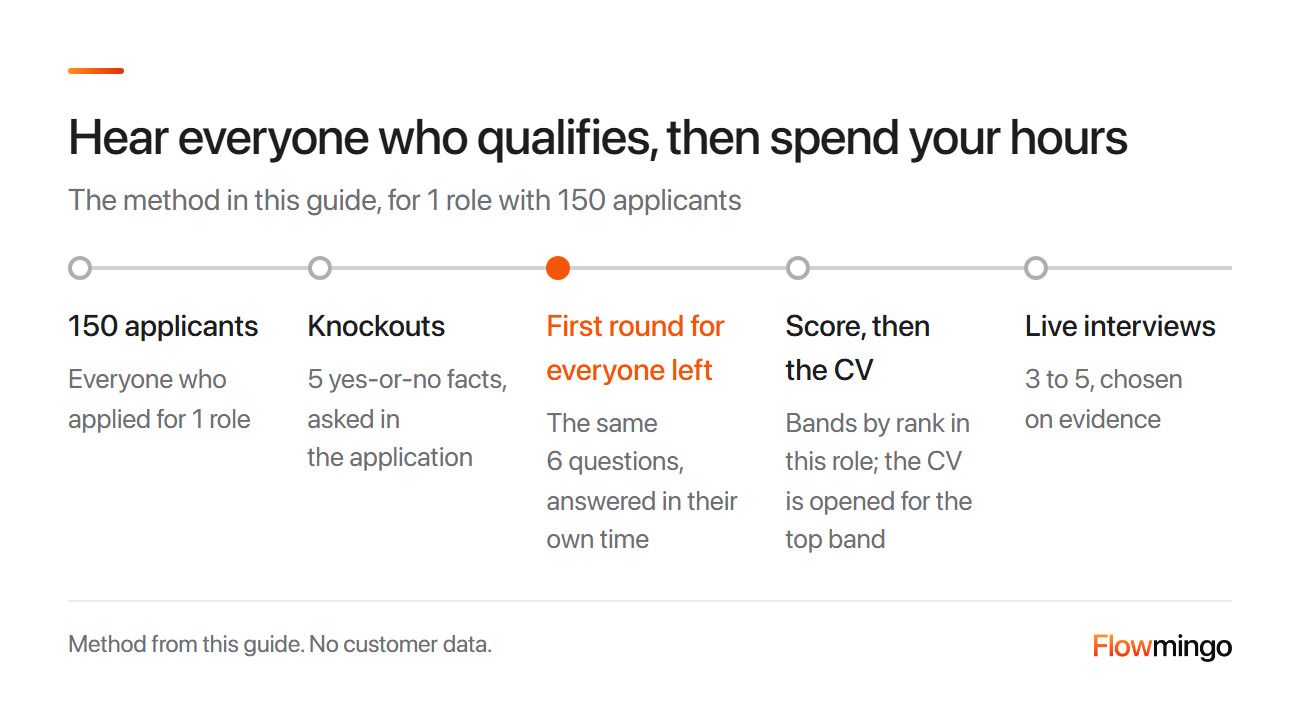
First round for everyone: 150 applicants, 5 knockouts and the same 6 questions in their own time. Then bands by rank before the CV, and 3 to 5 live interviews.
2. For which roles should you interview every applicant, and when is a CV shortlist enough?
Interview all applicants who pass the knockouts when the CV is a weak signal, as in hourly, entry-level and career-changer roles. A CV shortlist is enough when few people apply and most look strong, as with senior roles.
Hourly roles have the strongest evidence. In a foundational 2008 study, a US retailer's 1,363 stores moved from informal screening to the same test for every hourly applicant (Autor and Scarborough). Median tenure rose by 10% or more, with no measurable change in minority hiring.
It was a test added before the manager's interview, which both regimes kept, but the same first step for everyone beat informal screening.
With 6 strong senior applicants, interview all 6 live, because a recorded round adds a step without adding information. For a licensed role, the licence is a knockout, and then every holder gets the first round.
For example, with 150 applicants for 10 night-shift warehouse pickers, shift availability is the knockout, because CVs do not show who turns up at 22:00.
The illustrative figure sorts roles by what the CV tells you. An hourly CV says little about reliability, a graduate's shows degrees and a career changer's titles do not match.
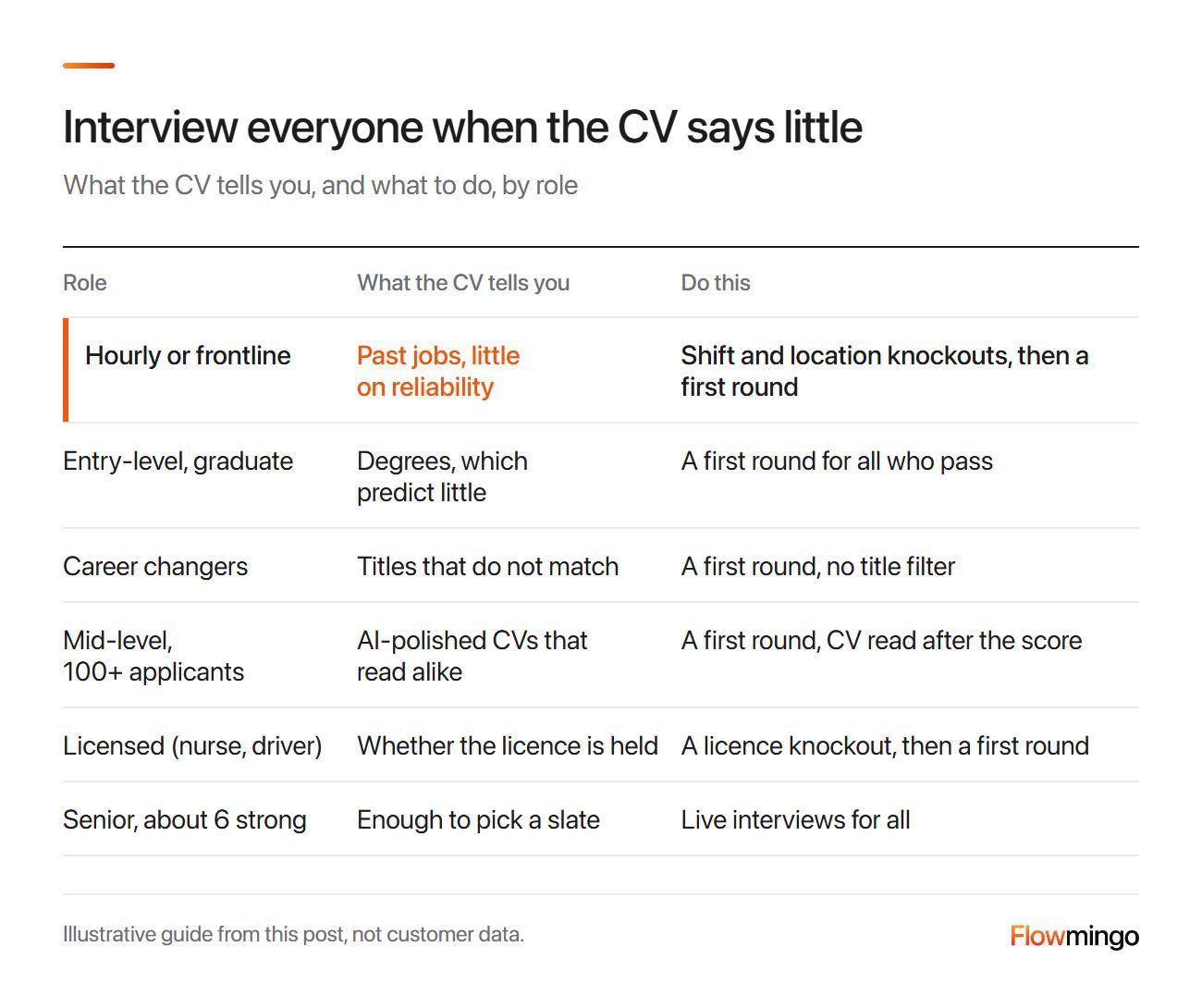
Role guide: hourly, entry-level, career-changer, mid-level and licensed roles get a first round after any knockouts. Senior roles with about 6 strong applicants get live interviews for all.
3. My CV filter rejects career changers and thin CVs: how many good candidates am I missing?
Probably more than you think: 88% of employers in a foundational Harvard Business School survey agreed their filters screen out qualified high-skills candidates. Rules on gaps, titles and thin CVs catch career changers and carers, and spelling errors cost interviews too.
That survey, Hidden Workers, covered 2,275 executives in 3 countries (foundational, 2021). Almost half screened out any CV with a gap of over 6 months.
Degree filters mislead too. In a foundational 2013 interview, Google's Laszlo Bock said some teams were 14% people who never went to college (The New York Times). A degree filter would have cut every one of them before an interview.
Spelling can cost a second-language writer the interview, because recruiters read typos as low ability. In a foundational 2023 experiment with 445 recruiters, 2 spelling errors cut a CV's interview chance by 7.3 points (Sterkens and colleagues). Its CVs were fictitious Flemish graduates' CVs in Dutch, so it did not test second-language writers: for them the risk is plausible, not measured.
Flowmingo data · 25,637 candidate results · 539 hiring projects · 246 companies · AI scores 9 Jul to 4 Nov 2026
- 12.5% of 457 projects gave the top AI interview score to the candidate with the top AI CV score among those interviewed, where chance alone gives 5.7%.
- 61.2% of 2,270 candidates who scored 8 or more out of 10 in the AI interview had an AI CV score below their project's top-20% cut, against 78.6% for a random applicant.
Both are Flowmingo AI scores, not job performance, and only candidates who did both stages count. The 2 stages rank people differently, and this does not show which ranking is right.
The 2 rankings named the same top candidate in about 1 in 8 projects, against 1 in 18 by chance. So the CV carries some signal, but in about 7 of 8 projects the top interview scorer was not the CV's first pick.
A top-fifth CV cut kept about 4 in 10 of those scoring 8 or more, against 2 in 10 for a random fifth.
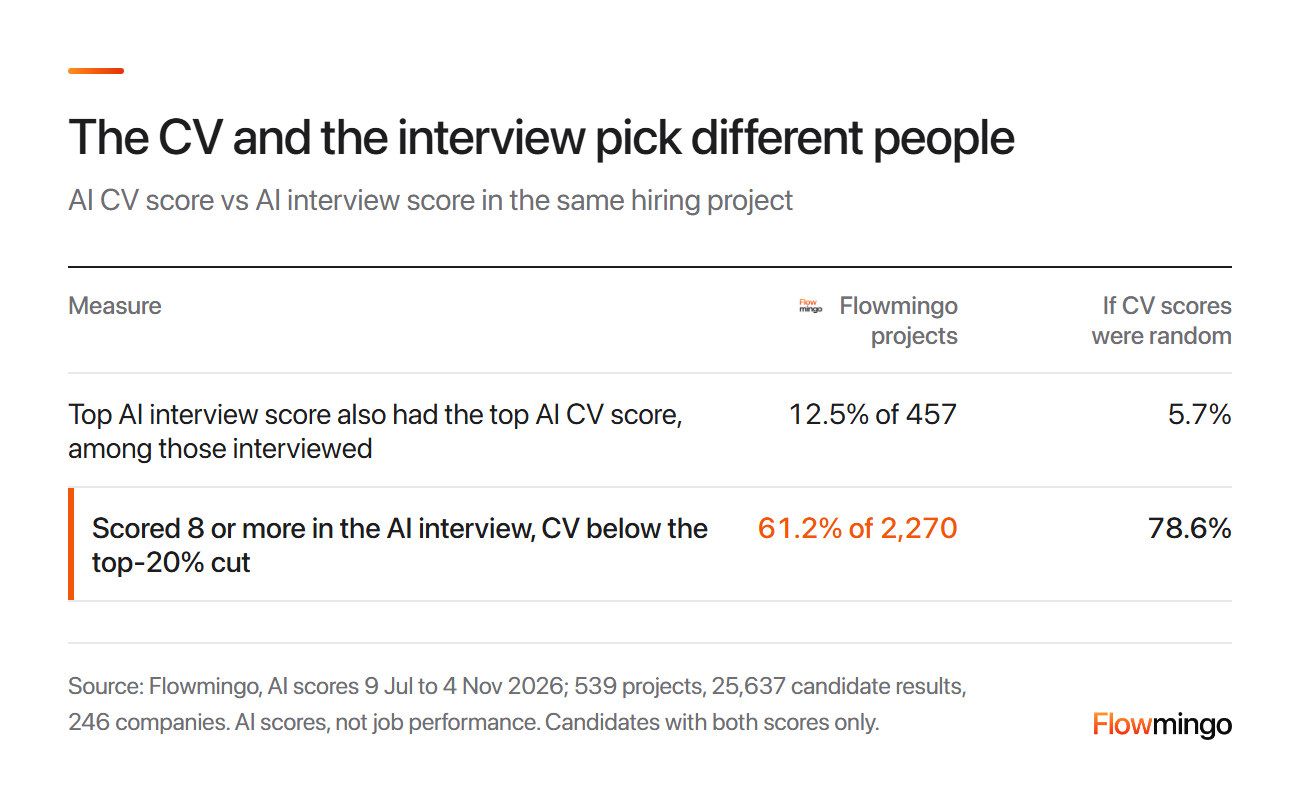
CV vs interview: the top interview score had the top CV score in 12.5% of 457 projects, against 5.7% by chance. 61.2% of 2,270 strong interviewers sat below the CV cut (random 78.6%).
The next figure shows who a CV rule cuts, the same shift as in skills-based hiring.
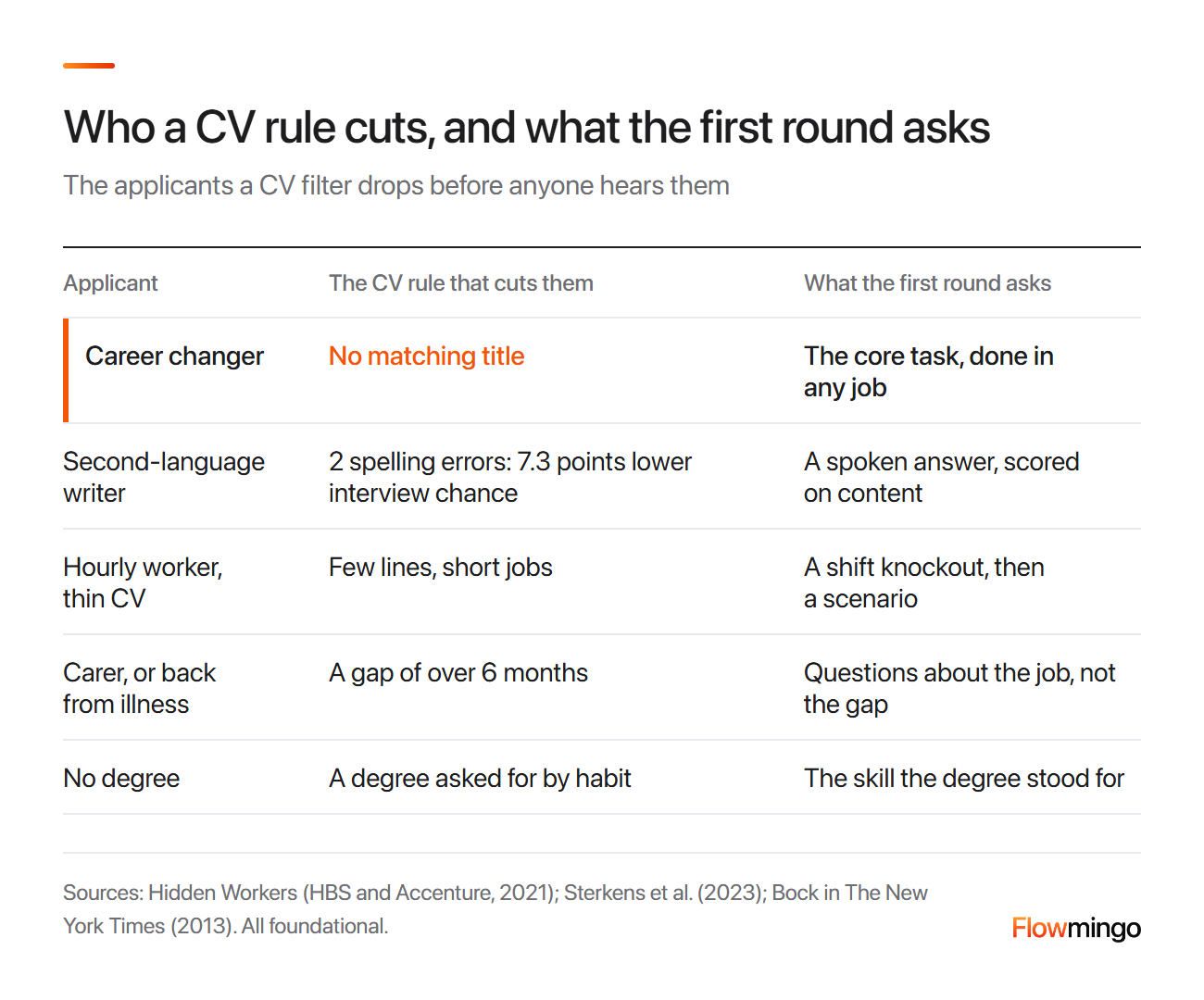
Who CV rules cut: career changers, second-language writers, hourly workers with thin CVs, carers with a gap and people without degrees. The first round asks about the job instead.
4. Do years of experience and degrees on a CV predict who will do the job well?
Barely: in a foundational 2022 re-analysis of hiring research, a structured interview predicted job performance about 6 times better than years of job experience.
In that re-analysis, Sackett and colleagues put the structured interview first, at 0.42 on a scale from 0 (no link) to 1 (perfect). An unstructured interview scored 0.19, and years of job experience 0.07.
Years of education scored 0.10 in Schmidt and Hunter's foundational 1998 review, which Sackett and colleagues did not re-estimate. Results vary, and about 1 in 10 structured interviews predicts at 0.18 or less, so how you write and score them matters.
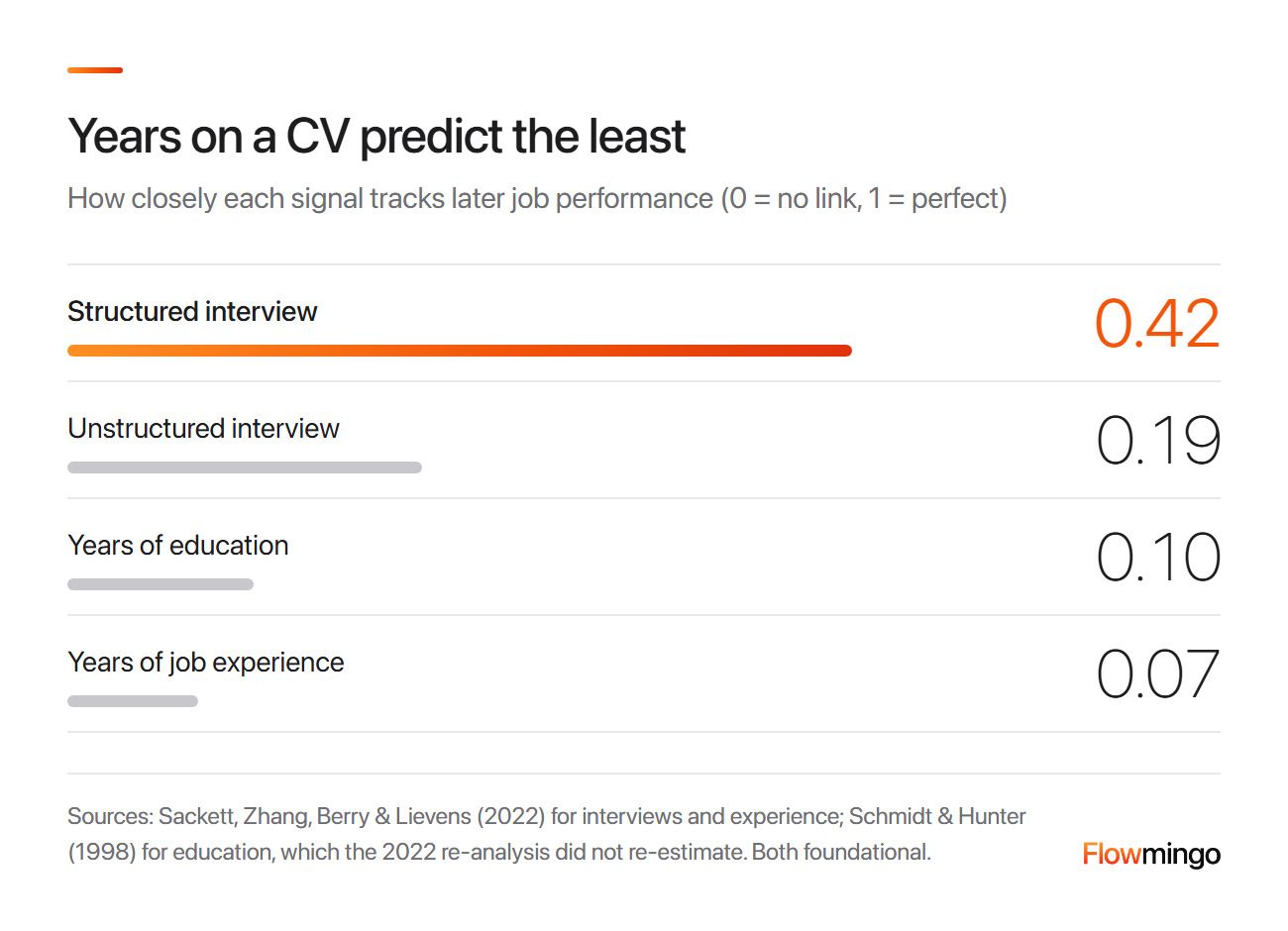
What predicts performance: structured interview 0.42, unstructured interview 0.19, years of education 0.10 and years of job experience 0.07, from foundational reviews.
4.1 When AI writes every CV, the CV says even less
When AI tailors every CV to the advert, a close match stops separating people. It shows how well someone prompts a writing tool, not how well they do the job.
Managers on r/managers describe it, though these are reports, not evidence. 1 hiring manager said every CV now opens the same way. Another got 3,000 applicants in a week for 1 IT role, and 75% claimed experience of tools used only inside that company.
A third met applicants claiming 8 or more years of SQL who then failed an easy SQL screen. So ask about a claimed task in the first round, for example: "Walk me through a report you built: the data, the decision it changed and what you would change." A strong answer names the source, the decision and the result.
5. How should you interview every applicant without burning out a 1-recruiter team?
Cut on yes-or-no knockouts first, then send everyone left the same 6 questions to answer in their own time. You spend minutes reading scored answers, not booking calls.
Keep it short, because a recorded round can put people off. In a field experiment with 3,000+ applicants, an asynchronous interview cut the share who carried on by 45 percentage points, against no interview step. A live online interview cut it by 17 points (Avery and colleagues).
It is a 2026 working paper, not yet peer-reviewed, and found the AI-scored recordings predicted later job success better than recruiters did.
Quality need not fall, according to a 2026 preprint of a field test at 1 firm with 67,056 randomly assigned applications. AI voice interviews made offers 12% more likely than recruiter interviews, with no drop in the hires' productivity (Jabarian and Henkel). People still made every decision.
5.1 Knockouts first: 5 yes-or-no facts, checked before any invite
A knockout is a fact that ends the application whatever else is true. Put each in the advert, because Acas says to use the information you told applicants you would use.
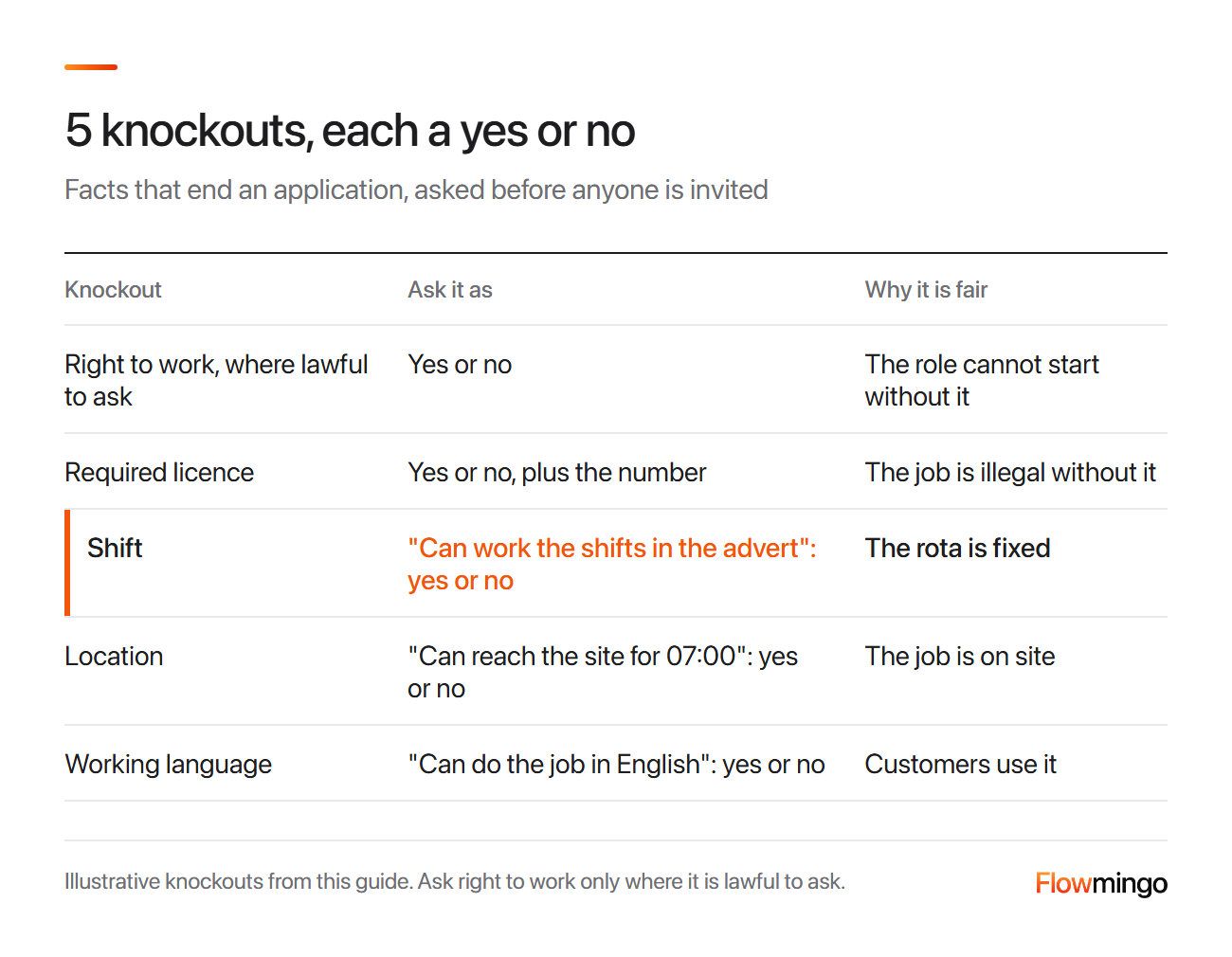
Knockout questions: right to work where lawful, a required licence, the shifts in the advert, reaching the site for 07:00 and the working language. Each is a yes or no.
Years of experience, a degree, a gap, a title or a CV score alone are not knockouts, because the job works without each. An office role may need only 2 or 3, as in our candidate shortlisting guide. A site job with shifts and a licence needs all 5.
5.2 The first round: 6 questions, the same for everyone
Write 5 or 6 questions tied to weighted criteria, with low, middle and high anchors. Here is an illustrative set for a high-volume support role.
| # | Question | Criterion (weight) | A strong answer shows |
|---|---|---|---|
| 1 | Tell me about a time a customer was angry with you, and how it ended. | Upset customers (Must Have, 4) | The problem, their words, the outcome |
| 2 | Walk me through your reply to a customer whose order is 3 days late and who wants a refund. | Process (Very Important, 3) | Facts checked, options, a time |
| 3 | Describe a time you had to learn a new system quickly. | Learning fast (Very Important, 3) | What, how long, how checked |
| 4 | Tell me about a shift when too much happened at once, and what you did first. | Prioritising (Important, 2) | A clear order and its reason |
| 5 | Explain, as you would to a customer, how to reset a password. | Clear explanation (Important, 2) | Steps in the right order, checks it worked |
| 6 | Tell me why this job, and what would make you stay a year. | Motivation, shift fit (Good to Have, 1) | Reasons tied to the job and hours |
Ask all 6 of everyone and write all 3 anchors, as here for question 2.
A low answer promises a refund at once or blames the courier, with nothing checked. A middle answer checks the order and apologises, then offers 1 fix. A high answer checks tracking and policy, offers a refund or a resend and says when the customer will hear back.
Our pre-screening interview questions and automated first-round interviews guides go further.
How Flowmingo helps
With Flowmingo's AI Interviewer, you send 1 link and each applicant does a spoken interview in their own time, on a laptop or a phone. You get the recording, the transcript and a scored report. Pre-screening questions on the job post mark each applicant Qualified or Disqualified, and a rule can send the interview to everyone who passes. You can mark questions must-ask, and when an answer is thin or drifts off topic, the AI asks a follow-up. AI interviews are unlimited on every plan, including Free.
6. 150 applicants and 30-minute phone screens: how many hours is that, and what is faster?
75 hours, before any scheduling. A scored first round for the 120 who pass the knockouts takes about 9 hours of your time, even if every one of them finishes.
The figure compares 3 ways through 150 applicants, in illustrative arithmetic, not customer data. It assumes 30-minute calls, 2 minutes a CV, 30 of 150 failing a knockout, the bands in section 7 and every answer scorable.
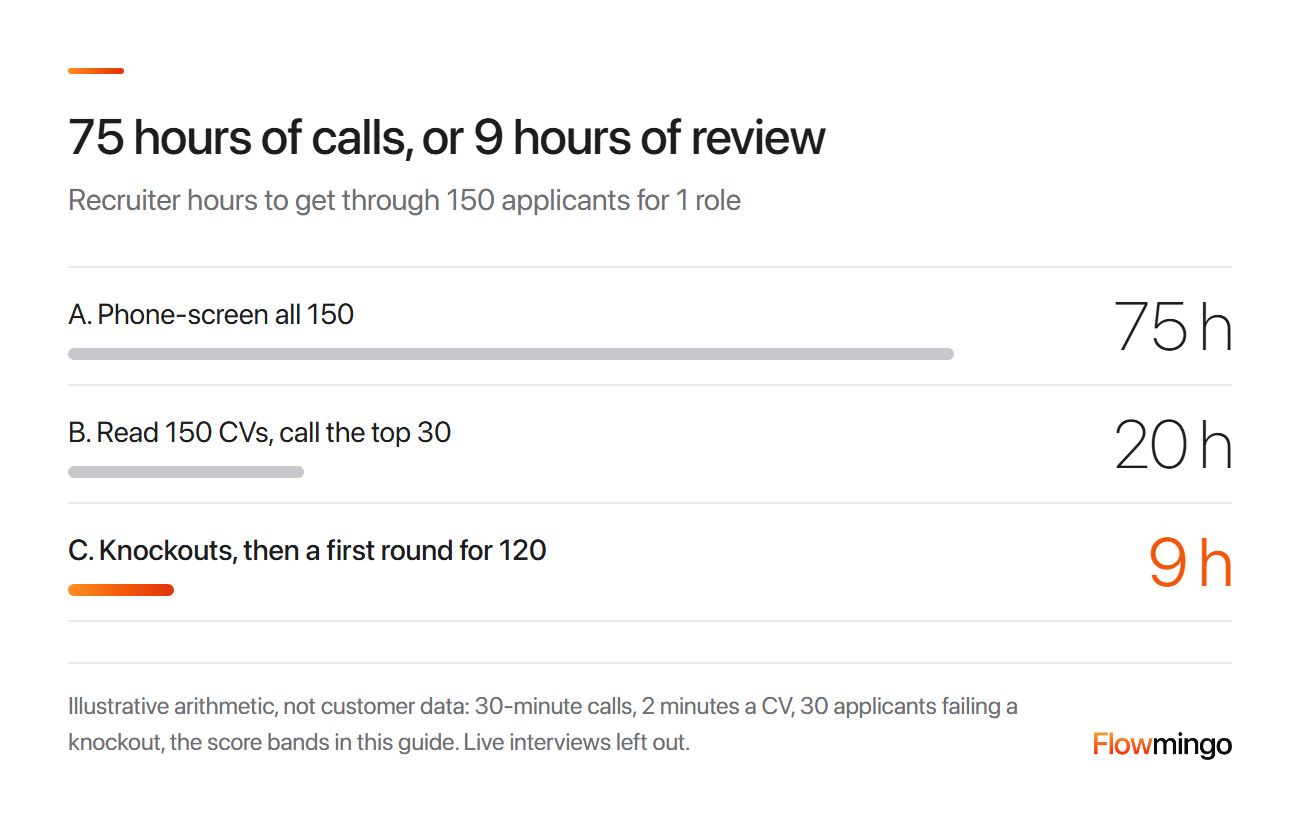
Hours for 150 applicants: 75 to phone-screen all and 20 to read 150 CVs and call 30. A first round for 120 takes 9: 1 hour of set-up, then 15, 15 and 90 answers at 15, 5 and 2 minutes.
Per applicant of all 150, that is 30 minutes for calls (A), 8 for the CV cut (B) and 3.6 for the first round (C).
2 minutes a CV sits between the 1-minute first pass and the 4-minute full read in our guide to screening resumes faster. Li, Raymond and Bergman cite a median of 31 seconds in software engineering recruiting. Fewer finishers also means fewer minutes, so 9 hours is the upper bound.
What option B saves is listening, not effort. For example, a career changer among the 120 CVs it sets aside is never asked a question.
Greenhouse counted 12.3 interview hours per hire in 2025, so option A spends about 6 times that before any live interview.
7. Should I score first-round answers before reading the CV, and where do the score bands go?
Yes: score the answers first, and open the CV only for people you are about to move forward. Set bands by rank within the role, and spend most minutes on the top one.
We read answers first because a CV opened first can colour how you hear them. A foundational 2018 study of 15 firms hiring hourly service workers supports scoring first and overriding rarely (Hoffman, Kahn and Li).
There, managers who most often hired against a job test's ranking got workers who left sooner. It tested a job test, not interview answers, so treat it as support, not proof. Either way, write a 1-line reason for every override.
These illustrative bands set where the minutes go, because a fixed score means different things in different roles. The top 15 get 15 minutes each, enough to watch the recording first.
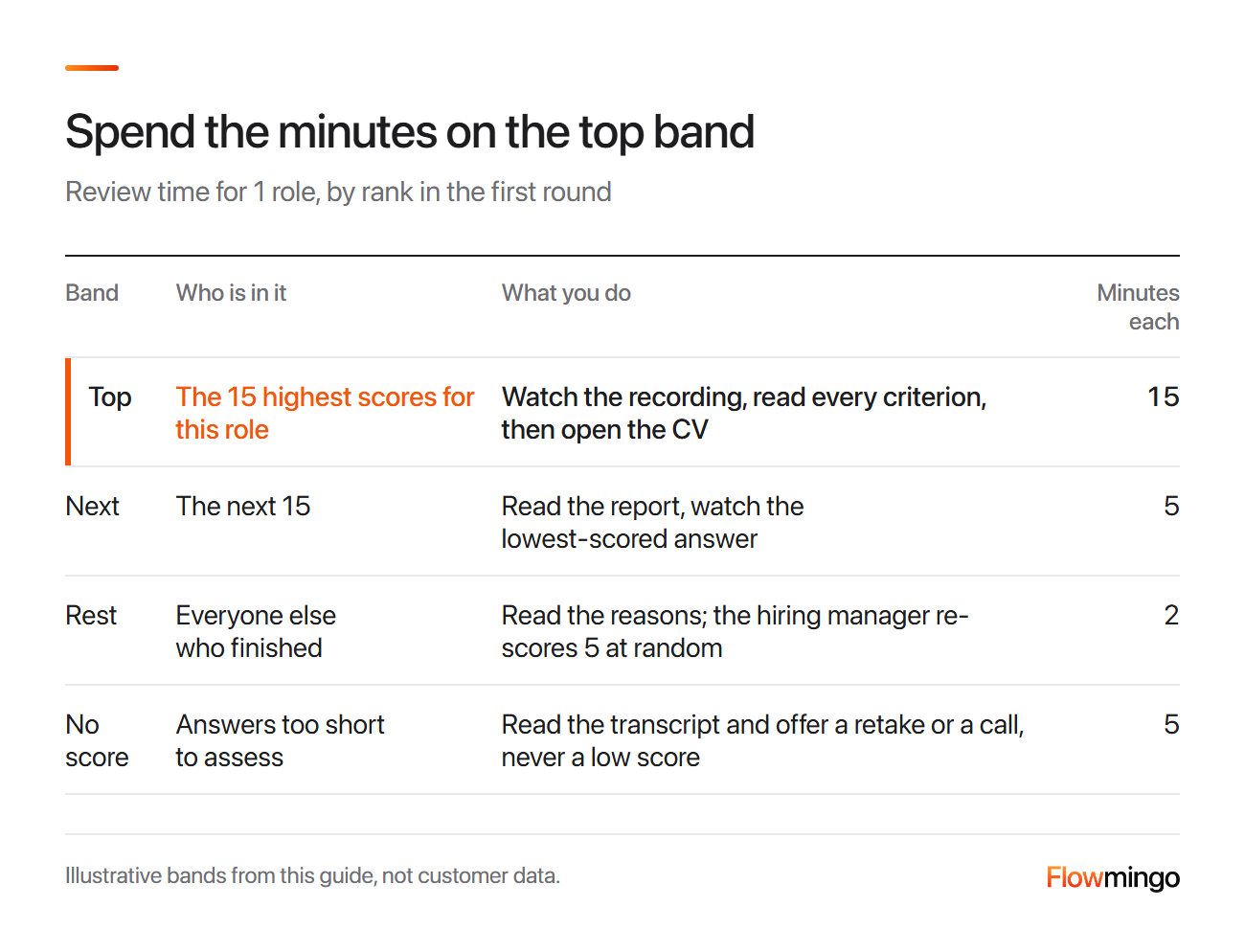
Score bands: the top 15 get 15 minutes each and the next 15 get 5. The rest get 2 each, and answers too short to assess get a retake or a call, never a low score.
A foundational 2018 post by Lou Adler gives the 80/20 rule: 80% of hiring effort on the most important 20% of the talent market. He means people looking for a career move, not your top applicants. Our analogy for a first round: hear everyone, then spend most minutes on the top band.
Acas says ideally 2 or more people choose who to interview, so the hiring manager re-scores 5 of the rest at random. Our interview scorecard template and candidate shortlisting guides cover the rest.
8. Do I legally have to interview every applicant, or ask them all the same questions?
No: in the UK and the US you choose whom to interview, unless your policy or a scheme you joined says otherwise. The same scored questions for everyone are not always required, but they can lower your risk.
This is general information, not legal advice. In the UK, Acas says: "You do not have to interview someone before giving them a job unless your organisation has a policy or rules that say you do."
Under the Equality Act, its discrimination guidance adds reasonable adjustments at any stage and no health questions, with limited exceptions. So offer another format on request.
Disability Confident employers in the UK offer an interview to applicants who declare a disability and meet the minimum criteria (Level 1 guidance). At high volume they may limit numbers, if their policy and adverts say so. The guidance does not say whether a recorded round counts as an interview, so offer these applicants a live interview on request.
In the US, the EEOC's foundational 2006 guidance on race and colour says employers "must apply the same selection criteria" to people of different races. Federal law does not require identical questions, but they can reduce risk, so keep the scored records.
In Singapore, TAFEP advises the same criteria for every candidate and records kept for at least 1 year. If you change the process mid-search, change it for everyone still in the round, so all face the same criteria Acas and the EEOC describe.
9. How long should applicants get to finish the first round, and will hourly workers do it?
Give applicants 7 days and put the date in the invite, because most finishers are done within 3 days. For hourly workers, keep it short, open outside office hours and clear that a person reviews every result.
Flowmingo data · Published with Apollo Technical · AI interviews created 15 Apr to 6 Oct 2026
- 84.8% of 22,372 invited candidates who finished did so within 72 hours of the invite, 47.9% within 24 hours and 97.4% within 7 days.
- 60.1% of 68,363 completed interviews were submitted outside Monday to Friday, 9am to 5pm, in the candidate's own time zone.
Timing of finishers only, not a completion rate: 602 companies for the timing (largest 13.9%) and 1,210 for the time of day (largest 7.3%).
Among finishers only, about half took a day or less, with a median of 24.9 hours. So a 7-day window loses about 3 in 100 finishers, close to the 2 in 100 in an earlier window in our invitation guide.
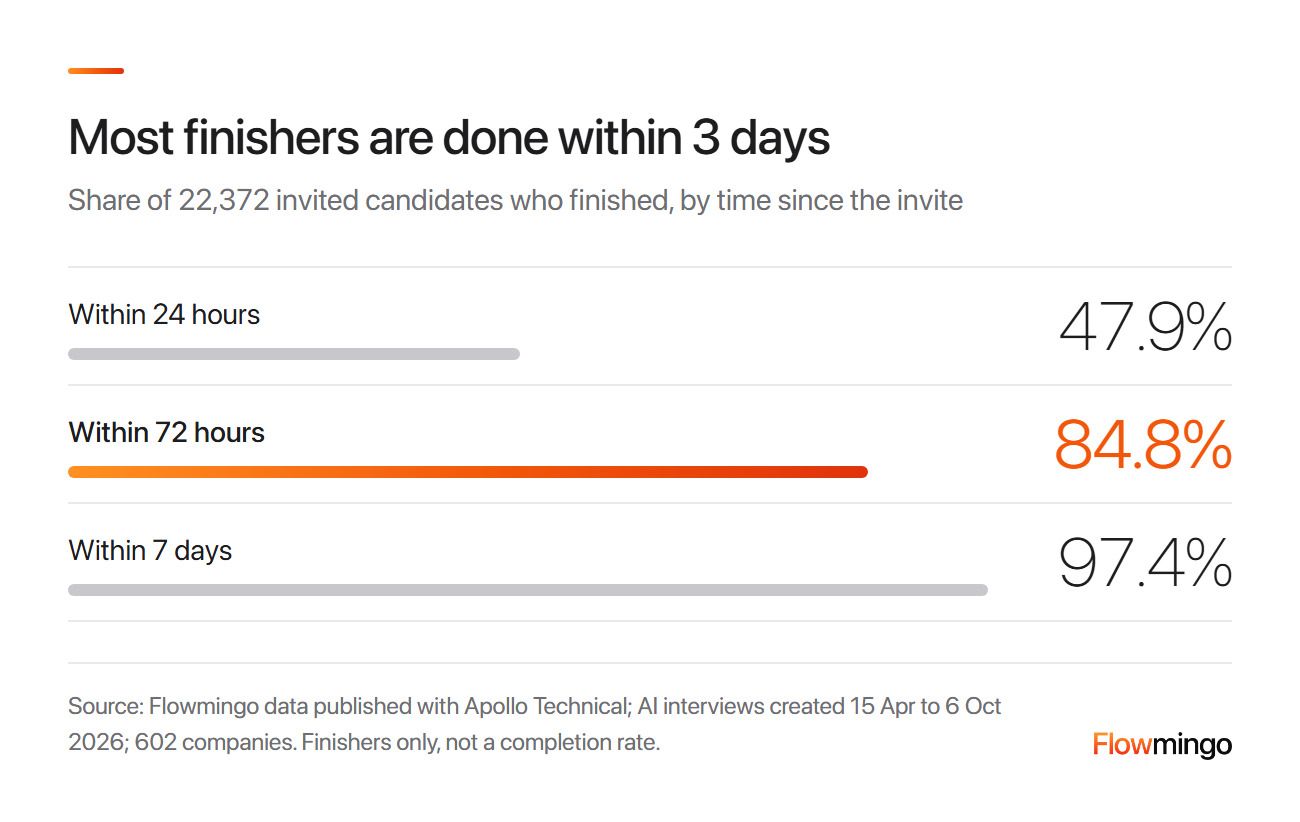
When finishers finish: of 22,372 invited candidates who finished, 47.9% did so within 24 hours, 84.8% within 72 hours and 97.4% within 7 days.
Most also finished outside office hours, which fill 40 of the week's 168 hours. That shows candidates are not tied to office hours, not that they prefer nights.
The risk is drop-out, which our AI interview completion rates guide tracks. In Avery and colleagues' experiment, the drop included the most qualified, and women were 5.1 points less likely than men to finish. In a separate vignette survey of more than 600 would-be applicants, people also rated the format less fair and more competitive.
So the invite below promises the same core questions and a person reviewing every result:
Subject: [Role] at [Company]: your first-round interview, open until [date]
Hi [first name],
Thanks for applying for [role]. Everyone who meets the basics gets the same 6 core questions, and a person on our team reviews every result.
It takes about 15 minutes on a laptop or a phone, at any time, evenings and weekends included. You can answer in [languages your team can review].
Start here: [link]. It closes on [date, 7 days from today]. To answer in writing or on a call instead, contact [name] at [email].
[Your name], [role] at [Company]
An HR team on r/humanresources worried about cracked phones, Spanish speakers and people who want a human. Allow the languages your team can review and offer a live call on request, as our high-volume recruiting guide advises.
Send it the day they apply: HR leads on r/humanresources say same-day contact cut their ghosting. Plan 2 reminders, on day 2 and day 5, as our interview invitation email templates set out, unless your software already sends them.
How Flowmingo helps
Flowmingo sends up to 2 reminders, about 2 and 4 days after the invite, to anyone who has not taken the interview. The link has no deadline, so write the closing date in the invite and set the interview to inactive that day.
10. Should you interview every applicant after you have already found a strong one?
Keep the first round open until the date you announced, because it costs little and day-1 finishers are only part of the field. Then take 3 to 5 people to live interviews, moving fast on the strong one.
Waiting costs minutes, not calls. About half of finishers take a day or less, so day 1 shows you at most about half of them.
Before you stop early, run Alison Green's foundational checks from Inc., plus a 4th of ours. If any fails, finish the round:
- The others are really weaker on the same questions, not just unread.
- You have hired this role before and know what strong looks like.
- You like their answers, not just them or how they remind you of you.
- (Ours) You have a backup candidate, and both of them know the date you will decide.
Meanwhile, book the strong applicant's live interview and tell everyone else when the round closes, with our rejection email templates.
10.1 How many candidates to interview live
On how many candidates to interview live, LHH's foundational rule of 3 says at least 3 per opening. Our rule is 3 to 5 from the top band, plus 1 or 2 backups kept warm in case your first choice declines.
That is fewer than the 19 first interviews in our candidate shortlisting example, where the live interview was the first time anyone heard the applicant. Here the first round already did that. In this guide's example, you hear 120, keep a top band of 15, take 3 to 5 to live interviews and hire 1.
How Flowmingo helps
In Flowmingo's AI Interviewer, sort a hiring project by Interview Score or filter by score range. Each criterion gets a 0 to 10 score with a 3 to 5 sentence reason, and nobody is rejected automatically. The overall score also counts the CV when the applicant sent one, so watch the recording or read the transcript before opening the CV. When 150 applicants leave you asking should you interview every applicant, run the first round free on Flowmingo.
11. Sources
Every study, law and guidance page cited above is listed below. The Reddit threads in the text show real situations, not evidence.
- Acas (2026, June 30). Choosing who to interview. Acas.
- Acas (2026, June 30). Follow discrimination law. Acas.
- Adler, L. (2018, March 22). How to use the 80/20 talent rule to increase quality of hire. LinkedIn Talent Blog.
- Autor, D. H., & Scarborough, D. (2008). Does job testing harm minority workers? Evidence from retail establishments. The Quarterly Journal of Economics, 123(1), 219-277.
- Avery, M., Ip, E., Leibbrandt, A., & Vecci, J. (2026). A brave new world of hiring: A natural field experiment on how asynchronous interviews and AI assessment reshape recruitment (CESifo Working Paper No. 12573). CESifo.
- Bradshaw, R. (2026, October 14). AI interview statistics 2026: What 172,486 first-round interviews show. Apollo Technical.
- Bryant, A. (2013, June 19). In head-hunting, big data may not be such a big deal. The New York Times.
- Fuller, J. B., Raman, M., Sage-Gavin, E., & Hines, K. (2021). Hidden workers: Untapped talent. Harvard Business School Project on Managing the Future of Work and Accenture.
- GOV.UK (2026, July 23). Level 1: Disability Confident committed. In Disability Confident guidance for levels 1, 2 and 3.
- Green, A. (2024, March 19). I found a perfect candidate: Do I need to interview others. Inc.
- Greenhouse (2026). The Hire Standard: Greenhouse benchmark report, North America (March 2026). Greenhouse.
- Hoffman, M., Kahn, L. B., & Li, D. (2018). Discretion in hiring. The Quarterly Journal of Economics, 133(2), 765-800.
- Jabarian, B., & Henkel, L. (2026). Voice AI in firms: A natural field experiment on automated job interviews (arXiv:2607.28222v2). arXiv.
- LHH (2024, June 14). How many candidates should you interview for a job: Hiring best practices. LHH.
- Li, D., Raymond, L. R., & Bergman, P. (2026). Hiring as exploration. The Review of Economic Studies, 93(2), 1200-1240.
- Sackett, P. R., Zhang, C., Berry, C. M., & Lievens, F. (2022). Revisiting meta-analytic estimates of validity in personnel selection: Addressing systematic overcorrection for restriction of range. Journal of Applied Psychology, 107(11), 2040-2068.
- Sackett, P. R., Zhang, C., Berry, C. M., & Lievens, F. (2023). Revisiting the design of selection systems in light of new findings regarding the validity of widely used predictors. Industrial and Organizational Psychology, 16(3), 283-300.
- Schmidt, F. L., & Hunter, J. E. (1998). The validity and utility of selection methods in personnel psychology: Practical and theoretical implications of 85 years of research findings. Psychological Bulletin, 124(2), 262-274.
- Sterkens, P., Caers, R., De Couck, M., Van Driessche, V., Geamanu, M., & Baert, S. (2023). Costly mistakes: Why and when spelling errors in resumes jeopardise interview chances. PLOS ONE, 18(4), e0283280.
- Tripartite Alliance for Fair and Progressive Employment Practices (2025). Conducting job interviews. TAFEP.
- U.S. Equal Employment Opportunity Commission (2006, April 19). Section 15: Race and color discrimination (EEOC-CVG-2006-1). EEOC.