
You have recruited for 5 to 10 years, and you are weighing how to start a recruitment agency of your own. At a 20% fee, 1 placement on a $100,000 salary earns $20,000.
Until now a desk or an in-house team handed you job orders, and the owner carried the law, the terms and the wait for cash. On your own, all 3 are yours.
That shift costs founders their savings. About 1 in 4 new US businesses in the sector that includes staffing closes within a year. And 35% of UK recruitment firms had a bad debt last year.
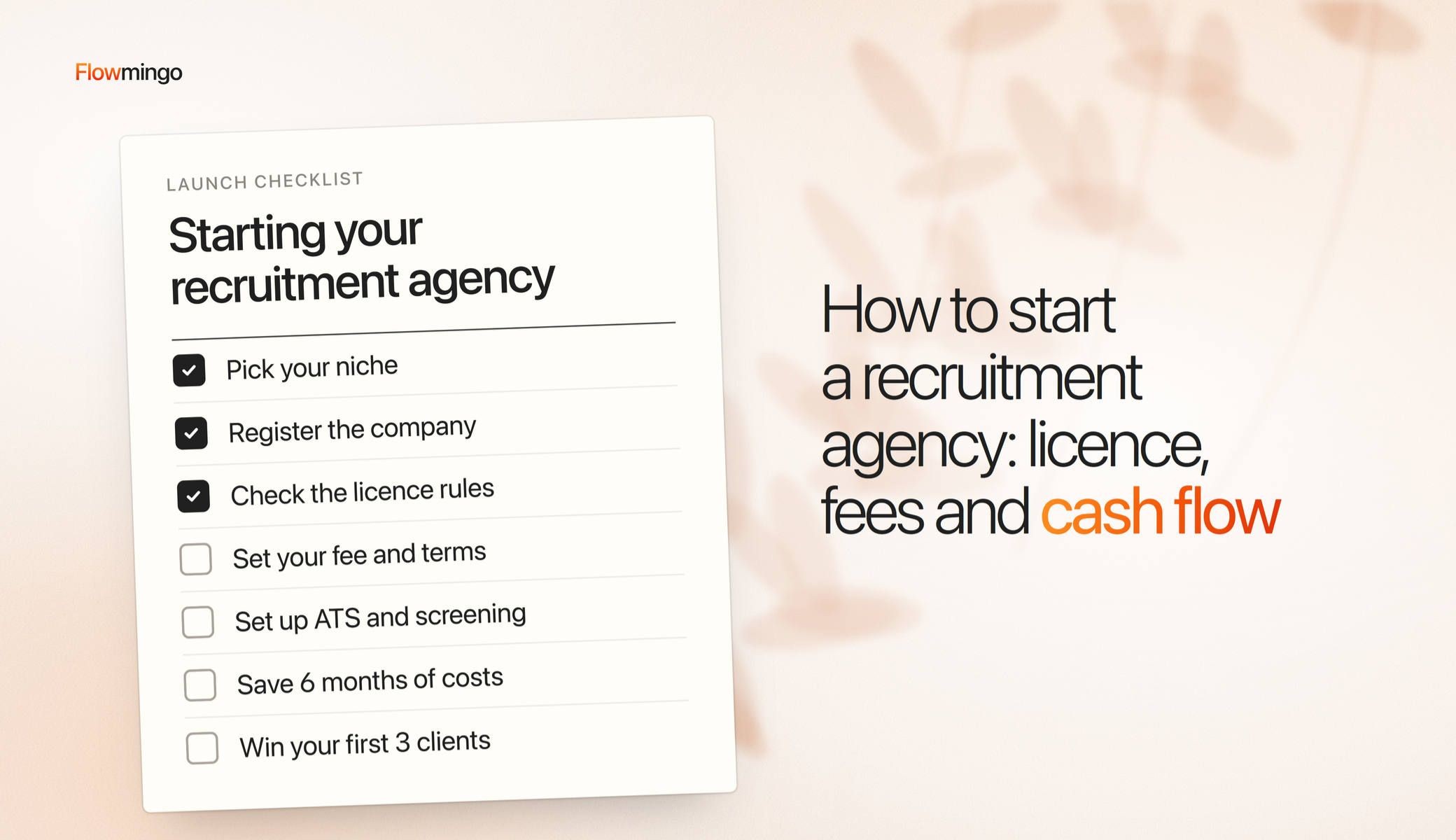
The fix is 3 moves. Sign terms before the first CV, and fund 6 months of living costs before the first fee. Then let software screen, so your hours go to clients.
Key takeaways
- Do I need a licence to start a recruitment agency? Not for most perm work in Great Britain. Singapore needs an MOM licence first, and US rules vary by state.
- What do recruitment agencies charge? Commonly 15-25% of first-year salary on contingency, and 25-35% retained. In the UK you cannot charge candidates for finding them work.
- How long until the first fee arrives? Month 3 or later after your first signed job order. With that order in weeks 11-13, it is about month 6 after you start.
- How do I protect my placement fee? Sign terms before the first CV. 35% of UK recruitment firms had a bad debt last year.
- Can 1 person run a recruitment agency? Yes, if tools handle screening. Half of applicants who finished a scored Flowmingo AI interview within 14 days did so within a day (invites Oct 2025 to Sep 2026).
1. How to start a recruitment agency after years recruiting: what goes in the first 90 days?
Spend the first 90 days on 4 jobs in order: niche and covenants, registration and licence, terms and tools, then the first signed job order. Each step protects the next one.
Pick the niche where 10 hiring managers would take your call this month. Being approached by a recruiter is now common for skilled workers, so your sourcing skill has a market.
In a foundational 2024 study, Black, Hasan and Koning surveyed 10,000 US workers. The share hired after a firm approached them rose from 4.9% in 1991 to 14.3% in 2022, and was higher for skilled workers.
It measures firms' own search: demand for the skill, not for agencies.
Register the company yourself on the official government site. The founder in a page-1 Reddit thread says you need not pay anyone to do it.
Warm up a new email domain slowly, because another founder's 100 emails to old clients in week 1 went to spam.
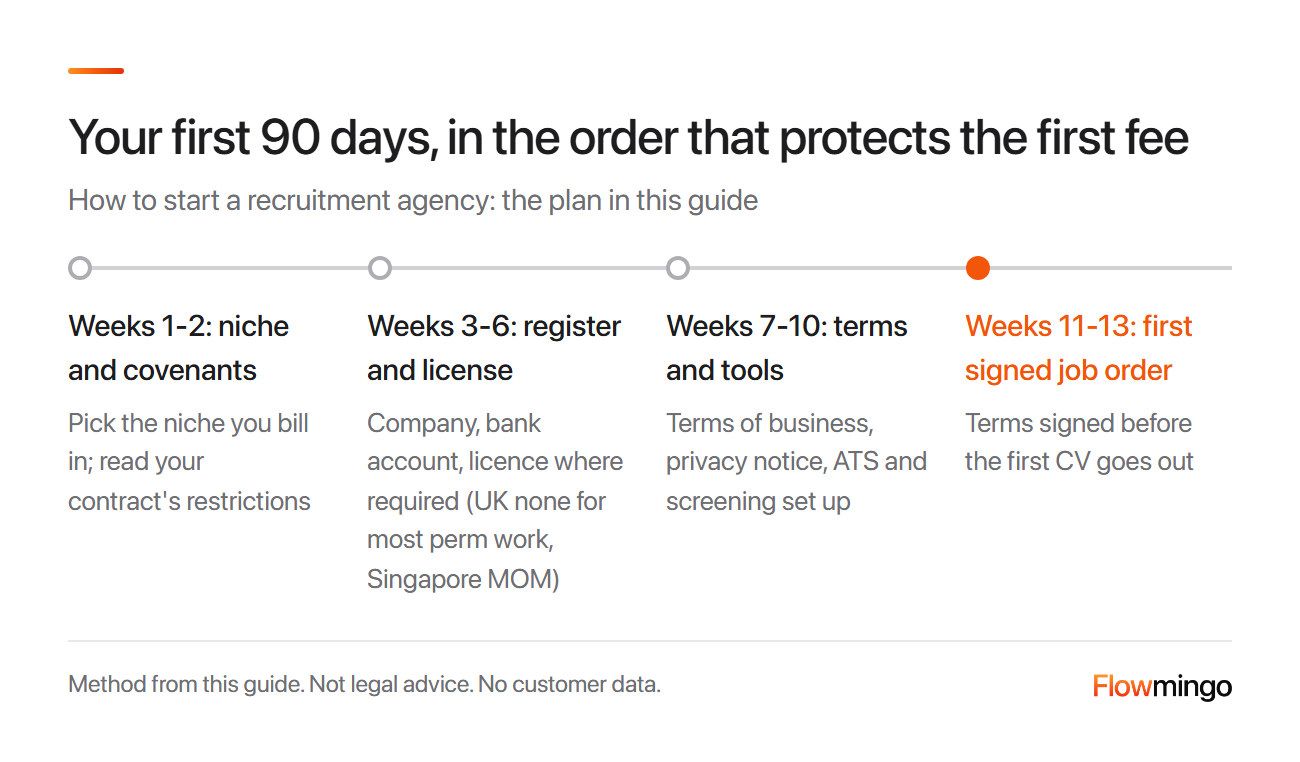
90-day launch plan: pick the niche you bill in and read your contract's restrictions. Then register and license, set up terms and tools, and sign terms before the first CV.
Covenants come first, in weeks 1 to 2, because your old contract may limit whom you can call. Registration and licence follow in weeks 3 to 6, then terms and tools in weeks 7 to 10.
The first signed job order comes last, in weeks 11 to 13, because terms must exist before you send a CV.
1.1 Can you start your own agency while under a non-compete?
Read the restrictive covenants in your contract, and get an employment lawyer's view before you contact a former client or candidate.
Note for the lawyer any clause on approaching former clients or candidates, how long it runs and the area it covers.
A founder in the same thread says moving clients over is easier than cold outreach, but did not say whether covenants applied.
2. Is starting your own agency worth it, and what does year 1 really look like?
It can be, but plan for the first fee in month 3 or later after your first signed job order. With the job order in weeks 11-13, that is about month 6 after you start, which is why you need 6 months of savings.
The US Bureau of Labor Statistics followed 45,518 new business locations (establishments) that opened in the 12 months to March 2019. The sector includes employment services, plus security, cleaning and waste firms.
Of those, 75.8% were still operating after 1 year, so 24.2% had closed. The share still operating was 50.4% after 5 years and 45.8% after 6.
The 5- and 6-year figures span the COVID years, so read this as context, not a forecast for agencies.
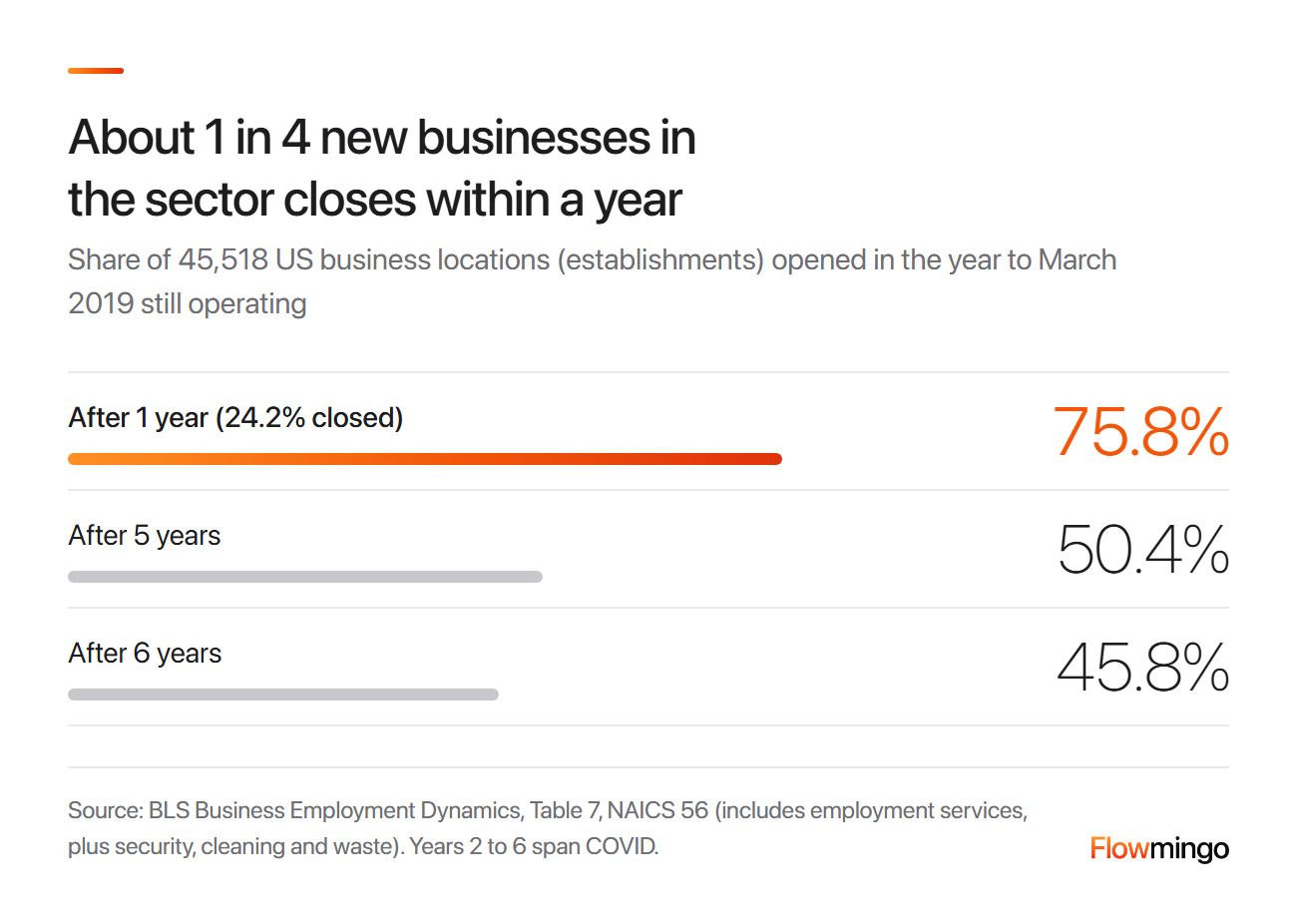
Business survival after opening: of 45,518 new US business locations in the sector, 75.8% were operating after 1 year and 24.2% had closed. 50.4% were operating after 5 years and 45.8% after 6.
SHRM's 2026 median time to fill for non-executive roles is 39 days, about 6 weeks, as in our hiring process guide. Add notice and payment terms, and our estimate is a first fee in month 3 or later.
SHRM's 2025 data brief puts the median cost per hire at US$10,625 for executives, against US$1,200 for non-executive roles, as in our recruiting metrics guide.
This means a fee is easiest to justify on senior hires. Before you resign, check yourself against 3 statements:
- 2 or 3 hiring managers already call you directly about roles.
- You can live for 6 months on savings with no fee coming in.
- You can sell as well as you recruit, which Dandan Zhu ranks above technical knowledge, as opinion.
3. How much does it cost to run a new agency for the first 12 months?
For a perm-only solo agency, the biggest cost is your own living costs until the first fee arrives, not software. A temp desk adds payroll float, which 1 US vendor puts at $50,000 to $200,000.
Fill in your own numbers below, because your rent, country and fee model change every total. The US ranges come from Advance Partners, a payroll-funding firm.
| Line | Perm-only solo | Source | Your number |
|---|---|---|---|
| Living costs until the first fee | 6 months x your monthly costs | Our estimate | __ |
| Formation and legal | $500-$2,000 | Advance Partners | __ |
| Licence | UK none for most perm work. Singapore S$500 + S$20,000 bond. Illinois often none if only employers pay, covered agencies US$250-US$500 a year + US$5,000 bond | MOM, Illinois | __ |
| Insurance | $3,000-$15,000 (US) | Advance Partners | __ |
| ATS or CRM | $15-$99 per user per month | HeroHunt, Bullhorn | __ |
| Screening and interviews | $0 on free plans to $99+ a month | Vendor pricing pages | __ |
| Payroll float, temp desk only | $50,000-$200,000 | Advance Partners | __ |
Advance Partners puts a solo recruiter agency at $25,000 to $50,000, and a website at $2,500 to $10,000.
The Reddit founder hosts a Canva site for about $15 a month, and calls LinkedIn Recruiter at about $600 a month "a waste of money".
ATS seats start at $15 per user per month for Manatal on annual billing, capped at 15 active jobs, says HeroHunt. Bullhorn lists its Starter plan at $99 per user per month.
In Singapore, a Select Licence ties up about S$20,500: S$500 in fees plus a S$20,000 security bond.
Say your living costs are $4,000 a month. 6 months of savings is $24,000, while 6 months of Bullhorn's Starter plan is $594. So months, not software, set your budget.
4. How to start a recruitment agency legally: do you need a licence in your country?
It depends where you place people. Great Britain has no general licence for perm work, Singapore requires an MOM licence first, and US rules vary.
4.1 Great Britain: what the 1973 Act and the 2003 Conduct Regulations mean for you
In Great Britain you need no general licence to place permanent staff in most sectors, but the conduct rules still apply. Northern Ireland has its own regulator, says GOV.UK guidance.
Under section 6 of the Employment Agencies Act, you cannot charge the candidate for finding them work, outside a few prescribed sectors. Nor, under regulation 5, can you make them buy extras, such as CV writing, to get on your books.
Regulation 27 bars adverts without a real vacancy and the hirer's authority. Each advert must name your agency and say temp or perm.
Under regulation 29, keep records on candidates and hirers for at least 1 year after you last provide them a service.
The Fair Work Agency took over enforcement on 7 April 2026. In a foundational 2022/23 report, the old inspectorate logged 2,300 complaints, 1,571 infringements and 385 warning letters.
4.2 US: state and city licences for a direct-hire agency
Each state and some cities set their own rules. An employer-paid exemption ends the moment you charge a candidate.
Illinois excludes recruiters paid solely by the employer, with conditions. Covered agencies pay US$250 to US$500 a year, plus a US$5,000 bond per location.
New York City exempts certain employer-fee-paid agencies that place only commercial, clerical, executive, administrative and professional applicants, and never charge them a fee. Exempt agencies must still follow the New York State Employment Agency Law for employer-fee-paid agencies.
Search your state labour department for "private employment agency licence", and your city's consumer-affairs site. For example, a Chicago founder paid only by clients reads the Illinois exemption and its conditions before filing.
4.3 Singapore: the MOM Select or Comprehensive licence
You need a Ministry of Manpower licence before you place anyone. The Select Licence is for agencies that place only workers earning more than S$4,500 a month.
Select needs a S$20,000 security bond, and staff need no CEI but must register with MOM. Comprehensive needs a S$60,000 security bond, and CEI for key appointment holders and every staff member doing EA work.
Both last 3 years and cost S$400 plus S$100. In-principle approval takes about 7 working days, and the bond up to 3 weeks.
Placing without a licence can mean up to S$80,000 and 2 years in prison under section 6 of the Act. This is not legal advice.
5. What GDPR and AI screening rules apply before you store your first CV?
Send every sourced candidate a privacy notice in your first message, and check any AI screening tool before you use it. Both rules apply from your first CV, because sourced profiles are personal data.
Article 14 of the GDPR covers candidates you find on LinkedIn, a job board or by referral, under EU and UK GDPR. Tell them who you are, your purpose and legal basis, how long you keep the data, its source and their rights.
Do it at first contact, or within 1 month at the latest. 2 lines cannot hold all 6 points, so a footer like this names 4 and links the rest:
- "I'm Jo, founder of Tan Search. I found your LinkedIn profile and hold it only to contact you about finance roles."
- "I keep it until this search closes, or sooner if you ask. My full notice, with the legal basis and your rights: [link]."
The UK Information Commissioner's Office audited AI recruitment tool providers from August 2023 to May 2024 and, in a November 2024 report, made 296 recommendations.
It found tools that guessed gender or ethnicity from a name. Before you buy a sourcing or screening tool, ask the vendor 4 things:
- Where did the candidate data come from, and were those people told?
- Can recruiters filter on, or infer, protected characteristics?
- For New York City roles, when was its last bias audit?
- Who decides who moves forward: the tool, or you?
Under New York City's foundational Local Law 144, an agency using an AI scoring tool needs a bias audit of it within the past year. It must give 10 business days' notice.
Regulation (EU) 2026/1744 moved the EU AI Act's high-risk duties for recruitment AI to 2 December 2027, not 2 August 2026. Ogletree Deakins also reported it.
That gives you about a year, until 2 December 2027, to choose compliant tools. This is not legal advice.
How Flowmingo helps
In each client's Hiring Project on Flowmingo, you can set the candidate terms and privacy document you and the client agreed. Flowmingo does not check that the wording meets legal requirements, so agree it with your client and your legal adviser. Who moves forward is always your call.
6. Recruitment agency fees: should a new agency charge contingency, retained or RPO?
Start with contingency at a clear percentage of first-year salary, and ask for retained on senior or hard-to-fill searches. Commonly quoted ranges are 15-25% for contingency and 25-35% for retained, paid in thirds.
Recruitment agency fees shape your cash flow as much as your income, because each model pays at a different time.
| Model | Typical fee | When you are paid |
|---|---|---|
| Contingency | 15-25% of first-year salary | After the hire starts |
| Retained | 25-35% of first-year total pay | In thirds |
| Contract or temp | Markup on pay, commonly 25-75% | Weekly or monthly |
| RPO | Per contract, no verified benchmark | Per contract |
The ranges come from HeroHunt, citing a sourcing vendor, so treat them as what clients compare you with, not survey data.
On a $100,000 salary, 15% earns $15,000, the 20% benchmark $20,000 and 25% earns $25,000. Retained at 30% earns $30,000, or 3 payments of $10,000 on engagement, shortlist and placement.
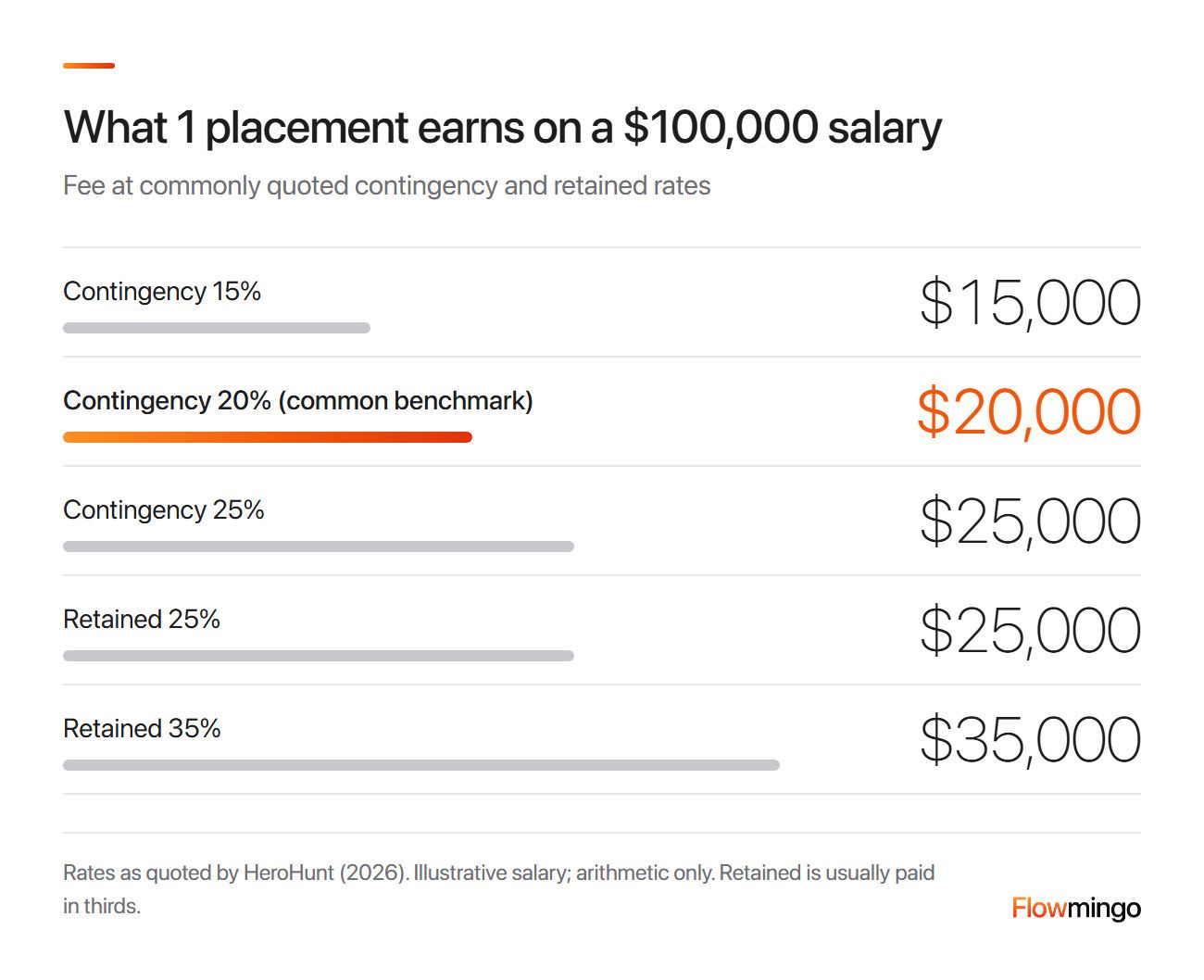
Fee on a $100,000 salary: contingency 15% earns $15,000, 20% (the common benchmark) $20,000 and 25% $25,000. Retained 25% earns $25,000 and retained 35% $35,000.
Retained helps cash flow because the first payment lands before you send a CV. For temp, a foundational Chron guide bills a $20-an-hour worker at $30, a 50% markup.
That $10 gap must also cover employer costs and the wait for payment. In our reading of a foundational 2013 review, temp supply means running payroll, which needs working capital.
Set RPO pricing once you know the volume. A Reddit founder was asked for an RPO proposal for 8 to 10 open reqs, and was unsure how to schedule payment.
7. How do you protect your placement fee from backdoor hires and late payers?
Get signed terms before you send a single CV, with the fee, introduction period, rebate period and payment days in writing.
Terms work because a dispute turns on the words you both signed. Anyone learning how to start a recruitment agency should cover these 6 points, shown as wording to adapt:
- Fee: 20% of first-year base salary, due on the start date.
- Introduction: the fee is due if you hire anyone we introduce, for any role, within 12 months.
- Rebate: if the hire leaves within 60 days, we refund part of the fee or replace them once.
- Payment: invoices are due within 15 days.
- Late payment: interest at 8% above the Bank of England base rate, where UK law applies.
- Signature: no search starts until both sides sign.
The 20%, 12 months and 60 days are example values, and this is not legal advice.
In a 2026 Reddit case of a backdoor hire, a managed service provider refused a 15% introduction fee. It cited clauses tied to 1 vacancy and 1 site.
The page-1 founder puts 15-day terms on invoices, because, in their words, clients on 30-day terms pay at day 45. The REC's December 2025 report found 35% of UK recruitment firms had a bad debt in the past year, against 29% across sectors.
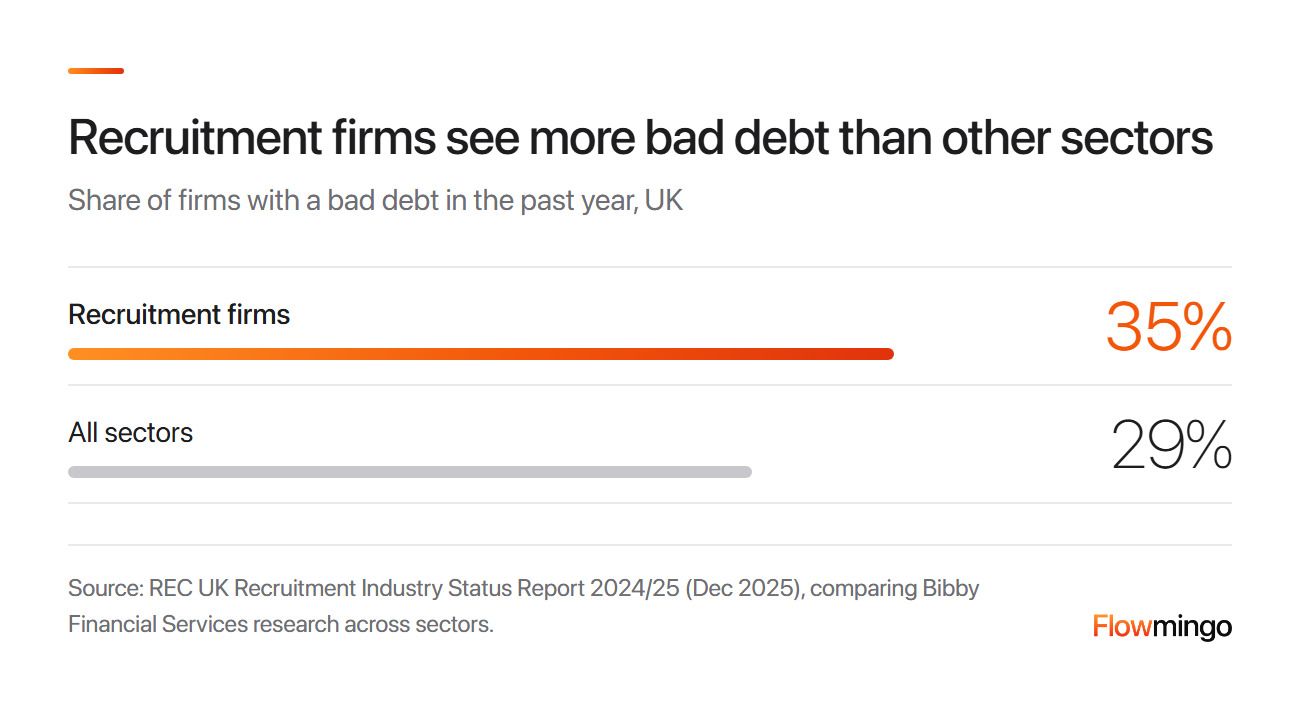
Bad debt by sector: 35% of UK recruitment firms had a bad debt in the past year, against 29% across all sectors (REC, December 2025).
Credit-check each new client. If terms name no rate, UK statutory interest is 8% plus base rate.
Our reading is that a rebate period matters to clients because outside hires cost more. In a foundational 2011 study, Bidwell found external hires at 1 US bank earned about 18% more yet performed worse for 2 years.
UK temp desks need 1 more clause. Under regulation 10, a temp-to-perm fee is unenforceable unless the client may instead keep the worker through you for an extended hire period.
8. As a new agency, how do you cover cash flow before clients pay invoices?
A perm-only agency needs savings for the months before the first fee lands. A temp desk pays workers weekly while clients pay in 30 to 60+ days, so it needs a payroll float or invoice funding.
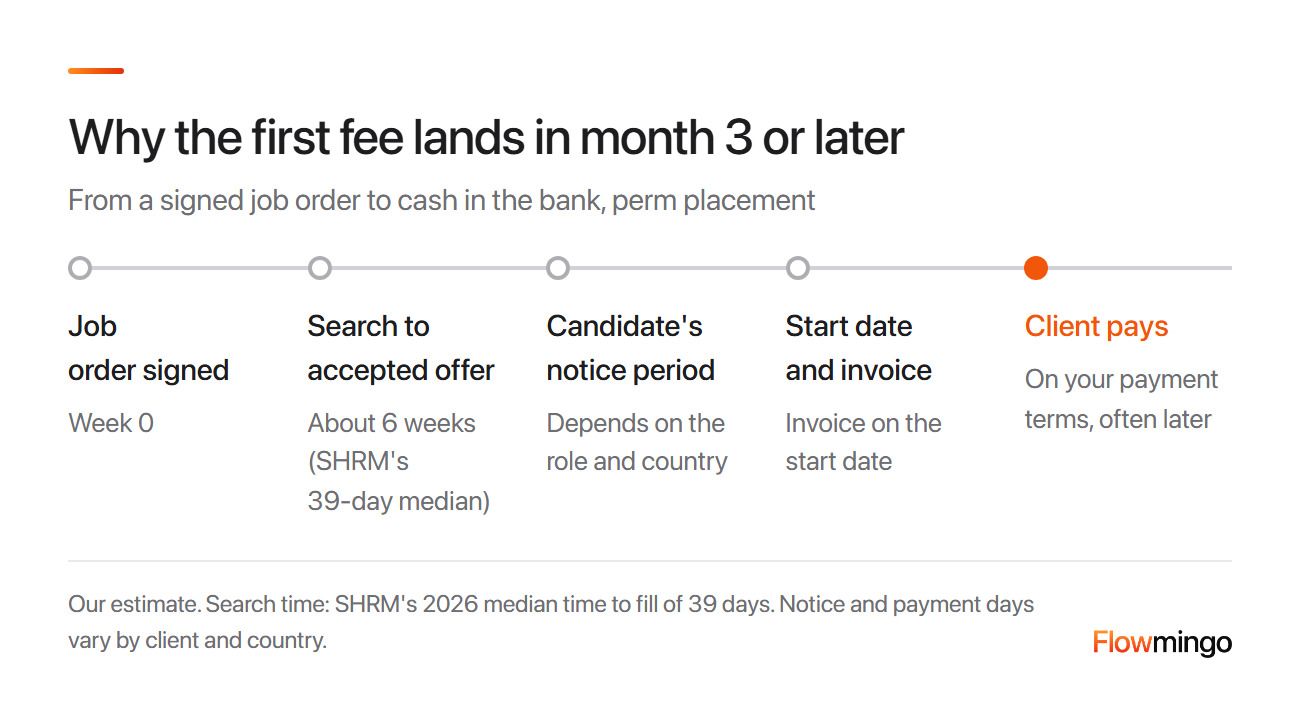
First-fee timeline: job order signed at week 0, about 6 weeks (SHRM's 39-day median) to an accepted offer, then the notice period. You invoice on the start date, and the client pays on your terms, often later.
Say the job order is signed in week 0 and the offer is accepted in week 6, near SHRM's 39-day median. Assume 4 weeks' notice, our assumption, not a benchmark.
The start date, and your invoice, fall in week 10. On 15-day terms the cash arrives around week 12, early in month 3. If a client on 30-day terms pays at day 45, it arrives in week 16.
Add the time before that job order, which the 90-day plan puts in weeks 11 to 13. The first fee then lands about month 6 after you start.
For a temp desk, Advance Partners says funding firms advance up to 90% of approved invoices.
In Singapore, the S$20,000 bond stays tied up for the licence's life plus 6 months. Elsewhere, a perm-only desk can start small: Advance Partners puts a DIY launch at $3,000 to $10,000.
A temp desk cannot start that way, because you pay workers before clients pay you. Track opening cash, fees received, payroll paid and closing cash week by week for 13 weeks.
9. How to start a recruitment agency with no clients: how do you win 3 job orders?
Start with hiring managers who already know your work, and sell to them, not to HR. Then qualify every job order before you take it, because a vague or underpaid search can cost weeks for $0.
Coverdill and Finlay studied contingency recruiters for a foundational 2017 book. Recruiters won job orders by convincing hiring managers to outsource, pointing to past results.
In another chapter, they rated clients on access, response speed, candidate treatment and fee. They rated job orders on urgency, clarity and viability, and struggled when made to work through HR.
The 48 hours below is our own illustrative threshold.
| Test | Green | Red |
|---|---|---|
| Access | You speak to the hiring manager | Only through HR or a vendor portal |
| Response speed | Feedback within 48 hours | Silence after shortlists |
| Clarity | Written brief with must-haves | Changing spec |
| Viability | Pay matches the requirements | Pay below the market |
In the foundational CIPD 2024 report, 20% of UK employers recruited in-house with agency help, and 31% mixed in-house and outsourced.
Yet the median cost per hire, agency fees included, was £1,500 for most staff and £2,000 for senior managers. Each rests on about 200 to 250 respondents. Pitch hard-to-fill roles, where a fee still looks cheap.
Some briefs you must refuse. In Singapore, foundational 2020 MOM licence conditions require agencies to turn down discriminatory requests.
In the US, Title VII bars an agency from refusing to refer anyone by race, colour, religion, sex or national origin. It covers placements with employers of 15 or more staff.
10. How to start a recruitment agency as 1 person: can you run delivery solo?
Yes, if tools do the volume work and you keep your hours for hiring managers and candidates. Screen with a structured interview applicants take in their own time, then send a short, evidenced shortlist.
In the same book, Coverdill and Finlay found LinkedIn helps most with finding prospects, and less with turning them into candidates.
In a later chapter, headhunters cope through specialisation and by separating the sourcing of prospects from recruiting them. That means software can find and screen while you take the calls that close.
Here is an illustrative week for 1 search:
- Monday: intake call with signed terms already in hand, then a written brief and criteria agreed.
- Tuesday: invite applicants to a structured interview they take in their own time, with your privacy notice linked.
- Wednesday and Thursday: review scored reports, and read the top ones in full.
- Friday: send the shortlist, with evidence for each candidate.
Flowmingo data · 24,612 applicants and 1,286 hiring projects · all companies, not agencies only · invites 1 Oct 2025 to 7 Sep 2026 (timing) and to 21 Sep 2026 (projects)
- 23.9 hours was the median time from invite to a finished, scored AI interview, among 24,612 applicants who finished within 14 days.
- 86.2% of those applicants finished within 72 hours of the invite, and 90% within 93.8 hours.
- 6 scored interviews came back in the median project of 1,286 that invited at least 10 applicants, from 25.5 invited.
Timing: 919 companies. Projects: 583 companies, 22.6% with no scored interview yet. Only the 25.3% who finished within 14 days are timed, and public-link applicants are not counted. An association, not a promise.
Our rough reading of the 2 medians is about 4 invites for each interview you want to review.
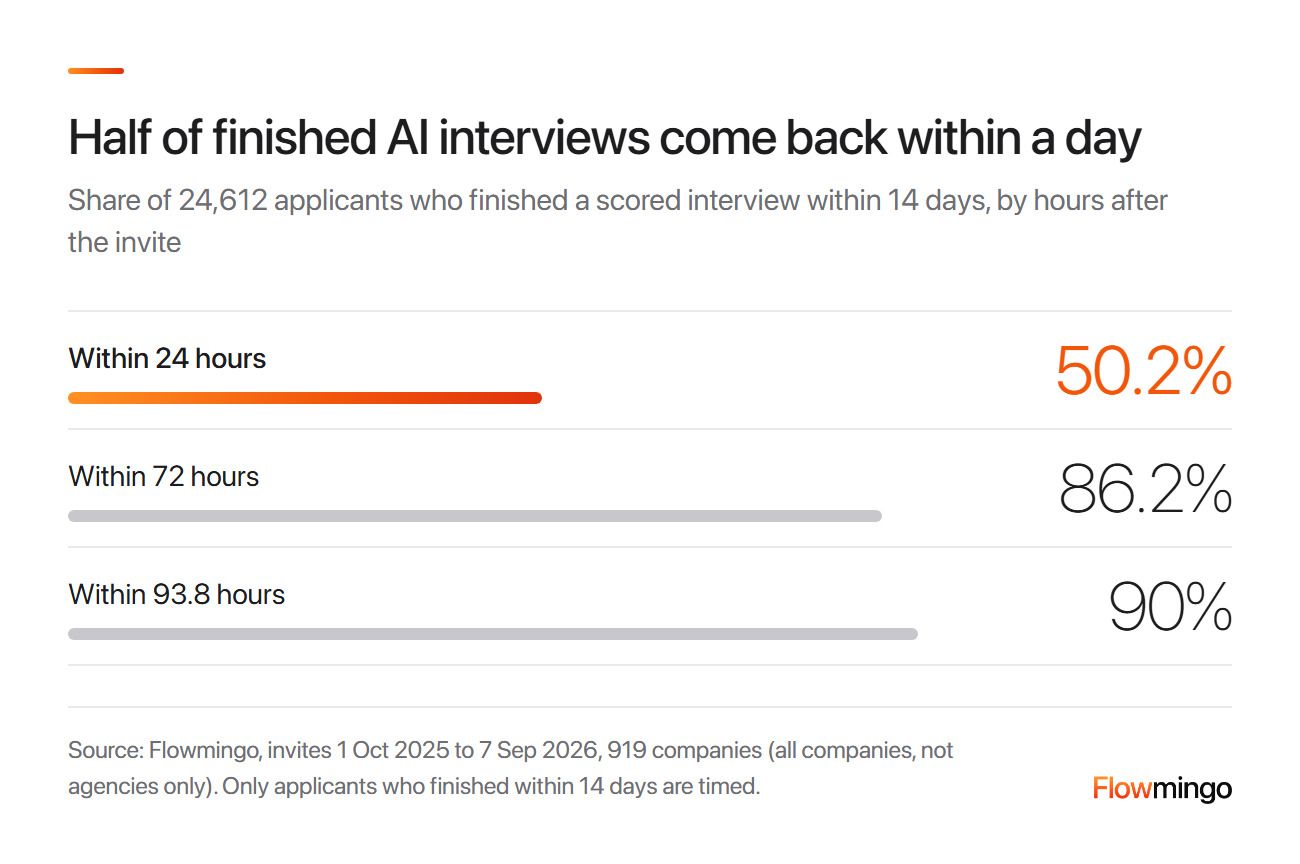
Response time to a scored AI interview: of applicants who finished within 14 days, 50.2% did so within 24 hours. 86.2% did within 72 hours and 90% within 93.8 hours.
Read the figure as your week. Of those who will finish, 50.2% do so within 24 hours, so Tuesday's invites are mostly back by Wednesday's review.
By 72 hours 86.2% are in, and 90% by 93.8 hours, so Friday's shortlist draws on nearly everyone who will respond.
The client pays for the shortlist, so send each candidate's scores, the gap to probe, and a note on any near miss.
You now have the order: covenants, licence, terms, budget, then the first 3 job orders. Screening is the part a solo founder can hand to software.
How Flowmingo helps
Flowmingo is a free AI hiring platform that agencies use to screen their own applicants. Send 1 link, and each applicant does a structured, spoken AI interview in their own time. It asks a follow-up when an answer is thin or off topic. You get the recording, the transcript and a report scoring each criterion 0 to 10 with a written reason. A Client link shows the report under the candidate's initials, with CV and contact details hidden. It is free on every plan, though video and transcripts may still identify the person. The Free plan is $0 with unlimited AI interviews and seats, each up to 20 minutes. Try Flowmingo on your first search while you work out how to start a recruitment agency.
11. Sources
Every study, law and quote in this guide links to a source below. Flowmingo figures come from Flowmingo's own platform data.
- Advance Partners (2026, July 23). Cost of starting a staffing agency. Advance Partners.
- Bidwell, M. (2011). Paying more to get less: The effects of external hiring versus internal mobility. Administrative Science Quarterly, 56(3), 369-407.
- Black, I., Hasan, S., & Koning, R. (2024). Hunting for talent: Firm-driven labor market search in the United States. Strategic Management Journal, 45(3), 429-462.
- Bonet, R., Cappelli, P., & Hamori, M. (2013). Labor market intermediaries and the new paradigm for human resources. Academy of Management Annals, 7(1), 341-392.
- Bullhorn (2026). 12 things to know before starting a recruitment company. Bullhorn.
- Chartered Institute of Personnel and Development (2024). Resourcing and talent planning report 2024. CIPD.
- Coverdill, J. E., & Finlay, W. (2017). High tech and high touch: Getting clients and job orders. ILR Press.
- Coverdill, J. E., & Finlay, W. (2017). High tech and high touch: Qualifying clients and job orders. ILR Press.
- Coverdill, J. E., & Finlay, W. (2017). High tech and high touch: Evolution or revolution. ILR Press.
- Coverdill, J. E., & Finlay, W. (2017). High tech and high touch: Being a headhunter. ILR Press.
- Duggan, T. (n.d.). How to start a recruitment business. Chron Small Business.
- Employment Agency Standards Inspectorate (2024). Employment Agency Standards (EAS) Inspectorate annual report, 2022 to 2023. GOV.UK, archived copy.
- European Union (2026). Regulation (EU) 2026/1744 amending Regulation (EU) 2024/1689, the Digital Omnibus on AI. Official Journal of the European Union.
- Fair Work Agency (2026, October 29). Overview of the Conduct Regulations 2003. GOV.UK.
- Gordons LLP (2026, April 23). The launch of the Fair Work Agency. Gordons LLP.
- GOV.UK (n.d.). Late commercial payments: Charging interest. GOV.UK.
- HeroHunt (2026). How to start a recruitment agency: 6 steps. HeroHunt.
- Illinois Department of Labor (n.d.). Private employment agency FAQ. State of Illinois.
- Information Commissioner's Office (2024). AI tools in recruitment: Audit outcomes report. ICO.
- Ministry of Manpower (2020, June 22). New licence conditions for employment agencies to strengthen fair hiring. MOM press release.
- Ministry of Manpower (n.d.). Which EA licence to get. MOM.
- NYC Department of Consumer and Worker Protection (n.d.). Automated employment decision tools (AEDT). City of New York.
- NYC Department of Consumer and Worker Protection (n.d.). Employment agency license checklist. City of New York.
- Ogletree Deakins (2026, June 16). EU nears approval of agreement to delay rules for AI use in employment decisions. Ogletree Deakins.
- Recruitment and Employment Confederation (2025, December 8). UK recruitment industry status report 2024/25. REC.
- Reddit, r/RecruitmentAgencies (2025). Starting my recruitment agency, any tips. Reddit.
- Reddit, r/recruiting (2024). Contract and RPO proposal for 8-10 open reqs. Reddit.
- Reddit, r/recruiting (2026). MSP refusing an introduction fee. Reddit.
- Regulation (EU) 2016/679, General Data Protection Regulation (2016). Article 14. gdpr-info.eu.
- Singapore Statutes Online (current edition). Employment Agencies Act 1958, section 6. Attorney-General's Chambers.
- Society for Human Resource Management (2025). 2025 recruiting executives benchmarking data brief. SHRM.
- Society for Human Resource Management (2026). 2026 recruiting executives benchmarking. SHRM.
- UK Parliament (1973). Employment Agencies Act 1973, section 6. legislation.gov.uk.
- UK Parliament (2003). The Conduct of Employment Agencies and Employment Businesses Regulations 2003, regulation 5. legislation.gov.uk.
- UK Parliament (2003). The Conduct of Employment Agencies and Employment Businesses Regulations 2003, regulation 10. legislation.gov.uk.
- UK Parliament (2003). The Conduct of Employment Agencies and Employment Businesses Regulations 2003, regulation 27. legislation.gov.uk.
- UK Parliament (2003). The Conduct of Employment Agencies and Employment Businesses Regulations 2003, regulation 29. legislation.gov.uk.
- United States Code (current text). 42 USC 2000e-2, Title VII of the Civil Rights Act of 1964. Legal Information Institute.
- U.S. Bureau of Labor Statistics (2025). Business employment dynamics: Survival of private sector establishments by opening year, administrative and waste services (Table 7). BLS.
- Zhu, D. (n.d.). What you need to start a recruitment firm. LinkedIn.