
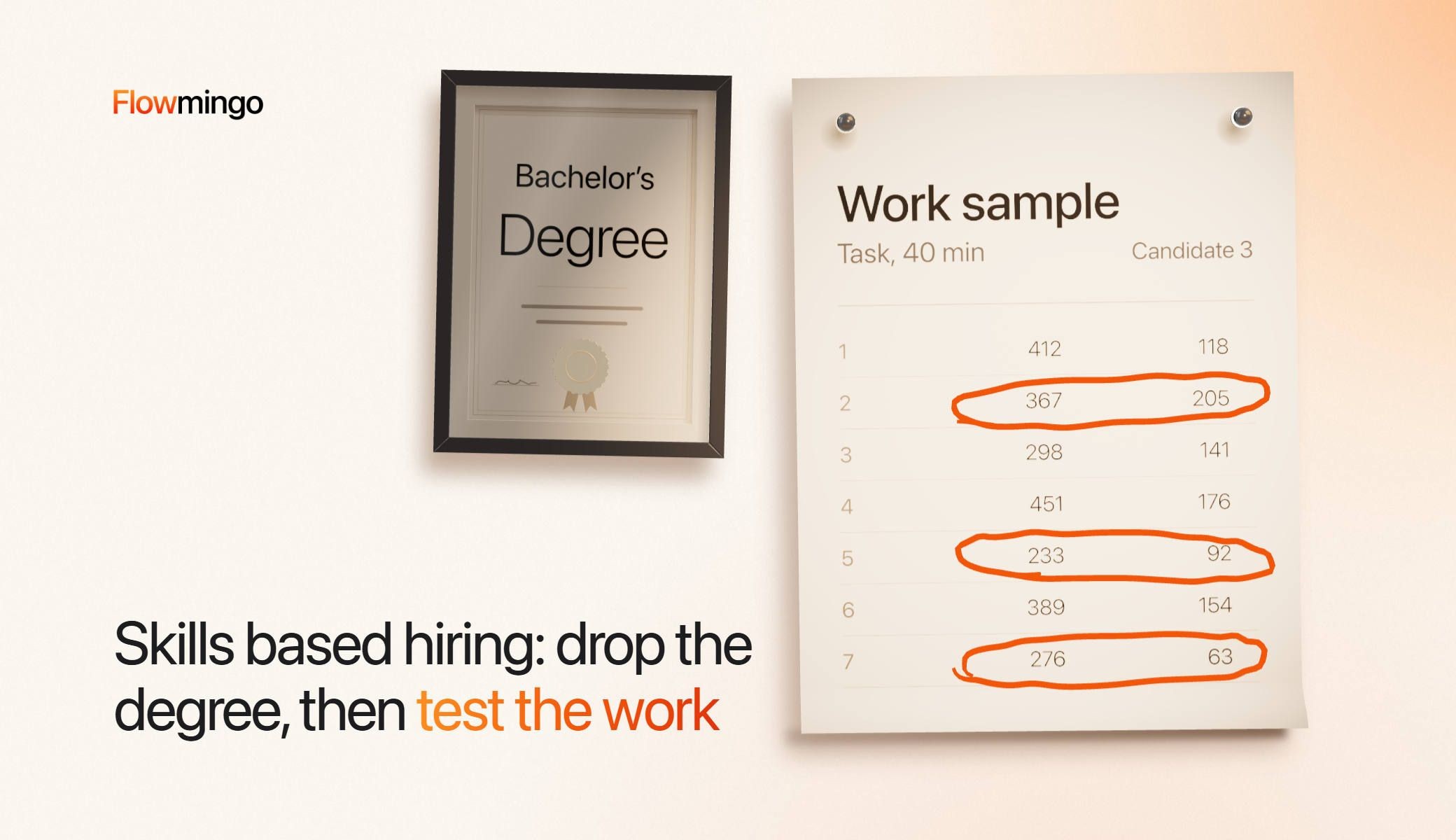
You took the degree requirements off the job ad, and the same kind of people still apply. That is skills based hiring on paper, and the change often stops there.
In 1 study of 11,300 roles at large US firms, dropping degree requirements added up to fewer than 1 in 700 US hires. Only 3.6% of roles dropped one, and just 37% of firms that did so changed who they hired.
The ad was never the problem. A hiring manager compares each candidate with the pool, so the degree stays a shortcut. Without a scored way to see skill, the old filter creeps back.
That costs you the people who can do the job. In SHRM's survey, 85% of HR professionals said a reliable skills check would make their organisation likelier to treat candidates without a degree as qualified.
This guide shows how to start skills based hiring on 1 role with no HR team, in 3 moves. Write a short skills list before you read a CV. Give every finalist the same work sample test, score it against written examples, then check pass rates by group.
Key takeaways
- If I drop the degree from the ad, will I hire different people? Only if you change how you assess: just 37% of the firms that dropped it hired more non-degreed people.
- What should I write down before the first CV? List 4 to 6 skills, split into must-have and learnable, each with its task.
- How long should a work sample test take? Plan 30 to 45 minutes (our rule), and never more than 3 hours.
- Will a skills test scare off good candidates? Not by length alone: most who quit did so in the first 20 minutes.
- Can I check a skills test for bias with 30 applicants? Yes, but a flag is a reason to look: 5 of 10 against 3 of 10 can be chance.
1. Our hires look the same after dropping the degree. Does skills based hiring work?
Not on its own: only 37% of the firms that dropped the degree line in an 11,300-role study changed who they hired.
The Burning Glass Institute and Harvard Business School tracked those roles in a foundational 2024 study. Hires without a bachelor's degree rose 3.5 points where firms dropped the requirement, but only 3.6% of roles dropped it. Across all US hires, the net change was 0.14 points, fewer than 1 in 700, about 97,000 of 77 million a year (the report's estimate).
Of the firms that dropped it, 45% changed the ad in name only and 18% slid back. Only the 37% that followed through hired about 18% more non-degreed workers.
The ad alone changes little because lasting change needs new processes and incentives, the report says, without naming the ones the 37% used. In SHRM's 2025 survey of 1,184 HR professionals, top barriers to skills-first hiring were degree reliance (29%) and no assessment tools or process (29%). Inconsistent practice came next (25%).
Our reading: this guide's 3 moves answer those barriers. A skills list gives consistency, the same test is the tool and written scoring is the process. The study covers firms with 500+ job ads a year, so it says nothing about small ones.
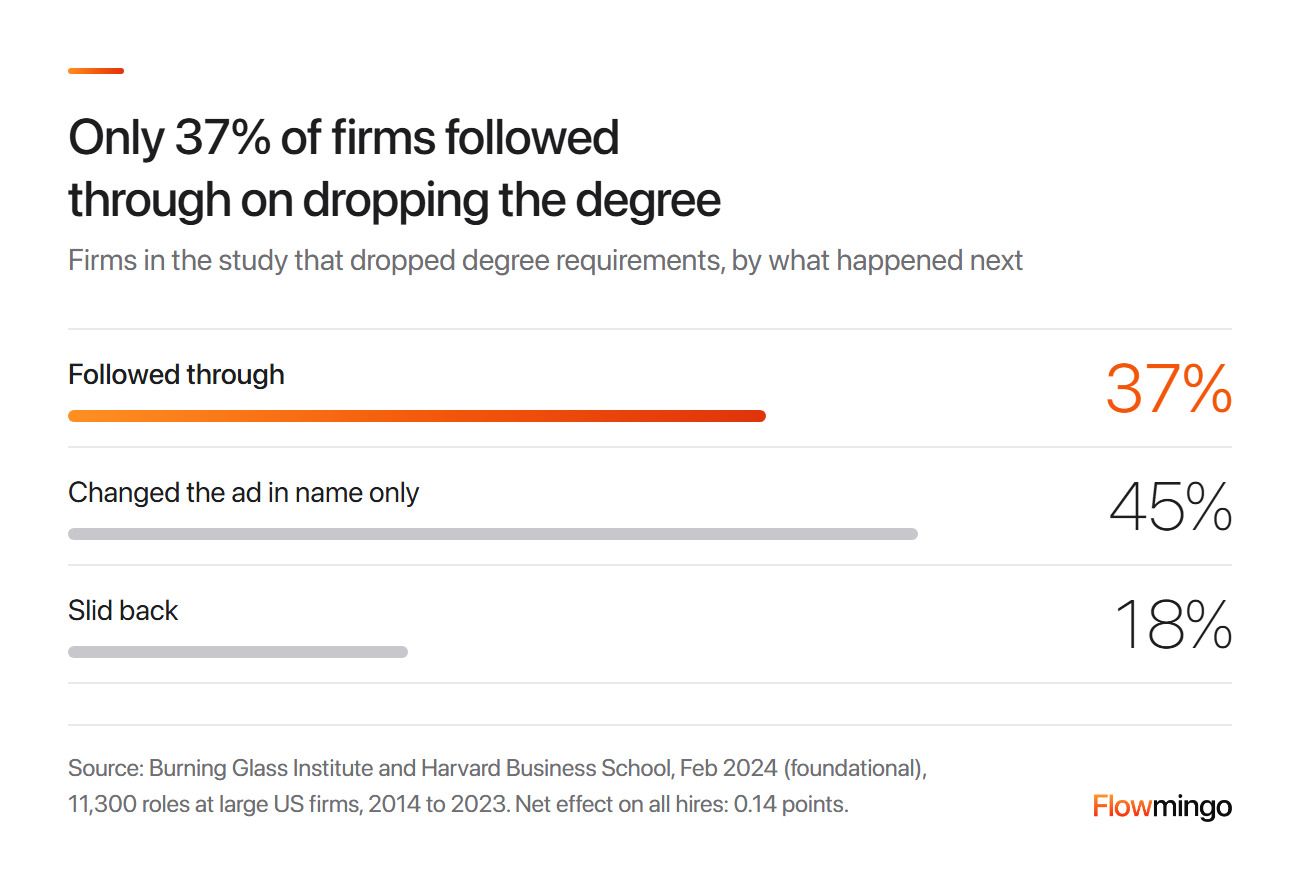
Degree requirement follow-through: 37% of the firms that dropped the requirement followed through, 45% changed the ad in name only and 18% slid back. The foundational 2024 study covered 11,300 roles.
2. With no HR team, how do I start skills based hiring on my next role?
Pilot skills based hiring on 1 role with 3 changes: a short skills list, 1 work sample test as your skills assessment and written scoring.
The figure below is our own 7-day plan, not research: skills list on day 1, test on day 2 and rubric on day 3. On days 4 to 6, after the first interviews, every finalist does the same task. On day 7 you add up scores, check pass rates by group and record any override.
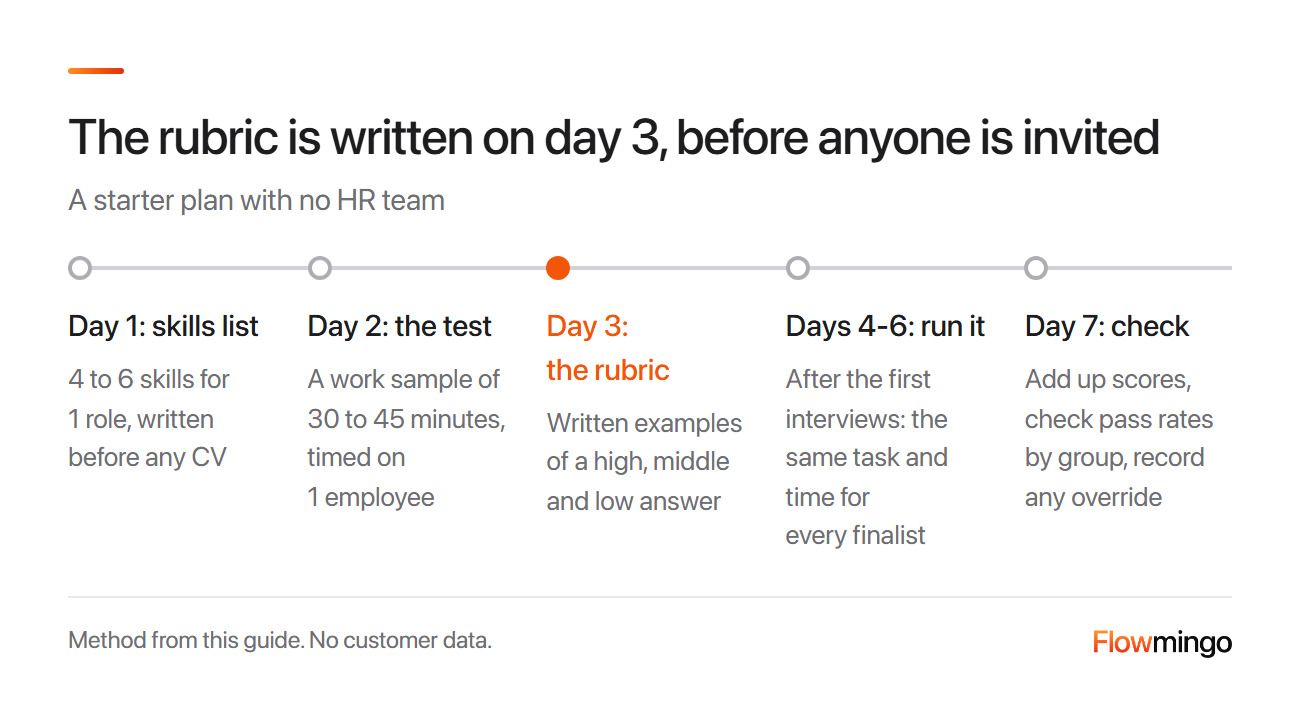
7-day starter plan: skills list, work sample test and rubric on days 1 to 3. Every finalist does the same task on days 4 to 6, then you check pass rates on day 7.
Start with 1 role, because a pilot teaches you the process before a bad hire does. Name 1 owner who writes the list and runs the scoring, so the process does not drift between candidates.
Order the checks from cheapest to dearest. Ask hard facts in the application, hold the first interview, then give the work sample test to the 4 or so people left. Our hiring process steps guide gives the test 4 days, so stretch days 4 to 6 if the test needs it.
With 200+ applicants, cut on hard facts first, as our candidate shortlisting guide shows.
3. How do I build the skills list for 1 role when the job description is outdated?
Build it from the work, not the old ad. List what the person must do in the first 90 days, and keep the 4 to 6 that matter most.
Start with the tasks, because an outdated ad lists duties that no longer exist. Ask the manager and the last person in the role for 6 to 10 tasks.
The foundational 1978 US Uniform Guidelines say a content-based test should rest on a job analysis, and does not suit skills learned on the job.
Split must-have from learnable: a must-have is needed on day 1, and you train a learnable skill, so do not test it.
Then lock and date the list before any CV. In 3 foundational 2005 experiments, people redefined what a job requires to fit the candidate they favoured. Fixing criteria first removed the discrimination (Uhlmann and Cohen).
Illustrative example, not customer data: an office administrator's skills list, locked on [date].
| Skill | Type | Task that shows it | Strong answer (5) |
|---|---|---|---|
| Keeps records accurate | Must-have | Find the 3 errors in a 25-line invoice sheet | Finds all 3 and says how each happened |
| Writes clearly | Must-have | Write a note on each error | A colleague could act on each note |
| Sets priorities | Must-have | Say which error to fix first | Says which error matters most and why |
| Spreadsheet formulas | Learnable | Not tested; we train it | n/a |
Rewrite the ad from the list. Washington State's sample posting leads with the work and lists what it does not require. Our example replaces "Degree preferred; 3+ years in an office" with:
"You will keep supplier invoices accurate. A degree is not required."
3.1 Should I drop years of experience too?
Drop the number and name the task instead. A foundational 2022 re-analysis by Sackett and colleagues found years of job experience track later performance at only 0.07, where 0 is no link.
Experience counts when it is specific: a foundational 1995 review found how much of the same work someone had done tracked performance at 0.43. The 2 studies correct differently, so read the direction, not the gap.
So write "has run payroll for 50+ staff", not "5 years in HR".
If a 2-year candidate beats a 10-year one on the test, score both on the same rubric and record any override.
4. What does a work sample test look like, and how long should it take?
In skills based hiring, a work sample test is a small, real slice of the job that every finalist does under the same conditions. Plan 30 to 45 minutes, and never more than 3 hours.
The 30 to 45 minutes is our rule, because only the 4 or so people left take it, not 244. The 3-hour ceiling comes from practitioner Jacob Kaplan-Moss in a foundational 2021 post. He reasons that 2 to 3 interviews plus logistics already take 4 to 5 hours of a candidate's time.
Copy this 6-line brief:
- The task: [1 sentence, a past case your team already resolved].
- The time: [30 to 45 minutes], tried first by 1 current employee, who should finish inside it.
- What they get: [a 1-page brief and any files].
- What they hand in: [1 file or 1 recording].
- The scoring: the rubric in section 5, 1 to 5.
- What they are told: "You have [40] minutes and do not need to finish. To change the format or timing, contact [name] at [email]. You will hear from us by [date, within 7 days]."
A foundational 2022 re-analysis by Sackett and colleagues finds a work sample tracks later performance at 0.33, down from 0.54 in a foundational 1998 estimate. A structured interview (0.42) ranks higher, so pair the test with one.
On a scale of 0 (no link) to 1 (perfect), the authors say the older figures were mainly inflated by a statistical correction. Their foundational 2023 follow-up says work samples suit skills a person already has, not entry-level roles where the skill is learned after hire. So test only the must-haves.
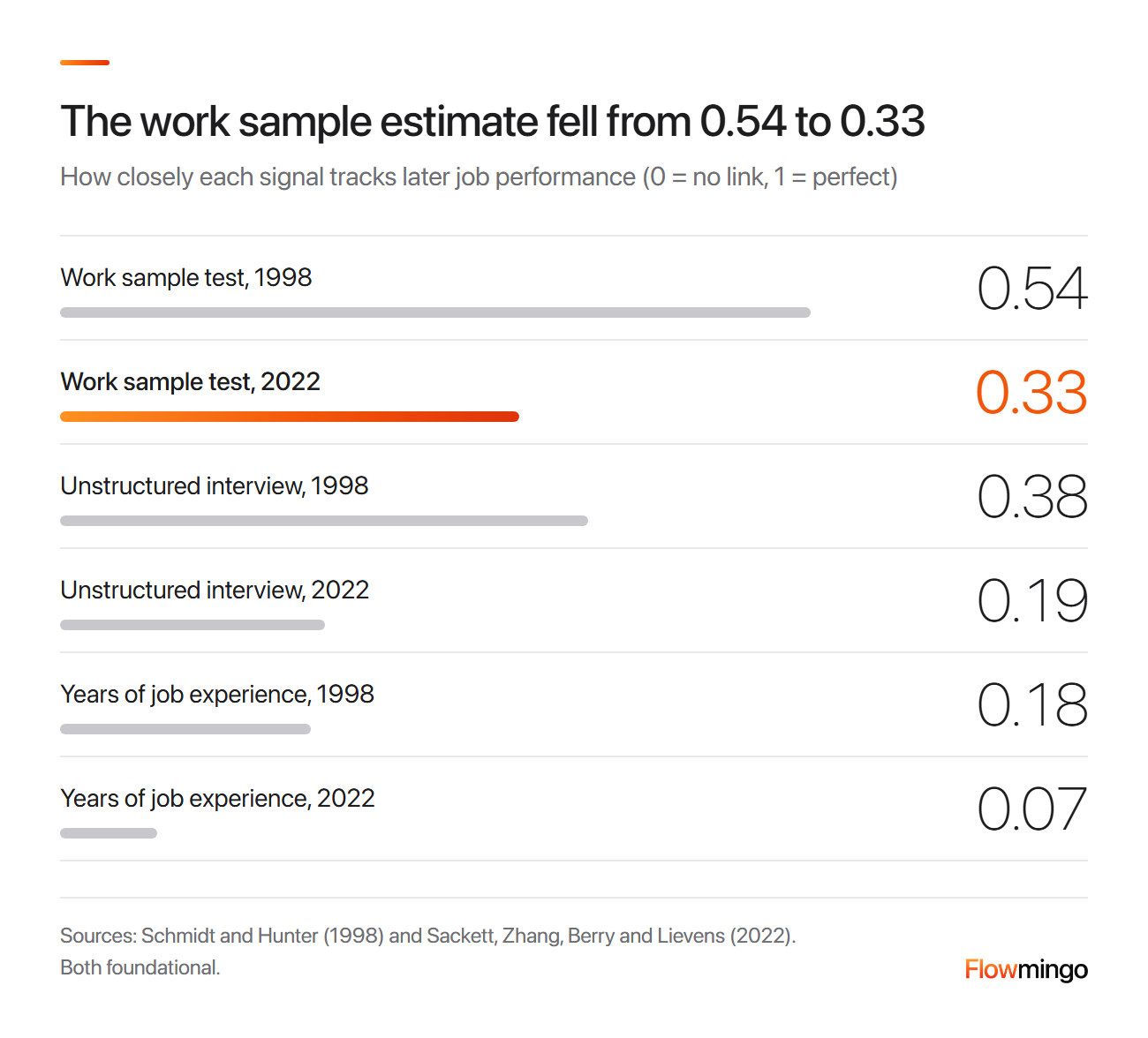
Work sample estimate over time: from 0.54 in 1998 to 0.33 in the foundational 2022 re-analysis. Unstructured interviews fell from 0.38 to 0.19, and years of job experience from 0.18 to 0.07.
How Flowmingo helps
Showcase is a work sample test: candidates share their screen and record 1 take per task, in their own time. Up to 10 tasks fit, with total time capped at 20 minutes on Free, 30 on Starter and 60 on Growth. Run longer tasks in a shared document.
4.1 Candidates are using ChatGPT on our take-home test. What should I change?
Managers report AI-written take-home answers on r/ExperiencedDevs and r/recruiting. We found no study of how common it is.
3 changes help, from our practice. Run the task as a timed session, and ask the candidate to explain 1 choice, such as why they flagged line 14 first. Change the task each round, so a leaked answer is useless.
5. How do I score a work sample so 2 reviewers agree on the same candidate?
Score each skill separately against written examples of a high, middle and low answer, with 2 reviewers working alone first. Compare, discuss any gap of 2 points or more, change a score only for a written reason, then average and add up.
Illustrative example, not customer data: the rubric for the section 3 invoice task.
| Criterion | 5 | 3 | 1 |
|---|---|---|---|
| Accuracy | Finds all 3 errors and says how each happened | Finds 2 errors | Finds 0 or 1, or changes a correct line |
| Clarity of the notes | A colleague could act on each note | Right, but raises a question | Vague or missing |
| Prioritising | Says which error matters most and why | Lists errors in no order | Does not say |
Use 2 reviewers. In a foundational 2013 meta-analysis by Huffcutt and colleagues, panel raters who watched the same interview agreed at 0.74, against 0.44 for separate interviews.
We apply that by analogy to a work sample. A score of 1 means perfect agreement, and this one flatters panels, because agreement is not accuracy.
| Candidate | Scorer 1 (accuracy, clarity, prioritising) | Scorer 2 | Gap to discuss | Agreed total out of 15 |
|---|---|---|---|---|
| A | 5, 4, 3 = 12 | 4, 4, 3 = 11 | None | 11.5 |
| B | 3, 4, 2 = 9 | 5, 3, 2 = 10 | Accuracy, 3 against 5 | 9.5 |
Discuss any gap of 2 or more with the answer in front of both scorers, and change a score only with a written reason. If the gap stays, average both scores, as for a gap of 1, then add the criteria with equal weights. For B, accuracy stayed at 3 and 5, averaging 4, so 4 + 3.5 + 2 = 9.5.
Write the rubric before anyone is invited, hide names and the CV from scorers where you can, and rank by total. Take the top slice, sized from your interview time, not a fixed pass mark. The card below uses Flowmingo's multiple-choice skill tests, not work samples, to show how widely scores spread.
Flowmingo data · 227 skill-test attempts that got through to the end · 225 candidates · 28 companies · started 25 Aug to 30 Sep 2026
- 65% was the median score, with blank questions counted as wrong.
- 31% to 86% was the range from the 10th to the 90th percentile of scores, with 46% at the 25th percentile and 77% at the 75th.
Multiple-choice skill tests scored automatically, time limits mostly 20 or 30 minutes, not work samples. The score is the share of questions answered correctly, a floor on what a candidate knew, pooled across different tests. Excludes Flowmingo's own organisations, demos, practice runs, recruiters' own teams and 2 very large customers.
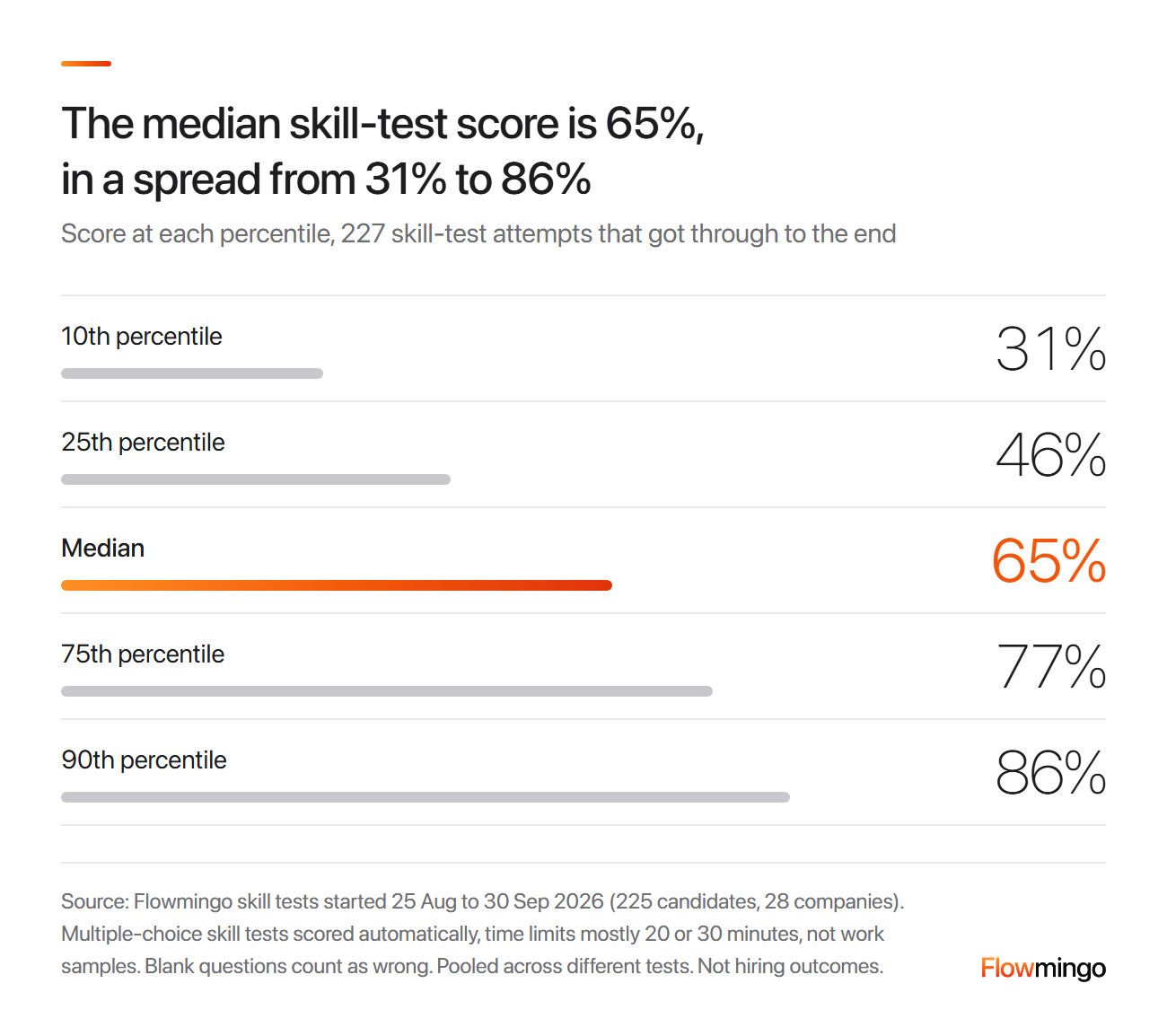
Multiple-choice skill-test score spread: median 65%, 31% at the 10th percentile and 86% at the 90th (Flowmingo data, 227 finished attempts, 2026, not work samples).
Among finishers, 22.9% scored 80% or more and 18.9% scored 40% or less. Because scores spread this widely across different tests, a fixed pass mark would reward the easier test, not the better candidate.
5.1 How do I judge a skill I don't have myself?
Borrow the answer key, because you cannot score what you cannot judge. Ask someone who does the job well to write the task and the 1, 3 and 5 examples before you see any candidate. For example, an accountant can plant 3 errors in a sheet and write what a strong note says.
6. Will a skills test scare off good candidates? How much of their time is fair?
Length alone did not drive people away in the largest study we found, but disrespected time topped the reasons to withdraw in a 2025 benchmark. State the time, ask for only the minutes you need, and send every candidate a result.
In a foundational 2017 study of 222,772 job seekers across 69 selection systems, total assessment length did not predict dropout. Most applicants who quit did so within the first 20 minutes. Systems that gave longer time estimates lost fewer people.
In the 2025 CandE benchmark, 32% of withdrawing candidates said interviews and appointments disrespected their time. Only 6% of candidates in the benchmark received feedback on assessment or test results. Survale, which sells candidate-survey software, now runs and publishes it.
Flowmingo data · 293 skill-test attempts · 287 candidates · 38 companies · started 25 Aug to 30 Sep 2026
- 77.5% of attempts (227) got through to the end of the test.
- 9.6% of attempts were never finished, 5.5% ended when the clock reached zero with answers recorded, 5.1% closed with no answers recorded and 2.4% ended another way with answers.
Multiple-choice skill tests scored automatically, time limits mostly 20 or 30 minutes, not work samples. With companies as the unit the 77.5% ranges from 65% to 85%. Attempts, not people. Some of the 5.1% may be capture failures. Excludes Flowmingo's own organisations, demos, practice runs, recruiters' own teams and 2 very large customers.
These are multiple-choice tests, so they show behaviour on a short timed test, not on a 30 to 45 minute work sample. The few attempts that closed with no answers may fit Hardy's finding that quitters leave early.
A clock reaching zero is mostly time deducted for flagged behaviour, so it does not show the test was too long. Name a result date within 7 days, because only 6% of candidates in that benchmark received feedback on assessment or test results.
We found no study on pay and dropout. Our practice is a past, resolved task inside the stated slot, with pay for anything longer or real.
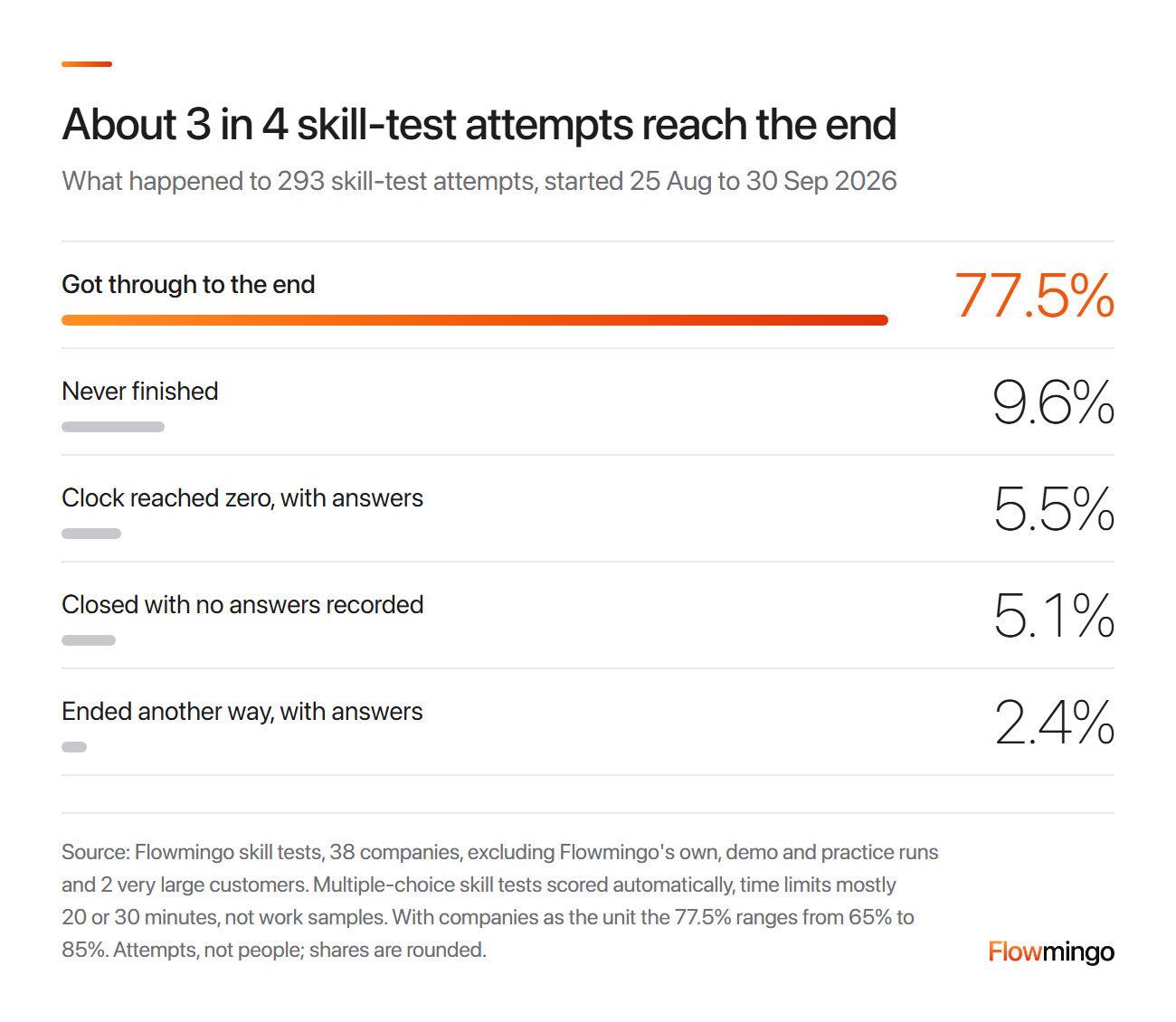
Skill-test attempt outcomes: of 293 multiple-choice attempts, 77.5% got through to the end, 9.6% were never finished and 5.5% ended when the clock reached zero.
6.1 Can a short test replace the CV filter?
A short test can replace the CV as your proof of skill, but not as the first gate. Test the 4 or so people left after the first interview, as section 2 says.
7. Is skills based hiring fairer, or can tests screen out older or disabled candidates?
Not automatically: skills based hiring can still screen out groups, so check results by group every round.
Roth and colleagues' foundational 2008 meta-analysis found a gap of 0.73 standard deviations between Black and White applicants on work sample tests. That is about double the 0.38 usually quoted, and 0 means no gap.
Exercises rating cognitive and job-knowledge skills showed 0.80, against 0.21 to 0.27 for social skills. The data cover US applicants only.
Our reading: what the exercise rewards moves the gap. For example, a heavy-writing task measures language more than the skill if the job needs little written English.
In Mobley v. Workday, a court granted preliminary certification on 16 May 2025 of an age-discrimination collective of applicants aged 40 and over (Holland & Knight). Workday says the case lacks merit, and it concerns a software vendor, not a skills test.
In Great Britain, Acas says you must make reasonable adjustments, and must ask anyone coming to interview whether they need any. Our interview invitation email templates show the line to copy: ask about the format, never about health.
8. How do I check a skills test for adverse impact with only 30 applicants?
Divide each group's pass rate by the highest group's rate and look at anything under 80%. With 30 applicants most groups are too small to read, so a flag is a reason to inspect the test, not proof of bias.
Group labels come from an optional equal-opportunities form that scorers never see. Local rules, for example UK and EU data protection law, may limit asking, so check first. Count "passed" as being in the top slice that moved on to the next stage.
The foundational 1978 Uniform Guidelines set the US rule, at 29 CFR 1607.4(D): a ratio below 4/5 (80%) generally counts as evidence of adverse impact. Smaller gaps can still count, and bigger ones may not when numbers are small.
The Guidelines name race, sex and ethnic group, so for age or disability use the ratio only as a rough alarm.
For example, 5 of 10 in group A and 3 of 10 in group B pass your work sample. The ratio is 60%, a flag. Yet a Fisher exact test gives p = 0.65, so a gap that size appears by chance about 2 times in 3.
With 50 of 100 against 30 of 100, the ratio is the same and p = 0.006, about 6 in 1,000, by our arithmetic.
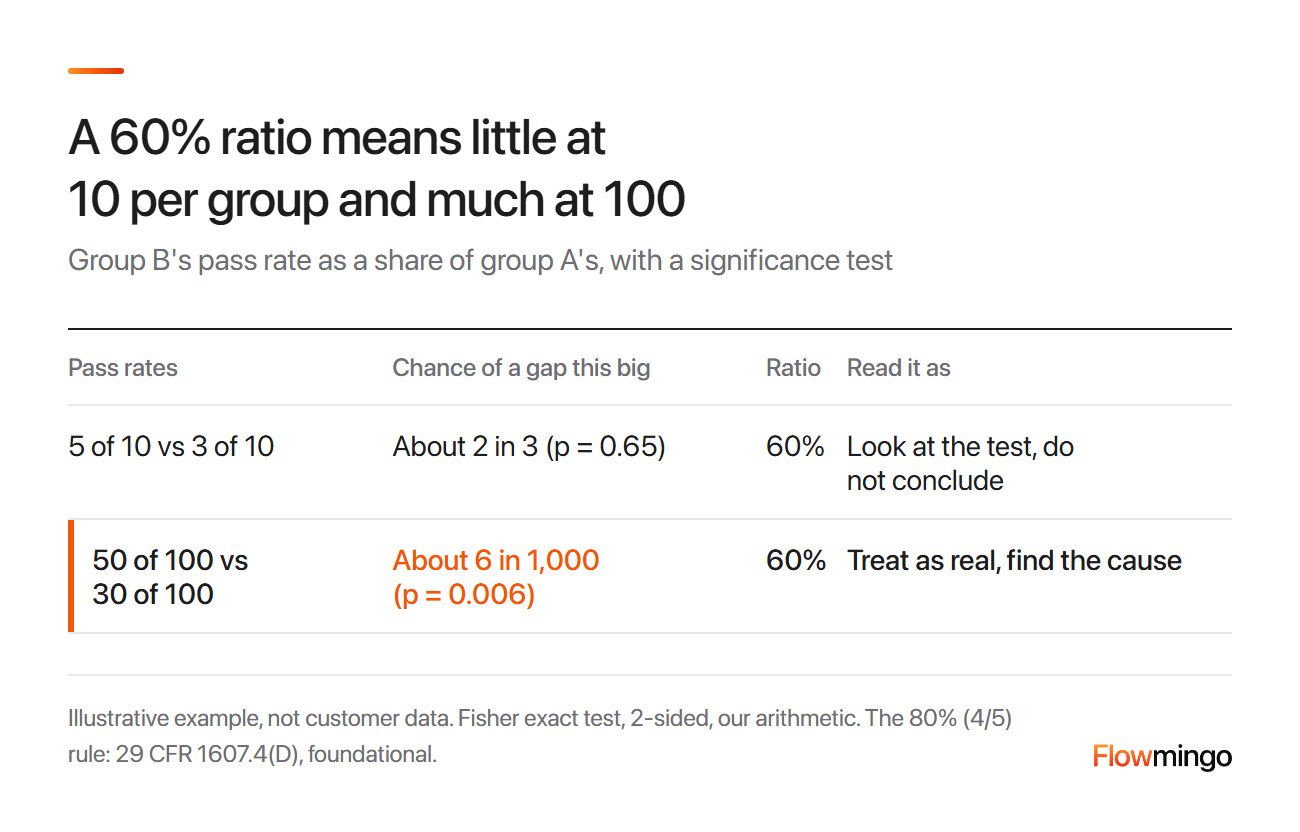
Illustrative pass-rate check: both gaps give a ratio of 60%, below the 80% line. At 10 per group, look at the test, do not conclude; at 100, treat it as real and find the cause.
Keep 6 records every round: the dated skills list, the task, the rubric, each score, pass rates by group and any override reason.
8.1 Does the 80% rule still apply in the US right now?
As of 4 October 2026 it still sits in the eCFR. A June 2026 Justice Department opinion and a July 2026 OPM rule both move federal agencies away from the Guidelines.
The EEOC lists a rescission for November 2026, but none has been published.
Keep the 6 records above anyway.
9. What do Singapore's Workplace Fairness Act and the UK Equality Act mean for our skills tests?
The UK Equality Act asks you to justify any test that disadvantages a protected group. Singapore's Tripartite Guidelines already ask for job-related criteria that applicants can see, and its Act, aimed at the end of 2027, adds a claims route.
This is general information, not legal advice.
| Where | Rule | What it means for a skills test |
|---|---|---|
| UK | Equality Act 2010, section 19 and section 60; Acas | Tests must be proportionate; adjust for disabled applicants |
| Singapore | Workplace Fairness Act (MOM), aimed at end-2027 | Hiring covered; claims up to S$250,000 |
Firms with fewer than 25 employees were exempt at first under a November 2024 fact sheet, so check the final Act. The Guidelines accept a degree, 3 years in a relevant field and specific skills as requirements, if they relate to the job.
So skills based hiring is not mandatory in Singapore, but a written skills list is your evidence. In the UK, a pass mark is indirect discrimination if it disadvantages a protected group and is not proportionate to a legitimate aim.
9.1 If software scores the test, do AI hiring laws apply?
A work sample your team scores by hand sits outside the EU AI rules. A tool that scores or ranks candidates with AI does not, because Annex III treats AI used to recruit or select people as high-risk.
For the EU, California, New York City and Illinois, see our candidate shortlisting guide.
10. Do I need assessment software for skills based hiring, or will a shared doc do?
A shared doc and a spreadsheet are enough for 1 role. Software earns its place when finalists or reviewers outgrow the sheet and you want scoring done for you.
For example, 4 finalists and 2 scorers fit 1 sheet, because there is little to track. The table is our judgement, not a study.
| What you need | Doc and sheet | Software starts to help when |
|---|---|---|
| Scores | 1 sheet with a column per criterion per scorer | Finalists or scorers outgrow the sheet |
| Group check | A tally of passes by group per round, using the form and local-rules check in section 8 | You need it every round across roles |
Software helps when you have more finalists than you can score in a day, or more than 2 reviewers. Until then, the sheet is faster to set up and easier to explain, because everyone can see every score.
A team lead with the budget asked this before buying assessment software.
Ask any vendor, including us, 6 questions:
- How is a score produced?
- Can I see each answer next to the key?
- What is recorded about the candidate?
- How is bias tested?
- Where is the data kept, and for how long?
- What do I pay per candidate?
Skills based hiring comes down to 3 moves and 1 check. Write the skills list, give every finalist the same test and score it in writing, then check pass rates by group.
How Flowmingo helps
Flowmingo is a free AI interviewer for recruiters. Tests are multiple choice, so they check job knowledge, not a work sample, and they are unlimited on every plan, including Free. Each result shows every answer next to the key. Showcase is a work sample, scored by your team, not AI. Try Flowmingo for your next round of skills based hiring.
11. Sources
Every study, law and survey in this guide links to a source below; Flowmingo figures come from Flowmingo's own platform data.
- Acas (2026, June 30). Following discrimination law: Recruitment. Acas.
- Burning Glass Institute, & Harvard Business School Managing the Future of Work (Sigelman, M., Fuller, J., & Martin, A.) (2024, February). Skills-based hiring: The long road from pronouncements to practice. Burning Glass Institute.
- Equal Employment Opportunity Commission and others (1978). Uniform guidelines on employee selection procedures, 29 CFR 1607.14: Technical standards for validity studies. eCFR.
- Equal Employment Opportunity Commission and others (1978). Uniform guidelines on employee selection procedures, 29 CFR 1607.4: Information on impact. Legal Information Institute.
- EU Artificial Intelligence Act [website] (n.d.). Annex III: High-risk AI systems referred to in Article 6(2). Future of Life Institute.
- Hardy, J. H., Gibson, C., Sloan, M., & Carr, A. (2017). Are applicants more likely to quit longer assessments? Examining the effect of assessment length on applicant attrition behavior. Journal of Applied Psychology, 102(7), 1148-1158.
- Holland & Knight (2025, May 27). Federal court allows collective action lawsuit over alleged AI hiring bias. Holland & Knight LLP.
- Huffcutt, A. I., Culbertson, S. S., & Weyhrauch, W. S. (2013). Employment interview reliability: New meta-analytic estimates by structure and format. International Journal of Selection and Assessment, 21(3).
- Kaplan-Moss, J. (2021, November 17). A framework for good work sample tests: Eight rules for fair tests. jacobian.org.
- Legislation.gov.uk (2010). Equality Act 2010, section 19: Indirect discrimination. UK Parliament.
- Legislation.gov.uk (2010). Equality Act 2010, section 60: Enquiries about disability and health. UK Parliament.
- Ministry of Manpower, Singapore (2024, November 12). Fact sheet on the Workplace Fairness Bill (first reading). MOM.
- Ministry of Manpower, Singapore (2025, November 4). Workplace Fairness (Dispute Resolution) Bill press release. MOM.
- Office of Legal Counsel, US Department of Justice (2026, June 9). Constitutionality of disparate-impact liability under Title VII. DOJ.
- Office of Personnel Management (2026, July 31). Removal of references to the Uniform Guidelines on Employee Selection Procedures in Federal personnel regulations. Federal Register, 91 FR 48234.
- Quinones, M. A., Ford, J. K., & Teachout, M. S. (1995). The relationship between work experience and job performance: A conceptual and meta-analytic review. Personnel Psychology, 48(4).
- Roth, P. L., Bobko, P., McFarland, L., & Buster, M. (2008). Work sample tests in personnel selection: A meta-analysis of Black-White differences in overall and exercise scores. Personnel Psychology, 61(3).
- Sackett, P. R., Zhang, C., Berry, C. M., & Lievens, F. (2022). Revisiting meta-analytic estimates of validity in personnel selection: Addressing systematic overcorrection for restriction of range. Journal of Applied Psychology.
- Sackett, P. R., Zhang, C., Berry, C. M., & Lievens, F. (2023). Revisiting the design of selection systems in light of new findings regarding the validity of widely used predictors. Industrial and Organizational Psychology.
- Schmidt, F. L., & Hunter, J. E. (1998). The validity and utility of selection methods in personnel psychology: Practical and theoretical implications of 85 years of research findings. Psychological Bulletin, 124(2).
- SHRM, & SHRM Foundation (2025). The skills-first movement: Redefining how organizations hire and grow. SHRM.
- Survale (2026, July 21). 2025 candidate experience (CandE) benchmark research: Key statistics. Survale (the CandE program, founded by Talent Board in 2011, is now part of Survale).
- Tripartite Alliance for Fair and Progressive Employment Practices (2023). Tripartite guidelines on fair employment practices. TAFEP.
- Uhlmann, E. L., & Cohen, G. L. (2005). Constructed criteria: Redefining merit to justify discrimination. Psychological Science, 16(6).
- Washington State Office of Financial Management (n.d., Wayback Machine snapshot 2026-04-18). Skills-based hiring. Washington State OFM.